

The DOI matches its Crossref record; 100 of the 101 references it cites were found in a registry or an index.
The Prevalence of Self-injurious Behaviour in Autism: A Meta-analytic Study
Open accessAbstract
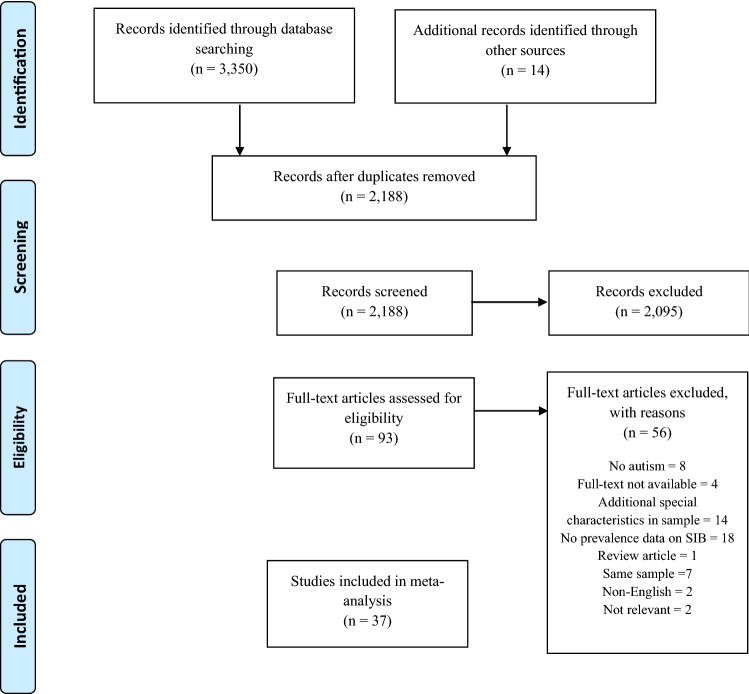
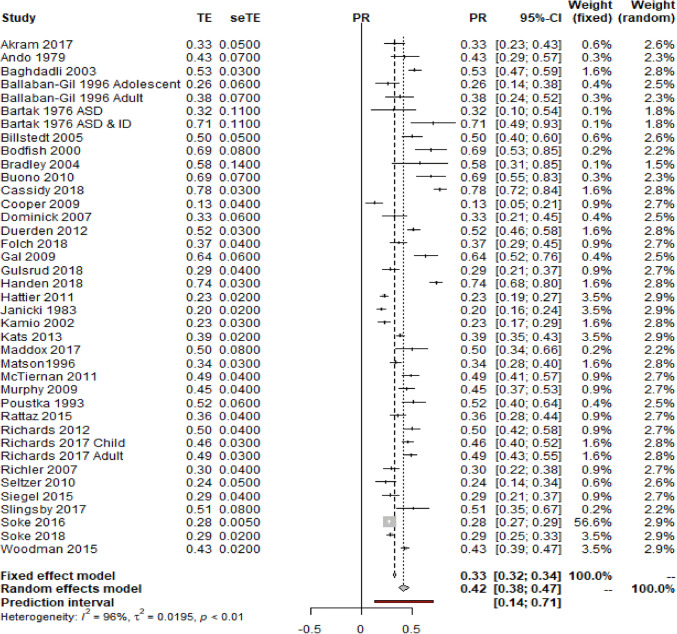
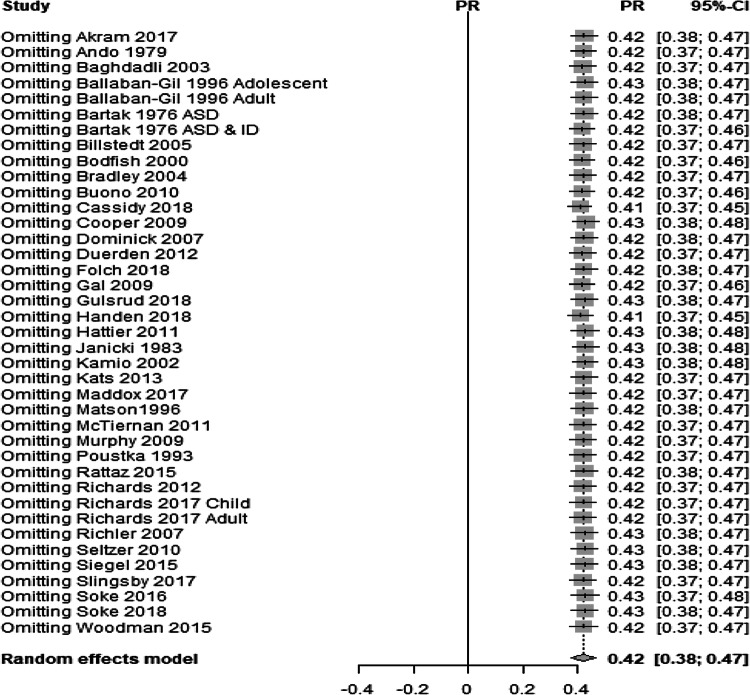
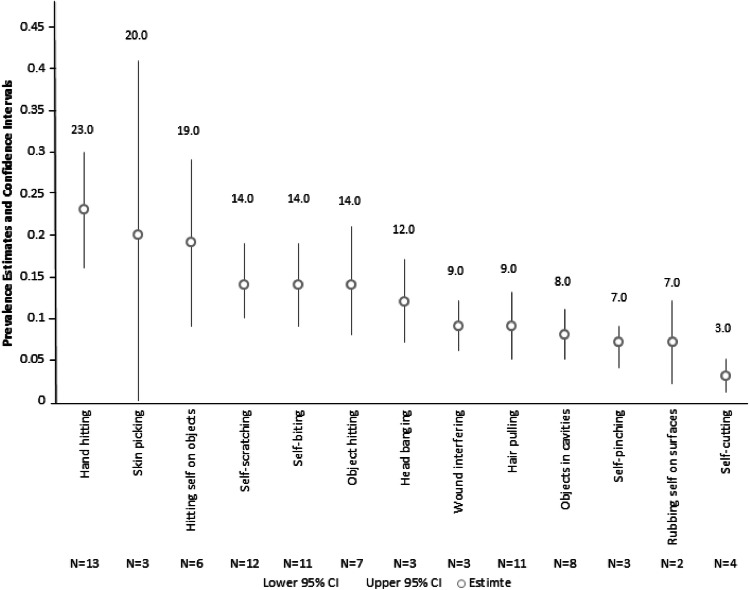
Self-injurious behaviour is purportedly common in autism, but prevalence rates have not yet been synthesised meta-analytically. In the present study, data from 14,379 participants in thirty-seven papers were analysed to generate a pooled prevalence estimate of self-injury in autism of 42% (confidence intervals 0.38–0.47). Hand-hitting topography was the most common form of self-injury (23%), self-cutting topography the least common (3%). Sub-group analyses revealed no association between study quality, participant intellectual disability or age and overall prevalence rate of self-injury. However, females obtained higher prevalence rates than males ( p = .013) and hair pulling and self-scratching were associated with intellectual disability ( p = .008 and p = .002, respectively). The results confirm very high rates of self-injury in autism and highlight within group risk-markers.
Overview
The claims and statistics of this paper haven’t been checked yet.
Run the check — free, no account needed. It reads the open-access text and checks the sources it cites.
Integrity signals
Registry
Cites
Statistics
Figures
Verification
Claims the paper makes
The claims and statistics of this paper haven’t been checked yet.
Run the check — free, no account needed. It reads the open-access text and checks the sources it cites.
Claims other papers make about this one
Each is checked against this paper’s own text: does it say what the citing paper says it does?
The cited source says what the claim attributes to it.
In the citing paper
“A recent meta-study reported that prevalence rates of SIB in the ASD population may be as high as 42% [121].”
From Pharmacological treatment in autism: a proposal for guidelines on common co-occurring psychiatric symptoms (2025) · cites this paper as [121]
The cited source says what the claim attributes to it.
In the citing paper
“A meta-analysis including 37 studies revealed a prevalence of self-harm of 42% in autistic individuals, irrespective of age and the presence or the absence of intellectual disability (ID) (Steenfeldt-Kristensen et al., 2020).”
From Feasibility, Acceptability and Preliminary Efficacy of Dialectical Behavior Therapy for Autistic Adults without Intellectual Disability: A Mixed Methods Study (2022) · cites this paper as Steenfeldt-Kristensen et al., 2020
In the citing paper
“Behaviors such as impulsivity and/or inattention can be contributing factors for injuries and unintentional incidents in children with ASD/ADHD.58,59”
From Mortality in Persons With Autism Spectrum Disorder or Attention-Deficit/Hyperactivity Disorder: A Systematic Review and Meta-analysis (2022) · cites this paper as [58]
Self-check
Percentages, sums and reported differences re-computed from the paper’s own numbers.
The self-check needs the paper’s full text.
Citations
Cites
Preferred Reporting Items for Systematic Reviews and Meta-Analyses: the PRISMA statement
Moher, D., Liberati, A., Tetzlaff, J., Altman, D. G., & for the PRISMA Group (2009) · BMJ · doi:10.1136/bmj.b2535 · Cited by 83,823
Preferred Reporting Items for Systematic Reviews and Meta-Analyses: The PRISMA Statement
Moher, D., Liberati, A., Tetzlaff, J., Altman, D. G., & The PRISMA Group (2009) · PLoS Medicine · doi:10.1371/journal.pmed.1000097 · Cited by 64,042
Preferred reporting items for systematic reviews and meta-analyses: the PRISMA Statement.
(2009) · PubMed Central · Cited by 44,859
Cochrane Handbook for Systematic Reviews of Interventions: Cochrane Book Series
(2008) · doi:10.1002/9780470712184 · Cited by 25,048
Wang, G., Ma, R., Qiao, G., Wada, K., Aizawa, Y., & Satoh, T. (2015) · Integrative Medicine International · doi:10.1159/000368408 · Cited by 18,762
Journal of Clinical Psychiatry
(2018) · Journal of Clinical Psychiatry · doi:10.5505/kpd · Cited by 13,703
Toward a functional analysis of self-injury
Iwata, B. A., Dorsey, M. F., Slifer, K. J., Bauman, K. E., & Richman, G. S. (1994) · Journal of Applied Behavior Analysis · doi:10.1901/jaba.1994.27-197 · Cited by 2,644
Baird, G., Simonoff, E., Pickles, A., Chandler, S., Loucas, T., Meldrum, D., & Charman, T. (2006) · The Lancet · doi:10.1016/s0140-6736(06)69041-7 · Cited by 2,104
Epidemiology of Pervasive Developmental Disorders
Fombonne, E. (2009) · Pediatric Research · doi:10.1203/pdr.0b013e31819e7203 · Cited by 1,971
Varieties of Repetitive Behavior in Autism: Comparisons to Mental Retardation
Bodfish, J. W., Symons, F. J., Parker, D. E., & Lewis, M. H. (2000) · Journal of Autism and Developmental Disorders · doi:10.1023/a:1005596502855 · Cited by 1,223
Research works printed but not linked: 1
- Weiss, J. (2002). Self-injurious behaviors in autism: A literature review. Journal on Developmental Disabilities, 9, 129–143.
Cited by
Sorted by citations
The Lancet Commission on the future of care and clinical research in autism
Lord, C., Charman, T., Havdahl, A., Carbone, P., Anagnostou, E., Boyd, B., Carr, T., de Vries, P. J., Dissanayake, C., Divan, G., et al. (2022) · The Lancet · doi:10.1016/s0140-6736(21)01541-5 · Cited by 924
Mental health problems in children with intellectual disability
Totsika, V., Liew, A., Absoud, M., Adnams, C. M., & Emerson, E. (2022) · The Lancet Child & Adolescent Health · doi:10.1016/s2352-4642(22)00067-0 · Cited by 191
Catalá-López, F., Hutton, B., Page, M. J., Driver, J. A., Ridao, M., Alonso-Arroyo, A., Valencia, A., Macías Saint-Gerons, D., & Tabarés-Seisdedos, R. (2022) · JAMA Pediatrics · doi:10.1001/jamapediatrics.2021.6401 · Cited by 148
Newell, V., Phillips, L., Jones, C., Townsend, E., Richards, C., & Cassidy, S. (2023) · Molecular Autism · doi:10.1186/s13229-023-00544-7 · Cited by 143
Self-citationRisk of Self-harm in Children and Adults With Autism Spectrum Disorder
Blanchard, A. M., Chihuri, S. T., DiGuiseppi, C. G., & Li, G. (2021) · JAMA Network Open · doi:10.1001/jamanetworkopen.2021.30272 · Cited by 138
Metadata
- Authors
- Steenfeldt-Kristensen, C., Jones, C. A., & Richards, C.
- Affiliations
- Coventry and Warwickshire Partnership NHS Trust (GB)
- University of Birmingham (GB)
- Corresponding author
- Richards, Caroline
- Venue
- Journal of Autism and Developmental Disorders
- Published
- 2020-04-15
- Volume
- 50
- Issue
- 11
- Pages
- 3857-3873
- ISSN
- 0162-3257 (ISSN-L)
- 1573-3432
- PMC
- PMC7557528
- OpenAlex
- W3016276573
- Cited by
- 150
- References
- 101
- Citations by year
- 2026: 20 · 2025: 31 · 2024: 33 · 2023: 27 · 2022: 25 · 2021: 10 · 2020: 4
- FWCI
- 2.23
- Type
- journal article
- Language
- en
- Open access
- hybrid
- doi.org
- Locations
- Journal of Autism and Developmental Disorders (publishedVersion, cc-by)
- PubMed Central (publishedVersion, cc-by)
- PubMed (publishedVersion)
- University of Birmingham Research Portal (University of Birmingham) (publishedVersion, cc-by)
- Topics
- Life Sciences › Neuroscience › Cognitive Neuroscience › Autism Spectrum Disorder Research
- Social Sciences › Psychology › Clinical Psychology › Suicide and Self-Harm Studies
- Social Sciences › Psychology › Developmental and Educational Psychology › Behavioral and Psychological Studies
- Keywords
- self-harm, autism spectrum disorder, prevalence, self-cutting, intellectual disability, sex differences, hair pulling, risk indicators
- MeSH terms
- Adolescent, Autistic Disorder, Female, Humans, Male, Intellectual Disability, Prevalence, Self-Injurious Behavior
About these checks
Registry, retraction, Cites and statistics results are computed, not judged, with one exception: a printed reference that no index lists is read once by a model before it counts as a citation error. Claims are extracted by a model and kept only when their quote appears verbatim in the text; each cited source is then checked, with a model’s help, for whether it says what the claim relies on. Those verdicts can be wrong — read the claim’s quote and the cited source before relying on one.
Statistics and arithmetic are recomputed, not judged.
Confidence bands are shown only for fields calibrated on our annotated test set. None is calibrated yet, so no band is shown.
What counts as a claim ›How we measure confidence ›How we check this ›
Are you an author, or do you see a problem with this page? Request a review
