

The DOI matches its Crossref record; 72 of the 75 references it cites were found in a registry or an index.
The impact of emotional well-being on long-term recovery and survival in physical illness: a meta-analysis
Open accessAbstract
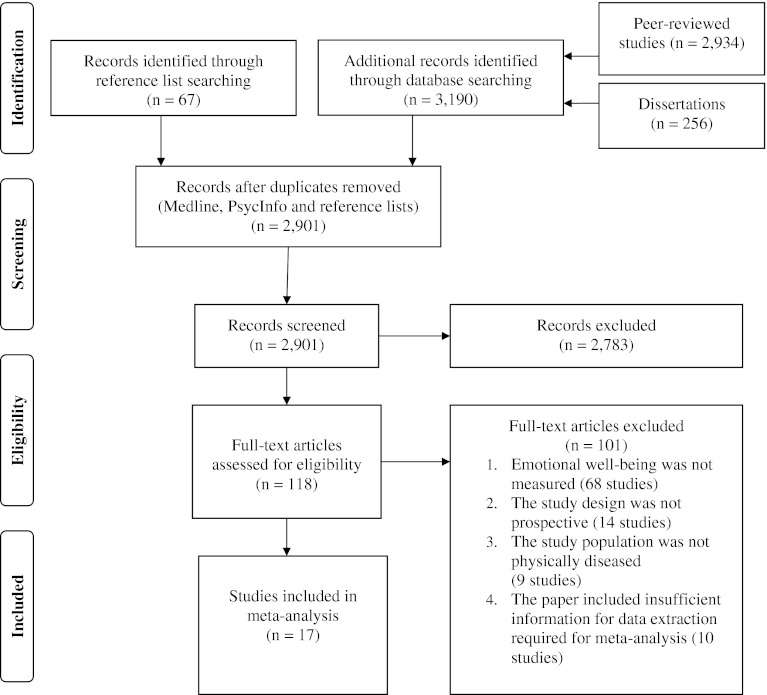
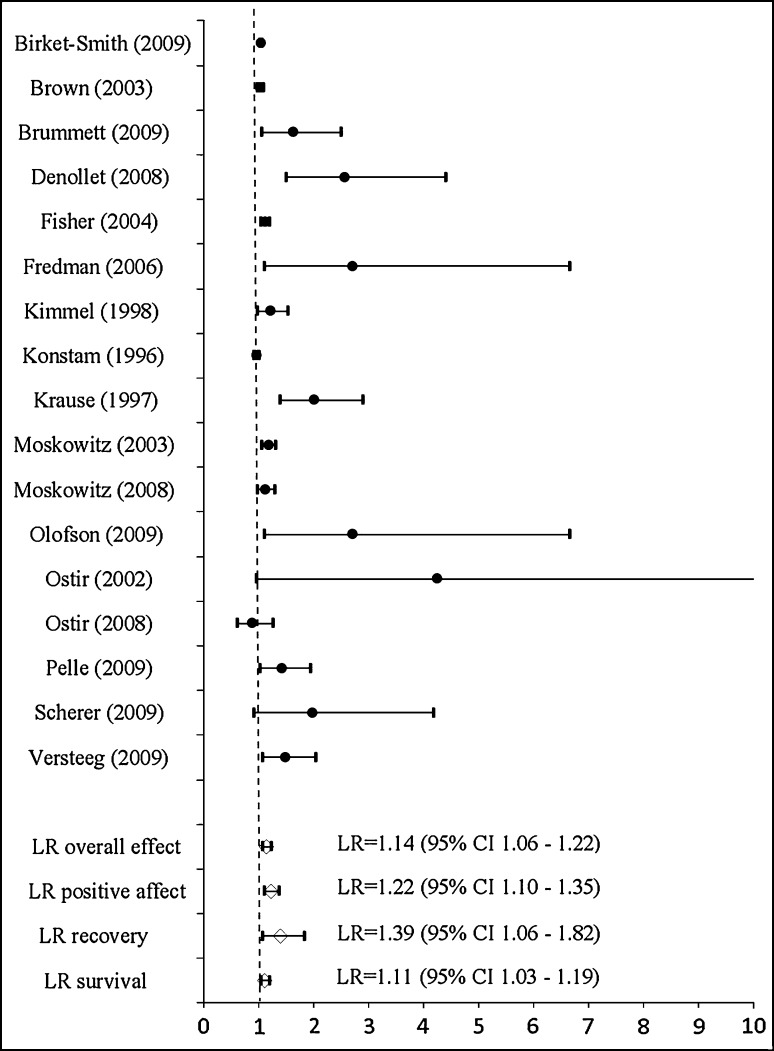
This meta-analysis synthesized studies on emotional well-being as predictor of the prognosis of physical illness, while in addition evaluating the impact of putative moderators, namely constructs of well-being, health-related outcome, year of publication, follow-up time and methodological quality of the included studies. The search in reference lists and electronic databases (Medline and PsycInfo) identified 17 eligible studies examining the impact of general well-being, positive affect and life satisfaction on recovery and survival in physically ill patients. Meta-analytically combining these studies revealed a Likelihood Ratio of 1.14, indicating a small but significant effect. Higher levels of emotional well-being are beneficial for recovery and survival in physically ill patients. The findings show that emotional well-being predicts long-term prognosis of physical illness. This suggests that enhancement of emotional well-being may improve the prognosis of physical illness, which should be investigated by future research.
Overview
The claims and statistics of this paper haven’t been checked yet.
Run the check — free, no account needed. It reads the open-access text and checks the sources it cites.
Integrity signals
Registry
Cites
Statistics
Figures
Verification
Claims the paper makes
The claims and statistics of this paper haven’t been checked yet.
Run the check — free, no account needed. It reads the open-access text and checks the sources it cites.
Claims other papers make about this one
Each is checked against this paper’s own text: does it say what the citing paper says it does?
The source backs part of the claim, not all of it — or backs it for a different population, condition or comparison.
In the citing paper
“Psychological distress can exacerbate physical symptoms, interfere with treatment adherence, and negatively influence overall well-being and recovery [7].”
From Effectiveness of Acceptance and Commitment Therapy (ACT) on disease acceptance for breast cancer patients: Study protocol of a randomized controlled trial (2024) · cites this paper as [7]
Experimental — accuracy not yet measuredIn the citing paper
“A meta-analysis even showed that emotional well-being predicts long-term prognosis of physical illness [5].”
From How to increase reach and adherence of web-based interventions: a design research viewpoint (2015) · cites this paper as [5]
Self-check
Percentages, sums and reported differences re-computed from the paper’s own numbers.
The self-check needs the paper’s full text.
Citations
Cites
Preferred Reporting Items for Systematic Reviews and Meta-Analyses: the PRISMA statement
Moher, D., Liberati, A., Tetzlaff, J., Altman, D. G., & for the PRISMA Group (2009) · BMJ · doi:10.1136/bmj.b2535 · Cited by 83,823
Preferred Reporting Items for Systematic Reviews and Meta-Analyses: The PRISMA Statement
Moher, D., Liberati, A., Tetzlaff, J., Altman, D. G., & The PRISMA Group (2009) · PLoS Medicine · doi:10.1371/journal.pmed.1000097 · Cited by 64,042
The CES-D Scale: A Self-Report Depression Scale for Research in the General Population
Radloff, L. S. (1977) · Applied Psychological Measurement · doi:10.1177/014662167700100306 · Cited by 53,267
Preferred reporting items for systematic reviews and meta-analyses: the PRISMA Statement.
(2009) · PubMed Central · Cited by 44,859
Development and validation of brief measures of positive and negative affect: The PANAS scales.
Watson, D., Clark, L. A., & Tellegen, A. (1988) · Journal of Personality and Social Psychology · doi:10.1037/0022-3514.54.6.1063 · Cited by 32,433
The satisfaction with life scale
Diener, E., Emmons, R. A., Larsen, R. J., & Griffin, S. (1985) · Journal of Personality Assessment · doi:10.1207/s15327752jpa4901_13 · Cited by 31,768 · cited 1×
“Life satisfaction was measured by the Satisfaction With Life Scale (n = 1; Diener et al., 1985), the MOS short form general health survey (n = 1; Stewart et al., 1988), and the Life Situation Questionnaire (n = 1; Krause, 1992).”
MethodCochrane Handbook for Systematic Reviews of Interventions: Cochrane Book Series
(2008) · doi:10.1002/9780470712184 · Cited by 25,048
EuroQol: a new facility for the measurement of health-related quality of life
(1990) · Health Policy · doi:10.1016/0168-8510(90)90421-9 · Cited by 15,736
Subjective well-being: Three decades of progress.
Diener, E., Suh, E. M., Lucas, R. E., & Smith, H. L. (1999) · Psychological Bulletin · doi:10.1037/0033-2909.125.2.276 · Cited by 12,910
From dissertation abstracts international
(1974) · ACM SIGGRAPH Computer Graphics · doi:10.1145/988616.988619 · Cited by 12,208
Research works printed but not linked: 2
- Hamilton, A. B. (1996). Do psychosocial factors predict metastatic cancer survival? A longitudinal assessment of breast, colon, and lung cancer patients. Dissertation Abstracts International, 57, 4029. (UMI No. 9632697).
- Ostir, G. V. (2001). Emotional well-being and subsequent health, functional ability and mortality in older non-Hispanic Whites, Blacks and Mexican Americans. Dissertation Abstracts International, 61, 2865. (UMI No. 9981512).
Cited by
Sorted by citations
Items 101–200 of 306
Hang, H., & Zhong, J. Y. (2022) · International Journal of Consumer Studies · doi:10.1111/ijcs.12807 · Cited by 10
Tsai, T. C., Lee, G. G., Ting, A., Antoni, M. H., Mendez, A. J., Carver, C. S., & Kim, Y. (2023) · Psychology and Health · doi:10.1080/08870446.2023.2238280 · Cited by 8
“Satisfaction with life, on the other hand, has been associated with fewer cancer-related symptoms and better quality of life and cancer survival (Dunn et al., 2013; Lamers et al., 2012; Lis et al., 2008; Polański et al., 2020).”
Prell, T., Witte, O. W., Gunkel, A., & Großkreutz, J. (2019) · Aging & Mental Health · doi:10.1080/13607863.2019.1642296 · Cited by 9
Mental Health and Illness In Relation to Physical Health Across the Lifespan
Lamers, S. M. A., Westerhof, G. J., Bohlmeijer, E. T., & Keyes, C. L. M. (2013) · Springer eBooks · doi:10.1007/978-1-4614-7282-7_2 · Cited by 8
Self-citationMental health among people with psoriasis undergoing patient education in climate therapy
Langeland, E., Robinson, H. S., Moum, T., Larsen, M. H., & Wahl, A. K. (2013) · Scandinavian Journal of Psychology · doi:10.1111/sjop.12073 · Cited by 8
Jochl, O. M., Afetse, E. K., Garg, S., Kanakamedala, A. C., Lind, D. R. G., Hinz, M., Rizzo, M. G., Millett, P. J., Ruzbarsky, J. J., & Provencher, M. T. (2024) · JSES Reviews Reports and Techniques · doi:10.1016/j.xrrt.2024.04.014 · Cited by 7
“18,25 As mental health proves a key component of patient recovery, a comprehensive understanding of the relationship between preoperative MHC and outcomes following SA is critical.”
BackgroundLongitudinal associations between well‐being, hair cortisol, and self‐reported health
Lawes, M., & Eid, M. (2024) · Applied Psychology Health and Well-Being · doi:10.1111/aphw.12628 · Cited by 7
“More-over, well-being facets were found to be associated with reduced risk for coronary heart disease (for a review see Boehm & Kubzansky, 2012), incident stroke (Lambiase et al., 2015), and a more favorable prognosis of various physical illnesses (for a meta-analysis see Lamers et al., 2012).”
Govindaraju, T., McCaffrey, T. A., McNeil, J. J., Reid, C. M., Smith, B. J., Campbell, D. J., Liew, D., & Owen, A. J. (2022) · Nutrition Metabolism and Cardiovascular Diseases · doi:10.1016/j.numecd.2022.01.025 · Cited by 7
Tamba, G. I., & Iancu, I. R. (2023) · Research in Social Sciences and Technology · doi:10.46303/ressat.2023.3 · Cited by 7
“Simply put, wellbeing refers to a feeling good state that can determine an improved physical and mental health with resonance in enhanced efficiency (Lamers et al., 2012; Oswald et al., 2015).”
BackgroundPredicting Self-Rated Health in Diabetes and Chronic Heart Failure – A Multiple Mediation Model
Böhme, S., & Renneberg, B. (2015) · Frontiers in Public Health · doi:10.3389/fpubh.2015.00266 · Cited by 7
“In a large meta-analysis emotional well-being was identified as a significant determinant of physical health (22).”
BackgroundClowns: a review about using this mask in the hospital environment
Sato, M. R., Ramos, A., Silva, C. C., Gameiro, G. R., & Scatena, C. (2016) · Redalyc (Universidad Autónoma del Estado de México) · Cited by 7
Lived experience of people with adrenocortical carcinoma and associated adrenal insufficiency
Yeoh, P., Czuber‐Dochan, W., Aylwin, S. J. B., & Sturt, J. A. (2022) · Endocrinology Diabetes & Metabolism · doi:10.1002/edm2.341 · Cited by 7
Mirzaei, S., Bagherian-Sararoudi, R., Davazdahemami, M. H., Izadi, R., & Sharbafchi, M. R. (2025) · BMC Psychiatry · doi:10.1186/s12888-025-06823-2 · Cited by 6
Wu, J., Li, Y., & Chao, Q. (2025) · BMC Geriatrics · doi:10.1186/s12877-025-06449-9 · Cited by 6
McMillan, D. W. (2021) · Cambridge University Press eBooks · doi:10.1017/9781108678971.004 · Cited by 6
DeFoor, M. T., Cognetti, D. J., Bedi, A., Carmack, D. B., Arner, J. W., DeFroda, S. F., Ernat, J. J., Frangiamore, S. J., Nuelle, C. W., & Sheean, A. J. (2024) · Arthroscopy Sports Medicine and Rehabilitation · doi:10.1016/j.asmr.2023.100812 · Cited by 6
POSITIVE PSYCHOLOGY AND ITS ENEMIES: A REPLY BASED ON SCIENTIFIC EVIDENCE
Vázquez, C. (2013) · DOAJ (DOAJ: Directory of Open Access Journals) · Cited by 6
Duncan, F. H., McGrath, M., Baskin, C., Osborn, D., Dykxhoorn, J. L., Kaner, E., Gnani, S., Lafortune, L., Lee, C. Y., Walters, K. R., et al. (2020) · BMJ Open · doi:10.1136/bmjopen-2020-037631 · Cited by 6
Brindal, E., Kakoschke, N., Golley, S., Rebuli, M. A., & Baird, D. (2023) · JMIR Mental Health · doi:10.2196/44925 · Cited by 6
“A recent meta-analysis of 17 papers suggested that emotional well-being influences changes in physical health in diseased populations [8].”
Promoting salutogenic pathways to health through complementary and integrative health approaches
Quinlan, E. B., Baumgartner, J. N., Chen, W., Weber, W. J., Horgusluoglu, E., & Edwards, E. (2024) · Frontiers in Psychology · doi:10.3389/fpsyg.2024.1473735 · Cited by 9
Weijers, A., Rasing, S. P. A., Creemers, D. H. M., Vermulst, A. A., Schellekens, A., & Westerhof, G. J. (2021) · Journal of Affective Disorders · doi:10.1016/j.jad.2021.09.048 · Cited by 5
Self-citationGugushvili, N., Täht, K., Rozgonjuk, D., Raudlam, M., Ruiter, R. A. C., & Verduyn, P. (2020) · Cyberpsychology Journal of Psychosocial Research on Cyberspace · doi:10.5817/cp2020-3 · Cited by 5
A New Lens on Improving Physical Health with Psychological Interventions: A Systematic Review
Paddon, L., & Kampman, H. (2023) · Journal of Happiness and Health · doi:10.47602/johah.v3i2.46 · Cited by 6
“One notable meta-analysis found a small protective effect of PW on recovery from a range of ailments including coronary heart disease (CHD), heart failure and spinal cord injury (Lamers et al., 2012).”
BackgroundTremolosa, I. A., & Selva-O’Callaghan, A. (2023) · Expert Review of Clinical Immunology · doi:10.1080/1744666x.2023.2238128 · Cited by 5
Happiness and Health: An Intricate Relationship
Kar, N. (2023) · Springer eBooks · doi:10.1007/978-981-99-3493-5_9 · Cited by 7
Tuckey, N., van Agteren, J. E., Chur‐Hansen, A., Ali, K., Fassnacht, D. B., Beatty, L., Bareham, M., Wardill, H. R., & Iasiello, M. P. (2024) · Asia-Pacific Journal of Clinical Oncology · doi:10.1111/ajco.14060 · Cited by 5
Mental health and meaning in life in Chinese military personnel: a cross-lagged analysis
Liu, B., Zou, M.-X., Bao, H.-X., Xu, X., Liu, X.-H., Zhang, B., Yang, Q., & Li, F. (2024) · BMC Psychology · doi:10.1186/s40359-024-01932-1 · Cited by 5
“Numerous studies have demonstrated the importance of subjective well-being for several outcomes such as mental health [17], disease recovery [18], health behavior [19], vocational success [20], and survival [21].”
BackgroundFeig, E. H., Healy, B. C., Celano, C. M., Nikrahan, G. R., Moskowitz, J. T., & Huffman, J. C. (2019) · International Journal of Wellbeing · doi:10.5502/ijw.v9i2.795 · Cited by 5
Rathore, P., Kumar, S., Haokip, N., Ratre, B., & Bhatnagar, S. (2020) · Indian Journal of Palliative Care · doi:10.4103/ijpc.ijpc_175_20 · Cited by 5
“Addressing emotional issues of patients helps a quicker recovery, longer survival, and better quality of life.[16] This will also decrease the stress and burnout among the caregivers and the treating health‐care workers.”
BackgroundImproving the Health Care Sector with a Happiness-Based Approach
Weiss, L., Kedzia, S., Francissen, A., & Westerhof, G. J. (2014) · Happiness studies book series · doi:10.1007/978-3-319-06459-8_4 · Cited by 5
Self-citationThe challenges and rewards of social prescribing in family medicine
Eong, J. T. W. A. (2024) · Frontiers in Health Services · doi:10.3389/frhs.2024.1446397 · Cited by 4
“A meta-analysis by Lamers et al. found that improvements to emotional well-being may improve the prognosis of physical illness (21).”
MethodHeggdal, K., Oftedal, B. F., & Hofoss, D. (2018) · European Journal for Person Centered Healthcare · doi:10.5750/ejpch.v6i2.1461 · Cited by 4
“Moreover, they emphasized that positive affect also had an indirect favourable effect by inciting healthier behavior and more active engagement in social networks” [35].”
BackgroundImproving Generalisation in Learning Assistance by Demonstration for Smart Wheelchairs
Schettino, V., & Demiris, Y. (2020) · Proceedings - IEEE International Conference on Robotics and Automation/Proceedings · doi:10.1109/icra40945.2020.9197490 · Cited by 4
“Although not anticipated, these variations in motor function and attitude are common with many real disabilities [28], [29], [30].”
BackgroundImpact of a cancer diagnosis on the income of adult cancer survivors: a scoping review protocol
Adam, S. E., Bentley, C., McQuarrie, L., Teckle, P., & Peacock, S. J. (2021) · BMJ Open · doi:10.1136/bmjopen-2020-047315 · Cited by 4
Koenig, H. G., VanderWeele, T. J., & Peteet, J. R. (2023) · Oxford University Press eBooks · doi:10.1093/oso/9780190088859.003.0002 · Cited by 5
Giraldo‐Santiago, N., Alvarez-Hernandez, L. R., Machado‐Escudero, Y., & Zhen‐Duan, J. (2024) · Clinical Social Work Journal · doi:10.1007/s10615-024-00920-7 · Cited by 4
“Through rigorous training and graduate education, these professionals are equipped to identify and engage in evidence-based practices that are effective in decreasing adverse outcomes among vulnerable populations (Giraldo-Santiago et al., 2023; Lamers et al., 2012).”
Merims, D., Natan, M. B., & Seleznev, I. (2018) · Topics in Geriatric Rehabilitation · doi:10.1097/tgr.0000000000000196 · Cited by 4
The effects of diabetes on mental health in South Korean adults
Lee, Y.-H., & Park, S.-S. (2019) · Technology and Health Care · doi:10.3233/thc-191739 · Cited by 4
Consciousness Physics: A Unified Theory, Working PapersPreprint
TIJANI, M. A. (2023) · doi:10.31219/osf.io/cnbzp · Cited by 4
Xuan, X., Huang, Y., & Zhang, Z. (2025) · Building Research & Information · doi:10.1080/09613218.2025.2521747 · Cited by 3
“The critical role of emotional well-being in both physical and psychological restoration has been extensively emphasized (Lamers et al., 2012; Schraub et al., 2013).”
Canning, T., Stewart, V., Harris, P., & Souraya, S. (2022) · Health Promotion Journal of Australia · doi:10.1002/hpja.607 · Cited by 5
Understanding the Religion, Mental, and Social Health Relationship
Koenig, H. G., VanderWeele, T. J., & Peteet, J. R. (2023) · Oxford University Press eBooks · doi:10.1093/oso/9780190088859.003.0016 · Cited by 7
AL-Ahdal, T. M. A., Barman, S., Dafka, S., Alahmad, B., Bärnighausen, T., Gertz, M., & Rocklöv, J. (2025) · iScience · doi:10.1016/j.isci.2025.111966 · Cited by 3
The Prospective Applications of Bioelectrical Impedance Analysis in Postpartum Women
Siek, J., Masiarz, A., Obuchowska, K., Kopeć, M., Małysza, Z., & Kimber-Trojnar, Ż. (2025) · Journal of Clinical Medicine · doi:10.3390/jcm14041126 · Cited by 3
“On the other hand, the results of another meta-analysis showed the great importance of general well-being, positive emotions, and life satisfaction for patients’ recovery and convalescence [26].”
Saulnier, L., Chau, A. M. T., Crowell, P., Bright, S., & Massey, S. R. (2025) · Journal of Health Psychology · doi:10.1177/13591053251328993 · Cited by 3
“Additionally, research suggests that non-obstetric surgical recovery is benefited by psychological wellness variables, such as emotional health (Lamers et al., 2011), spirituality (Curcio et al., 2022), and cognitive function (Bowyer and Royse, 2018).”
Rocha, H. C. F., Duarte, M., & Dominique‐Ferreira, S. (2024) · Smart innovation, systems and technologies · doi:10.1007/978-981-99-9758-9_18 · Cited by 3
Yang, X., Sun, P., Yao, X., & Kou, Y. (2024) · Journal of Health Psychology · doi:10.1177/13591053241267095 · Cited by 3
“A meta-analysis study also found that higher levels of emotional well-being are beneficial for recovery and survival in physically ill patients (Lamers et al., 2012).”
Sun, B., Thangavelu, V., Yakubov, R., Sun, C., Khan, M., Chaudhari, S., & Sheth, U. (2025) · Shoulder & Elbow · doi:10.1177/17585732251314130 · Cited by 3
“7 This is especially problematic as the global prevalence of PDs, particularly mood and anxiety disorders, have signi fi cantly increased in recent years.”
Rosero, E. V., Ibarra, R. C., Plata, D. M., Ortiz, V. T., Mena, Y., & González, E. R. (2017) · Aquichan · doi:10.5294/aqui.2017.17.1.6 · Cited by 3
The Relationship Between Mental Health and General Physical Health
Kim, H. J., & Ko, Y.-G. (2016) · Korean Journal of Health Psychology · doi:10.17315/kjhp.2016.21.4.008 · Cited by 3
KITAJI, Y., Suzuki, A., Harashima, H., & MIYANO, S. (2014) · Rigakuryoho Kagaku · doi:10.1589/rika.29.1017 · Cited by 3
Weiss, L. (2016) · doi:10.3990/1.9789036541817 · Cited by 4
Vázquez, C., & Chaves, C. A. U. (2015) · Elsevier eBooks · doi:10.1016/b978-0-12-397045-9.00049-5 · Cited by 6
Intervenciones basadas en psicología positiva para adultos mayores: una revisión sistemática
Torres, N., & Rangel, A. L. G.-C. (2023) · Psicología Iberoamericana · doi:10.48102/pi.v31i1.441 · Cited by 5
“Aunque su objetivo central implica mejorar el bienestar, se ha evidenciado que la implementación de IPP puede reducir la presencia y recurrencia de síntomas depresivos y ansiosos (Lamers et al., 2012; Rusk & Waters, 2013).”
BackgroundImpact of Early Mobilisation on the Clinical Outcomes of Patients With Traumatic Brain Injury
Xia, F., Li, C., & Liu, Y. (2025) · Nursing in Critical Care · doi:10.1111/nicc.70166 · Cited by 2
“These psychological improvements may contribute to the observed enhancement in QoL, as physical recovery often aligns with better mental and emotional health outcomes [51].”
Emergency Department Waiting Experience: The Impact of an Attentive Robot
Kopelman, Y. R., Shriki, D. D., Elias, R. C., Leivy, T., Waksberg, J., Leybel, M., Ashkar, J., Hamdan, M., & Erel, H. (2026) · ACM/IEEE International Conference on Human-Robot Interaction (HRI) · doi:10.1145/3757279.3785552 · Cited by 2
Dang, J., Bashmi, L., Meeneghan, S., White, J., Hedrick, R., Djurovic, J., Vanle, B., Nguyen, D., Almendarez, J., Ravets, P., et al. (2018) · OBM Integrative and Complementary Medicine · doi:10.21926/obm.icm.1802011 · Cited by 4
Productive Activities But Not Paid Work Relate to Well-Being in Older Adults
Sagherian, K., Rose, K. M., Zhu, S., Byon, H. D., & Crawford, K. (2020) · Research in Gerontological Nursing · doi:10.3928/19404921-20201124-02 · Cited by 2
Psychological Well-Being and Positive Emotions
Koenig, H. G., VanderWeele, T. J., & Peteet, J. R. (2023) · Oxford University Press eBooks · doi:10.1093/oso/9780190088859.003.0012 · Cited by 2
Charzyńska, E., Offenbächer, M., Halverson, K., Hirsch, J. K., Kohls, N., Hanshans, C., Sirois, F. M., & Toussaint, L. L. (2024) · British Journal of Health Psychology · doi:10.1111/bjhp.12749 · Cited by 3
Mikkonen, J., Martela, F., Holopainen, R., Ekström, K., Goubert, L., Leinonen, V., Selander, T. A., Airaksinen, O., & Neblett, R. (2025) · Scandinavian Journal of Pain · doi:10.1515/sjpain-2024-0067 · Cited by 2
“Subjective well-being is closely related to objec-tive measures of better health, recovery, and longevity in both healthy and clinical populations [2,4 – 6].”
Shah, S. (2021) · Elsevier eBooks · doi:10.1016/b978-0-12-821573-9.00008-4 · Cited by 3
Palhaços: uma revisão acerca do uso dessa máscara no ambiente hospitalar
Sato, M. R., Ramos, A., Silva, C. C., Gameiro, G. R., & Scatena, C. (2016) · Cited by 2
Nagaoka, M., Koreki, A., Kosugi, T., Ninomiya, A., Mimura, M., & Sado, M. (2023) · Psychology Research and Behavior Management · doi:10.2147/prbm.s406347 · Cited by 2
Tummala–Narra, P., Gonzalez, L. D., & Hailes, H. P. (2021) · Cambridge University Press eBooks · doi:10.1017/9781108678971.029 · Cited by 1
The Cambridge Handbook of Community Psychology
(2021) · Cambridge University Press eBooks · doi:10.1017/9781108678971 · Cited by 1
Koenig, H. G., VanderWeele, T. J., & Peteet, J. R. (2023) · Oxford University Press eBooks · doi:10.1093/oso/9780190088859.003.0025 · Cited by 1
Substance Use and Substance Use Disorders
Koenig, H. G., VanderWeele, T. J., & Peteet, J. R. (2023) · Oxford University Press eBooks · doi:10.1093/oso/9780190088859.003.0010 · Cited by 2
Koenig, H. G., VanderWeele, T. J., & Peteet, J. R. (2023) · Oxford University Press eBooks · doi:10.1093/oso/9780190088859.003.0014 · Cited by 4
Koenig, H. G., VanderWeele, T. J., & Peteet, J. R. (2023) · Oxford University Press eBooks · doi:10.1093/oso/9780190088859.003.0015 · Cited by 1
Development of Positive Psychology Among Freshmen at Universities
Aloka, P. J. O., Ajayi, O. B., & Mnyamana, N. (2024) · Springer eBooks · doi:10.1007/978-3-031-72520-3_1 · Cited by 1
Czap, H., & Briguglio, M. (2025) · Routledge eBooks · doi:10.4324/9781003382447-5 · Cited by 1
Mental Health and Foundational Academic Behaviours: Pieces of the Academic Success Puzzle
Kapil, M., Rostampour, R., Hadwin, A. F., Miller, M., & MacDonald, S. (2025) · Canadian Journal of Higher Education · doi:10.47678/cjhe.v55i2.190351 · Cited by 1
Alon, R., Weidenfeld, S., & Hoffman, R. (2025) · Educational Studies · doi:10.1080/03055698.2025.2573299
“Well-being encompasses emotional, psychological, and social dimensions that enable individuals to thrive, manage challenges, and contribute to their environment (Bodeker et al., 2021; Chen et al., 2023; Lamers et al., 2012).”
Alon, R., Rosenthal, R., & Rubin, O. (2026) · British Journal of Guidance and Counselling · doi:10.1080/03069885.2026.2622436 · Cited by 1
“According to Lamers et al. (2012), well-being is comprised of three aspects: emotional well-being , which includes happiness, interest in life, and life satisfaction; psychological well-being , reflected in self-acceptance, personal growth, purpose in life, positive relations with others, autonomy…”
Evans, G., Hamerston, L., Cherrett, L. M., & Sadd, D. (2018) · International Journal of Systems and Society · doi:10.4018/ijss.2018070102 · Cited by 1
“To some extent Sanne et al (2012) would contest Schickler’s position because they explain the importance of well-being during physical illness, and Barak’s (2006) insight that an individual with a base-line well-being level is more likely to recover and survive a serious illness such as cancer.”
BackgroundChamorro, E., & Barroso, M. M. (2021) · Women · doi:10.3390/women1040025 · Cited by 1
“[24] came to similar conclusions, showing, through a meta-analysis of 17 studies, that SWB is associated with better recovery and survival in physical ill patients.”
ResultDefining Wellness across World Cultures
Alarcón, R. D. (2021) · Cambridge University Press eBooks · doi:10.1017/9781108678971.007 · Cited by 1
Rewriting the Community Psychology Narrative
Clauss‐Ehlers, C. S. (2021) · Cambridge University Press eBooks · doi:10.1017/9781108678971.035 · Cited by 1
Community Impact of Social Media
Storck-Martinez, C., Lomaro, C., Koguc, G., & Clauss‐Ehlers, C. S. (2021) · Cambridge University Press eBooks · doi:10.1017/9781108678971.023 · Cited by 1
Bundgaard, K., Lietzen, L. W., Jensen, P. E., & Gregersen, M. (2023) · Health · doi:10.4236/health.2023.157048 · Cited by 1
En, W. C. (2023) · Iris Journal of Educational Research · doi:10.33552/ijer.2023.01.000503 · Cited by 1
Koenig, H. G., VanderWeele, T. J., & Peteet, J. R. (2023) · Oxford University Press eBooks · doi:10.1093/oso/9780190088859.003.0027 · Cited by 1
Koenig, H. G., VanderWeele, T. J., & Peteet, J. R. (2023) · Oxford University Press eBooks · doi:10.1093/oso/9780190088859.003.0008 · Cited by 2
Public Health and Human Flourishing
Koenig, H. G., VanderWeele, T. J., & Peteet, J. R. (2023) · Oxford University Press eBooks · doi:10.1093/oso/9780190088859.003.0032 · Cited by 1
Understanding the Religion–Physical Health Relationship
Koenig, H. G., VanderWeele, T. J., & Peteet, J. R. (2023) · Oxford University Press eBooks · doi:10.1093/oso/9780190088859.003.0031 · Cited by 1
Koenig, H. G., VanderWeele, T. J., & Peteet, J. R. (2023) · Oxford University Press eBooks · doi:10.1093/oso/9780190088859.003.0017 · Cited by 1
Koenig, H. G., VanderWeele, T. J., & Peteet, J. R. (2023) · Oxford University Press eBooks · doi:10.1093/oso/9780190088859.003.0006 · Cited by 1
Looking on the Bright Side of Life
Lippert, M. W., Schoppmann, J., Kranhold, A.-L., Marks, J., Liedtke, L. M., Margraf, J., & Schneider, S. (2024) · Kindheit und Entwicklung · doi:10.1026/0942-5403/a000439 · Cited by 1
Readjustment of Children's Roles and Social Relationships after Parental Divorce
Fachrina, F., & Anggraini, N. (2024) · KnE Social Sciences · doi:10.18502/kss.v9i23.16737 · Cited by 1
“…a disharmonious family which results in the divorce of their parents causes a high level of delinquency, especially among teenagers, who tend to show: (1) naughty behavior, (2) experience depression, (3) have active sexual intercourse, (4) tendency toward illegal drugs (Lamers, 2012; Amato, 2001.”
BackgroundHou, C., Chen, Q., Chen, P., Li, X., & Li, K. (2025) · Robotica · doi:10.1017/s0263574725101781 · Cited by 1
“Emotional levels are positively correlated with recovery and survival from physical illness [89].”
De relatie tussen veerkracht en subjectief welbevinden in diabetes type 2 patiënten
Spijkerman, M., van Wezep, M., Vaandrager, L., Bolier, L., & Walburg, J. A. (2015) · TSG - Tijdschrift voor gezondheidswetenschappen · doi:10.1007/s12508-015-0122-7 · Cited by 1
“SW is van belang voor diabetespatiënten, omdat dit bijdraagt aan beter zelfmanagement, een betere kwaliteit van leven, en een verlaagd risico op mentale comorbiditeit en mortaliteit.(13,14) Diverse studies laten zien dat er aanzienlijke verschillen zijn in SW na een ingrijpende gebeurtenis, zoals een chronische ziekte.”
BackgroundSelf-citationAtraves do nariz vermelho: a identidade do palhaco terapeutico
Melo, C. D. F., & Ramos, C. D. O. (2020) · Avances en Psicología Latinoamericana · doi:10.12804/revistas.urosario.edu.co/apl/a.5986 · Cited by 1
Euthymia: a neglected aspect of trait depression and its role in predicting subjective well-being
Bąk, W., & Łysiak, M. (2021) · Current Issues in Personality Psychology · doi:10.5114/cipp.2021.104801 · Cited by 1
“Many arguments have been made to suggest that mental illness can or even should be treated by promoting well-being strategies, and that positive psychology approaches may be instrumental in order to delay adverse health outcomes (Lamers et al., 2012; Rao et al., 2017).”
BackgroundGowanus Canal and Public Policy
Bingham, B., & Opotow, S. V. (2021) · Cambridge University Press eBooks · doi:10.1017/9781108678971.020 · Cited by 1
Thulin, E. J., & Zimmerman, M. A. (2021) · Cambridge University Press eBooks · doi:10.1017/9781108678971.015 · Cited by 1
Promoting Change amid Systemic Oppression
Clauss‐Ehlers, C. S. (2021) · Cambridge University Press eBooks · doi:10.1017/9781108678971.003 · Cited by 1
Skin Cancer Patients’ Psychological Well-Being: Identifying the Statistically Significant Predictors
Lepley, M. M. (2022) · International journal of high school research · doi:10.36838/v4i5.11 · Cited by 1
Kolasa, J., Woźniak, M., Cyrkot, T., Cichoń, E., Szczepanowski, R., & Pawlak, A. (2023) · Medical Research Journal · doi:10.5603/mrj.a2023.0021 · Cited by 1
Ramaswamy, B. (2016) · SHURA (Sheffield Hallam University Research Archive) (Sheffield Hallam University) · Cited by 1
Metadata
- Authors
- Lamers, S. M. A., Bolier, L., Westerhof, G. J., Smit, F., & Bohlmeijer, E. T.
- Affiliations
- University of Twente (NL)
- Trimbos Institute (NL)
- Corresponding author
- Lamers, Sanne M. A.
- Venue
- Journal of Behavioral Medicine
- Published
- 2011-09-15
- Volume
- 35
- Issue
- 5
- Pages
- 538-547
- ISSN
- 0160-7715 (ISSN-L)
- 1573-3521
- PMC
- PMC3439612
- OpenAlex
- W2052269750
- Cited by
- 306
- References
- 75
- Citations by year
- 2026: 14 · 2025: 22 · 2024: 25 · 2023: 62 · 2022: 19 · 2021: 61 · 2020: 15 · 2019: 14 · 2018: 19 · 2017: 12 · 2016: 14 · 2015: 11 · 2014: 8 · 2013: 8 · 2012: 1
- FWCI
- 0.73
- Type
- journal article
- Language
- en
- Open access
- hybrid
- doi.org
- Licence
- cc-by-nc
- Locations
- Journal of Behavioral Medicine (publishedVersion, cc-by-nc)
- PubMed Central (publishedVersion, cc-by-nc)
- PubMed (publishedVersion)
- Pure Amsterdam UMC (publishedVersion)
- Amsterdam UMC (VU Amsterdam) - Institutional Repository (publishedVersion)
- VU Research Portal (publishedVersion, other-oa)
- University of Twente Research Information (publishedVersion, cc-by-nc)
- Digital Academic REpository of VU University Amsterdam (Vrije Universiteit Amsterdam) (submittedVersion)
- University of Twente Research Information (submittedVersion, other-oa)
- Data Archiving and Networked Services (DANS) (submittedVersion)
- Data Archiving and Networked Services (DANS) (submittedVersion, other-oa)
- Topics
- Social Sciences › Psychology › Social Psychology › Psychological Well-being and Life Satisfaction
- Health Sciences › Medicine › Oncology › Cancer survivorship and care
- Health Sciences › Health Professions › General Health Professions › Health, psychology, and well-being
- Keywords
- emotional well-being, positive affect, life satisfaction, physical illness, prognosis, long-term recovery, survival, physical health outcomes, moderators
- MeSH terms
- Affect, Disease, Emotions, Humans, Mental Health, Prognosis, Patient Satisfaction, Survivors
About these checks
Registry, retraction, Cites and statistics results are computed, not judged, with one exception: a printed reference that no index lists is read once by a model before it counts as a citation error. Claims are extracted by a model and kept only when their quote appears verbatim in the text; each cited source is then checked, with a model’s help, for whether it says what the claim relies on. Those verdicts can be wrong — read the claim’s quote and the cited source before relying on one.
Statistics and arithmetic are recomputed, not judged.
Confidence bands are shown only for fields calibrated on our annotated test set. None is calibrated yet, so no band is shown.
What counts as a claim ›How we measure confidence ›How we check this ›
Are you an author, or do you see a problem with this page? Request a review
