

The DOI matches its Crossref record; 72 of the 75 references it cites were found in a registry or an index.
The impact of emotional well-being on long-term recovery and survival in physical illness: a meta-analysis
Open accessAbstract
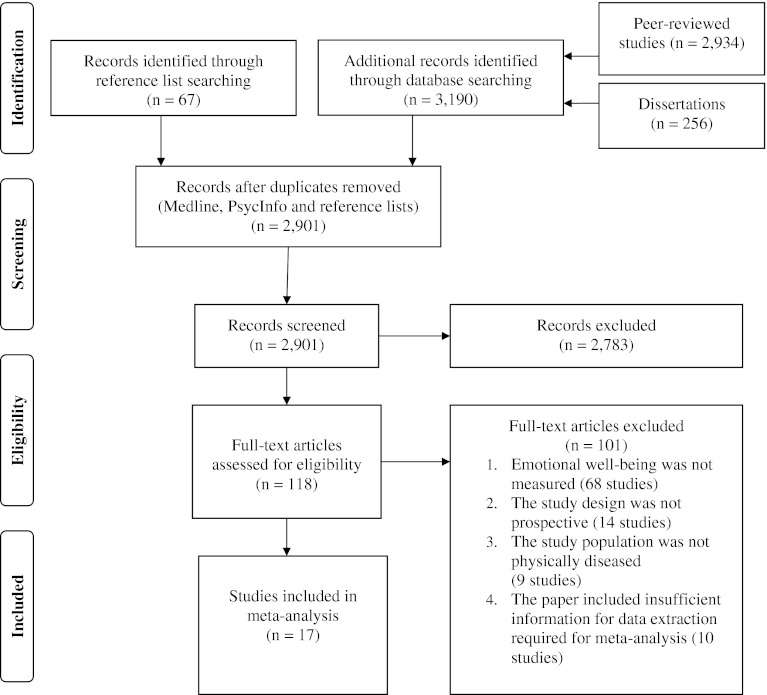
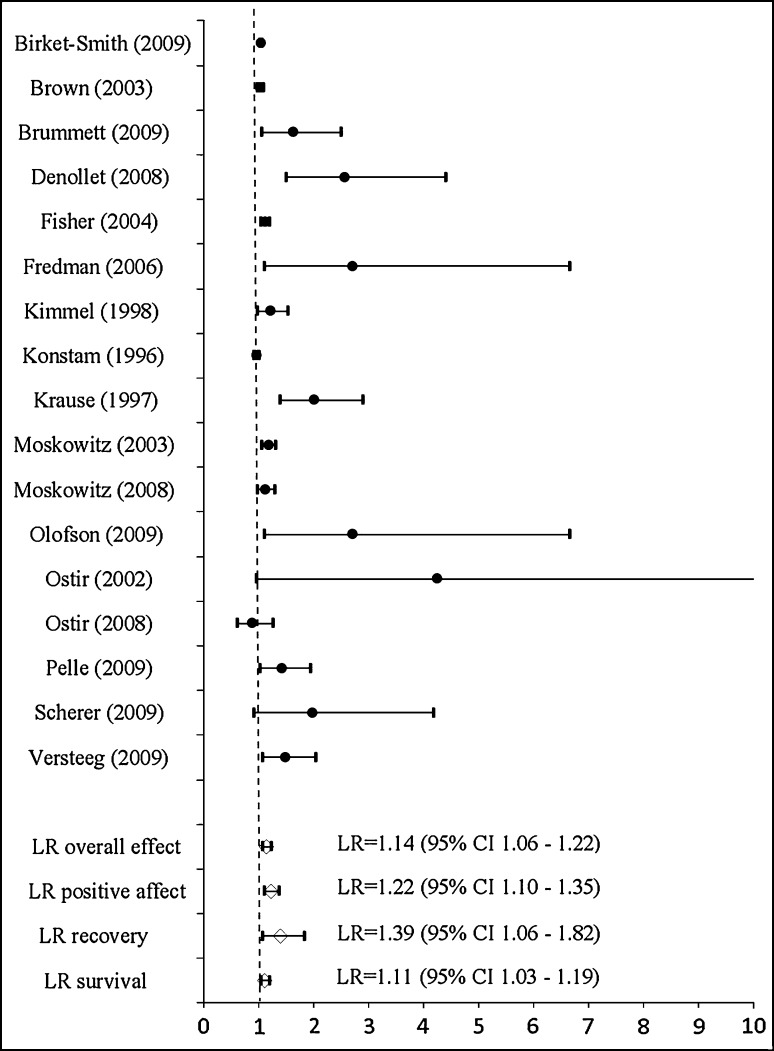
This meta-analysis synthesized studies on emotional well-being as predictor of the prognosis of physical illness, while in addition evaluating the impact of putative moderators, namely constructs of well-being, health-related outcome, year of publication, follow-up time and methodological quality of the included studies. The search in reference lists and electronic databases (Medline and PsycInfo) identified 17 eligible studies examining the impact of general well-being, positive affect and life satisfaction on recovery and survival in physically ill patients. Meta-analytically combining these studies revealed a Likelihood Ratio of 1.14, indicating a small but significant effect. Higher levels of emotional well-being are beneficial for recovery and survival in physically ill patients. The findings show that emotional well-being predicts long-term prognosis of physical illness. This suggests that enhancement of emotional well-being may improve the prognosis of physical illness, which should be investigated by future research.
Overview
The claims and statistics of this paper haven’t been checked yet.
Run the check — free, no account needed. It reads the open-access text and checks the sources it cites.
Integrity signals
Registry
Cites
Statistics
Figures
Verification
Claims the paper makes
The claims and statistics of this paper haven’t been checked yet.
Run the check — free, no account needed. It reads the open-access text and checks the sources it cites.
Claims other papers make about this one
Each is checked against this paper’s own text: does it say what the citing paper says it does?
The source backs part of the claim, not all of it — or backs it for a different population, condition or comparison.
In the citing paper
“Psychological distress can exacerbate physical symptoms, interfere with treatment adherence, and negatively influence overall well-being and recovery [7].”
From Effectiveness of Acceptance and Commitment Therapy (ACT) on disease acceptance for breast cancer patients: Study protocol of a randomized controlled trial (2024) · cites this paper as [7]
Experimental — accuracy not yet measuredIn the citing paper
“A meta-analysis even showed that emotional well-being predicts long-term prognosis of physical illness [5].”
From How to increase reach and adherence of web-based interventions: a design research viewpoint (2015) · cites this paper as [5]
Self-check
Percentages, sums and reported differences re-computed from the paper’s own numbers.
The self-check needs the paper’s full text.
Citations
Cites
Preferred Reporting Items for Systematic Reviews and Meta-Analyses: the PRISMA statement
Moher, D., Liberati, A., Tetzlaff, J., Altman, D. G., & for the PRISMA Group (2009) · BMJ · doi:10.1136/bmj.b2535 · Cited by 83,823
Preferred Reporting Items for Systematic Reviews and Meta-Analyses: The PRISMA Statement
Moher, D., Liberati, A., Tetzlaff, J., Altman, D. G., & The PRISMA Group (2009) · PLoS Medicine · doi:10.1371/journal.pmed.1000097 · Cited by 64,042
The CES-D Scale: A Self-Report Depression Scale for Research in the General Population
Radloff, L. S. (1977) · Applied Psychological Measurement · doi:10.1177/014662167700100306 · Cited by 53,267
Preferred reporting items for systematic reviews and meta-analyses: the PRISMA Statement.
(2009) · PubMed Central · Cited by 44,859
Development and validation of brief measures of positive and negative affect: The PANAS scales.
Watson, D., Clark, L. A., & Tellegen, A. (1988) · Journal of Personality and Social Psychology · doi:10.1037/0022-3514.54.6.1063 · Cited by 32,433
The satisfaction with life scale
Diener, E., Emmons, R. A., Larsen, R. J., & Griffin, S. (1985) · Journal of Personality Assessment · doi:10.1207/s15327752jpa4901_13 · Cited by 31,768 · cited 1×
“Life satisfaction was measured by the Satisfaction With Life Scale (n = 1; Diener et al., 1985), the MOS short form general health survey (n = 1; Stewart et al., 1988), and the Life Situation Questionnaire (n = 1; Krause, 1992).”
MethodCochrane Handbook for Systematic Reviews of Interventions: Cochrane Book Series
(2008) · doi:10.1002/9780470712184 · Cited by 25,048
EuroQol: a new facility for the measurement of health-related quality of life
(1990) · Health Policy · doi:10.1016/0168-8510(90)90421-9 · Cited by 15,736
Subjective well-being: Three decades of progress.
Diener, E., Suh, E. M., Lucas, R. E., & Smith, H. L. (1999) · Psychological Bulletin · doi:10.1037/0033-2909.125.2.276 · Cited by 12,910
From dissertation abstracts international
(1974) · ACM SIGGRAPH Computer Graphics · doi:10.1145/988616.988619 · Cited by 12,208
The benefits of frequent positive affect: Does happiness lead to success?
Lyubomirsky, S., King, L., & Diener, E. (2005) · Psychological Bulletin · doi:10.1037/0033-2909.131.6.803 · Cited by 7,143
Review of the Satisfaction With Life Scale
Pavot, W., & Diener, E. (2009) · Social indicators research series · doi:10.1007/978-90-481-2354-4_5 · Cited by 3,462
Mental illness and/or mental health? Investigating axioms of the complete state model of health
Keyes, C. L. M. (2005) · Journal of Consulting and Clinical Psychology · doi:10.1037/0022-006x.73.3.539 · Cited by 3,357 · cited 1×
“…is accumulating evidence that psychopathology and wellbeing are more than merely opposite poles of the same dimension (Huppert & Whittington, 2003; Keyes, 2005, 2007; Lamers et al., 2011; Watson & Tellegen, 1985), and both well-being and mental disorders may have independent impacts on physical…”
BackgroundThe MOS Short-form General Health Survey: Reliability and Validity in a Patient Population
Stewart, A. L., Hays, R. D., & Ware, J. E. (1988) · Medical Care · doi:10.1097/00005650-198807000-00007 · Cited by 3,339 · cited 1×
“Life satisfaction was measured by the Satisfaction With Life Scale (n = 1; Diener et al., 1985), the MOS short form general health survey (n = 1; Stewart et al., 1988), and the Life Situation Questionnaire (n = 1; Krause, 1992).”
MethodHerrmann, C. (1997) · Journal of Psychosomatic Research · doi:10.1016/s0022-3999(96)00216-4 · Cited by 2,885 · cited 1×
“…affect of the Center for Epidemiological Studies Depression Scale (n = 7; Radloff, 1977), the subscale Positive affect of the Hospital Anxiety and Depression Scale (n = 2; Herrmann, 1997), the Mood Adjective Check List (n = 2; Nowlis, 1965), and the Global Mood Scale (n = 2; Denollet, 1993).”
BackgroundDanaei, G., Ding, E. L., Mozaffarian, D., Taylor, B., Rehm, J., Murray, C. J. L., & Ezzati, M. (2009) · PLoS Medicine · doi:10.1371/journal.pmed.1000058 · Cited by 2,860
Chapter 9: Analysing Data and Undertaking Meta-Analyses
Deeks, J. J., Higgins, J. P. T., & Altman, D. G. (2008) · Cited by 2,782
Garnefski, N., Kraaij, V., Schroevers, M. J., & Somsen, G. A. (2008) · Journal of Clinical Psychology in Medical Settings · doi:10.1007/s10880-008-9136-5 · Cited by 2,495
Katz, S. (1963) · JAMA · doi:10.1001/jama.1963.03060120024016 · Cited by 2,421 · cited 1×
“…measured by the Duke Activity Status Index (n = 1; Hlatky et al., 1989), (modified version of the) Katz’s Activities of Daily Living scale (n = 2; Katz et al., 1963), the Inpatient Rehabilitation Facilities-Patient Assessment Instrument (n = 1; Ottenbacher et al., 1996), the EuroQol (Euroqol…”
MethodKeyes, C. L. M. (2007) · American Psychologist · doi:10.1037/0003-066x.62.2.95 · Cited by 2,268 · cited 1×
“…is accumulating evidence that psychopathology and wellbeing are more than merely opposite poles of the same dimension (Huppert & Whittington, 2003; Keyes, 2005, 2007; Lamers et al., 2011; Watson & Tellegen, 1985), and both well-being and mental disorders may have independent impacts on physical…”
BackgroundHappy People Live Longer: Subjective Well‐Being Contributes to Health and Longevity
Diener, E., & Chan, M. Y. (2011) · Applied Psychology: Health and Well-Being · doi:10.1111/j.1758-0854.2010.01045.x · Cited by 2,260
Does positive affect influence health?
Pressman, S. D., & Cohen, S. (2005) · Psychological Bulletin · doi:10.1037/0033-2909.131.6.925 · Cited by 2,087
Analysing Data and Undertaking Meta‐Analyses
Deeks, J. J., Higgins, J. P., & Altman, D. G. (2008) · Cochrane Handbook for Systematic Reviews of Interventions · doi:10.1002/9780470712184.ch9 · Cited by 1,800
Association of depression and diabetes complications: a meta-analysis
de Groot, M., Anderson, R., Freedland, K. E., Clouse, R. E., & Lustman, P. J. (2001) · Psychosomatic Medicine · doi:10.1097/00006842-200107000-00015 · Cited by 1,799 · cited 1×
“…is associated with increased osteoporosis (Michelson et al., 1996), coronary heart disease (Glassman & Shapiro, 1998), diabetes complications (De Groot et al., 2001), cancer incidence, progression (Spiegel & Giese-Davis, 2003) and cancer mortality (Satin et al., 2009), and anxiety may influence…”
BackgroundHlatky, M. A., Boineau, R., Higginbotham, M. B., Lee, K. L., Mark, D. B., Califf, R. M., Cobb, F. R., & Pryor, D. B. (1989) · The American Journal of Cardiology · doi:10.1016/0002-9149(89)90496-7 · Cited by 1,747 · cited 1×
“Functional status was measured by the Duke Activity Status Index (n = 1; Hlatky et al., 1989), (modified version of the) Katz’s Activities of Daily Living scale (n = 2; Katz et al., 1963), the Inpatient Rehabilitation Facilities-Patient Assessment Instrument (n = 1; Ottenbacher et al., 1996), the…”
MethodChida, Y., & Steptoe, A. (2008) · Psychosomatic Medicine · doi:10.1097/psy.0b013e31818105ba · Cited by 1,592
The reliability of the functional independence measure: A quantitative review
Ottenbacher, K. J., Hsu, Y., Granger, C. V., & Fiedler, R. C. (1996) · Archives of Physical Medicine and Rehabilitation · doi:10.1016/s0003-9993(96)90184-7 · Cited by 1,415 · cited 1×
“…of the) Katz’s Activities of Daily Living scale (n = 2; Katz et al., 1963), the Inpatient Rehabilitation Facilities-Patient Assessment Instrument (n = 1; Ottenbacher et al., 1996), the EuroQol (Euroqol group, 1990), and by measuring usual walking speed, rapid walking speed and chair stands (n = 1).”
BackgroundEvaluating the psychometric properties of the mental health continuum-short form (MHC-SF)
Lamers, S. M. A., Westerhof, G. J., Bohlmeijer, E. T., ten Klooster, P. M., & Keyes, C. L. M. (2011) · Journal of Clinical Psychology · doi:10.1002/jclp.20741 · Cited by 1,402 · cited 2×
“Additional studies need to be conducted, using reliable questionnaires which are designed to measure well-being, such as the Positive and Negative Affect Scales (PANAS; Watson et al., 1988) and Mental Health Continuum-Short Form (MHC-SF; Lamers et al., 2011).”
BackgroundSelf-citationRosenberg, M. S. (2005) · Evolution · doi:10.1111/j.0014-3820.2005.tb01004.x · Cited by 1,285
Toward a consensual structure of mood
Watson, D., & Tellegen, A. (1985) · Psychological Bulletin · doi:10.1037//0033-2909.98.2.219 · Cited by 1,170 · cited 1×
“…evidence that psychopathology and wellbeing are more than merely opposite poles of the same dimension (Huppert & Whittington, 2003; Keyes, 2005, 2007; Lamers et al., 2011; Watson & Tellegen, 1985), and both well-being and mental disorders may have independent impacts on physical health.”
BackgroundDepression as a predictor of disease progression and mortality in cancer patients: A Meta‐Analysis
Satin, J. R., Linden, W., & Phillips, M. J. (2009) · Cancer · doi:10.1002/cncr.24561 · Cited by 972 · cited 1×
“…coronary heart disease (Glassman & Shapiro, 1998), diabetes complications (De Groot et al., 2001), cancer incidence, progression (Spiegel & Giese-Davis, 2003) and cancer mortality (Satin et al., 2009), and anxiety may influence the development of coronary heart disease (Kubzansky & Kawachi, 2000).”
BackgroundDepression and cancer: mechanisms and disease progression
Spiegel, D., & Giese-Davis, J. (2003) · Biological Psychiatry · doi:10.1016/s0006-3223(03)00566-3 · Cited by 874 · cited 1×
“…et al., 1996), coronary heart disease (Glassman & Shapiro, 1998), diabetes complications (De Groot et al., 2001), cancer incidence, progression (Spiegel & Giese-Davis, 2003) and cancer mortality (Satin et al., 2009), and anxiety may influence the development of coronary heart disease…”
BackgroundVeenhoven, R. (2008) · Journal of Happiness Studies · doi:10.1007/s10902-006-9042-1 · Cited by 771 · cited 15×
“Searching the reference lists of the literature reviews (Chida & Steptoe, 2008; Diener & Chan, 2011; Howell et al., 2007; Lyubomirsky et al., 2005; Pressman & Cohen, 2005; Veenhoven, 2008) and searching databases revealed in total 2,901 records.”
BackgroundMethodResultInfluentialHealth benefits: Meta-analytically determining the impact of well-being on objective health outcomes
Howell, R. T., Kern, M. L., & Lyubomirsky, S. (2007) · Health Psychology Review · doi:10.1080/17437190701492486 · Cited by 686
Depression and the Course of Coronary Artery Disease
Glassman, A. H., & Shapiro, P. A. (1998) · American Journal of Psychiatry · doi:10.1176/ajp.155.1.4 · Cited by 674 · cited 1×
“For example, depression is associated with increased osteoporosis (Michelson et al., 1996), coronary heart disease (Glassman & Shapiro, 1998), diabetes complications (De Groot et al., 2001), cancer incidence, progression (Spiegel & Giese-Davis, 2003) and cancer mortality (Satin et al., 2009), and…”
BackgroundSterne, J. A., Egger, M., & Moher, D. (2008) · Cochrane Handbook for Systematic Reviews of Interventions · doi:10.1002/9780470712184.ch10 · Cited by 651 · cited 1×
“The fail-safe number indicates the number of nonsignificant unpublished studies needed to reduce the overall significant effect to non-significance (Sterne et al., 2008).”
BackgroundHuppert, F. A., & Whittington, J. E. (2003) · British Journal of Health Psychology · doi:10.1348/135910703762879246 · Cited by 536 · cited 1×
“After all, there is accumulating evidence that psychopathology and wellbeing are more than merely opposite poles of the same dimension (Huppert & Whittington, 2003; Keyes, 2005, 2007; Lamers et al., 2011; Watson & Tellegen, 1985), and both well-being and mental disorders may have independent…”
BackgroundCuijpers, P., van Straten, A., Bohlmeijer, E., Hollon, S. D., & Andersson, G. (2010) · Psychological Medicine · doi:10.1017/s0033291709006114 · Cited by 533
Self-citationResearch with the mood adjective checklist
Nowlis, V. (1965) · Medical Entomology and Zoology · Cited by 527
Bone Mineral Density in Women with Depression
Michelson, D., Stratakis, C., Hill, L., Reynolds, J., Galliven, E., Chrousos, G., & Gold, P. (1996) · New England Journal of Medicine · doi:10.1056/nejm199610173351602 · Cited by 471 · cited 1×
“For example, depression is associated with increased osteoporosis (Michelson et al., 1996), coronary heart disease (Glassman & Shapiro, 1998), diabetes complications (De Groot et al., 2001), cancer incidence, progression (Spiegel & Giese-Davis, 2003) and cancer mortality (Satin et al., 2009), and…”
BackgroundGoing to the heart of the matter
Kubzansky, L. D., & Kawachi, I. (2000) · Journal of Psychosomatic Research · doi:10.1016/s0022-3999(99)00091-4 · Cited by 442 · cited 1×
“…coronary heart disease (Glassman & Shapiro, 1998), diabetes complications (De Groot et al., 2001), cancer incidence, progression (Spiegel & Giese-Davis, 2003) and cancer mortality (Satin et al., 2009), and anxiety may influence the development of coronary heart disease (Kubzansky & Kawachi, 2000).”
BackgroundWell-being therapy. A novel psychotherapeutic approach for residual symptoms of affective disorders
FAVA, G. A., RAFANELLI, C., CAZZARO, M., CONTI, S., & GRANDI, S. (1998) · Psychological Medicine · doi:10.1017/s0033291797006363 · Cited by 427
Psychosocial factors, behavioral compliance and survival in urban hemodialysis patients
Kimmel, P. L., Peterson, R. A., Weihs, K. L., Simmens, S. J., Alleyne, S. I., Cruz, I., & Veis, J. H. (1998) · Kidney International · doi:10.1046/j.1523-1755.1998.00989.x · Cited by 404 · cited 1×
“…2 Hip fracture, age 65+ (N = 432) Positive affect (CES-D) Functional status: usual and rapid walking speed, chair stands 2.700 (1.096–6.654) 0 Kimmel et al. (1998) 1.00 4 Hemodialysis patients (N = 295) Life satisfaction (SWLS) Survival 1.205 (0.960–1.513) 0 Konstam et…”
InfluentialActa Psychiatrica Scandinavica
Munk‐Jørgensen, P., & Licht, R. W. (1998) · Acta Psychiatrica Scandinavica · doi:10.1111/j.1600-0447.1998.tb10008.x · Cited by 389
Konstam, V., Salem, D. N., Pouleur, H. G., Kostis, J. B., Gorkin, L., Shumaker, S. A., Mottard, I., Woods, P., Konstam, M. A., & Yusuf, S. (1996) · The American Journal of Cardiology · doi:10.1016/s0002-9149(96)00463-8 · Cited by 352
Positive Affect Predicts Lower Risk of AIDS Mortality
Moskowitz, J. T. (2003) · Psychosomatic Medicine · doi:10.1097/01.psy.0000073873.74829.23 · Cited by 291 · cited 3×
“For one study (Moskowitz, 2003), the result based on multiple measure-”
MethodResultInfluentialWong, W. C., Cheung, C. S., & Hart, G. J. (2008) · Emerging Themes in Epidemiology · doi:10.1186/1742-7622-5-23 · Cited by 257 · cited 1×
“Quality assessment Two reviewers (SL and LB) independently assessed methodological quality of the included studies, using a protocol based on the quality checklist for observational studies of Wong et al. (2008).”
MethodPsychological Distress and Cancer Survival: A Follow-Up 10 Years After Diagnosis
Brown, K. W., Levy, A. R., Rosberger, Z., & Edgar, L. (2003) · Psychosomatic Medicine · doi:10.1097/01.psy.0000077503.96903.a6 · Cited by 213 · cited 1×
“…interval) Conclusiond Birket-Smith et al. (2009) 1.00 6 Chronic heart disease (N = 85) Well-being (WHO-5) Survival 1.024 (1.005–1.042) + Brown et al. (2003) 0.80 10 Cancer (N = 205) Positive affect (MACL) Survival 0.990 (0.938–1.045) 0 Brummett et al. (2009) 0.67 3 Coronary artery…”
InfluentialFledderus, M., Bohlmeijer, E. T., Smit, F., & Westerhof, G. J. (2010) · American Journal of Public Health · doi:10.2105/ajph.2010.196196 · Cited by 197
Self-citationPositive affect uniquely predicts lower risk of mortality in people with diabetes.
Moskowitz, J. T., Epel, E. S., & Acree, M. (2008) · Health Psychology · doi:10.1037/0278-6133.27.1.s73 · Cited by 191 · cited 1×
“…satisfaction (LSQ) Survival 1.990 (1.373–2.885) + Moskowitz (2003) 0.60 10.8 HIV + patients (N = 407) Positive affect (CES-D) Survival 1.163 (1.042–1.299) + Moskowitz et al. (2008) 0.80 10 Diabetic patients (N = 715) Positive affect (CES-D) Survival 1.111 (0.962–1.284) 0 Olofson et…”
InfluentialInternal and external validity of the WHO Well‐Being Scale in the elderly general population
Heun, R., Burkart, M., Maier, W., & Bech, P. (1999) · Acta Psychiatrica Scandinavica · doi:10.1111/j.1600-0447.1999.tb00973.x · Cited by 160 · cited 1×
“The studies measured general well-being using the WHO-5 well-being index (n = 1; Heun et al., 1999), positive affect using the subscale Positive affect of the Center for Epidemiological Studies Depression Scale (n = 7; Radloff, 1977), the subscale Positive affect of the Hospital Anxiety and…”
MethodEmotional distress and fatigue in coronary heart disease: the Global Mood Scale (GMS)
Denollet, J. (1993) · Psychological Medicine · doi:10.1017/s0033291700038903 · Cited by 142 · cited 4×
“…affect of the Center for Epidemiological Studies Depression Scale (n = 7; Radloff, 1977), the subscale Positive affect of the Hospital Anxiety and Depression Scale (n = 2; Herrmann, 1997), the Mood Adjective Check List (n = 2; Nowlis, 1965), and the Global Mood Scale (n = 2; Denollet, 1993).”
BackgroundMethodInfluentialMortality after spinal cord injury: An 11-year prospective study
Krause, J. S., Sternberg, M., Lottes, S., & Maides, J. (1997) · Archives of Physical Medicine and Rehabilitation · doi:10.1016/s0003-9993(97)90193-3 · Cited by 109 · cited 1×
“…(SWLS) Survival 1.205 (0.960–1.513) 0 Konstam et al. (1996) 0.80 3 Congestive heart failure (N = 5,025) Life satisfaction (MOS) Survival 0.949 (0.899–1.001) 0 Krause et al. (1997) 1.00 11 Spinal cord injury (N = 330) Life satisfaction (LSQ) Survival 1.990 (1.373–2.885) + Moskowitz (2003) 0.60 10.8…”
InfluentialFava, G. A. (2016) · doi:10.1002/9781118468197.ch26 · Cited by 105
Elderly Patients with Hip Fracture with Positive Affect Have Better Functional Recovery over 2 Years
Fredman, L., Hawkes, W., Black, S. E., Bertrand, R. M., & Magaziner, J. S. (2006) · Journal of the American Geriatrics Society · doi:10.1111/j.1532-5415.2006.00786.x · Cited by 95 · cited 1×
“…2.550 (1.479–4.397) + Fisher et al. (2004) 0.67 2 Arthritis, age 65+ (N = 937) Positive affect (CES-D) Functional status (ADL) 1.099 (1.024–1.181) + Fredman et al. (2006) 0.50 2 Hip fracture, age 65+ (N = 432) Positive affect (CES-D) Functional status: usual and rapid walking speed, chair…”
InfluentialDenollet, J., Pedersen, S. S., Daemen, J., de Jaegere, P. P. T., Serruys, P. W. J. C., & van Domburg, R. T. (2007) · Journal of Internal Medicine · doi:10.1111/j.1365-2796.2007.01870.x · Cited by 89 · cited 1×
“…0 Brummett et al. (2009) 0.67 3 Coronary artery disease, age 60+ (N = 948) Positive affect (CES-D) Functional status (DASI) 1.609 (1.039–2.492) + Denollet et al. (2008) 0.80 2 Coronary artery disease (N = 874) Positive affect (HADS) Survival 2.550 (1.479–4.397) + Fisher et al. (2004) 0.67…”
InfluentialAssociations Between Positive Emotion and Recovery of Functional Status Following Stroke
Ostir, G. V., Berges, I.-M., Ottenbacher, M. E., Clow, A., & Ottenbacher, K. J. (2008) · Psychosomatic Medicine · doi:10.1097/psy.0b013e31816fd7d0 · Cited by 84
Differential Effects of Premorbid Physical and Emotional Health on Recovery from Acute Events
Ostir, G. V., Goodwin, J. S., Markides, K. S., Ottenbacher, K. J., Balfour, J. L., & Guralnik, J. M. (2002) · Journal of the American Geriatrics Society · doi:10.1046/j.1532-5415.2002.50167.x · Cited by 81 · cited 1×
“…1.111 (0.962–1.284) 0 Olofson et al. (2009) 0.60 8 Chronic alveolar hypoventilation (N = 44) Positive affect (MACL) Survival 1.961 (0.901–4.167) 0 Ostir et al. (2002) 0.50 1 Acute events (stroke, heart attack or hip fracture), age 65+ (N = 240) Positive affect (CES-D) Functional…”
InfluentialBottino, S. M. B., Fráguas, R., & Gattaz, W. F. (2009) · Archives of Clinical Psychiatry (São Paulo) · doi:10.1590/s0101-60832009000900007 · Cited by 65
Pelle, A. J. M., Pedersen, S. S., Szabó, B. M., & Denollet, J. (2009) · Quality of Life Research · doi:10.1007/s11136-009-9485-z · Cited by 52 · cited 1×
“…(ADL) 2.700 (1.096–6.653) + Ostir et al. (2008) 0.50 0.25 Stroke, age 55+ (N = 823) Positive affect (CES-D) Functional status (IRF-PAI) 4.241 (0.939–19.151) 0 Pelle et al. (2009) 0.83 1 Chronic heart failure (N = 276) Positive affect (GMS) Health status (HCS) 0.865 (0.603–1.241) 0 Scherer…”
InfluentialLife satisfaction after spinal cord injury: A descriptive study.
Krause, J. S. (1992) · Rehabilitation Psychology · doi:10.1037/h0079092 · Cited by 50 · cited 1×
“Life satisfaction was measured by the Satisfaction With Life Scale (n = 1; Diener et al., 1985), the MOS short form general health survey (n = 1; Stewart et al., 1988), and the Life Situation Questionnaire (n = 1; Krause, 1992).”
MethodMental disorders and general well-being in cardiology outpatients—6-year survival
Birket‐Smith, M., Hansen, B. H., Hanash, J. A., Hansen, J. F., & Rasmussen, A. (2009) · Journal of Psychosomatic Research · doi:10.1016/j.jpsychores.2009.01.003 · Cited by 47
Positive affect and disability among older Mexican Americans with arthritis
Fisher, M. N., Snih, S. A., Ostir, G. V., & Goodwin, J. S. (2004) · Arthritis Care & Research · doi:10.1002/art.20079 · Cited by 44
Versteeg, H., Pedersen, S. S., Erdman, R. A. M., van Nierop, J. W. I., de Jaegere, P. P. T., & van Domburg, R. T. (2009) · Quality of Life Research · doi:10.1007/s11136-009-9511-1 · Cited by 27 · cited 2×
“…0 Scherer and HermannLingen (2009) 0.80 1 Patients of the general medical ward (N = 575) Positive affect (HADS; 1 item on enjoyment) Survival 1.400 (1.016–1.930) + Versteeg et al. (2009) 0.83 1 Coronary artery disease (N = 533) Positive affect (GMS) Functional status (EQ5D mobility) 1.031…”
MethodInfluentialBrummett, B. H., Morey, M. C., Boyle, S. H., & Mark, D. B. (2009) · The Journals of Gerontology Series B · doi:10.1093/geronb/gbp041 · Cited by 26
BONE MINERAL DENSITY IN WOMEN WITH DEPRESSION
Ichelson, D. A. M., Ill, L. A. H., Eynolds, J. A. R., Alliven, E. L. G., & Old, P. H. G. (2012) · Cited by 26
The File-Drawer Problem, Revisited
Young, S. S., & Bang, H. (2004) · Science · doi:10.1126/science.306.5699.1133d · Cited by 22
Single item on positive affect is associated with 1-year survival in consecutive medical inpatients
Scherer, M., & Herrmann‐Lingen, C. (2008) · General Hospital Psychiatry · doi:10.1016/j.genhosppsych.2008.09.020 · Cited by 19
A Happy Person, a Healthy Person?
Penninx, B. W. J. H. (2000) · Journal of the American Geriatrics Society · doi:10.1111/j.1532-5415.2000.tb05009.x · Cited by 16
RENDLE–SHORT, J., Gray, O. P., & Dodge, J. A. (1985) · A Synopsis of Children's Diseases · doi:10.1016/b978-1-4831-8407-4.50112-7 · Cited by 15
Olofson, J., Dellborg, C., Sullivan, M., Midgren, B., Caro, O., & Bergman, B. (2009) · Quality of Life Research · doi:10.1007/s11136-009-9445-7 · Cited by 10 · cited 1×
“…affect (CES-D) Survival 1.163 (1.042–1.299) + Moskowitz et al. (2008) 0.80 10 Diabetic patients (N = 715) Positive affect (CES-D) Survival 1.111 (0.962–1.284) 0 Olofson et al. (2009) 0.60 8 Chronic alveolar hypoventilation (N = 44) Positive affect (MACL) Survival 1.961 (0.901–4.167) 0 Ostir et…”
InfluentialPsychological and environmental factors of rehabilitation outcome in the elderly
Caron, M. D. (1996) · ScholarWorks@UMassAmherst (University of Massachusetts Amherst) · Cited by 2
Research works printed but not linked: 2
- Hamilton, A. B. (1996). Do psychosocial factors predict metastatic cancer survival? A longitudinal assessment of breast, colon, and lung cancer patients. Dissertation Abstracts International, 57, 4029. (UMI No. 9632697).
- Ostir, G. V. (2001). Emotional well-being and subsequent health, functional ability and mortality in older non-Hispanic Whites, Blacks and Mexican Americans. Dissertation Abstracts International, 61, 2865. (UMI No. 9981512).
Cited by
Sorted by citations
Positive psychology interventions: a meta-analysis of randomized controlled studies
Bolier, L., Haverman, M., Westerhof, G. J., Riper, H., Smit, F., & Bohlmeijer, E. (2013) · BMC Public Health · doi:10.1186/1471-2458-13-119 · Cited by 1,996
“In addition, the available evidence suggests that well-being reduces the risk of developing mental symptoms and disorders [21,22] and helps reduce mortality risks in people with physical disease [23].”
Self-citationHandbook of Religion and Health
Koenig, H. G., VanderWeele, T. J., & Peteet, J. R. (2023) · doi:10.1093/oso/9780190088859.001.0001 · Cited by 1,160
Advances and Open Questions in the Science of Subjective Well-Being
Diener, E., Lucas, R. E., & Oishi, S. (2018) · Collabra Psychology · doi:10.1525/collabra.115 · Cited by 1,333
van den Bosch, M. A., & Sang, Å. O. (2017) · Environmental Research · doi:10.1016/j.envres.2017.05.040 · Cited by 1,070
If, Why, and When Subjective Well‐Being Influences Health, and Future Needed Research
Diener, E., Pressman, S. D., Hunter, J. F., & Delgadillo‐Chase, D. (2017) · Applied Psychology Health and Well-Being · doi:10.1111/aphw.12090 · Cited by 816
Metadata
- Authors
- Lamers, S. M. A., Bolier, L., Westerhof, G. J., Smit, F., & Bohlmeijer, E. T.
- Affiliations
- University of Twente (NL)
- Trimbos Institute (NL)
- Corresponding author
- Lamers, Sanne M. A.
- Venue
- Journal of Behavioral Medicine
- Published
- 2011-09-15
- Volume
- 35
- Issue
- 5
- Pages
- 538-547
- ISSN
- 0160-7715 (ISSN-L)
- 1573-3521
- PMC
- PMC3439612
- OpenAlex
- W2052269750
- Cited by
- 306
- References
- 75
- Citations by year
- 2026: 14 · 2025: 22 · 2024: 25 · 2023: 62 · 2022: 19 · 2021: 61 · 2020: 15 · 2019: 14 · 2018: 19 · 2017: 12 · 2016: 14 · 2015: 11 · 2014: 8 · 2013: 8 · 2012: 1
- FWCI
- 0.73
- Type
- journal article
- Language
- en
- Open access
- hybrid
- doi.org
- Licence
- cc-by-nc
- Locations
- Journal of Behavioral Medicine (publishedVersion, cc-by-nc)
- PubMed Central (publishedVersion, cc-by-nc)
- PubMed (publishedVersion)
- Pure Amsterdam UMC (publishedVersion)
- Amsterdam UMC (VU Amsterdam) - Institutional Repository (publishedVersion)
- VU Research Portal (publishedVersion, other-oa)
- University of Twente Research Information (publishedVersion, cc-by-nc)
- Digital Academic REpository of VU University Amsterdam (Vrije Universiteit Amsterdam) (submittedVersion)
- University of Twente Research Information (submittedVersion, other-oa)
- Data Archiving and Networked Services (DANS) (submittedVersion)
- Data Archiving and Networked Services (DANS) (submittedVersion, other-oa)
- Topics
- Social Sciences › Psychology › Social Psychology › Psychological Well-being and Life Satisfaction
- Health Sciences › Medicine › Oncology › Cancer survivorship and care
- Health Sciences › Health Professions › General Health Professions › Health, psychology, and well-being
- Keywords
- emotional well-being, positive affect, life satisfaction, physical illness, prognosis, long-term recovery, survival, physical health outcomes, moderators
- MeSH terms
- Affect, Disease, Emotions, Humans, Mental Health, Prognosis, Patient Satisfaction, Survivors
About these checks
Registry, retraction, Cites and statistics results are computed, not judged, with one exception: a printed reference that no index lists is read once by a model before it counts as a citation error. Claims are extracted by a model and kept only when their quote appears verbatim in the text; each cited source is then checked, with a model’s help, for whether it says what the claim relies on. Those verdicts can be wrong — read the claim’s quote and the cited source before relying on one.
Statistics and arithmetic are recomputed, not judged.
Confidence bands are shown only for fields calibrated on our annotated test set. None is calibrated yet, so no band is shown.
What counts as a claim ›How we measure confidence ›How we check this ›
Are you an author, or do you see a problem with this page? Request a review
