

Understanding the determinants of novel technology adoption among teachers: the case of 3D printing
Open accessThe DOI matches its Crossref record, with a small difference in title or year; 50 of the 50 references it cites were found in a registry or an index; 1 of the 36 sources its claims cite were checked for support.
Abstract
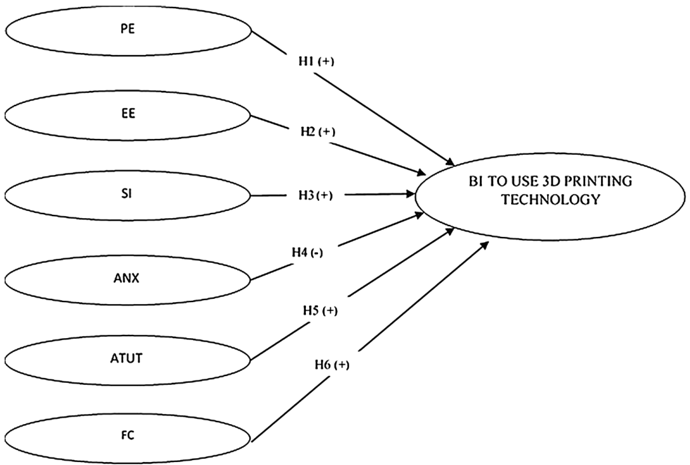
3D printing consists of novel technologies that raised high expectations about their future impact on economy and society. However, despite major efforts of manufacturers and governments to promote the technology, the adoption rate is still low. Among others, the absence of appropriate technology education is considered a major hurdle for adoption. The main goal of this paper is to investigate the behavioral intention of high school teachers to use these novel technologies in class. We propose applying the unified theory of acceptance and use of technology by integrating anxiety and attitude toward using technology. Data from 103 high school teachers is utilized to empirically validate the conceptual model. The results show that performance expectancy, facilitating conditions, anxiety, and attitude toward using technology significantly affect the adoption of novel technology. Contrary to expectations, effort expectancy and social influence do not affect the behavioral intention. Thus, the study adds to prior knowledge by underlining the need for further investigation of the relevance of anxiety and attitude toward using a novel technology in individual adoption processes.
Overview
CoChat Summary
## TL;DR
This study examines what drives high school teachers’ intention to use 3D printing in class, using an extended UTAUT model and survey data from 103 Austrian teachers. The strongest predictors were performance expectancy, facilitating conditions, anxiety, and attitude toward using technology; effort expectancy and social influence were not significant.
## Key findings
- In the multiple linear regression, performance expectancy (estimate = 0.555, *p* = 0.023), attitude toward using technology (estimate = 0.625, *p* = 0.004), anxiety (estimate = -0.451, *p* = 0.006), and facilitating conditions (estimate = 0.478, *p* = 0.026) significantly predicted behavioral intention to use 3D printing.
- Effort expectancy (estimate = -0.248, *p* = 0.229) and social influence (estimate = 0.043, *p* = 0.838) were not significant predictors.
- The model fit was R-square = 0.614 and adjusted R-square = 0.568; the overall regression was significant with F = 11.908 with 6 and 91 df.
- Among controls, early adopter status was positively associated with behavioral intention (estimate = 1.531, *p* = 0.000), while previous 3D printing experience was negatively associated (estimate = -1.087, *p* = 0.027).
## Methods
- The authors conducted an empirical survey study tied to the project “SmartLab goes to school”; teachers from high schools in an Austrian region were invited, and the final analytic sample was 103 teachers after excluding cases with more than 10% missing data.
- They measured behavioral intention, PE, EE, SI, ANX, ATUT, and FC using adapted UTAUT scales on seven-point Likert scales; reliability was assessed with Cronbach’s alpha.
- Main analysis used multiple linear regression predicting behavioral intention to use 3D printing, with controls for early adopter, gender, age, 3D printing experience, and technical subject taught; they also reported independent-sample t-tests, ANOVA, and chi-square tests for group comparisons.
## Limitations
- The paper states that the sample was limited to 103 respondents from one Austrian region, and notes a self-selection bias because more men participated than women.
- It states that, because of the technology’s novelty and low adoption rate, the study could not test whether behavioral intention leads to actual use.
- It also says larger-scale studies are needed and that results may not generalize to different geographical and cultural contexts.
- Evident from the text: the study relies on cross-sectional self-report survey data, so causal claims are not established by the design.
Model-written summary. Check it against the paper before relying on it.
Integrity signals
Registry
Cites
Statistics
Figures
Verification
Claims the paper makes
1 Valid · 0 Not valid · 31 Not checked · 51 Own results and interpretations
Every source the paper cites for this claim was checked and supports it.
In the paper
“This result is consistent with Kabra etal. (2017), for example, who did not find significant effects of social influence on the behavioral intention to use information technology.”
What the sources say
- Supportedcites Kabra et al. 2017 matched to “Understanding behavioural intention to use information technology: Insights from humanitarian practitioners” (2017) source
Table 4 (Summary of hypothesis results) reports that social influence was not significantly associated with behavioural intention to use IT (H3: p>0.10). The Discussion likewise describes a non-significant relationship in the study’s humanitarian-organization context. (LLM, conf=0.95)
plain- Asserted: passes — The authors put it forward as true.
- Checkable: passes — It can be checked against evidence.
- Load-bearing: passes — The paper’s conclusions depend on it.
- Based: passes — The paper gives a reason why it holds.
- Supported
A result the paper reports from its own data — it cites no other source for it, so there is none to check. The quote shows it is in the paper.
In the paper
“There are no significant differences between the three school types (ANOVA).”
plain- Asserted: passes — The authors put it forward as true.
- Checkable: passes — It can be checked against evidence.
- Load-bearing: unclear — It is unclear whether the paper’s conclusions depend on it.
- Based: passes — The paper gives a reason why it holds.
A result the paper reports from its own data — it cites no other source for it, so there is none to check. The quote shows it is in the paper.
In the paper
“The coefficients for gender, age, and subject taught are not significant.”
plain- Asserted: passes — The authors put it forward as true.
- Checkable: passes — It can be checked against evidence.
- Load-bearing: unclear — It is unclear whether the paper’s conclusions depend on it.
- Based: passes — The paper gives a reason why it holds.
A result the paper reports from its own data — it cites no other source for it, so there is none to check. The quote shows it is in the paper.
In the paper
“Contrary to expectations, effort expectancy and social influence do not affect the behavioral intention.”
- Also stated in: § 4 Results · plain
“However, the coefficients of EE and SI are not significant.”
- Also stated in: § 4 Results · plain
“Therefore, we have to reject hypotheses H2 and H3 (Table7).”
plainn = 103- Asserted: passes — The authors put it forward as true.
- Checkable: passes — It can be checked against evidence.
- Load-bearing: passes — The paper’s conclusions depend on it.
- Based: passes — The paper gives a reason why it holds.
- Also stated in: § 4 Results · plain
A result the paper reports from its own data — it cites no other source for it, so there is none to check. The quote shows it is in the paper.
In the paper
“The results show that performance expectancy, facilitating conditions, anxiety, and attitude toward using technology significantly affect the adoption of novel technology.”
- Also stated in: § 4 Results · hedged
“The results of the multiple linear regression analysis indicate that the coefficients of PE, ATUT, and FC are significantly positive.”
- Also stated in: § 4 Results · plain
“The significant coefficients indicate that H1 , H4 , and H5 are supported.”
plainstates an associationn = 103 ·- Asserted: passes — The authors put it forward as true.
- Checkable: passes — It can be checked against evidence.
- Load-bearing: passes — The paper’s conclusions depend on it.
- Based: passes — The paper gives a reason why it holds.
- Also stated in: § 4 Results · hedged
40 more claims
Create a free account to see all 83 claims and every source verdict.
- The quote only partly states this claim. 2
- It may state two separate claims as one. 7
- Probably not a substantial claim. 29
Citations
Cites
The theory of planned behavior
Ajzen, I. (1991) · Organizational Behavior and Human Decision Processes · doi:10.1016/0749-5978(91)90020-t · Cited by 134,657
Perceived usefulness, perceived ease of use, and user acceptance of information technology
Davis, F. D. (1989) · MIS Quarterly · doi:10.2307/249008 · Cited by 68,483 · cited 3×
“It is represented as a subjective norm in TRA, TAM, and TPB (Macedo 2017).”
MethodUser Acceptance of Information Technology: Toward A Unified View1
Venkatesh, V., Morris, M. G., Davis, G. B., & Davis, F. D. (2003) · MIS Quarterly · doi:10.2307/30036540 · Cited by 45,035 · cited 10×
“Performance expectancy (Venkatesh et al. 2003) See Table 4 Effort expectancy (Venkatesh et al.”
BackgroundMethodInfluentialHerne, H., Cooley, W. W., & Lohnes, P. R. (1973) · Journal of the Royal Statistical Society. Series A (General) · doi:10.2307/2344428 · Cited by 35,697
User Acceptance of Computer Technology: A Comparison of Two Theoretical Models
Davis, F. D., Bagozzi, R. P., & Warshaw, P. R. (1989) · Management Science · doi:10.1287/mnsc.35.8.982 · Cited by 25,709 · cited 2×
“It is represented as a subjective norm in TRA, TAM, and TPB (Macedo 2017).”
Method(1985) · Medical Entomology and Zoology · Cited by 19,180
Venkatesh, V., Thong, J. Y. L., & Xu, X. (2012) · MIS Quarterly · doi:10.2307/41410412 · Cited by 15,756
Qu, X. (2007) · Technometrics · doi:10.1198/tech.2007.s455 · Cited by 14,705
Technological Pedagogical Content Knowledge: A Framework for Teacher Knowledge
Mishra, P., & Koehler, M. J. (2006) · Teachers College Record: The Voice of Scholarship in Education · doi:10.1111/j.1467-9620.2006.00684.x · Cited by 12,604
Moore, G. C., & Benbasat, I. (1991) · Information Systems Research · doi:10.1287/isre.2.3.192 · Cited by 9,150 · cited 1×
“1991), and the innovation diffusion theory (IDT) (Moore and Benbasat 1991).”
BackgroundVenkatesh, V. (2000) · Information Systems Research · doi:10.1287/isre.11.4.342.11872 · Cited by 6,664
Sheppard, B. H., Hartwick, J., & Warshaw, P. R. (1988) · Journal of Consumer Research · doi:10.1086/209170 · Cited by 3,867
Personal Computing: Toward a Conceptual Model of Utilization1
Thompson, R. L., Higgins, C. A., & Howell, J. M. (1991) · MIS Quarterly · doi:10.2307/249443 · Cited by 3,814
Assessing IT Usage: The Role of Prior Experience
Taylor, S., & Todd, P. (1995) · MIS Quarterly · doi:10.2307/249633 · Cited by 2,891 · cited 2×
“The role of intention as a predictor of behavior is well established in the literature (e.g. Sheppard et al. 1988; Taylor and Todd 1995).”
Background3-D printing: The new industrial revolution
Berman, B. (2012) · Business Horizons · doi:10.1016/j.bushor.2011.11.003 · Cited by 2,481
Additive manufacturing and its societal impact: a literature review
Huang, S. H., Liu, P., Mokasdar, A., & Hou, L. (2013) · The International Journal of Advanced Manufacturing Technology · doi:10.1007/s00170-012-4558-5 · Cited by 1,862 · cited 1×
“One poignant example is customized healthcare products that improve population health and quality of life (Huang et al. 2013).”
BackgroundVenkatesh, V., Thong, J. Y. L., & Xin, X. (2012) · Journal of the Association for Information Systems · doi:10.5281/zenodo.897039 · Cited by 1,277
The influence of technology anxiety on consumer use and experiences with self-service technologies
Meuter, M. L., Ostrom, A. L., Bitner, M. J., & Roundtree, R. (2003) · Journal of Business Research · doi:10.1016/s0148-2963(01)00276-4 · Cited by 1,247
Yi, M. Y., Jackson, J. D., Park, J. S., & Probst, J. C. (2006) · Information & Management · doi:10.1016/j.im.2005.08.006 · Cited by 1,139
Hoque, R., & Sorwar, G. (2017) · International Journal of Medical Informatics · doi:10.1016/j.ijmedinf.2017.02.002 · Cited by 1,004 · cited 1×
“Hoque and Sorwar (2017) indicate that ANX is a significant driver of BI.”
BackgroundFrom rapid prototyping to home fabrication: How 3D printing is changing business model innovation
Rayna, T., & Striukova, L. (2016) · Technological Forecasting and Social Change · doi:10.1016/j.techfore.2015.07.023 · Cited by 816
Empirical examination of the adoption of WebCT using TAM
Ngai, E. W. T., Poon, J. K. L., & Chan, Y. H. C. (2007) · Computers & Education · doi:10.1016/j.compedu.2004.11.007 · Cited by 813
Weller, C., Kleer, R., & Piller, F. T. (2015) · International Journal of Production Economics · doi:10.1016/j.ijpe.2015.02.020 · Cited by 783 · cited 1×
“In order to use this novel technology to its full potential, specific knowledge and skills are required (Weller et al. 2015).”
Background(2013) · Medical Entomology and Zoology · Cited by 690
Mueller, J., Wood, E., Willoughby, T., Ross, C., & Specht, J. (2008) · Computers & Education · doi:10.1016/j.compedu.2008.02.003 · Cited by 558 · cited 1×
“Otherwise, the novel technology might be underutilized and end up as a dust collector (Mueller et al. 2008).”
BackgroundUnlocking value for a circular economy through 3D printing: A research agenda
Despeisse, M., Baumers, M., Brown, P., Charnley, F., Ford, S. J., Garmulewicz, A., Knowles, S., Minshall, T. H. W., Mortara, L., Reed-Tsochas, F. P., et al. (2017) · Technological Forecasting and Social Change · doi:10.1016/j.techfore.2016.09.021 · Cited by 529 · cited 1×
“For instance, the higher marginal costs of manufacturing compared to traditional manufacturing processes (Despeisse et al. 2017).”
BackgroundJiang, R., Kleer, R., & Piller, F. T. (2017) · Technological Forecasting and Social Change · doi:10.1016/j.techfore.2017.01.006 · Cited by 480 · cited 1×
“1 3 effects on the economy, policy, and society (Gartner et al. 2015; Jiang et al. 2017; Xu et al. 2017).”
BackgroundRapid manufacturing in the spare parts supply chain: Alternative approaches to capacity deployment
Holmström, J., Partanen, J., Tuomi, J., & Walter, M. (2010) · Journal of Manufacturing Technology Management · doi:10.1108/17410381011063996 · Cited by 431 · cited 1×
“In addition, 3D printing can positively affect environmentally friendly production, because it can reduce the amount of input material needed and the amount of waste produced (Holmström et al. 2010; Berman 2012).”
BackgroundMacedo, I. M. (2017) · Computers in Human Behavior · doi:10.1016/j.chb.2017.06.013 · Cited by 402 · cited 8×
“Further, consistent with previous research (e.g. Macedo 2017), facilitating H2 Teachers with high levels of effort expectancy are more likely to have a stronger intention to use 3D printing technology Not supported H3 Teachers with high levels of social influence are more likely to have a stronger…”
BackgroundMethodInfluentialCampbell, I., Diegel, O., Kowen, J., & Wohlers, T. T. (2018) · ResearchSpace (University of Auckland) · Cited by 377
Šumak, B., & Šorgo, A. (2016) · Computers in Human Behavior · doi:10.1016/j.chb.2016.07.037 · Cited by 295 · cited 7×
“It relates to an individual’s thinking and feelings about the usage of technology (Sumak and Sorgo 2016).”
BackgroundResultInfluentialAdoption of 3D-printing technologies in manufacturing: A survey analysis
Schniederjans, D. G. (2017) · International Journal of Production Economics · doi:10.1016/j.ijpe.2016.11.008 · Cited by 249 · cited 3×
“Reasons for this are manifold, but have not yet been sufficiently analyzed (e.g. Schniederjans 2017; Yeh and Chen 2018).”
BackgroundInfluentialBridging the divide: using UTAUT to predict multigenerational tablet adoption practices
Magsamen-Conrad, K., Upadhyaya, S., Joa, C. Y., & Dowd, J. (2015) · Computers in Human Behavior · doi:10.1016/j.chb.2015.03.032 · Cited by 241
Xu, G., Wu, Y., Minshall, T., & Zhou, Y. (2018) · Technological Forecasting and Social Change · doi:10.1016/j.techfore.2017.06.030 · Cited by 206 · cited 1×
“1 3 effects on the economy, policy, and society (Gartner et al. 2015; Jiang et al. 2017; Xu et al. 2017).”
BackgroundKabra, G., Ramesh, A., Akhtar, P., & Dash, M. K. (2017) · Telematics and Informatics · doi:10.1016/j.tele.2017.05.010 · Cited by 201 · cited 1×
“The belief depends on the subjective norm, image, and social factors (Kabra et al. 2017).”
BackgroundCritical success factors for adoption of 3D printing
Yeh, C.-C., & Chen, Y.-F. (2018) · Technological Forecasting and Social Change · doi:10.1016/j.techfore.2018.02.003 · Cited by 177
Predicting the use of online information services based on a modified UTAUT model
Oh, J.-C., & Yoon, S.-J. (2014) · Behaviour & Information Technology · doi:10.1080/0144929x.2013.872187 · Cited by 157 · cited 1×
“While, for instance, Oh and Yoon (2014) found a strong path between SI and BI, the study of Magsamen-Conrad et al.”
BackgroundUser entrepreneur business models in 3D printing
Holzmann, P., Breitenecker, R. J., Soomro, A. A., & Schwarz, E. J. (2017) · Journal of Manufacturing Technology Management · doi:10.1108/jmtm-12-2015-0115 · Cited by 148
Self-citationRethinking determinants of ICT acceptance: towards an integrated and comprehensive overview
Verdegem, P., & De Marez, L. (2011) · Technovation · doi:10.1016/j.technovation.2011.02.004 · Cited by 119
Kwak, K., Kim, W., & Park, K. (2017) · Technological Forecasting and Social Change · doi:10.1016/j.techfore.2017.06.022 · Cited by 94
3D printing: the new industrial revolution
Berman, B. (2013) · IEEE Engineering Management Review · doi:10.1109/emr.2013.6693869 · Cited by 78
Redmann, D., & Kotrlik, J. (2004) · Journal of Vocational Education Research · doi:10.5328/jver29.1.3 · Cited by 61
A new approach to measuring technology with an application to the shape of the diffusion curves
Comín, D., Hobijn, B., & Rovito, E. (2008) · The Journal of Technology Transfer · doi:10.1007/s10961-007-9079-2 · Cited by 53 · cited 1×
“Diffusion of new production techniques, such as 3D printing, is typically measured by the share of output that is produced with the technology (Comin et al. 2008).”
BackgroundOzusaglam, S., Robin, S. R., & Wong, C. Y. (2017) · The Journal of Technology Transfer · doi:10.1007/s10961-017-9560-5 · Cited by 38
Gartner, J., Maresch, D., & Fink, M. (2015) · Creativity and Innovation Management · doi:10.1111/caim.12132 · Cited by 35 · cited 1×
“1 3 effects on the economy, policy, and society (Gartner et al. 2015; Jiang et al. 2017; Xu et al. 2017).”
BackgroundTechnology Transfer in Education – Application to Developing Countries
Klauss, R. (2000) · The Journal of Technology Transfer · doi:10.1023/a:1007822605056 · Cited by 16 · cited 1×
“Further, all actions need to be assessed and implemented carefully in order to secure successful adoption (Klauss 2000).”
BackgroundGarrigós, J. A., Hervás-Oliver, J.-L., & Nuchera, A. H. (2006) · The Journal of Technology Transfer · doi:10.1007/s10961-006-0020-x · Cited by 10
Parents’ Social Comparisons of Siblings and Youth Problem Behavior: A Moderated Mediation Model
Jensen, A. C., McHale, S. M., & Pond, A. M. (2015) · ScholarsArchive (Brigham Young University) · doi:10.1007/s1096 · Cited by 5
Tracking Global Growth in Industrial-Scale Additive Manufacturing
Wohlers, T. (2014) · 3D Printing and Additive Manufacturing · doi:10.1089/3dp.2013.0004
Economic Implications of 3D Printing: Market Structure Models Revisited
Weller, C., Kleer, R., Piller, F. T., & Hinke, C. (2014) · Academy of Management Proceedings · doi:10.5465/ambpp.2014.10947abstract
Research works printed but not linked: 2
- Holzmann, P., Breitenecker, R. J., & Schwarz, E. J. (2015). Business models for disruptive technologiesFindings from the 3D printing industry. In 60th international council on small business (ICSB) world conference (pp. 6-9).
- Taiwo, A. A., & Downe, A. G. (2013). The theory of user acceptance and use of technology (UTAUT): A meta-analytic review of empirical findings. Journal of Theoretical and Applied Information Technology, 49 (1), 48-58.
Cited by
Shin, J., Mollah, M. A., & Choi, J. (2023) · Sustainability · doi:10.3390/su15032027 · Cited by 198
“Traditional business strategies and processes are shifting due to recent breakthroughs in digital technology and the growth of threads in digital transformation [1,2].”
Kumar, A., Mani, V., Jain, V., Gupta, H., & Venkatesh, V. G. (2023) · Computers & Industrial Engineering · doi:10.1016/j.cie.2022.108815 · Cited by 164
“A recent study by Holzmann et al. (2020) aligned with our findings that the behavioral intentions of healthcare professionals about using AI technologies are the most potent indicator of users ’ intention.”
ResultIdentifying relevant segments of AI applications adopters – Expanding the UTAUT2’s variables
Cabrera-Sánchez, J.-P., Villarejo-Ramos, Á. F., Liébana-Cabanillas, F., & Shaikh, A. A. (2021) · Telematics and Informatics · doi:10.1016/j.tele.2020.101529 · Cited by 146
Wang, K., Ruan, Q., Zhang, X., Fu, C., & Duan, B. (2024) · Behavioral Sciences · doi:10.3390/bs14050373 · Cited by 137
Wijaya, T., Cao, Y., Weinhandl, R., Yusron, E., & Lavicza, Z. (2022) · Mathematics · doi:10.3390/math10071008 · Cited by 97
Metadata
- Authors
- Holzmann, P., Schwarz, E. J., & Audretsch, D. B.
- Affiliations
- University of Klagenfurt (AT)
- Indiana University Bloomington (US)
- Corresponding author
- Holzmann, Patrick
- Venue
- The Journal of Technology Transfer
- Published
- 2018-09-14
- Volume
- 45
- Issue
- 1
- Pages
- 259-275
- ISSN
- 0892-9912 (ISSN-L)
- 1573-7047
- OpenAlex
- W2891563739
- Semantic Scholar
- 43a7f89c07f954baa24f24aab4aac4367f390ff6
- Cited by
- 107
- References
- 48
- Citations by year
- 2026: 8 · 2025: 19 · 2024: 17 · 2023: 23 · 2022: 18 · 2021: 11 · 2020: 7 · 2019: 4
- FWCI
- 7.80
- Type
- journal article
- Language
- en
- Open access
- hybrid
- doi.org
- Licence
- cc-by
- creativecommons.org/licenses/by/4.0 (tdm)
- Locations
- The Journal of Technology Transfer (publishedVersion, cc-by)
- RePEc: Research Papers in Economics (submittedVersion)
- IUScholarWorks Open (Indiana University) (submittedVersion)
- Topics
- Social Sciences › Decision Sciences › Information Systems and Management › Technology Adoption and User Behaviour
- Social Sciences › Education › Education and Technology Integration
- Life Sciences › Agricultural and Biological Sciences › General Agricultural and Biological Sciences › Agricultural Innovations and Practices
- Keywords
- 3D printing, technology adoption, teachers, behavioral intention, UTAUT, technology anxiety, attitude toward using technology, performance expectancy, facilitating conditions, effort expectancy, social influence, secondary school teachers, technology education
About these checks
Registry, retraction, Cites and statistics results are computed, not judged, with one exception: a printed reference that no index lists is read once by a model before it counts as a citation error. Claims are extracted by a model and kept only when their quote appears verbatim in the text; each cited source is then checked, with a model’s help, for whether it says what the claim relies on. Those verdicts can be wrong — read the claim’s quote and the cited source before relying on one.
A language model drew the claims from the paper on 2026-10-11, under version 3 of the claim definition (model deepseek-v4.1-flash, prompt extract-v3).
A second model labelled each claim on 2026-10-11 (model jev-1.13-20260917, definition revision gold-guideline-v0.2).
Cited sources are checked with a language model’s help (gpt-6-sol).
Statistics and arithmetic are recomputed, not judged.
Confidence bands are shown only for fields calibrated on our annotated test set. None is calibrated yet, so no band is shown.
What counts as a claim ›How we measure confidence ›How we check this ›
Are you an author, or do you see a problem with this page? Request a review
Data sources
Bibliographic data: Semantic Scholar, OpenAlex, Crossref.
Contains information from the Semantic Scholar Academic Graph Datasets, made available under the ODC Attribution License (ODC-BY 1.0).
Semantic Scholar’s data is described in: Kinney, R., et al. (2023). The Semantic Scholar Open Data Platform. arXiv:2301.10140.
