

The DOI matches its Crossref record; 133 of the 135 references it cites were found in a registry or an index.
Linking parent–child and peer relationship quality to empathy in adolescence: A multilevel meta–analysis
Open accessAbstract
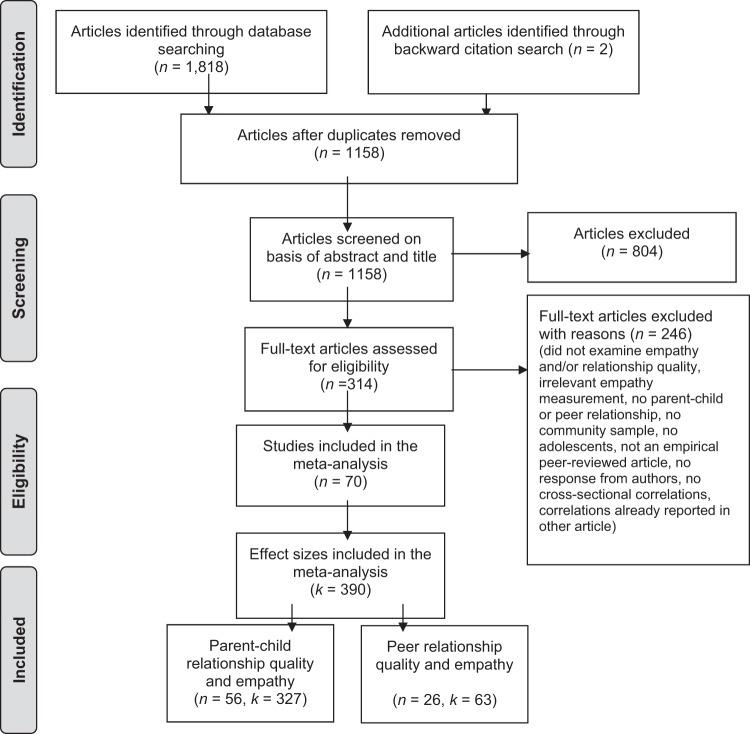
Empathy, which is the ability to feel concern for and to understand others' feelings, is thought to develop in high quality relationships with parent and peers, but also to facilitate the quality of these relationships. While a wide literature has addressed this aspect, the heterogeneity of primary studies, in which different indicators of relationship quality (e.g., support, conflict) and empathy (i.e., affective and cognitive) have been examined, makes it difficult to draw conclusive answers. Therefore, it remained ambiguous how parent-child and peer relationship quality are associated with adolescents' empathy. In order to increase the understanding of these associations, a multilevel meta-analysis was performed, which allowed for including multiple effect sizes from each study. By a systematic literate search, 70 eligible studies were found that provided 390 effect sizes from 75 independent samples. The results showed a small positive correlation between parent-child relationship quality and empathy, and a small-to-moderate positive correlation between peer relationship quality and empathy, which was significantly stronger than the correlation with parent-child relationship quality. Hence, the meta-analytic results indicate that adolescents with higher quality relationships, especially with peers, indeed tend to show more concern for and understanding of others' emotions than adolescents with lower quality relationships. Moreover, the moderation analyses showed stronger correlations for the positive dimension of relationship quality than for the negative dimension, and stronger correlations for composite scores of affective and cognitive empathy than for separate scores of the empathy dimensions. However, no differences in correlations were found between the affective and cognitive empathy dimension, and no moderation effects were found for gender and age. Thus, this meta-analysis demonstrates robust positive associations between parent-child and peer relationship quality and empathy in adolescence, implying that good empathic abilities may be a protective factor for experiencing poor relationships.
Overview
The claims and statistics of this paper haven’t been checked yet.
Run the check — free, no account needed. It reads the open-access text and checks the sources it cites.
Integrity signals
Registry
Cites
Statistics
Figures
Verification
Claims the paper makes
The claims and statistics of this paper haven’t been checked yet.
Run the check — free, no account needed. It reads the open-access text and checks the sources it cites.
Claims other papers make about this one
Each is checked against this paper’s own text: does it say what the citing paper says it does?
The source backs part of the claim, not all of it — or backs it for a different population, condition or comparison.
In the citing paper
“Previous empirical studies also found that the cognitive and affective dimensions of empathy exerted different effects on various positive and negative behaviors. Generally, cognitive empathy had closer ties to other variables [45,46].”
From The Relationship between Empathy and Attachment in Children and Adolescents: Three-Level Meta-Analyses. (2022) · cites this paper as [46]
Experimental — accuracy not yet measured
Self-check
Percentages, sums and reported differences re-computed from the paper’s own numbers.
The self-check needs the paper’s full text.
Citations
Cites
R: A Language and Environment for Statistical Computing
R Core Team (2000) · doi:10.32614/r.manuals · Cited by 355,893
Bias in meta-analysis detected by a simple, graphical test
Egger, M., Smith, G. D., Schneider, M., & Minder, C. (1997) · BMJ · doi:10.1136/bmj.315.7109.629 · Cited by 56,722
Conducting Meta-Analyses in R with the metafor Package
Viechtbauer, W. (2010) · Journal of Statistical Software · doi:10.18637/jss.v036.i03 · Cited by 20,464
Duval, S., & Tweedie, R. (2000) · Biometrics · doi:10.1111/j.0006-341x.2000.00455.x · Cited by 14,099
Measuring individual differences in empathy: Evidence for a multidimensional approach.
Davis, M. H. (1983) · Journal of Personality and Social Psychology · doi:10.1037/0022-3514.44.1.113 · Cited by 10,272
Borenstein, M., Hedges, L. V., Higgins, J. P. T., & Rothstein, H. R. (2021) · doi:10.1002/9781119558378 · Cited by 9,799
The file drawer problem and tolerance for null results.
Rosenthal, R. (1979) · Psychological Bulletin · doi:10.1037/0033-2909.86.3.638 · Cited by 9,068 · cited 1×
“In addition to the funnel plots, the statistic Rosen-thal ’ s Fail-safe N was calculated, which indicates how many missing studies would be required in order to fi nd a non-signi fi cant ( p > 0.05) correlation (Borenstein et al. 2011; Rosenthal 1979).”
InfluentialCohen, J. (1992) · Psychological Bulletin · doi:10.1037//0033-2909.112.1.155 · Cited by 8,771
The Moral Judgment Of The Child
Piaget, J. (2013) · Routledge eBooks · doi:10.4324/9781315009681 · Cited by 4,409
Gender schema theory: A cognitive account of sex typing.
Bem, S. L. (1981) · Psychological Review · doi:10.1037/0033-295x.88.4.354 · Cited by 4,408
Research works printed but not linked: 1
- *Humfress, H., O’Connor, T. G., Slaughter, J., Target, M., & Fonagy, P. (2002). General and relationship–specific models of social cognition: Explaining the overlap and discrepancies. Journal of Child Psychology and Psychiatry, 43, 873–883. · DOI
Cited by
Sorted by citations
Adolescent–Parent Relationships: Progress, Processes, and Prospects
Smetana, J. G., & Rote, W. M. (2019) · Annual Review of Developmental Psychology · doi:10.1146/annurev-devpsych-121318-084903 · Cited by 263
Shao, Y., & Kang, S. (2022) · Frontiers in Psychology · doi:10.3389/fpsyg.2022.938756 · Cited by 124
Conduct Disorders and Empathy Development
Frick, P. J., & Kemp, E. C. (2020) · Annual Review of Clinical Psychology · doi:10.1146/annurev-clinpsy-081219-105809 · Cited by 133
Is empathy associated with more prosocial behaviour? A meta‐analysis
Yin, Y., & Wang, Y. (2022) · Asian Journal Of Social Psychology · doi:10.1111/ajsp.12537 · Cited by 140
Longitudinal Research on Perspective Taking in Adolescence: A Systematic Review
Hall, H. K., Millear, P. M. R., Summers, M. J., & Isbel, B. (2021) · Adolescent Research Review · doi:10.1007/s40894-021-00150-9 · Cited by 62
Musitu-Ferrer, D., León-Moreno, C., Callejas-Jerónimo, J. E., Ibáñez, M. E., & Ochoa, G. M. (2019) · International Journal of Environmental Research and Public Health · doi:10.3390/ijerph16142461 · Cited by 58
Current understanding of developmental changes in adolescent perspective taking
Hollarek, M., & Lee, N. C. (2022) · Current Opinion in Psychology · doi:10.1016/j.copsyc.2022.101308 · Cited by 55
The Association between Interparental Conflict and Youth Anxiety: A Three-level Meta-analysis
Ran, G., Niu, X., Zhang, Q., Li, S., Liu, J., Chen, X., & Wu, J. (2021) · Journal of Youth and Adolescence · doi:10.1007/s10964-020-01388-7 · Cited by 61
Zhu, X., Deng, C., & Bai, W. (2023) · Frontiers in Public Health · doi:10.3389/fpubh.2023.1190534 · Cited by 49
Ratliff, E. L., Morris, A., Cui, L.-X., Jespersen, J. E., Silk, J., & Criss, M. M. (2023) · Frontiers in Psychology · doi:10.3389/fpsyg.2023.1193449 · Cited by 52
Ecosocialization – an Ecological Turn in the Process of Socialization
Keto, S., & Foster, R. (2020) · International Studies in Sociology of Education · doi:10.1080/09620214.2020.1854826 · Cited by 72
Fuentes, M. C., García, Ó. F., Alcaide, M., Garcia-Ros, R., & Pérez, J. F. G. (2022) · Frontiers in Psychology · doi:10.3389/fpsyg.2022.1060821 · Cited by 45
Trivedi‐Bateman, N., & Crook, E. L. (2021) · Psychology Crime and Law · doi:10.1080/1068316x.2021.1962870 · Cited by 43
Petersen, J. M., Zurita Ona, P., & Twohig, M. P. (2024) · Cognitive and Behavioral Practice · doi:10.1016/j.cbpra.2022.08.002 · Cited by 42
Xu, X., Liu, Z., Gong, S., & Wu, Y. (2022) · International Journal of Environmental Research and Public Health · doi:10.3390/ijerph19031391 · Cited by 39
“Furthermore, recent meta-analyses of correlation between empathy and parent–child–peer relationship also failed to identify the moderating effects of gender [46].”
BackgroundResultInfluentialCarrizales, A., Branje, S., & Lannegrand‐Willems, L. (2021) · Journal of Adolescence · doi:10.1016/j.adolescence.2021.10.006 · Cited by 37
Marzilli, E., Cerniglia, L., & Cimino, S. (2021) · Brain Sciences · doi:10.3390/brainsci11060687 · Cited by 41
Li, W., He, Q.-F., Lan, J., Attiq‐Ur‐Rehman, Ge, M., Shen, L.-T., Hu, F., Jia, Y.-J., & Chen, H. (2024) · Journal of Youth and Adolescence · doi:10.1007/s10964-024-02079-3 · Cited by 44
Álvarez-García, D., Castro, P. G., Núñez, J. C., Rodríguez, C., & Cerezo, R. (2019) · Frontiers in Psychology · doi:10.3389/fpsyg.2019.02071 · Cited by 35
Marini, A., Safitri, D., Lestari, I., Suntari, Y., Nuraini, S., Nafiah, M., Saipiatuddin, S., Arum, W. S. A., Sudrajat, A., & Iskandar, R. (2021) · International Journal of Interactive Mobile Technologies (iJIM) · doi:10.3991/ijim.v15i21.24959 · Cited by 35
Miklikowska, M., Tilton‐Weaver, L. C., & Burk, W. J. (2022) · Developmental Psychology · doi:10.1037/dev0001347 · Cited by 53
A meta-analytic review of the relations between anxiety and empathy
Nair, T. K., Waslin, S. M., Rodrigues, G. A., Datta, S., Moore, M., & Brumariu, L. E. (2023) · Journal of Anxiety Disorders · doi:10.1016/j.janxdis.2023.102795 · Cited by 38
Zhou, X., Huang, J. X., Qin, S., Tao, K., & Ning, Y. (2023) · Frontiers in Psychology · doi:10.3389/fpsyg.2023.1165830 · Cited by 44
Wachs, S., Castellanos, M., Wettstein, A., Bilz, L., & Gámez‐Guadix, M. (2022) · Journal of Interpersonal Violence · doi:10.1177/08862605221120905 · Cited by 46
The association between adult attachment and problematic Internet use: A three-level meta-analysis
Niu, X., Xie, Y., Gou, L.-X., King, D. L., Gu, J., & Wang, J. (2023) · Computers in Human Behavior · doi:10.1016/j.chb.2023.107957 · Cited by 30
The development of empathy in child maltreatment contexts
Berzenski, S. R., & Yates, T. M. (2022) · Child Abuse & Neglect · doi:10.1016/j.chiabu.2022.105827 · Cited by 38
Scharpf, F., Mkinga, G., Masath, F. B., & Hecker, T. (2020) · European Child & Adolescent Psychiatry · doi:10.1007/s00787-020-01649-7 · Cited by 34
Theory of Mind and Peer Attachment in Adolescence
Białecka‐Pikul, M., Stępień‐Nycz, M., Szpak, M., Grygiel, P., Bosacki, S., Devine, R. T., & Hughes, C. H. (2021) · Journal of Research on Adolescence · doi:10.1111/jora.12630 · Cited by 34
van Meegen, M., der Graaff, J. V., Carlo, G., Meeus, W., & Branje, S. (2024) · Journal of Youth and Adolescence · doi:10.1007/s10964-023-01885-5 · Cited by 25
Association between self-reported empathy and level of physical activity in healthy young adults
Shima, T., Jesmin, S., Nakao, H., Tai, K., Shimofure, T., Arai, Y., Kiyama, K., & Onizawa, Y. (2021) · The Journal of Physical Fitness and Sports Medicine · doi:10.7600/jpfsm.10.45 · Cited by 24
Heel, M. V., Bijttebier, P., Colpin, H., Goossens, L., Noortgate, W. V. D., Verschueren, K., & Leeuwen, K. G. V. (2020) · Journal of Adolescence · doi:10.1016/j.adolescence.2020.09.012 · Cited by 23
Linking attachment to empathy in childhood and adolescence: A multilevel meta-analysis
Li, S., Ran, G., & Chen, X. (2021) · Journal of Social and Personal Relationships · doi:10.1177/02654075211031006 · Cited by 23
Child maltreatment risk mediates the association between maternal and child empathy
Meidan, A., & Uzefovsky, F. (2020) · Child Abuse & Neglect · doi:10.1016/j.chiabu.2020.104523 · Cited by 23
Yang, X., Liao, T., Wang, Y., Ren, L., & Zeng, J. (2024) · Clinical Psychology Review · doi:10.1016/j.cpr.2024.102501 · Cited by 30
Fu, W., Xiao, Y., Cui, Y., & Zhou, T. (2022) · Frontiers in Psychology · doi:10.3389/fpsyg.2022.1034232 · Cited by 21
Empathy Trends in American Youth Between 1979 and 2018: An Update
Konrath, S., Martingano, A. J., Davis, M., & Breithaupt, F. A. (2023) · Social Psychological and Personality Science · doi:10.1177/19485506231218360 · Cited by 21
The Association between Parental Attachment and Youth Suicidal Ideation: A Three-Level Meta-analysis
Yang, H., Ran, G., Zhang, Q., & Niu, X. (2021) · Archives of Suicide Research · doi:10.1080/13811118.2021.2020192 · Cited by 26
The other side of the screen: The impact of perspective‐taking on adolescents’ online communication
Bowman‐Smith, C. K., Sosa‐Hernandez, L., & Nilsen, E. S. (2021) · Journal of Adolescence · doi:10.1016/j.adolescence.2021.08.006 · Cited by 26
Parental attachment and depression in adolescents: Moderation mediation model of empathy and gender
Chen, H., Meza, J. I., Yan, Y. X., Wu, Q., & Lin, X. (2021) · Current Psychology · doi:10.1007/s12144-021-01698-4 · Cited by 20
Skabeikytė‐Norkienė, G., Sharp, C., Kulesz, P. A., & Barkauskienė, R. (2022) · Borderline Personality Disorder and Emotion Dysregulation · doi:10.1186/s40479-022-00202-z · Cited by 20
Paciello, M., Corbelli, G., Pomponio, I. D., & Cerniglia, L. (2023) · Children · doi:10.3390/children10020219 · Cited by 24
Why Do They Do It? The Psychology Behind Antisocial Behavior in Children and Adolescents
Mazza, M., Lisci, F. M., Marzo, E. M., Masi, V. D., Abate, F., & Marano, G. (2025) · Pediatric Reports · doi:10.3390/pediatric17020026 · Cited by 25
Wang, W., Liu, J., Liu, Y., Wang, P., Guo, Z., Hong, D., & Jiang, S. (2022) · Current Psychology · doi:10.1007/s12144-022-03309-2 · Cited by 22
Cognitive flexibility as a protective factor for empathy
Cai, Z., & Qi, B. (2023) · Frontiers in Psychology · doi:10.3389/fpsyg.2022.1064494 · Cited by 19
Belizaire, S., Powers, M., & Mekawi, Y. (2023) · Family Process · doi:10.1111/famp.12951 · Cited by 17
Cao, X., & Chen, J. (2024) · Journal of Youth and Adolescence · doi:10.1007/s10964-024-02062-y · Cited by 29
Maximiano‐Barreto, M. A., Luchesi, B. M., de Moura, A. B., Pavarini, S. C. I., & Chagas, M. H. N. (2021) · Australian Journal on Ageing · doi:10.1111/ajag.12959 · Cited by 16
Martínez, Á. M., Jurado, M. D. M. M., Fuentes, M. D. C. P., Márquez, M. D. M. S., Martín, A. B. B., & Linares, J. J. G. (2021) · Psychology Research and Behavior Management · doi:10.2147/prbm.s313831 · Cited by 15
Deng, C., Gong, X., Liu, W., Huebner, E. S., & Tian, L. (2022) · Journal of Social and Personal Relationships · doi:10.1177/02654075221087618 · Cited by 18
Social network position, trust behavior, and neural activity in young adolescents
Sijtsma, H., van Buuren, M., Hollarek, M., Walsh, R. J., Lee, N. C., Braams, B. R., & Krabbendam, L. (2023) · NeuroImage · doi:10.1016/j.neuroimage.2023.119882 · Cited by 18
Associations between physical exercise and social-emotional competence in primary school children
Wang, P., Gao, X., Cui, X., & Shi, C. (2025) · Scientific Reports · doi:10.1038/s41598-025-02871-6 · Cited by 22
Chen‐Bouck, L., Patterson, M. M., Qiao, B., & Peng, A. (2021) · Journal of Adolescent Research · doi:10.1177/07435584211064209 · Cited by 19
Carrizales, A., Gülseven, Z., & Lannegrand‐Willems, L. (2022) · Journal of Social and Personal Relationships · doi:10.1177/02654075221099652 · Cited by 16
Wang, J., Wang, M., Du, X., Viana, K., Hou, K., & Zou, H. (2023) · Journal of Youth and Adolescence · doi:10.1007/s10964-023-01855-x · Cited by 10
Dearth‐Wesley, T., Herman, A. N., & Whitaker, R. C. (2023) · International Journal of Adolescence and Youth · doi:10.1080/02673843.2023.2254136 · Cited by 17
Li, X., Zhang, W., Ji, L., & Cao, Y. (2024) · Journal of Youth and Adolescence · doi:10.1007/s10964-024-02023-5 · Cited by 17
The parent–child relationship and child shame and guilt: A meta-analytic systematic review
van Eickels, R. L., Siegel, M., Juhasz, A. J., & Zemp, M. (2025) · Child Development · doi:10.1111/cdev.14212 · Cited by 14
Davis, A. N., Carlo, G., Maiya, S., Schwartz, S. J., Szapocznik, J., & Rosiers, S. E. D. (2021) · New Directions for Child and Adolescent Development · doi:10.1002/cad.20417 · Cited by 13
Jabar, M. A., Kasilag, R. M., Collado, Z. C., & Jamoral, R. (2021) · Asia Pacific Journal of Education · doi:10.1080/02188791.2021.1944841 · Cited by 26
Recognizing Ecosocialization in Childhood Memories
Foster, R., Zin, M., Keto, S., & Pulkki, J. M. (2022) · Educational Studies · doi:10.1080/00131946.2022.2051031 · Cited by 18
Association Between Children’s Empathy and Depression: The Moderating Role of Social Preference
Cui, D., Liu, L., & Li, Y. (2022) · Child Psychiatry & Human Development · doi:10.1007/s10578-021-01312-5 · Cited by 14
Lee, U., & Lee, Y. (2024) · Behavioral Sciences · doi:10.3390/bs14121212 · Cited by 10
Peer attachment in adolescence: What are the individual and relational associated factors?
Therriault, D., Lemelin, J., Toupin, J., & Déry, M. (2024) · Social Development · doi:10.1111/sode.12762 · Cited by 20
The effects of adapted physical education sessions on the empathy of female students with overweight
Slimi, O., Marsigliante, S., Ciardo, V., Bahloul, M., Selmi, O., Jebabli, N., & Muscella, A. (2023) · Frontiers in Psychology · doi:10.3389/fpsyg.2023.1170446 · Cited by 13
Eden, S., Heiman, T., Olenik‐Shemesh, D., & Yablon, Y. B. (2023) · Youth & Society · doi:10.1177/0044118x231169493 · Cited by 11
The impact of family environment, optimism, and empathy on students' creativity
Li, Z., & Li, Q. (2024) · Personality and Individual Differences · doi:10.1016/j.paid.2024.113019 · Cited by 11
Self-oriented affective empathy is associated with increased negative affect
Hülsemann, M., Kaurin, A., Kollmann, B., Chmitorz, A., Ahrens, K. F., Schenk, C., Plichta, M. M., Lutz, B., Basten, U., Fiebach, C. J., et al. (2025) · Scientific Reports · doi:10.1038/s41598-025-09860-9 · Cited by 10
Needs of Youth and Parents From Multi-Problem Families in the Search for Youth-Initiated Mentors
Koper, N., Creemers, H. E., van Dam, L., Stams, G. J. J. M., & Branje, S. (2021) · Youth & Society · doi:10.1177/0044118x211058217 · Cited by 9
Vaughan, E. P., Frick, P. J., Robertson, E., Ray, J. V., Thornton, L. C., Myers, T. D. W., Steinberg, L. D., & Cauffman, E. E. (2022) · Clinical Psychological Science · doi:10.1177/21677026221101070 · Cited by 9
Zhou, H. X., Tian, C., Hong, L., Fan, Z., & Chen, W. (2024) · The Journal of Genetic Psychology · doi:10.1080/00221325.2024.2413488 · Cited by 13
Qin, G., Xie, R., Wang, D., Wu, W., Wan, S., & Li, W. (2022) · Frontiers in Psychology · doi:10.3389/fpsyg.2022.883718 · Cited by 8
Wilson, K. J., Nguyen, T. H., & McKinney, C. (2023) · Current Psychology · doi:10.1007/s12144-023-04564-7 · Cited by 8
Yi, K., Wu, Y., Liu, Y., & Xu, Z. (2024) · SAGE Open · doi:10.1177/21582440241256339 · Cited by 8
Rodrigues, H., & Medina, J. C. (2021) · The British Journal of Criminology · doi:10.1093/bjc/azab004 · Cited by 8
Dubé, C., Morin, A. J. S., Tóth‐Király, I., Olivier, É., Tracey, D., McCune, V. S., Craven, R. G., & Maïano, C. (2022) · Journal of Autism and Developmental Disorders · doi:10.1007/s10803-022-05783-w · Cited by 7
Gifted and typically developing students' friendship quality: Does empathy make a difference?
Akgül, G., & Kaya, N. G. (2023) · Journal of Research in Special Educational Needs · doi:10.1111/1471-3802.12629 · Cited by 7
Fino, E., Kapllanaj, M., Crocetti, E., & Rubini, M. (2025) · Journal of Happiness Studies · doi:10.1007/s10902-024-00856-2 · Cited by 21
Wang, Y., Boele, S., Keijsers, L., & Hawk, S. T. (2025) · Journal of Adolescence · doi:10.1002/jad.12527 · Cited by 7
Shi, C., Wang, X., Tian, J., Cheng, L., Chen, J., & Wang, P. (2026) · Scientific Reports · doi:10.1038/s41598-025-33533-2 · Cited by 9
Parent and peer attachment in bullying experiences among pre-adolescents
Carter, M., van der Watt, R., & Esterhuyse, K. G. F. (2023) · Journal of Psychology in Africa · doi:10.1080/14330237.2023.2182948 · Cited by 7
Ji, X., Feng, N., & Cui, L. (2024) · Current Psychology · doi:10.1007/s12144-024-06109-y · Cited by 8
Ecosocial Care Ethics in and through Dance Education
Foster, R., & Ojanen, W. (2025) · Journal of Dance Education · doi:10.1080/15290824.2024.2423230 · Cited by 7
Becoming humane : The development of kindness in an age of division
Malti, T. (2026) · International Journal of Behavioral Development · doi:10.1177/01650254251344602 · Cited by 6
Wachs, S., Schittenhelm, C., Kops, M., & Wright, M. F. (2025) · Journal of Interpersonal Violence · doi:10.1177/08862605241308296 · Cited by 8
Wang, H., Zhang, Y., Ao, L., Huang, R., Meng, Y., Jia, S., Zhang, X., & Liu, Y. (2025) · Cerebral Cortex · doi:10.1093/cercor/bhae501 · Cited by 6
Haoliang, Z., Fu, H., Liu, H., Wang, B., & Zhong, X. (2025) · Behavioral Sciences · doi:10.3390/bs15070982 · Cited by 6
Family and peer influences on adolescent psychological inflexibility: a regression mixture analysis
Liu, L., Hu, X., Ma, M., Zhang, W., Peng, B., Zhang, B., & Luo, X. (2025) · Frontiers in Psychology · doi:10.3389/fpsyg.2025.1650930 · Cited by 6
Miguel, R. R., Sousa, R., Santos, L., Brazão, N., Rijo, D., Castilho, P., & Gilbert, P. (2022) · Child Abuse & Neglect · doi:10.1016/j.chiabu.2022.105690 · Cited by 8
Bechtiger, L., Steinhoff, A., Buchmann, M. C., & Shanahan, L. (2021) · Journal of Research on Adolescence · doi:10.1111/jora.12602 · Cited by 7
Zhang, R., Guo, Y., Bai, B., Wang, Y., Gao, L., & Cheng, L. (2022) · International Journal of Environmental Research and Public Health · doi:10.3390/ijerph19095630 · Cited by 6
Kong, M. G., & Lu, Y. (2023) · Children and Youth Services Review · doi:10.1016/j.childyouth.2023.107031 · Cited by 6
Espinoza, C. N., Goering, M., & Mrug, S. (2024) · Journal of Research on Adolescence · doi:10.1111/jora.12987 · Cited by 11
Almeida, T. C., Guarda, R., & Cunha, O. S. (2024) · Deviant Behavior · doi:10.1080/01639625.2024.2385924 · Cited by 6
Parental attachment and adolescent Internet morality: A moderated mediation model
Xiao, X., Zhan, Y., & Zhong, Y. (2020) · European Journal of Developmental Psychology · doi:10.1080/17405629.2020.1852922 · Cited by 7
Who Matters the Most? The Role of Parents, Teachers, and Peers’ Support in Adolescents’ Well-beingPreprint
Fino, E., Kapllanaj, M., Crocetti, E., & Rubini, M. (2023) · Preprints.org · doi:10.20944/preprints202306.1229.v1 · Cited by 6
Mauroy, A., Galdiolo, S., Meillerais, S., Verhofstadt, L., & Gaugue, J. (2025) · Personal Relationships · doi:10.1111/pere.70000 · Cited by 6
Marquis‐Brideau, C., Bernier, A., Cimon‐Paquet, C., & Sirois, M. (2022) · Social Development · doi:10.1111/sode.12644 · Cited by 7
Peng, Y., Zhao, L., Li, X., Long, Y., Xu, X., Zhang, H., & Jiang, L. (2024) · PubMed Central · doi:10.12182/20240160507 · Cited by 5
de Wied, M. A., der Graaff, J. V., de Rooij, G., Scheepers, F. E., Hoekstra, P. J., Branje, S., & van de Schoot, R. (2020) · Children and Youth Services Review · doi:10.1016/j.childyouth.2020.105301 · Cited by 6
Eisenhut, L., Bahmani, D. S., Ngo, V. T., Mikoteit, T., Brühl, A. B., Stadler, C., Dürsteler, K. M., Hatzinger, M., & Brand, S. (2023) · Journal of Clinical Medicine · doi:10.3390/jcm12062248 · Cited by 7
Metadata
- Authors
- Boele, S., Van der Graaff, J., de Wied, M., Van der Valk, I. E., Crocetti, E., & Branje, S.
- Affiliations
- Tilburg University (NL)
- University of Bologna (IT)
- Utrecht University (NL)
- Corresponding author
- Boele, Savannah
- Venue
- Journal of Youth and Adolescence
- Published
- 2019-02-27
- Volume
- 48
- Issue
- 6
- Pages
- 1033-1055
- ISSN
- 0047-2891 (ISSN-L)
- 1573-6601
- PMC
- PMC6525137
- OpenAlex
- W2920732182
- Cited by
- 216
- References
- 135
- Citations by year
- 2026: 25 · 2025: 42 · 2024: 41 · 2023: 37 · 2022: 33 · 2021: 25 · 2020: 8 · 2019: 4
- FWCI
- 2.77
- Type
- journal article
- Language
- en
- Open access
- hybrid
- doi.org
- Licence
- Locations
- Journal of Youth and Adolescence (publishedVersion, cc-by)
- Europe PMC (PubMed Central) (publishedVersion, cc-by)
- PubMed Central (publishedVersion, cc-by)
- PubMed (publishedVersion)
- Research portal (Tilburg University) (submittedVersion, other-oa)
- Data Archiving and Networked Services (DANS) (submittedVersion, other-oa)
- Archivio istituzionale della ricerca (Alma Mater Studiorum Università di Bologna) (submittedVersion, cc-by)
- Utrecht University Repository (Utrecht University) (submittedVersion, other-oa)
- Topics
- Social Sciences › Psychology › Clinical Psychology › Child and Adolescent Psychosocial and Emotional Development
- Social Sciences › Psychology › Social Psychology › Attachment and Relationship Dynamics
- Social Sciences › Psychology › Developmental and Educational Psychology › Child and Animal Learning Development
- Keywords
- empathy, parent-child relationship, peer relationships, relationship quality, affective empathy, cognitive empathy, adolescents, social support, relationship conflict, protective factors
- MeSH terms
- Adolescent, Psychology, Adolescent, Empathy, Humans, Interpersonal Relations, Parent-Child Relations, Peer Group, Models, Statistical
About these checks
Registry, retraction, Cites and statistics results are computed, not judged, with one exception: a printed reference that no index lists is read once by a model before it counts as a citation error. Claims are extracted by a model and kept only when their quote appears verbatim in the text; each cited source is then checked, with a model’s help, for whether it says what the claim relies on. Those verdicts can be wrong — read the claim’s quote and the cited source before relying on one.
Statistics and arithmetic are recomputed, not judged.
Confidence bands are shown only for fields calibrated on our annotated test set. None is calibrated yet, so no band is shown.
What counts as a claim ›How we measure confidence ›How we check this ›
Are you an author, or do you see a problem with this page? Request a review
