

The DOI matches its Crossref record; 133 of the 135 references it cites were found in a registry or an index.
Linking parent–child and peer relationship quality to empathy in adolescence: A multilevel meta–analysis
Open accessAbstract
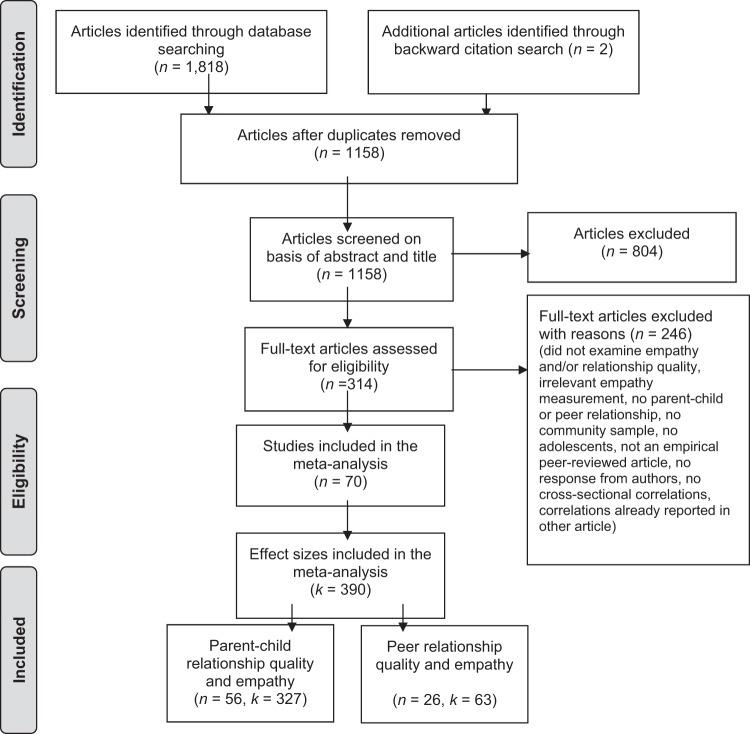
Empathy, which is the ability to feel concern for and to understand others' feelings, is thought to develop in high quality relationships with parent and peers, but also to facilitate the quality of these relationships. While a wide literature has addressed this aspect, the heterogeneity of primary studies, in which different indicators of relationship quality (e.g., support, conflict) and empathy (i.e., affective and cognitive) have been examined, makes it difficult to draw conclusive answers. Therefore, it remained ambiguous how parent-child and peer relationship quality are associated with adolescents' empathy. In order to increase the understanding of these associations, a multilevel meta-analysis was performed, which allowed for including multiple effect sizes from each study. By a systematic literate search, 70 eligible studies were found that provided 390 effect sizes from 75 independent samples. The results showed a small positive correlation between parent-child relationship quality and empathy, and a small-to-moderate positive correlation between peer relationship quality and empathy, which was significantly stronger than the correlation with parent-child relationship quality. Hence, the meta-analytic results indicate that adolescents with higher quality relationships, especially with peers, indeed tend to show more concern for and understanding of others' emotions than adolescents with lower quality relationships. Moreover, the moderation analyses showed stronger correlations for the positive dimension of relationship quality than for the negative dimension, and stronger correlations for composite scores of affective and cognitive empathy than for separate scores of the empathy dimensions. However, no differences in correlations were found between the affective and cognitive empathy dimension, and no moderation effects were found for gender and age. Thus, this meta-analysis demonstrates robust positive associations between parent-child and peer relationship quality and empathy in adolescence, implying that good empathic abilities may be a protective factor for experiencing poor relationships.
Overview
The claims and statistics of this paper haven’t been checked yet.
Run the check — free, no account needed. It reads the open-access text and checks the sources it cites.
Integrity signals
Registry
Cites
Statistics
Figures
Verification
Claims the paper makes
The claims and statistics of this paper haven’t been checked yet.
Run the check — free, no account needed. It reads the open-access text and checks the sources it cites.
Claims other papers make about this one
Each is checked against this paper’s own text: does it say what the citing paper says it does?
The source backs part of the claim, not all of it — or backs it for a different population, condition or comparison.
In the citing paper
“Previous empirical studies also found that the cognitive and affective dimensions of empathy exerted different effects on various positive and negative behaviors. Generally, cognitive empathy had closer ties to other variables [45,46].”
From The Relationship between Empathy and Attachment in Children and Adolescents: Three-Level Meta-Analyses. (2022) · cites this paper as [46]
Experimental — accuracy not yet measured
Self-check
Percentages, sums and reported differences re-computed from the paper’s own numbers.
The self-check needs the paper’s full text.
Citations
Cites
R: A Language and Environment for Statistical Computing
R Core Team (2000) · doi:10.32614/r.manuals · Cited by 355,893
Bias in meta-analysis detected by a simple, graphical test
Egger, M., Smith, G. D., Schneider, M., & Minder, C. (1997) · BMJ · doi:10.1136/bmj.315.7109.629 · Cited by 56,722
Conducting Meta-Analyses in R with the metafor Package
Viechtbauer, W. (2010) · Journal of Statistical Software · doi:10.18637/jss.v036.i03 · Cited by 20,464
Duval, S., & Tweedie, R. (2000) · Biometrics · doi:10.1111/j.0006-341x.2000.00455.x · Cited by 14,099
Measuring individual differences in empathy: Evidence for a multidimensional approach.
Davis, M. H. (1983) · Journal of Personality and Social Psychology · doi:10.1037/0022-3514.44.1.113 · Cited by 10,272
Borenstein, M., Hedges, L. V., Higgins, J. P. T., & Rothstein, H. R. (2021) · doi:10.1002/9781119558378 · Cited by 9,799
The file drawer problem and tolerance for null results.
Rosenthal, R. (1979) · Psychological Bulletin · doi:10.1037/0033-2909.86.3.638 · Cited by 9,068 · cited 1×
“In addition to the funnel plots, the statistic Rosen-thal ’ s Fail-safe N was calculated, which indicates how many missing studies would be required in order to fi nd a non-signi fi cant ( p > 0.05) correlation (Borenstein et al. 2011; Rosenthal 1979).”
InfluentialCohen, J. (1992) · Psychological Bulletin · doi:10.1037//0033-2909.112.1.155 · Cited by 8,771
The Moral Judgment Of The Child
Piaget, J. (2013) · Routledge eBooks · doi:10.4324/9781315009681 · Cited by 4,409
Gender schema theory: A cognitive account of sex typing.
Bem, S. L. (1981) · Psychological Review · doi:10.1037/0033-295x.88.4.354 · Cited by 4,408
Research works printed but not linked: 1
- *Humfress, H., O’Connor, T. G., Slaughter, J., Target, M., & Fonagy, P. (2002). General and relationship–specific models of social cognition: Explaining the overlap and discrepancies. Journal of Child Psychology and Psychiatry, 43, 873–883. · DOI
Cited by
Sorted by citations
Items 101–200 of 215
Rhodes, C. A., Wolchik, S. A., Uhlman, R. N., O’Hara, K. L., Sandler, I. N., Tein, J., & Porter, M. M. (2023) · Development and Psychopathology · doi:10.1017/s0954579423000925 · Cited by 7
Acceptance and Commitment Therapy for Adolescent Anxiety
Petersen, J. M., & Pimentel, S. S. (2024) · Current Treatment Options in Psychiatry · doi:10.1007/s40501-024-00335-8 · Cited by 4
“Improving perspective-taking and other self-as-con-text related skills has shown benefit for adolescent peer and familial relationships, along with reduced distress [16, 17].”
Rachman, Y. A., Sumarwan, U., Latifah, M., & Herawati, T. (2025) · Multidisciplinary Science Journal · doi:10.31893/multiscience.2025363 · Cited by 8
Itagaki, S., Takebayashi, Y., Murakami, M., Harigane, M., Maeda, M., Mizuki, R., Oikawa, Y., Goto, S., Momoi, M., Miura, I., et al. (2020) · Journal of Radiation Research · doi:10.1093/jrr/rraa126 · Cited by 4
Kozina, A., Veldin, M., Rožman, M., & Jugović, I. (2022) · Current Psychology · doi:10.1007/s12144-022-03480-6 · Cited by 4
Kindergarteners' peer relationships and early school absenteeism
Ansari, A., Yang, Q., Purtell, K. M., Lin, T., & Justice, L. M. (2023) · Journal of Applied Developmental Psychology · doi:10.1016/j.appdev.2023.101529 · Cited by 4
Beyazıt, U., AKKUŞ, S. Y., & Ayhan, A. B. (2023) · Theory and Practice in Child Development · doi:10.46303/tpicd.2023.14 · Cited by 4
Li, F., Cao, E. Y., & Ma, M. (2022) · International Journal of Early Childhood · doi:10.1007/s13158-021-00310-x · Cited by 4
Pereira, L. B., & Oliva, Â. D. (2023) · Current Psychology · doi:10.1007/s12144-022-04141-4 · Cited by 4
Familiäre Unterstützung als Schutzfaktor für Jugendliche während der COVID-19-Pandemie
van Eickels, R. L., Zemp, M., & Grütter, J. (2022) · Kindheit und Entwicklung · doi:10.1026/0942-5403/a000376 · Cited by 4
Stronger Empathy and Better Peer Relationship? One‐Year Cross‐Lagged Panel Analysis in Preschoolers
Zeng, X., Xiong, Y., Mo, K., Yang, M., Xie, B., & Yan, Z. (2024) · PsyCh Journal · doi:10.1002/pchj.815 · Cited by 10
Doba, K., Debbané, M., Auger, É., & Nandrino, J. (2025) · Journal of Affective Disorders · doi:10.1016/j.jad.2025.01.052 · Cited by 5
Wei, X., Li, X., Teng, X., Bai, J., & Ren, F. (2022) · The Journal of Psychology · doi:10.1080/00223980.2022.2134276 · Cited by 5
Spielvogel, B., Warner, R. P., Sibthorp, J., & Akiva, T. (2024) · Applied Developmental Science · doi:10.1080/10888691.2024.2363811 · Cited by 3
Du, Q., Roorda, D. L., Koomen, H. M. Y., Jak, S., & Zee, M. (2025) · Educational Research Review · doi:10.1016/j.edurev.2025.100688 · Cited by 4
Baş, G. (2025) · European Journal of Psychology of Education · doi:10.1007/s10212-025-00988-w · Cited by 6
Building empathy through a design thinking project: A case study with middle secondary schoolboys
Dawbin, B., Sherwen, M., Dean, S., Donnelly, S., & Cant, R. (2021) · FedUni ResearchOnline (Federation University Australia) · Cited by 3
Preparing LGBTQ youth for the high school to college transition: a multidimensional approach
Luh, H.-J., deLeyer-Tiarks, J. M., Wojcik, H., & Mandracchia, F. (2023) · International journal of LGBTQ+ youth studies. · doi:10.1080/19361653.2023.2264830 · Cited by 4
Wang, Z., Liang, J., & Chen, W. (2024) · Journal of Adult Development · doi:10.1007/s10804-024-09485-8 · Cited by 4
Longitudinal effects of father‐adolescent attachment on anxiety: A multi‐informant study
Vetterly, S., Dennis, S. H., Davies, P. T., & Cummings, E. M. (2024) · Social Development · doi:10.1111/sode.12774 · Cited by 2
Li, Q., Shen, X., Tu, Y., Zhou, Z., & Wang, J. (2025) · Journal of Youth and Adolescence · doi:10.1007/s10964-025-02170-3 · Cited by 3
A Cross-National Study on Prosocial Behaviors in Emerging Adulthood During the COVID-19 Pandemic
van Meegen, M., der Graaff, J. V., Branje, S., Padilla‐Walker, L. M., Carlo, G., Berger, C., Carrizales, A., Garandeau, C. F., Gerbino, M., Gülseven, Z., et al. (2025) · Emerging Adulthood · doi:10.1177/21676968251339685 · Cited by 2
Chen, Z., Gao, R., Li, J., Liu, Y., Lu, Y., & Chu, X. (2025) · Social Psychology of Education · doi:10.1007/s11218-025-10116-7 · Cited by 3
Adolescents' Mental Well‐Being and Social Support: Mixed Methods Study
Cilar, L., Štiglic, G., Barr, O. G., & Pajnkihar, M. (2025) · International Journal of Mental Health Nursing · doi:10.1111/inm.70195 · Cited by 2
Başay, Ö., EZBER, S. N., İNCİ, U. E., ÖZTÜRK, M., SOYUGÜZEL, M. O., & Başay, B. K. (2021) · Namık Kemal Tıp Dergisi · doi:10.4274/nkmj.galenos.2021.820118 · Cited by 2
Positive conflict resolution behaviors in psychological health: Northern Cyprus sample
Hatun, İ., & Serin, N. B. (2021) · International Journal of Public Health Science (IJPHS) · doi:10.11591/ijphs.v10i4.21007 · Cited by 2
Dubé, C., Morin, A. J. S., Olivier, É., Tóth‐Király, I., Tracey, D., Craven, R. G., & Maïano, C. (2022) · Journal of Autism and Developmental Disorders · doi:10.1007/s10803-022-05805-7 · Cited by 2
Jacobsen, S. L., Hart, S., Anderson-Ingstrup, J., & Gattino, G. (2024) · Frontiers in Psychology · doi:10.3389/fpsyg.2023.1296113 · Cited by 2
Li, P. (2024) · Interdisciplinary Humanities and Communication Studies · doi:10.61173/4bbwzq18 · Cited by 2
Davranış Sorunlarını Yordamada Ebeveyn Çocuk İlişkisi
Cesur, E., & Yurdakul, Y. (2024) · Gazi Üniversitesi Gazi Eğitim Fakültesi Dergisi · doi:10.17152/gefad.1355049 · Cited by 2
Chen, Z., Zou, H., Jiang, L., Chen, Y., Wu, J., Zhu, W., & Zhang, W. (2025) · Psychology in the Schools · doi:10.1002/pits.23497 · Cited by 2
Social Networking Site Use and Adolescents Empathic Skills: A Systematic Literature Review
Baumann, L., Spangenberger, P., Birkefeld, K., Dörre, M., Bollmacher, L., & Nebel, S. (2026) · Adolescent Research Review · doi:10.1007/s40894-025-00279-x · Cited by 3
Brooks, C., Helson, C., McCormack, M., Baur, L. A., Gill, T. P., Green, J. B., Billah, B., Cronin, P., Johar, A., Plaskett, J., et al. (2022) · BMC Public Health · doi:10.1186/s12889-022-13452-x · Cited by 2
DURLANIK, H. K., & Uzman, E. (2022) · Dicle Üniversitesi Ziya Gökalp Eğitim Fakültesi Dergisi · doi:10.14582/duzgef.2022.187 · Cited by 3
Covid-19 Kapanması Sırasında Ebeveyn Stresi ve Ebeveyn-Çocuk İlişkileri
Zorbaz, S. D., & KİYE, S. (2023) · Iğdır üniversitesi sosyal bilimler dergisi · doi:10.54600/igdirsosbilder.1250110 · Cited by 1
Leung, E., Onge-Shank, C. S., Holfeld, B. J., Brake, C., Poole, A., Konishi, C., & Craig, W. (2024) · Current Psychology · doi:10.1007/s12144-024-06129-8 · Cited by 3
Tong, J. S., Egdom, D. V., French, K. A., & Zhang, J. (2024) · Journal of Business and Psychology · doi:10.1007/s10869-024-09974-3 · Cited by 3
Mokmin, N. A. M., & Apandi, N. E. F. Z. (2024) · Interactive Learning Environments · doi:10.1080/10494820.2024.2434840 · Cited by 1
Xu, Y., Zhao, X., & Li, W. (2025) · The Journal of Genetic Psychology · doi:10.1080/00221325.2025.2484582 · Cited by 1
Understanding Acceptance and Commitment Therapy for Youth
Petersen, J. M. (2025) · Psychiatric Clinics of North America · doi:10.1016/j.psc.2025.02.012 · Cited by 1
Chen, X. (2025) · Psychology in the Schools · doi:10.1002/pits.70016 · Cited by 3
Luo, L., Guo, Y., Zhou, Y., & Li, C. (2025) · Journal of Applied Developmental Psychology · doi:10.1016/j.appdev.2025.101859 · Cited by 1
Kaya, E., & Cesur, E. (2025) · Buca eğitim fakültesi dergisi (Online)/Buca Eğitim Fakültesi dergisi · doi:10.53444/deubefd.1562323 · Cited by 1
Jin, C. J., Liu, Y., Yang, Y., Niu, J., Yu, J., Li, W., & Fan, C. (2025) · BMC Psychology · doi:10.1186/s40359-025-03663-3 · Cited by 2
Nested ecologies of childhood: A microbial turn in developmental theory
Millei, Z., Lee, N. M., Alminde, S., Breinholt, A., Grönroos, M., Hohti, R., Keto, S., Roslund, M. I., Spyrou, S., Tammi, T., et al. (2026) · Journal of Childhood Education & Society · doi:10.37291/2717638x.202671712 · Cited by 1
Carson, J. S., Jones, M. S., Gibbs, B. G., & Erickson, L. D. (2026) · Journal of Child and Family Studies · doi:10.1007/s10826-026-03265-6 · Cited by 1
Shodiq, S. F., & Makrufi, A. D. (2026) · International Journal of Adolescence and Youth · doi:10.1080/02673843.2026.2657347 · Cited by 1
Yin, L., Hu, Y., Zeng, Z., & Tan, R. (2026) · Journal of School Psychology · doi:10.1016/j.jsp.2026.101572 · Cited by 1
Chen, X., Khir, A. M., Yang, Y., & Wong, B. Y. (2026) · Acta Psychologica · doi:10.1016/j.actpsy.2026.107254 · Cited by 1
Jorgensen-Wells, M. A., James, S. L., Rogers, A. A., & Padilla‐Walker, L. M. (2022) · Journal of Family Studies · doi:10.1080/13229400.2022.2122534 · Cited by 1
Brown, S. M., Faw, M. H., Lucas‐Thompson, R. G., Pettigrew, J., & Quirk, K. M. (2023) · Adversity and Resilience Science · doi:10.1007/s42844-023-00093-1 · Cited by 1
(2023) · Journal of Social Science and Humanities · doi:10.53469/jssh.2023.5(05).03 · Cited by 1
Two-Wave Stability of Grandiose and Vulnerable Narcissism During Adolescence
Fontana, A., Cianfanelli, B., Verbaro, R., Cuzzocrea, G., Benzi, I. M. A., & Sideli, L. (2023) · The Journal of Nervous and Mental Disease · doi:10.1097/nmd.0000000000001687 · Cited by 2
Neves, A. P. B., Padama, A. M. D., Malgapu, M. G. S., Golosino, B. L. V., & Arcinas, M. M. (2023) · International Journal of Multidisciplinary Applied Business and Education Research · doi:10.11594/ijmaber.04.07.41 · Cited by 1
Jiang, X., Chen, X., Liang, B., & Liu, J. (2024) · Crime & Delinquency · doi:10.1177/00111287241276522 · Cited by 1
The Promise of Digital Wellness to Promote Youth Well-Being and Healthy Communities
Laffier, J., Rehman, A., & Westley, M. (2025) · IntechOpen eBooks · doi:10.5772/intechopen.1008817 · Cited by 1
“Empathy First!” – A Comparative Analysis of Parental and Adolescent Views on Parenting
Mandelkow, L. (2025) · Child & Youth Services · doi:10.1080/0145935x.2025.2481056 · Cited by 1
NICMOS Design Reference Mission and Ground System Volume Estimate
MacKenty, J. W., & Kutina, R. (1995) · Cited by 1
Social Selves and Social Others in Adolescent Development
Walsh, R. J. (2023) · doi:10.5463/thesis.360 · Cited by 2
Lee, N. C., & Pinkse-Schepers, A. L. (2024) · Elsevier eBooks · doi:10.1016/b978-0-323-96023-6.00121-4 · Cited by 2
Dent, E. (2019) · Brock University Digital Repository (Brock University)
Time to Get Social: Adaptive Social Processes in the Daily Lives of Youth (Full PhD thesis)Preprint
Achterhof, R. (2022) · PsyArXiv (OSF Preprints) · doi:10.31234/osf.io/knzms
Leong, O. N. R., & Liu, S. (2022) · Asian Social Work and Policy Review · doi:10.1111/aswp.12252
How social and personal resources support teaching and learning effectiveness
(2023) · Frontiers research topics · doi:10.3389/978-2-83251-636-2
Sijtsma, H. (2023) · doi:10.5463/thesis.49
Antisocial Personality Disorder: Psychological Dynamics of Inmates in Murder Cases
Widhigdo, J. C. (2023) · Psikostudia Jurnal Psikologi · doi:10.30872/psikostudia.v12i1.9739
Validating a brief Empathy Quotient Test with adolescents from Mexico
Ledesma-Amaya, L. I., Galindo-Aldana, G., Gálvez, V., Cruz, J. S., & Saldaña, R. M. E. G. (2023) · Behavioral Psychology/Psicología Conductual · doi:10.51668/bp.8323104n · Cited by 1
Better together: Supporting youth with mental health needs by utilizing the social network
Koper, N. (2023) · Utrecht University Repository (Utrecht University) · doi:10.33540/1736 · Cited by 1
Stermer, E. (2021) · Voices from the Middle · doi:10.58680/vm202131433
Goering, M., Espinoza, C. N., & Mrug, S. (2024) · Journal of Adolescence · doi:10.1002/jad.12292
الأداء الوالدي التأملي وأثره في تحسين جودة العلاقة بين الوالدين والأبناء(منظور نفسي)
خوج, ح. أ., & الجاسر, ا. ع. ا. م. (2024) · سياقات اللغة والدراسات البينية · doi:10.21608/siaqat.2024.279323.1031
Guo, K., & Guo, F. (2024) · Research Square · doi:10.21203/rs.3.rs-4216674/v1
Interpretation bias for ambiguous scenarios among individuals with high and low levels of empathy
Fang, Y., Xu, T., & Li, H. (2024) · Asian Journal Of Social Psychology · doi:10.1111/ajsp.12620
Adolescent dropouts’ functioning in relationships with parents and peers
Rzechowska, E. (2024) · Studia z Teorii Wychowania · doi:10.5604/01.3001.0054.7899
Empathy, emotional expression and peer relationship among Chinese college students
Xiao, H. (2024) · International Journal of Research Studies in Psychology · doi:10.5861/ijrsp.2024.039
Bastarache, A.-L., Marceau, E., St-Onge, J., Didier, O., & Terradas, M. M. (2024) · European Journal of Trauma & Dissociation · doi:10.1016/j.ejtd.2024.100483
Investigating the Factor Structure of the Japanese Version of the Interpersonal Reactivity Index
Himichi, T., Kawamura, Y., & Goto, T. (2024) · Japanese Psychological Research · doi:10.1111/jpr.12567
Orta Çocukluk Döneminde Empatik Eğilimin Arkadaşlık Niteliğini Yordayıcı Rolü
Yurdakul, Y. (2024) · İnönü Üniversitesi Eğitim Fakültesi Dergisi · doi:10.17679/inuefd.1476177
Kim, C., & Woo, C. H. (2024) · Journal of Korean Public Health Nursing · doi:10.5932/jkphn.2024.38.3.438
Apandi, N. E. F. Z., & Mokmin, N. A. M. (2024) · Lecture notes in educational technology · doi:10.1007/978-981-97-8752-4_2
An Integrative Approach to Moral DevelopmentDuring Adolescence
Baird, A. A., & Matthews, M. M. (2025) · Cambridge University Press eBooks · doi:10.1017/9781108894357.024
Origins, Development, and Variation
Malle, B., & Robbins, P. (2025) · Cambridge University Press eBooks · doi:10.1017/9781108894357.021
Espinoza, C. N., Goering, M., Dahlman, A. E., Patki, A., Tiwari, H. K., Richter, C. G., & Mrug, S. (2025) · Applied Psychology Health and Well-Being · doi:10.1111/aphw.70026
Differentiation of parents' moral cultivation in educating children in the South Sulawesi
Afiah, N. (2024) · Journal of Advanced Guidance and Counseling · doi:10.21580/jagc.2024.5.2.18092
Early childhood precursors of compassionate concern for others: a 17-year longitudinal study
Lee, S., Ip, K. I., Mahalingam, R., & Olson, S. L. (2025) · The Journal of Positive Psychology · doi:10.1080/17439760.2025.2498129
Examining Gender Differences in Children’s Reasoning About Empathy
Guerrero, M. J., Smith-Flores, A. S., & Powell, L. J. (2026) · Journal of Cognition and Development · doi:10.1080/15248372.2026.2667519
Niu, X., Gou, L.-X., Shen, X., & Wang, J.-L. (2025) · Early Education and Development · doi:10.1080/10409289.2025.2505831
Merritt, E. C. (2023) · Scholars Archive - University at Albany (University at Albany, State University of New York) · doi:10.54014/42h0-37w2
Impacts of Parent Separation Within Siblings: A Literature Review
Tello Hernandez, A. (2025) · doi:10.15760/honors.1717
Wang, Q., Qiao, Y., & Su, Y. (2025) · Behavioral Sciences · doi:10.3390/bs15070902 · Cited by 1
The role of impulsivity and sensation seeking in associations between empathy and crime
Schroll, D. M., Armstrong, T. A., Boisvert, D. L., Wells, J., Lewis, R. H., & Cooke, E. M. (2025) · Psychology Crime and Law · doi:10.1080/1068316x.2025.2549134
Valores y empatía como predictores de la calidad de la amistad en adolescentes de Argentina
Rodríguez, L. M., Resett, S. A., Mesurado, B., & Moreno, J. E. (2025) · European Journal of Education and Psychology · doi:10.32457/ejep.v18i1.2900
The Quality of Parent-Adolescent and Peer-Adolescent Relationships and Trust in Strangers
Sijtsma, H., van Buuren, M., Buczny, J., Hollarek, M., Walsh, R. J., Lee, N. C., & A, L. K. M. (2025) · The Journal of Early Adolescence · doi:10.1177/02724316251379489
Uma intervenção baseada na técnica indutiva para reduzir o bullying escolar entre crianças
Pires, M. F. D. N., & Sampaio, L. R. (2025) · Dedica · doi:10.30827/dreh.23.2025.34490
Gonta, M., Meiping, W., Tassew, M. D., & Shegaze, M. (2025) · Research Square · doi:10.21203/rs.3.rs-8033757/v1
Yaghoobi, A., Karimi, K., Mohammadi, S., & Yaghoobi, F. (2026) · The Educational and Developmental Psychologist · doi:10.1080/20590776.2025.2598465
Kumah, P. K., Baidoo, S. T., Yusif, H. M., & Tayviah, M. M. (2026) · Discover Psychology · doi:10.1007/s44202-026-00595-w · Cited by 1
van den Hanenberg, D. A. M., Schuiringa, H. D., Laceulle, O. M., van der Veld, W. M., Scholte, R. H. J., & van der Heijden, P. T. (2026) · Journal of Social and Clinical Psychology · doi:10.1521/jscp.2026.45.1.002
Metadata
- Authors
- Boele, S., Van der Graaff, J., de Wied, M., Van der Valk, I. E., Crocetti, E., & Branje, S.
- Affiliations
- Tilburg University (NL)
- University of Bologna (IT)
- Utrecht University (NL)
- Corresponding author
- Boele, Savannah
- Venue
- Journal of Youth and Adolescence
- Published
- 2019-02-27
- Volume
- 48
- Issue
- 6
- Pages
- 1033-1055
- ISSN
- 0047-2891 (ISSN-L)
- 1573-6601
- PMC
- PMC6525137
- OpenAlex
- W2920732182
- Cited by
- 216
- References
- 135
- Citations by year
- 2026: 25 · 2025: 42 · 2024: 41 · 2023: 37 · 2022: 33 · 2021: 25 · 2020: 8 · 2019: 4
- FWCI
- 2.77
- Type
- journal article
- Language
- en
- Open access
- hybrid
- doi.org
- Licence
- Locations
- Journal of Youth and Adolescence (publishedVersion, cc-by)
- Europe PMC (PubMed Central) (publishedVersion, cc-by)
- PubMed Central (publishedVersion, cc-by)
- PubMed (publishedVersion)
- Research portal (Tilburg University) (submittedVersion, other-oa)
- Data Archiving and Networked Services (DANS) (submittedVersion, other-oa)
- Archivio istituzionale della ricerca (Alma Mater Studiorum Università di Bologna) (submittedVersion, cc-by)
- Utrecht University Repository (Utrecht University) (submittedVersion, other-oa)
- Topics
- Social Sciences › Psychology › Clinical Psychology › Child and Adolescent Psychosocial and Emotional Development
- Social Sciences › Psychology › Social Psychology › Attachment and Relationship Dynamics
- Social Sciences › Psychology › Developmental and Educational Psychology › Child and Animal Learning Development
- Keywords
- empathy, parent-child relationship, peer relationships, relationship quality, affective empathy, cognitive empathy, adolescents, social support, relationship conflict, protective factors
- MeSH terms
- Adolescent, Psychology, Adolescent, Empathy, Humans, Interpersonal Relations, Parent-Child Relations, Peer Group, Models, Statistical
About these checks
Registry, retraction, Cites and statistics results are computed, not judged, with one exception: a printed reference that no index lists is read once by a model before it counts as a citation error. Claims are extracted by a model and kept only when their quote appears verbatim in the text; each cited source is then checked, with a model’s help, for whether it says what the claim relies on. Those verdicts can be wrong — read the claim’s quote and the cited source before relying on one.
Statistics and arithmetic are recomputed, not judged.
Confidence bands are shown only for fields calibrated on our annotated test set. None is calibrated yet, so no band is shown.
What counts as a claim ›How we measure confidence ›How we check this ›
Are you an author, or do you see a problem with this page? Request a review
