

The DOI matches its Crossref record; 133 of the 135 references it cites were found in a registry or an index.
Linking parent–child and peer relationship quality to empathy in adolescence: A multilevel meta–analysis
Open accessAbstract
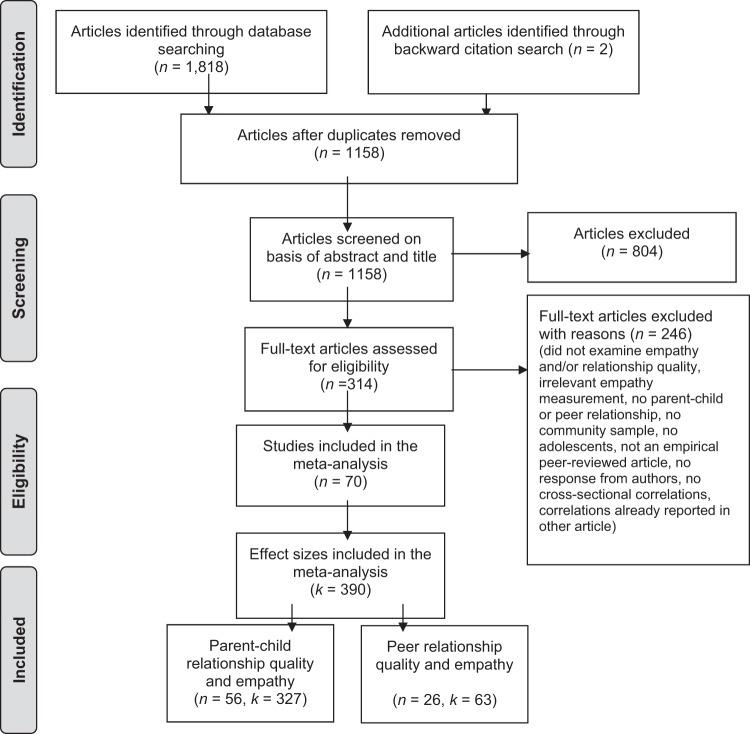
Empathy, which is the ability to feel concern for and to understand others' feelings, is thought to develop in high quality relationships with parent and peers, but also to facilitate the quality of these relationships. While a wide literature has addressed this aspect, the heterogeneity of primary studies, in which different indicators of relationship quality (e.g., support, conflict) and empathy (i.e., affective and cognitive) have been examined, makes it difficult to draw conclusive answers. Therefore, it remained ambiguous how parent-child and peer relationship quality are associated with adolescents' empathy. In order to increase the understanding of these associations, a multilevel meta-analysis was performed, which allowed for including multiple effect sizes from each study. By a systematic literate search, 70 eligible studies were found that provided 390 effect sizes from 75 independent samples. The results showed a small positive correlation between parent-child relationship quality and empathy, and a small-to-moderate positive correlation between peer relationship quality and empathy, which was significantly stronger than the correlation with parent-child relationship quality. Hence, the meta-analytic results indicate that adolescents with higher quality relationships, especially with peers, indeed tend to show more concern for and understanding of others' emotions than adolescents with lower quality relationships. Moreover, the moderation analyses showed stronger correlations for the positive dimension of relationship quality than for the negative dimension, and stronger correlations for composite scores of affective and cognitive empathy than for separate scores of the empathy dimensions. However, no differences in correlations were found between the affective and cognitive empathy dimension, and no moderation effects were found for gender and age. Thus, this meta-analysis demonstrates robust positive associations between parent-child and peer relationship quality and empathy in adolescence, implying that good empathic abilities may be a protective factor for experiencing poor relationships.
Overview
The claims and statistics of this paper haven’t been checked yet.
Run the check — free, no account needed. It reads the open-access text and checks the sources it cites.
Integrity signals
Registry
Cites
Statistics
Figures
Verification
Claims the paper makes
The claims and statistics of this paper haven’t been checked yet.
Run the check — free, no account needed. It reads the open-access text and checks the sources it cites.
Claims other papers make about this one
Each is checked against this paper’s own text: does it say what the citing paper says it does?
The source backs part of the claim, not all of it — or backs it for a different population, condition or comparison.
In the citing paper
“Previous empirical studies also found that the cognitive and affective dimensions of empathy exerted different effects on various positive and negative behaviors. Generally, cognitive empathy had closer ties to other variables [45,46].”
From The Relationship between Empathy and Attachment in Children and Adolescents: Three-Level Meta-Analyses. (2022) · cites this paper as [46]
Experimental — accuracy not yet measured
Self-check
Percentages, sums and reported differences re-computed from the paper’s own numbers.
The self-check needs the paper’s full text.
Citations
Cites
R: A Language and Environment for Statistical Computing
R Core Team (2000) · doi:10.32614/r.manuals · Cited by 355,893
Bias in meta-analysis detected by a simple, graphical test
Egger, M., Smith, G. D., Schneider, M., & Minder, C. (1997) · BMJ · doi:10.1136/bmj.315.7109.629 · Cited by 56,722
Conducting Meta-Analyses in R with the metafor Package
Viechtbauer, W. (2010) · Journal of Statistical Software · doi:10.18637/jss.v036.i03 · Cited by 20,464
Duval, S., & Tweedie, R. (2000) · Biometrics · doi:10.1111/j.0006-341x.2000.00455.x · Cited by 14,099
Measuring individual differences in empathy: Evidence for a multidimensional approach.
Davis, M. H. (1983) · Journal of Personality and Social Psychology · doi:10.1037/0022-3514.44.1.113 · Cited by 10,272
Borenstein, M., Hedges, L. V., Higgins, J. P. T., & Rothstein, H. R. (2021) · doi:10.1002/9781119558378 · Cited by 9,799
The file drawer problem and tolerance for null results.
Rosenthal, R. (1979) · Psychological Bulletin · doi:10.1037/0033-2909.86.3.638 · Cited by 9,068 · cited 1×
“In addition to the funnel plots, the statistic Rosen-thal ’ s Fail-safe N was calculated, which indicates how many missing studies would be required in order to fi nd a non-signi fi cant ( p > 0.05) correlation (Borenstein et al. 2011; Rosenthal 1979).”
InfluentialCohen, J. (1992) · Psychological Bulletin · doi:10.1037//0033-2909.112.1.155 · Cited by 8,771
The Moral Judgment Of The Child
Piaget, J. (2013) · Routledge eBooks · doi:10.4324/9781315009681 · Cited by 4,409
Gender schema theory: A cognitive account of sex typing.
Bem, S. L. (1981) · Psychological Review · doi:10.1037/0033-295x.88.4.354 · Cited by 4,408
Lewis, M., Haviland, J. M., & Barrett, L. F. (1993) · Contemporary Sociology A Journal of Reviews · doi:10.2307/2076468 · Cited by 3,944
The Role of the Family Context in the Development of Emotion Regulation
Morris, A. S., Silk, J. S., Steinberg, L. D., Myers, S. S., & Robinson, L. R. (2007) · Social Development · doi:10.1111/j.1467-9507.2007.00389.x · Cited by 3,530
The functional architecture of human empathy
Decety, J., & Jackson, P. L. (2004) · Behavioral and Cognitive Neuroscience Reviews · doi:10.1177/1534582304267187 · Cited by 3,407
Rose, A. J., & Rudolph, K. D. (2006) · Psychological Bulletin · doi:10.1037/0033-2909.132.1.98 · Cited by 2,517
Handbook of research methods for studying daily life
Mehl, M. R., Conner, T. S., & Csíkszentmihályi, M. (2012) · Choice Reviews Online · doi:10.5860/choice.50-1159 · Cited by 2,121
Age and Sex Differences in Perceptions of Networks of Personal Relationships
Furman, W. C., & Buhrmester, D. (1992) · Child Development · doi:10.1111/j.1467-8624.1992.tb03599.x · Cited by 2,096
Eisenberg, N., & Strayer, J. (1987) · Cited by 1,708
Development and validation of the Basic Empathy Scale
Jolliffe, D., & Farrington, D. P. (2005) · Journal of Adolescence · doi:10.1016/j.adolescence.2005.08.010 · Cited by 1,625
The Company they keep: friendship in childhood and adolescence
(1996) · Choice Reviews Online · doi:10.5860/choice.34-1227 · Cited by 1,351
Cheung, M. W.-L. (2014) · Psychological Methods · doi:10.1037/a0032968 · Cited by 1,342
Fitting three-level meta-analytic models in R: A step-by-step tutorial
Assink, M., & Wibbelink, C. J. M. (2016) · The Quantitative Methods for Psychology · doi:10.20982/tqmp.12.3.p154 · Cited by 1,330
Adolescent Development in Interpersonal and Societal Contexts
Smetana, J. G., Campione-Barr, N., & Metzger, A. (2006) · Annual Review of Psychology · doi:10.1146/annurev.psych.57.102904.190124 · Cited by 1,264
Adolescent Relations with Mothers, Fathers, and Friends.
Dager, E. Z., Youniss, J., & Smollar, J. (1986) · Contemporary Sociology A Journal of Reviews · doi:10.2307/2069267 · Cited by 1,213
Co–Rumination in the Friendships of Girls and Boys
Rose, A. J. (2002) · Child Development · doi:10.1111/1467-8624.00509 · Cited by 1,172
Writing meta-analytic reviews.
Rosenthal, R. (1995) · Psychological Bulletin · doi:10.1037/0033-2909.118.2.183 · Cited by 1,108
The growth of interpersonal understanding : developmental and clinical analyses
Selman, R. L. (1980) · Medical Entomology and Zoology · Cited by 1,089
Daily Companionship in Late Childhood and Early Adolescence: Changing Developmental Contexts
Larson, R. W., & Richards, M. H. (1991) · Child Development · doi:10.1111/j.1467-8624.1991.tb01531.x · Cited by 1,055
Parenting Stress, Mental Health, Dyadic Adjustment: A Structural Equation Model
Rollè, L., Prino, L. E., Sechi, C., Vismara, L., Neri, E., Polizzi, C., Trovato, A., Volpi, B., Molgora, S., Fenaroli, V., et al. (2017) · Frontiers in Psychology · doi:10.3389/fpsyg.2017.00839 · Cited by 1,047
Daily Companionship in Late Childhood and Early Adolescence: Changing Developmental Contexts
Larson, R., & Richards, M. H. (1991) · Child Development · doi:10.2307/1131003 · Cited by 992
Children's Time With Fathers in Intact Families
Yeung, W. J., Sandberg, J., Davis-Kean, P. E., & Hofferth, S. L. (2001) · Journal of Marriage and the Family · doi:10.1111/j.1741-3737.2001.00136.x · Cited by 975
Empathy: Conceptualization, measurement, and relation to prosocial behavior
Eisenberg, N., & Fabes, R. A. (1990) · Motivation and Emotion · doi:10.1007/bf00991640 · Cited by 947
Larson, R. W., Richards, M. H., Moneta, G. B., Holmbeck, G. N., & Duckett, E. (1996) · Developmental Psychology · doi:10.1037/0012-1649.32.4.744 · Cited by 898
The Development of Companionship and Intimacy
Buhrmester, D., & Furman, W. C. (1987) · Child Development · doi:10.1111/j.1467-8624.1987.tb01444.x · Cited by 778
(2013) · Psychology Press eBooks · doi:10.4324/9780203581957 · Cited by 752
Attachment and Loss, Volume I: Attachment
Giddens, A., & Bowlby, J. (1970) · British Journal of Sociology · doi:10.2307/588279 · Cited by 745
Eisenberg, N., Eggum, N. D., & Giunta, L. D. (2010) · Social Issues and Policy Review · doi:10.1111/j.1751-2409.2010.01020.x · Cited by 714
Perspective taking and empathic concern in adolescence: Gender differences in developmental changes.
der Graaff, J. V., Branje, S., de Wied, M. A., Hawk, S. T., van Lier, P. A. C., & Meeus, W. (2013) · Developmental Psychology · doi:10.1037/a0034325 · Cited by 671
Adolescent Relations with Mothers, Fathers, and Friends
Walters, J., Youniss, J., & Smollar, J. (1986) · Journal of Marriage and the Family · doi:10.2307/352416 · Cited by 660
Prosocial Behavior in Adolescence: Gender Differences in Development and Links with Empathy
der Graaff, J. V., Carlo, G., Crocetti, E., Koot, H. M., & Branje, S. (2017) · Journal of Youth and Adolescence · doi:10.1007/s10964-017-0786-1 · Cited by 651
The differential relations of parent and peer attachment to adolescent adjustment
Laible, D. J., Carlo, G., & Raffaelli, M. (2000) · Journal of Youth and Adolescence · doi:10.1023/a:1005169004882 · Cited by 600
Laible, D., Carlo, G., & Roesch, S. C. (2004) · Journal of Adolescence · doi:10.1016/j.adolescence.2004.05.005 · Cited by 543
Zhou, Q., Eisenberg, N., Losoya, S. H., Fabes, R. A., Reiser, M., Guthrie, I. K., Murphy, B. C., Cumberland, A. J., & Shepard, S. A. (2002) · Child Development · doi:10.1111/1467-8624.00446 · Cited by 513
Developmental changes in adolescents’ perceptions of relationships with their parents
De Goede, I. H. A., Branje, S. J. T., & Meeus, W. H. J. (2009) · Journal of Youth and Adolescence · doi:10.1007/s10964-008-9286-7 · Cited by 502
Self-citationWhy researchers should think "within-person": A paradigmatic rationale.
Hamaker, E. L. (2012) · Cited by 472
Meta-analysis of multiple outcomes: a multilevel approach
Van den Noortgate, W., López-López, J. A., Marín-Martínez, F., & Sánchez-Meca, J. (2015) · Behavior Research Methods · doi:10.3758/s13428-014-0527-2 · Cited by 450
Parents and Peers in Social Development: A Sullivan-Piaget Perspective
Youniss, J. (1980) · Medical Entomology and Zoology · Cited by 440
The measurement of friendship perceptions: Conceptual and methodological issues.
Furman, W. C. (1996) · Cited by 327
Empathy and prosocial behavior.
Hoffman, M. L. (2008) · Cited by 324
Empathy and conflict resolution in friendship relations among adolescents.
de Wied, M., Branje, S., & Meeus, W. (2007) · Aggressive Behavior · doi:10.1002/ab.20166 · Cited by 319
Attachment and empathy as predictors of roles as defenders or outsiders in bullying interactions
Nickerson, A. B., Mele, D., & Princiotta, D. K. (2008) · Journal of School Psychology · doi:10.1016/j.jsp.2008.06.002 · Cited by 314
Eisenberg, N., Zhou, Q., & Koller, S. H. (2001) · Child Development · doi:10.1111/1467-8624.00294 · Cited by 306
Carlo, G., Mestre, M. V., García, P. S., Porcar, A. M. T., & Armenta, B. E. (2010) · International Journal of Behavioral Development · doi:10.1177/0165025410375921 · Cited by 306
Smith, R. L., & Rose, A. J. (2011) · Developmental Psychology · doi:10.1037/a0025309 · Cited by 270
Laible, D. (2007) · Personality and Individual Differences · doi:10.1016/j.paid.2007.03.010 · Cited by 267
Laible, D., & Carlo, G. (2004) · Journal of Adolescent Research · doi:10.1177/0743558403260094 · Cited by 245
The Socialization of Prosocial Development.
Hastings, P. D., Utendale, W. T., & Sullivan, C. (2007) · Cited by 242
Parenting Styles or Practices? Parenting, Sympathy, and Prosocial Behaviors Among Adolescents
Carlo, G., McGinley, M. M., Hayes, R., Batenhorst, C., & Wilkinson, J. (2007) · The Journal of Genetic Psychology · doi:10.3200/gntp.168.2.147-176 · Cited by 225
A Developmental Guide to the Organisation of Close Relationships
Laursen, B. P., & Bukowski, W. M. (1997) · International Journal of Behavioral Development · doi:10.1080/016502597384659 · Cited by 220
Sibling Relationships and Empathy Across the Transition to Adolescence
Lam, C. B., Solmeyer, A. R., & McHale, S. M. (2012) · Journal of Youth and Adolescence · doi:10.1007/s10964-012-9781-8 · Cited by 198
Chow, C. M., Ruhl, H., & Buhrmester, D. (2012) · Journal of Adolescence · doi:10.1016/j.adolescence.2012.10.004 · Cited by 192
Soenens, B., Duriez, B., Vansteenkiste, M., & Goossens, L. (2007) · Personality and Social Psychology Bulletin · doi:10.1177/0146167206296300 · Cited by 180
van der Mark, I. L., van IJzendoorn, M. H., & Bakermans‐Kranenburg, M. J. (2002) · Social Development · doi:10.1111/1467-9507.00210 · Cited by 176
Developmental changes and gender differences in adolescents' perceptions of friendships
De Goede, I. H. A., Branje, S. J. T., & Meeus, W. H. J. (2009) · Journal of Adolescence · doi:10.1016/j.adolescence.2009.03.002 · Cited by 166
Self-citationCarlo, G., Raffaelli, M., Laible, D., & Meyer, K. A. (1999) · Sex Roles · doi:10.1023/a:1018856601513 · Cited by 157
The role of gender in the socialization of emotion: Key concepts and critical issues
Root, A. K., & Denham, S. A. (2010) · New Directions for Child and Adolescent Development · doi:10.1002/cd.265 · Cited by 155
Communication and Understanding in Parent-Adolescent Relationships
SILLARS, A. L., Koerner, A. F., & Fitzpatrick, M. A. (2005) · Human Communication Research · doi:10.1093/hcr/31.1.102 · Cited by 153
Carlo, G., Roesch, S. C., & Melby, J. (1998) · The Journal of Early Adolescence · doi:10.1177/0272431698018003003 · Cited by 143
Miklikowska, M., Duriez, B., & Soenens, B. (2011) · Developmental Psychology · doi:10.1037/a0024726 · Cited by 142
Batanova, M., & Loukas, A. (2011) · Journal of Youth and Adolescence · doi:10.1007/s10964-011-9634-x · Cited by 141
Estévez, E., Jiménez, T. I., & Ruiz, D. M. (2018) · Psicothema · doi:10.7334/psicothema2016.294 · Cited by 137
Empathy and related responses in children.
Barnett, M. A. (1987) · Cited by 134
Associations Between Friendship, Sympathy, and Prosocial Behavior Toward Friends
Padilla‐Walker, L. M., Fraser, A. M., Black, B. C., & Bean, R. A. (2014) · Journal of Research on Adolescence · doi:10.1111/jora.12108 · Cited by 132
Overgaauw, S., Rieffe, C. J., Broekhof, E., Crone, E. A., & Güroğlu, B. (2017) · Frontiers in Psychology · doi:10.3389/fpsyg.2017.00870 · Cited by 132
Early Adolescent Empathy, Parental Support, and Antisocial Behavior
de Kemp, R. A. T., Overbeek, G. J., de Wied, M. A., Engels, R. C. M. E., & Scholte, R. H. J. (2007) · The Journal of Genetic Psychology · doi:10.3200/gntp.168.1.5-18 · Cited by 125
Matrix product ansatz for Fermi fields in one dimension
Chung, S. S., Sun, K., & Bolech, C. J. (2015) · Physical Review B · doi:10.1103/physrevb.91.121108 · Cited by 118
Systematic Reviews With Meta-Analysis
Crocetti, E. (2015) · Emerging Adulthood · doi:10.1177/2167696815617076 · Cited by 117
Attachment Representations and Time Perspective in Adolescence
Laghi, F., D’Alessio, M., Pallini, S., & Baiocco, R. (2008) · Social Indicators Research · doi:10.1007/s11205-008-9249-0 · Cited by 96
Reyes, A. D. L., Lerner, M. D., Thomas, S. A., Daruwala, S. E., & Goepel, K. (2013) · Research on Child and Adolescent Psychopathology · doi:10.1007/s10802-013-9733-0 · Cited by 95
Meuwese, R., Cillessen, A. H. N., & Güroğlu, B. (2017) · Social Development · doi:10.1111/sode.12213 · Cited by 87
Harper, J. M., Padilla‐Walker, L. M., & Jensen, A. C. (2014) · Journal of Research on Adolescence · doi:10.1111/jora.12174 · Cited by 86
Thompson, K. L., & Gullone, E. (2008) · Anthrozoös · doi:10.2752/175303708x305774 · Cited by 80
Adolescents' Prosocial Behavior Toward Family, Friends, and Strangers: A Person‐Centered Approach
Padilla‐Walker, L. M., Dyer, W. J., Yorgason, J. B., Fraser, A. M., & Coyne, S. M. (2013) · Journal of Research on Adolescence · doi:10.1111/jora.12102 · Cited by 79
Johnson, H. D., Wernli, M. A., & LaVoie, J. C. (2013) · The Journal of Genetic Psychology · doi:10.1080/00221325.2012.670672 · Cited by 75
Happé, F. (2003) · Journal of Child Psychology and Psychiatry · doi:10.1111/1469-7610.00137 · Cited by 74
Trajectories of perceived support in mother–adolescent relationships: The poor (quality) get poorer.
Laursen, B. P., DeLay, D., & Adams, R. E. (2010) · Developmental Psychology · doi:10.1037/a0020679 · Cited by 73
The student resilience survey: psychometric validation and associations with mental health
Lereya, S. T., Humphrey, N., Patalay, P., Wolpert, M., Boehnke, J. R., MacDougall, A. M., & Deighton, J. (2016) · Child and Adolescent Psychiatry and Mental Health · doi:10.1186/s13034-016-0132-5 · Cited by 71
Kenny, M. E., & Gallagher, L. A. (2002) · Journal of Adolescence · doi:10.1006/jado.2002.0461 · Cited by 70
der Graaff, J. V., Branje, S., de Wied, M. A., & Meeus, W. (2012) · Aggressive Behavior · doi:10.1002/ab.21435 · Cited by 68
Democracy begins at home: Democratic parenting and adolescents' support for democratic values
Miklikowska, M., & Hurme, H. (2011) · European Journal of Developmental Psychology · doi:10.1080/17405629.2011.576856 · Cited by 68
Lissa, C. J. V., Hawk, S. T., Branje, S., Koot, H. M., & Meeus, W. (2016) · Journal of Adolescence · doi:10.1016/j.adolescence.2015.12.005 · Cited by 68
Batanova, M., & Loukas, A. (2013) · Journal of Youth and Adolescence · doi:10.1007/s10964-013-0051-1 · Cited by 66
Henry, C. S., Sager, D. W., & Plunkett, S. W. (1996) · Family Relations · doi:10.2307/585500 · Cited by 66
Association of peripheral BDNF level with cognition, attention and behavior in preschool children
Yeom, C., Park, Y. H., Choi, S., & Bhang, S. (2016) · Child and Adolescent Psychiatry and Mental Health · doi:10.1186/s13034-016-0097-4 · Cited by 63
McGinley, M. M. (2018) · The Journal of Genetic Psychology · doi:10.1080/00221325.2018.1438985 · Cited by 58
Lissa, C. J. V., Hawk, S. T., Branje, S., Koot, H. M., van Lier, P. A. C., & Meeus, W. (2014) · Journal of Youth and Adolescence · doi:10.1007/s10964-014-0152-5 · Cited by 56
Intra‐Individual Differences and Relationship‐Specificity of Mentalising in Early Adolescence
O’Connor, T. G., & Hirsch, N. (1999) · Social Development · doi:10.1111/1467-9507.00094 · Cited by 55
Stressful events and depression among Chinese adolescents: The mitigating role of protective factors
Zhang, W., Li, H., Gong, Y., & Ungar, M. T. (2013) · School Psychology International · doi:10.1177/0143034312472760 · Cited by 54
Empathic accuracy and adolescent romantic relationships.
Haugen, P., Welsh, D. P., & McNulty, J. (2008) · Journal des adolescens · doi:10.1016/j.adolescence.2008.03.003 · Cited by 53
Hünefeldt, T., Laghi, F., Ortu, F., & Belardinelli, M. O. (2013) · Journal of Adolescence · doi:10.1016/j.adolescence.2013.03.012 · Cited by 52
Perceptions of Father Parenting Style, Empathy, and Self-Esteem Among Greek Preadolescents
Αντωνοπούλου, Κ., Alexopoulos, D. A., & Maridaki‐Kassotaki, K. (2012) · Marriage & Family Review · doi:10.1080/01494929.2012.665016 · Cited by 51
Emotional separation and detachment as two distinct dimensions of parent—adolescent relationships
Ingoglia, S., Coco, A. L., Liga, F., & Cricchio, M. G. L. (2011) · International Journal of Behavioral Development · doi:10.1177/0165025410385878 · Cited by 49
Zhang, S., Baams, L., van de Bongardt, D., & Dubas, J. S. (2017) · Research on Child and Adolescent Psychopathology · doi:10.1007/s10802-017-0321-6 · Cited by 49
Role of Parent-Child Relationships in Mediating the Effects of Marital Disruption
Black, A. E., & Pedro‐Carroll, J. L. (1993) · Journal of the American Academy of Child & Adolescent Psychiatry · doi:10.1097/00004583-199309000-00021 · Cited by 48
BULLYING AMONG KOREAN ADOLESCENTS: THE ROLE OF EMPATHY AND ATTACHMENT
You, S., Lee, J., Lee, Y., & Kim, A. Y. (2015) · Psychology in the Schools · doi:10.1002/pits.21842 · Cited by 47
Green, L. M., Missotten, L. C., Tone, E. B., & Luyckx, K. (2018) · Journal of Child and Family Studies · doi:10.1007/s10826-018-1216-z · Cited by 44
Li, X., Bian, C., Chen, Y., Huang, J., Ma, Y., Tang, L., Yan, Q., Ye, X., Tang, J., & Yu, Y. (2015) · Personality and Individual Differences · doi:10.1016/j.paid.2015.07.008 · Cited by 41
Telef, B. B., & Furlong, M. J. (2017) · Cross-Cultural Research · doi:10.1177/1069397117694815 · Cited by 41
Heller, S. R., Robinson, L. C., Henry, C. S., & Plunkett, S. W. (2006) · Marriage & Family Review · doi:10.1300/j002v40n04_06 · Cited by 38
Proactive parenting practices during early adolescence: A cluster approach
Padilla‐Walker, L. M., Christensen, K. J., & Day, R. D. (2010) · Journal of Adolescence · doi:10.1016/j.adolescence.2010.05.008 · Cited by 38
Development and Validation of the Social Emotional Health Survey–Higher Education Version
Furlong, M., You, S., Shishim, M., & Dowdy, E. (2016) · Applied Research in Quality of Life · doi:10.1007/s11482-016-9464-9 · Cited by 38
‘Youth’s Conflict Resolution Strategies in their Dating Relationships’
Courtain, A., & Glowacz, F. (2018) · Journal of Youth and Adolescence · doi:10.1007/s10964-018-0930-6 · Cited by 37
Siu, A. M. H., & Shek, D. T. L. (2005) · Social Indicators Research · doi:10.1007/s11205-004-8034-y · Cited by 37
Siu, A. M. H., & Shek, D. T. L. (2005) · Springer eBooks · doi:10.1007/1-4020-3602-7_18 · Cited by 34
Personal and Contextual Factors Related to Internalizing Problems During Adolescence
Delgado, A. O., Jiménez, Á. P., & Reina., M. (2014) · Child & Youth Care Forum · doi:10.1007/s10566-014-9250-5 · Cited by 34
Parenting style and peer attachment as predictors of emotional instability in children
Llorca, A., García, P. S., Malonda-Vidal, E., & Tomás, M. T. C. (2017) · Social Behavior and Personality An International Journal · doi:10.2224/sbp.5363 · Cited by 33
Murphy, T. P., Laible, D., Augustine, M. E., & Robeson, L. (2015) · The Journal of Genetic Psychology · doi:10.1080/00221325.2015.1072082 · Cited by 32
der Graaff, J. V., Meeus, W., de Wied, M. A., Boxtel, A. V., van Lier, P. A. C., & Branje, S. (2015) · Research on Child and Adolescent Psychopathology · doi:10.1007/s10802-015-9989-7 · Cited by 32
Batanova, M., & Loukas, A. (2012) · Journal of Youth and Adolescence · doi:10.1007/s10964-012-9768-5 · Cited by 31
You, S., & Kim, A. Y. (2016) · School Psychology International · doi:10.1177/0143034316631039 · Cited by 30
Adams, G. R., Jones, R. M., Schvaneveldt, J. D., & Jenson, G. O. (1982) · Journal of Adolescence · doi:10.1016/s0140-1971(82)80029-8 · Cited by 29
Daniel, E., Dys, S. P., Buchmann, M. C., & Malti, T. (2015) · Social Development · doi:10.1111/sode.12146 · Cited by 28
Predictors of delinquency among adolescents and young adults: A new psychosocial control perspective
Curcio, A. L., Mak, A. S., & George, A. M. (2016) · Australian & New Zealand Journal of Criminology · doi:10.1177/0004865816628594 · Cited by 28
Borenstein, M., Hedges, L. V., Higgins, J. P. T., & Rothstein, H. R. (2009) · doi:10.1002/9780470743386.fmatter · Cited by 28
Individual, Family, and Peer predictors of Violence Among Samoan Adolescents
Stevens, D. L., & Hardy, S. A. (2011) · Youth & Society · doi:10.1177/0044118x11424756 · Cited by 24
Carlo, G., Streit, C., & Crockett, L. J. (2018) · Cultural Diversity & Ethnic Minority Psychology · doi:10.1037/cdp0000188 · Cited by 24
Relational and social‐cognitive correlates of early adolescents’ forgiveness of parents
Christensen, K. J., Padilla‐Walker, L. M., Busby, D. M., Hardy, S. A., & Day, R. D. (2011) · Journal of Adolescence · doi:10.1016/j.adolescence.2011.01.001 · Cited by 23
McLaren, R. M., & Pederson, J. (2014) · Journal of Communication · doi:10.1111/jcom.12072 · Cited by 22
Psychosocial Correlates of Intimacy Achievement Among Adolescent Fathers-to-Be
Winstanley, M., Meyers, S. A., & Florsheim, P. (2002) · Journal of Youth and Adolescence · doi:10.1023/a:1014093308760 · Cited by 18
Vieira, E. T. (2015) · Journal of Family Violence · doi:10.1007/s10896-015-9705-y · Cited by 9
Wu, C., Guo, N., Hsieh, Y., & Yeh, K. (2015) · Swiss Journal of Psychology · doi:10.1024/1421-0185/a000161 · Cited by 9
Distributive-Justice Reasoning in Families With Adolescents
Marshall, S. K., Adams, G. R., & Ryan, B. A. (2001) · Journal of Family Issues · doi:10.1177/019251301022001005 · Cited by 6
How Children Develop Empathy: The Contribution of Developmental Affective Neuroscience
Decety, J., & Michalska, K. J. (2011) · The MIT Press eBooks · doi:10.7551/mitpress/9780262016612.003.0010 · Cited by 6
Henry, C. S., Nichols, J. P., Robinson, L. C., & Neal, R. A. (2005) · Journal of Divorce & Remarriage · doi:10.1300/j087v43n03_02 · Cited by 3
Research works printed but not linked: 1
- *Humfress, H., O’Connor, T. G., Slaughter, J., Target, M., & Fonagy, P. (2002). General and relationship–specific models of social cognition: Explaining the overlap and discrepancies. Journal of Child Psychology and Psychiatry, 43, 873–883. · DOI
Cited by
Sorted by citations
Adolescent–Parent Relationships: Progress, Processes, and Prospects
Smetana, J. G., & Rote, W. M. (2019) · Annual Review of Developmental Psychology · doi:10.1146/annurev-devpsych-121318-084903 · Cited by 263
Shao, Y., & Kang, S. (2022) · Frontiers in Psychology · doi:10.3389/fpsyg.2022.938756 · Cited by 124
Conduct Disorders and Empathy Development
Frick, P. J., & Kemp, E. C. (2020) · Annual Review of Clinical Psychology · doi:10.1146/annurev-clinpsy-081219-105809 · Cited by 133
Is empathy associated with more prosocial behaviour? A meta‐analysis
Yin, Y., & Wang, Y. (2022) · Asian Journal Of Social Psychology · doi:10.1111/ajsp.12537 · Cited by 140
Longitudinal Research on Perspective Taking in Adolescence: A Systematic Review
Hall, H. K., Millear, P. M. R., Summers, M. J., & Isbel, B. (2021) · Adolescent Research Review · doi:10.1007/s40894-021-00150-9 · Cited by 62
Metadata
- Authors
- Boele, S., Van der Graaff, J., de Wied, M., Van der Valk, I. E., Crocetti, E., & Branje, S.
- Affiliations
- Tilburg University (NL)
- University of Bologna (IT)
- Utrecht University (NL)
- Corresponding author
- Boele, Savannah
- Venue
- Journal of Youth and Adolescence
- Published
- 2019-02-27
- Volume
- 48
- Issue
- 6
- Pages
- 1033-1055
- ISSN
- 0047-2891 (ISSN-L)
- 1573-6601
- PMC
- PMC6525137
- OpenAlex
- W2920732182
- Cited by
- 216
- References
- 135
- Citations by year
- 2026: 25 · 2025: 42 · 2024: 41 · 2023: 37 · 2022: 33 · 2021: 25 · 2020: 8 · 2019: 4
- FWCI
- 2.77
- Type
- journal article
- Language
- en
- Open access
- hybrid
- doi.org
- Licence
- Locations
- Journal of Youth and Adolescence (publishedVersion, cc-by)
- Europe PMC (PubMed Central) (publishedVersion, cc-by)
- PubMed Central (publishedVersion, cc-by)
- PubMed (publishedVersion)
- Research portal (Tilburg University) (submittedVersion, other-oa)
- Data Archiving and Networked Services (DANS) (submittedVersion, other-oa)
- Archivio istituzionale della ricerca (Alma Mater Studiorum Università di Bologna) (submittedVersion, cc-by)
- Utrecht University Repository (Utrecht University) (submittedVersion, other-oa)
- Topics
- Social Sciences › Psychology › Clinical Psychology › Child and Adolescent Psychosocial and Emotional Development
- Social Sciences › Psychology › Social Psychology › Attachment and Relationship Dynamics
- Social Sciences › Psychology › Developmental and Educational Psychology › Child and Animal Learning Development
- Keywords
- empathy, parent-child relationship, peer relationships, relationship quality, affective empathy, cognitive empathy, adolescents, social support, relationship conflict, protective factors
- MeSH terms
- Adolescent, Psychology, Adolescent, Empathy, Humans, Interpersonal Relations, Parent-Child Relations, Peer Group, Models, Statistical
About these checks
Registry, retraction, Cites and statistics results are computed, not judged, with one exception: a printed reference that no index lists is read once by a model before it counts as a citation error. Claims are extracted by a model and kept only when their quote appears verbatim in the text; each cited source is then checked, with a model’s help, for whether it says what the claim relies on. Those verdicts can be wrong — read the claim’s quote and the cited source before relying on one.
Statistics and arithmetic are recomputed, not judged.
Confidence bands are shown only for fields calibrated on our annotated test set. None is calibrated yet, so no band is shown.
What counts as a claim ›How we measure confidence ›How we check this ›
Are you an author, or do you see a problem with this page? Request a review
