

With a Little Help from Their Peers: The Impact of Classmates on Adolescents’ Development of Prosocial Behavior
The DOI matches its Crossref record; 56 of the 56 references it cites were found in a registry or an index.
Abstract
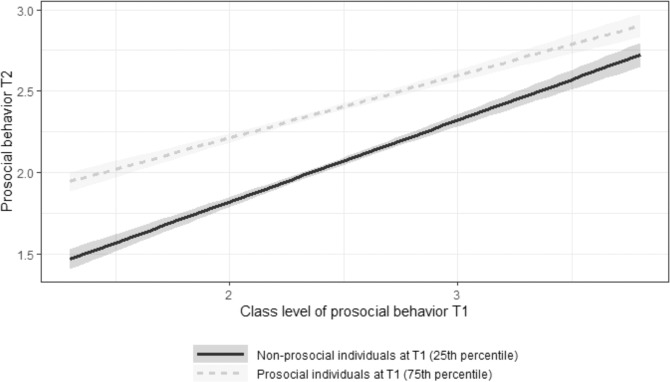
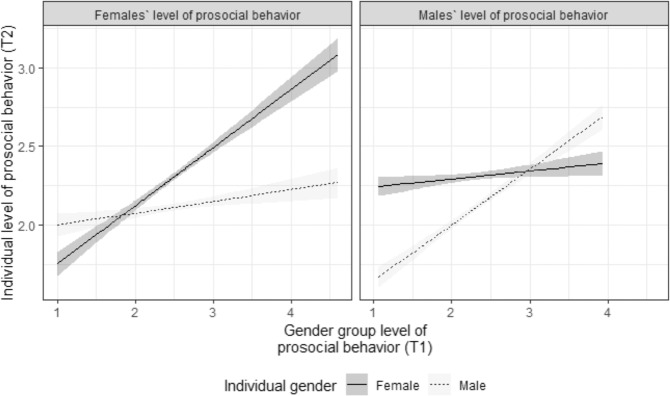
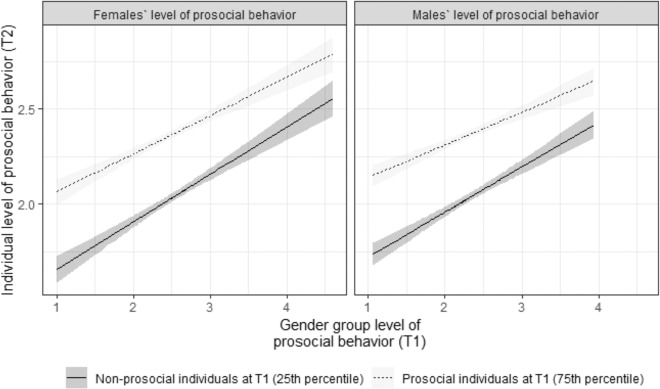
Peer groups are critical socialization agents for the development of social behavior in adolescence, but studies examining peer-group effects on individuals’ prosocial behavior are scarce. Using a two-wave, multilevel data set ( N = 16,893, 8481 male; 8412 female; mean age at Time 1: 14.0 years) from 1308 classes in 252 secondary schools in Germany, main effects of the classroom level of prosocial behavior, cross-level interactions between the classroom and the individual levels of prosocial behavior at Time 1, and the moderating role of gender were examined. The results showed that adolescents in classrooms with high collective levels of prosocial behavior at Time 1 reported more prosocial behavior at Time 2, about two years later, reflecting a class-level main effect. A significant cross-level interaction indicated that a high classroom level of prosocial behavior particularly affected individuals with lower levels of prosocial behavior at Time 1. The influence of same-gender peers was larger compared with opposite-gender peers. The findings are discussed with respect to social learning mechanisms in the development of prosocial behavior and their implications for interventions to promote prosocial behavior.
Overview
The claims and statistics of this paper haven’t been checked yet.
Free: it reads the open-access text and checks the first 5 claims that cite a source we can check. Create a free account to check every claim.
Integrity signals
Registry
Cites
Statistics
Figures
Verification
Claims the paper makes
The claims and statistics of this paper haven’t been checked yet.
Free: it reads the open-access text and checks the first 5 claims that cite a source we can check. Create a free account to check every claim.
Claims other papers make about this one
Each is checked against this paper’s own text: does it say what the citing paper says it does?
In the citing paper
“This result corroborates previous findings attesting to the role of prosocial peer influence on the development of prosocial behaviors (Busching & Krahé, 2020) and the positive effect of prosocial artificial agents (Oliveira et al., 2021;Peter et al., 2021).”
From Countering dis/misinformation sharing by hindering moral disengagement in adolescence: the role of prosocial conversational modeling (2026) · cites this paper as Busching & Krahé, 2020
Self-check
Percentages, sums and reported differences re-computed from the paper’s own numbers.
The self-check needs the paper’s full text.
Citations
Cites
Kytle, J., & Bandura, A. (1978) · Contemporary Sociology · doi:10.2307/2065952 · Cited by 25,422 · cited 3×
“learned in the course of socialization, not only through direct reinforcement, but also through observational learning (Bandura 1977).”
BackgroundJennings, P. A., & Greenberg, M. T. (2009) · Review of Educational Research · doi:10.3102/0034654308325693 · Cited by 3,686
Prosocial Behavior: Multilevel Perspectives
Penner., L. A., Dovidio., J. F., Piliavin., J. A., & Schroeder., D. A. (2005) · Annual Review of Psychology · doi:10.1146/annurev.psych.56.091103.070141 · Cited by 2,308
Multilevel Analysis: Techniques and Applications
Hox, J. J., Moerbeek, M., & van de Schoot, R. (2017) · Routledge eBooks · doi:10.4324/9781315650982 · Cited by 1,671
On the Use of Beta Coefficients in Meta-Analysis.
Peterson, R. A., & Brown, S. P. (2005) · Journal of Applied Psychology · doi:10.1037/0021-9010.90.1.175 · Cited by 1,643 · cited 2×
“Since there are no measures of effect size for multilevel models including cross-level interactions and random components, we additionally report beta weights, which provide an indication of the size of the effects (Peterson and Brown 2005).”
BackgroundBeyond Homophily: A Decade of Advances in Understanding Peer Influence Processes
Brechwald, W. A., & Prinstein, M. J. (2011) · Journal of Research on Adolescence · doi:10.1111/j.1532-7795.2010.00721.x · Cited by 1,334
Intraclass Correlation Values for Planning Group-Randomized Trials in Education
Hedges, L. V., & Hedberg, E. C. (2007) · Educational Evaluation and Policy Analysis · doi:10.3102/0162373707299706 · Cited by 847
Prosocial Behavior in Adolescence: Gender Differences in Development and Links with Empathy
Van der Graaff, J., Carlo, G., Crocetti, E., Koot, H. M., & Branje, S. (2018) · Journal of Youth and Adolescence · doi:10.1007/s10964-017-0786-1 · Cited by 562
Influence of peers and friends on children's and adolescents' eating and activity behaviors
Salvy, S.-J., de la Haye, K., Bowker, J. C., & Hermans, R. C. J. (2012) · Physiology & Behavior · doi:10.1016/j.physbeh.2012.03.022 · Cited by 486
Normative Influences on Aggression in Urban Elementary School Classrooms
Henry, D., Guerra, N., Huesmann, R., Tolan, P., VanAcker, R., & Eron, L. (2000) · American Journal of Community Psychology · doi:10.1023/a:1005142429725 · Cited by 392
Research works printed but not linked: 4
- Aiken LS West SG Multiple regression. Testing and interpreting interactions 1991 Newbury Park, CA US Sage Publications
- Eisenberg, N., Eggum-Wilkens, N. D., & Spinrad, T. L. (2015). The development of prosocial behavior. In D.A. Schroeder, & W.G. Graziano (Eds.), Oxford library of psychology. The Oxford handbook of prosocial behavior (pp. 114–136). New York, NY, US: Oxford University Press.
- Furthmüller P Methodenbericht Dokumentation der Scientific-Use-Files: Erhebungsverfahren und Datensätze von 2005 bis 2009 2015 München Deutsches Jugendinstitut e.V
- Kline RB Principles and practice of structural equation modeling 2011 3rd ed. New York Guilford Press
Cited by
Butler, N., Quigg, Z., Bates, R., Jones, L., Ashworth, E., Gowland, S., & Jones, M. (2022) · School Mental Health · doi:10.1007/s12310-022-09502-9 · Cited by 254
Paciello, M., Corbelli, G., Sportelli, C., Cicirelli, P. G., & D’Errico, F. (2026) · Humanities and Social Sciences Communications · doi:10.1057/s41599-026-08382-7 · Cited by 1
Metadata
- Authors
- Busching, R., & Krahé, B.
- ORCID
- Busching, Robert
- Venue
- Journal of Youth and Adolescence
- Published
- 2020-06-11
- Volume
- 49
- Issue
- 9
- Pages
- 1849-1863
- ISSN
- 0047-2891
- 1573-6601
- PMC
- PMC7423867
- Cited by
- 90
- References
- 56
- Language
- en
- Licence
- creativecommons.org/licenses/by/4.0 (tdm)
- creativecommons.org/licenses/by/4.0 (vor)
About these checks
Registry, retraction, Cites and statistics results are computed, not judged, with one exception: a printed reference that no index lists is read once by a model before it counts as a citation error. Claims are extracted by a model and kept only when their quote appears verbatim in the text; each cited source is then checked, with a model’s help, for whether it says what the claim relies on. Those verdicts can be wrong — read the claim’s quote and the cited source before relying on one.
Statistics and arithmetic are recomputed, not judged.
Confidence bands are shown only for fields calibrated on our annotated test set. None is calibrated yet, so no band is shown.
What counts as a claim ›How we measure confidence ›How we check this ›
Are you an author, or do you see a problem with this page? Request a review
Data sources
Bibliographic data: Semantic Scholar, OpenAlex, Crossref.
Contains information from the Semantic Scholar Academic Graph Datasets, made available under the ODC Attribution License (ODC-BY 1.0).
Semantic Scholar’s data is described in: Kinney, R., et al. (2023). The Semantic Scholar Open Data Platform. arXiv:2301.10140.
