

With a Little Help from Their Peers: The Impact of Classmates on Adolescents’ Development of Prosocial Behavior
The DOI matches its Crossref record; 9 of the 9 references it cites were found in a registry or an index.
Abstract
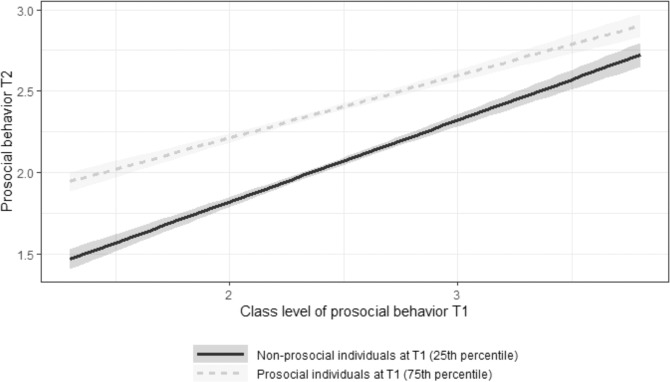
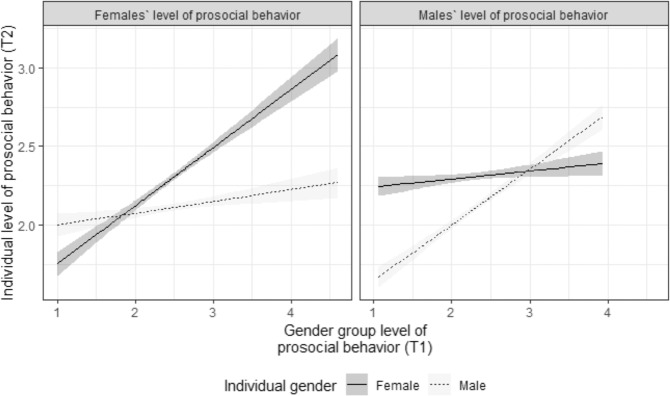
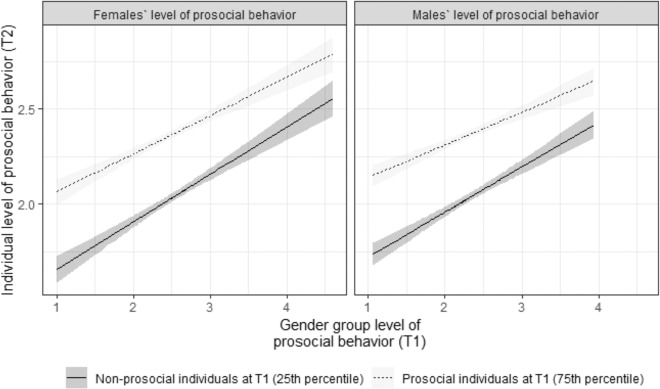
Peer groups are critical socialization agents for the development of social behavior in adolescence, but studies examining peer-group effects on individuals’ prosocial behavior are scarce. Using a two-wave, multilevel data set ( N = 16,893, 8481 male; 8412 female; mean age at Time 1: 14.0 years) from 1308 classes in 252 secondary schools in Germany, main effects of the classroom level of prosocial behavior, cross-level interactions between the classroom and the individual levels of prosocial behavior at Time 1, and the moderating role of gender were examined. The results showed that adolescents in classrooms with high collective levels of prosocial behavior at Time 1 reported more prosocial behavior at Time 2, about two years later, reflecting a class-level main effect. A significant cross-level interaction indicated that a high classroom level of prosocial behavior particularly affected individuals with lower levels of prosocial behavior at Time 1. The influence of same-gender peers was larger compared with opposite-gender peers. The findings are discussed with respect to social learning mechanisms in the development of prosocial behavior and their implications for interventions to promote prosocial behavior.
Overview
The claims and statistics of this paper haven’t been checked yet.
Free: it reads the open-access text and checks the first 5 claims that cite a source we can check. Create a free account to check every claim.
Integrity signals
Registry
Cites
Statistics
Figures
Verification
Claims the paper makes
The claims and statistics of this paper haven’t been checked yet.
Free: it reads the open-access text and checks the first 5 claims that cite a source we can check. Create a free account to check every claim.
Claims other papers make about this one
Each is checked against this paper’s own text: does it say what the citing paper says it does?
In the citing paper
“This result corroborates previous findings attesting to the role of prosocial peer influence on the development of prosocial behaviors (Busching & Krahé, 2020) and the positive effect of prosocial artificial agents (Oliveira et al., 2021;Peter et al., 2021).”
From Countering dis/misinformation sharing by hindering moral disengagement in adolescence: the role of prosocial conversational modeling (2026) · cites this paper as Busching & Krahé, 2020
Self-check
Percentages, sums and reported differences re-computed from the paper’s own numbers.
The self-check needs the paper’s full text.
Citations
Cites
Kytle, J., & Bandura, A. (1978) · Contemporary Sociology · doi:10.2307/2065952 · Cited by 25,422 · cited 3×
“learned in the course of socialization, not only through direct reinforcement, but also through observational learning (Bandura 1977).”
BackgroundJennings, P. A., & Greenberg, M. T. (2009) · Review of Educational Research · doi:10.3102/0034654308325693 · Cited by 3,686
Prosocial Behavior: Multilevel Perspectives
Penner., L. A., Dovidio., J. F., Piliavin., J. A., & Schroeder., D. A. (2005) · Annual Review of Psychology · doi:10.1146/annurev.psych.56.091103.070141 · Cited by 2,308
On the Use of Beta Coefficients in Meta-Analysis.
Peterson, R. A., & Brown, S. P. (2005) · Journal of Applied Psychology · doi:10.1037/0021-9010.90.1.175 · Cited by 1,643 · cited 2×
“Since there are no measures of effect size for multilevel models including cross-level interactions and random components, we additionally report beta weights, which provide an indication of the size of the effects (Peterson and Brown 2005).”
BackgroundIntraclass Correlation Values for Planning Group-Randomized Trials in Education
Hedges, L. V., & Hedberg, E. C. (2007) · Educational Evaluation and Policy Analysis · doi:10.3102/0162373707299706 · Cited by 847
Lam, C. B., McHale, S. M., & Crouter, A. C. (2014) · Child Development · doi:10.1111/cdev.12235 · Cited by 339
Peer Influence on Prosocial Behavior in Adolescence
van Hoorn, J., van Dijk, E., Meuwese, R., Rieffe, C., & Crone, E. A. (2016) · Journal of Research on Adolescence · doi:10.1111/jora.12173 · Cited by 300
Hidden Invalidity Among 15 Commonly Used Measures in Social and Personality Psychology
Hussey, I., & Hughes, S. (2020) · Advances in Methods and Practices in Psychological Science · doi:10.1177/2515245919882903 · Cited by 199 · cited 1×
“Because no information about the validation of the prosocial behavior measure was available, we tested the factorial structure as well as the correlation of prosocial behavior with related constructs (Hussey and Hughes 2020).”
MethodShin, H. (2017) · Journal of Youth and Adolescence · doi:10.1007/s10964-017-0702-8 · Cited by 81
Research works printed but not linked: 51
- Aiken LS West SG Multiple regression. Testing and interpreting interactions 1991 Newbury Park, CA US Sage Publications
- Barry CM Wentzel KR Friend influence on prosocial behavior: the role of motivational factors and friendship characteristics Developmental Psychology 2006 42 153 163 10.1037/0012-1649.42.1.15 16420125 · doi:10.1037/0012-1649.42.1.15 · Paper page
- Boor-Klip HJ Segers E Hendrickx MMHG Cillessen AHN The moderating role of classroom descriptive norms in the association of student behavior with social preference and popularity The Journal of Early Adolescence 2017 37 387 413 10.1177/0272431615609158 · DOI
- Brechwald WA Prinstein MJ Beyond homophily: a decade of advances in understanding peer influence processes Journal of Research on Adolescence 2011 21 166 179 10.1111/j.1532-7795.2010.00721.x 23730122 PMC3666937 · DOI · Paper page
- Busching R Krahé B The girls set the tone: gendered classroom norms and the development of aggression in adolescence Personality and Social Psychology Bulletin 2015 41 659 676 10.1177/0146167215573212 25742920 · DOI
- Busching R Krahé B The contagious effect of deviant behavior in adolescence. Social Psychological and Personality Science 2018 9 815 824 10.1177/1948550617725151 · DOI
- Choukas-Bradley S Giletta M Cohen GL Prinstein MJ Peer influence, peer status, and prosocial behavior: an experimental investigation of peer socialization of adolescents’ intentions to volunteer Journal of Youth and Adolescence 2015 44 2197 2210 10.1007/s10964-015-0373-2 26525387 PMC5985442 · DOI · Paper page
- Conklin CG Kamps D Wills H The effects of Class-Wide Function-related Intervention Teams (CW-FIT) on students’ prosocial classroom behaviors Journal of Behavioral Education 2017 26 75 100 10.1007/s10864-016-9252-5 · DOI
- Coyne SM Warburton WA Essig LW Stockdale LA Violent video games, externalizing behavior, and prosocial behavior: a five-year longitudinal study during adolescence Developmental Psychology 2018 54 1868 1880 10.1037/dev0000574 30234338 · DOI · Paper page
- Dijkstra JK Gest SD Peer norm salience for academic achievement, prosocial behavior, and bullying: Implications for adolescent school experiences. The Journal of Early Adolescence 2015 35 79 96 10.1177/0272431614524303 · DOI
- Dishion, T. J. (2014). A developmental model of aggression and violence: microsocial and macrosocial dynamics within an ecological framework. In M. Lewis & K.D. Rudolph (Eds.), Handbook of developmental psychopathology (pp. 449–465). Boston, MA: Springer US. · DOI
- Eisenberg, N., Eggum-Wilkens, N. D., & Spinrad, T. L. (2015). The development of prosocial behavior. In D.A. Schroeder, & W.G. Graziano (Eds.), Oxford library of psychology. The Oxford handbook of prosocial behavior (pp. 114–136). New York, NY, US: Oxford University Press.
- Fabes RA Carlo G Kupanoff K Laible D Early adolescence and prosocial/moral behavior I: the role of individual processes The Journal of Early Adolescence 1999 19 5 16 10.1177/0272431699019001001 · DOI · Paper page
- Farrell AD Thompson EL Mehari KR Dimensions of peer influences and their relationship to adolescents’ aggression, other problem behaviors and prosocial behavior Journal of Youth and Adolescence 2017 46 1351 1369 10.1007/s10964-016-0601-4 27812839 PMC10509779 · DOI · Paper page
- Foulkes L Leung JT Fuhrmann D Knoll LJ Blakemore S-J Age differences in the prosocial influence effect Developmental Science 2018 21 e12666 10.1111/desc.12666 29658168 PMC6221149 · DOI · Paper page
- Furthmüller P Methodenbericht Dokumentation der Scientific-Use-Files: Erhebungsverfahren und Datensätze von 2005 bis 2009 2015 München Deutsches Jugendinstitut e.V
- Gerbino M Zuffianò A Eisenberg N Castellani V Luengo Kanacri BP Pastorelli C Caprara GV Adolescents’ prosocial behavior predicts good grades beyond intelligence and personality traits Journal of Personality 2018 86 247 260 10.1111/jopy.12309 28236293 · DOI · Paper page
- Grard A Kunst A Kuipers M Richter M Rimpela A Federico B Lorant V Same-sex friendship, school gender composition, and substance use: a social network study of 50 European schools Substance Use & Misuse 2018 53 998 1007 10.1080/10826084.2017.1392976 29190174 · DOI
- Grusec JE Skubiski SL Model nurturance, demand characteristics of the modeling experiment, and altruism Journal of Personality and Social Psychology 1970 14 352 359 10.1037/h0028985 5024074 · DOI
- Henry D Guerra N Huesmann LR Tolan P VanAcker R Eron L Normative influences on aggression in urban elementary school classrooms American Journal of Community Psychology 2000 28 59 81 10.1023/A:1005142429725 10824274 · DOI · Paper page
- Henry DB Cartland J Ruchross H Monahan K A return potential measure of setting norms for aggression American Journal of Community Psychology 2004 33 131 149 10.1023/B:AJCP.0000027001.71205.dd 15212174 · DOI
- Hoffman BR Sussman S Unger JB Valente TW Peer influences on adolescent cigarette smoking: a theoretical review of the literature Substance Use & Misuse 2006 41 103 155 10.1080/10826080500368892 16393739 · DOI · Paper page
- Hofmann V Müller CM Avoiding antisocial behavior among adolescents: the positive influence of classmates’ prosocial behavior Journal of Adolescence 2018 68 136 145 10.1016/j.adolescence.2018.07.013 30077085 · DOI
- Hox JJ Moerbeek M Multilevel analysis 2017 3rd ed. New York, NY Routledge · DOI · Paper page
- Hsiao Y Cheng C-L Chiu Y-W Gender network dynamics in prosocial and aggressive behavior of early adolescents Social Networks 2019 58 12 23 10.1016/j.socnet.2019.01.002 · DOI
- Huesmann LR An integrative theoretical understanding of aggression: a brief exposition Current Opinion in Psychology 2018 19 119 124 10.1016/j.copsyc.2017.04.015 29279209 PMC6441609 · DOI
- Jung J Busching R Krahé B Catching aggression from one’s peers: a longitudinal and multilevel analysis Social and Personality Psychology Compass 2019 13 e12433. 10.1111/spc3.12433 · DOI
- Kline RB Principles and practice of structural equation modeling 2011 3rd ed. New York Guilford Press
- Krahé B Busching R Möller I Media violence use and aggression among german adolescents: associations and trajectories of change in a three-wave longitudinal study Psychology of Popular Media Culture 2013 1 152 166 10.1037/a0028663 · DOI
- Krahé B Möller I Links between self-reported media violence exposure and teacher ratings of aggression and prosocial behavior among German adolescents Journal of Adolescence 2011 34 279 287 10.1016/j.adolescence.2010.05.003 20627370 · DOI
- Laninga-Wijnen L Harakeh Z Dijkstra JK Veenstra R Vollebergh W Aggressive and prosocial peer norms: change, stability, and associations with adolescent aggressive and prosocial behavior development The Journal of Early Adolescence 2018 38 178 203 10.1177/0272431616665211 · DOI
- Laninga-Wijnen L Harakeh Z Dijkstra JK Veenstra R Vollebergh W Who sets the aggressive popularity norm in classrooms? It’s the number and strength of aggressive, prosocial, and bi-strategic adolescents Journal of Abnormal Child Psychology 2020 48 13 27 10.1007/s10802-019-00571-0 31327118 PMC6925065 · DOI
- Laninga-Wijnen, L., Steglich, C., Harakeh, Z., Vollebergh, W., Veenstra, R., & Dijkstra, J.K. (2019). The role of prosocial and aggressive popularity norm combinations in prosocial and aggressive friendship processes. Journal of Youth and Adolescence. 10.1007/s10964-019-01088-x. PMC7079708 31407189 · DOI
- Marino, C., Gini, G., Angelini, F., Vieno, A., & Spada, M.M. (2020). Social norms and e-motions in problematic social media use among adolescents. Addictive Behaviors Reports. 10.1016/j.abrep.2020.100250. PMC7244919 32467839 · DOI · Paper page
- McKeown S Taylor LK Perceived peer and school norm effects on youth antisocial and prosocial behaviours through intergroup contact in Northern Ireland The British Journal of Social Psychology 2018 57 652 665 10.1111/bjso.12257 29663432 · DOI
- Mercer SH McMillen JS DeRosier ME Predicting change in children’s aggression and victimization using classroom-level descriptive norms of aggression and pro-social behavior Journal of School Psychology 2009 47 267 289 10.1016/j.jsp.2009.04.001 19480888 PMC2689928 · DOI
- O’Brennan LM Bradshaw CP Furlong MJ Influence of classroom and school climate on teacher perceptions of student problem behavior School Mental Health 2014 6 125 136 10.1007/s12310-014-9118-8 25346779 PMC4204794 · DOI
- Ragan DT Similarity between deviant peers: developmental trends in influence and selection Criminology 2020 11 1 34 10.1111/1745-9125.12238 · DOI
- Rohlf, H., Krahé, B., & Busching, R. (2016). The socializing effect of classroom aggression on the development of aggression and social rejection: a two-wave multilevel analysis. Journal of School Psychology, 57–72. 10.1016/j.jsp.2016.05.002. 27586070 · DOI
- Salvy S-J La Haye K de Bowker JC Hermans RCJ Influence of peers and friends on children’s and adolescents’ eating and activity behaviors Physiology & Behavior 2012 106 369 378 10.1016/j.physbeh.2012.03.022 22480733 PMC3372499 · DOI · Paper page
- Sauerwein M Theis D Fischer N How youths’ profiles of extracurricular and leisure activity affect their social development and academic achievement International Journal for Research on Extended Education 2016 4 103 124 10.3224/ijree.v4i1.24778 · DOI
- Shin H Ryan AM North E Friendship processes around prosocial and aggressive behaviors: the role of teacher–student relatedness and differences between elementary-school and middle-school classrooms Merrill-Palmer Quarterly 2019 65 232 263 10.13110/merrpalmquar1982.65.2.0232 · DOI
- StEG-Konsortium. (2011). Studie zur Entwicklung von Ganztagsschulen (StEG). Datensatz der Längsschnitterhebungen von 2005, 2007 und 2009 (Version: 1): IQB - Institut zur Qualitätsentwicklung im Bildungswesen. 10.5159/IQB_StEG_v1. · doi:10.5159/iqb_steg_v1
- Stormshak EA Bierman KL Bruschi C Dodge KA Coie JD The relation between behavior problems and peer preference in different classroom contexts Child Development 1999 70 169 182 10.1111/1467-8624.00013 10191521 PMC2761650 · DOI · Paper page
- Stotsky, M.T., Bowker, J.C., & Etkin, R.G. (2019). Receiving prosocial behavior: examining the reciprocal associations between positive peer treatment and psychosocial and behavioral outcomes. Journal of Research on Adolescence. 10.1111/jora.12537. 31670899 · DOI
- Torrente CE Cappella E Watling Neal J Children’s positive school behaviors and social preference in urban elementary classrooms Journal of Community Psychology 2014 42 143 161 10.1002/jcop.21599 · DOI
- van der Graaff J Carlo G Crocetti E Koot HM Branje S Prosocial behavior in adolescence: gender differences in development and links with empathy Journal of Youth and Adolescence 2018 47 1086 1099 10.1007/s10964-017-0786-1 29185207 PMC5878203 · DOI · Paper page
- van Goethem AAJ van Hoof A van Aken MAG Orobio de Castro B Raaijmakers QAW Socialising adolescent volunteering: how important are parents and friends? Age dependent effects of parents and friends on adolescents’ volunteering behaviours Journal of Applied Developmental Psychology 2014 35 94 101 10.1016/j.appdev.2013.12.003 · DOI
- van Rijsewijk L Dijkstra JK Pattiselanno K Steglich C Veenstra R Who helps whom? Investigating the development of adolescent prosocial relationships Developmental Psychology 2016 52 894 908 10.1037/dev0000106 27228450 · DOI
- Vitória, P., Pereira, S. E., Muinos, G., Vries, H. de, & Lima, M. L. (2020). Parents modelling, peer influence and peer selection impact on adolescent smoking behavior: a longitudinal study in two age cohorts. Addictive Behaviors, 100. 10.1016/j.addbeh.2019.106131. 31614308 · DOI
- Widman L Choukas-Bradley S Helms SW Prinstein MJ Adolescent susceptibility to peer influence in sexual situations Journal of Adolescent Health 2016 58 323 329 10.1016/j.jadohealth.2015.10.253 26794431 PMC4766019 · DOI
Cited by
Butler, N., Quigg, Z., Bates, R., Jones, L., Ashworth, E., Gowland, S., & Jones, M. (2022) · School Mental Health · doi:10.1007/s12310-022-09502-9 · Cited by 254
Paciello, M., Corbelli, G., Sportelli, C., Cicirelli, P. G., & D’Errico, F. (2026) · Humanities and Social Sciences Communications · doi:10.1057/s41599-026-08382-7 · Cited by 1
Metadata
- Authors
- Busching, R., & Krahé, B.
- ORCID
- Busching, Robert
- Venue
- Journal of Youth and Adolescence
- Published
- 2020-06-11
- Volume
- 49
- Issue
- 9
- Pages
- 1849-1863
- ISSN
- 0047-2891
- 1573-6601
- PMC
- PMC7423867
- Cited by
- 90
- References
- 9
- Language
- en
- Licence
- creativecommons.org/licenses/by/4.0 (tdm)
- creativecommons.org/licenses/by/4.0 (vor)
About these checks
Registry, retraction, Cites and statistics results are computed, not judged, with one exception: a printed reference that no index lists is read once by a model before it counts as a citation error. Claims are extracted by a model and kept only when their quote appears verbatim in the text; each cited source is then checked, with a model’s help, for whether it says what the claim relies on. Those verdicts can be wrong — read the claim’s quote and the cited source before relying on one.
Statistics and arithmetic are recomputed, not judged.
Confidence bands are shown only for fields calibrated on our annotated test set. None is calibrated yet, so no band is shown.
What counts as a claim ›How we measure confidence ›How we check this ›
Are you an author, or do you see a problem with this page? Request a review
Data sources
Bibliographic data: Semantic Scholar, OpenAlex, Crossref.
Contains information from the Semantic Scholar Academic Graph Datasets, made available under the ODC Attribution License (ODC-BY 1.0).
Semantic Scholar’s data is described in: Kinney, R., et al. (2023). The Semantic Scholar Open Data Platform. arXiv:2301.10140.
