

Managing hyperglycemia in patients with Cushing’s disease treated with pasireotide: medical expert recommendations
Open accessThe DOI matches its Crossref record; 16 of the 16 references it cites were found in a registry or an index.
Abstract
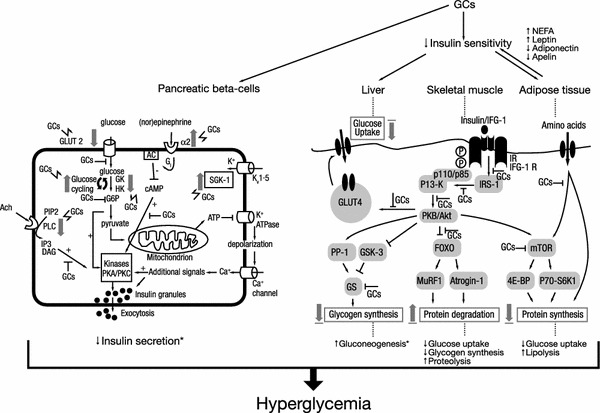
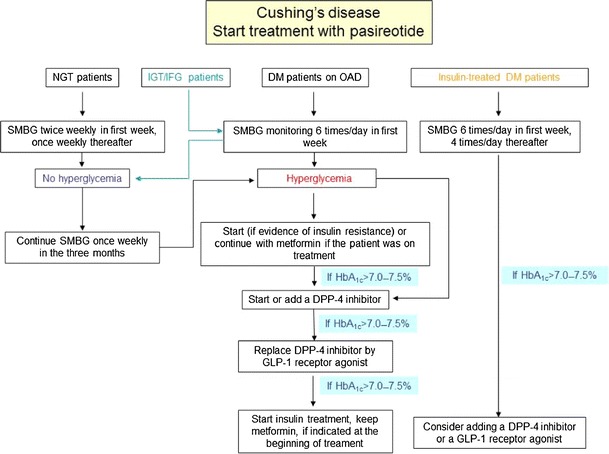
To recommend an approach to monitoring and treating hyperglycemia in pasireotide-treated patients with Cushing's disease, a severe clinical condition caused by a pituitary adenoma hypersecreting adrenocorticotropic hormone. Advisory Board meeting of ten European experts in pituitary disease and diabetes mellitus in Munich, Germany, on February 23, 2012, to obtain expert recommendations. Cushing's disease presents a number of management challenges. Pasireotide, a novel agent for the treatment of Cushing's disease with proven biochemical and clinical efficacy, improves outcomes and expands treatment options. Clinical trials have shown that the pasireotide adverse event profile is similar to that of other somatostatin analogs, except for a higher frequency of hyperglycemia. Mechanistic studies in healthy volunteers suggest that pasireotide-associated hyperglycemia is due to reduced secretion of glucagon-like peptide (GLP)-1, glucose-dependent insulinotropic polypeptide, and insulin; however, it is associated with intact postprandial glucagon secretion. Individual patients' results demonstrate effective hyperglycemia management by following standard guidelines for the treatment of diabetes mellitus with individual adaptation to the specific underlying pathophysiology, i.e., preferential use of GLP-1 based-medications. Patients on pasireotide treatment should be monitored for changes in glucose metabolism and hyperglycemia. Diabetes mellitus should be managed by initiation of medical therapy with metformin and staged treatment intensification with a dipeptidyl peptidase-4 inhibitor, with a switch to a GLP-1 receptor agonist and initiation of insulin, as required, to achieve and maintain glycemic control. Further research into hyperglycemia following pasireotide treatment will help refine the optimal strategy in Cushing's disease.
Overview
The claims and statistics of this paper haven’t been checked yet.
Free: it reads the open-access text and checks the first 5 claims that cite a source we can check. Create a free account to check every claim.
Integrity signals
Registry
Cites
Statistics
Figures
Verification
Claims the paper makes
The claims and statistics of this paper haven’t been checked yet.
Free: it reads the open-access text and checks the first 5 claims that cite a source we can check. Create a free account to check every claim.
Claims other papers make about this one
Each is checked against this paper’s own text: does it say what the citing paper says it does?
In the citing paper
“To counteract these adverse events, patients are often administered GLP -1 agonists, targeting the Gas-coupled glucagonlike peptide-1 receptor (GLP1R) (Colao et al., 2014).”
From Gαs–Protein Kinase A (PKA) Pathway Signalopathies: The Emerging Genetic Landscape and Therapeutic Potential of Human Diseases Driven by Aberrant Gαs-PKA Signaling (2021) · cites this paper as Colao et al., 2014
Self-check
Percentages, sums and reported differences re-computed from the paper’s own numbers.
The self-check needs the paper’s full text.
Citations
Cites
Inzucchi, S. E., Bergenstal, R. M., Buse, J. B., Diamant, M., Ferrannini, E., Nauck, M., Peters, A. L., Tsapas, A., Wender, R., & Matthews, D. R. (2012) · Diabetologia · doi:10.1007/s00125-012-2534-0 · Cited by 3,919
Standards of Medical Care in Diabetes—2012
(2012) · Diabetes Care · doi:10.2337/dc12-s011 · Cited by 2,240
Lacroix, A., Feelders, R. A., Stratakis, C. A., & Nieman, L. K. (2015) · The Lancet · doi:10.1016/s0140-6736(14)61375-1 · Cited by 1,777
Treatment of adrenocorticotropin-dependent Cushing’s syndrome: a consensus statement
Biller, B. M. K., Grossman, A. B., Stewart, P. M., Melmed, S., Bertagna, X., Bertherat, J., Buchfelder, M., Colao, A., Hermus, A. R., Hofland, L. J., et al. (2008) · The Journal of Clinical Endocrinology & Metabolism · doi:10.1210/jc.2007-2734 · Cited by 853 · cited 3×
“Although initial surgery is most frequently used as the first-line option, it often fails [1, 17].”
BackgroundSelf-citationA 12-month phase 3 study of pasireotide in Cushing's disease
Colao, A., Petersenn, S., Newell-Price, J., Findling, J. W., Gu, F., Maldonado, M., Schoenherr, U., Dipl.-Biol., Mills, D., Salgado, L. R., et al. (2012) · New England Journal of Medicine · doi:10.1056/nejmoa1105743 · Cited by 628
Self-citationMorbidity and mortality in Cushing's disease: an epidemiological approach.
Etxabe, J., & Vazquez, J. A. (1994) · Clinical Endocrinology · doi:10.1111/j.1365-2265.1994.tb02486.x · Cited by 622
Glucocorticoids, metabolism and metabolic diseases
Vegiopoulos, A., & Herzig, S. (2007) · Molecular and Cellular Endocrinology · doi:10.1016/j.mce.2007.05.015 · Cited by 535 · cited 1×
“Or they may be indirect, through the inhibition of insulin sensitivity by the depletion of glycogen storage in the liver [27–30].”
BackgroundFleseriu, M., Biller, B. M. K., Findling, J. W., Molitch, M. E., Schteingart, D. E., Gross, C., on behalf of the SEISMIC Study Investigators, The SEISMIC Study Investigators include, Auchus, R., Bailey, T., et al. (2012) · The Journal of Clinical Endocrinology & Metabolism · doi:10.1210/jc.2011-3350 · Cited by 479 · cited 1×
“also in development [21, 22].”
Van Raalte, D. H., Ouwens, D. M., & Diamant, M. (2009) · European Journal of Clinical Investigation · doi:10.1111/j.1365-2362.2008.02067.x · Cited by 439
Faggiano, A., Pivonello, R., Spiezia, S., De Martino, M. C., Filippella, M., Di Somma, C., Lombardi, G., & Colao, A. (2003) · The Journal of Clinical Endocrinology & Metabolism · doi:10.1210/jc.2002-021558 · Cited by 358 · cited 1×
“The effects of Cushing’s disease include metabolic and cardiovascular complications, osteoporosis and other bone alterations, kidney stones, autoimmune diseases, and susceptibility to opportunistic infections [4–15].”
BackgroundSelf-citation
Research works printed but not linked: 22
- Newell-Price J, Bertagna X, Grossman AB, Nieman LK (2006) Cushing’s syndrome. Lancet 367:1605–1617 · DOI · Paper page
- Lindholm J, Juul S, Jørgensen JO et al (2001) Incidence and late prognosis of Cushing’s syndrome: a population-based study. J Clin Endocrinol Metab 86:117–123
- Chanson P, Salenave S (2010) Metabolic syndrome in Cushing’s syndrome. Neuroendocrinology 92(Suppl 1):96–101 · DOI · Paper page
- Colao A, Pivonello R, Spiezia S et al (1994) Persistence of increased cardiovascular risk in patients with Cushing’s disease after five years of successful cure. J Clin Endocrinol Metab 84:2664–2672
- Faggiano A, Pivonello R, Filippella M et al (2001) Spine abnormalities and damage in patients cured from Cushing’s disease. Pituitary 4:153–161 · DOI
- Faggiano A, Pivonello R, Ruosi C et al (2001) Uncommon clinical course of multiple osteochondromatosis in a patient with a long-term history of Cushing’s disease. Pituitary 4:187–193 · DOI
- Di Somma C, Pivonello R, Loche S et al (2002) Severe impairment of bone mass and turnover in Cushing’s disease: comparison between childhood-onset and adulthood-onset disease. Clin Endocrinol (Oxf) 56:153–158 · DOI · Paper page
- Faggiano A, Pivonello R, Melis D et al (2002) Evaluation of circulating levels and renal clearance of natural amino acids in patients with Cushing’s disease. J Endocrinol Invest 25:142–151 · DOI
- Faggiano A, Pivonello R, Melis D et al (2003) Nephrolithiasis in Cushing’s disease: prevalence, etiopathogenesis, and modification after disease cure. J Clin Endocrinol Metab 88:2076–2080 · DOI · Paper page
- van der Eerden AW, den Heijer M, Oyen WJ, Hermus AR (2007) Cushing’s syndrome and bone mineral density: lowest Z scores in young patients. Neth J Med 65:137–141
- Bakker RC, Gallas PR, Romijn JA, Wiersinga WM (1998) Cushing’s syndrome complicated by multiple opportunistic infections. J Endocrinol Invest 21:329–333 · DOI
- Colao A, Pivonello R, Faggiano A et al (2000) Increased prevalence of thyroid autoimmunity in patients successfully treated for Cushing’s disease. Clin Endocrinol (Oxf) 53:13–19 · DOI · Paper page
- Castinetti F, Nagai M, Dufour H et al (2007) Gamma knife radiosurgery is a successful adjunctive treatment in Cushing’s disease. Eur J Endocrinol 156:91–98 · DOI · Paper page
- Devin JK, Allen GS, Cmelak AJ, Duggan DM, Blevins LS (2004) The efficacy of linear accelerator radiosurgery in the management of patients with Cushing’s disease. Stereotact Funct Neurosurg 82:254–262 · DOI · Paper page
- Dang CN, Trainer P (2007) Pharmacological management of Cushing’s syndrome: an update. Arq Bras Endocrinol Metabol 51:1339–1348 · DOI
- Munir A, Newell-Price J (2010) Management of diabetes mellitus in Cushing’s syndrome. Neuroendocrinology 92(Suppl 1):82–85 · DOI · Paper page
- Petersenn S, Schopohl J, Barkan A et al (2010) Pasireotide (SOM230) demonstrates efficacy and safety in patients with acromegaly: a randomized, multicenter, phase II trial. J Clin Endocrinol Metab 95:2781–2789 · DOI · Paper page
- Shah P, Mudaliar S (2010) Pioglitazone: side effect and safety profile. Expert Opin Drug Saf 9:347–354 · DOI · Paper page
- Esposito K, Chiodini P, Capuano A et al (2012) Basal supplementation of insulin lispro protamine suspension versus insulin glargine and detemir for type 2 diabetes: meta-analysis of randomized controlled trials. Diabetes Care 5:2698–2705 · DOI
- Reznik Y, Bertherat J, Borson-Chazot F et al (2012) Management of hyperglycaemia in Cushing’s disease: experts’ proposals on the use of pasireotide. Diabetes Metab. doi: 10.1016/j.diabet.2012.10.005 · DOI
- Tuomilehto J, Lindström J, Hellmich M et al (2010) Development and validation of a risk-score model for subjects with impaired glucose tolerance for the assessment of the risk of type 2 diabetes mellitus–the STOP-NIDDM risk-score. Diabetes Res Clin Pract 87:267–274 · DOI
- Lindström J, Tuomilehto J (2003) The diabetes risk score. A practical tool to predict type 2 diabetes risk. Diabetes Care 26:725–731 · DOI · Paper page
Cited by
Consensus on diagnosis and management of Cushing's disease: a guideline update
Fleseriu, M., Auchus, R., Bancos, I., Ben-Shlomo, A., Bertherat, J., Biermasz, N. R., Boguszewski, C. L., Bronstein, M. D., Buchfelder, M., Carmichael, J. D., et al. (2021) · The Lancet Diabetes & Endocrinology · doi:10.1016/s2213-8587(21)00235-7 · Cited by 953
Self-citationComplications of Cushing's syndrome: state of the art
Pivonello, R., Isidori, A. M., De Martino, M. C., Newell-Price, J., Biller, B. M. K., & Colao, A. (2016) · The Lancet Diabetes & Endocrinology · doi:10.1016/s2213-8587(16)00086-3 · Cited by 641
Self-citationThe Treatment of Cushing's Disease
Pivonello, R., De Leo, M., Cozzolino, A., & Colao, A. (2015) · Endocrine Reviews · doi:10.1210/er.2013-1048 · Cited by 465
Self-citationGadelha, M. R., Bronstein, M. D., Brue, T., Coculescu, M., Fleseriu, M., Guitelman, M., Pronin, V., Raverot, G., Shimon, I., Lievre, K. K., et al. (2014) · The Lancet Diabetes & Endocrinology · doi:10.1016/s2213-8587(14)70169-x · Cited by 396
Self-citationMetabolic comorbidities in Cushing's syndrome
Ferraù, F., & Korbonits, M. (2015) · European Journal of Endocrinology · doi:10.1530/eje-15-0354 · Cited by 187
Glucose Metabolism Abnormalities in Cushing Syndrome: From Molecular Basis to Clinical Management
Scaroni, C., Zilio, M., Foti, M., & Boscaro, M. (2017) · Endocrine Reviews · doi:10.1210/er.2016-1105 · Cited by 140
Ramms, D. J., Raimondi, F., Arang, N., Herberg, F. W., Taylor, S. S., & Gutkind, J. S. (2021) · Pharmacological Reviews · doi:10.1124/pharmrev.120.000269 · Cited by 79
Baroni, M. G., Giorgino, F., Pezzino, V., Scaroni, C., & Avogaro, A. (2016) · Journal of Endocrinological Investigation · doi:10.1007/s40618-015-0404-6 · Cited by 41
“liraglutide, exenatide, dulaglutide) may be effective in reducing the pasireotideassociated hyperglycemia without the risk of hypoglycemia [178].”
BackgroundInfluential
Metadata
- Authors
- Colao, A., De Block, C., Gaztambide, M. S., Kumar, S., Seufert, J., & Casanueva, F. F.
- Venue
- Pituitary
- Published
- 2013-04-07
- Volume
- 17
- Issue
- 2
- Pages
- 180-186
- ISSN
- 1386-341X (ISSN-L)
- 1573-7403
- PMC
- PMC3942628
- OpenAlex
- W2120194262
- Cited by
- 151
- References
- 16
- FWCI
- 12.50
- Type
- journal article
- Language
- en
- Open access
- hybrid
About these checks
Registry, retraction, Cites and statistics results are computed, not judged, with one exception: a printed reference that no index lists is read once by a model before it counts as a citation error. Claims are extracted by a model and kept only when their quote appears verbatim in the text; each cited source is then checked, with a model’s help, for whether it says what the claim relies on. Those verdicts can be wrong — read the claim’s quote and the cited source before relying on one.
Statistics and arithmetic are recomputed, not judged.
Confidence bands are shown only for fields calibrated on our annotated test set. None is calibrated yet, so no band is shown.
What counts as a claim ›How we measure confidence ›How we check this ›
Are you an author, or do you see a problem with this page? Request a review
Data sources
Bibliographic data: Semantic Scholar, OpenAlex, Crossref.
Contains information from the Semantic Scholar Academic Graph Datasets, made available under the ODC Attribution License (ODC-BY 1.0).
Semantic Scholar’s data is described in: Kinney, R., et al. (2023). The Semantic Scholar Open Data Platform. arXiv:2301.10140.
