

Climate change and non-migration—Exploring the role of place relations in rural and coastal Bangladesh
Open accessThe DOI matches its Crossref record; 95 of the 97 references it cites were found in a registry or an index.
Abstract
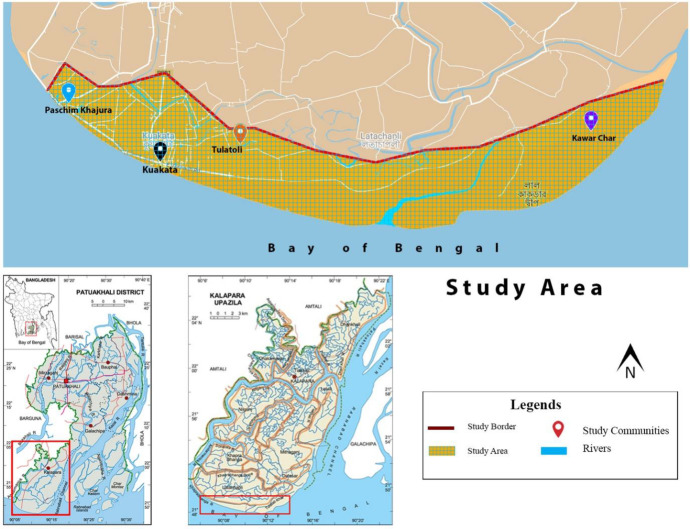
Of growing research and policy interest are the experiences of people living under conditions of climate change–induced environmental stress, which either are unable to migrate (sometimes described as a ‘trapped population’) or are seemingly unwilling to do so (sometimes described as the ‘voluntarily immobile’). This paper problematises and expands upon these binary categories: examining the complex dimensionality of non-migration as a form of place relations, explored through qualitative study of rural and coastal Bangladeshi communities. Through 60 semi-structured interviews of individuals from four communities in the Kalapara region, the analysis proffers four qualitatively derived and inter-related dimensions of voluntary and involuntary non-migration framed as a form of place relations. These four dimensions concern the following: (1) livelihood opportunities, (2) place obduracy, (3) risk perceptions, and (4) social-structural constraints, with the interplay between these elements explaining diverse non-migratory experiences. In our analysis, ‘place obduracy’ is introduced as a concept to describe the differential speed of environmental change and socio-cultural adaptation responses to explain non-migratory experiences. Our discussion provides insight into how to best support non-migrant people’s adaptive capacity in the face of growing climate emergency.
Overview
The claims and statistics of this paper haven’t been checked yet.
Free: it reads the open-access text and checks the first 5 claims that cite a source we can check. Create a free account to check every claim.
Integrity signals
Registry
Cites
Statistics
Figures
Verification
Claims the paper makes
The claims and statistics of this paper haven’t been checked yet.
Free: it reads the open-access text and checks the first 5 claims that cite a source we can check. Create a free account to check every claim.
Claims other papers make about this one
Each is checked against this paper’s own text: does it say what the citing paper says it does?
The cited source says what the claim attributes to it.
In the citing paper
“It is this complexity and multiplicity of factors that compel some scholars to argue that differentiating climate-related migration drivers from other socio-economic and political factors is difficult (Rabbani et al., 2022 [57]).”
From A Systematic Review of International and Internal Climate-Induced Migration in Africa (2023) · cites this paper as Rabbani et al., 2022 [57]
Self-check
Percentages, sums and reported differences re-computed from the paper’s own numbers.
The self-check needs the paper’s full text.
Citations
Cites
Using thematic analysis in psychology
Braun, V., & Clarke, V. (2006) · Qualitative Research in Psychology · doi:10.1191/1478088706qp063oa · Cited by 194,414 · cited 1×
“…the context and production processes of broader themes, subsequently followed by a more detailed examination of utterances to better understand the psychological, socio-cultural, and political-economic context and to produce an interpretive framework (Baxter & Eyles, 1997; Braun & Clarke, 2006).”
BackgroundLee, E. S. (1966) · Demography · doi:10.2307/2060063 · Cited by 4,535 · cited 1×
“However, this process is complex and differentially distributed across age, gender, community status, education, household demographics, and class structures (Clar, 2019; Lee, 1966).”
BackgroundMigration and Development: A Theoretical Perspective
de Haas, H. (2010) · International Migration Review · doi:10.1111/j.1747-7379.2009.00804.x · Cited by 2,245 · cited 1×
“…and so, migratory/non-migratory decisions can be understood as outcomes from complex livelihood strategies that households adopt in order to increase their coping capacity with change and uncertainty (De Haas, 2010; Logan et al., 2016; Maxmillan, 2016; Aniah et al., 2019; Biswas & Mallick, 2020).”
BackgroundThe Measurement of Place Attachment: Validity and Generalizability of a Psychometric Approach
Williams, D. R., & Vaske, J. J. (2003) · Forest Science · doi:10.1093/forestscience/49.6.830 · Cited by 1,725 · cited 1×
“Place dependence – the functional provision of particular resources that support human activities (Williams & Vaske, 2003).”
BackgroundTheory and Practice in Assessing Vulnerability to Climate Change andFacilitating Adaptation
Kelly, P. M., & Adger, W. N. (2000) · Climatic Change · doi:10.1023/a:1005627828199 · Cited by 1,630
Predictors of public climate change awareness and risk perception around the world
Lee, T. M., Markowitz, E. M., Howe, P. D., Ko, C.-Y., & Leiserowitz, A. A. (2015) · Nature Climate Change · doi:10.1038/nclimate2728 · Cited by 1,356
Australian Journal of Emergency Management
(2021) · Australian Journal of Emergency Management · doi:10.47389/13241540 · Cited by 1,308
Evaluating Qualitative Research in Social Geography: Establishing ‘Rigour’ in Interview Analysis
Baxter, J., & Eyles, J. (1997) · Transactions of the Institute of British Geographers · doi:10.1111/j.0020-2754.1997.00505.x · Cited by 1,170 · cited 1×
“…the context and production processes of broader themes, subsequently followed by a more detailed examination of utterances to better understand the psychological, socio-cultural, and political-economic context and to produce an interpretive framework (Baxter & Eyles, 1997; Braun & Clarke, 2006).”
BackgroundPlace Attachment and Environmentally Responsible Behavior
Vaske, J. J., & Kobrin, K. C. (2001) · The Journal of Environmental Education · doi:10.1080/00958960109598658 · Cited by 1,113 · cited 2×
“…precipitation changes (Hugo, 1996; Hunter, 2005; McLeman, 2009; Black et al., 2011; Kniveton et al., 2011; Chen & Mueller, 2019), fire (Paton et al., 2008), biodiversity loss, flood, and disruption to ecosystem services (Adams & Adger, 2013; Adie, 2020; Bonaiuto et al., 2016; Vaske & Kobrin, 2001).”
BackgroundBlack, R., Bennett, S. R. G., Thomas, S. M., & Beddington, J. R. (2011) · Nature · doi:10.1038/478477a · Cited by 1,043
Research works printed but not linked: 6
- Hossain, B. M. R., Hassan, S. M. K., Islam, S., & Nabi, F. D. (2017). Empowering the vulnerable women in disaster prone areas: A case study of southern and northern region of Bangladesh. IOSR Journal Of Humanities And Social Science, 22(9), 14–21. [Online]. Available at: 10.9790/0837-2209151421 · doi:10.9790/0837-2209151421
- McLeman R On the origins of environmental migration Fordham Environmental Law Review 2009 20 2 403 425
- Miah, M. Y., Zia, M., Kamal, U., Salam, M. A., & Islam, M. S. (2020). Impact of salinity intrusion on agriculture of Southwest Bangladesh-A review. International Journal of Agricultural Policy and Research, 8(2), 40–47. [Online]. Available at: 10.15739/IJAPR.20.005 · doi:10.15739/ijapr.20.005
- Sakdapolrak, P., Naruchaikusol, S., Ober, K., Peth, S., Porst, L., Rockenbauch, T., & Tolo, V. (2016). Migration in a changing climate. Towards a translocal social resilience approach. Journal of the Geographical Society of Berlin, 147(2), 81–94
- Tuan, Y.-F. (1974). A study of environmental perception, attitudes and values. New Jersey: Prentice Hall: Englewood Cliffs
- UNHCR. (2020). Trends at a glance: Global trends forced displacement in 2019. UNHCR The UN Refugee Agency, pp.1–84. [Online]. Available at: https://www.unhcr.org/5ee200e37.pdf
Cited by
Climate change and migration: A review and new framework for analysis
Daoust, G. D., & Selby, J. (2024) · Wiley Interdisciplinary Reviews Climate Change · doi:10.1002/wcc.886 · Cited by 77
“…often take precedence over perceived climate change impacts and concerns about future climate change (Adams, 2016; Amin et al., 2021; Bhusal et al., 2021; Farbotko, 2022; Kelman et al., 2017; Khanian et al., 2019; McMichael et al., 2021; Piggott-McKellar & McMichael, 2021; Rabbani et al., 2022).”
A Systematic Review of International and Internal Climate-Induced Migration in Africa
Ofori, D. O., Bandauko, E., Kutor, S. K., Odoi, A., Asare, A. B., Akyea, T., & Arku, G. (2023) · Sustainability · doi:10.3390/su152216105 · Cited by 23
“It is this complexity and multiplicity of factors that compel some scholars to argue that differentiating climate-related migration drivers from other socio-economic and political factors is difficult (Rabbani et al., 2022 [57]).”
Impacts of Climate Change on Rural Communities: Vulnerability and Adaptation in the Global South
Atkinson, C. L., & Atkinson, A. M. (2023) · Encyclopedia · doi:10.3390/encyclopedia3020052 · Cited by 22
“Migration is a key concern in many rural places and such phenomena will continue to be affected by climate change [31].”
BackgroundHossain, M. Z., Rahman, M. A. U., Rahaman, K. R., Ha-Mim, N. M., & Haque, S. F. (2023) · Environment Development and Sustainability · doi:10.1007/s10668-023-03857-y · Cited by 23
“Furthermore, in their study, Rabbani et al. (2022) have recognized the concept of ‘place obduracy’ as a significant component within the specific context of coastal Bangladesh.”
Environmental migration and non-migration: Learning through an intergenerational lens
Mallick, B., & Hunter, L. M. (2024) · Migration Studies · doi:10.1093/migration/mnae031 · Cited by 21
Environmental immobility: A systematic review of empirical research
Sengupta, M. (2025) · AMBIO · doi:10.1007/s13280-025-02195-9 · Cited by 23
“…put due to place-based attachments may seemingly be doing so voluntarily, there may be structural mobility barriers in the form of locally embedded occupational skills (e.g. farming in specific biophysical conditions) that preclude any real choice regarding staying decisions (Rabbani et al. 2022).”
InfluentialMichael, T. O. (2024) · Frontiers in Sustainability · doi:10.3389/frsus.2024.1385513 · Cited by 23
Sultana, Z., Mees, H. L. P., Mallick, B., Driessen, P., & Bailey, A. (2025) · Sustainable Cities and Society · doi:10.1016/j.scs.2025.106803 · Cited by 17
Understanding the socio‐economic impacts of climate change on riparian communities in Bangladesh
Filho, W. L., Wolf, F., Abubakar, I. R., Al‐Amin, A. Q., Roy, S., Malakar, K., Alam, G. M. M., & Sarker, M. N. I. (2022) · River Research and Applications · doi:10.1002/rra.4056 · Cited by 15
Climate (im)mobilities in the Eastern Hindu Kush: The case of Lotkuh Valley, Pakistan
Khan, S. A., Doevenspeck, M., & Sass, O. (2023) · Population and Environment · doi:10.1007/s11111-023-00443-2 · Cited by 17
“Apart from this involuntary immobility, some households voluntarily prefer to stay in their places of origin and lack migration aspirations (Rabbani et al., 2022; Zickgraf, 2018).”
Michael, T. O. (2024) · Social Sciences · doi:10.3390/socsci13020089 · Cited by 16
Impact of Rohingya influx on host community’s relations to places in Bangladesh
Sultana, Z. (2023) · International Journal of Intercultural Relations · doi:10.1016/j.ijintrel.2023.101782 · Cited by 10
Rabbani, M. M. G., & Cotton, M. (2025) · Environmental Hazards · doi:10.1080/17477891.2025.2492320 · Cited by 11
“…norms and cultural values are embedded in religious and place-based identities, and this can lead to a form of maladaptation termed place obduracy (Rabbani et al., 2022) whereby the pace of social and cultural change needed to ensure public safety is out-stripped by the pace of environmental…”
Self-citationAhmed, K. J., Haq, S. M. A., & Hyder, M. B. (2023) · Frontiers in Environmental Science · doi:10.3389/fenvs.2023.1160394 · Cited by 7
Sowrav, S. F. F., Rahman, S. M. M., Hafiz, K. B., & Hossain, M. A. (2024) · Environmental Challenges · doi:10.1016/j.envc.2024.101019 · Cited by 5
Understanding Mobility Through Climate Risk Perceptions
Hermans, K., & Kizilkaya, S. (2025) · Wiley Interdisciplinary Reviews Climate Change · doi:10.1002/wcc.70029 · Cited by 9
Sreekumar, G., & Mandal, S. K. (2024) · Economics of Disasters and Climate Change · doi:10.1007/s41885-024-00158-0 · Cited by 4
“This may also be attributed to households’ social capital, social and community networks, place attachment, and kinship, which result in non-migration despite the increased risk of disasters such as flood (Neef et al. 2018; Buchori et al. 2021; Khatun et al. 2022; Rabbani et al. 2022).”
InfluentialTropical Cyclones and the Mobility of Older Persons: Insights from Coastal Bangladesh
Malak, M. A., & Lina, N. K. (2024) · Sustainable development goals series · doi:10.1007/978-981-97-3234-0_2 · Cited by 5
Everyone’s Adaptation: Exploring individual heat stress adaptation
Sultana, Z., Mees, H. L. P., Mallick, B., Driessen, P., & Bailey, A. (2025) · Climate Risk Management · doi:10.1016/j.crm.2025.100712 · Cited by 7
Does local non-farm income moderate the intensity of climate change induced migration in India?
Sreekumar, G., Mandal, S. K., & Drall, A. (2024) · Journal of Policy Modeling · doi:10.1016/j.jpolmod.2024.07.005 · Cited by 5
Immobility, Older Adults and Adaptation to Tropical Cyclones: Insights from Coastal Bangladesh
Malak, M. A., Lina, N. K., Quader, M. A., & Mahmood, R. (2024) · Migration and Development · doi:10.1177/21632324241281093 · Cited by 4
“Older adults’ ability to adapt and cope later in life is generally affected by threats from environmental stressors (Rabbani et al., 2022).”
Guragain, U. P., Srisawasdi, W., & Ali, S. (2025) · SAGE Open · doi:10.1177/21582440251338934 · Cited by 5
“These findings align with recent research by Mallick et al. (2023) and Rabbani et al. (2022), which emphasizes the complex interplay between place attachment, economic prospects, and the social and environmental factors that shape the decision to either migrate or remain.”
Climatic Vulnerability and Migration: Evidence from Coastal Sundarbans
Mandal, P., & Paul, S. (2025) · Springer geography · doi:10.1007/978-3-032-05858-4_1 · Cited by 3
Staying put amidst the changing climate: lessons from older Nepalis
Ayalon, L., Roy, S., & Magar, S. T. (2025) · Innovation in Aging · doi:10.1093/geroni/igaf128 · Cited by 3
Islam, M. R., Islam, M. M., & Ahmed, F. (2026) · Journal of Urban Health · doi:10.2139/ssrn.5353171 · Cited by 3
Sreekumar, G., & Mandal, S. K. (2024) · Indian Economic Review · doi:10.1007/s41775-024-00233-z · Cited by 7
“Therefore, availability of multiple livelihood opportunities and the psychological bond attached to the community often results in voluntary non-migration among rural households (Rabbani et al., 2022).”
Mandal, P., Nandy, D., Roy, S., Bhattacharya, S., & Paul, S. (2025) · Weather Climate and Society · doi:10.1175/wcas-d-24-0125.1 · Cited by 1
Climate change adaptation through rural entrepreneurship: A pathway to sustainable livelihoods
Borkhani, F. R., Khaleghi, B., Azizi-Khalkheili, T., & Kouchaky, Z. (2026) · Journal of Environmental Studies and Sciences · doi:10.1007/s13412-026-01099-8 · Cited by 2
Das, K. K. (2026) · Migration and Development · doi:10.1177/21632324261427528 · Cited by 1
Ahsan, M. N., Naim, J., Supty, H. I., Khatun, F., Kumar, P., Okano, N., Ohara, M., & Nasrin, N. (2026) · Habitat International · doi:10.1016/j.habitatint.2026.103789 · Cited by 2
Widiawaty, M. A., Sunardi, S., Dede, M., & Afriana, N. N. (2026) · Journal of Maps · doi:10.1080/17445647.2026.2658875 · Cited by 1
Planning climate destination cities: migrant narratives from Mongla, Bangladesh
Hasan, F. N., Shah, S. H., & Best, K. B. (2026) · Climate and Development · doi:10.1080/17565529.2026.2692563 · Cited by 1
Ripples of change: exploring water security in farming systems—insights from Hamedan province, Iran
Choobchian, S., & Motaghed, M. (2025) · Sustainable Water Resources Management · doi:10.1007/s40899-025-01219-2 · Cited by 1
(In)voluntary Non-migrants? Unfulfilled Migration Intentions under Emigration Restrictions
Brunarska, Z. (2025) · Nationalities Papers · doi:10.1017/nps.2025.10088 · Cited by 2
“…voluntary and involuntary may be as problematic as in mobility-focused research has, however, not received much attention until recently and the evidence for the blurriness of the boundary remains scarce (for exceptions, see Mallick and Hunter 2024; Rabbani, Cotton and Friend 2022; Robins 2022).”
Climate change adaptation in Bangladesh: Sen's capability approach and the role of freedom of choice
Assaduzzaman, M. (2023) · doi:10.3990/1.9789036557153 · Cited by 4
Márquez, Y. P., & Giatti, L. L. (2025) · Regional Environmental Change · doi:10.1007/s10113-025-02486-7
“These challenges are compounded by contextual factors such as poor housing, food insecurity, and institutional failures like poor governance and corruption, which limit migrants’ adaptive capacity (Hansen et al. 2014; Rabbani et al. 2022).”
Zhao, X., Zheng, Y., Wang, Y., Liu, S., Wang, X., Chen, F., & Wang, F. (2026) · BMJ Open · doi:10.1136/bmjopen-2025-107521
Sithole, F., Chekero, T., Sibanda, P., & Muzenje, A. (2026) · Critical African Studies · doi:10.1080/21681392.2026.2695121
Resilient or relocating? Migrants' settlement responses to climate extremes in Chinese cities
Wang, C., Du, R., & Liu, H. (2026) · Environmental Impact Assessment Review · doi:10.1016/j.eiar.2026.108672
Auslender, E., Weatherill, C. K., & Rabbani, M. M. G. (2026) · Environmental Politics · doi:10.1080/09644016.2026.2724664
Self-citationEsariti, L., Purnomo, M. S., Kharisma, D. A., Hillman, F., & Handayani, W. (2026) · Local Environment · doi:10.1080/13549839.2026.2726215
Uğurlu, Ö., ALTINTAŞ, H. Y., Gerdan, S., & Cartier, S. (2026) · Sustainability · doi:10.3390/su181910130
Wang, Q., & Lin, B. (2026) · Tourism Management Perspectives · doi:10.1016/j.tmp.2026.101543
Sengupta, M. (2026) · Regional Environmental Change · doi:10.1007/s10113-026-02710-y
“…also be argued that notions of fatalism and beliefs centring on the external determination of one’s fate during disasters, such as through religious meaning-making, are deeply embedded in the social psychology of the broader study region (see also Ayeb-Karlsson et al. 2019; Rabbani et al. 2022).”
Metadata
- Authors
- Rabbani, M. M. G., Cotton, M., & Friend, R.
- Affiliations
- University of York (GB)
- Teesside University (GB)
- Corresponding author
- Rabbani, M. M. Golam
- Venue
- Population and Environment
- Published
- 2022-05-21
- Volume
- 44
- Issue
- 1-2
- Pages
- 99-122
- ISSN
- 0199-0039 (ISSN-L)
- 1573-7810
- PMC
- PMC9123852
- OpenAlex
- W4281257932
- Semantic Scholar
- 62fe5d8c414c5ff87d61590e395edd12a89ccb71
- Cited by
- 44
- References
- 97
- Citations by year
- 2026: 13 · 2025: 13 · 2024: 10 · 2023: 7 · 2022: 1
- FWCI
- 11.15
- Type
- journal article
- Language
- en
- Open access
- hybrid
- doi.org
- Licence
- cc-by
- creativecommons.org/licenses/by/4.0 (tdm)
- creativecommons.org/licenses/by/4.0 (vor)
- Locations
- Population and Environment (publishedVersion, cc-by)
- PubMed Central (publishedVersion, cc-by)
- PubMed (publishedVersion)
- TeesRep (Teesside University) (publishedVersion, cc-by)
- White Rose Research Online (University of Leeds, The University of Sheffield, University of York) (acceptedVersion)
- Teesside University Research Portal (Teesside University) (submittedVersion, cc-by)
- Topics
- Social Sciences › Sociology and Political Science › Climate Change, Adaptation, Migration
- Social Sciences › Sociology and Political Science › Climate Change Communication and Perception
- Social Sciences › Sociology and Political Science › Hydropower, Displacement, Environmental Impact
- Keywords
- non-migration, climate change, place relations, trapped populations, livelihood opportunities, risk perception, sociocultural adaptation, adaptive capacity, rural communities, coastal communities, Bangladesh
About these checks
Registry, retraction, Cites and statistics results are computed, not judged, with one exception: a printed reference that no index lists is read once by a model before it counts as a citation error. Claims are extracted by a model and kept only when their quote appears verbatim in the text; each cited source is then checked, with a model’s help, for whether it says what the claim relies on. Those verdicts can be wrong — read the claim’s quote and the cited source before relying on one.
Statistics and arithmetic are recomputed, not judged.
Confidence bands are shown only for fields calibrated on our annotated test set. None is calibrated yet, so no band is shown.
What counts as a claim ›How we measure confidence ›How we check this ›
Are you an author, or do you see a problem with this page? Request a review
Data sources
Bibliographic data: Semantic Scholar, OpenAlex, Crossref.
Contains information from the Semantic Scholar Academic Graph Datasets, made available under the ODC Attribution License (ODC-BY 1.0).
Semantic Scholar’s data is described in: Kinney, R., et al. (2023). The Semantic Scholar Open Data Platform. arXiv:2301.10140.
