

More human than human: measuring ChatGPT political bias
Open accessThe DOI matches its Crossref record; 49 of the 49 references it cites were found in a registry or an index.
Abstract
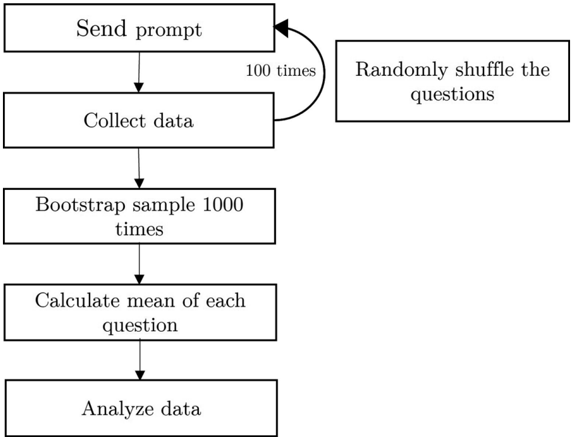
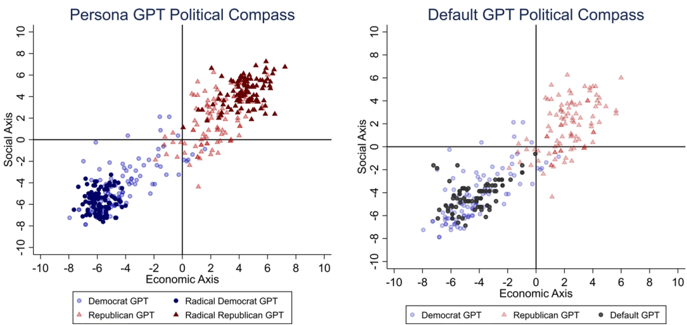
We investigate the political bias of a large language model (LLM), ChatGPT, which has become popular for retrieving factual information and generating content. Although ChatGPT assures that it is impartial, the literature suggests that LLMs exhibit bias involving race, gender, religion, and political orientation. Political bias in LLMs can have adverse political and electoral consequences similar to bias from traditional and social media. Moreover, political bias can be harder to detect and eradicate than gender or racial bias. We propose a novel empirical design to infer whether ChatGPT has political biases by requesting it to impersonate someone from a given side of the political spectrum and comparing these answers with its default. We also propose dose-response, placebo, and profession-politics alignment robustness tests. To reduce concerns about the randomness of the generated text, we collect answers to the same questions 100 times, with question order randomized on each round. We find robust evidence that ChatGPT presents a significant and systematic political bias toward the Democrats in the US, Lula in Brazil, and the Labour Party in the UK. These results translate into real concerns that ChatGPT, and LLMs in general, can extend or even amplify the existing challenges involving political processes posed by the Internet and social media. Our findings have important implications for policymakers, media, politics, and academia stakeholders.
Overview
The claims and statistics of this paper haven’t been checked yet.
Free: it reads the open-access text and checks the first 5 claims that cite a source we can check. Create a free account to check every claim.
Integrity signals
Registry
Cites
Statistics
Figures
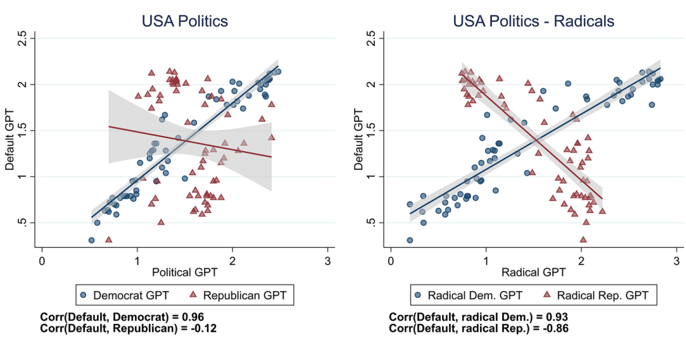
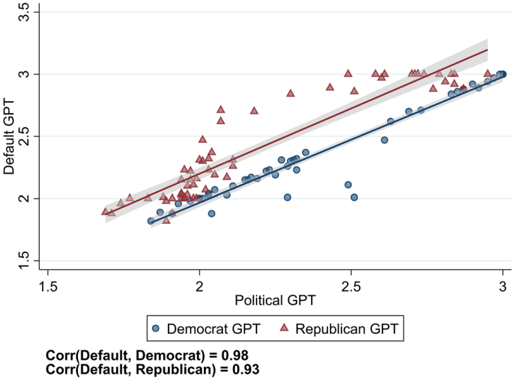
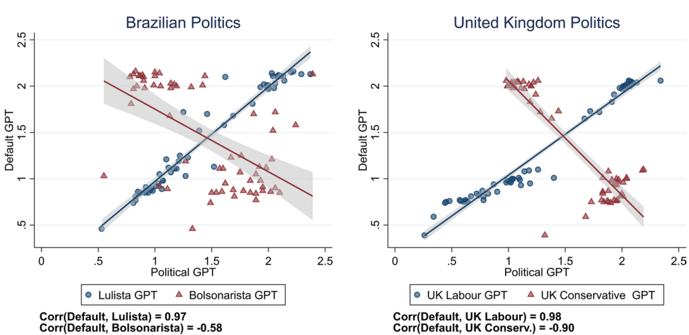
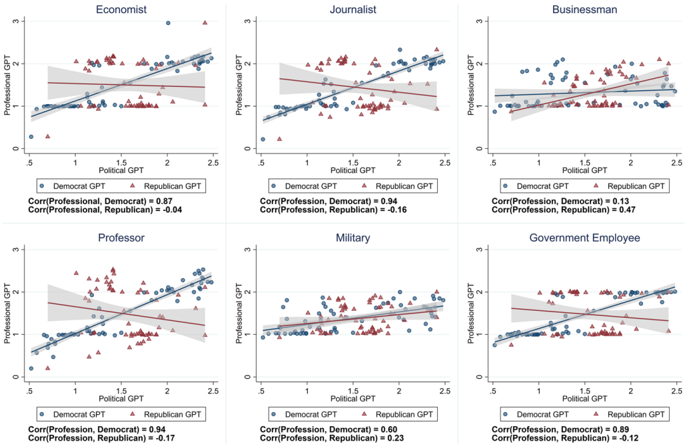
Verification
Claims the paper makes
The claims and statistics of this paper haven’t been checked yet.
Free: it reads the open-access text and checks the first 5 claims that cite a source we can check. Create a free account to check every claim.
Claims other papers make about this one
Each is checked against this paper’s own text: does it say what the citing paper says it does?
The cited source says what the claim attributes to it.
In the citing paper
“On one hand, we must be mindful that several studies have underscored the ways in which the outputs of GenAI tools like ChatGPT can inadvertently reinforce biases in areas such as gender and politics (Gross, 2023; Motoki et al., 2024; Rutinowski et al., 2024).”
From If ChatGPT can do it, where is my creativity? generative AI boosts performance but diminishes experience in creative writing (2025) · cites this paper as Motoki et al., 2024
The cited source says what the claim attributes to it.
In the citing paper
“Available data point to ChatGPT output expressing more progressive than traditional political views [38][39][40].”
From The Impact of Artificial Intelligence on Human Sexuality: A Five-Year Literature Review 2020–2024 (2024) · cites this paper as [39]
Self-check
Percentages, sums and reported differences re-computed from the paper’s own numbers.
The self-check needs the paper’s full text.
Citations
Cites
Semantics derived automatically from language corpora contain human-like biases
Caliskan, A., Bryson, J. J., & Narayanan, A. (2017) · Science · doi:10.1126/science.aal4230 · Cited by 2,887 · cited 3×
“It is particularly important that our method does not need access to the inner parameters of the LLM, like word embeddings (Caliskan et al., 2017), as companies make them opaque or costly due to competition concerns (Vincent, 2023; Science Media Centre, 2023), nor advanced programming skills.”
Generative Agents: Interactive Simulacra of Human Behavior
Park, J. S., O'Brien, J., Cai, C. J., Morris, M. R., Liang, P., & Bernstein, M. S. (2023) · Proceedings of the 36th Annual ACM Symposium on User Interface Software and Technology · doi:10.1145/3586183.3606763 · Cited by 2,187 · cited 1×
“Finally, Park et al. (2023) document that ChatGPT can simulate human behavior, taking actions that vary with the agents’ experiences and environment.”
Generative Agents: Interactive Simulacra of Human Behavior
Park, J. S., O'Brien, J. C., Cai, C. J., Morris, M. R., Liang, P., & Bernstein, M. S. (2023) · arXiv · doi:10.48550/arxiv.2304.03442 · Cited by 2,173 · cited 1×
“Finally, Park et al. (2023) document that ChatGPT can simulate human behavior, taking actions that vary with the agents’ experiences and environment.”
ChatGPT: five priorities for research
van Dis, E. A. M., Bollen, J., Zuidema, W., van Rooij, R., & Bockting, C. L. (2023) · Nature · doi:10.1038/d41586-023-00288-7 · Cited by 1,842 · cited 2×
“We answer a call from van Dis et al. (2023) to hold LLMs on to human verification, addressing the standing issue of the lack of a reliable method for measuring their biases.”
Chollet, F. (2017) · Cited by 1,158
Gentzkow, M., & Shapiro, J. M. (2006) · Journal of Political Economy · doi:10.1086/499414 · Cited by 1,013 · cited 1×
“One avenue is understanding channels and implications of bias through modeling (Castañeda & Martinelli, 2018; Gentzkow & Shapiro, 2006).”
Groseclose, T., & Milyo, J. (2005) · The Quarterly Journal of Economics · doi:10.1162/003355305775097542 · Cited by 991 · cited 2×
“We focus on the issue of political bias, as it can have major social consequences (Bernhardt et al., 2008; Chiang & Knight, 2011; Groseclose & Milyo, 2005; Levendusky, 2013) and is subtler than other biases (Peters, 2022).”
Graphs in Statistical Analysis
Anscombe, F. J. (1973) · The American Statistician · doi:10.1080/00031305.1973.10478966 · Cited by 976
Out of One, Many: Using Language Models to Simulate Human Samples
Argyle, L. P., Busby, E. C., Fulda, N., Gubler, J. R., Rytting, C., & Wingate, D. (2023) · Political Analysis · doi:10.1017/pan.2023.2 · Cited by 783 · cited 3×
“We know from existing literature that certain professions are more aligned with Democrats or with Repub-licans, as detailed in Table 5, and we know that ChatGPT can correctly reproduce known distributions from specific subgroups (Argyle et al., 2022).”
InfluentialSocial Media, News Consumption, and Polarization: Evidence from a Field Experiment
Levy, R. (2021) · American Economic Review · doi:10.1257/aer.20191777 · Cited by 624
Research works printed but not linked: 3
- Brown, T. B., Mann, B., Ryder, N., Subbiah, M., Kaplan, J., Dhariwal, P. & Amodei, D. (2020) 07. Lan- guage models are few-shot learners. arXiv.
- Cameron, A. C. & Trivedi, P. K. (2022). Microeconometrics using Stata (2nd ed.). College StationStata Press.
- Jelveh, Z., Kogut, B. & Naidu, S. (2022). Political language in economics [SSRN Scholarly Paper].
Cited by
Items 301–353 of 353
Forget Data-Only Optimization for Unlearning
Wang, Y. (2026) · Synthesis lectures on computer vision · doi:10.1007/978-3-032-17282-2_4
Same Model, Different Politics? How Language Shapes AI IdeologyPreprint
Levy-Yeyati, E. L., Ciappa, C. M., & Onofri, M. (2026) · SSRN Electronic Journal · doi:10.2139/ssrn.6772263
Thiele, J., & Sindermann, C. (2026) · Computers in Human Behavior Reports · doi:10.1016/j.chbr.2026.101137 · Cited by 3
Baek, S., Lee, S., Kim, H., & Park, S. (2026) · American Journal of Preventive Medicine · doi:10.1016/j.amepre.2026.108454 · Cited by 1
Do AI Models Have Values? Measuring Cultural Value Orientations Across 30 Large Language Models
Zhang, S., & Han, Q. (2026) · IEEE Conference on Artificial Intelligence (CAI) · doi:10.1109/cai68641.2026.11536432 · Cited by 1
“Prior audits of LLM bias have emphasized political ideology and issue-position tests [6], [7].”
Jin, Y. (2026) · SocArXiv (OSF Preprints) · doi:10.2139/ssrn.6876161
A conversational AI toolkit for citizen deliberation in party primary elections
Jiménez, F. R. V., & Malý, M. (2026) · Open Research Europe · doi:10.12688/openreseurope.24102.1
“…ideological biases that vary by training and reinforcement, to generate persuasive content optimised for engagement rather than accuracy and to influence user beliefs in ways that are not always transparent (Goldstein et al., 2023; Motoki, Pinho Neto, & Rodrigues, 2024; Salvi et al., 2024).”
SoK: A taxonomy of LLM threats
Stylianou, I., Bountakas, P., Zarras, A., Farao, A., Bolgouras, V., & Xenakis, C. (2026) · Computer Science Review · doi:10.1016/j.cosrev.2026.101013 · Cited by 2
Rozado, D., & Tetlock, P. E. (2026) · Theory and Society · doi:10.1007/s11186-026-09719-6 · Cited by 1
When LLMs Give Voting Advice: Bias, Coherence, and Educational Risk
Abed, O., Basri, R., Bök, P.-B., & Große-Kampmann, M. (2026) · Lecture notes in computer science · doi:10.1007/978-3-032-29773-0_23
Bias in Generative Outputs: Evidence from Text and Text-to-Image Systems
Spennemann, D. H. R. (2026) · Springer eBooks · doi:10.1007/978-3-031-75316-9_157-1 · Cited by 1
Zhou, J., & Zhou, T. (2026) · Philosophy of engineering and technology · doi:10.1007/978-981-95-8023-1_8 · Cited by 1
INTELIGÊNCIA ARTIFICIAL E PROPAGANDA ELEITORAL: NOVOS DESAFIOS À DEMOCRACIA INDIRETA
Correra, M. C., & Pereira, C. J. L. (2026) · Revista Multidisciplinar do Nordeste Mineiro · doi:10.66104/8cbpz192 · Cited by 1
Impartial Intelligence? Evidence of Country-Label Sensitivity in AI Financial Analysis
Motoki, F., & Pinto, J. (2026) · Journal of Business Ethics · doi:10.1007/s10551-026-06385-7 · Cited by 1
Self-citationLanger, Y., Nguyen, C., & Fischer, M. (2026) · Lecture notes in computer science · doi:10.1007/978-3-032-29596-5_9
Wang, C.-C., Liu, F.-C., Xie, J., Lai, C.-M., & Lin, C.-S. (2026) · Education and Information Technologies · doi:10.1007/s10639-026-14086-x
“Another issue is that the literature suggests LLMs exhibit biases (Motoki et al., 2024 ).”
Jovic, M., & Ćirović, M. (2026) · Research Square · doi:10.21203/rs.3.rs-10249462/v1
Dubey, S., Arora, H., & Kaushik, A. (2026) · Electronics · doi:10.3390/electronics15143003
Synthetic data and digital twins: The hype, the facts, the promise
Toubia, O. (2026) · Current Opinion in Psychology · doi:10.2139/ssrn.7065919
Institutional AI communication: publisher ideology and perceived algorithmic fairness
Chung, U. C., Kim, W., Lee, S. Y., Park, S. I., & Chang, J. (2026) · AI and Ethics · doi:10.1007/s43681-026-01266-1
“…demonstrate that political identity influences perceptions of algorithmic bias [28], that evaluations of algorithmic fairness depend on perceived fairness–accuracy tradeoffs [ 29], and that concerns regarding political bias have extended to evaluations of generative AI systems themselves [30, 31].”
Can Conservatism Mitigate the AI Alignment Problem?Preprint
de Vries, B. (2026) · SSRN Electronic Journal · doi:10.2139/ssrn.7117938
AI-Assisted Academic Writing as an Inquisitorial Appellate CourtPreprint
Sarel, R. (2026) · SSRN Electronic Journal · doi:10.2139/ssrn.6535239
Allocating Human Oversight in AI-Enabled AnalyticsPreprint
Ye, Z., Lyu, J., & Tao, R. (2026) · SSRN Electronic Journal · doi:10.2139/ssrn.6561778
Woo, H. J., & Kim, M. (2026) · Scientific Reports · doi:10.1038/s41598-026-64139-x
Kim, D., Park, G., Park, J. S., & Lee, T. (2026) · Behavior Research Methods · doi:10.3758/s13428-026-03133-7
“Nevertheless, concerns regarding potential model biases and output inconsistencies remain, underscoring the need for cautious interpretation and rigorous validation of generated data (Motoki et al., 2024; Sale-cha et al., 2024).”
Cultural asymmetry in generative AI systems through the lens of Kazakh ethical philosophy
Turarbekova, L., Нурышева, Г., Azerbayev, A., & Amrebayeva, Z. (2026) · AI & Society · doi:10.1007/s00146-026-03195-3
MacKay, M., Gosselin, S., Sonier, K., Wong, J., Zamani, S., Zarrinkalam, F., & McWhirter, J. E. (2026) · Journal of Health Communication · doi:10.1080/10810730.2026.2709807
A Sociological Eye on AI. Key Concepts, Analytical Dimensions, and Methodological Tensions
Solaroli, M., & Garzonio, E. (2026) · Sociologica · doi:10.60923/issn.1971-8853/23907
“Alongside these dichotomies, a substantial body of scholarly research has focused on specific issues of AI bias, accuracy, authenticity, authorship, and evidentiary power (Baert et al., 2025; Elliott, 2022; Bender et al., 2021; Nadeem et al., 2022; Motoki et al., 2023; Schneider & Hagendorff, 2025).”
Not for people like me: How frontier AI models redirect skeptical rural school staff
Rossmiller, Z. (2026) · Computers and Education Artificial Intelligence · doi:10.1016/j.caeai.2026.100659
Machines Referencing the Qurʾan: Citation Patterns in LLM-Generated Islam
Svensson, J. (2026) · Journal of digital Islamicate research. · doi:10.1163/27732363-12340003
Ashby‐King, D. T., Salzano, M., & Noonan, I. G. (2026) · Public Relations Review · doi:10.1016/j.pubrev.2026.102759
Palicki, S.-K., Bravo, I., & Claessen, C. (2026) · Social Science Computer Review · doi:10.1177/08944393261473230
Can Democracy Survive Radical Cognitive Divergence?Preprint
de Vries, B., & Gibbons, A. F. (2026) · SSRN Electronic Journal · doi:10.2139/ssrn.7386398
Angelis, C. D. (2026) · Revista de ciencias sociales. · doi:10.61303/0718-3631.v35i57.605
Uzunoğlu, S., & Uzunoğlu, D. (2026) · Research Square · doi:10.21203/rs.3.rs-10519741/v1
Ideology by Alphabet: Option Order and the Measurement of Machine Political PreferencesPreprint
Olah, T., Erdey, L., Tőkés, T., & Nádasi, L. (2026) · Research Square · doi:10.21203/rs.3.rs-11063104/v1
A Corpus for Evaluating Neutrality in Political Biographies on Wikipedia: NeutralWikiPol-Fr
Planche, V., Jourlin, P., & Marrel, G. (2026) · Lecture notes in computer science · doi:10.1007/978-3-032-39150-6_10
Chandra, Y., & Tan, J. (2026) · Policy Studies Journal · doi:10.1111/psj.70165
LangBiTe: model-driven bias testing of text-to-text large language models
Morales, S., Clarisó, R., & Cabot, J. (2026) · Software & Systems Modeling · doi:10.1007/s10270-026-01425-2
Which AI? A Comparative Evaluation of Generative AI and Neuro‐Symbolic AI for Silicon Sampling
Zahradníčková, K., Polišenský, J., Lukeš, M., Hranický, R., & Pouč, P. (2026) · Psychology and Marketing · doi:10.1002/mar.70272 · Cited by 1
Pavlíček, M., Štěpánek, L., Kotyrba, M., & Volná, E. (2026) · Machine Learning and Knowledge Extraction · doi:10.3390/make8100303
Mendybaev, B. (2026) · GUMILYOV JOURNAL OF SOCIOLOGY · doi:10.32523/3080-1702-2026-156-3-63-72
Large language models exhibit status quo bias in climate-relevant advice
Wynes, S., Shah, A., & Milardović, V. (2026) · Environmental Research Communications · doi:10.1088/2515-7620/aea1eb
“An extensive literature has also investigated the biases of LLMs in terms of gender (Wan et al 2023), politics (Fang et al 2024, Motoki et al 2024) and more (Bengio et al 2025).”
Sopiyah, I. (2026) · Journal of Citizenship · doi:10.37950/joc.v5i3.853
“…peluang untuk memperluas civic knowledge sekaligus risiko baru berupa halusinasi, bias, persuasi terpersonalisasi, deepfake, dan ketergantungan pada platform komersial (Danaher, 2016; Jungherr, 2023; Jungherr & Schroeder, 2023; Kreps & Kriner, 2023; Matz et al., 2024; Motoki et al., 2024).”
Perceived political bias in large language models reduces persuasive abilities
DiGiuseppe, M. R., & Robison, J. (2026) · PNAS Nexus · doi:10.1093/pnasnexus/pgag324 · Cited by 3
From cyberspeak to algorithmic newspeak: soft derogation and the ethics of AI-generated language
Kardum, M., & Skelac, I. (2026) · Kybernetes · doi:10.1108/k-05-2026-1196
Just a Simulation? A Review of Large Language Models as Subjects in Experimental EconomicsPreprint
Kitadai, A., & Nishino, N. (2026) · SSRN Electronic Journal · doi:10.2139/ssrn.7613458
Generative AI for Work, Democracy, and Gender: The Good, the Bad, and the Unknown
Sartori, L., & Piva, R. (2026) · Springer eBooks · doi:10.1007/978-3-031-61050-9_27-1 · Cited by 1
Changing Tunes: A Longitudinal Study of Political Drift in LLMsPreprint
Nogueira, B. D., Perdekamp, J. G., Swazinna, L., Kirsten, E., Köbis, N., Kulshrestha, J., Pauly, M., & Zafar, M. B. (2026) · SSRN Electronic Journal · doi:10.2139/ssrn.7662460 · Cited by 1
Machine Behavior: Paradigm Shift of Communication Research in AI Era
Zhang, H., Lin, R., Ren, W., & Wang, J. (2026) · Communication and the Public · doi:10.1177/20570473261490141
Ge, W., Li, Y., Wen, Q., Zhu, Q., Hu, Y., & Wang, B. (2026) · Computers in Human Behavior Reports · doi:10.1016/j.chbr.2026.101412
Metadata
- Authors
- Motoki, F., Pinho Neto, V., & Rodrigues, V.
- Affiliations
- University of East Anglia (GB)
- Corresponding author
- Motoki, Fabio
- Venue
- Public Choice
- Published
- 2023-08-17
- Volume
- 198
- Issue
- 1-2
- Pages
- 3-23
- ISSN
- 0048-5829 (ISSN-L)
- 1573-7101
- OpenAlex
- W4385852384
- Semantic Scholar
- 3d8a3517231643c1df79bc32c8c2664a4cba3a41
- Cited by
- 329
- References
- 44
- Citations by year
- 2026: 94 · 2025: 125 · 2024: 81 · 2023: 28
- FWCI
- 81.89
- Type
- journal article
- Language
- en
- Open access
- hybrid
- doi.org
- Licence
- cc-by
- creativecommons.org/licenses/by/4.0 (tdm)
- creativecommons.org/licenses/by/4.0 (vor)
- Locations
- Public Choice (publishedVersion, cc-by)
- SSRN Electronic Journal (acceptedVersion)
- UEA Digital Repository (University of East Anglia) (acceptedVersion)
- RePEc: Research Papers in Economics (submittedVersion)
- UEA Digital Repository (University of East Anglia) (submittedVersion)
- Funders
- Coordenação de Aperfeiçoamento de Pessoal de Nível Superior (Finance Code 001)
- Topics
- Physical Sciences › Computer Science › Artificial Intelligence › Ethics and Social Impacts of AI
- Social Sciences › Communication › Social Media and Politics
- Social Sciences › Sociology and Political Science › Media Influence and Politics
- Keywords
- ChatGPT, large language models, political bias, algorithmic bias, impersonation, placebo tests, robustness testing, Luiz Inácio Lula da Silva, Labour Party, political polarization, AI-generated text
About these checks
Registry, retraction, Cites and statistics results are computed, not judged, with one exception: a printed reference that no index lists is read once by a model before it counts as a citation error. Claims are extracted by a model and kept only when their quote appears verbatim in the text; each cited source is then checked, with a model’s help, for whether it says what the claim relies on. Those verdicts can be wrong — read the claim’s quote and the cited source before relying on one.
Statistics and arithmetic are recomputed, not judged.
Confidence bands are shown only for fields calibrated on our annotated test set. None is calibrated yet, so no band is shown.
What counts as a claim ›How we measure confidence ›How we check this ›
Are you an author, or do you see a problem with this page? Request a review
Data sources
Bibliographic data: Semantic Scholar, OpenAlex, Crossref.
Contains information from the Semantic Scholar Academic Graph Datasets, made available under the ODC Attribution License (ODC-BY 1.0).
Semantic Scholar’s data is described in: Kinney, R., et al. (2023). The Semantic Scholar Open Data Platform. arXiv:2301.10140.
