

More human than human: measuring ChatGPT political bias
Open accessThe DOI matches its Crossref record; 49 of the 49 references it cites were found in a registry or an index.
Abstract
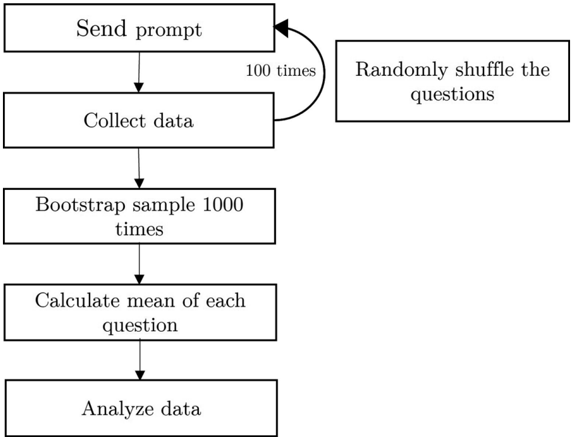
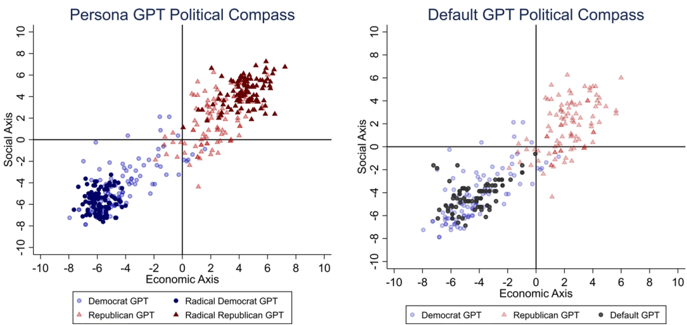
We investigate the political bias of a large language model (LLM), ChatGPT, which has become popular for retrieving factual information and generating content. Although ChatGPT assures that it is impartial, the literature suggests that LLMs exhibit bias involving race, gender, religion, and political orientation. Political bias in LLMs can have adverse political and electoral consequences similar to bias from traditional and social media. Moreover, political bias can be harder to detect and eradicate than gender or racial bias. We propose a novel empirical design to infer whether ChatGPT has political biases by requesting it to impersonate someone from a given side of the political spectrum and comparing these answers with its default. We also propose dose-response, placebo, and profession-politics alignment robustness tests. To reduce concerns about the randomness of the generated text, we collect answers to the same questions 100 times, with question order randomized on each round. We find robust evidence that ChatGPT presents a significant and systematic political bias toward the Democrats in the US, Lula in Brazil, and the Labour Party in the UK. These results translate into real concerns that ChatGPT, and LLMs in general, can extend or even amplify the existing challenges involving political processes posed by the Internet and social media. Our findings have important implications for policymakers, media, politics, and academia stakeholders.
Overview
The claims and statistics of this paper haven’t been checked yet.
Free: it reads the open-access text and checks the first 5 claims that cite a source we can check. Create a free account to check every claim.
Integrity signals
Registry
Cites
Statistics
Figures
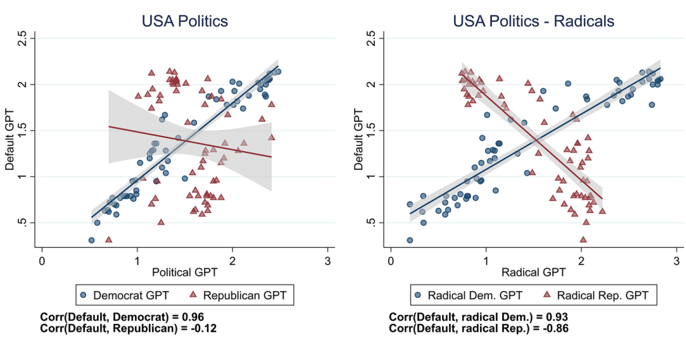
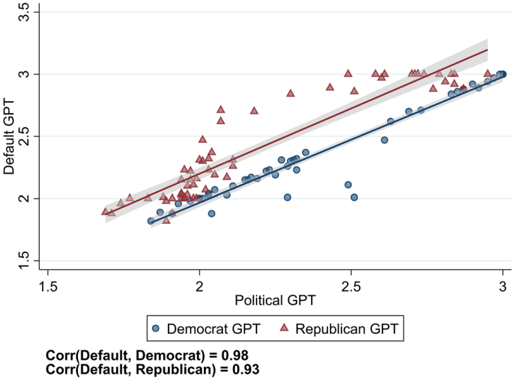
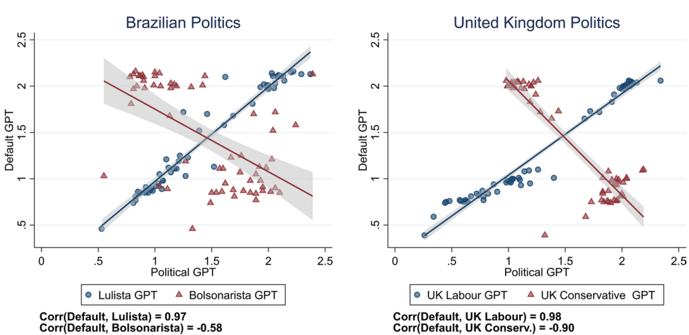
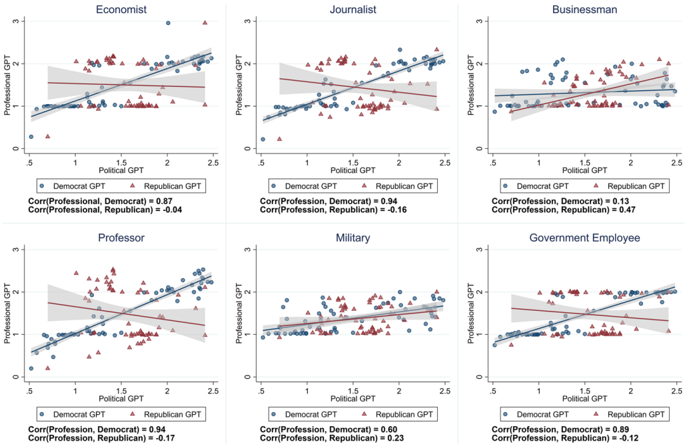
Verification
Claims the paper makes
The claims and statistics of this paper haven’t been checked yet.
Free: it reads the open-access text and checks the first 5 claims that cite a source we can check. Create a free account to check every claim.
Claims other papers make about this one
Each is checked against this paper’s own text: does it say what the citing paper says it does?
The cited source says what the claim attributes to it.
In the citing paper
“On one hand, we must be mindful that several studies have underscored the ways in which the outputs of GenAI tools like ChatGPT can inadvertently reinforce biases in areas such as gender and politics (Gross, 2023; Motoki et al., 2024; Rutinowski et al., 2024).”
From If ChatGPT can do it, where is my creativity? generative AI boosts performance but diminishes experience in creative writing (2025) · cites this paper as Motoki et al., 2024
The cited source says what the claim attributes to it.
In the citing paper
“Available data point to ChatGPT output expressing more progressive than traditional political views [38][39][40].”
From The Impact of Artificial Intelligence on Human Sexuality: A Five-Year Literature Review 2020–2024 (2024) · cites this paper as [39]
Self-check
Percentages, sums and reported differences re-computed from the paper’s own numbers.
The self-check needs the paper’s full text.
Citations
Cites
Semantics derived automatically from language corpora contain human-like biases
Caliskan, A., Bryson, J. J., & Narayanan, A. (2017) · Science · doi:10.1126/science.aal4230 · Cited by 2,887 · cited 3×
“It is particularly important that our method does not need access to the inner parameters of the LLM, like word embeddings (Caliskan et al., 2017), as companies make them opaque or costly due to competition concerns (Vincent, 2023; Science Media Centre, 2023), nor advanced programming skills.”
Generative Agents: Interactive Simulacra of Human Behavior
Park, J. S., O'Brien, J., Cai, C. J., Morris, M. R., Liang, P., & Bernstein, M. S. (2023) · Proceedings of the 36th Annual ACM Symposium on User Interface Software and Technology · doi:10.1145/3586183.3606763 · Cited by 2,187 · cited 1×
“Finally, Park et al. (2023) document that ChatGPT can simulate human behavior, taking actions that vary with the agents’ experiences and environment.”
Generative Agents: Interactive Simulacra of Human Behavior
Park, J. S., O'Brien, J. C., Cai, C. J., Morris, M. R., Liang, P., & Bernstein, M. S. (2023) · arXiv · doi:10.48550/arxiv.2304.03442 · Cited by 2,173 · cited 1×
“Finally, Park et al. (2023) document that ChatGPT can simulate human behavior, taking actions that vary with the agents’ experiences and environment.”
ChatGPT: five priorities for research
van Dis, E. A. M., Bollen, J., Zuidema, W., van Rooij, R., & Bockting, C. L. (2023) · Nature · doi:10.1038/d41586-023-00288-7 · Cited by 1,842 · cited 2×
“We answer a call from van Dis et al. (2023) to hold LLMs on to human verification, addressing the standing issue of the lack of a reliable method for measuring their biases.”
Chollet, F. (2017) · Cited by 1,158
Gentzkow, M., & Shapiro, J. M. (2006) · Journal of Political Economy · doi:10.1086/499414 · Cited by 1,013 · cited 1×
“One avenue is understanding channels and implications of bias through modeling (Castañeda & Martinelli, 2018; Gentzkow & Shapiro, 2006).”
Groseclose, T., & Milyo, J. (2005) · The Quarterly Journal of Economics · doi:10.1162/003355305775097542 · Cited by 991 · cited 2×
“We focus on the issue of political bias, as it can have major social consequences (Bernhardt et al., 2008; Chiang & Knight, 2011; Groseclose & Milyo, 2005; Levendusky, 2013) and is subtler than other biases (Peters, 2022).”
Graphs in Statistical Analysis
Anscombe, F. J. (1973) · The American Statistician · doi:10.1080/00031305.1973.10478966 · Cited by 976
Out of One, Many: Using Language Models to Simulate Human Samples
Argyle, L. P., Busby, E. C., Fulda, N., Gubler, J. R., Rytting, C., & Wingate, D. (2023) · Political Analysis · doi:10.1017/pan.2023.2 · Cited by 783 · cited 3×
“We know from existing literature that certain professions are more aligned with Democrats or with Repub-licans, as detailed in Table 5, and we know that ChatGPT can correctly reproduce known distributions from specific subgroups (Argyle et al., 2022).”
InfluentialSocial Media, News Consumption, and Polarization: Evidence from a Field Experiment
Levy, R. (2021) · American Economic Review · doi:10.1257/aer.20191777 · Cited by 624
Research works printed but not linked: 3
- Brown, T. B., Mann, B., Ryder, N., Subbiah, M., Kaplan, J., Dhariwal, P. & Amodei, D. (2020) 07. Lan- guage models are few-shot learners. arXiv.
- Cameron, A. C. & Trivedi, P. K. (2022). Microeconometrics using Stata (2nd ed.). College StationStata Press.
- Jelveh, Z., Kogut, B. & Naidu, S. (2022). Political language in economics [SSRN Scholarly Paper].
Cited by
(2024) · doi:10.1109/access.2024.3365742 · Cited by 934
“This is due to the inherent biases in the training data, which are assimilated by the model and reflected in its responses [181].”
BackgroundHarnessing the power of AI in qualitative research: Exploring, using and redesigning ChatGPT
Zhang, H., Wu, C., Xie, J., Lyu, Y., Cai, J., & Carroll, J. M. (2025) · Computers in Human Behavior Artificial Humans · doi:10.1016/j.chbah.2025.100144 · Cited by 410
“First, there is a risk that AI systems, including ChatGPT, might inadvertently perpetuate existing biases in their training data [74].”
Synthetic Replacements for Human Survey Data? The Perils of Large Language Models
Bisbee, J., Clinton, J. D., Dorff, C., Kenkel, B., & Larson, J. M. (2024) · Political Analysis · doi:10.1017/pan.2024.5 · Cited by 209
“Our findings raise serious questions about the use and performance of LLMs for the characterization of public opinion and the creation of synthetic data, connecting with a growing body of research that asks similar questions (Bender et al. 2021; Spirling 2023) and documents similar issues (Abdulhai…”
The Self-Perception and Political Biases of ChatGPT
Rutinowski, J., Franke, S., Endendyk, J., Dormuth, I., & Pauly, M. (2023) · arXiv · doi:10.48550/arxiv.2304.07333 · Cited by 178
“Compared to the publications that conducted similar tests with ChatGPT [24], [25], [28], [29], we also obtain results indicating a political bias of ChatGPT towards progressive views.”
BackgroundMethodResultInfluentialStorey, V. C., Yue, W. T., Zhao, J. L., & Lukyanenko, R. (2025) · Information Systems Frontiers · doi:10.1007/s10796-025-10581-7 · Cited by 296
“Tools such as ChatGPT, have been shown to exhibit a variety of such biases, including political, moral and cultural (Motoki et al., 2024).”
Rethinking machine unlearning for large language models
Liu, S., Yao, Y., Jia, J., Casper, S., Baracaldo, N., Hase, P., Yao, Y., Liu, C. Y., Xu, X., Li, H., et al. (2025) · Nature Machine Intelligence · doi:10.1038/s42256-025-00985-0 · Cited by 643
“These include societal biases and stereotyping Bender et al. (2021); Motoki et al. (2023); Kotek et al. (2023), the generation of sensitive, private, harmful, or illegal content Nasr et al. (2023); Wen et al. (2023); Karamolegkou et al. (2023); Patil et al. (2024), ease of jailbreaking Wei et al.…”
Akpan, I. J., Kobara, Y. M., Owolabi, J., Akpan, A. A., & Offodile, O. F. (2025) · International Transactions in Operational Research · doi:10.1111/itor.13522 · Cited by 137
Ethical ChatGPT: Concerns, Challenges, and Commandments
Zhou, J., Müller, H., Holzinger, A., & Chen, F. (2024) · Electronics · doi:10.3390/electronics13173417 · Cited by 128
Safeguarding large language models: a survey
Dong, Y., Mu, R., Zhang, Y., Sun, S., Zhang, T., Wu, C., Jin, G., Qi, Y., Hu, J., Meng, J., et al. (2025) · Artificial Intelligence Review · doi:10.1007/s10462-025-11389-2 · Cited by 323
“The presence of political bias is examined in ChatGPT, focusing on aspects such as race, gender, religion, and political orientation [50].”
AI for social science and social science of AI: A survey
Xu, R. F., Sun, Y., Ren, M., Guo, S., Pan, R., Lin, H., Sun, L., & Han, X. (2024) · Information Processing & Management · doi:10.1016/j.ipm.2024.103665 · Cited by 227
Using ChatGPT for human–computer interaction research: a primer
Tabone, W., & de Winter, J. (2023) · Royal Society Open Science · doi:10.1098/rsos.231053 · Cited by 116
Responsible governance of generative AI: conceptualizing GenAI as complex adaptive systems
Janssen, M. (2025) · Policy and Society · doi:10.1093/polsoc/puae040 · Cited by 174
How understanding large language models can inform the use of ChatGPT in physics education
Polverini, G., & Gregorcic, B. (2024) · European Journal of Physics · doi:10.1088/1361-6404/ad1420 · Cited by 107
“Researchers have reported that LLMs exhibit bias regarding gender [36,37], race [38,39], religion and caste [40], as well as political views [41].”
BackgroundFoundation Model for Advancing Healthcare: Challenges, Opportunities and Future Directions
He, Y., Huang, F., Jiang, X., Nie, Y., Wang, M., Wang, J., & Chen, H. (2024) · IEEE Reviews in Biomedical Engineering · doi:10.1109/rbme.2024.3496744 · Cited by 248
“Some work has unearthed pervasive biases and stereotypes in LFMs [252], [253].”
The Social Impact of Generative AI: An Analysis on ChatGPT
Baldassarre, M. T., Caivano, D., Fernandez Nieto, B., Gigante, D., & Ragone, A. (2023) · Proceedings of the 2023 ACM Conference on Information Technology for Social Good · doi:10.1145/3582515.3609555 · Cited by 112
Large language models as a substitute for human experts in annotating political text
Heseltine, M., & von Hohenberg, B. C. (2024) · Research & Politics · doi:10.1177/20531680241236239 · Cited by 217
“Biases inherent in the training of these models (Bisbee et al., 2023; Motoki et al., 2024) may seep into text annotation, especially ones more speci fi c or contentious than the classi fi - cations done here.”
BackgroundPerils and opportunities in using large language models in psychological research
Abdurahman, S., Atari, M., Karimi-Malekabadi, F., Xue, M. J., Trager, J., Park, P. S., Golazizian, P., Omrani, A., & Dehghani, M. (2024) · PNAS Nexus · doi:10.1093/pnasnexus/pgae245 · Cited by 111
The political preferences of LLMs
Rozado, D. (2024) · PLOS ONE · doi:10.1371/journal.pone.0306621 · Cited by 83
“Shortly after the release of ChatGPT, its answers to political orientation tests were documented as manifesting left-leaning political preferences [11–13].”
BackgroundThe Security of Using Large Language Models: A Survey with Emphasis on ChatGPT
Zhou, W., Zhu, X., Han, Q.-L., Li, L., Chen, X., Wen, S., & Xiang, Y. (2025) · IEEE/CAA Journal of Automatica Sinica · doi:10.1109/jas.2024.124983 · Cited by 95
Guiding the way: a comprehensive examination of AI guidelines in global media
de‐Lima‐Santos, M., Yeung, W. N., & Dodds, T. (2024) · AI & Society · doi:10.1007/s00146-024-01973-5 · Cited by 151
“Moreover, top-down guidance and ethical standards are seen as essential for responsible AI use.”
The Self-Perception and Political Biases of ChatGPT
Rutinowski, J., Franke, S., Endendyk, J., Dormuth, I., Roidl, M., & Pauly, M. (2024) · Human Behavior and Emerging Technologies · doi:10.1155/2024/7115633 · Cited by 98
ChatGPT and the digitisation of writing
Zhao, X., Cox, A., & Cai, L. (2024) · Humanities and Social Sciences Communications · doi:10.1057/s41599-024-02904-x · Cited by 93
Exploring ChatGPT and its impact on society
Haque, M. A., & Li, S. (2024) · AI and Ethics · doi:10.1007/s43681-024-00435-4 · Cited by 115
“People are worried about biases in the design and impact of ChatGPT [61, 71].”
BackgroundPerformance and biases of large language models in public opinion simulation.
Qu, Y., & Wang, J. (2024) · Humanities and Social Sciences Communications · doi:10.1057/s41599-024-03609-x · Cited by 79
Urman, A., & Makhortykh, M. (2024) · Telematics and Informatics · doi:10.1016/j.tele.2024.102211 · Cited by 113
Wong, W. K. O. (2024) · Journal of Open Innovation: Technology, Market, and Complexity · doi:10.1016/j.joitmc.2024.100278 · Cited by 59
Karjus, A. (2025) · Humanities and Social Sciences Communications · doi:10.1057/s41599-025-04503-w · Cited by 32
“These issues have been and will be discussed elsewhere (Bender et al. 2021; Binz and Schulz 2023; Rooij et al. 2024; Feng et al. 2023; Hagendorff et al. 2024; Liesenfeld et al. 2023; Lund et al. 2023; Motoki et al. 2023; Novozhilova et al. 2024; Ollion et al. 2024; Tomlinson et al. 2024).”
Algorithmic Literacy, AI Literacy and Responsible Generative AI Literacy
Cox, A. (2024) · Journal of Web Librarianship · doi:10.1080/19322909.2024.2395341 · Cited by 67
“• It produces statements containing unacknowledged and harmful bias, e.g. studies have shown it has political bias but also reproduces sexist and racist stereotypes (Deshpande et al., 2023; Motoki et al., 2023).”
ChatGPT in finance: Applications, challenges, and solutions
Khan, M. S., & Umer, H. (2024) · Heliyon · doi:10.1016/j.heliyon.2024.e24890 · Cited by 67
“Even if we elicit multiple responses from ChatGPT for the same prompt, a lack of general consensus on evaluating these responses, especially in the case of assessing biased outcomes, can lead to contradicting results [17].”
BackgroundResultRahimzadeh, V., Kostick-Quenet, K., Blumenthal Barby, J., & McGuire, A. L. (2023) · The American Journal of Bioethics · doi:10.1080/15265161.2023.2233358 · Cited by 66
The Impact of Artificial Intelligence on Human Sexuality: A Five-Year Literature Review 2020–2024
Döring, N., Le, T. D., Vowels, L. M., Vowels, M. J., & Marcantonio, T. L. (2024) · Current Sexual Health Reports · doi:10.1007/s11930-024-00397-y · Cited by 65
Generative AI in Marketing: Promises, Perils, and Public Policy Implications
Kumar, V., Kotler, P., Gupta, S., & Rajan, B. (2024) · Journal of Public Policy & Marketing · doi:10.1177/07439156241286499 · Cited by 96
“…gender, race, religion, and other social constructs (e.g., Wan et al. 2023); (3) users ’ writing and thinking being in fl uenced through opinionated outputs (Jakesch et al. 2023); and (4) left-leaning bias (in politics) that can impact policy making (Motoki, Neto, and Rodrigues 2024; Rozado 2023).”
Cantens, T. (2024) · AI & Society · doi:10.1007/s00146-023-01840-9 · Cited by 80
“Similar questions are emerging on political neutrality, as recent research explores the “political biases” of GenAI (Motoki et al. 2023; Rozado 2023), calling for “ethical” GenAI to maintain its political “neutrality”.”
Tsuria, R., & Tsuria, Y. (2024) · Religions · doi:10.3390/rel15030375 · Cited by 84
“This finding aligns with a recent study by Motoki et al. (2023) which investigated ChatGPT’s political bias in several national contexts (the USA, UK, and Brazil).”
ResultGenerative AI in the context of assistive technologies: Trends, limitations and future directions
Fu, B., Hadid, A., & Damer, N. (2024) · Image and Vision Computing · doi:10.1016/j.imavis.2024.105347 · Cited by 67
Mei, P., Brewis, D. N., Nwaiwu, F., Sumanathilaka, D., Alva-Manchego, F., & Demaree-Cotton, J. (2025) · Computers in Human Behavior: Artificial Humans · doi:10.1016/j.chbah.2025.100140 · Cited by 50
“On one hand, we must be mindful that several studies have underscored the ways in which the outputs of GenAI tools like ChatGPT can inadvertently reinforce biases in areas such as gender and politics (Gross, 2023; Motoki et al., 2024; Rutinowski et al., 2024).”
Kacperski, C., Ulloa, R., Bonnay, D., Kulshrestha, J., Selb, P., & Spitz, A. (2025) · PLoS ONE · doi:10.1371/journal.pone.0309047 · Cited by 63
“While researchers have started to look into ChatGPT’s political bias [85,86] and its effects on political attitude formation [87] we could not identify any research on pre-existing differences in political self-perception and behavior and how this might affect CA usage, especially conversational…”
ChatGPT in Academic Writing: A Scientometric Analysis of Literature Published Between 2022 and 2023
Lendvai, G. F. (2025) · Journal of Empirical Research on Human Research Ethics · doi:10.1177/15562646251350203 · Cited by 60
“…purposes, as the platform regularly exhibits content and opinions that are diagnostic, educational, cultural, demographic, political and ideo-logical, and in some instances, even gender bias (Gross, 2023; Huang, 2024; Motoki et al., 2023; Qu & Wang, 2024; Rozado, 2023; Schmidt et al., 2024).”
Alvero, A. J., Lee, J., Regla-Vargas, A., Kizilcec, R. F., Joachims, T., & Antonio, A. L. (2024) · Journal of Big Data · doi:10.1186/s40537-024-00986-7 · Cited by 48
“Apart from sociodemographic biases, recent research has noted the distinct characteristics or “profiles” of LLMs. Specifically, it has been observed that these models exhibit a left-leaning bias in their responses [57, 61] and an affinity for Western cultural values [80].”
BackgroundGenerative AI Meets Open-Ended Survey Responses: Research Participant Use of AI and Homogenization
Zhang, S., Xu, J., & Alvero, A. (2025) · Sociological Methods & Research · doi:10.1177/00491241251327130 · Cited by 108
Systematic Biases in LLM Simulations of Debates
Taubenfeld, A., Dover, Y., Reichart, R., & Goldstein, A. (2024) · Proceedings of the 2024 Conference on Empirical Methods in Natural Language Processing · doi:10.18653/v1/2024.emnlp-main.16 · Cited by 47
“Furthermore, Motoki et al. (2024) reveals that ChatGPT exhibits pronounced political biases.”
Large language models and political science
Linegar, M., Kocielnik, R., & Alvarez, R. M. (2023) · Frontiers in Political Science · doi:10.3389/fpos.2023.1257092 · Cited by 42
From SOFT approach to SWOT analysis, a historical reconstruction
Puyt, R. W., Lie, F. B., & Madsen, D. Ø. (2024) · Journal of Management History · doi:10.1108/jmh-05-2023-0047 · Cited by 53
He, A. J., Zhang, Z., Anand, P., & McMinn, S. (2024) · Journal of Asian Public Policy · doi:10.1080/17516234.2024.2447195 · Cited by 53
“Generative AI-based content is not free from biases, and such biased content can thus interfere with academic learning if tools such as ChatGPT are used as a knowledge source (Motoki et al., 2023; Ray, 2023; Rutinowski et al., 2024).”
The impact of advanced AI systems on democracy
Summerfield, C., Argyle, L. P., Bakker, M. A., Collins, T., Durmus, E., Eloundou, T., Gabriel, I., Ganguli, D., Hackenburg, K., Hadfield, G. K., et al. (2025) · Nature Human Behaviour · doi:10.1038/s41562-025-02309-z · Cited by 89
“These studies have revealed that after safety fine-tuning (a post-training method designed to minimize harmful or illegal outputs 11 ), models favour more libertarian (for example, favouring deregulation) and progressive (for example, supporting civil rights) opinions 12–14 .”
Navigating the Ethical Terrain of AI-Generated Text Tools: A Review
Mohamed, Y. A., Mohamed, A. H. H. M., Khanan, A., Bashir, M., Adiel, M. A. E., & Elsadig, M. A. (2024) · IEEE Access · doi:10.1109/access.2024.3521945 · Cited by 54
Toubia, O., Gui, G., Peng, T., Merlau, D. J., Li, A., & Chen, H. (2025) · Marketing Science · doi:10.1287/mksc.2025.0262 · Cited by 103
Synthetic Replacements for Human Survey Data? The Perils of Large Language Models
Bisbee, J., Clinton, J. D., Dorff, C., Kenkel, B., & Larson, J. (2023) · doi:10.31235/osf.io/5ecfa · Cited by 213
Toward Artificial Empathy for Human-Centered Design
Zhu, Q., & Luo, J. (2023) · Journal of Mechanical Design · doi:10.1115/1.4064161 · Cited by 45
Opportunities, challenges and risks of using artificial intelligence for evidence synthesis
Siemens, W., von Elm, E. B., Binder, H., Böhringer, D., Eisele‐Metzger, A., Gartlehner, G., Hanegraaf, P., Metzendorf, M., Mosselman, J. J., Nowak, A. J., et al. (2025) · BMJ Evidence-Based Medicine · doi:10.1136/bmjebm-2024-113320 · Cited by 45
“13 If training data are biased, for example, by ignoring or under-representing certain population groups, the output will likely be biased and lead to skewed results of systematic reviews.”
Assessing political bias and value misalignment in generative artificial intelligence
Motoki, F. Y. S., Pinho Neto, V., & Rangel, V. (2025) · Journal of Economic Behavior & Organization · doi:10.1016/j.jebo.2025.106904 · Cited by 32
Self-citationIn generative AI we trust: can chatbots effectively verify political information?
Kuznetsova, E., Makhortykh, M., Vziatysheva, V., Stolze, M., Baghumyan, A., & Urman, A. (2025) · Journal of Computational Social Science · doi:10.1007/s42001-024-00338-8 · Cited by 32
“One suggestion for improving information quality is to counter false narratives, for example through inoculation and pre-bunking (Lewandowsky & Cook, 2020) which has shown promise in forming resistance to misinformation for at least 3 months (Maertens et al., 2021).”
Democratizing academic research with Artificial Intelligence: The misleading case of language
Ghio, A. (2023) · Critical Perspectives on Accounting · doi:10.1016/j.cpa.2023.102687 · Cited by 39
The cultural stereotype and cultural bias of ChatGPT
Yuan, H., Che, Z., Zhang, Y., Shao, L. H., Yuan, X., Huang, L., Hu, X., Peng, K., & Luo, S. (2025) · Journal of Pacific Rim Psychology · doi:10.1177/18344909251355673 · Cited by 38
“As a generative large language model, ChatGPT has strong anthropo-morphism (Waldrop, 2024); that is, it can simulate its speci fi c behavior based on the assumed identity (Motoki et al., 2023).”
Know Thyself, Improve Thyself: Personalized LLMs for Self-Knowledge and Moral Enhancement
Giubilini, A., Mann, S. P., Voinea, C., Earp, B. D., & Savulescu, J. (2024) · Science and Engineering Ethics · doi:10.1007/s11948-024-00518-9 · Cited by 41
Reinforcement Learning from Human Feedback in LLMs: Whose Culture, Whose Values, Whose Perspectives?
Barman, K. G., Lohse, S., & de Regt, H. W. (2025) · Philosophy & Technology · doi:10.1007/s13347-025-00861-0 · Cited by 58
“– RLHF can reinforce politically unbalanced judgements of the tutored models, an issue that seems to be associated with the demographic composition of the selected evaluators (Motoki et al., 2023).”
Machine Bias. How Do Generative Language Models Answer Opinion Polls?
Boelaert, J., Coavoux, S., Ollion, É., Petev, I. D., & Präg, P. (2025) · Sociological Methods & Research · doi:10.1177/00491241251330582 · Cited by 92
ChatGPT giving advice on how to cheat in university assignments: how workable are its suggestions?
Spennemann, D. H. R., Biles, J. M., Brown, L., Ireland, M. F., Longmore, L., Singh, C., Wallis, A., & Ward, C. (2024) · Interactive Technology and Smart Education · doi:10.1108/itse-10-2023-0195 · Cited by 37
Artificial intelligence—friend or foe in fake news campaigns
Węcel, K., Sawiński, M., Stróżyna, M., Lewoniewski, W., Księżniak, E., Stolarski, P., & Abramowicz, W. (2023) · Economics and Business Review · doi:10.18559/ebr.2023.2.736 · Cited by 28
KoBBQ: Korean Bias Benchmark for Question Answering
Jin, J., Kim, J., Lee, N., Yoo, H., Oh, A. H., & Lee, H. (2024) · Transactions of the Association for Computational Linguistics · doi:10.1162/tacl_a_00661 · Cited by 134
Generative AI framework for sensory and consumer research
Motoki, K., Low, J. Y. Q., & Velasco, C. (2025) · Food Quality and Preference · doi:10.1016/j.foodqual.2025.105600 · Cited by 32
Normative Evaluation of Large Language Models with Everyday Moral Dilemmas
Sachdeva, P., & van Nuenen, T. (2025) · Proceedings of the 2025 ACM Conference on Fairness, Accountability, and Transparency · doi:10.1145/3715275.3732044 · Cited by 26
Content moderation by LLM: from accuracy to legitimacy
Huang, T. (2025) · Artificial Intelligence Review · doi:10.1007/s10462-025-11328-1 · Cited by 24
“Publication date: June 2025.”
Maltby, J., Rayes, T., Nage, A., Sharif, S., Omar, M., & Nichani, S. (2024) · PLoS ONE · doi:10.1371/journal.pone.0307164 · Cited by 43
Surprising gender biases in GPT
Fulgu, R. A., & Capraro, V. (2024) · Computers in Human Behavior Reports · doi:10.1016/j.chbr.2024.100533 · Cited by 45
How do people react to political bias in generative artificial intelligence (AI)?
Messer, U. (2024) · Comput. Hum. Behav. Artif. Humans · doi:10.1016/j.chbah.2024.100108 · Cited by 29
Palmer, A., & Spirling, A. (2023) · Political Science · doi:10.1080/00323187.2024.2335471 · Cited by 23
“Earlier research (e.g. Motoki, Pinho Neto, and Rodrigues 2023) finds that LLMs have a consistent liberal/left political bias.”
MethodGenerative AI for Pro-Democracy Platforms
Tsai, L. L., Pentland, A., Braley, A., Chen, N., Enríquez, J. R., & Reuel, A. (2024) · doi:10.21428/e4baedd9.5aaf489a · Cited by 35
Feng, W., Li, Y., Ma, C., & Yu, L. (2025) · IEEE Access · doi:10.1109/access.2025.3530683 · Cited by 29
“Moreover, studies have suggested that generative AI, like ChatGPT, may introduce algorithmic biases, leading to potentially serious consequences [19].”
The ethical security of large language models: A systematic review
Liu, F., Jiang, J., Lu, Y., Huang, Z., & Jiang, J. (2025) · Frontiers of Engineering Management · doi:10.1007/s42524-025-4082-6 · Cited by 31
“This is particularly concerning in authoritarian countries, where AI development may be exploited for manipulation (Jungherr, 2023; Motoki et al., 2024; Rozado, 2023; Saetra, 2023; Sang and Yu, 2023; Zhang, 2023).”
Leveraging large language models for thematic analysis: a case study in the charity sector
Wen, C., Clough, P., Paton, R., & Middleton, R. (2025) · AI & Society · doi:10.1007/s00146-025-02487-4 · Cited by 45
“For example, LLMs inherently carry the biases in their training data which can result in prejudiced and unfair outputs (Motoki et al. 2024).”
Ceron, T., Falk, N., Baric, A., Nikolaev, D., & Padó, S. (2024) · Transactions of the Association for Computational Linguistics · doi:10.1162/tacl_a_00710 · Cited by 80
AI for Management and Organization Research: Examples and Reflections from Project Studies
Geraldi, J. G., Locatelli, G., Dei, G., Söderlund, J., & Clegg, S. R. (2024) · Project Management Journal · doi:10.1177/87569728241266938 · Cited by 29
“Similar problems and biases will confront users of AI technologies, such as ChatGPT, where reports already indicate bias regarding race, gender, political orientation, and religion (Motoki et al., 2024).”
The chat-chamber effect: Trusting the AI hallucination
Jacob, C., Kerrigan, P., & Bastos, M. (2025) · Big Data & Society · doi:10.1177/20539517241306345 · Cited by 22
“ChatGPT in particular has been found to exhibit a systematic liberal bias toward the Democrats in the USA, the Worker ’ s Party in Brazil, and the Labour Party in the UK (Motoki et al., 2024).”
Salzano, M., & Ashby‐King, D. T. (2025) · Public Relations Inquiry · doi:10.1177/2046147x251320170 · Cited by 30
“As much has been said about the possible biases of GenAI programs such as ChatGPT (Deshpande et al., 2023; Equality Now, 2023; Motoki et al., 2023), we determined CTA would facilitate our qualitative data analysis and interpretation in identifying patterns across the data while also considering “…”
Johnson, D. L., & Davis, C. (2024) · New Directions for Higher Education · doi:10.1002/he.20511 · Cited by 29
Chimbga, B. (2023) · Communications in computer and information science · doi:10.1007/978-3-031-49002-6_4 · Cited by 21
Mixed methods assessment of the influence of demographics on medical advice of ChatGPT
Andreadis, K., Newman, D. R., Twan, C., Shunk, A., Mann, D. M., & Stevens, E. R. (2024) · Journal of the American Medical Informatics Association · doi:10.1093/jamia/ocae086 · Cited by 20
Lin, C., Gao, Y., Ta, N., Li, K., & Fu, H. (2023) · Telematics and Informatics · doi:10.1016/j.tele.2023.102068 · Cited by 35
Mapping the individual, social and biospheric impacts of Foundation Models
Hernández, A. D., Krishna, S., Perini, A., Katell, M. A., Bennett, S., Borda, A., Hashem, Y., Hadjiloizou, S., Mahomed, S., Jayadeva, S., et al. (2024) · ACM Conference on Fairness, Accountability, and Transparency (FAccT) · doi:10.1145/3630106.3658939 · Cited by 48
Political biases and inconsistencies in bilingual GPT models—the cases of the U.S. and China
Zhou, D., & Zhang, Y. (2024) · Scientific Reports · doi:10.1038/s41598-024-76395-w · Cited by 42
“As a result, existing studies find that, for instance, ChatGPT holds systemic liberal views rather than reflecting an average opinion 49,50 .”
ResultStochastic lies: How LLM-powered chatbots deal with Russian disinformation about the war in Ukraine
Makhortykh, M., Sydorova, M., Baghumyan, A., Vziatysheva, V., & Kuznetsova, E. (2024) · Harvard Kennedy School Misinformation Review · doi:10.37016/mr-2020-154 · Cited by 19
“In some cases, the likelihood of different sequences in response to user prompts can be similar and together with the inherent stochasticity of LLMs underlying the chatbots (Motoki et al., 2024), it can contribute to chatbot outputs varying substantially for the same prompts.”
BackgroundLarge language models (LLMs) as agents for augmented democracy
Gudiño, J., Grandi, U., & Hidalgo, C. A. (2024) · Philosophical Transactions of the Royal Society A Mathematical Physical and Engineering Sciences · doi:10.1098/rsta.2024.0100 · Cited by 51
Wang, J. S., Haider, S., Tohidi, A., Gupta, A., Zhang, Y., Callison-Burch, C., Rothschild, D. M., & Watts, D. J. (2025) · CHI Conference on Human Factors in Computing Systems · doi:10.1145/3706598.3713716 · Cited by 40
ChatGPTest: Opportunities and Cautionary Tales of Utilizing AI for Questionnaire Pretesting
Olivos, F., & Liu, M. (2024) · Field Methods · doi:10.1177/1525822x241280574 · Cited by 24
“AI technologies like large language models (LLMs) have demonstrated remarkable potential in generating human-like text, offering a promising approach to pretesting survey instruments.”
InfluentialFrom Bytes to Biases: Investigating the Cultural Self-Perception of Large Language Models
Messner, W., Greene, T., & Matalone, J. (2025) · Journal of Public Policy & Marketing · doi:10.1177/07439156251319788 · Cited by 26
“Political bias detection often relies on the political compass, sometimes combined with ideology assessments (Fujimoto and Takemoto 2023; Ghafouri et al. 2023; Hartmann, Schwenzow, and Witte 2023; Motoki, Neto, and Rodrigues 2023; Rutinowski et al. 2023).”
Philosophical Investigations into AI Alignment: A Wittgensteinian Framework
Pérez‐Escobar, J. A., & Sarikaya, D. (2024) · Philosophy & Technology · doi:10.1007/s13347-024-00761-9 · Cited by 23
“For instance, ChatGPT commits to specific political positions in a way qualified as algorithmic bias (e.g., McGee, 2023; Motoki et al., 2023; Rozado, 2023; Rutinowski et al., 2023), but this may be the intentional outcome of human political bias or the result of misalignment.”
Synthetic users: insights from designers’ interactions with persona-based chatbots
Gu, H., Chandrasegaran, S. K., & Lloyd, P. A. (2025) · Artificial intelligence for engineering design analysis and manufacturing · doi:10.1017/s0890060424000283 · Cited by 35
Towards a digital planetary health perspective: generative AI and the digital determinants of health
Lupton, D. A. (2025) · Health Promotion International · doi:10.1093/heapro/daaf153 · Cited by 19
“Furthermore, due to entrenched bias in the data used to train chatbots and other large language models, bias involving gender, race, religion, and political orientation is also evident in the responses these tools generate (Motoki et al .”
Imran, M. A. (2025) · Journalism & Mass Communication Educator · doi:10.1177/10776958251315116 · Cited by 27
“The “human-in-the-loop” approach, which emphasizes the importance of retaining human oversight in AI-driven processes, is crucial for preserving journalistic integrity (Motoki et al., 2024).”
Generative Artificial Intelligence and the Future of Public Knowledge
Spennemann, D. H. R. (2025) · Knowledge · doi:10.3390/knowledge5030020 · Cited by 18
“Consequently, while some studies suggested right-leaning moral foundations in the generated answers [161], political orientation tests, for example, showed that ChatGPT exhibits a preference for libertarian, progressive, and left-leaning viewpoints [156,162–167], with a North American slant [168].”
International AI Safety Report
Bengio, Y., Mindermann, S., Privitera, D., Besiroglu, T., Bommasani, R., Casper, S., Choi, Y., Fox, P., Garfinkel, B., Goldfarb, D., et al. (2025) · arXiv · doi:10.48550/arxiv.2501.17805 · Cited by 16
Potnis, D. D., Tahamtan, I., & McDonald, L. (2024) · Journal of the Association for Information Science and Technology · doi:10.1002/asi.24955 · Cited by 22
“For instance, political bias is more challenging to detect and eliminate than gender or racial biases (Motoki et al., 2023).”
Basha, M., & Rodríguez-Pérez, G. (2025) · Information and Software Technology · doi:10.1016/j.infsof.2025.107804 · Cited by 20
Feeds of Distrust: Investigating How AI-Powered News Chatbots Shape User Trust and Perceptions
Govers, J., Pareek, S., Velloso, E., & Gonçalves, J. (2025) · ACM Transactions on Interactive Intelligent Systems · doi:10.1145/3722227 · Cited by 17
“Importantly, news chatbots are indifferent to human journalists, with risks of influence by nation states, corporations, and motivated individuals to manipulate public opinion and indoctrinate the audience [26, 36, 62].”
Cabezas-Clavijo, Á., & Sidorenko-Bautista, P. (2026) · Journal of Data and Information Science · doi:10.1515/jdis-2025-0326 · Cited by 22
From Gaze to Data: Privacy and Societal Challenges of Using Eye-tracking Data to Inform GenAI Models
Abdrabou, Y., Özdel, S., Maquiling, V., Bozkir, E., & Kasneci, E. (2025) · ACM Symposium on Eye Tracking Research and Applications (ETRA) · doi:10.1145/3715669.3726788 · Cited by 19
“This highlights the importance of robust privacy measures to prevent unauthorized disclosure and protect the user’s identity.”
Kostka, G., & Zhou, H. (2026) · Technology in Society · doi:10.1016/j.techsoc.2026.103379 · Cited by 19
Una aproximación a ChatGPT como herramienta jurídica: sesgos, capacidades y utilidades futuras
Dolmestch, R. N., & Fuentes-Loureiro, M.-Á. (2023) · IDP Revista de Internet Derecho y Política · doi:10.7238/idp.v0i39.417024 · Cited by 9
Metadata
- Authors
- Motoki, F., Pinho Neto, V., & Rodrigues, V.
- Affiliations
- University of East Anglia (GB)
- Corresponding author
- Motoki, Fabio
- Venue
- Public Choice
- Published
- 2023-08-17
- Volume
- 198
- Issue
- 1-2
- Pages
- 3-23
- ISSN
- 0048-5829 (ISSN-L)
- 1573-7101
- OpenAlex
- W4385852384
- Semantic Scholar
- 3d8a3517231643c1df79bc32c8c2664a4cba3a41
- Cited by
- 329
- References
- 44
- Citations by year
- 2026: 94 · 2025: 125 · 2024: 81 · 2023: 28
- FWCI
- 81.89
- Type
- journal article
- Language
- en
- Open access
- hybrid
- doi.org
- Licence
- cc-by
- creativecommons.org/licenses/by/4.0 (tdm)
- creativecommons.org/licenses/by/4.0 (vor)
- Locations
- Public Choice (publishedVersion, cc-by)
- SSRN Electronic Journal (acceptedVersion)
- UEA Digital Repository (University of East Anglia) (acceptedVersion)
- RePEc: Research Papers in Economics (submittedVersion)
- UEA Digital Repository (University of East Anglia) (submittedVersion)
- Funders
- Coordenação de Aperfeiçoamento de Pessoal de Nível Superior (Finance Code 001)
- Topics
- Physical Sciences › Computer Science › Artificial Intelligence › Ethics and Social Impacts of AI
- Social Sciences › Communication › Social Media and Politics
- Social Sciences › Sociology and Political Science › Media Influence and Politics
- Keywords
- ChatGPT, large language models, political bias, algorithmic bias, impersonation, placebo tests, robustness testing, Luiz Inácio Lula da Silva, Labour Party, political polarization, AI-generated text
About these checks
Registry, retraction, Cites and statistics results are computed, not judged, with one exception: a printed reference that no index lists is read once by a model before it counts as a citation error. Claims are extracted by a model and kept only when their quote appears verbatim in the text; each cited source is then checked, with a model’s help, for whether it says what the claim relies on. Those verdicts can be wrong — read the claim’s quote and the cited source before relying on one.
Statistics and arithmetic are recomputed, not judged.
Confidence bands are shown only for fields calibrated on our annotated test set. None is calibrated yet, so no band is shown.
What counts as a claim ›How we measure confidence ›How we check this ›
Are you an author, or do you see a problem with this page? Request a review
Data sources
Bibliographic data: Semantic Scholar, OpenAlex, Crossref.
Contains information from the Semantic Scholar Academic Graph Datasets, made available under the ODC Attribution License (ODC-BY 1.0).
Semantic Scholar’s data is described in: Kinney, R., et al. (2023). The Semantic Scholar Open Data Platform. arXiv:2301.10140.
