

The DOI matches its Crossref record; 80 of the 81 references it cites were found in a registry or an index.
Trust, social capital, and the bond market benefits of ESG performance
Open accessAbstract
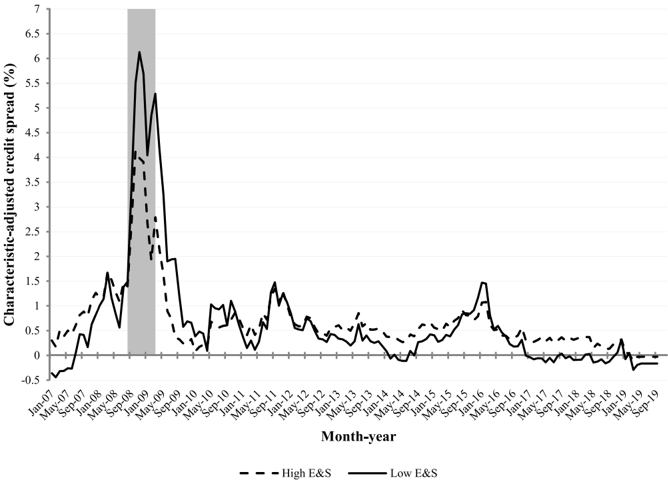
We investigate whether a firm’s social capital and the trust that it engenders are viewed favorably by bondholders. Using firms’ environmental and social (E&S) performance to proxy for social capital, we find no relation between social capital and bond spreads over the period 2006–2019. However, during the 2008–2009 financial crisis, which represents a shock to trust and default risk, high-social-capital firms benefited from lower bond spreads. These effects are stronger for firms with higher expected agency costs of debt and firms whose E&S efforts are more salient. During the crisis, high-social-capital firms were also able to raise more debt, at lower spreads, and for longer maturities. We find no evidence that the governance element of ESG is related to bond spreads. The gap between E&S performance of firms in the bottom and top E&S terciles has narrowed since the financial crisis, especially in the year prior to accessing the bond market.
Overview
The claims and statistics of this paper haven’t been checked yet.
Run the check — free, no account needed. It reads the open-access text and checks the sources it cites.
Integrity signals
Registry
Cites
Statistics
Figures
Verification
Claims the paper makes
The claims and statistics of this paper haven’t been checked yet.
Run the check — free, no account needed. It reads the open-access text and checks the sources it cites.
Claims other papers make about this one
Each is checked against this paper’s own text: does it say what the citing paper says it does?
In the citing paper
“Voluntary nature of CSR activities: In most instances, CSR activities and policies are voluntary in nature and go beyond legal, regulatory, and contractual requirements.9”
From Mandatory CSR and sustainability reporting: economic analysis and literature review (2021) · cites this paper as [9]
Self-check
Percentages, sums and reported differences re-computed from the paper’s own numbers.
The self-check needs the paper’s full text.
Citations
Cites
Theory of the firm: Managerial behavior, agency costs and ownership structure
Jensen, M. C., & Meckling, W. H. (1976) · Journal of Financial Economics · doi:10.1016/0304-405x(76)90026-x · Cited by 71,491
The Social Responsibility of Business Is to Increase Its Profits
Friedman, M. (2007) · Corporate Ethics and Corporate Governance · doi:10.1007/978-3-540-70818-6_14 · Cited by 11,529 · cited 1×
“Of course, a competing view is that investments in social capital benefit some stakeholders but do not add value to the firm (e.g., Friedman 1970; Masulis and Reza 2015, 2021; Cheng et al. 2020).”
Estimating Standard Errors in Finance Panel Data Sets: Comparing Approaches
Petersen, M. A. (2008) · Review of Financial Studies · doi:10.1093/rfs/hhn053 · Cited by 10,804
Illiquidity and stock returns: cross-section and time-series effects
Yakov Amihud, A. (2002) · Journal of Financial Markets · doi:10.1016/s1386-4181(01)00024-6 · Cited by 9,645
LINS, K. V., SERVAES, H., & TAMAYO, A. (2017) · The Journal of Finance · doi:10.1111/jofi.12505 · Cited by 3,794
Self-citationN. Berger, A., & F. Udell, G. (1998) · Journal of Banking & Finance · doi:10.1016/s0378-4266(98)00038-7 · Cited by 3,690 · cited 2×
“Third, our results add to the literature on the determinants of firms’ contractual arrangements with creditors in the primary bond market (e.g., Berger and Udell 1998; Billett et al. 2007; Chava et al. 2010).”
Fairness and retaliation: the economics of reciprocity
Fehr, E., & Gächter, S. (2000) · Journal of Economic Perspectives · doi:10.1257/jep.14.3.159 · Cited by 3,239
The Role of Social Capital in Financial Development
Guiso, L., Sapienza, P., & Zingales, L. (2004) · American Economic Review · doi:10.1257/0002828041464498 · Cited by 3,170
Smith, C. W., & Warner, J. B. (1979) · Journal of Financial Economics · doi:10.1016/0304-405x(79)90011-4 · Cited by 2,855
Bank lending during the financial crisis of 2008
Ivashina, V., & Scharfstein, D. S. (2009) · Journal of Financial Economics · doi:10.1016/j.jfineco.2009.12.001 · Cited by 2,758
Research works printed but not linked: 1
- Feldhütter, P., and S. Schaefer. (2018). The myth of the credit spread puzzle. The Review of Financial Studies 31 (8): 2897–2942.
Cited by
Sorted by citations
Mandatory CSR and sustainability reporting: economic analysis and literature review
Christensen, H. B., Hail, L., & Leuz, C. (2021) · Review of Accounting Studies · doi:10.1007/s11142-021-09609-5 · Cited by 1,923
“Similar to the insurance effects in equity markets, the negative association between CSR and loan spreads is more pronounced in periods of low trust and crisis, such as during the 2008-2009 financial crisis (Amiraslani et al. 2021). CSR bonds appear to outperform conventional bonds during down markets (Henke 2016). Ev…”
Climate Risk and Capital Structure
Ginglinger, É., & Moreau, Q. (2019) · Management Science · doi:10.1287/mnsc.2023.4952 · Cited by 688
Apergis, N., Poufinas, T., & Αντωνόπουλος, Α. (2022) · Energy Economics · doi:10.1016/j.eneco.2022.106186 · Cited by 434
Climate Regulatory Risks and Corporate BondsPreprint
Seltzer, L., Starks, L. T., & Zhu, Q. (2020) · SSRN Electronic Journal · doi:10.2139/ssrn.3563271 · Cited by 119
What you see is not what you get: ESG scores and greenwashing risk
Kathan, M. C., Utz, S., Dorfleitner, G., Eckberg, J., & Chmel, L. (2025) · Finance research letters · doi:10.1016/j.frl.2024.106710 · Cited by 109
Metadata
- Authors
- Amiraslani, H., Lins, K. V., Servaes, H., & Tamayo, A.
- Affiliations
- INSEAD (SG)
- University of Utah (US)
- London Business School (GB)
- Centre for Economic Policy Research (GB)
- Corresponding author
- Tamayo, Ane
- Venue
- Review of Accounting Studies
- Published
- 2022-04-14
- Volume
- 28
- Issue
- 2
- Pages
- 421-462
- ISSN
- 1380-6653 (ISSN-L)
- 1573-7136
- OpenAlex
- W4226118220
- Cited by
- 222
- References
- 81
- Citations by year
- 2026: 54 · 2025: 71 · 2024: 40 · 2023: 30 · 2022: 14
- FWCI
- 28.95
- Type
- journal article
- Language
- en
- Open access
- hybrid
- doi.org
- Locations
- Review of Accounting Studies (publishedVersion, cc-by)
- London School of Economics and Political Science Research Online (London School of Economics and Political Science) (acceptedVersion)
- London Business School Research Online (London Business School) (submittedVersion)
- London School of Economics and Political Science Theses Online (London School of Economics and Political Science) (submittedVersion, cc-by)
- RePEc: Research Papers in Economics (submittedVersion)
- Funders
- Syracuse University
- Cyprus University of Technology
- University of Cyprus
- University of Alberta
- University of Exeter
- University of Warwick
- Bar-Ilan University
- Université de Genève
- Nazarbayev University
- Economic and Social Research Council
- Topics
- Social Sciences › Business, Management and Accounting › Strategy and Management › Corporate Social Responsibility Reporting
- Social Sciences › Economics, Econometrics and Finance › Finance › Credit Risk and Financial Regulations
- Social Sciences › Economics, Econometrics and Finance › Finance › Sustainable Finance and Green Bonds
- Keywords
- social capital, trust, ESG performance, environmental and social performance, bond spreads, bond market access, 2008 financial crisis, agency costs of debt, default risk, bond maturity, corporate governance, debt financing
About these checks
Registry, retraction, Cites and statistics results are computed, not judged, with one exception: a printed reference that no index lists is read once by a model before it counts as a citation error. Claims are extracted by a model and kept only when their quote appears verbatim in the text; each cited source is then checked, with a model’s help, for whether it says what the claim relies on. Those verdicts can be wrong — read the claim’s quote and the cited source before relying on one.
Statistics and arithmetic are recomputed, not judged.
Confidence bands are shown only for fields calibrated on our annotated test set. None is calibrated yet, so no band is shown.
What counts as a claim ›How we measure confidence ›How we check this ›
Are you an author, or do you see a problem with this page? Request a review
