

Wealth, Race, and Under-Addressed Financial Need in Federal Student Aid Policy
Open accessThe DOI matches its Crossref record; 58 of the 58 references it cites were found in a registry or an index; 9 of the 57 sources its claims cite were checked for support.
Abstract
Abstract Federal student aid formulas prioritize income over wealth. Using nationally representative data from two cohorts, we argue that federal student aid policy thus under-addresses wealth-driven financial need and that this oversight contributes to racial disparities in student debt, in turn reinforcing the United States’s longstanding racial wealth stratification. Our analyses show that Black and Latine students are disproportionately likely to be low-wealth and to face double disadvantage by wealth and income. We find that, even net of federally-determined financial need, lower-wealth students borrow more in their first year, borrow more over the course of 12 years, owe a greater percentage of original student debt after 12 years, and are more likely to have defaulted on a student loan over the course of 12 years—suggesting considerable unmet need. A basic simulation of how students would have fared with the implementation of a supplemental wealth-based Pell Grant indicates that better accounting for wealth in financial aid can reduce debt burdens and confront racial inequities in student loan debt. The results therefore highlight higher education’s centrality as a social institution in which seemingly race-neutral policies may nonetheless reinforce racial stratification.
Overview
CoChat Summary
## TL;DR
Federal student aid formulas prioritize income over wealth, and this paper argues that omission leaves many low-wealth students with unmet need. Using nationally representative data from two cohorts, the authors find that lower-wealth students borrow more, owe more 12 years later, and default more often, with Black and Latine students disproportionately affected.
## Key findings
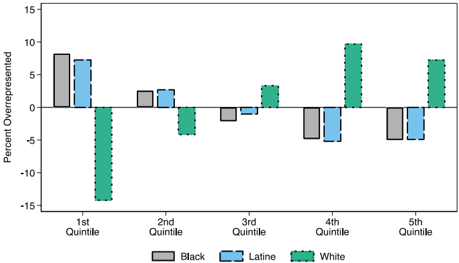
- In the 2017–18 FAFSA-filing sample of first-time, full-time dependent students, Black and Latine students were concentrated in the bottom wealth quintiles: over one third of Black students were in the bottom quintile, 28% of Latine students were in the bottom quintile, and nearly 60% of Black students and over half of Latine students were in the two bottom quintiles.
- Among non-Pell recipients, 21% had family wealth below $1,000 overall, compared with 48% of Black students and 32% of Latine students; among Pell recipients, 29% were low-wealth overall, 48% of Black Pell recipients were low-wealth, and 39% of Latine Pell recipients were low-wealth.
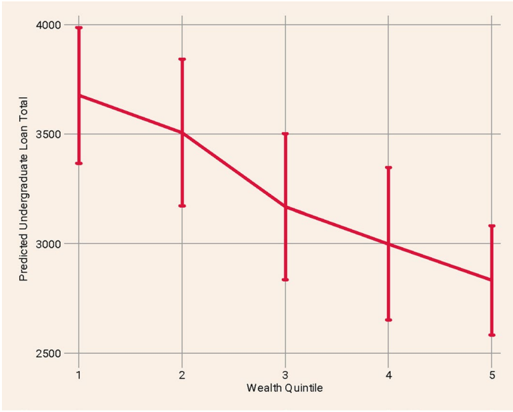
- In first-year borrowing, students in the bottom wealth quintile borrowed $843 more than those in the top quintile, a 30% difference, after controlling for Expected Family Contribution (EFC), race, and institutional level.
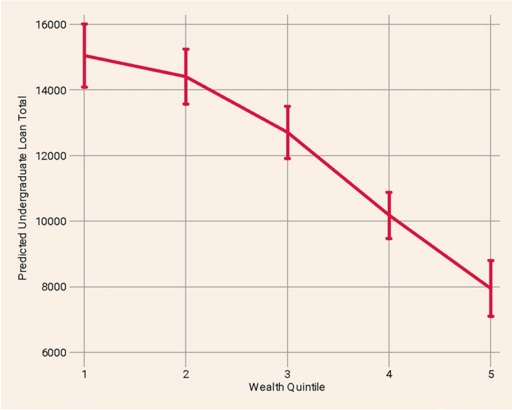
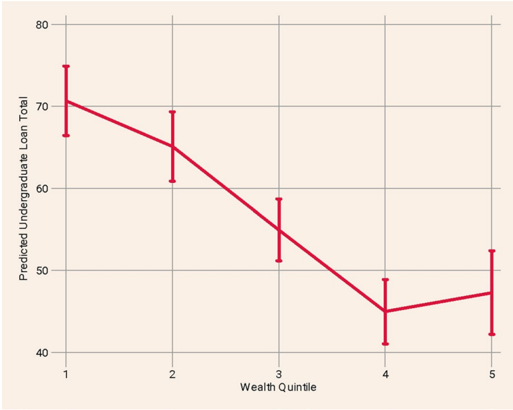
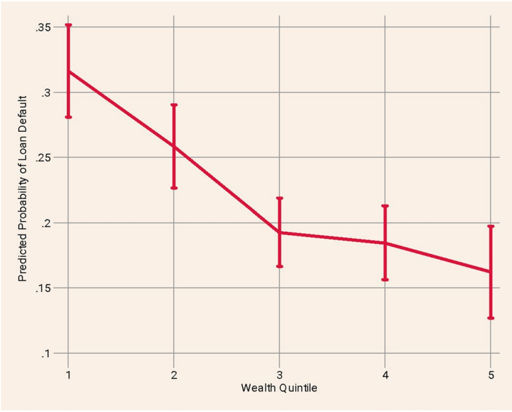
- Twelve years after college entry, students in the bottom wealth quintile owed about 70% of their undergraduate debt, while those in the top two quintiles typically owed less than 50%; the predicted probability of default in the bottom quintile was 32%, versus 16% in the top quintile.
- A simulated Wealth-Based Pell Grant for students with $500 or less in family wealth would raise aggregate first-year loan-free status from 41% to 53%, and Black students’ loan-free status from 27% to 50%; the authors say it could eliminate the Black-white disparity in debt-free status.
## Methods
- The study uses two nationally representative datasets: NPSAS:18 for a recent cohort of first-time, full-time dependent FAFSA filers (analytic sample 23,740) and BPS:04/09 for longer-run outcomes among dependent FAFSA filers (analytic sample 10,780, varying by outcome).
- Wealth is measured from FAFSA asset records, with wealth quintiles used in most analyses; race, EFC, institutional level, and in some long-run models months enrolled full-time and part-time are included as controls.
- The main analysis consists of descriptive comparisons across race and wealth, plus regression models predicting first-year borrowing, 12-year borrowing, percent still owed, and default; survey weights and multiple imputation are used, and a counterfactual simulation estimates the effect of a supplemental Wealth-Based Pell.
## Limitations
- The paper states that its wealth measure is constrained by the data and likely understates wealth’s relationship to debt outcomes and race because FAFSA excludes some assets and does not ask about debts; this likely biases estimates toward zero.
- The authors note that data on Native American and Alaska Native students are too sparse for inclusion, and Southeast Asian subgroups cannot be identified because of ethnic aggregation in the data.
- The study focuses on dependent, full-time students who filed the FAFSA, so independent and part-time students are excluded; this is explicitly stated by the authors as a scope choice.
Model-written summary. Check it against the paper before relying on it.
Integrity signals
Registry
Cites
Statistics
Figures
Verification
Claims the paper makes
9 Valid · 5 Not valid · 30 Not checked · 132 Own results and interpretations
Every source the paper cites for this claim was checked and supports it.
In the paper
“Parental wealth is central to the financial transfers that play a growing role in students' college financing (Rauscher, 2016).”
What the sources say
- Supportedcites Rauscher, 2016 matched to “Passing It On: Parent-to-Adult Child Financial Transfers for School and Socioeconomic Attainment” (2016) source
The Conclusion reports that parental transfers for education have increased, become more commonplace, and grown more dependent on parental wealth over time. The Results likewise find that transfers for school became more dependent on household wealth across successive cohorts. (LLM, conf=0.93)
plainstates a cause- Asserted: passes — The authors put it forward as true.
- Checkable: passes — It can be checked against evidence.
- Load-bearing: passes — The paper’s conclusions depend on it.
- Based: passes — The paper gives a reason why it holds.
- Supported
The sources with a verdict support this claim; the rest weren’t checked yet, have no full text we could read, or their verdicts aren’t rated yet.
In the paper
“Family wealth is a distinct form of economic advantage that can shape higher education outcomes, above and beyond family income (Conley, 2001; Pfeffer, 2018).”
What the sources say
- Not checked — no full text of the sourcecites Conley, 2001 matched to “Capital for College: Parental Assets and Postsecondary Schooling” (2001) source
- Supportedcites Pfeffer, 2018 matched to “Growing Wealth Gaps in Education” (2018) source
The Background and Motivation section describes wealth and income as distinct and reports associations between family wealth and educational attainment conditional on income. The Findings section reports significant adjusted wealth gaps in college attendance and graduation, supporting wealth as an independent source of advantage for higher education outcomes. (LLM, conf=0.94)
plainstates a possible cause- Asserted: passes — The authors put it forward as true.
- Checkable: passes — It can be checked against evidence.
- Load-bearing: passes — The paper’s conclusions depend on it.
- Based: passes — The paper gives a reason why it holds.
The cited sources support only part of this claim — read each source’s verdict below.
In the paper
“For any given family, regardless of annual household earnings, the stock of capital on hand can fund students' educational and living expenses, in turn fostering success in higher education (Pfeffer, 2018).”
What the sources say
- Partly supportedcites Pfeffer, 2018 matched to “Growing Wealth Gaps in Education” (2018) sourceExperimental — accuracy not yet measured
The Findings section (page unavailable) reports that family wealth predicts college graduation and persistence independently of income. The Background section says wealth may ease constraints created by tuition and board costs, but the paper measures total net worth, not specifically liquid capital. The Conclusion also states that the study does not establish the causal pathway from wealth to educational success. (LLM, conf=0.86)
plainstates a cause- Asserted: passes — The authors put it forward as true.
- Checkable: passes — It can be checked against evidence.
- Load-bearing: passes — The paper’s conclusions depend on it.
- Based: passes — The paper gives a reason why it holds.
- Partly supported
Every source the paper cites for this claim was checked and supports it.
In the paper
“Addo et al. (2016) show that, even when accounting for family income differences, individuals from low-wealth families have more student debt than their higher wealth peers.”
What the sources say
- Supportedcites Addo et al., 2016 matched to “Young, Black, and (Still) in the Red: Parental Wealth, Race, and Student Loan Debt” (2016) source
The Results (Multivariate Analyses; page not provided) state that Model 2 includes parental income and finds significantly less student loan debt among young adults from wealthier families. The reported association is a 2% decline in debt per $10,000 increase in parental net worth. (LLM, conf=0.91)
plainstates an association- Asserted: passes — The authors put it forward as true.
- Checkable: passes — It can be checked against evidence.
- Load-bearing: passes — The paper’s conclusions depend on it.
- Based: passes — The paper gives a reason why it holds.
- Supported
A result the paper reports from its own data — it cites no other source for it, so there is none to check. The quote shows it is in the paper.
In the paper
“borrow more over the course of 12years”
plainstates an association- Asserted: passes — The authors put it forward as true.
- Checkable: passes — It can be checked against evidence.
- Load-bearing: passes — The paper’s conclusions depend on it.
- Based: passes — The paper gives a reason why it holds.
101 more claims
Create a free account to see all 176 claims and to verify the 1 reference still open.
- It may state two separate claims as one. 48
- Probably not a substantial claim. 25
- The quote only partly states this claim. 1
Citations
Cites
The Color of Law: A Forgotten History of How Our Government Segregated America
Pattillo, M. (2018) · Contemporary Sociology: A Journal of Reviews · doi:10.1177/0094306118792220ll · Cited by 2,247
Black Wealth, White Wealth: A New Perspective on Racial Inequality.
Green, R. D., Oliver, M. L., & Shapiro, T. M. (1995) · The Journal of Negro Education · doi:10.2307/2967270 · Cited by 1,851 · cited 3×
“Stalled change is a function of what Oliver and Shapiro (2006) refer to as the “racialization of state policy.””
Wealth Inequality in the United States since 1913: Evidence from Capitalized Income Tax Data
Saez, E., & Zucman, G. (2016) · The Quarterly Journal of Economics · doi:10.1093/qje/qjw004 · Cited by 1,636 · cited 2×
“Wealth inequality in the US was also at a century low point (Saez & Zucman, 2016).”
The Color of Law: A Forgotten History of How Our Government Segregated America
Rothstein, R. (2017) · Berkeley Planning Journal · doi:10.5070/bp329138440 · Cited by 1,617
Racial and Ethnic Stratification in Educational Achievement and Attainment
Kao, G., & Thompson, J. S. (2003) · Annual Review of Sociology · doi:10.1146/annurev.soc.29.010202.100019 · Cited by 1,386 · cited 1×
“However, ethnic aggregation in the data prevents us from identifying Southeast Asian subgroups, who have among the lowest socioeconomic resources, from others who have among the highest (Kao and Thompson 2003).”
Race, Reform, and Retrenchment: Transformation and Legitimation in Antidiscrimination Law
Crenshaw, K. W. (1988) · Harvard Law Review · doi:10.2307/1341398 · Cited by 1,344
Education Pays: The Benefits of Higher Education for Individuals and Society
Baum, S., Ma, J., & Payea, K. (2007) · Cited by 1,110
(2005) · Choice Reviews Online · doi:10.5860/choice.43-2422 · Cited by 1,108
Race, Reform, and Retrenchment: Transformation and Legitimation in Antidiscrimination Law
Crenshaw, K. (1988) · German Law Journal · doi:10.1017/s2071832200016850 · Cited by 1,022
Social and Economic Returns to College Education in the United States
Hout, M. (2012) · Annual Review of Sociology · doi:10.1146/annurev.soc.012809.102503 · Cited by 943 · cited 1×
“In turn, the increase in college-educated people will boost tax revenue and reduce public expenditures in healthcare and other areas (Baum, Ma, and Payea 2013; Hout, 2012).”
Race for Profit: How Banks and the Real Estate Industry Undermined Black Homeownership
Taylor, K.-Y. (2019) · doi:10.5149/northcarolina/9781469653662.001.0001 · Cited by 854
(2017) · bepress Legal Repository · Cited by 771
Administrative Burden: Policymaking by Other Means
Herd, P., & Moynihan, D. P. (2019) · Russell Sage Foundation eBooks · doi:10.7758/9781610448789 · Cited by 579
Administrative burden policymaking by other means
Herd, P., & Moynihan, D. P. (n.d.) · Cited by 457
Paying the Price: College Costs, Financial Aid, and the Betrayal of the American Dream
Goldrick-Rab, S. (2016) · doi:10.7208/chicago/9780226404486.001.0001 · Cited by 379 · cited 2×
“Because college financing often falls on students and their families (Goldrick-Rab, 2016; Zaloom, 2019), family wealth provides a vital, and vastly unequal, form of financial support for college (Conley, 2001; Pfeffer, 2018).”
Capital for College: Parental Assets and Postsecondary Schooling
Conley, D. (2001) · Sociology of Education · doi:10.2307/2673145 · Cited by 325 · cited 3×
“Because college financing often falls on students and their families (Goldrick-Rab, 2016; Zaloom, 2019), family wealth provides a vital, and vastly unequal, form of financial support for college (Conley, 2001; Pfeffer, 2018).”
Young, Black, and (Still) in the Red: Parental Wealth, Race, and Student Loan Debt
Addo, F. R., Houle, J. N., & Simon, D. (2016) · Race and Social Problems · doi:10.1007/s12552-016-9162-0 · Cited by 249 · cited 4×
“We show that one result of unmet need for low-wealth students is student loan debt, which plays a role in producing short-term, long-term, and intergenerational financial inse-curity, especially for Black families (Addo et al., 2016; Addo and Houle 2016; Meschede et al., 2017).”
InfluentialSaez, E., & Zucman, G. (2020) · Journal of Economic Perspectives · doi:10.1257/jep.34.4.3 · Cited by 247
The Political Economy of Education, Financial Literacy, and the Racial Wealth Gap
Louis, F. R. B. O. S., Hamilton, D., & Darity, W. A. J. (2017) · Review · doi:10.20955/r.2017.59-76 · Cited by 220 · cited 2×
“Wealth-based inequality overlooked by the Pell Grant also has implications for racial stratification because the distribution of wealth is even more racialized than the distribution of income (Derenoncourt et al., 2024; Hamilton & Darity, 2017).”
Degrees of inequality: how the politics of higher education sabotaged the American dream
(2015) · Choice Reviews Online · doi:10.5860/choice.187681 · Cited by 218
Disparities in Debt: Parents’ Socioeconomic Resources and Young Adult Student Loan Debt
Houle, J. N. (2014) · Sociology of Education · doi:10.1177/0038040713512213 · Cited by 215 · cited 1×
“Although the relationship between borrowing and income is non-linear (Houle, 2013; Sanchez et al., 2024), Addo et al. (2016) show that, even when accounting for family income differences, individuals from low-wealth families have more student debt than their higher wealth peers.”
Wealth of Two Nations: The U.S. Racial Wealth Gap, 1860–2020
Derenoncourt, E., Kim, C. H., Kuhn, M., & Schularick, M. H. (2023) · The Quarterly Journal of Economics · doi:10.1093/qje/qjad044 · Cited by 190
Growing Wealth Gaps in Education
Pfeffer, F. T. (2018) · Demography · doi:10.1007/s13524-018-0666-7 · Cited by 178 · cited 5×
“Family wealth is a distinct form of economic advantage that can shape higher education outcomes, above and beyond family income (Conley, 2001; Pfeffer, 2018).”
InfluentialDegrees of Inequality: How the Politics of Higher Education Sabotaged the American Dream
Naylor, L. A. (2015) · Public Integrity · doi:10.1080/10999922.2015.1000113 · Cited by 144 · cited 1×
“However, in more recent years, the shift to a low-income means-tested Pell, the declining purchasing power of Pell (Mettler, 2014), and growth in wealth inequality (Saez & Zucman, 2020)—along with the primary focus on income disadvantage that has always characterized Pell—may have left wealth…”
Indebted: how families make college work at any cost
Ingram, N., Nissen, S., & Burke, P. J. (2020) · British Journal of Sociology of Education · doi:10.1080/01425692.2020.1766823 · Cited by 116
Hamilton, L. T., & Nielsen, K. (2020) · University of Chicago Press eBooks · doi:10.7208/chicago/9780226747590.001.0001 · Cited by 109 · cited 1×
“Changes in public support for higher education occurred as the demographics of the sector began a radical shift away from white students (Hamilton & Nielsen, 2021).”
Self-citationStefanski, L. A. (2000) · Journal of the American Statistical Association · doi:10.1080/01621459.2000.10474347 · Cited by 99 · cited 1×
“If this measurement error biases our estimates, we expect that it does so toward zero (Stefanski, 2000), meaning that any relationship between wealth and desired student loan outcomes would be even more pronounced than what is estimated.”
Saez, E., & Zucman, G. (2020) · National Bureau of Economic Research · doi:10.3386/w27922 · Cited by 94
Return to Being Black, Living in the Red: A Race Gap in Wealth That Goes Beyond Social Origins
Killewald, A. (2013) · Demography · doi:10.1007/s13524-012-0190-0 · Cited by 92 · cited 1×
“Notably, however, debt can be misleading, as wealthier families, who are more likely to be white, often have access to strong credit and high amounts of what is coded as “good debt” (e.g., real estate, property, and vehicles) with favorable repayment terms (Killewald, 2013; Seamster, 2019).”
Seamster, L. (2019) · Contexts · doi:10.1177/1536504219830674 · Cited by 83 · cited 1×
“Notably, however, debt can be misleading, as wealthier families, who are more likely to be white, often have access to strong credit and high amounts of what is coded as “good debt” (e.g., real estate, property, and vehicles) with favorable repayment terms (Killewald, 2013; Seamster, 2019).”
Diverging Fortunes: Racial/Ethnic Inequality in Wealth Trajectories in Middle and Late Life
Brown, T. H. (2016) · Race and Social Problems · doi:10.1007/s12552-016-9160-2 · Cited by 74 · cited 1×
“These include high levels of educational disadvantage, concentration in low wage and often insecure jobs, and residential segregation (Bohrt & Itzigsohn, 2015; Brown, 2016; Keister et al., 2015; Salgado and Ortiz 2020).”
Wealth Inequality and the Racial Wealth Gap
Aladangady, A., & Forde, A. (2021) · FEDS Notes · doi:10.17016/2380-7172.2861 · Cited by 70 · cited 1×
“While the average Black or Latine household earns around half as much as the average white household, Black households own only about 15%, and Latine households around 20%, as much wealth as white families (Aladangady & Forde, 2021).”
Passing It On: Parent-to-Adult Child Financial Transfers for School and Socioeconomic Attainment
Rauscher, E. (2016) · RSF: The Russell Sage Foundation Journal of the Social Sciences · doi:10.7758/rsf.2016.2.6.09 · Cited by 67 · cited 2×
“Higher-wealth families can draw on their assets, often alongside income, to afford college, whereas low-wealth students—even those with moderate family income—may struggle to cover the costs of postsecondary education (Rauscher, 2016).”
Immigrants and wealth attainment: migration, inequality, and integration
Vallejo, J. A., & Keister, L. A. (2019) · Journal of Ethnic and Migration Studies · doi:10.1080/1369183x.2019.1592872 · Cited by 64 · cited 1×
“Relatively high rates of immigration also play a role in Latine wealth disadvantage; lack of access to citizenship, inability to transport sources of wealth across countries, and discrimination based on country-of-origin limit wealth accumulation (Vallejo & Keister, 2020).”
The Looming Student Loan Crisis Is Worse Than We Thought
Scott-Clayton, J. E. (2018) · Columbia University · doi:10.7916/d8wt05qv · Cited by 58 · cited 1×
“…resources post-graduation that high-wealth students may use to repay their student debt, and moreover, low-wealth students are less likely to attain their degree in the first place (Braga et al., 2017), limiting their economic prospects and ability to repay their student debt (Scott-Clayton 2018).”
Bankers in the Ivory Tower: The Troubling Rise of Financiers in US Higher Education
Eaton, C. (2022) · doi:10.7208/chicago/9780226720562.001.0001 · Cited by 55 · cited 6×
“Unlike other parts of President Johnson’s Great Society legislation (including Medicaid, Medicare, and Social Security), the Pell Grant was never awarded full entitlement status (Curs et al., 2007; Eaton, 2022).”
InfluentialSelf-citation“Family Achievements?”: How a College Degree Accumulates Wealth for Whites and Not For Blacks
Louis, F. R. B. O. S., Meschede, T., Taylor, J., Mann, A., & Shapiro, T. M. (2017) · Review · doi:10.20955/r.2017.121-137 · Cited by 52
The Differential Impact of Wealth Versus Income in the College-Going Process
Jez, S. J. (2014) · Research in Higher Education · doi:10.1007/s11162-014-9332-0 · Cited by 51 · cited 3×
“Low wealth hurts individuals’ chances of attending and completing college (Hotz et al., 2023; Jez, 2014; Pfeffer, 2018).”
The Impact of Student Loan Debt on Small Business Formation
Ambrose, B. W., Cordell, L. R., & Ma, S. (2015) · Working paper · doi:10.21799/frbp.wp.2015.26 · Cited by 47
Worker Power and Class Polarization in Intra-Year Work Hour Volatility
LaBriola, J., & Schneider, D. (2019) · Social Forces · doi:10.1093/sf/soz032 · Cited by 46 · cited 1×
“For an example of a similar weighting approach, see the work of LaBriola and Schneider (2020).”
Protopsaltis, S., & Parrott, S. (2017) · VTechWorks (Virginia Tech) · Cited by 44
Indebted: How Families Make College Work at Any Cost
Zaloom, C. (2019) · Project Muse (Johns Hopkins University) · Cited by 39
Growing Wealth Gaps in EducationPreprint
Pfeffer, F. T. (2017) · SocArXiv (OSF Preprints) · doi:10.31235/osf.io/s5dpm · Cited by 37
Mexican American Mobility: Early Life Processes and Adult Wealth Ownership
Keister, L. A., Vallejo, J. A., & Borelli, E. P. (2015) · Social Forces · doi:10.1093/sf/sou102 · Cited by 31 · cited 1×
“These include high levels of educational disadvantage, concentration in low wage and often insecure jobs, and residential segregation (Bohrt & Itzigsohn, 2015; Brown, 2016; Keister et al., 2015; Salgado and Ortiz 2020).”
The Pell Program at Thirty Years
Curs, B. R., Singell, L. D., & Waddell, G. R. (2007) · Higher Education: Handbook of Theory and Research · doi:10.1007/978-1-4020-5666-6_6 · Cited by 29 · cited 3×
“Unlike other parts of President Johnson’s Great Society legislation (including Medicaid, Medicare, and Social Security), the Pell Grant was never awarded full entitlement status (Curs et al., 2007; Eaton, 2022).”
Debt Overhang and Deleveraging in the US Household Sector: Gauging the Impact on Consumption
Albuquerque, B., & Krustev, G. (2017) · Review of Income and Wealth · doi:10.1111/roiw.12265 · Cited by 23 · cited 1×
“Second, by leaving college with less debt, individuals can more readily stimulate the economy by starting small businesses (Ambrose, Cordell, and Ma 2015) and buying goods and services with their money rather than using it to pay off debt (Albuquerque & Krustev, 2018).”
(2018) · Cited by 22
Stefanski, L. A. (2000) · Journal of the American Statistical Association · doi:10.2307/2669787 · Cited by 21
Goldstein, A., Eaton, C., Villalobos, A. D., Chakrabarti, P., Cohen, J., & Donnelly, K. (2023) · RSF The Russell Sage Foundation Journal of the Social Sciences · doi:10.7758/rsf.2023.9.4.04 · Cited by 19 · cited 1×
“When forming financial aid policy, it is important to minimize administrative burden (Herd & Moynihan, 2018), which has been shown to hinder equity in the financial aid sys-tem (Goldstein et al., 2023).”
Self-citationWealth Gaps between White, Black and Hispanic Families in 2019Preprint
Kent, A. H., & Ricketts, L. R. (2021) · RePEc: Research Papers in Economics · Cited by 16
Mexican Americans and wealth: economic status, family and place
Salgado, C. D., & Ortiz, V. (2020) · Journal of Ethnic and Migration Studies · doi:10.1080/1369183x.2019.1592878 · Cited by 13 · cited 2×
“These include high levels of educational disadvantage, concentration in low wage and often insecure jobs, and residential segregation (Bohrt & Itzigsohn, 2015; Brown, 2016; Keister et al., 2015; Salgado and Ortiz 2020).”
Hotz, V. J., Wiemers, E., Rasmussen, J., & Maxwell, K. (2021) · The Journal of Human Resources · doi:10.3368/jhr.1018-9828r2 · Cited by 13
(2018) · Center for Law and Social Policy, Inc. (CLASP) · Cited by 10
Bohrt, M. A., & Itzigsohn, J. (2015) · Sociology of Race and Ethnicity · doi:10.1177/2332649215570760 · Cited by 9 · cited 1×
“These include high levels of educational disadvantage, concentration in low wage and often insecure jobs, and residential segregation (Bohrt & Itzigsohn, 2015; Brown, 2016; Keister et al., 2015; Salgado and Ortiz 2020).”
Debt, Doubt, and Dreams: Understanding the Latino College Completion Gap
Elengold, K., Dorrance, J., & Agans, R. (2020) · SSRN Electronic Journal · doi:10.2139/ssrn.3733738 · Cited by 7 · cited 1×
“While Black students borrow at high rates (Houle & Addo, 2022), Latine students report high levels of debt aversion and often work long hours or go without (Elengold, Dorrance, and Agans 2020).”
Understanding Themes in Postsecondary Research Using Topic Modeling and Journal Abstracts
Takei, M., Porter, S. R., Umbach, P. D., & Nakano, J. (2023) · Research in Higher Education · doi:10.1007/s11162-023-09761-8 · Cited by 5 · cited 1×
“The inattention to wealth is thus relevant not just for student debt but also for college access and completion—two of the most prevalent topics in higher education research (Takei et al., 2024).”
Worker Power and Class Polarization in Intra-Year Work Hour Volatility
LaBriola, J., & Schneider, D. (2019) · doi:10.31235/osf.io/rzfg2
The Impact of Student Loan Debt on Small Business Formation
Ambrose, B. W., Cordell, L., & Ma, S. (2015) · doi:10.2139/ssrn.2646101
Research works printed but not linked: 2
- Houle, J., & Addo, F. R. (2022). A dream defaulted: The student loan crisis among black borrowers . Harvard Education Press.
- Miller, B. (2017). New federal data show a student loan crisis for African American borrowers . Center for American Progress.
Cited by
Spencer, G. (2026) · American Journal of Education · doi:10.1086/743001
Metadata
- Authors
- Smith, C. M., Hamilton, L. T., & Eaton, C.
- Affiliations
- University of Georgia (US)
- University of California, Merced (US)
- Corresponding author
- Smith, Christian Michael
- Venue
- Research in Higher Education
- Published
- 2025-07-11
- Volume
- 66
- Issue
- 5
- ISSN
- 0361-0365 (ISSN-L)
- 1573-188X
- OpenAlex
- W4412196902
- Semantic Scholar
- 571ab7dea6a8f73e00e1968da7892151909f95b9
- Cited by
- 2
- References
- 52
- Citations by year
- 2026: 2
- FWCI
- 6.25
- Type
- journal article
- Language
- en
- Open access
- hybrid
- doi.org
- Licence
- cc-by
- creativecommons.org/licenses/by/4.0 (tdm)
- creativecommons.org/licenses/by/4.0 (vor)
- Locations
- Research in Higher Education (publishedVersion, cc-by)
- Funders
- Arnold Ventures (20-05200)
- Lumina Foundation (1116920)
- Topics
- Social Sciences › Education › Higher Education Research Studies
- Social Sciences › Education › School Choice and Performance
- Social Sciences › Sociology and Political Science › Intergenerational and Educational Inequality Studies
- Keywords
- federal student aid, student financial need, student loan default, Pell grants, Black students, Latine students, student debt burden, race-neutral policies, higher education equity
About these checks
Registry, retraction, Cites and statistics results are computed, not judged, with one exception: a printed reference that no index lists is read once by a model before it counts as a citation error. Claims are extracted by a model and kept only when their quote appears verbatim in the text; each cited source is then checked, with a model’s help, for whether it says what the claim relies on. Those verdicts can be wrong — read the claim’s quote and the cited source before relying on one.
The claim verdicts this report counts are experimental: their accuracy is not yet measured.
A language model drew the claims from the paper on 2026-10-11, under version 3 of the claim definition (model deepseek-v4.1-flash, prompt extract-v3).
A second model labelled each claim on 2026-10-11 (model jev-1.13-20260917, definition revision gold-guideline-v0.2).
Cited sources are checked with a language model’s help (gpt-6-sol).
Statistics and arithmetic are recomputed, not judged.
Confidence bands are shown only for fields calibrated on our annotated test set. None is calibrated yet, so no band is shown.
What counts as a claim ›How we measure confidence ›How we check this ›
Are you an author, or do you see a problem with this page? Request a review
Data sources
Bibliographic data: Semantic Scholar, OpenAlex, Crossref.
Contains information from the Semantic Scholar Academic Graph Datasets, made available under the ODC Attribution License (ODC-BY 1.0).
Semantic Scholar’s data is described in: Kinney, R., et al. (2023). The Semantic Scholar Open Data Platform. arXiv:2301.10140.
