

Entrepreneurial ecosystems, institutional quality, and the unexpected role of the sustainability orientation of entrepreneurs
Open accessThe DOI matches its Crossref record; 141 of the 143 references it cites were found in a registry or an index, and 1 are not checked yet; 4 of the 49 sources its claims cite were checked for support.
Abstract
Examines how the sustainability orientation of entrepreneurial ecosystem (EE) actors facilitates the intensity and growth orientation of entrepreneurship. Primary data on 1,789 actors across 17 cities in East and South-East Europe shows that institutional quality moderates this relationship.
Verified 2026-11-25 · 1 reference not checked yet
Overview
CoChat Summary
TL;DR
This paper argues that entrepreneurial ecosystem (EE) outcomes depend not only on formal institutional quality but also on the sustainability orientation of EE actors. Using survey data from 1,789 actors in 17 cities, the authors find that sustainability orientation is positively associated with EE growth orientation and intensity, and that its marginal effect is larger in places with weaker formal institutions.
Key findings
- In OLS models, the Global Entrepreneurship Development Index (GEDI) was positively associated with EE outcomes: for growth orientation, GEDI was significant in Table 3 (e.g., β = 0.004* in spec. 2 and β = 0.005 in spec. 3); for EE intensity, GEDI was also positive and significant (e.g., β = 0.005* in spec. 6 and β = 0.006* in spec. 7).
- Sustainability orientation had a positive association with both outcomes: for EE growth orientation, β = 0.089* (spec. 3) and β = 0.104* (spec. 4); for EE intensity, β = 0.065* (spec. 7) and β = 0.092* (spec. 8).
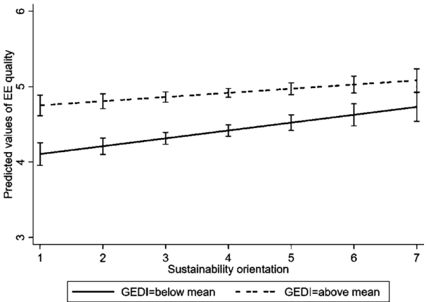
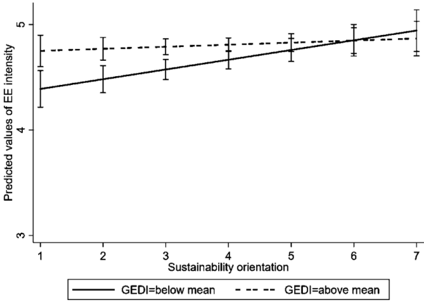
- The GEDI × sustainability interaction was negative and significant for both outcomes, supporting the claim that sustainability matters more where institutions are weaker: β = -0.021 for growth orientation and β = -0.029 for intensity (Table 3); the paper reports a similar “catching-up” effect in robustness checks.
- The robustness discussion states that moving sustainability orientation from 1 to 7 raises EE growth orientation from about 4 to almost 5 in low-GEDI regions, versus about 4.5 to just above 5 in high-GEDI regions; for EE intensity, it rises from 4.25 to 5 in low-GEDI regions versus 4.75 to 5 in high-GEDI regions.
Methods
- Cross-sectional survey study of 1,789 EE actors across 17 cities in 10 countries in Central/Eastern Europe, South-Eastern Europe, Central Asia, and the Balkans; data were collected between December 2018 and February 2020.
- Dependent variables were EE growth orientation and EE intensity, both measured on 1–7 Likert scales; the main explanatory variables were sustainability orientation and country-level institutional quality proxied by GEDI, plus an interaction between the two.
- Main analysis used OLS regression with heteroscedasticity-robust standard errors, city and year fixed effects, and VIF checks for multicollinearity; robustness checks used a binary GEDI split around the sample mean.
Limitations
- The paper states that GEDI is only available at the country level, not the regional level, so it assumes institutions are roughly homogeneous within countries; this is a stated limitation.
- The authors state that endogeneity may be present and that causality cannot be claimed from the cross-sectional data; this is a stated limitation.
- The paper says the study’s methodological weaknesses are its static focus and the number of cities; it also notes that future work should use longitudinal data and more regional institutional measures.
Model-written summary. Check it against the paper before relying on it.
Integrity signals
Registry
Cites
Statistics
Figures
Verification
Claims the paper makes
3 Valid · 3 Not valid · 26 Not checked · 75 Own results and interpretations
The cited sources that could be checked couldn’t confirm or dispute this claim.
In the paper
“It is therefore likely that developing countries will benefit more from sustainable growth behavior, being cautious with the environment, and sustainable living (Audretsch et al., 2019).”
§ Entrepreneurial ecosystems, institutional quality, and the unexpected role of the sustainability orientation of entrepreneurs > 2.3 Sustainability orientation compensating for weak institutions in entrepreneurial ecosystems
What the sources say
- Could not verifycites Audretsch et al., 2019 matched to “Entrepreneurial ecosystems: economic, technological, and societal impacts” (2019) sourceExperimental — accuracy not yet measured
The Economic, technological, and societal impacts section discusses the sustainability of entrepreneurial ecosystems, not sustainable living or environmentally cautious behavior. Searches for developing countries, sustainable growth, and environmental sustainability found no passage comparing benefits for developing countries with those for other countries. Page numbers are unavailable in our copy. (LLM, conf=0.77)
hedgedstates a possible cause- Asserted: passes — The authors put it forward as true.
- Checkable: passes — It can be checked against evidence.
- Load-bearing: passes — The paper’s conclusions depend on it.
- Based: passes — The paper gives a reason why it holds.
- Rests on an assumption not shown here.
- Could not verify
The cited sources support only part of this claim — read each source’s verdict below.
In the paper
“Our work also demonstrates that EEs that aim to support social entrepreneurship (Volkmann et al., 2019) are conduits for regional economic development (Audretsch et al., 2015).”
§ Entrepreneurial ecosystems, institutional quality, and the unexpected role of the sustainability orientation of entrepreneurs > 5 Discussion and conclusion
What the sources say
- Partly supportedcites Volkmann et al., 2019 matched to “Sustainable entrepreneurial ecosystems: an emerging field of research” (2021) sourceExperimental — accuracy not yet measured
Volkmann et al. describe entrepreneurial ecosystems that foster sustainable entrepreneurship (section 1), but they do not establish that these ecosystems specifically aim to support social entrepreneurship. Section 4 treats social entrepreneurship as a related but distinct topic. The regional-development claim is attached to Audretsch et al., not this source. (LLM, conf=0.78)
- Not checked — no full text of the sourcecites Audretsch et al., 2015 matched to “Infrastructure and entrepreneurship” (2015) source
boostedstates a cause- Asserted: passes — The authors put it forward as true.
- Checkable: passes — It can be checked against evidence.
- Load-bearing: passes — The paper’s conclusions depend on it.
- Based: passes — The paper gives a reason why it holds.
- Partly supported
A result the paper reports from its own data — it cites no other source for it, so there is none to check. The quote shows it is in the paper.
In the paper
“This paper finds that regions in the developing countries are able to level up in growth orientation and intensity of entrepreneurial activity with the regions in developed countries should entrepreneurial ecosystem prioritizes sustainability orientation.”
§ Entrepreneurial ecosystems, institutional quality, and the unexpected role of the sustainability orientation of entrepreneurs > Abstract
plainstates a possible cause- Asserted: passes — The authors put it forward as true.
- Checkable: passes — It can be checked against evidence.
- Load-bearing: passes — The paper’s conclusions depend on it.
- Based: passes — The paper gives a reason why it holds.
- Rests on 3 assumptions not shown here.
A result the paper reports from its own data — it cites no other source for it, so there is none to check. The quote shows it is in the paper.
In the paper
“We also found that an increase in sustainability awareness in countries with a higher GEDI had a lower marginal increase growth orientation of EE than for countries with a lower GEDI (β = -0.021;p < 0.05, spec.3, Table 3), supporting H3.”
§ Entrepreneurial ecosystems, institutional quality, and the unexpected role of the sustainability orientation of entrepreneurs > 4.1 Analysis using OLS regression model
plainstates a cause- Asserted: passes — The authors put it forward as true.
- Checkable: passes — It can be checked against evidence.
- Load-bearing: passes — The paper’s conclusions depend on it.
- Based: passes — The paper gives a reason why it holds.
A result the paper reports from its own data — it cites no other source for it, so there is none to check. The quote shows it is in the paper.
In the paper
“Our survey data thus demonstrates that there are only positive effects in fostering sustainability orientation in both institutionally more-and less-developed regions.”
§ Entrepreneurial ecosystems, institutional quality, and the unexpected role of the sustainability orientation of entrepreneurs > 5 Discussion and conclusion
boostedstates a cause- Asserted: passes — The authors put it forward as true.
- Checkable: passes — It can be checked against evidence.
- Load-bearing: passes — The paper’s conclusions depend on it.
- Based: passes — The paper gives a reason why it holds.
40 more claims
Create a free account to see all 107 claims and to verify the 14 references still open.
- Probably not a substantial claim. 32
- It may state two separate claims as one. 32
- The quote only partly states this claim. 11
Citations
Cites
The Promise of Entrepreneurship as a Field of Research
Shane, S., & Venkataraman, S. (2000) · Academy of Management Review · doi:10.5465/amr.2000.2791611 · Cited by 11,223
(2013) · Academy of Management Review · doi:10.5465/amr · Cited by 6,716
The Worldwide Governance Indicators: Methodology and Analytical Issues
Kaufmann, D., Kraay, A., & Mastruzzi, M. (2011) · Hague Journal on the Rule of Law · doi:10.1017/s1876404511200046 · Cited by 5,621 · cited 1×
“This indicator describes perceptions about the use of public office for private gain, including both petty and grand forms of corruption, as well as the “capture” of the state by elites and private interests (Kaufmann et al., 2011).”
Social entrepreneurship research: A source of explanation, prediction, and delight
Mair, J., & Martí, I. (2006) · Journal of World Business · doi:10.1016/j.jwb.2005.09.002 · Cited by 4,015 · cited 1×
“In addition to commercial and social orientation, entrepreneurs also respond to environmental market failure (Mair & Marti, 2006) and commit to sustainability orientation (Doherty et al., 2014; Sey-fang et al., 2014).”
Entrepreneurship: Productive, Unproductive, and Destructive
Baumol, W. J. (1990) · Journal of Political Economy · doi:10.1086/261712 · Cited by 3,649
A typology of social entrepreneurs: Motives, search processes and ethical challenges
Zahra, S. A., Gedajlovic, E., Neubaum, D. O., & Shulman, J. M. (2009) · Journal of Business Venturing · doi:10.1016/j.jbusvent.2008.04.007 · Cited by 2,780
CONDUCTING INTERORGANIZATIONAL RESEARCH USING KEY INFORMANTS.
KUMAR, N., STERN, L. W., & ANDERSON, J. C. (1993) · Academy of Management Journal · doi:10.2307/256824 · Cited by 2,467 · cited 1×
“A statistically random sample was created in which a key respondent (Kumar et al., 1993), such as a company founder, policymaker, or university professor, was invited to complete the survey.”
Do green supply chains lead to competitiveness and economic performance?
Rao, P., & Holt, D. (2005) · International Journal of Operations & Production Management · doi:10.1108/01443570510613956 · Cited by 2,453
Entrepreneurial Ecosystems and Regional Policy: A Sympathetic Critique
Stam, E. (2015) · European Planning Studies · doi:10.1080/09654313.2015.1061484 · Cited by 2,406 · cited 5×
“We use two dependent variables to describe the performance of EEs, including the growth orientation and intensity of the EE, drawing on prior research by Brown and Mason (2017), Stam (2015, 2018), and Audretsch and Belitski (2017).”
InfluentialThe Relational Organization of Entrepreneurial Ecosystems
Spigel, B. (2017) · Entrepreneurship Theory and Practice · doi:10.1111/etap.12167 · Cited by 2,257
Research works printed but not linked: 8
- 64. Isenberg, D. (2011). The entrepreneurship ecosystem strategy as a new paradigm for economic policy: Principles for cultivating entrepreneurship. Dublin: Institute of Interna- tional European Affairs.
- 65. Isenberg, D. (2010). How to start an entrepreneurial revolution. Harward Business Review, 88(6)
- 70. Kirzner, I. M. (1973). Entrepreneurship and competition. Uni- versity of Chicago Press.
- 78. Kunze, I. (2012). Social innovations for communal and eco- logical living: Lessons from sustainability research and observations in intentional communities. Communal Societies: Journal of the Communal Studies Association, 32(1), 50-67.
- 110. Schumpeter, J. (1934). The theory of economic development Harvard University Press. Cambridge, MA: UK.
- 121. Stam, E., & Bosma, N. (2015). Local policies for high-growth firms. The Oxford handbook of local competitiveness, 286-305
- 122. Stam, E., Bosma, N., Van Witteloostuijn, A., De Jong, J., Bogaert, S., Edwards, N., & Jaspers, F. (2012). Ambi- tious entrepreneurship: A review of the academic litera- ture and directions for public policy (1-162). Den Haag: Advisory Council for Science and Technology Policy.
- 130. United Nations. (2015). World leaders adopt sustainable devel- opment goals. http:// www. undp. org/ conte nt/ undp/ en/ home/ press center/ press relea ses/ 2015/ 09/ 24/ undp-welco mes-adopt ion-of-susta inable-devel opment-goals-by- world-leade rs. html
Cited by
Filippelli, S., Troise, C., Bigliardi, B., & Corvello, V. (2024) · Technological Forecasting and Social Change · doi:10.1016/j.techfore.2024.123900 · Cited by 72
Sustainable and inclusive development in left-behind places
Benner, M., Trippl, M., & Hassink, R. (2024) · Review of Regional Research · doi:10.1007/s10037-024-00216-w · Cited by 35
Institutions and macroeconomic indicators: entrepreneurial activities across the world
Kara, O., Altınay, L., Bağış, M., Kurutkan, M. N., & Vatankhah, S. (2023) · Management Decision · doi:10.1108/md-04-2023-0490 · Cited by 33
Exploring the effect of institutions on entrepreneurial ecosystems: A meta–analysis
Goletsis, Y., Christogeorgou, K., & Mylonidis, N. (2024) · Journal of Small Business Management · doi:10.1080/00472778.2024.2363845 · Cited by 32
Deng, W., Liang, Q., Zhang, S. X., & Wang, W. (2023) · Asia Pacific Journal of Management · doi:10.1007/s10490-023-09930-4 · Cited by 18
Decoding value exchange in entrepreneurial ecosystems through a service-dominant lens
Donaldson, C., Newbery, R., Berbegal‐Mirabent, J., & Kallmuenzer, A. (2024) · Small Business Economics · doi:10.1007/s11187-024-00935-x · Cited by 23
Ammirato, S., Felicetti, A. M., Filippelli, S., & Maran, T. K. (2024) · Review of Managerial Science · doi:10.1007/s11846-024-00777-7 · Cited by 24
Institutional enablers for sustainable entrepreneurship: a configurational analysis
Maaßen, C., Lopez, T., & Urbano, D. (2025) · Small Business Economics · doi:10.1007/s11187-025-01076-5 · Cited by 32
A game theory analysis of regional innovation ecosystems
Shakiba, H., & Belitski, M. (2024) · The Journal of Technology Transfer · doi:10.1007/s10961-024-10131-4 · Cited by 22
Self-citationUnpacking the relationship between entrepreneurial marketing activities and small firm performance
Aliakbari, A., Crick, J. M., Chen, W., & Crick, D. (2024) · International Journal of Entrepreneurial Behaviour & Research · doi:10.1108/ijebr-10-2024-1173 · Cited by 12
Oliveira, A. Y., Mendes, J. A. J., Zanon, L. G., Gerólamo, M. C., & Zuin, V. G. (2025) · Business Strategy & Development · doi:10.1002/bsd2.70083 · Cited by 14
Sustainable entrepreneurship: exploring the intention–behavior gap
Dixit, J. K., Agrawal, V., & Agarwal, S. (2024) · Management Decision · doi:10.1108/md-01-2024-0056 · Cited by 17
Moradi, M. A., & Jahanbakht, M. (2026) · Administrative Sciences · doi:10.3390/admsci16020097 · Cited by 15
Entrepreneurial ecosystems governance: critical perspectives and steps forward
Nave, E., Torres, P., Querido, A. R., Ferreira, J. J., & Fernandes, G. (2024) · The Journal of Technology Transfer · doi:10.1007/s10961-024-10172-9 · Cited by 19
Gregori, P., Schwarz, E. J., & Holzmann, P. (2025) · Small Business Economics · doi:10.1007/s11187-025-01071-w · Cited by 18
Self-citationClimate change and systemic risk: Evidence from financial intermediaries
Pellegrini, C. B., Pellegrini, L., & Vismara, S. (2025) · Technological Forecasting and Social Change · doi:10.1016/j.techfore.2025.124408 · Cited by 18
Roshid, M. M., Saiyed, S., Karim, R., Haque, T., Siddique, M. S. R., Haque, M. A., Kumar, V., & Habib, S. B. (2025) · Environment Innovation and Management · doi:10.1142/s3060901125500103 · Cited by 16
Exploring knowledge spillovers: innovation strategies in resource-rich countries
Khlystova, O., & Kalyuzhnova, Y. (2025) · The Journal of Technology Transfer · doi:10.1007/s10961-025-10221-x · Cited by 18
Salwan, P., Ajgaonkar, S., Neelam, N. G., & Venkatachalam, R. (2025) · Cogent Social Sciences · doi:10.1080/23311886.2025.2493777 · Cited by 19
Towards a comprehensive framework of the institutional dimensions in entrepreneurship research
Urbano, D., Álvarez, C., & Lopez, T. (2025) · Small Business Economics · doi:10.1007/s11187-025-01124-0 · Cited by 22
Crisis as a catalyst: how the pre-existing values of entrepreneurs shape strategic crisis responses
Tomlinson, O., Sinkovics, N., Sinkovics, R. R., & Fath, B. P. (2025) · Small Business Economics · doi:10.1007/s11187-025-01080-9 · Cited by 11
Demirdağ, İ. (2024) · European Planning Studies · doi:10.1080/09654313.2024.2307334 · Cited by 8
Editorial: An ecosystem theory of family business
Ratten, V. (2024) · Journal of Family Business Management · doi:10.1108/jfbm-07-2024-308 · Cited by 8
Perez, J. P., Martins, I., Aparicio, S., Lopez, T., & Urbano, D. (2025) · The International Journal of Management Education · doi:10.1016/j.ijme.2025.101328 · Cited by 9
Toepler, F., & Velamuri, V. K. (2025) · Managerial and Decision Economics · doi:10.1002/mde.4518 · Cited by 10
Entrepreneurial ecosystems and blended value creation: a configurational view
do Prado, N. B., de Moraes, G. H. S. M., Fischer, B. B., & Anholon, R. (2025) · Journal of Entrepreneurship and Public Policy · doi:10.1108/jepp-10-2024-0195 · Cited by 8
Uneven Contributions: Informal Entrepreneurship and Sustainability in the Global South
Baijou, M., Ahmed, T., Youssef, M. H., & Kraus, S. (2026) · Business Strategy and the Environment · doi:10.1002/bse.70607 · Cited by 7
do Prado, N. B., & de Moraes, G. H. S. M. (2024) · The Journal of Technology Transfer · doi:10.1007/s10961-024-10167-6 · Cited by 12
The impact of Big Five Personality Traits on entrepreneurial orientation
Youssef, M. H., Sayour, N., Naser, V., Hussein, H. M., & Harakeh, M. (2025) · Entrepreneurship and Regional Development · doi:10.1080/08985626.2025.2570320 · Cited by 11
The jazz jam session improvisation model of stakeholder engagement in entrepreneurial ecosystems
Audretsch, D. B., Belitski, M., & Herzig, M. (2025) · Journal of Small Business Management · doi:10.1080/00472778.2025.2450009 · Cited by 7
Self-citationBreaking bad? Playing the fool and constructing the ‘bad researcher’ in entrepreneurship
Harrison, R. (2024) · Journal of Business Venturing Insights · doi:10.1016/j.jbvi.2024.e00484 · Cited by 4
Demirdağ, İ., & Nirwansyah, A. W. (2024) · Natural Hazards · doi:10.1007/s11069-024-06753-4 · Cited by 9
Sustainability orientation of academic spinoffs: does it pay?
Civera, A., & Meoli, M. (2025) · Small Business Economics · doi:10.1007/s11187-025-01070-x · Cited by 6
Koch, L. L., Tonial, G., Matos, F., & Pletsch, A. L. B. (2025) · European Journal of Innovation Management · doi:10.1108/ejim-11-2024-1402 · Cited by 12
Pizzichini, L., Briamonte, M. F., Papa, A., & Giudice, M. D. (2025) · Technovation · doi:10.1016/j.technovation.2025.103334 · Cited by 7
Organizing ecosystems for the greater good: An integrative review
Raizada, A., & Sinha, S. (2025) · Journal of Cleaner Production · doi:10.1016/j.jclepro.2025.145148 · Cited by 4
Fuseini, E. I. (2025) · Journal of Small Business & Entrepreneurship · doi:10.1080/08276331.2025.2587475 · Cited by 5
Method for and Analysis of Early-Stage Firm Growth Patterns Using World Bank Data
Lavilla, R. E., & Ruíz‐Navarro, J. (2024) · Sustainability · doi:10.3390/su16041450 · Cited by 7
Sohail, K., Belitski, M., & Christiansen, L. C. (2025) · Journal of Small Business Management · doi:10.1080/00472778.2025.2581669 · Cited by 8
Self-citationChahdoura, A., Khefacha, I., & Mrabet, N. (2025) · International Review of Applied Economics · doi:10.1080/02692171.2025.2568372 · Cited by 2
Capelleras, J., Contín‐Pilart, I., Larraza‐Kintana, M., & Martin‐Sanchez, V. (2026) · Small Business Economics · doi:10.1007/s11187-025-01159-3 · Cited by 5
CONSTRAINED AGRICULTURAL ENTREPRENEURSHIP: EVIDENCE FROM THE HIGHLAND HIMALAYAN CONTEXT
Raza, G., Kratzer, J., & Haq, M. (2025) · Journal of Developmental Entrepreneurship · doi:10.1142/s1084946725500153 · Cited by 6
Ogbuabor, J. E., Emeka, E. T., Chinweuba, N. H., & Urama, C. E. (2025) · Journal of the Knowledge Economy · doi:10.1007/s13132-024-02297-x · Cited by 2
Rosa, J. G., Mejía‐Morelos, J. H., Agredano, F., Theodoraki, C., Cisneros, L., & Kariv, D. (2026) · Journal of Cleaner Production · doi:10.1016/j.jclepro.2026.148528 · Cited by 3
Demirdağ, İ., & Eraydın, A. (2024) · Eastern European Economics · doi:10.1080/00128775.2024.2354752 · Cited by 4
Civic awareness of social entrepreneurship and consumer boycotts: A collective action approach
Schenkenhofer, J. E., & Silvio Vismara, A. (2025) · Small Business Economics · doi:10.1007/s11187-025-01078-3 · Cited by 2
Köseoğlu, M. A. (2025) · Sustainable Development · doi:10.1002/sd.70137 · Cited by 4
The role of entrepreneurial ecosystems in sustainable local economic development
de Bruyn, C., Venter, M., Krüger, N. A., van Rensburg, L. J., Meyer, N., Bowmaker‐Falconer, A., Meyer, D., Moos, M., Goss, R., Fubah, C. N., et al. (2025) · doi:10.4102/aosis.2025.bk527 · Cited by 5
Zeng, Z., Tang, W., Luo, F., & Wu, L. (2025) · SAGE Open · doi:10.1177/21582440251378543 · Cited by 5
Audretsch, D. B., Fiedler, A., Fath, B. P., & Verreynne, M. (2026) · Industry and Innovation · doi:10.1080/13662716.2026.2637176 · Cited by 3
Self-citationAkiode, M. (2023) · Qeios · doi:10.32388/jx1u6p · Cited by 1
Alfehaid, F., & Omri, A. (2026) · Sustainable Development · doi:10.1002/sd.70765 · Cited by 4
Ünlü, H., & Rao‐Nicholson, R. (2024) · Elsevier eBooks · doi:10.1016/b978-0-443-13701-3.00026-8 · Cited by 4
Akiode, M. (2023) · Qeios · doi:10.32388/jx1u6p.2 · Cited by 1
Akiode, M., & Roundy, P. T. (2025) · Poverty & Public Policy · doi:10.1002/pop4.70043 · Cited by 2
Paunović, I., Apostolopoulos, S., Αποστολόπουλος, Ν., Newbery, R., Miljković, I. B., Maniatopoulos, G., & King, M. (2026) · Small Business Economics · doi:10.1007/s11187-026-01187-7 · Cited by 1
Perez, J. P., Martins, I., Aparicio, S., Lopez, T., & Urbano, D. (2026) · World Development · doi:10.1016/j.worlddev.2026.107346 · Cited by 5
Ecosystem for Business Startup in Punjab: Issues, Challenges, and Way Forward
Awan, J. T. (2025) · Journal of Pakistan Administration · doi:10.65755/jpa-20254602-109 · Cited by 3
Jiménez, J. C. (2025) · Journal of Entrepreneurship and Public Policy · doi:10.1108/jepp-04-2024-0056 · Cited by 2
Long-Term Effects of Shocks on New Opportunity and Necessity EntrepreneurshipPreprint
Congregado, E., Fossen, F. M., Rubino, N., et al. (2024) · SSRN Electronic Journal · doi:10.2139/ssrn.4800267 · Cited by 1
Culture over regulation: institutional dimensions driving sustainable entrepreneurship
Maaßen, C., Lopez, T., & Urbano, D. (2026) · Small Business Economics · doi:10.1007/s11187-026-01176-w · Cited by 6
Advancing corporate green innovation through science: The role of freedom of expression and NGOs
Ouadghiri, I. E., Peillex, J., Platania, F., & Hernandez, C. T. (2026) · Technological Forecasting and Social Change · doi:10.1016/j.techfore.2026.124577 · Cited by 2
Natural resources in entrepreneurial ecosystem evolution: leadership challenges in peripheries
Romaní, G., Atienza, M., & Mason, C. M. (2026) · Regional Studies · doi:10.1080/00343404.2026.2696397
Rincón, A. G., & Avolio, B. E. (2026) · Competitiveness Review An International Business Journal incorporating Journal of Global Competitiveness · doi:10.1108/cr-07-2025-0220
BÜYÜMEDEN OLGUNLUĞA: TEKNOPARK PERFORMANSINI YENİDEN ÇERÇEVELEMEK
Özkan, C. (2026) · İstanbul Ticaret Üniversitesi Girişimcilik Dergisi · doi:10.55830/tje.1953932
Mutsamwira, S. (2026) · SSRN Electronic Journal · doi:10.2139/ssrn.6170787 · Cited by 1
Modrego, F., Foster, W., & Atienza, M. (2026) · Economic Analysis and Policy · doi:10.1016/j.eap.2026.08.055
Entrepreneurship ecosystems and national climate change performance: a global multi-method analysis
Köseoğlu, M. A., & Arıcı, N. Ç. (2026) · Small Business Economics · doi:10.1007/s11187-026-01225-4 · Cited by 1
Desai, P., Thomas, F., Upadhayay, D., & Shah, D. H. (2026) · SN Business & Economics · doi:10.1007/s43546-026-01410-3
COMPORTAMENTO ECOEMPREENDEDOR NO CONTEXTO PANDÊMICO
do Prado, N. B., de Moraes, G. H. S. M., Pinto, K. E. F., Vodă, A. I., & Synodinos, C. (2024) · Revista de Administração de Empresas · doi:10.1590/s0034-759020240203x · Cited by 1
Guevara-Otero, N., Pérez, A. M. V., Rudi, G. R., & Cossío, N. S. (2026) · The Journal of Technology Transfer · doi:10.1007/s10961-025-10312-9 · Cited by 2
Hidayat, M., & Fatmasari, F. (2026) · Research Square · doi:10.21203/rs.3.rs-8717122/v1
Blalock, E. C., Fan, Y., & Lyu, X. (2025) · Journal of Fashion Marketing and Management · doi:10.1108/jfmm-06-2024-0220 · Cited by 3
Cultivating Innovation Ecosystems to Drive Sustainable Market Success
Suganya, R. V., Vetrivel, M., & Kumar, A. V. S. (2025) · IGI Global eBooks · doi:10.4018/979-8-3693-8739-9.ch012 · Cited by 2
di Santo, N., Annosi, M. C., Sisto, R., & Appio, F. P. (2026) · Long Range Planning · doi:10.1016/j.lrp.2026.102690 · Cited by 1
Fostering Entrepreneurship: Insights from North Africa and the GCC
Awashreh, R. A. (2026) · Journal of Entrepreneurship and Innovation in Emerging Economies · doi:10.1177/23939575261464455
Driving sustainability: turning entrepreneurs’ motivations into actions
Hernández, Y. B., Mora-Ruano, R., Grijalba, M. A., & Pérez-Encinas, A. (2026) · International Journal of Entrepreneurial Behaviour & Research · doi:10.1108/ijebr-05-2025-0663 · Cited by 1
IS MANAGING LOCAL GOVERNMENT THROUGH AN ENTREPRENEURIAL ECOSYSTEM A NEW APPROACH?
Tross, U., Raudsaar, M., & Hirv, T. (2026) · Trames Journal of the Humanities and Social Sciences · doi:10.3176/tr.2026.1.02
Maina, S. M., & Urban, B. (2026) · Small Business International Review · doi:10.26784/sbir/53d9c397
Alyassi, A. M. A. A., & Zakaria, N. (2025) · International Review of Management and Marketing · doi:10.32479/irmm.19288 · Cited by 1
Banc, C., & Messeghem, K. (2026) · Revue de l’Entrepreneuriat · doi:10.3917/e.entre.hs5.0065 · Cited by 1
Kitumba, G. K. (2026) · Cogent Business & Management · doi:10.1080/23311975.2026.2712021
Heß, M., Reuther, J., Grichnik, D., & Wincent, J. (2025) · Journal of Business Research · doi:10.1016/j.jbusres.2025.115628 · Cited by 2
Chanprasitchai, O.-A., & Narkbunnum, W. (2026) · Journal of Open Innovation: Technology, Market and Complexity · doi:10.1016/j.joitmc.2026.100879
Entrepreneurship Resilience: Female-Led Small Businesses Facing Diverse Crises
Kuran, O., & Khabbaz, L. (2026) · Entrepreneurship Research Journal · doi:10.1515/erj-2026-0213
Chapter 1: Entrepreneurial ecosystems and local economic development: A systematic review
de Bruyn, C. O., & Venter, M. (2025) · doi:10.4102/aosis.2025.bk527.01
Tetteh, E. N. A. (2023) · Advances in information quality and management · doi:10.4018/978-1-6684-7366-5.ch071 · Cited by 2
Xu, Z., Pea-Assounga, J. B. B., & Lu, H. (2026) · Education + Training · doi:10.1108/et-11-2025-0944
Zhang, M., & Hartley, J. L. (2026) · Journal of Chinese Economic and Business Studies · doi:10.1080/14765284.2026.2719196
The scaling of game-changer business models to address societal grand challenges
Gunaratne, D., Sinkovics, N., Sinkovics, R. R., & Molina‐Castillo, F. (2025) · Multinational Business Review · doi:10.1108/mbr-07-2024-0130 · Cited by 3
RAISSI, M., Darkaoui, A., & Admi, S. (2026) · Multidisciplinary Science Journal · doi:10.31893/multiscience.2026465
Metadata
- Authors
- Audretsch, D. B., Belitski, M., Eichler, G. M., & Schwarz, E.
- Affiliations
- Indiana University Bloomington (US)
- University of Reading (GB)
- University of Klagenfurt (AT)
- Corresponding author
- Belitski, Maksim
- Venue
- Small Business Economics
- Published
- 2023-04-04
- Volume
- 62
- Issue
- 2
- Pages
- 503-522
- ISSN
- 0921-898X (ISSN-L)
- 1573-0913
- OpenAlex
- W4362556602
- Semantic Scholar
- 115b03c375cb78801c3ebd297d5db69410acd821
- Cited by
- 105
- References
- 143
- Citations by year
- 2026: 37 · 2025: 39 · 2024: 22 · 2023: 7
- FWCI
- 25.67
- Type
- journal article
- Language
- en
- Open access
- hybrid
- doi.org
- Licence
- cc-by
- creativecommons.org/licenses/by/4.0 (tdm)
- creativecommons.org/licenses/by/4.0 (vor)
- Locations
- Small Business Economics (publishedVersion, cc-by)
- CentAUR (University of Reading) (submittedVersion)
- RePEc: Research Papers in Economics (submittedVersion)
- Topics
- Social Sciences › Business, Management and Accounting › Management of Technology and Innovation › Entrepreneurship Studies and Influences
- Social Sciences › Business, Management and Accounting › Management of Technology and Innovation › University-Industry-Government Innovation Models
- Social Sciences › Economics, Econometrics and Finance › Economics and Econometrics › Regional Development and Management Studies
- Keywords
- entrepreneurial ecosystems, institutional quality, sustainability orientation, entrepreneurship growth, Sustainable Development Goals, ecosystem actors, regional policy
About these checks
Registry, retraction, Cites and statistics results are computed, not judged, with one exception: a printed reference that no index lists is read once by a model before it counts as a citation error. Claims are extracted by a model and kept only when their quote appears verbatim in the text; each cited source is then checked, with a model’s help, for whether it says what the claim relies on. Those verdicts can be wrong — read the claim’s quote and the cited source before relying on one.
The claim verdicts this report counts are experimental: their accuracy is not yet measured.
A language model drew the claims from the paper on 2026-10-10, under version 3 of the claim definition (model deepseek-v4.1-flash, prompt extract-v3).
A second model labelled each claim on 2026-10-10 (model jev-1.13-20260917, definition revision gold-guideline-v0.2).
Cited sources are checked with a language model’s help (gpt-6-sol).
Statistics and arithmetic are recomputed, not judged.
Confidence bands are shown only for fields calibrated on our annotated test set. None is calibrated yet, so no band is shown.
What counts as a claim ›How we measure confidence ›How we check this ›
Are you an author, or do you see a problem with this page? Request a review
Data sources
Bibliographic data: Semantic Scholar, OpenAlex, Crossref.
Contains information from the Semantic Scholar Academic Graph Datasets, made available under the ODC Attribution License (ODC-BY 1.0).
Semantic Scholar’s data is described in: Kinney, R., et al. (2023). The Semantic Scholar Open Data Platform. arXiv:2301.10140.
