

Entrepreneurial ecosystems, institutional quality, and the unexpected role of the sustainability orientation of entrepreneurs
Open accessThe DOI matches its Crossref record; 141 of the 143 references it cites were found in a registry or an index, and 1 are not checked yet; 4 of the 49 sources its claims cite were checked for support.
Abstract
Examines how the sustainability orientation of entrepreneurial ecosystem (EE) actors facilitates the intensity and growth orientation of entrepreneurship. Primary data on 1,789 actors across 17 cities in East and South-East Europe shows that institutional quality moderates this relationship.
Verified 2026-11-25 · 1 reference not checked yet
Overview
CoChat Summary
TL;DR
This paper argues that entrepreneurial ecosystem (EE) outcomes depend not only on formal institutional quality but also on the sustainability orientation of EE actors. Using survey data from 1,789 actors in 17 cities, the authors find that sustainability orientation is positively associated with EE growth orientation and intensity, and that its marginal effect is larger in places with weaker formal institutions.
Key findings
- In OLS models, the Global Entrepreneurship Development Index (GEDI) was positively associated with EE outcomes: for growth orientation, GEDI was significant in Table 3 (e.g., β = 0.004* in spec. 2 and β = 0.005 in spec. 3); for EE intensity, GEDI was also positive and significant (e.g., β = 0.005* in spec. 6 and β = 0.006* in spec. 7).
- Sustainability orientation had a positive association with both outcomes: for EE growth orientation, β = 0.089* (spec. 3) and β = 0.104* (spec. 4); for EE intensity, β = 0.065* (spec. 7) and β = 0.092* (spec. 8).
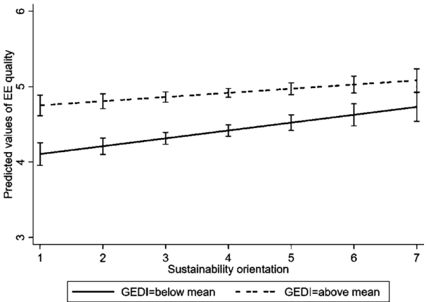
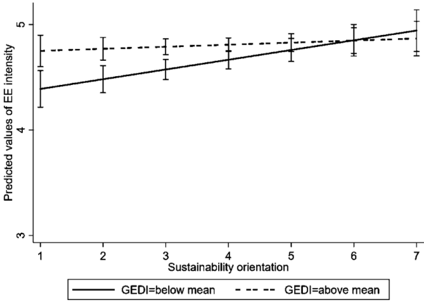
- The GEDI × sustainability interaction was negative and significant for both outcomes, supporting the claim that sustainability matters more where institutions are weaker: β = -0.021 for growth orientation and β = -0.029 for intensity (Table 3); the paper reports a similar “catching-up” effect in robustness checks.
- The robustness discussion states that moving sustainability orientation from 1 to 7 raises EE growth orientation from about 4 to almost 5 in low-GEDI regions, versus about 4.5 to just above 5 in high-GEDI regions; for EE intensity, it rises from 4.25 to 5 in low-GEDI regions versus 4.75 to 5 in high-GEDI regions.
Methods
- Cross-sectional survey study of 1,789 EE actors across 17 cities in 10 countries in Central/Eastern Europe, South-Eastern Europe, Central Asia, and the Balkans; data were collected between December 2018 and February 2020.
- Dependent variables were EE growth orientation and EE intensity, both measured on 1–7 Likert scales; the main explanatory variables were sustainability orientation and country-level institutional quality proxied by GEDI, plus an interaction between the two.
- Main analysis used OLS regression with heteroscedasticity-robust standard errors, city and year fixed effects, and VIF checks for multicollinearity; robustness checks used a binary GEDI split around the sample mean.
Limitations
- The paper states that GEDI is only available at the country level, not the regional level, so it assumes institutions are roughly homogeneous within countries; this is a stated limitation.
- The authors state that endogeneity may be present and that causality cannot be claimed from the cross-sectional data; this is a stated limitation.
- The paper says the study’s methodological weaknesses are its static focus and the number of cities; it also notes that future work should use longitudinal data and more regional institutional measures.
Model-written summary. Check it against the paper before relying on it.
Integrity signals
Registry
Cites
Statistics
Figures
Verification
Claims the paper makes
3 Valid · 3 Not valid · 26 Not checked · 75 Own results and interpretations
The cited sources that could be checked couldn’t confirm or dispute this claim.
In the paper
“It is therefore likely that developing countries will benefit more from sustainable growth behavior, being cautious with the environment, and sustainable living (Audretsch et al., 2019).”
§ Entrepreneurial ecosystems, institutional quality, and the unexpected role of the sustainability orientation of entrepreneurs > 2.3 Sustainability orientation compensating for weak institutions in entrepreneurial ecosystems
What the sources say
- Could not verifycites Audretsch et al., 2019 matched to “Entrepreneurial ecosystems: economic, technological, and societal impacts” (2019) sourceExperimental — accuracy not yet measured
The Economic, technological, and societal impacts section discusses the sustainability of entrepreneurial ecosystems, not sustainable living or environmentally cautious behavior. Searches for developing countries, sustainable growth, and environmental sustainability found no passage comparing benefits for developing countries with those for other countries. Page numbers are unavailable in our copy. (LLM, conf=0.77)
hedgedstates a possible cause- Asserted: passes — The authors put it forward as true.
- Checkable: passes — It can be checked against evidence.
- Load-bearing: passes — The paper’s conclusions depend on it.
- Based: passes — The paper gives a reason why it holds.
- Rests on an assumption not shown here.
- Could not verify
The cited sources support only part of this claim — read each source’s verdict below.
In the paper
“Our work also demonstrates that EEs that aim to support social entrepreneurship (Volkmann et al., 2019) are conduits for regional economic development (Audretsch et al., 2015).”
§ Entrepreneurial ecosystems, institutional quality, and the unexpected role of the sustainability orientation of entrepreneurs > 5 Discussion and conclusion
What the sources say
- Partly supportedcites Volkmann et al., 2019 matched to “Sustainable entrepreneurial ecosystems: an emerging field of research” (2021) sourceExperimental — accuracy not yet measured
Volkmann et al. describe entrepreneurial ecosystems that foster sustainable entrepreneurship (section 1), but they do not establish that these ecosystems specifically aim to support social entrepreneurship. Section 4 treats social entrepreneurship as a related but distinct topic. The regional-development claim is attached to Audretsch et al., not this source. (LLM, conf=0.78)
- Not checked — no full text of the sourcecites Audretsch et al., 2015 matched to “Infrastructure and entrepreneurship” (2015) source
boostedstates a cause- Asserted: passes — The authors put it forward as true.
- Checkable: passes — It can be checked against evidence.
- Load-bearing: passes — The paper’s conclusions depend on it.
- Based: passes — The paper gives a reason why it holds.
- Partly supported
A result the paper reports from its own data — it cites no other source for it, so there is none to check. The quote shows it is in the paper.
In the paper
“This paper finds that regions in the developing countries are able to level up in growth orientation and intensity of entrepreneurial activity with the regions in developed countries should entrepreneurial ecosystem prioritizes sustainability orientation.”
§ Entrepreneurial ecosystems, institutional quality, and the unexpected role of the sustainability orientation of entrepreneurs > Abstract
plainstates a possible cause- Asserted: passes — The authors put it forward as true.
- Checkable: passes — It can be checked against evidence.
- Load-bearing: passes — The paper’s conclusions depend on it.
- Based: passes — The paper gives a reason why it holds.
- Rests on 3 assumptions not shown here.
A result the paper reports from its own data — it cites no other source for it, so there is none to check. The quote shows it is in the paper.
In the paper
“We also found that an increase in sustainability awareness in countries with a higher GEDI had a lower marginal increase growth orientation of EE than for countries with a lower GEDI (β = -0.021;p < 0.05, spec.3, Table 3), supporting H3.”
§ Entrepreneurial ecosystems, institutional quality, and the unexpected role of the sustainability orientation of entrepreneurs > 4.1 Analysis using OLS regression model
plainstates a cause- Asserted: passes — The authors put it forward as true.
- Checkable: passes — It can be checked against evidence.
- Load-bearing: passes — The paper’s conclusions depend on it.
- Based: passes — The paper gives a reason why it holds.
A result the paper reports from its own data — it cites no other source for it, so there is none to check. The quote shows it is in the paper.
In the paper
“Our survey data thus demonstrates that there are only positive effects in fostering sustainability orientation in both institutionally more-and less-developed regions.”
§ Entrepreneurial ecosystems, institutional quality, and the unexpected role of the sustainability orientation of entrepreneurs > 5 Discussion and conclusion
boostedstates a cause- Asserted: passes — The authors put it forward as true.
- Checkable: passes — It can be checked against evidence.
- Load-bearing: passes — The paper’s conclusions depend on it.
- Based: passes — The paper gives a reason why it holds.
40 more claims
Create a free account to see all 107 claims and to verify the 14 references still open.
- Probably not a substantial claim. 32
- It may state two separate claims as one. 32
- The quote only partly states this claim. 11
Citations
Cites
The Promise of Entrepreneurship as a Field of Research
Shane, S., & Venkataraman, S. (2000) · Academy of Management Review · doi:10.5465/amr.2000.2791611 · Cited by 11,223
(2013) · Academy of Management Review · doi:10.5465/amr · Cited by 6,716
The Worldwide Governance Indicators: Methodology and Analytical Issues
Kaufmann, D., Kraay, A., & Mastruzzi, M. (2011) · Hague Journal on the Rule of Law · doi:10.1017/s1876404511200046 · Cited by 5,621 · cited 1×
“This indicator describes perceptions about the use of public office for private gain, including both petty and grand forms of corruption, as well as the “capture” of the state by elites and private interests (Kaufmann et al., 2011).”
Social entrepreneurship research: A source of explanation, prediction, and delight
Mair, J., & Martí, I. (2006) · Journal of World Business · doi:10.1016/j.jwb.2005.09.002 · Cited by 4,015 · cited 1×
“In addition to commercial and social orientation, entrepreneurs also respond to environmental market failure (Mair & Marti, 2006) and commit to sustainability orientation (Doherty et al., 2014; Sey-fang et al., 2014).”
Entrepreneurship: Productive, Unproductive, and Destructive
Baumol, W. J. (1990) · Journal of Political Economy · doi:10.1086/261712 · Cited by 3,649
A typology of social entrepreneurs: Motives, search processes and ethical challenges
Zahra, S. A., Gedajlovic, E., Neubaum, D. O., & Shulman, J. M. (2009) · Journal of Business Venturing · doi:10.1016/j.jbusvent.2008.04.007 · Cited by 2,780
CONDUCTING INTERORGANIZATIONAL RESEARCH USING KEY INFORMANTS.
KUMAR, N., STERN, L. W., & ANDERSON, J. C. (1993) · Academy of Management Journal · doi:10.2307/256824 · Cited by 2,467 · cited 1×
“A statistically random sample was created in which a key respondent (Kumar et al., 1993), such as a company founder, policymaker, or university professor, was invited to complete the survey.”
Do green supply chains lead to competitiveness and economic performance?
Rao, P., & Holt, D. (2005) · International Journal of Operations & Production Management · doi:10.1108/01443570510613956 · Cited by 2,453
Entrepreneurial Ecosystems and Regional Policy: A Sympathetic Critique
Stam, E. (2015) · European Planning Studies · doi:10.1080/09654313.2015.1061484 · Cited by 2,406 · cited 5×
“We use two dependent variables to describe the performance of EEs, including the growth orientation and intensity of the EE, drawing on prior research by Brown and Mason (2017), Stam (2015, 2018), and Audretsch and Belitski (2017).”
InfluentialThe Relational Organization of Entrepreneurial Ecosystems
Spigel, B. (2017) · Entrepreneurship Theory and Practice · doi:10.1111/etap.12167 · Cited by 2,257
The Allocation of Talent: Implications for Growth
Murphy, K. M., Shleifer, A., & Vishny, R. W. (1991) · The Quarterly Journal of Economics · doi:10.2307/2937945 · Cited by 2,092
Sustainable entrepreneurship and sustainability innovation: categories and interactions
Schaltegger, S., & Wagner, M. (2011) · Business Strategy and the Environment · doi:10.1002/bse.682 · Cited by 2,049
De Soto, H., & Co-PLAN (2000) · doi:10.37199/t40002609 · Cited by 1,960
Social Enterprises as Hybrid Organizations: A Review and Research Agenda
Doherty, B., Haugh, H., & Lyon, F. (2014) · International Journal of Management Reviews · doi:10.1111/ijmr.12028 · Cited by 1,821
A Positive Theory of Social Entrepreneurship
Santos, F. M. (2012) · Journal of Business Ethics · doi:10.1007/s10551-012-1413-4 · Cited by 1,768
Strategic entrepreneurship: entrepreneurial strategies for wealth creation
Hitt, M. A., Ireland, R. D., Camp, S. M., & Sexton, D. L. (2001) · Strategic Management Journal · doi:10.1002/smj.196 · Cited by 1,576
Entrepreneurial innovation: The importance of context
Autio, E., Kenney, M., Mustar, P., Siegel, D., & Wright, M. (2014) · Research Policy · doi:10.1016/j.respol.2014.01.015 · Cited by 1,456
Shepherd, D. A., & Patzelt, H. (2011) · Entrepreneurship Theory and Practice · doi:10.1111/j.1540-6520.2010.00426.x · Cited by 1,356
National systems of entrepreneurship: measurement issues and policy implications
Ács, Z. J., Autio, E., & Szerb, L. (2014) · Research Policy · doi:10.1016/j.respol.2013.08.016 · Cited by 1,301 · cited 2×
“Following Acs et al. (2014), we control for formal and informal institutions directly.”
Entrepreneurial ecosystem elements
Stam, E., & van de Ven, A. (2021) · Small Business Economics · doi:10.1007/s11187-019-00270-6 · Cited by 1,276
What is the value of entrepreneurship? A review of recent research
van Praag, C. M., & Versloot, P. H. (2007) · Small Business Economics · doi:10.1007/s11187-007-9074-x · Cited by 1,206
The Impact of Entrepreneurship on Economic Growth
Carree, M. A., & Thurik, A. R. (2010) · Handbook of Entrepreneurship Research · doi:10.1007/978-1-4419-1191-9_20 · Cited by 1,061
Bacq, S., & Janssen, F. (2011) · Entrepreneurship & Regional Development · doi:10.1080/08985626.2011.577242 · Cited by 1,037 · cited 3×
“( 1234567890) (Besser et al., 2006) and exploring entrepreneurial opportunities that would benefit the public (Bacq & Janssen, 2011).”
Social Entrepreneurship Research: Past Achievements and Future Promises
Saebi, T., Foss, N. J., & Linder, S. (2019) · Journal of Management · doi:10.1177/0149206318793196 · Cited by 1,001
Entrepreneurial ecosystems in cities: establishing the framework conditions
Audretsch, D. B., & Belitski, M. (2017) · The Journal of Technology Transfer · doi:10.1007/s10961-016-9473-8 · Cited by 977
Self-citationKuckertz, A., & Wagner, M. (2010) · Journal of Business Venturing · doi:10.1016/j.jbusvent.2009.09.001 · Cited by 944
Looking inside the spiky bits: a critical review and conceptualisation of entrepreneurial ecosystems
Brown, R., & Mason, C. (2017) · Small Business Economics · doi:10.1007/s11187-017-9865-7 · Cited by 852 · cited 4×
“Building on prior (social and sustainable) EE literature (Audretsch & Belitski, 2017; Brown & Mason, 2017; Cameron, 2012; Kabbaj et al., 2016; Stam, 2015; Volkmann et al., 2019), we argue that sustainability orientation may be used as a pillar of EEs.”
InfluentialInstitutions and entrepreneurship development in Russia: A comparative perspective
Aidis, R., Estrin, S., & Mickiewicz, T. (2008) · Journal of Business Venturing · doi:10.1016/j.jbusvent.2008.01.005 · Cited by 801
Sustainable valley entrepreneurial ecosystems
Cohen, B. (2006) · Business Strategy and the Environment · doi:10.1002/bse.428 · Cited by 796 · cited 3×
“Furthermore, a culture of sustainability orientation (Cohen, 2006; Sánchez-Hernández and Maldonado-Briegas 2019) includes accepting and supporting individuals attempting to start their own businesses who are pursuing environmentally-friendly and productive goals.”
Which institutions encourage entrepreneurial growth aspirations?
Estrin, S., Korosteleva, J., & Mickiewicz, T. (2013) · Journal of Business Venturing · doi:10.1016/j.jbusvent.2012.05.001 · Cited by 792
Testing Baumol: Institutional quality and the productivity of entrepreneurship
Sobel, R. S. (2008) · Journal of Business Venturing · doi:10.1016/j.jbusvent.2008.01.004 · Cited by 784
Does self-employment reduce unemployment?
Thurik, A. R., Carree, M. A., van Stel, A., & Audretsch, D. B. (2008) · Journal of Business Venturing · doi:10.1016/j.jbusvent.2008.01.007 · Cited by 748
Self-citationSocial Innovation and Social Entrepreneurship: A Systematic Review
Phillips, W., Lee, H., Ghobadian, A., O’Regan, N., & James, P. (2015) · Group & Organization Management · doi:10.1177/1059601114560063 · Cited by 745
Exploring country-level institutional arrangements on the rate and type of entrepreneurial activity
Stenholm, P., Acs, Z. J., & Wuebker, R. (2013) · Journal of Business Venturing · doi:10.1016/j.jbusvent.2011.11.002 · Cited by 729
The emergence of entrepreneurial ecosystems: A complex adaptive systems approach
Roundy, P. T., Bradshaw, M., & Brockman, B. K. (2018) · Journal of Business Research · doi:10.1016/j.jbusres.2018.01.032 · Cited by 681 · cited 1×
“…variables reflect respondent’s attitudes towards the four pillars of EE, as well as their perceptions regarding institutional quality, which adds to the complex system of interactions between various elements of entrepreneurial economies in a region (Roundy et al., 2018; Stam and Ven, 2019).”
Effects of New Business Formation on Regional Development over Time
Fritsch, M., & Mueller, P. (2004) · Regional Studies · doi:10.1080/0034340042000280965 · Cited by 658
Regional Governance Matters: Quality of Government within European Union Member States
Charron, N., Dijkstra, L., & Lapuente, V. (2014) · Regional Studies · doi:10.1080/00343404.2013.770141 · Cited by 646 · cited 1×
“…and social EE (Almeida et al., 2012; Kabbaj et al., 2016; Siddike & Kohda, 2016), there are already hints that improvement of the sustainability orientation will have a greater effect on EE outcomes in developing economies than in developed economies (Charron et al., 2014; Szerb et al., 2013).”
Entrepreneurship, institutional economics, and economic growth: an ecosystem perspective
Acs, Z. J., Estrin, S., Mickiewicz, T., & Szerb, L. (2018) · Small Business Economics · doi:10.1007/s11187-018-0013-9 · Cited by 582 · cited 3×
“GEDI consists of three blocks or sub-indexes: entrepreneurial attitudes, entrepreneurial abilities, and entrepreneurial aspirations with 14 pillars-indicators (Acs et al., 2018a).”
InfluentialThe Role of Government Policy on Entrepreneurial Activity: Productive, Unproductive, or Destructive?
Minniti, M. (2008) · Entrepreneurship Theory and Practice · doi:10.1111/j.1540-6520.2008.00255.x · Cited by 560
Meek, W. R., Pacheco, D. F., & York, J. G. (2010) · Journal of Business Venturing · doi:10.1016/j.jbusvent.2009.09.007 · Cited by 558 · cited 1×
“Sustainability policy and responsible behavior of EE actors and communities thus facilitate business growth and entrepreneurship (Meek et al., 2010) and also make it possible for entrepreneurial activity to benefit society as a whole (Koe et al., 2014; Szerb et al., 2019).”
Creativity and/or Alertness: A Reconsideration of the Schumpeterian Entrepreneur
Kirzner, I. M. (1999) · The Review of Austrian Economics · doi:10.1023/a:1007719905868 · Cited by 551
Institutions and Entrepreneurship Quality
Chowdhury, F., Audretsch, D. B., & Belitski, M. (2019) · Entrepreneurship Theory and Practice · doi:10.1177/1042258718780431 · Cited by 514
Self-citationEntrepreneurship, Management, and the Structure of Payoffs.
Mayer, C., & Baumöl, W. J. (1996) · The Economic Journal · doi:10.2307/2234945 · Cited by 505
A grassroots sustainable energy niche? Reflections on community energy in the UK
Seyfang, G., Hielscher, S., Hargreaves, T., Martiskainen, M., & Smith, A. (2014) · Environmental Innovation and Societal Transitions · doi:10.1016/j.eist.2014.04.004 · Cited by 503
Entrepreneurial ecosystems: economic, technological, and societal impacts
Audretsch, D. B., Cunningham, J. A., Kuratko, D. F., Lehmann, E. E., & Menter, M. (2019) · The Journal of Technology Transfer · doi:10.1007/s10961-018-9690-4 · Cited by 480
Self-citationBacq, S., & Alt, E. (2018) · Journal of Business Venturing · doi:10.1016/j.jbusvent.2018.01.004 · Cited by 467
Infrastructure and entrepreneurship
Audretsch, D. B., Heger, D., & Veith, T. (2015) · Small Business Economics · doi:10.1007/s11187-014-9600-6 · Cited by 451
Self-citationReward structures and the allocation of talent
Acemoglu, D. (1995) · European Economic Review · doi:10.1016/0014-2921(94)00014-q · Cited by 449
Kern, F., Rogge, K. S., & Howlett, M. (2019) · Research Policy · doi:10.1016/j.respol.2019.103832 · Cited by 443 · cited 1×
“…sustainability orientation is known to have a positive impact on EE outcomes, it is also expected to boost many other sustainability related topics, enforcing the effects of sustainability policies and contributing to sustainable urban development (Kern et al., 2019; L. Zhang et al., 2018).”
The Influence of Formal and Informal Institutional Voids on Entrepreneurship
Webb, J. W., Khoury, T. A., & Hitt, M. A. (2020) · Entrepreneurship Theory and Practice · doi:10.1177/1042258719830310 · Cited by 411 · cited 4×
“Second, should policymakers adopt sustainability policies to leverage institutional voids in their countries and regions (Webb et al., 2020), they may enable further convergence in intensity and growth orientation of EEs and the creation of stronger long-term regional institutions.”
InfluentialSize matters: entrepreneurial entry and government
Aidis, R., Estrin, S., & Mickiewicz, T. M. (2012) · Small Business Economics · doi:10.1007/s11187-010-9299-y · Cited by 409
Barriers to innovation through public procurement: a supplier perspective
Uyarra, E., Edler, J., Garcia-Estevez, J., Georghiou, L., & Yeow, J. (2014) · Technovation · doi:10.1016/j.technovation.2014.04.003 · Cited by 408 · cited 1×
“Financial austerity has created opportunities for the establishment of new social enterprises to bid for contracts to deliver out-sourced public services (Uyarra et al., 2014; Vickers et al., 2017).”
Towards modern sustainable cities: Review of sustainability principles and trends
Sodiq, A., Baloch, A. A. B., Khan, S. A., Sezer, N., Mahmoud, S., Jama, M., & Abdelaal, A. (2019) · Journal of Cleaner Production · doi:10.1016/j.jclepro.2019.04.106 · Cited by 408
Regional systems of entrepreneurship: the nexus of human capital, knowledge and new firm formation
Qian, H., Acs, Z. J., & Stough, R. R. (2013) · Journal of Economic Geography · doi:10.1093/jeg/lbs009 · Cited by 390
Entrepreneurship, management, and the structure of payoffs
(1994) · Choice Reviews Online · doi:10.5860/choice.31-6135 · Cited by 389
Entrepreneurship and sustainability: The need for innovative and institutional solutions
Ben Youssef, A., Boubaker, S., & Omri, A. (2018) · Technological Forecasting and Social Change · doi:10.1016/j.techfore.2017.11.003 · Cited by 360
Social Innovation: Integrating Micro, Meso, and Macro Level Insights From Institutional Theory
van Wijk, J., Zietsma, C., Dorado, S., de Bakker, F. G. A., & Martí, I. (2019) · Business & Society · doi:10.1177/0007650318789104 · Cited by 348
Entrepreneurial ecosystems: a dynamic lifecycle model
Cantner, U., Cunningham, J. A., Lehmann, E. E., & Menter, M. (2021) · Small Business Economics · doi:10.1007/s11187-020-00316-0 · Cited by 333
Stam, E., & Spigel, B. (2018) · The SAGE Handbook of Small Business and Entrepreneurship · doi:10.4135/9781473984080.n21 · Cited by 315
Sustainable entrepreneurial ecosystems: an emerging field of research
Volkmann, C., Fichter, K., Klofsten, M., & Audretsch, D. B. (2021) · Small Business Economics · doi:10.1007/s11187-019-00253-7 · Cited by 311
Self-citationHow entrepreneurial ecosystems take form: Evidence from social impact initiatives in Seattle
Thompson, T. A., Purdy, J. M., & Ventresca, M. J. (2018) · Strategic Entrepreneurship Journal · doi:10.1002/sej.1285 · Cited by 306 · cited 1×
“In order to facilitate growth orientation and intensity of EEs, it is important to focus on a sustainable EE orientation (Cohen, 2006; T. A. Thompson et al., 2018) as well as improving the formal institutional environment (Sobel, 2008; Stenholm et al., 2013).”
Formal and Informal Institutions Under Codecision: Continuous Constitution‐Building in Europe
Farrell, H., & Héritier, A. (2003) · Governance · doi:10.1111/1468-0491.00229 · Cited by 306
The governance of entrepreneurial ecosystems
Colombo, M. G., Dagnino, G. B., Lehmann, E. E., & Salmador, M. (2019) · Small Business Economics · doi:10.1007/s11187-017-9952-9 · Cited by 291
Strategy: Process, content, context—An international perspective
(1995) · Long Range Planning · doi:10.1016/0024-6301(95)92128-1 · Cited by 289
The diverse world of social enterprise: A collection of social enterprise stories
Thompson, J., & Doherty, B. (2006) · International Journal of Social Economics · doi:10.1108/03068290610660643 · Cited by 285
Measure Twice, Cut Once: Entrepreneurial Ecosystem Metrics
Leendertse, J., Schrijvers, M., & Stam, E. (2022) · Research Policy · doi:10.1016/j.respol.2021.104336 · Cited by 282
Sustainable Entrepreneurship: Is Entrepreneurial will Enough? A North–South Comparison
Spence, M., Ben Boubaker Gherib, J., & Ondoua Biwolé, V. (2011) · Journal of Business Ethics · doi:10.1007/s10551-010-0656-1 · Cited by 281
Audretsch, D. B., & Belitski, M. (2021) · Regional Studies · doi:10.1080/00343404.2020.1854711 · Cited by 280
Self-citationEntrepreneurship as an Urban Event? Empirical Evidence from European Cities
Bosma, N., & Sternberg, R. (2014) · Regional Studies · doi:10.1080/00343404.2014.904041 · Cited by 239
Adapting to Grand Environmental Challenges Through Collective Entrepreneurship
Doh, J. P., Tashman, P., & Benischke, M. H. (2019) · Academy of Management Perspectives · doi:10.5465/amp.2017.0056 · Cited by 239
How different formal institutions affect opportunity and necessity entrepreneurship
Fuentelsaz, L., González, C., Maícas, J. P., & Montero, J. (2015) · BRQ Business Research Quarterly · doi:10.1016/j.brq.2015.02.001 · Cited by 237
Social Entrepreneurship Reserach: a Source of Explanation, Prediction and Delight
Mair, J., & Marti Lanuza, I. (2005) · SSRN Electronic Journal · doi:10.2139/ssrn.673446 · Cited by 237
Roxas, B., Ashill, N., & Chadee, D. (2017) · Journal of Small Business Management · doi:10.1111/jsbm.12259 · Cited by 225
Measuring an Entrepreneurial Ecosystem
Bell-Masterson, J., & Stangler, D. (2015) · SSRN Electronic Journal · doi:10.2139/ssrn.2580336 · Cited by 223
Eichler, G. M., & Schwarz, E. J. (2019) · Sustainability · doi:10.3390/su11020522 · Cited by 222
Self-citationMeasuring Entrepreneurial Ecosystems
Stam, E. (2017) · International studies in entrepreneurship · doi:10.1007/978-3-319-63531-6_9 · Cited by 221
Belitski, M., Aginskaja, A., & Marozau, R. (2019) · Research Policy · doi:10.1016/j.respol.2018.10.011 · Cited by 217
Self-citationWilliams, N. J., Jaramillo, P., Taneja, J., & Ustun, T. S. (2015) · Renewable and Sustainable Energy Reviews · doi:10.1016/j.rser.2015.07.153 · Cited by 212
Doing Institutional Analysis Digging Deeper Than Markets and Hierarchies
Ostrom, E. (2005) · Handbook of New Institutional Economics · doi:10.1007/0-387-25092-1_31 · Cited by 209
Vickers, I., Lyon, F., Sepulveda, L., & McMullin, C. (2017) · Research Policy · doi:10.1016/j.respol.2017.08.003 · Cited by 203
Responsible Entrepreneurship in Developing Countries: Understanding the Realities and Complexities
Azmat, F., & Samaratunge, R. (2009) · Journal of Business Ethics · doi:10.1007/s10551-009-0054-8 · Cited by 200
Szerb, L., Lafuente, E., Horváth, K., & Páger, B. (2019) · Regional Studies · doi:10.1080/00343404.2018.1510481 · Cited by 198
Who is left out: exploring social boundaries in entrepreneurial ecosystems
Neumeyer, X., Santos, S. C., & Morris, M. H. (2019) · The Journal of Technology Transfer · doi:10.1007/s10961-018-9694-0 · Cited by 191 · cited 1×
“Entrepreneurship generates taxable revenues and profits, creates jobs, builds new business networks (Colombo et al., 2019), develops infrastructure, and facilitates economic development (Carree & Thurik, 2010; Neumeyer et al., 2019).”
Lumpkin, G. T., Bacq, S., & Pidduck, R. J. (2018) · Journal of Small Business Management · doi:10.1111/jsbm.12379 · Cited by 189
Emerging needs of social innovators and social innovation ecosystems
Audretsch, D. B., Eichler, G. M., & Schwarz, E. J. (2021) · International Entrepreneurship and Management Journal · doi:10.1007/s11365-021-00789-9 · Cited by 186
Self-citationEntrepreneurial ecosystems in cities: The role of institutions
Audretsch, D. B., Belitski, M., & Cherkas, N. (2021) · PLOS ONE · doi:10.1371/journal.pone.0247609 · Cited by 182
Self-citationE Pluribus Unum: Impact Entrepreneurship as a Solution to Grand Challenges
Markman, G. D., Waldron, T. L., Gianiodis, P. T., & Espina, M. I. (2019) · Academy of Management Perspectives · doi:10.5465/amp.2019.0130 · Cited by 180
Dealmakers in Place: Social Capital Connections in Regional Entrepreneurial Economies
Feldman, M., & Zoller, T. D. (2012) · Regional Studies · doi:10.1080/00343404.2011.607808 · Cited by 178
Regulatory Uncertainty: A Reason to Postpone Investments? Not Necessarily
Hoffmann, V. H., Trautmann, T., & Hamprecht, J. (2009) · Journal of Management Studies · doi:10.1111/j.1467-6486.2009.00866.x · Cited by 169 · cited 2×
“Particularly, formal institutions are often weak or inefficient in developing economies, and they are subject to change, with high uncertainty and risks leading to regional differences in institutions (Hoffmann et al., 2009; Williams et al., 2015).”
Entrepreneurship, management, and the structure of payoffs
Baumol, W. J. (1993) · Cited by 163
Qian, H. (2018) · Economic Development Quarterly · doi:10.1177/0891242418760981 · Cited by 154
Social entrepreneurship and entrepreneurial ecosystems: Complementary or disjoint phenomena?
Roundy, P. T. (2017) · International Journal of Social Economics · doi:10.1108/ijse-02-2016-0045 · Cited by 151
Huybrechts, B., & Haugh, H. (2017) · Organization Studies · doi:10.1177/0170840617717097 · Cited by 149
Framing Social Problems in Social Entrepreneurship
Hervieux, C., & Voltan, A. (2016) · Journal of Business Ethics · doi:10.1007/s10551-016-3252-1 · Cited by 144
Hertel, C. J., Bacq, S. C., & Belz, F. (2019) · Academy of Management Discoveries · doi:10.5465/amd.2018.0153 · Cited by 141
Talent, creativity and regional economic performance: the case of China
Qian, H. (2008) · The Annals of Regional Science · doi:10.1007/s00168-008-0282-3 · Cited by 134
Hooi, H. C., Ahmad, N. H., Amran, A., & Rahman, S. A. (2016) · Management Research Review · doi:10.1108/mrr-06-2015-0144 · Cited by 126 · cited 2×
“Our main explanatory variable, sustainability orientation, draws on the work of Kunze (2012) and Hooi et al. (2016) and is measured on the Likert scale: “There is a strong awareness of sustainability in my region/city (healthy life style, veganism, energy efficiency, sustainable growth, corporate…”
Content, J., Bosma, N., Jordaan, J., & Sanders, M. (2020) · Regional Studies · doi:10.1080/00343404.2019.1680827 · Cited by 124
Linking Social Entrepreneurship and Sustainability
Zhang, D. D., & Swanson, L. (2014) · Journal of Social Entrepreneurship · doi:10.1080/19420676.2014.880503 · Cited by 119
Fan, Y., & Zheng, S. (2020) · Cities · doi:10.1016/j.cities.2020.102895 · Cited by 115
Factors Associated with Propensity for Sustainable Entrepreneurship
Koe, W.-L., Omar, R., & Majid, I. A. (2014) · Procedia - Social and Behavioral Sciences · doi:10.1016/j.sbspro.2014.04.009 · Cited by 113
Raza, A., Muffatto, M., & Saeed, S. (2018) · Journal of Small Business and Enterprise Development · doi:10.1108/jsbed-01-2018-0014 · Cited by 111
From resource munificence to ecosystem integration: the case of government sponsorship in St. Louis
Motoyama, Y., & Knowlton, K. (2016) · Entrepreneurship & Regional Development · doi:10.1080/08985626.2016.1186749 · Cited by 111
A Model of Destructive Entrepreneurship: Insight for Conflict and Postconflict Recovery
Desai, S., Acs, Z. J., & Weitzel, U. (2013) · Journal of Conflict Resolution · doi:10.1177/0022002712464853 · Cited by 102
Policies to enhance the drivers of green housing development in China
Zhang, L., Wu, J., & Liu, H. (2018) · Energy Policy · doi:10.1016/j.enpol.2018.06.029 · Cited by 102 · cited 1×
“…sustainability orientation is known to have a positive impact on EE outcomes, it is also expected to boost many other sustainability related topics, enforcing the effects of sustainability policies and contributing to sustainable urban development (Kern et al., 2019; L. Zhang et al., 2018).”
Self-employment and well-being across institutional contexts
Fritsch, M., Sorgner, A., & Wyrwich, M. (2019) · Journal of Business Venturing · doi:10.1016/j.jbusvent.2019.105946 · Cited by 100
Belitski, M., & Desai, S. (2015) · The Journal of Technology Transfer · doi:10.1007/s10961-015-9446-3 · Cited by 98
Self-citationKogut, B., & Ragin, C. (2006) · European Management Review · doi:10.1057/palgrave.emr.1500048 · Cited by 95 · cited 1×
“Further controls build on prior studies (Aidis et al., 2012; Audretsch & Belitski, 2017; Fritsch et al., 2019; Kogut & Ragin, 2006; Ostrom, 2005) and are related to the extent of media support to entrepreneurship (Stenholm et al., 2013) or entrepreneurial culture in a region (Belitski et al., 2019;…”
The role of institutions in latent and emergent entrepreneurship
Audretsch, D. B., Belitski, M., Caiazza, R., & Desai, S. (2021) · Technological Forecasting and Social Change · doi:10.1016/j.techfore.2021.121263 · Cited by 92
Self-citationFor the greater good: business networks and business social responsibility to communities
Besser, T. L., Miller, N. J., & Perkins, R. K. (2006) · Entrepreneurship and Regional Development · doi:10.1080/08985620600715046 · Cited by 78
Global Entrepreneurship and Development Index 2018
(2018) · doi:10.1007/978-3-030-03279-1 · Cited by 78
A STUDY OF THE SOCIAL ENTREPRENEURSHIP ECOSYSTEM: THE CASE OF MOROCCO
Kabbaj, M., Ouazzani, K. E., Elamrani, J., & Lemtaoui, M. (2016) · Journal of Developmental Entrepreneurship · doi:10.1142/s1084946716500217 · Cited by 67
The complementarity perspective to the entrepreneurial ecosystem taxonomy
Godley, A., Morawetz, N., & Soga, L. R. (2019) · Small Business Economics · doi:10.1007/s11187-019-00197-y · Cited by 67
A Theory of Destructive Entrepreneurship
Desai, S., & Acs, Z. J. (2007) · doi:10.2139/ssrn.1029648 · Cited by 66
ICT reuse in socio-economic enterprises
Ongondo, F. O., Williams, I. D., Dietrich, J., & Carroll, C. (2013) · Waste Management · doi:10.1016/j.wasman.2013.08.020 · Cited by 66
New Business Creation: An International Overview
Reynolds, P. D., & Curtin, R. T. (2010) · International studies in entrepreneurship · doi:10.1007/978-1-4419-7536-2 · Cited by 64
Does Self-Employment Reduce Unemployment?Preprint
Thurik, R., Carree, M., van Stel, A. J., et al. (2007) · SSRN Electronic Journal · doi:10.2139/ssrn.1029672 · Cited by 57
Sustainable Living in Finland: Combating Climate Change in Everyday Life
Salonen, A. O., Siirilä, J., & Valtonen, M. (2018) · Sustainability · doi:10.3390/su10010104 · Cited by 56
(2014) · Eurasian Journal of Business and Economics · Cited by 56
Misallocation of Entrepreneurial Talent in Postconflict Environments
Sanders, M., & Weitzel, U. (2013) · Journal of Conflict Resolution · doi:10.1177/0022002712464852 · Cited by 52
Huybrechts, B., & Haugh, H. (2018) · doi:10.17863/cam.11197 · Cited by 49
Almeida, M. C., de Mello, J. M. C., & Etzkowitz, H. (2012) · International Journal of Technology and Globalisation · doi:10.1504/ijtg.2012.048326 · Cited by 48
Entrepreneurial ecosystems in conflict regions: evidence from Ukraine
Belitski, M., Cherkas, N., & Khlystova, O. (2022) · The Annals of Regional Science · doi:10.1007/s00168-022-01203-0 · Cited by 44
Self-citationSkills and knowledge-based entrepreneurship: evidence from US cities
Qian, H. (2017) · Regional Studies · doi:10.1080/00343404.2016.1213383 · Cited by 44 · cited 2×
“Sustainable businesses require a set of framework conditions that provide an opportune environment for enhancing sustainable and environmentally friendly innovation (Qian, 2017; Saebi et al., 2019).”
Hernández, M. I. S., & Briegas, J. J. M. (2019) · Sustainability · doi:10.3390/su11133625 · Cited by 40
Institutions and entrepreneurship: the mediating role of corruption
Khyareh, M. M. (2017) · World Journal of Entrepreneurship Management and Sustainable Development · doi:10.1108/wjemsd-09-2016-0045 · Cited by 37
Eurasian Journal of Business and Economics
(2015) · doi:10.17015/ejbe.2015.015 · Cited by 34
Entrepreneurship in Small Cities: Evidence From U.S. Micropolitan Areas
Liu, S., Qian, H., & Haynes, K. E. (2020) · Economic Development Quarterly · doi:10.1177/0891242420941927 · Cited by 33
(2007) · doi:10.1787/9789264039070-en · Cited by 33
Air pollution lowers travel demand in a consumer city
Wang, B., & Zheng, S. (2020) · Transportation Research Part D Transport and Environment · doi:10.1016/j.trd.2020.102616 · Cited by 32
Social Entrepreneurs in the Social Innovation Ecosystem
Cameron, H. (2012) · Palgrave Macmillan UK eBooks · doi:10.1057/9780230367098_9 · Cited by 23
Dealmakers in Place: Social Capital Connections in Regional Entrepreneurial EconomiesPreprint
Feldman, M. P., & Zoller, T. (2012) · SSRN Electronic Journal · doi:10.2139/ssrn.2014302 · Cited by 16
Entrepreneurial activity across European cities
(2010) · Cited by 11
Self-citationBelitski, M., & Grigore, A.-M. (2022) · European Planning Studies · doi:10.1080/09654313.2021.1985436 · Cited by 10
Self-citationCarden, A. (2008) · The Review of Austrian Economics · doi:10.1007/s11138-008-0052-6 · Cited by 3
(2013) · Repository of the Academy's Library (Library of the Hungarian Academy of Sciences)
(2008) · University Microfilms International eBooks
What is the Value of Entrepreneurship? A Review of Recent Research
van Praag, M., & Versloot, P. H. (2007) · doi:10.2139/ssrn.1010568
Research works printed but not linked: 8
- 64. Isenberg, D. (2011). The entrepreneurship ecosystem strategy as a new paradigm for economic policy: Principles for cultivating entrepreneurship. Dublin: Institute of Interna- tional European Affairs.
- 65. Isenberg, D. (2010). How to start an entrepreneurial revolution. Harward Business Review, 88(6)
- 70. Kirzner, I. M. (1973). Entrepreneurship and competition. Uni- versity of Chicago Press.
- 78. Kunze, I. (2012). Social innovations for communal and eco- logical living: Lessons from sustainability research and observations in intentional communities. Communal Societies: Journal of the Communal Studies Association, 32(1), 50-67.
- 110. Schumpeter, J. (1934). The theory of economic development Harvard University Press. Cambridge, MA: UK.
- 121. Stam, E., & Bosma, N. (2015). Local policies for high-growth firms. The Oxford handbook of local competitiveness, 286-305
- 122. Stam, E., Bosma, N., Van Witteloostuijn, A., De Jong, J., Bogaert, S., Edwards, N., & Jaspers, F. (2012). Ambi- tious entrepreneurship: A review of the academic litera- ture and directions for public policy (1-162). Den Haag: Advisory Council for Science and Technology Policy.
- 130. United Nations. (2015). World leaders adopt sustainable devel- opment goals. http:// www. undp. org/ conte nt/ undp/ en/ home/ press center/ press relea ses/ 2015/ 09/ 24/ undp-welco mes-adopt ion-of-susta inable-devel opment-goals-by- world-leade rs. html
Cited by
Filippelli, S., Troise, C., Bigliardi, B., & Corvello, V. (2024) · Technological Forecasting and Social Change · doi:10.1016/j.techfore.2024.123900 · Cited by 72
Sustainable and inclusive development in left-behind places
Benner, M., Trippl, M., & Hassink, R. (2024) · Review of Regional Research · doi:10.1007/s10037-024-00216-w · Cited by 35
Institutions and macroeconomic indicators: entrepreneurial activities across the world
Kara, O., Altınay, L., Bağış, M., Kurutkan, M. N., & Vatankhah, S. (2023) · Management Decision · doi:10.1108/md-04-2023-0490 · Cited by 33
Exploring the effect of institutions on entrepreneurial ecosystems: A meta–analysis
Goletsis, Y., Christogeorgou, K., & Mylonidis, N. (2024) · Journal of Small Business Management · doi:10.1080/00472778.2024.2363845 · Cited by 32
Deng, W., Liang, Q., Zhang, S. X., & Wang, W. (2023) · Asia Pacific Journal of Management · doi:10.1007/s10490-023-09930-4 · Cited by 18
Metadata
- Authors
- Audretsch, D. B., Belitski, M., Eichler, G. M., & Schwarz, E.
- Affiliations
- Indiana University Bloomington (US)
- University of Reading (GB)
- University of Klagenfurt (AT)
- Corresponding author
- Belitski, Maksim
- Venue
- Small Business Economics
- Published
- 2023-04-04
- Volume
- 62
- Issue
- 2
- Pages
- 503-522
- ISSN
- 0921-898X (ISSN-L)
- 1573-0913
- OpenAlex
- W4362556602
- Semantic Scholar
- 115b03c375cb78801c3ebd297d5db69410acd821
- Cited by
- 105
- References
- 143
- Citations by year
- 2026: 37 · 2025: 39 · 2024: 22 · 2023: 7
- FWCI
- 25.67
- Type
- journal article
- Language
- en
- Open access
- hybrid
- doi.org
- Licence
- cc-by
- creativecommons.org/licenses/by/4.0 (tdm)
- creativecommons.org/licenses/by/4.0 (vor)
- Locations
- Small Business Economics (publishedVersion, cc-by)
- CentAUR (University of Reading) (submittedVersion)
- RePEc: Research Papers in Economics (submittedVersion)
- Topics
- Social Sciences › Business, Management and Accounting › Management of Technology and Innovation › Entrepreneurship Studies and Influences
- Social Sciences › Business, Management and Accounting › Management of Technology and Innovation › University-Industry-Government Innovation Models
- Social Sciences › Economics, Econometrics and Finance › Economics and Econometrics › Regional Development and Management Studies
- Keywords
- entrepreneurial ecosystems, institutional quality, sustainability orientation, entrepreneurship growth, Sustainable Development Goals, ecosystem actors, regional policy
About these checks
Registry, retraction, Cites and statistics results are computed, not judged, with one exception: a printed reference that no index lists is read once by a model before it counts as a citation error. Claims are extracted by a model and kept only when their quote appears verbatim in the text; each cited source is then checked, with a model’s help, for whether it says what the claim relies on. Those verdicts can be wrong — read the claim’s quote and the cited source before relying on one.
The claim verdicts this report counts are experimental: their accuracy is not yet measured.
A language model drew the claims from the paper on 2026-10-10, under version 3 of the claim definition (model deepseek-v4.1-flash, prompt extract-v3).
A second model labelled each claim on 2026-10-10 (model jev-1.13-20260917, definition revision gold-guideline-v0.2).
Cited sources are checked with a language model’s help (gpt-6-sol).
Statistics and arithmetic are recomputed, not judged.
Confidence bands are shown only for fields calibrated on our annotated test set. None is calibrated yet, so no band is shown.
What counts as a claim ›How we measure confidence ›How we check this ›
Are you an author, or do you see a problem with this page? Request a review
Data sources
Bibliographic data: Semantic Scholar, OpenAlex, Crossref.
Contains information from the Semantic Scholar Academic Graph Datasets, made available under the ODC Attribution License (ODC-BY 1.0).
Semantic Scholar’s data is described in: Kinney, R., et al. (2023). The Semantic Scholar Open Data Platform. arXiv:2301.10140.
