

The DOI matches its Crossref record, with a small difference in title or year; 11 of the 11 references it cites were found in a registry or an index.
The 40-year debate: a meta-review on what works for juvenile offenders
Open accessAbstract
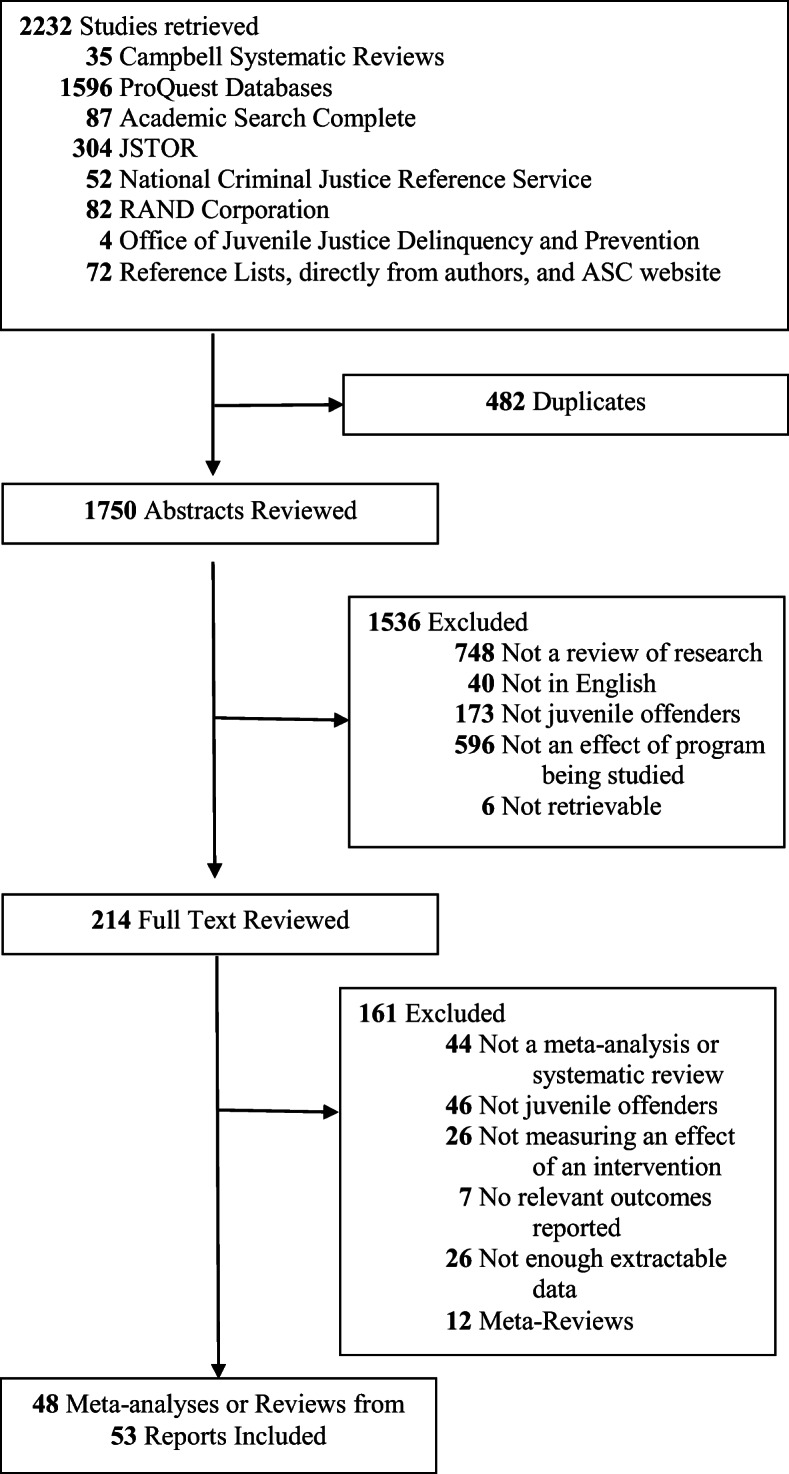
Objectives: This meta-review integrates the findings of meta-analyses and systematic reviews to explore the effect of intervention programs on recidivism for juvenile offenders. Methods: The systematic literature search gathered 48 meta-analyses and systematic reviews from 53 research reports, contributing 56 independent effect sizes for analysis. These effect sizes were statistically integrated, and five moderators of theoretical and methodological importance were tested using meta-regression. Results: On average, intervention programs are associated with a significant reduction in recidivism (rΦ = −0.09, p < 0.001) for juvenile offenders who participate in a program compared to those who do not. However, reductions in recidivism significantly vary between the levels of criminal justice system, characteristics of juvenile offenders, types of program modalities, and methodological quality. Conclusions: Results indicate that intervention programs can be an effective approach to reducing recidivism for juvenile offenders, especially when combined with a rehabilitative program modality.
Overview
The claims and statistics of this paper haven’t been checked yet.
Run the check — free, no account needed. It reads the open-access text and checks the sources it cites.
Integrity signals
Registry
Cites
Statistics
Figures
Verification
Claims the paper makes
The claims and statistics of this paper haven’t been checked yet.
Run the check — free, no account needed. It reads the open-access text and checks the sources it cites.
Claims other papers make about this one
Each is checked against this paper’s own text: does it say what the citing paper says it does?
The source backs part of the claim, not all of it — or backs it for a different population, condition or comparison.
In the citing paper
“residential judicial interventions for youth have been shown to produce only small effects on criminal recidivism (Pappas & Dent, 2021)”
From Safety First! Residential Group Climate and Antisocial Behavior: A Multilevel Meta-analysis (2025) · cites this paper as Pappas & Dent, 2021
Experimental — accuracy not yet measured
Self-check
Percentages, sums and reported differences re-computed from the paper’s own numbers.
The self-check needs the paper’s full text.
Citations
Cites
The PRISMA 2020 statement: An updated guideline for reporting systematic reviews
Page, M. J., McKenzie, J. E., Bossuyt, P. M., Boutron, I., Hoffmann, T. C., Mulrow, C. D., Shamseer, L., Tetzlaff, J. M., Akl, E. A., Brennan, S. E., et al. (2021) · BMJ · doi:10.1136/bmj.n71 · Cited by 108,283
Shea, B. J., Reeves, B. C., Wells, G., Thuku, M., Hamel, C., Moran, J., Moher, D., Tugwell, P., Welch, V., Kristjansson, E., et al. (2017) · BMJ · doi:10.1136/bmj.j4008 · Cited by 10,636
Power failure: why small sample size undermines the reliability of neuroscience
Button, K. S., Ioannidis, J. P. A., Mokrysz, C., Nosek, B. A., Flint, J., Robinson, E. S. J., & Munafò, M. R. (2013) · Nature Reviews Neuroscience · doi:10.1038/nrn3475 · Cited by 7,641
The PRISMA 2020 statement: An updated guideline for reporting systematic reviews
Page, M. J., McKenzie, J. E., Bossuyt, P. M., Boutron, I., Hoffmann, T. C., Mulrow, C. D., Shamseer, L., Tetzlaff, J. M., Akl, E. A., Brennan, S. E., et al. (2021) · PLoS Medicine · doi:10.1371/journal.pmed.1003583 · Cited by 5,148
What is ‘quality of evidence’ and why is it important to clinicians?
Guyatt, G. H., Oxman, A. D., Kunz, R., Vist, G. E., Falck-Ytter, Y., & Schünemann, H. J. (2008) · BMJ · doi:10.1136/bmj.39490.551019.be · Cited by 3,250
Research Synthesis and Meta-Analysis: A Step-by-Step Approach
Cooper, H. (2017) · doi:10.4135/9781071878644 · Cited by 1,716
Landenberger, N. A., & Lipsey, M. W. (2005) · Journal of Experimental Criminology · doi:10.1007/s11292-005-3541-7 · Cited by 850
The rules of the game called psychological science
Bakker, M., van Dijk, A., & Wicherts, J. M. (2012) · Perspectives on Psychological Science · doi:10.1177/1745691612459060 · Cited by 800
The Effectiveness of Restorative Justice Practices: A Meta-Analysis
Latimer, J., Dowden, C., & Muise, D. (2005) · The Prison Journal · doi:10.1177/0032885505276969 · Cited by 688
Reporting standards for research in psychology: why do we need them? What might they be?
APA Publications and Communications Board Working Group on Journal Article Reporting Standards (2008) · American Psychologist · doi:10.1037/0003-066x.63.9.839 · Cited by 571
Research works printed but not linked: 44
- Andrews, D. A., & Bonta, J. (2006). The psychology of criminal conduct (4th ed.). LexisNexis.
- Andrews, D. A., & Dowden, C. (2006). Risk principle of case classification in correctional treatment: A meta-analytic investigation. International Journal of Offender Therapy and Comparative Criminology, 50(1), 88–100. · DOI
- Andrews, D. A., Zinger, I., Hoge, R. D., Bonta, J., Gendreau, P., & Cullen, F. T. (1990). Does correctional treatment work? A clinically relevant and psychologically informed meta-analysis. Criminology, 28(3), 369–404. · DOI · Paper page
- Barnes, J. C., TenEyck, M. F., Pratt, T. C., & Cullen, F. T. (2020). How powerful is the evidence in criminology? On whether we should fear a coming crisis of confidence. Justice Quarterly, 37(3), 383–409. · DOI
- Borenstein, M., Hedges, L. V., Higgins, J. P. T., & Rothstein, H. R. (2009). Introduction to meta-analysis. Wiley, Ltd. · DOI · Paper page
- Bouchard, J., & Wong, J. S. (2017). A Jury of Their Peers: A meta-analysis of the effects of teen court on criminal recidivism. Journal of Youth and Adolescence, 46(7), 1472–1487. · DOI
- Bouchard, J. & Wong, J. S. (2018). Examining the effects of intensive supervision and aftercare programs for at-risk youth: A systematic review and meta-analysis. International Journal of Offender Therapy and Comparative Criminology, 62(6), 1509–1534. · DOI
- Cohen, J., Cohen, P., West, S. G., & Aiken, L. S. (2002). Applied multiple regression/correlation analysis for the behavioral sciences (3rd ed.). Routledge.
- Cullen, F. T., & Gendreau, P. (2001). From nothing works to what works: Changing professional ideology in the 21st century. The Prison Journal, 81(3), 313–338. · DOI
- Cullen, F. T., Pratt, T. C., & Turanovic, J. J. (2017). The failure of swift, certain, and fair supervision: Choosing a more hopeful future. Perspectives, 41(3), 66–78.
- Dopp, A. R., Borduin, C. M., Kuppens, S., & White II, M. H. (2017). Family-based treatments for serious juvenile offenders: A multilevel meta-analysis. Journal of Consulting and Clinical Psychology, 85(4), 335–354. · DOI
- Dowden, C., & Andrews, D. A. (1999). What works in young offender treatment: A meta-analysis. Forum on Corrections Research, 11(2), 21–24.
- Dowden, C., & Andrews, D. A. (2003). Does family intervention work for delinquents? Results of a meta-analysis. Canadian Journal of Criminology and Criminal Justice, 45(3), 327–342. · DOI
- Garrido, V., & Morales, L. A. (2007). Serious (violent or chronic) juvenile offenders: A systematic review of treatment effectiveness in secure corrections. Campbell Systematic Reviews, 2007(7), 1–46. · DOI
- Gendreau, P., & Ross, R. (1987). Revivification of rehabilitation: Evidence from the 1980’s. Justice Quarterly, 4(3), 349–407. · DOI
- Gendreau, P., Goggin, C., French, S. & Smith, P. (2006). Practicing psychology in correctional settings: “What works” in reducing criminal behavior. In A. K. Hess & 166 P. Smith, P. Gendreau, and K. Swartz, I. B. Weiner (Eds.), The handbook of forensic psychology (3rd ed, pp. 722–750). John Wiley.
- Genovés, V. G., Morales, L. A., & Sánchez-Meca, J. (2006). What works for serious juvenile offenders? A systematic review. Psicothema, 18(3), 611–619.
- Gottschalk, R., Davidson, W. S. I., Gensheimer, L. K., & Mayer, J. P. (1987a). Community-based interventions. In H. C. Quay (Ed.), Wiley series on personality processes. Handbook of juvenile delinquency (pp. 266–289). John Wiley & Sons.
- Henggeler, S. W., Schoenwald, S. K., Borduin, C. M., Rowland, M. D., & Cunningham, P. B. (2009). Multisystemic therapy for antisocial behavior in children and adolescents. The Guilford Press.
- Johnson, S. D., Tilley, N., & Bowers, K. J. (2015). Introducing EMMIE: An evidence rating scale to encourage mixed-method crime prevention synthesis reviews. Journal of Experimental Criminology, 11, 459–473. · DOI
- Kim, B., Merlo, A. V., & Benekos, P. J. (2013). Effective correctional intervention programmes for juveniles: Review and synthesis of meta-analytic evidence. International Journal of Police Science and Management, 15(3), 169–189.
- Lee, C., & Wong, J. S. (2020). Examining the effects of teen dating violence prevention programs: A systematic review and meta-analysis. Journal of Experimental Criminology, 1–40. · DOI · Paper page
- Lipsey, M.W. (2009). The primary factors that characterize effective interventions with juvenile offenders: A meta-analytic overview. Victims and Offenders, 4(2), 124–147. · DOI · Paper page
- Lipsey, M.W. & Cullen, F.T. (2007). The effectiveness of correctional rehabilitation: A review of systematic reviews. Annual Review of Law and Social Science, 3, 297–320. · DOI · Paper page
- Lipsey, M. W., & Wilson, D. B. (1998). Effective intervention for serious juvenile offenders: A synthesis of research. In R. Loeber & D. P. Farrington (Eds.), Serious & violent juvenile offenders: Risk factors and successful interventions (pp. 313–345). Sage Publications, Inc. · DOI · Paper page
- Lipsey, M. W., & Wilson, D. B. (2001). Applied social research methods series; Vol. 49. Practical meta-analysis. Sage Publications, Inc.
- Livingstone, N., Macdonald, G., & Carr, N. (2013). Restorative justice conferencing for reducing recidivism in young offenders (aged 7 to 21). Cochrane Database of Systematic Reviews, 2013(2), 1–89. · DOI · Paper page
- MacKenzie, D. L. (2006). What works in corrections: reducing the criminal activities of offenders and deliquents. Cambridge University Press. · DOI
- Martinson, R. (1974). What works? Questions and answers about prison reform. The Public Interest, 35, 22–54.
- Mitchell, O., Wilson, D., Eggers, A., & MacKenzie, D. (2012). Drug courts’ effects on criminal offending for juveniles and adults. Campbell Systematic Reviews, 2012(4), 1–86.
- Moon, M. M., Sundt, J. L., Cullen, F. T., & Wright, J. P. (2000). Is child saving dead? Public support for juvenile rehabilitation. Crime & Delinquency, 46(1), 38–60. · DOI
- Nuijten, M. B., van Assen, M. A. L. M., Augusteijn, H. E. M., Crompvoets, E. A. V., & Wicherts, J. M. (2018). Effect sizes, power, and biases in intelligence research: A meta-meta-analysis. Preprint retrieved from https://psyarxiv.com/ytsvw. · DOI
- Petrosino A., Turpin-Petrosino C., & Guckenburg, S. (2010). Formal system processing of juveniles: Effects on delinquency. Campbell Systematic Reviews, 2010(1), 1–88. · DOI
- Polanin, J. R., Hennessy, E. A., & Tsuji, S. (2020). Transparency and reproducibility of meta-analyses in psychology: a meta-review. Perspectives on Psychological Science, 15(4), 1026–1041. · DOI · Paper page
- Reitzel, L. R., & Carbonell, J. L. (2006). The effectiveness of sexual offender treatment for juveniles as measured by recidivism: A meta-analysis. Sexual Abuse, 18(4), 401–421. · DOI
- Rossi, P. H., Lipsey, M. W., & Henry, G. T. (2019). Evaluation: A systematic approach (8th ed.). Sage Publications.
- Shea, B. J., Hamel, C., Wells, G. A., Bouter, L. M., Kristjansson, E., Grimshaw, J., Henry, D. A., & Boers, M. (2009). AMSTAR is a reliable and valid measurement tool to assess the methodological quality of systematic reviews. Journal of Clinical Epidemiology, 62(10), 1013–1020. · DOI · Paper page
- Stein, D. M., Deberard, S., & Homan, K. (2013). Predicting success and failure in juvenile drug treatment court: A meta-analytic review. Journal of Substance Abuse Treatment, 44, 159–168. · DOI
- Uman, L. A. (2011). Systematic reviews and meta-analyses. Journal of the Canadian Academy of Child and Adolescent Psychiatry, 20, 57–59.
- Van der Stouwe, T., Asscher, J. J., Stams, G. J., Deković, M., & Laan, P. H. (2014). The effectiveness of Multisystemic Therapy (MST): A meta-analysis. Clinical Psychology Review, 34(6), 468–481. · DOI
- Vancampfort, D., Firth, J., Correll, C. U., Solmi, M., Siskind, D., De Hert, M., Carney, R., Koyanagi, A., Carvalho, A. F., Gaughran, F., & Stubbs, B. (2019). The impact of pharmacological and non-pharmacological interventions to improve physical health outcomes in people with schizophrenia: A meta-review of meta-analyses of randomized controlled trials. World Psychiatry, 18(1), 53–66. · DOI · Paper page
- Whitehead, J. T., & Lab, S. P. (1989). A meta-analysis of juvenile correctional treatment. Journal of Research in Crime and Delinquency, 26(3), 276–295. · DOI
- Wilson, S. J., Lipsey, M. W., & Soydan, H. (2003). Are mainstream programs for juvenile delinquency less effective with minority youth than majority youth? A meta-analysis of outcomes research. Research on Social Work Practice, 13(1), 3–26. · DOI
- Wilson, D. B., Brennan, I., & Olaghere, A. (2018a). Police-initiated diversion for youth to prevent future delinquent behavior: A systematic review. Campbell Systematic Reviews. 2018(5), 1–85. · DOI
Cited by
Sorted by citations
Safety First! Residential Group Climate and Antisocial Behavior: A Multilevel Meta-analysis
E. M. A, E., J. J, R., G. H. P, V. D. H., E. J. E, H., C. H. Z, K., K. S, N., S, V., J. D, L., G. J. J. M, S., E, K., et al. (2025) · International Journal of Offender Therapy and Comparative Criminology · doi:10.1177/0306624x241252052 · Cited by 4
“…group climate, although health service utilization in detained youth (White et al., 2019) and adults (Persson et al., 2017) has been shown to be low, and residential judicial interventions for youth have been shown to produce only small effects on criminal recidi-vism (Pappas & Dent, 2021).”
Metadata
- Authors
- Pappas, L. N., & Dent, A. L.
- Affiliations
- University of California, Irvine (US)
- Corresponding author
- Pappas, Laceé N.
- ORCID
- Pappas, Laceé N.
- Venue
- Journal of Experimental Criminology
- Published
- 2021-06-12
- Volume
- 19
- Issue
- 1
- Pages
- 1-30
- ISSN
- 1572-8315 (ISSN-L)
- 1573-3750
- PMC
- PMC8196268
- OpenAlex
- W3168315948
- Cited by
- 72
- References
- 11
- Citations by year
- 2026: 17 · 2025: 20 · 2024: 22 · 2023: 5 · 2022: 7
- FWCI
- 61.73
- Type
- book chapter
- Language
- en
- Open access
- hybrid
- doi.org
- Locations
- Journal of Experimental Criminology (publishedVersion, cc-by)
- PubMed Central (publishedVersion, cc-by)
- PubMed (publishedVersion)
- eScholarship (California Digital Library) (submittedVersion, cc-by)
- Topics
- Social Sciences › Sociology and Political Science › Crime Patterns and Interventions
- Social Sciences › Sociology and Political Science › Criminal Justice and Corrections Analysis
- Social Sciences › Law › Criminal Justice and Penology
- Keywords
- juvenile offenders, recidivism, intervention program, juvenile justice, rehabilitation, recidivism reduction, program effectiveness, offender characteristics
About these checks
Registry, retraction, Cites and statistics results are computed, not judged, with one exception: a printed reference that no index lists is read once by a model before it counts as a citation error. Claims are extracted by a model and kept only when their quote appears verbatim in the text; each cited source is then checked, with a model’s help, for whether it says what the claim relies on. Those verdicts can be wrong — read the claim’s quote and the cited source before relying on one.
Statistics and arithmetic are recomputed, not judged.
Confidence bands are shown only for fields calibrated on our annotated test set. None is calibrated yet, so no band is shown.
What counts as a claim ›How we measure confidence ›How we check this ›
Are you an author, or do you see a problem with this page? Request a review
How to cite
Cite CoChat for the checks on this page, and the paper for its own findings.
- This page
- CoChat. (2026). Citation check: The 40-year debate: a meta-review on what works for juvenile offenders. https://app.cochat.ai/papers/10.1007/s11292-021-09472-z
- The paper
- Pappas, L. N., & Dent, A. L. (2023). The 40-year debate: a meta-review on what works for juvenile offenders. Journal of Experimental Criminology. https://doi.org/10.1007/s11292-021-09472-z
