

Applications of Explainable Artificial Intelligence in Finance—a systematic review of Finance, Information Systems, and Computer Science literature
Open accessThe DOI matches its Crossref record; 126 of the 126 references it cites were found in a registry or an index; 6 of the 38 sources its claims cite were checked for support.
Abstract
Explainable Artificial Intelligence (XAI) is of tremendous importance in the highly-regulated finance domain. This paper provides a systematic literature review screening 2,022 articles from leading outlets, identifying 60 relevant papers. It classifies XAI methods and goals, highlighting that risk management, portfolio optimization, and stock market applications are well-researched, while anti-money laundering is understudied. Both transparent models and post-hoc explainability are implemented.
Overview
CoChat Summary
## TL;DR
This paper systematically reviews explainable AI (XAI) research in Finance across Finance, Information Systems, and Computer Science outlets. From 2,022 screened articles, the authors identify 60 relevant papers and show that the literature is growing, but unevenly concentrated in a few finance areas and XAI goals.
## Key findings
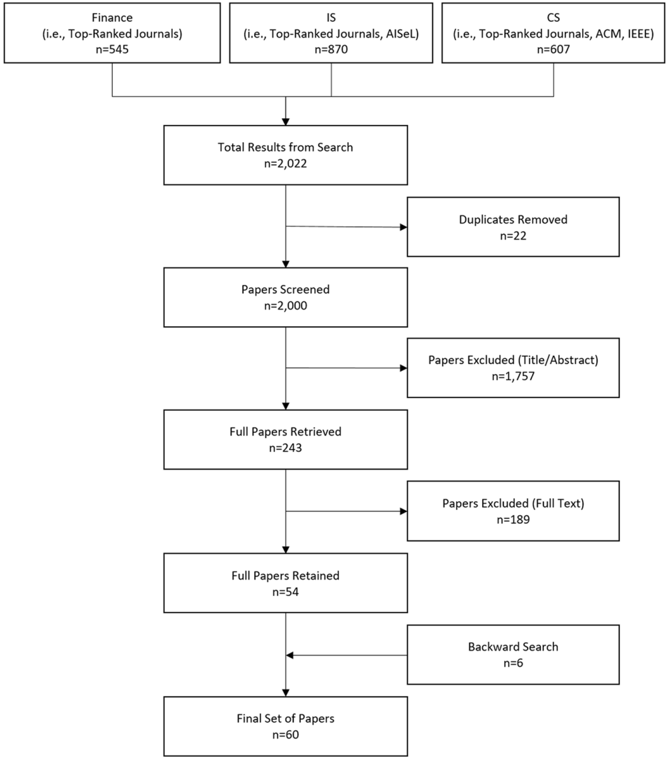
- The search screened 2,022 articles, removed duplicates to 2,000, narrowed to 243 after title/abstract screening, yielded 54 full-text matches, and ended with 60 papers after backward searching.
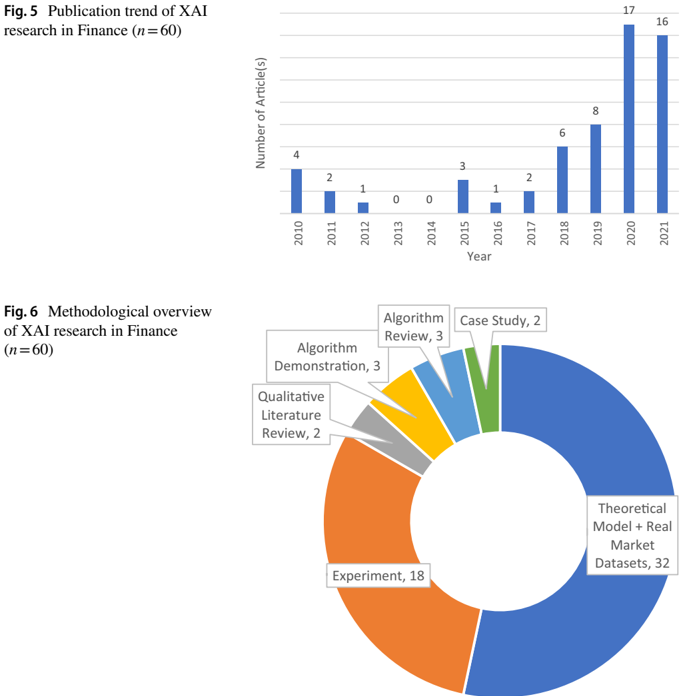
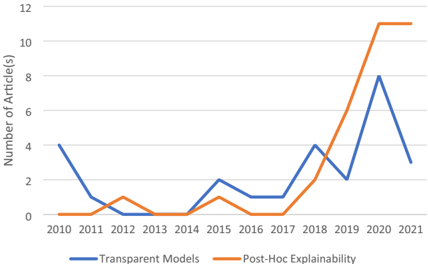
- Publication volume is concentrated in recent years: 2020 (n = 17) and 2021 (n = 16) together account for over 55% of the sample.
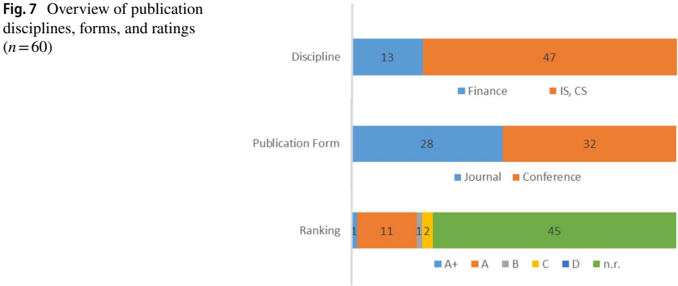
- By discipline, about a quarter of the sample is in Finance literature (n = 13), while most papers are from IS and CS (n = 47).
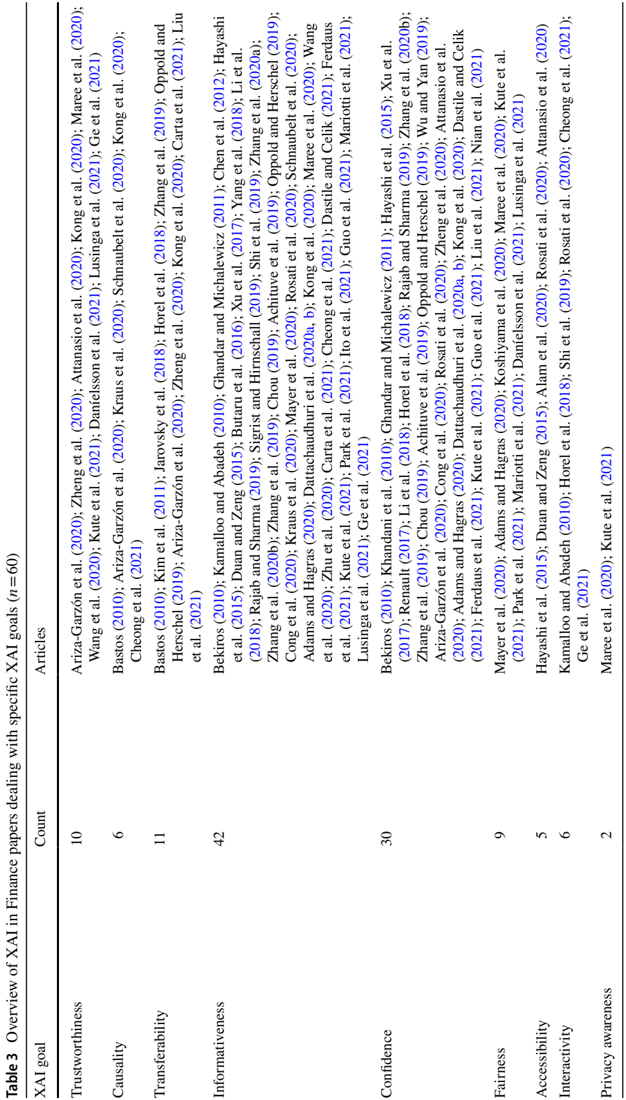
- On XAI goals, most papers address informativeness (n = 43), while only 2 target privacy awareness.
- On methods, the sample is split between transparent models (n = 26) and post-hoc explainability (n = 32); among post-hoc methods, model-agnostic (n = 16) and model-specific (n = 21) approaches are both used.
- The paper reports that risk management, portfolio optimization, and stock market applications are well-researched, while anti-money laundering is understudied.
## Methods
- The study is a systematic literature review (SLR) guided by Kitchenham (2004), using a transparent and reproducible review protocol.
- Search scope covered the top-ranked Finance journals, the eight IS basket journals, top CS journals, and databases including ACM Digital Library, AIS eLibrary, and IEEE Xplore; the search window was 2010 to 2021 and ran from October 2021 to January 2022.
- The authors coded the final set by publication details, XAI goal, XAI method, and area of Finance, using three independent coders and a multiple-classification scheme.
## Limitations
- The paper states that an exhaustive SLR remains impossible and that the search could be expanded with more databases, different keywords, and a broader publication-date range.
- The review is limited to recent research from the last decade and to the outlets/databases searched; this is stated in the paper.
- The text also makes evident that some tables and figures are only partially visible in the provided text, but this is a limitation of the supplied excerpt, not stated as a paper limitation.
Model-written summary of a shortened version of the paper’s full text (it is longer than we read). Check it against the paper before relying on it.
Integrity signals
Registry
Cites
Statistics
Figures
Verification
Claims the paper makes
4 Valid · 10 Not valid · 18 Not checked · 54 Own results and interpretations
The sources with a verdict support this claim; the rest weren’t checked yet, have no full text we could read, or their verdicts aren’t rated yet.
In the paper
“Related studies (e.g., Arrieta et al. 2019; Chou 2019) confirm decision trees to be well-employed in XAI research”
What the sources say
- Supportedcites Arrieta et al. 2019 matched to “Explainable Artificial Intelligence (XAI): Concepts, Taxonomies, Opportunities and Challenges toward Responsible AI” (2019) source
Section 3.2, “Decision Trees,” treats decision trees as a transparent model relevant to explainable AI and says they have long been used in decision-support contexts, with many applications. This supports the broad claim that they are well employed in XAI research; the source does not quantify their prevalence. (LLM, conf=0.86)
- Not checked — no full text of the sourcecites Chou 2019 matched to “An Explainable Hybrid Model for Bankruptcy Prediction Based on the Decision Tree and Deep Neural Network” (2019) source
boostedn = 12- Asserted: passes — The authors put it forward as true.
- Checkable: passes — It can be checked against evidence.
- Load-bearing: unclear — It is unclear whether the paper’s conclusions depend on it.
- Based: passes — The paper gives a reason why it holds.
- Supported
The cited sources support only part of this claim — read each source’s verdict below.
In the paper
“Besides, regulators in many countries demand greater transparency and explainability of decisions in the financial sector by requiring XAI rather than AI-based systems (Kalyanathaya 2022).”
What the sources say
- Partly supportedcites Kalyanathaya 2022 matched to “A Literature Review and Research Agenda on Explainable Artificial Intelligence (XAI)” (2022) sourceExperimental — accuracy not yet measured
The 'Why explainable AI is important?' section does carry a regulatory-demand point: it states that AI decision-making 'must ensure compliance with company policies, industry standards and government regulations' and that under Article 14 of the GDPR a company using automated decision-making tools 'must explain the rationale, importance and consequences of such processing', and it names finance (with healthcare) as a domain where trust/reliance is critical. However, our copy attributes no such requirement to 'regulators in many countries', ties no XAI mandate specifically to the financial sector, and nowhere says regulators require XAI *rather than* AI-based systems; the Table 3 summary (Conclusion) mentions regulatory bodies' research agendas on XAI only while describing Arrieta et al. [44]. So the general regulatory-demand-for-explainability element is supported, but the multi-country, financial-sector and XAI-instead-of-AI elements of the claim are not. (LLM, conf=0.78)
plainstates a cause- Asserted: passes — The authors put it forward as true.
- Checkable: passes — It can be checked against evidence.
- Load-bearing: passes — The paper’s conclusions depend on it.
- Based: passes — The paper gives a reason why it holds.
- Partly supported
The cited sources support only part of this claim — read each source’s verdict below.
In the paper
“Thus, XAI is a driver of further AI usage and adoption (Adadi and Berrada 2018; Janiesch etal. 2021; Mirbabaie etal. 2021; Sigrist and Hirnschall 2019) in particular in these domains as it helps to mitigate the current black-box nature of AI-based systems, i.e., unobservable inner workings.”
What the sources say
- Partly supportedcites Adadi and Berrada 2018 matched to “Peeking Inside the Black-Box: A Survey on Explainable Artificial Intelligence (XAI)” (2018) sourceExperimental — accuracy not yet measured
Our copy supports the regulated-domain half of the claim: the FINANCE section (XAI application domains) states that 'the financial industry is highly regulated', that AI credit models struggle to provide the required 'reason code' because the basis for denial is 'the output from an opaque ML algorithm', and that bureaus such as Equifax/Experian are working to make these decisions 'more explainable and auditor friendly'. The adoption half is only implicit: the paper says explainability 'leads to building trust' and 'leads towards more trustworthy AI systems' (a: EXPLAIN TO JUSTIFY; d: EXPLAIN TO DISCOVER), and that unexplained errors 'could... deter adoption of such systems' (d: EXPLAIN TO DISCOVER) — i.e., that opacity hinders uptake, not that XAI drives further AI usage/adoption. Indeed the same section hedges that 'explainability... is not always a necessity' and that making AI explainable 'is undoubtedly expensive', and the survey nowhere reports adoption as an outcome of XAI. (LLM, conf=0.72)
- Not matchedcites Janiesch etal. 2021
An author–year citation the paper’s reference list doesn’t settle. We don’t search these by name.
- Not matchedcites Mirbabaie etal. 2021
An author–year citation the paper’s reference list doesn’t settle. We don’t search these by name.
plainstates a cause- Asserted: passes — The authors put it forward as true.
- Checkable: passes — It can be checked against evidence.
- Load-bearing: unclear — It is unclear whether the paper’s conclusions depend on it.
- Based: passes — The paper gives a reason why it holds.
- Partly supported
The cited sources support only part of this claim — read each source’s verdict below.
In the paper
“Increased trust ultimately results in more widespread adoption of AI applications (Adadi and Berrada 2018; Janiesch etal. 2021; Mirbabaie et al. 2021; Sigrist and Hirnschall 2019).”
What the sources say
- Partly supportedcites Adadi and Berrada 2018 matched to “Peeking Inside the Black-Box: A Survey on Explainable Artificial Intelligence (XAI)” (2018) sourceExperimental — accuracy not yet measured
Our copy connects trust and adoption only indirectly and at lower generality: in 'd: EXPLAIN TO DISCOVER' it says errors in an AI-based diagnosis system 'could not only harm the patient but also deter adoption of such systems', and in 'a: EXPLAIN TO JUSTIFY' and 'd: EXPLAIN TO DISCOVER' it holds that explainability 'leads to building trust' and 'towards more trustworthy AI systems' (echoing the DARPA goal quoted in 'II. Background A'). What the paper does not state is the positive causal chain the citing sentence asserts — that increased trust ultimately results in more widespread adoption of AI applications across the board; its adoption remark is a domain-specific warning about errors deterring uptake, and its trust statements stop at trust itself. So the trust-and-adoption ingredients are present, but the generalised 'trust → wider adoption' conclusion attributed to this source is not. (LLM, conf=0.65)
- Not matchedcites Janiesch etal. 2021
An author–year citation the paper’s reference list doesn’t settle. We don’t search these by name.
- Partly supportedcites Mirbabaie et al. 2021 matched to “The rise of artificial intelligence – understanding the AI identity threat at the workplace” (2022) sourceExperimental — accuracy not yet measured
Our copy of Mirbabaie et al. supports only the adoption-side of the claim and via a different antecedent: the Discussion states that 'a positive association with AI could reduce resistance behavior and support the individual acceptance of AI' (individual-level, driven by AI identity, not trust), and the Conclusion recommends 'introducing explainable AI as well focusing on trustworthy, responsible, and ethical employees who supervise AI implementations and applications' (Qualitative evaluation likewise frames trustworthiness as a property of supervising employees, and explainability as needed against the black box). No passage in our copy states that increased trust in AI results in more widespread adoption of AI applications, so the trust-to-adoption causal link attributed here is not supported by this source. (LLM, conf=0.65)
plainstates a cause- Asserted: passes — The authors put it forward as true.
- Checkable: passes — It can be checked against evidence.
- Load-bearing: unclear — It is unclear whether the paper’s conclusions depend on it.
- Based: passes — The paper gives a reason why it holds.
- Partly supported
None of the sources cited for this claim have been checked yet.
In the paper
“Relevant research concerning XAI in the form of general additive models in Finance (Berg 2007; Taylan etal. 2007; Calabrese 2012) did not appear in our search.”
What the sources say
- Not checked — no full text of the sourcecites Berg 2007 matched to “Bankruptcy prediction by generalized additive models” (2007) source
- Not matchedcites Taylan etal. 2007
An author–year citation the paper’s reference list doesn’t settle. We don’t search these by name.
- Not matchedcites Calabrese 2012
An author–year citation the paper’s reference list doesn’t settle. We don’t search these by name.
plain- Asserted: passes — The authors put it forward as true.
- Checkable: passes — It can be checked against evidence.
- Load-bearing: passes — The paper’s conclusions depend on it.
- Based: passes — The paper gives a reason why it holds.
- Rests on 2 assumptions not shown here.
35 more claims
Create a free account to see all 86 claims and to verify the 1 reference still open.
- It may state two separate claims as one. 31
- Probably not a substantial claim. 23
Citations
Cites
A Unified Approach to Interpreting Model Predictions
Lundberg, S., & Lee, S.-I. (2017) · arXiv · doi:10.48550/arxiv.1705.07874 · Cited by 23,707
The Market for "Lemons": Quality Uncertainty and the Market Mechanism
Akerlof, G. A. (1970) · The Quarterly Journal of Economics · doi:10.2307/1879431 · Cited by 23,016
"Why Should I Trust You?": Explaining the Predictions of Any Classifier
Ribeiro, M. T., Singh, S., & Guestrin, C. (2016) · Proceedings of the 22nd ACM SIGKDD International Conference on Knowledge Discovery and Data Mining · doi:10.1145/2939672.2939778 · Cited by 17,555 · cited 1×
“LIME is a rule extraction technique and builds locally linear models around the prediction of the model that it tries to explain (Ribeiro et al. 2016).”
Literature review as a research methodology: An overview and guidelines
Snyder, H. (2019) · Journal of Business Research · doi:10.1016/j.jbusres.2019.07.039 · Cited by 11,524 · cited 3×
“Thus, SLRs cluster the current state of research according to predefined criteria and thereby contribute to the conceptualization of the topic under investigation (Paré et al. 2015; Snyder 2019).”
Arrieta, A. B., Díaz-Rodríguez, N., Del Ser, J., Bennetot, A., Tabik, S., Barbado, A., García, S., Gil-López, S., Molina, D., Benjamins, R., et al. (2019) · arXiv · doi:10.48550/arxiv.1910.10045 · Cited by 11,321
Artificial intelligence: A modern approach
Nilsson, N. J. (1996) · Artificial Intelligence · doi:10.1016/0004-3702(96)00007-0 · Cited by 10,583
Barredo Arrieta, A., Díaz-Rodríguez, N., Del Ser, J., Bennetot, A., Tabik, S., Barbado, A., Garcia, S., Gil-Lopez, S., Molina, D., Benjamins, R., et al. (2020) · Information Fusion · doi:10.1016/j.inffus.2019.12.012 · Cited by 10,423
Peeking Inside the Black-Box: A Survey on Explainable Artificial Intelligence (XAI)
Adadi, A., & Berrada, M. (2018) · IEEE Access · doi:10.1109/access.2018.2870052 · Cited by 6,294 · cited 3×
“Therefore, research on XAI in Finance gains interest (Adadi and Berrada 2018).”
The Black Box Society: The Secret Algorithms That Control Money and Information
Pasquale, F. (2015) · doi:10.4159/harvard.9780674736061 · Cited by 3,796
Machine learning and deep learning
Janiesch, C., Zschech, P., & Heinrich, K. (2021) · Electronic Markets · doi:10.1007/s12525-021-00475-2 · Cited by 2,959 · cited 2×
“Increased trust ultimately results in more widespread adoption of AI applications (Adadi and Berrada 2018; Janiesch et al. 2021; Mirbabaie et al. 2021; Sigrist and Hirnschall 2019).”
Research works printed but not linked: 6
- Hoofnagle CJ (2013) How the fair credit reporting act regulates big data. SSRN, Rochester, NY
- IEEE (2021) IEEE finance playbook version 1.0 trusted data and artificial intelligence systems (AIS) for financial services
- Kim J, Bae JK, Delen D (2011) Understading black boxes: knowledge induction from models. PACIS 2011 Proceedings
- Padmanabhan B, Fang X, Sahoo N, Burton-Jones A (2022) Machine learning in information systems research. MIS Q 46:iii-xix
- Rzepka C, Berger B (2018) User interaction with ai-enabled systems: a systematic review of IS research. In: 39th International conference on information systems, San Francisco 2018
- Shapiro SC (1992) Artificial intelligence. Encycl Artif Intell 1:54-57
Cited by
Items 101–200 of 283
Revolutionizing Finance: Insights on the Impact of Automation
Bostan, A.-I., & Dragomirescu, O.-A. (2024) · Proceedings of the ... International Conference on Business Excellence · doi:10.2478/picbe-2024-0275 · Cited by 8
Srivastava, K., Sorathiya, A., Mehta, J. H., & Chotaliya, V. (2024) · International Conference on Electronics, Computers and Artificial Intelligence (ECAI) · doi:10.1109/ecai61503.2024.10607516 · Cited by 8
“[10] explores XAI in Finance, emphasizing the potential superiority of XAI models over current industry standards and the necessity for further investigation into regulatory compliance.”
BackgroundEmerging Trends in Applying Artificial Intelligence to Monkeypox Disease: A Bibliometric Analysis
Khaleel, Y. L., Habeeb, M. A., & Benotsmane, R. (2024) · Applied Data Science and Analysis · doi:10.58496/adsa/2024/012 · Cited by 9
“The use of AI is not limited to any specific field including health care [5]–[9], finance [10], self-driving car [11], [12], environmental analysis [13], [14], Natural Language Processing [15], [16], production [17], learning and many others in a bid to improve on various operations, experiences…”
BackgroundTowards Trustworthy Aircraft Safety: Explainable AI for Accurate Incident and Accident Predictions
Amin, M., Noor, U., Fatima, M., Rashid, Z., & Altmann, J. (2025) · Lecture notes in computer science · doi:10.1007/978-3-031-81226-2_18 · Cited by 4
Explainable Artificial Intelligence for Business and Economics: Methods, Applications and Challenges
Lyu, Q., & Wu, S. (2025) · Expert Systems · doi:10.1111/exsy.70017 · Cited by 10
LLM-based embeddings for clustering and predicting integrated reporting quality levels of companies
Sarıoğlu, M., Sarıyer, G., & Sözen, M. E. (2025) · Discover Computing · doi:10.1007/s10791-025-09590-6 · Cited by 6
Modeling Inverse Demand Function with Explainable Dual Neural Networks
Cao, Z., Chen, Z., Mishra, P., Amini, H., & Feinstein, Z. (2023) · ACM International Conference on AI in Finance (ICAIF) · doi:10.1145/3604237.3626887 · Cited by 7
“These measures aim to ensure traceability of decisions [40], adherence to legal regulations [26], and observance of privacy standards [38].”
BackgroundFormulAI: Designing Rule-Based Datasets for Interpretable and Challenging Machine Learning Tasks
Tissot, H. C. (2024) · Artificial Intelligence and Applications · doi:10.47852/bonviewaia42021781 · Cited by 10
Evaluating Transparency: A Cross-Model Exploration of Explainable AI in Financial Forecasting
Valensky, D., & Mohaghegh, M. (2023) · IEEE Asia-Pacific Conference on Computer Science and Data Engineering (CSDE) · doi:10.1109/csde59766.2023.10487732 · Cited by 8
“For instance, over 55% of the XAI in finance articles were published in 2020 and 2021, respectively [27].”
BackgroundCan ESG Shape Cost of Capital? A Bibliometric Review and Empirical Analysis Through MLPreprint
Bussmann, N., Tanda, A., & Yu, E. P. (2022) · SSRN Electronic Journal · doi:10.2139/ssrn.4173890 · Cited by 4
Application of Explainable Artificial Intelligence in Fintech
Kumar, R., Gupta, P., & Bhawna (2025) · Wiley eBooks · doi:10.1002/9781394271078.ch19 · Cited by 5
The Future of Sustainable Finance: AI-Driven Sustainable Pairs Trading in Market-Neutral Investing
Stiefenhofer, P., Deniz, C., Chen, Y., Qian, J., & Almehthel, H. M. (2024) · Springer eBooks · doi:10.1007/978-3-031-66205-8_6 · Cited by 10
Gupta, S., & Singh, A. (2024) · International Studies of Management and Organization · doi:10.1080/00208825.2024.2442191 · Cited by 9
“The research also indicates that the users, who perceives the usefulness of app will experience enhanced SFN, as the degree of converting PU in SFN is dependent on user’s self-efficacy (Thongsri, Shen, and Bao 2020; Weber, Carl, and Hinz 2024).”
DLBacktrace: Model Agnostic Explainability for any Deep Learning Model
Sankarapu, V. K., Chitroda, C., Rathore, Y., Singh, N. K., & Seth, P. (2025) · International Joint Conference on Neural Networks (IJCNN) · doi:10.1109/ijcnn64981.2025.11228632 · Cited by 13
“[16] reviews XAI applications in finance, emphasizing transparency’s role in regulatory compliance.”
A Data-Driven Topic Modeling Analysis of Blockchain in Food Supply Chain Traceability
Rejeb, A., Rejeb, K., Molavi, H., & Keogh, J. G. (2025) · Information · doi:10.3390/info16121096 · Cited by 6
“Both are widely used in bibliometric research for their comprehensive coverage and reliable indexing of peer-reviewed publications [42,56].”
Jung, N. H., & Oh, T. (2025) · PLoS ONE · doi:10.1371/journal.pone.0332779 · Cited by 4
“Overfitting and interpretability persist [24].”
InfluentialEmon, M. M. H., Rahman, K. M., Islam, M. M. Z., Nath, A., Kutub, J., & Santa, N. A. (2025) · International Conference on Sustainable Technologies for Industry 5.0 (STI) · doi:10.1109/sti69347.2025.11367590 · Cited by 13
“In high-contact service companies, customers will appreciate accuracy and justification of service choices [4].”
Explanation-Guided Adversarial Training for Robust and Interpretable Models
Chen, C., Chen, Y., Lin, S., Hong, D., Wu, S., Liao, X., & Liu, C. (2026) · IEEE Transactions on Circuits and Systems for Video Technology · doi:10.1109/tcsvt.2026.3666191 · Cited by 6
“More importantly, EGAT uniquely enforces semantic consistency, resulting in stable and meaningful heatmaps aligned with object regions critical for decisions even facing adversarial attacks.”
An Explainable AI Multi-Agent Recommender System for Financial Document Access Control
Toudas, K. S., Roumeliotis, K. I., Nasiopoulos, D. Κ., & Georgakopoulos, G. (2026) · Information Systems Frontiers · doi:10.1007/s10796-026-10742-2 · Cited by 8
Bashir, M., El–Sappagh, S., Woo, S. S., Kim, D. I., & Abuhmed, T. (2026) · Information Fusion · doi:10.1016/j.inffus.2026.104507 · Cited by 6
Unveil the Black-Box Model for Healthcare Explainable AI
Aluvalu, R., Devi, V. S., Kumar, C. N., Goutham, N., & Nikitha, K. (2024) · Computational intelligence methods and applications · doi:10.1007/978-981-97-3705-5_3 · Cited by 3
XentricAI: A Gesture Sensing Calibration Approach Through Explainable and User-Centric AI
Seifi, S., Sukianto, T., Strobel, M., Carbonelli, C., Servadei, L., & Wille, R. (2024) · Communications in computer and information science · doi:10.1007/978-3-031-63800-8_12 · Cited by 5
Jo, A. A., & Raj, E. D. (2024) · International Conference on Computing, Communication and Networking Technologies (ICCCNT) · doi:10.1109/icccnt61001.2024.10724314 · Cited by 5
Rethinking explainable AI in financial services
Pimentel, R., & Pisoni, G. (2025) · AI & Society · doi:10.1007/s00146-025-02315-9 · Cited by 3
FedSync: Synchronized and Explainable Federated Learning with XAI in IoT-Based Healthcare Data
Dündar, B., Sezer, E. A., Okay, F. Y., & Özdemir, S. (2025) · International Conference on Smart Applications, Communications and Networking (SmartNets) · doi:10.1109/smartnets65254.2025.11106872 · Cited by 5
“XAI is used in a wide variety of fields such as sales, finance, healthcare, transportation, intelligent systems, human resources, etc. [22], [23].”
Sánchez‐García, E., Martínez‐Falcó, J., Marco‐Lajara, B., & Słoniec, J. (2024) · Applied Computer Science · doi:10.35784/acs-2024-12 · Cited by 3
“The impact of computer science in the fields of management and economics extends beyond the initial layers of enhanced decision-making and data analysis, permeating deeper into the strategic fabric of these disciplines (Milosz & Milosz, 2014; Sarker, 2021; Weber et al., 2023).”
BackgroundKismawadi, E. R., Aditchere, J., & Libeesh, P. C. (2024) · Financial Mathematics and Fintech · doi:10.1007/978-3-031-47324-1_4 · Cited by 6
Explainable AI: A Way to Achieve Trustworthy AI
Li, Y., Xiao, Y., Gong, Y., Zhang, R., Huo, Y., & Wu, Y. (2024) · IEEE Conference on Big Data Security on Cloud (BigDataSecurity) · doi:10.1109/bigdatasecurity62737.2024.00034 · Cited by 10
“P. Weber et al. in [34] argue that the realization of XAI in the financial domain usually tends to take an ex post explanatory approach.”
BackgroundUwabor, H. S., Emmanuel, I., & Ijiga, O. M. (2025) · International Journal of Scientific Research and Modern Technology. · doi:10.38124/ijsrmt.v4i11.1028 · Cited by 3
Kumari, A., Iqbal, N., & Fazil, S. (2024) · International Journal of Management Research and Emerging Sciences · doi:10.56536/ijmres.v14i4.668 · Cited by 6
“However, these relatively recent financial services have not received much research attention (Weber et al., 2023).”
Artificial intelligence in educational assignments: issues of academic integrity
Logachev, M. S. (2026) · Frontiers in Computer Science · doi:10.3389/fcomp.2026.1729059 · Cited by 2
AI and Risks of Hiring Bias Due to Gender Imbalances in Historical Data
Burch, J. M., Jackson, R. A., & Craig, C. I. (2026) · Voice of the Publisher · doi:10.4236/vp.2026.121007 · Cited by 2
FinTech Education With Artificial Intelligence
Ahsan, A., Yusuf, D. H. M., & Abidin, J. Z. (2026) · Advances in computational intelligence and robotics book series · doi:10.4018/979-8-3693-6346-1.ch009 · Cited by 2
Explainable AI for Precise Leaf Disease Diagnosis: A Comparative Study
Balanageshwara, S., Kumara, V., Badiger, M., & Naik, A. (2026) · Engineering Technology & Applied Science Research · doi:10.48084/etasr.16335 · Cited by 2
Bridging the gap: Explainable AI for advancing Earth System Science
Huang, F., Jiang, S., Shangguan, W., Li, L., Zhang, Y., Zhang, R., Li, Q., Li, D., & Dai, Y. (2026) · Science China Earth Sciences · doi:10.1007/s11430-025-1898-3 · Cited by 2
Human–AI hybrid finance: from AI tools to decision systems
Kou, G., Li, Y., Wang, H., & Wang, X. (2026) · Financial Innovation · doi:10.1186/s40854-026-00941-w · Cited by 15
“Surveys of XAI in finance therefore emphasize that explainability is a functional requirement for adoption, contestability, and model risk management rather than a cosmetic interface feature (Weber et al. 2024; Černevičienė and Kabašinskas 2024; Mersha et al. 2024; Arrieta et al. 2020).”
A framework for generating explanations of machine learning models in Fintech industry
Kalyanathaya, K. P., & Krishna Prasad, K. (2024) · THE SCIENTIFIC TEMPER · doi:10.58414/scientifictemper.2024.15.2.33 · Cited by 4
“…there have been studies on interpretability and explainability in AI models and some research on explainability techniques in specific fintech applications, there is a lack of a unified framework that addresses the unique challenges and requirements of the fintech industry (Weber et al ., 2023).”
BackgroundAgrawal, R., & Sharma, K. (2024) · Revue d intelligence artificielle · doi:10.18280/ria.380321 · Cited by 9
Mahmoud, H. A., Imran, A., Hassan, C. A. U., et al. (2024) · IEEE Access · doi:10.1109/access.2024.3481034 · Cited by 2
“The study described in [21] explores the application of the bacterial foraging optimization algorithm (BFOA) to enhance cost management within accounting information systems, with a primary objective of improving cost management and allocation processes.”
BackgroundGuesmi, A., Aswani, N. S., & Shafique, M. (2024) · IEEE International Conference on Image Processing Workshops (ICIPW) · doi:10.1109/icipcw64161.2024.10769124 · Cited by 6
“In critical domains such as healthcare, neuroscience, finance, and autonomous driving [5, 6, 7, 8], reliable explanations are essential for understanding model decisions and fostering trust in their predictions.”
Podille, V. R., Adithya Varun, M., Dhanurmika, S., Harsha, G. P., & Abhijit, G. G. S. (2024) · Journal of Computer Allied Intelligence (JCAI). · doi:10.69996/jcai.2024026 · Cited by 3
Nomological Deductive Reasoning for Trustworthy, Human-Readable, and Actionable AI Outputs
Hakizimana, G., & Ledezma Espino, A. (2025) · Algorithms · doi:10.3390/a18060306 · Cited by 2
“In domains like healthcare and finance, explainability is essential for professionals to evaluate AI-generated outputs [7–9].”
Question Answering over Knowledge Graphs for Explainable Satellite Scheduling
Powell, C., & Riccardi, A. (2025) · Journal of Aerospace Information Systems · doi:10.2514/1.i011531 · Cited by 5
Preiß, N., & Westner, M. K. (2025) · Lecture notes in networks and systems · doi:10.1007/978-981-96-6438-2_15 · Cited by 2
An Assessment of the Level of Adoption of AI/ML in Banking and Financial Institutions
Yadav, N., Divya, Rani, N., Singh, M., & Chowdhury, S. S. H. (2023) · Advances in finance, accounting, and economics book series · doi:10.4018/979-8-3693-0082-4.ch013 · Cited by 2
Question Answering Over Knowledge Graphs for Explainable Satellite SchedulingPreprint
Powell, C., & Riccardi, A. (2024) · SSRN Electronic Journal · doi:10.2139/ssrn.4833242 · Cited by 2
Artificial Intelligence Across Borders: Transforming Industries Through Intelligent Innovation
Panda, S. P. (2025) · doi:10.70593/978-93-49910-25-6 · Cited by 30
Domain‐Specific AI Algorithms and Models in Decision‐Making
Priya, P. K., Reethika, A., Sathyamoorthy, M., & Dhanaraj, R. K. (2025) · Wiley eBooks · doi:10.1002/9781394275311.ch2 · Cited by 4
Facilitating Investment Strategy Negotiations Through Logic
Callewaert, B., Decleyre, N., Vandevelde, S., et al. (2023) · IEEE Symposium Series on Computational Intelligence (SSCI) · doi:10.1109/ssci52147.2023.10372044 · Cited by 1
“The use of symbolic AI and automated reasoning techniques has proven throughout the years to be a great facilitator of trans-parency and trust in several domains including finance [7], [8], [12].”
MethodHierarchical Fuzzy Classifier Design Using a Reject Option
Fuerst, R., Masuyama, N., & Nojima, Y. (2024) · IEEE International Conference on Fuzzy Systems (FUZZ-IEEE) · doi:10.1109/fuzz-ieee60900.2024.10612164 · Cited by 1
“In recent years, AI models were increasingly applied to fields such as medicine and finance [1] [2].”
MethodCaran, S., & Başarır, Ç. (2025) · Advances in finance, accounting, and economics book series · doi:10.4018/979-8-3693-7036-0.ch004 · Cited by 1
Leveraging Periodicity for Tabular Deep Learning
Rizzo, M., Ayyurek, E., Albarelli, A., & Gasparetto, A. (2025) · Electronics · doi:10.3390/electronics14061165 · Cited by 2
Research on the Role of AI in FinTech and Consumer Trust
Tan, J. (2025) · SHS Web of Conferences · doi:10.1051/shsconf/202521301012 · Cited by 6
Research on Investor Education in China Based on Large Language Models
Xie, X., Yang, X.-L., & Cui, R. (2025) · International Conference on Educational and Information Technology · doi:10.1109/iceit64364.2025.10975865
“[23] For instance, BERT has been used to analyze financial news with promising accuracy.”
The Future of Personal Finance: Artificial Intelligence, Machine Learning, and Big Data
Khan, K. A. (2025) · IGI Global eBooks · doi:10.4018/979-8-3693-7160-2.ch009 · Cited by 1
Enhancing Transparency in Credit Decisions: Explainability for AI Models
Bhuvaneswari, U., & Muthukrishnan, S. (2024) · International Conference on Advances in Computing, Communication and Materials (ICACCM) · doi:10.1109/icaccm61117.2024.11059189 · Cited by 1
Graziano, E. A., Petroccione, G., & Siggia, D. (2025) · Emerald Group Publishing Limited eBooks · doi:10.1108/s2754-58652025000004b002 · Cited by 4
Liu, Y., Wu, Z., Dong, X., Jiang, S., & Li, W. (2025) · Proceedings of the ACM on Human-Computer Interaction · doi:10.1145/3773065 · Cited by 2
“Explainable AI (XAI) methods aim to reveal the decision-making processes of machine learning models, especially in high-stakes domains such as healthcare [27], finance [36], and autonomous driving [23].”
Can AI readiness and strong institutions curb AML risk? Cross-country evidence from panel data
Kirichok, O., Hurochkina, V., Zhanseitova, G., Dudchenko, V. Y., Rubanov, P. M., Babaiev, D., & Lyeonov, S. (2025) · Public and Municipal Finance · doi:10.21511/pmf.14(4).2025.05 · Cited by 1
Nguyen, L., Boersma, M., & Acar, E. (2025) · Communications in computer and information science · doi:10.1007/978-3-032-08330-2_16 · Cited by 3
Evolution and impact of AI in knowledge sharing: insights from a bibliometric analysis
Trinh, N., Nguyen, M., & Ngo, D.-T. (2025) · Evolutionary Intelligence · doi:10.1007/s12065-025-01129-4 · Cited by 1
“Additionally, AI can analyze communication patterns and networks within an organization to identify bottlenecks and suggest improvements, promoting a more efficient flow of information [84 ].”
Artificial intelligence in finance: unveiling foundations, themes, and future research agendas
Rasheed, M. H., Khalid, J., & Rasheed, M. S. (2026) · Future Business Journal · doi:10.1186/s43093-026-00759-z · Cited by 7
“[106] and enabling better anticipation of regulatory impacts [107].”
Integrating AI into financial reporting and investment: multi-layered framework
Juma’h, A. H., Chuang, M., & Harfouche, A. (2026) · Journal of Decision System · doi:10.1080/12460125.2026.2645969 · Cited by 5
Trust in human–AI collaboration in finance: a bibliometric–systematic literature review
Mirabile, M., Corazza, G. E., & Alonso, J. M. (2026) · AI & Society · doi:10.1007/s00146-026-03049-y · Cited by 9
“…methods by task (Černevičienė and Kabašinskas 2024), evaluated robustness in credit risk (Heng and Subramanian 2023), cataloged techniques (Weber et al. 2024), tested model-agnostic approaches (Khan et al. 2025), and demonstrated interpretable statistical methods that improve both…”
Çavdar, E. Z., & Bozanta, A. (2026) · Knowledge and Information Systems · doi:10.1007/s10115-026-02773-7 · Cited by 9
Speeding Things Up. Can Explainability Improve Human Learning?
Mannmeusel, J., Rothfelder, M., & Khoshrou, S. (2023) · Communications in computer and information science · doi:10.1007/978-3-031-44064-9_4 · Cited by 2
Kaur, J., & Özen, E. (2023) · Advances in finance, accounting, and economics book series · doi:10.4018/979-8-3693-1746-4.ch006 · Cited by 1
Effects of Artificial Intelligence on Money Laundering in Southern Africa
Dzingirai, M. (2024) · Springer proceedings in business and economics · doi:10.1007/978-3-031-46177-4_26 · Cited by 3
Goh, K. M., Lim, D. H. Y., Sham, Z. D., & Prakash, K. B. (2025) · Research in Astronomy and Astrophysics · doi:10.1088/1674-4527/adce8f · Cited by 2
Artificial intelligence and behavioural finance biases: improving Lebanese investors decision-making
Chammaa, C., & Haddad, L. (2025) · Journal of Decision System · doi:10.1080/12460125.2025.2537076 · Cited by 4
“According to Weber et al. (2024), however, there is currently no research that reviews the application of Explainable AI (XAI) in Finance on a broader level.”
Türkiye'nin Bilgisayar Bilimi ve Bilgi Sistemleri Araştırma Alanındaki Bilimsel Üretkenliği
Şaylan, Ö. F., & Damar, M. (2025) · Mehmet Akif Ersoy Üniversitesi Uygulamalı Bilimler Dergisi · doi:10.31200/makuubd.1669292 · Cited by 1
Sun, A., & Han, W. (2025) · Research Square · doi:10.21203/rs.3.rs-7306404/v2 · Cited by 1
Hur, P., & Kubsch, M. (2025) · Wiley eBooks · doi:10.1002/9781394352821.ch15 · Cited by 2
Turizm İşletmelerinde Finansal Teknoloji Uygulamaları
Eren, D. (2023) · Özgür Yayınları eBooks · doi:10.58830/ozgur.pub298.c1473
Kocaarslan, B. (2024) · Journal of Behavioral Finance · doi:10.1080/15427560.2024.2368726
“When artificial intelligence (AI) models lack transparency, post-hoc explainability methods are employed (Weber, Carl, and Hinz 2024).”
Meyer, H., Röser, A. M., & Zureck, A. (2024) · SSRN Electronic Journal · doi:10.2139/ssrn.4887834 · Cited by 3
Computer Information Management and Network Construction based on Artificial Intelligence
Wang, M., & Zhang, S. (2024) · doi:10.1109/icdsis61070.2024.10594032
“Patrick Weber et al. [8] implemented Explainable Artificial Intelligence (XAI) for information management systems, utilizing it differently for storage and data processing.”
BackgroundYin, D. (2024) · IEEE Access · doi:10.1109/access.2024.3434546 · Cited by 2
“Secondly, financial technology innovations improve the efficiency and convenience of financial services, The associate editor coordinating the review of this manuscript and approving it for publication was Abdullah Iliyasu . promote financial inclusivity, and drive stable economic growth [6].”
BackgroundArtificial Intelligence in Finance Sector for Risk Prediction
Abdelnapi, N. M., Darwish, A., & Hassanien, A. E. (2024) · Studies in systems, decision and control · doi:10.1007/978-3-031-63451-2_17 · Cited by 2
Explainable AI in business: Trends & future scope
Sharma, S. (2024) · AIP conference proceedings · doi:10.1063/5.0227789
InvestoAI‐Tailored Investment Recommendation
Samani, N., Uttare, T., Maliya, R. M., & Samani, K. (2024) · Wiley eBooks · doi:10.1002/9781394234028.ch10 · Cited by 2
Revolutionizing Financial management: Unleashing the power of AI for Sustainable Growth
Bhokare, A. S., Patil, S. D., & Kulkarni, P. M. (2024) · ITM Web of Conferences · doi:10.1051/itmconf/20246801033 · Cited by 1
Design and Smart Audit System Using PSO Algorithm
Wu, Y., Sun, T., & Chang, D. (2024) · International Conference on Data Analytics, Computing and Artificial Intelligence (ICDACAI) · doi:10.1109/icdacai65086.2024.00046
AI in Finance: Innovative Approaches for Sustainable Business Models
Bartelt, C., & Röser, A. M. (2024) · E-conom · doi:10.17836/ec.2024.2.007 · Cited by 5
Fuzzy Non-Payment Risk Management Rooted in Optimized Household Consumption Units
Llanes, G. I., & Salcedo, A. M. (2025) · Risks · doi:10.3390/risks13040074
Artificial Intelligence Tools and Use Cases in Corporate Finance
Ajape, M. K., & Adegbayibi, A. T. (2025) · Contributions to finance and accounting · doi:10.1007/978-3-031-87368-3_9 · Cited by 3
Use of AI in Selected Financial Institutions: A Double-Edged Sword Effect
Srivastava, R., Ranjan, S., & Tarnnum, S. (2025) · International Conference on Cognitive Computing in Engineering, Communications, Sciences and Biomedical Health Informatics (IC3ECSBHI) · doi:10.1109/ic3ecsbhi63591.2025.10990982
“[14] Fintech firms leverage AI and its diverse applications to achieve digital financial inclusion, aiming to enable participation in the mainstream financial market by low-income earners, the underserved, women, youth, and small businesses.”
Building Trust in AI: Leadership Insights from Malaysian Fintech Boards
Zarifis, A., & Yarovaya, L. (2025) · Financial innovation and technology · doi:10.1007/978-3-031-83402-8_15
Gonaygunta, H., Maturi, M. H., Yadulla, A. R., Ravindran, R. K., Cruz, E. D. L., Nadella, G. S., & Meduri, K. (2025) · Systems and Information Engineering Design Symposium · doi:10.1109/sieds65500.2025.11021190 · Cited by 4
“Figure 2 illustrates the feature correlations.”
Research on Optimizing Financial Audit Process Using AI
Long, X. (2025) · doi:10.1109/ainit65432.2025.11035079
“…as an identifier of the sample number, in the field of financial data feature extraction, deep learning technology shows significant advantages in automation, explores the potential regular connections in complex data, and significantly improves the efficiency and accuracy of audit procedures [6] .”
Explainable AI: Applications, Challenges, Current Solutions and Future Research Directions
Butt, T. A., & Iqbal, M. (2024) · doi:10.1145/3718391.3718408 · Cited by 2
Tu, J. (2025) · Journal of Computational Methods in Sciences and Engineering · doi:10.1177/14727978251352159
Explainable AI for Fraud Detection in Financial Transactions
(2024) · doi:10.52783/jisem.v9i3.32 · Cited by 13
Kırıkkaleli, D., Athari, S. A., Olushola, O. V., et al. (2025) · SSRN Electronic Journal · doi:10.2139/ssrn.5371376
The Artificial Intelligence Revolution and The Moroccan Stock Market's Efficiency: GPT3 Versus GPT4
Oummou, Y. A., & Omerani, D. (2025) · Advances in computational intelligence and robotics book series · doi:10.4018/979-8-3373-5499-6.ch010
Critical Analysis of the Application of AI in Risk Management Financial Services
Jadhav, K. D. (2025) · IEEE World AI IoT Congress (AIIoT) · doi:10.1109/aiiot65859.2025.11105290
Regulating Artificial Intelligence for Social Impact
Lytras, M. D., & Șerban, A. C. (2025) · Emerald Group Publishing Limited eBooks · doi:10.1108/978-1-83708-432-620251001 · Cited by 1
Enhancing Sustainability in Finance Using AI: A Review of Current Practices and Future Possibilities
Dsouza, S., & Abiad, M. (2025) · Emerald Group Publishing Limited eBooks · doi:10.1108/978-1-83708-432-620251006
Shahid, R., Batool, F., Ashfaq, M. H., & Muhammad, S. G. (2025) · IGI Global eBooks · doi:10.4018/979-8-3373-6955-6.ch005
Polymeni, S., Skoutas, D. N., Kormentzas, G., & Skianis, C. (2025) · Information · doi:10.3390/info16090797 · Cited by 1
“This opacity is particularly problematic when integrating with FinTech mechanisms; for an IoT system of financial incentives and penalties to be considered fair and effective, its decision-making logic must be transparent, auditable, and easily communicated [15].”
Metadata
- Authors
- Weber, P., Carl, K. V., & Hinz, O.
- Affiliations
- Goethe University Frankfurt (DE)
- Corresponding author
- Weber, Patrick
- Venue
- Management Review Quarterly
- Published
- 2023-02-28
- Volume
- 74
- Issue
- 2
- Pages
- 867-907
- ISSN
- 2198-1620 (ISSN-L)
- 2198-1639
- OpenAlex
- W4322775759
- Cited by
- 292
- References
- 119
- Citations by year
- 2026: 86 · 2025: 114 · 2024: 73 · 2023: 18
- FWCI
- 6.10
- Type
- journal article
- Language
- en
- Open access
- hybrid
- doi.org
- Licence
- cc-by
- creativecommons.org/licenses/by/4.0 (tdm)
- creativecommons.org/licenses/by/4.0 (vor)
- Locations
- Management Review Quarterly (publishedVersion, cc-by)
- Econstor (Econstor) (submittedVersion, cc-by)
- RePEc: Research Papers in Economics (submittedVersion)
- Publication Server of Goethe University Frankfurt am Main (Goethe University Frankfurt) (submittedVersion, cc-by)
- Funders
- efl – the Data Science Institute
- Johann Wolfgang Goethe-Universität, Frankfurt am Main
- Topics
- Physical Sciences › Computer Science › Artificial Intelligence › Explainable Artificial Intelligence (XAI)
- Physical Sciences › Computer Science › Artificial Intelligence › Ethics and Social Impacts of AI
- Physical Sciences › Computer Science › Artificial Intelligence › Artificial Intelligence Applications
- Keywords
- explainable AI, financial decision-making, transparency, regulatory compliance, risk management, portfolio optimization, stock market prediction, anti-money laundering, post-hoc explanation, model interpretability
About these checks
Registry, retraction, Cites and statistics results are computed, not judged, with one exception: a printed reference that no index lists is read once by a model before it counts as a citation error. Claims are extracted by a model and kept only when their quote appears verbatim in the text; each cited source is then checked, with a model’s help, for whether it says what the claim relies on. Those verdicts can be wrong — read the claim’s quote and the cited source before relying on one.
The claim verdicts this report counts are experimental: their accuracy is not yet measured.
A language model drew the claims from the paper on 2026-10-09, under version 3 of the claim definition (model deepseek-v4.1-flash, prompt extract-v3).
A second model labelled each claim on 2026-10-09 (model jev-1.13-20260917, definition revision gold-guideline-v0.2).
Cited sources are checked with a language model’s help (gpt-6-sol and qwen3.8-omni-flash).
Statistics and arithmetic are recomputed, not judged.
Confidence bands are shown only for fields calibrated on our annotated test set. None is calibrated yet, so no band is shown.
What counts as a claim ›How we measure confidence ›How we check this ›
Are you an author, or do you see a problem with this page? Request a review
Data sources
Bibliographic data: Semantic Scholar, OpenAlex, Crossref.
Contains information from the Semantic Scholar Academic Graph Datasets, made available under the ODC Attribution License (ODC-BY 1.0).
Semantic Scholar’s data is described in: Kinney, R., et al. (2023). The Semantic Scholar Open Data Platform. arXiv:2301.10140.
