

Applications of Explainable Artificial Intelligence in Finance—a systematic review of Finance, Information Systems, and Computer Science literature
Open accessThe DOI matches its Crossref record; 126 of the 126 references it cites were found in a registry or an index; 6 of the 38 sources its claims cite were checked for support.
Abstract
Explainable Artificial Intelligence (XAI) is of tremendous importance in the highly-regulated finance domain. This paper provides a systematic literature review screening 2,022 articles from leading outlets, identifying 60 relevant papers. It classifies XAI methods and goals, highlighting that risk management, portfolio optimization, and stock market applications are well-researched, while anti-money laundering is understudied. Both transparent models and post-hoc explainability are implemented.
Overview
CoChat Summary
## TL;DR
This paper systematically reviews explainable AI (XAI) research in Finance across Finance, Information Systems, and Computer Science outlets. From 2,022 screened articles, the authors identify 60 relevant papers and show that the literature is growing, but unevenly concentrated in a few finance areas and XAI goals.
## Key findings
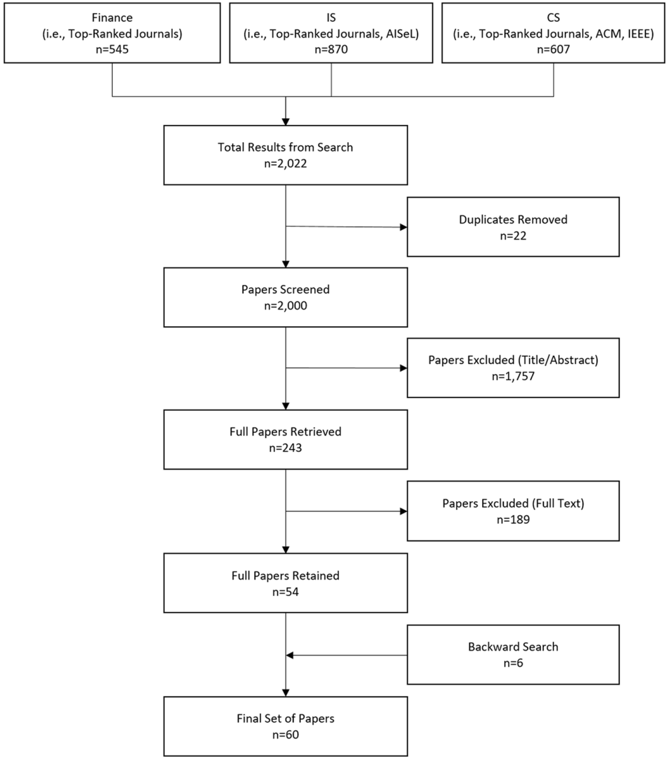
- The search screened 2,022 articles, removed duplicates to 2,000, narrowed to 243 after title/abstract screening, yielded 54 full-text matches, and ended with 60 papers after backward searching.
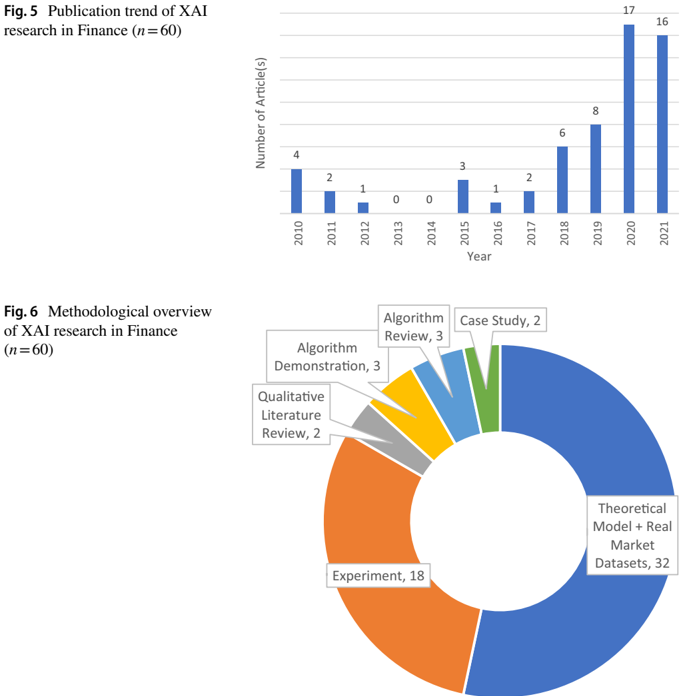
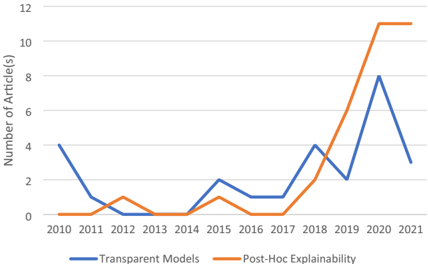
- Publication volume is concentrated in recent years: 2020 (n = 17) and 2021 (n = 16) together account for over 55% of the sample.
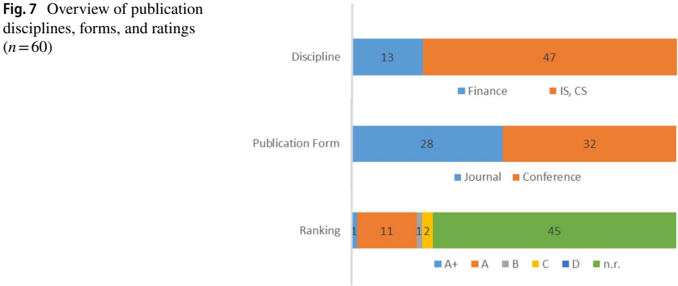
- By discipline, about a quarter of the sample is in Finance literature (n = 13), while most papers are from IS and CS (n = 47).
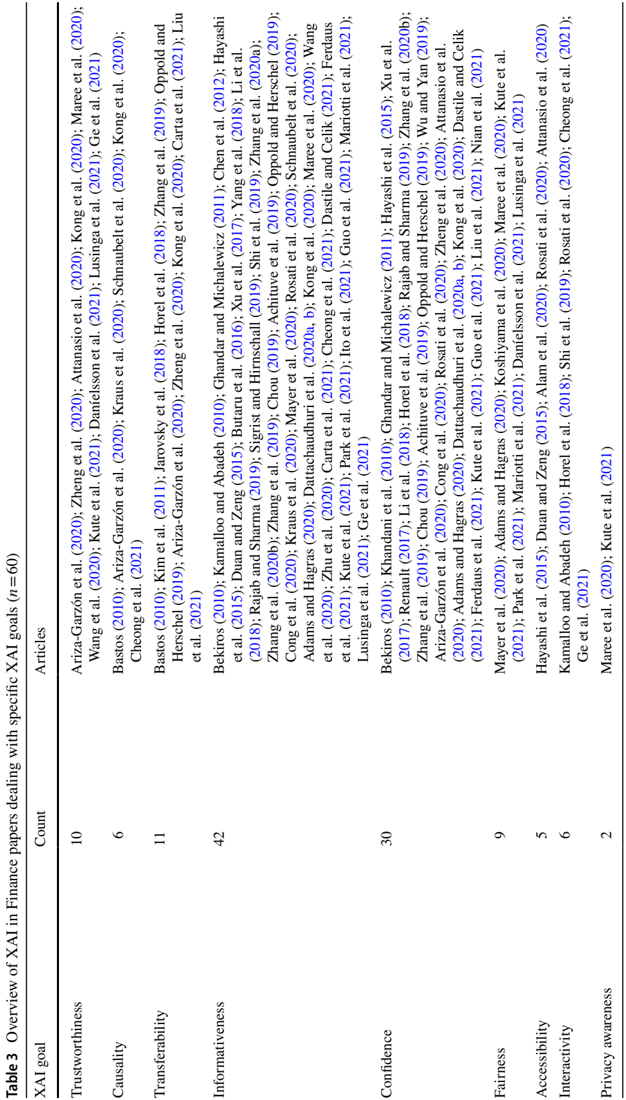
- On XAI goals, most papers address informativeness (n = 43), while only 2 target privacy awareness.
- On methods, the sample is split between transparent models (n = 26) and post-hoc explainability (n = 32); among post-hoc methods, model-agnostic (n = 16) and model-specific (n = 21) approaches are both used.
- The paper reports that risk management, portfolio optimization, and stock market applications are well-researched, while anti-money laundering is understudied.
## Methods
- The study is a systematic literature review (SLR) guided by Kitchenham (2004), using a transparent and reproducible review protocol.
- Search scope covered the top-ranked Finance journals, the eight IS basket journals, top CS journals, and databases including ACM Digital Library, AIS eLibrary, and IEEE Xplore; the search window was 2010 to 2021 and ran from October 2021 to January 2022.
- The authors coded the final set by publication details, XAI goal, XAI method, and area of Finance, using three independent coders and a multiple-classification scheme.
## Limitations
- The paper states that an exhaustive SLR remains impossible and that the search could be expanded with more databases, different keywords, and a broader publication-date range.
- The review is limited to recent research from the last decade and to the outlets/databases searched; this is stated in the paper.
- The text also makes evident that some tables and figures are only partially visible in the provided text, but this is a limitation of the supplied excerpt, not stated as a paper limitation.
Model-written summary of a shortened version of the paper’s full text (it is longer than we read). Check it against the paper before relying on it.
Integrity signals
Registry
Cites
Statistics
Figures
Verification
Claims the paper makes
4 Valid · 10 Not valid · 18 Not checked · 54 Own results and interpretations
The sources with a verdict support this claim; the rest weren’t checked yet, have no full text we could read, or their verdicts aren’t rated yet.
In the paper
“Related studies (e.g., Arrieta et al. 2019; Chou 2019) confirm decision trees to be well-employed in XAI research”
What the sources say
- Supportedcites Arrieta et al. 2019 matched to “Explainable Artificial Intelligence (XAI): Concepts, Taxonomies, Opportunities and Challenges toward Responsible AI” (2019) source
Section 3.2, “Decision Trees,” treats decision trees as a transparent model relevant to explainable AI and says they have long been used in decision-support contexts, with many applications. This supports the broad claim that they are well employed in XAI research; the source does not quantify their prevalence. (LLM, conf=0.86)
- Not checked — no full text of the sourcecites Chou 2019 matched to “An Explainable Hybrid Model for Bankruptcy Prediction Based on the Decision Tree and Deep Neural Network” (2019) source
boostedn = 12- Asserted: passes — The authors put it forward as true.
- Checkable: passes — It can be checked against evidence.
- Load-bearing: unclear — It is unclear whether the paper’s conclusions depend on it.
- Based: passes — The paper gives a reason why it holds.
- Supported
The cited sources support only part of this claim — read each source’s verdict below.
In the paper
“Besides, regulators in many countries demand greater transparency and explainability of decisions in the financial sector by requiring XAI rather than AI-based systems (Kalyanathaya 2022).”
What the sources say
- Partly supportedcites Kalyanathaya 2022 matched to “A Literature Review and Research Agenda on Explainable Artificial Intelligence (XAI)” (2022) sourceExperimental — accuracy not yet measured
The 'Why explainable AI is important?' section does carry a regulatory-demand point: it states that AI decision-making 'must ensure compliance with company policies, industry standards and government regulations' and that under Article 14 of the GDPR a company using automated decision-making tools 'must explain the rationale, importance and consequences of such processing', and it names finance (with healthcare) as a domain where trust/reliance is critical. However, our copy attributes no such requirement to 'regulators in many countries', ties no XAI mandate specifically to the financial sector, and nowhere says regulators require XAI *rather than* AI-based systems; the Table 3 summary (Conclusion) mentions regulatory bodies' research agendas on XAI only while describing Arrieta et al. [44]. So the general regulatory-demand-for-explainability element is supported, but the multi-country, financial-sector and XAI-instead-of-AI elements of the claim are not. (LLM, conf=0.78)
plainstates a cause- Asserted: passes — The authors put it forward as true.
- Checkable: passes — It can be checked against evidence.
- Load-bearing: passes — The paper’s conclusions depend on it.
- Based: passes — The paper gives a reason why it holds.
- Partly supported
The cited sources support only part of this claim — read each source’s verdict below.
In the paper
“Thus, XAI is a driver of further AI usage and adoption (Adadi and Berrada 2018; Janiesch etal. 2021; Mirbabaie etal. 2021; Sigrist and Hirnschall 2019) in particular in these domains as it helps to mitigate the current black-box nature of AI-based systems, i.e., unobservable inner workings.”
What the sources say
- Partly supportedcites Adadi and Berrada 2018 matched to “Peeking Inside the Black-Box: A Survey on Explainable Artificial Intelligence (XAI)” (2018) sourceExperimental — accuracy not yet measured
Our copy supports the regulated-domain half of the claim: the FINANCE section (XAI application domains) states that 'the financial industry is highly regulated', that AI credit models struggle to provide the required 'reason code' because the basis for denial is 'the output from an opaque ML algorithm', and that bureaus such as Equifax/Experian are working to make these decisions 'more explainable and auditor friendly'. The adoption half is only implicit: the paper says explainability 'leads to building trust' and 'leads towards more trustworthy AI systems' (a: EXPLAIN TO JUSTIFY; d: EXPLAIN TO DISCOVER), and that unexplained errors 'could... deter adoption of such systems' (d: EXPLAIN TO DISCOVER) — i.e., that opacity hinders uptake, not that XAI drives further AI usage/adoption. Indeed the same section hedges that 'explainability... is not always a necessity' and that making AI explainable 'is undoubtedly expensive', and the survey nowhere reports adoption as an outcome of XAI. (LLM, conf=0.72)
- Not matchedcites Janiesch etal. 2021
An author–year citation the paper’s reference list doesn’t settle. We don’t search these by name.
- Not matchedcites Mirbabaie etal. 2021
An author–year citation the paper’s reference list doesn’t settle. We don’t search these by name.
plainstates a cause- Asserted: passes — The authors put it forward as true.
- Checkable: passes — It can be checked against evidence.
- Load-bearing: unclear — It is unclear whether the paper’s conclusions depend on it.
- Based: passes — The paper gives a reason why it holds.
- Partly supported
The cited sources support only part of this claim — read each source’s verdict below.
In the paper
“Increased trust ultimately results in more widespread adoption of AI applications (Adadi and Berrada 2018; Janiesch etal. 2021; Mirbabaie et al. 2021; Sigrist and Hirnschall 2019).”
What the sources say
- Partly supportedcites Adadi and Berrada 2018 matched to “Peeking Inside the Black-Box: A Survey on Explainable Artificial Intelligence (XAI)” (2018) sourceExperimental — accuracy not yet measured
Our copy connects trust and adoption only indirectly and at lower generality: in 'd: EXPLAIN TO DISCOVER' it says errors in an AI-based diagnosis system 'could not only harm the patient but also deter adoption of such systems', and in 'a: EXPLAIN TO JUSTIFY' and 'd: EXPLAIN TO DISCOVER' it holds that explainability 'leads to building trust' and 'towards more trustworthy AI systems' (echoing the DARPA goal quoted in 'II. Background A'). What the paper does not state is the positive causal chain the citing sentence asserts — that increased trust ultimately results in more widespread adoption of AI applications across the board; its adoption remark is a domain-specific warning about errors deterring uptake, and its trust statements stop at trust itself. So the trust-and-adoption ingredients are present, but the generalised 'trust → wider adoption' conclusion attributed to this source is not. (LLM, conf=0.65)
- Not matchedcites Janiesch etal. 2021
An author–year citation the paper’s reference list doesn’t settle. We don’t search these by name.
- Partly supportedcites Mirbabaie et al. 2021 matched to “The rise of artificial intelligence – understanding the AI identity threat at the workplace” (2022) sourceExperimental — accuracy not yet measured
Our copy of Mirbabaie et al. supports only the adoption-side of the claim and via a different antecedent: the Discussion states that 'a positive association with AI could reduce resistance behavior and support the individual acceptance of AI' (individual-level, driven by AI identity, not trust), and the Conclusion recommends 'introducing explainable AI as well focusing on trustworthy, responsible, and ethical employees who supervise AI implementations and applications' (Qualitative evaluation likewise frames trustworthiness as a property of supervising employees, and explainability as needed against the black box). No passage in our copy states that increased trust in AI results in more widespread adoption of AI applications, so the trust-to-adoption causal link attributed here is not supported by this source. (LLM, conf=0.65)
plainstates a cause- Asserted: passes — The authors put it forward as true.
- Checkable: passes — It can be checked against evidence.
- Load-bearing: unclear — It is unclear whether the paper’s conclusions depend on it.
- Based: passes — The paper gives a reason why it holds.
- Partly supported
None of the sources cited for this claim have been checked yet.
In the paper
“Relevant research concerning XAI in the form of general additive models in Finance (Berg 2007; Taylan etal. 2007; Calabrese 2012) did not appear in our search.”
What the sources say
- Not checked — no full text of the sourcecites Berg 2007 matched to “Bankruptcy prediction by generalized additive models” (2007) source
- Not matchedcites Taylan etal. 2007
An author–year citation the paper’s reference list doesn’t settle. We don’t search these by name.
- Not matchedcites Calabrese 2012
An author–year citation the paper’s reference list doesn’t settle. We don’t search these by name.
plain- Asserted: passes — The authors put it forward as true.
- Checkable: passes — It can be checked against evidence.
- Load-bearing: passes — The paper’s conclusions depend on it.
- Based: passes — The paper gives a reason why it holds.
- Rests on 2 assumptions not shown here.
35 more claims
Create a free account to see all 86 claims and to verify the 1 reference still open.
- It may state two separate claims as one. 31
- Probably not a substantial claim. 23
Citations
Cites
A Unified Approach to Interpreting Model Predictions
Lundberg, S., & Lee, S.-I. (2017) · arXiv · doi:10.48550/arxiv.1705.07874 · Cited by 23,707
The Market for "Lemons": Quality Uncertainty and the Market Mechanism
Akerlof, G. A. (1970) · The Quarterly Journal of Economics · doi:10.2307/1879431 · Cited by 23,016
"Why Should I Trust You?": Explaining the Predictions of Any Classifier
Ribeiro, M. T., Singh, S., & Guestrin, C. (2016) · Proceedings of the 22nd ACM SIGKDD International Conference on Knowledge Discovery and Data Mining · doi:10.1145/2939672.2939778 · Cited by 17,555 · cited 1×
“LIME is a rule extraction technique and builds locally linear models around the prediction of the model that it tries to explain (Ribeiro et al. 2016).”
Literature review as a research methodology: An overview and guidelines
Snyder, H. (2019) · Journal of Business Research · doi:10.1016/j.jbusres.2019.07.039 · Cited by 11,524 · cited 3×
“Thus, SLRs cluster the current state of research according to predefined criteria and thereby contribute to the conceptualization of the topic under investigation (Paré et al. 2015; Snyder 2019).”
Arrieta, A. B., Díaz-Rodríguez, N., Del Ser, J., Bennetot, A., Tabik, S., Barbado, A., García, S., Gil-López, S., Molina, D., Benjamins, R., et al. (2019) · arXiv · doi:10.48550/arxiv.1910.10045 · Cited by 11,321
Artificial intelligence: A modern approach
Nilsson, N. J. (1996) · Artificial Intelligence · doi:10.1016/0004-3702(96)00007-0 · Cited by 10,583
Barredo Arrieta, A., Díaz-Rodríguez, N., Del Ser, J., Bennetot, A., Tabik, S., Barbado, A., Garcia, S., Gil-Lopez, S., Molina, D., Benjamins, R., et al. (2020) · Information Fusion · doi:10.1016/j.inffus.2019.12.012 · Cited by 10,423
Peeking Inside the Black-Box: A Survey on Explainable Artificial Intelligence (XAI)
Adadi, A., & Berrada, M. (2018) · IEEE Access · doi:10.1109/access.2018.2870052 · Cited by 6,294 · cited 3×
“Therefore, research on XAI in Finance gains interest (Adadi and Berrada 2018).”
The Black Box Society: The Secret Algorithms That Control Money and Information
Pasquale, F. (2015) · doi:10.4159/harvard.9780674736061 · Cited by 3,796
Machine learning and deep learning
Janiesch, C., Zschech, P., & Heinrich, K. (2021) · Electronic Markets · doi:10.1007/s12525-021-00475-2 · Cited by 2,959 · cited 2×
“Increased trust ultimately results in more widespread adoption of AI applications (Adadi and Berrada 2018; Janiesch et al. 2021; Mirbabaie et al. 2021; Sigrist and Hirnschall 2019).”
Research works printed but not linked: 6
- Hoofnagle CJ (2013) How the fair credit reporting act regulates big data. SSRN, Rochester, NY
- IEEE (2021) IEEE finance playbook version 1.0 trusted data and artificial intelligence systems (AIS) for financial services
- Kim J, Bae JK, Delen D (2011) Understading black boxes: knowledge induction from models. PACIS 2011 Proceedings
- Padmanabhan B, Fang X, Sahoo N, Burton-Jones A (2022) Machine learning in information systems research. MIS Q 46:iii-xix
- Rzepka C, Berger B (2018) User interaction with ai-enabled systems: a systematic review of IS research. In: 39th International conference on information systems, San Francisco 2018
- Shapiro SC (1992) Artificial intelligence. Encycl Artif Intell 1:54-57
Cited by
Items 201–283 of 283
AI in Finance: Predictive Analytics and Risk Management
Shahu, V. (2025) · Lecture notes in networks and systems · doi:10.1007/978-981-96-5604-2_37
Optimization of Financial System Based on Decision Tree Classification Algorithm
Lv, X. (2025) · doi:10.1109/icicr65456.2025.00054
“The results show that this method effectively controls the financial and funding risks of relevant enterprises [6].”
Sun, A., & Han, W. (2025) · Research Square · doi:10.21203/rs.3.rs-7306404/v1
Research on Enterprise Financial Risk Early Warning Based on Deep Learning
Quan, S. (2025) · doi:10.1145/3757110.3757156
“At the same time, mAP, as the ratio of AP to the number of tags, reflects the average accuracy of the model as a whole [ 8 ] .”
Manjunath, B. R. (2025) · SSRN Electronic Journal · doi:10.2139/ssrn.5600296
Zimmermann, F., Coimbra, M. E., & Durst, S. (2025) · Palgrave studies in financial services technology · doi:10.1007/978-3-032-03523-3_2 · Cited by 1
Learning Across Modalities: A Systematic Survey of Multimodal Models for Financial AnalysisPreprint
D’Amico, S., Mercorio, F., Nobani, N., et al. (2025) · SSRN Electronic Journal · doi:10.2139/ssrn.5682250
Manjunath, B. R. (2025) · SSRN Electronic Journal · doi:10.2139/ssrn.5692169
Ruqnuzzaman, M., & Uddin, K. Z. (2025) · Research Square · doi:10.21203/rs.3.rs-8004820/v1
Manjunath, B. R. (2025) · SSRN Electronic Journal · doi:10.2139/ssrn.5719345
Angara, D., & Yellapu, J. (2025) · Journal of Information & Knowledge Management · doi:10.1142/s0219649225501163 · Cited by 1
Duarte, D. A., Santos, L. C., Araújo, N. V. D. O., Santana, O. S. D. S. S., & de Faria, W. J. J. (2025) · RCMOS - Revista Científica Multidisciplinar O Saber · doi:10.51473/rcmos.v1i2.2025.1708
Bhattacharjee, J., Singh, R., Pandey, S., & Sharma, R. (2025) · AI & Society · doi:10.1007/s00146-025-02754-4 · Cited by 4
“Weber et al.. (2024) examined XAI in finance, computer science, information systems, underlining its capability for bridging the gap among user understanding and complicated algorithms.”
Artificial intelligence CNN for information system optimization and decision support model
Yang, X., Liu, Y., Zhang, L., et al. (2025) · Scientific Reports · doi:10.1038/s41598-025-33258-2
FLEXtime: Filterbank Learning to Explain Time Series
Brüsch, T., Wickstrøm, K., Schmidt, M. N., Jenssen, R., & Alstrøm, T. S. (2025) · Communications in computer and information science · doi:10.1007/978-3-032-08330-2_12
“Explainability of black-box models is paramount for safe decision-making in critical domains such as health care [5,12] and finance [57].”
Artificial Intelligence in Wealth Management
Herold, S., & Goltzsche, C. (2025) · Sustainable finance · doi:10.1007/978-3-032-02530-2_9
Noman, R., Shahid, M., Alam, M., Hasan, F., & Lapina, M. (2025) · IGI Global eBooks · doi:10.4018/979-8-3373-7922-7.ch001
Li, M. (2025) · Highlights in Business Economics and Management · doi:10.54097/wp0eqf05
A mini-approach for retail banking with transparent recommendation system enabled by explainable AI
Bairagi, P., & Arora, S. (2026) · Discover Artificial Intelligence · doi:10.1007/s44163-025-00817-5 · Cited by 1
“It enhances transparency by showing users how their data influences decisions, thereby building trust [70].”
InfluentialYang, Y., Liu, X., Domínguez, J. L. C., Fang, Y., Xie, W., Shen, B., & Siau, K. L. (2026) · Journal of Organizational and End User Computing · doi:10.4018/joeuc.400122 · Cited by 1
Liu, Y., Li, X., & Su, C. (2026) · Systems · doi:10.3390/systems14030234 · Cited by 4
Multi Modal and Self Learning Agents in Finance
Yadav, A., Luqman, M., Desai, A. P., Gauba, H., & Yadav, P. (2025) · IEEE International Conference on Big Data (BigData) · doi:10.1109/bigdata66926.2025.11401653
Disengagement drivers in AI-enabled financial service advisors: The mediating role of distrust
Kumari, P. (2026) · Journal of Strategy & Innovation · doi:10.1016/j.jsinno.2026.200569 · Cited by 3
Dong, B., Zhang, X., Liu, Y., Zhang, T., Liu, X., 侯灵敏, Meng, L., Guo, Z., & Mulati, A. (2026) · Entropy · doi:10.3390/e28030354
“In particular, few studies have compared both data-level and algorithm-level strategies within a unified pipeline that considers not only predictive performance but also business interpretability [34–36].”
Chopra, S., Sharma, A., Rath, P. K., & Ben, D. (2025) · International Conference on Computational Innovations and Sustainable Technologies (ICCIST) · doi:10.1109/iccist67338.2025.11438497
Kommuri, R. S. (2025) · IEEE International Conference on Emerging Trends in Computing and Communication (ETCOM) · doi:10.1109/etcom66606.2025.11436692
Framework for the Ethical and Societally Conscious AI Deployment
León, M. (2026) · WSEAS Transactions on Information Science and Applications archive · doi:10.37394/23209.2026.23.20 · Cited by 1
Bertrand, A. (2024) · theses.fr (ABES) · doi:10.70675/216d3647z78bcz4c68z9ba9z2d0a029cf1b4 · Cited by 8
Chang, W., & Yu, J. (2026) · Frontiers in Psychology · doi:10.3389/fpsyg.2026.1777758 · Cited by 1
“…indicated that transparency is significant in building user trust since it improves explainability but that over-transparent algorithms can exhibit information overload or even challenge user confidence in algorithms (Watkins and Woods, 2024; Weber et al., 2024; Zhu et al., 2023; Zhu et al., 2024).”
Artificial intelligence and job automation: opening the “black-box” of the underlying mechanisms
Peng, G., Zhang, Y. J., & Li, Y.-M. (2026) · Information Technology and Management · doi:10.1007/s10799-026-00489-2
Sher, L. (2026) · Behavioral Sciences · doi:10.3390/bs16050689 · Cited by 1
“…the importance of transparent risk communication, clear presentation of account information, and responsible platform design as elements of organizational duty of care in digitally mediated financial environments ( ˇCerneviˇcien˙e & Kabašinskas, 2024; Weber et al., 2024; Devarajulu et al., 2025).”
Explainable artificial intelligence for determining integrated reporting quality prediction factors
Sarıoğlu, M., Sarıyer, G., Simic, V., & Kara, K. (2026) · Information Technology and Management · doi:10.1007/s10799-026-00482-9 · Cited by 2
Pundhir, S. K. S., Mittal, R., Anand, I. M., et al. (2026) · Advances in computational intelligence and robotics book series · doi:10.4018/979-8-3373-3648-0.ch001
Exploring the Implications of AI-Based Predictive Analytics for Financial Risk Management
Chandani, P., Bhadoria, D. S., Rawat, V., et al. (2026) · Lecture notes in networks and systems · doi:10.1007/978-3-032-18907-3_13
Rejeb, A., Rejeb, K., & Treiblmaier, H. (2026) · Quality & Quantity · doi:10.1007/s11135-026-02837-4
“XAI makes AI systems transparent, enables finan - cial professionals to uncover and correct these biases, and supports equitable and ethical decision-making across the board (Weber et al. 2024).”
InfluentialManjunath, B. R., & Kumar, C. H. V. (2026) · Discover Artificial Intelligence · doi:10.1007/s44163-026-01374-1
“These three characteristics, fairness, additivity, and consistency, have made SHAP a very popular XAI framework across applications, especially in finance, where it is also the most commonly used among financial organizations such as banks, asset managers, and fintech companies [30].”
黄, 菲., 蒋, 世., 上官, 微., 李, 璐., 张, 叶., Zhang, R., Li, Q., 李, 丹., & 戴, 永. (2026) · SCIENTIA SINICA Terrae · doi:10.1360/n072025-0316
SemTab: A Hybrid Framework for Semantic Feature Generation on Tabular Data
Chen, O., Chou, K., Nagpal, R., Palacios, R., & Gupta, A. D. (2025) · IEEE MIT Undergraduate Research Technology Conference (URTC) · doi:10.1109/urtc68753.2025.11533131
“Recent systematic reviews suggest a trend toward post-hoc explain-ability in financial modeling, despite the availability of inherently transparent alternatives [20].”
Brîncoveanu, C., Carl, K. V., & Hinz, O. F. (2026) · Lecture notes in computer science · doi:10.1007/978-3-032-28316-0_10
Self-citationPuranik, P., Pethe, R., & Kasetwar, A. R. (2026) · Cureus Journal of Computer Science. · doi:10.7759/s44389-025-00078-4
A Review of AI-Enabled Economic Decision-Making in Intelligent Financial Systems
Aggarwal, S., Saxena, P., Deepika, R., et al. (2026) · doi:10.1109/icisessc68634.2026.11542663
Kyambade, M., & Namatovu, A. (2026) · SAGE Open · doi:10.1177/21582440261457060 · Cited by 4
“This technological evolution has garnered significant scholarly attention worldwide across multiple sectors, including healthcare, education, and finance (Song et al., 2025; Weber et al., 2024).”
Exploring neural networks and machine learning in predicting personal loan defaults
HOANG, H. T. T., Nguyen, N. M., & Ngo, D. (2026) · Risk Governance and Control Financial Markets & Institutions · doi:10.22495/rgcv16i2p11
Jiang, Z., & Jiang, X. (2026) · Frontiers in Artificial Intelligence · doi:10.3389/frai.2026.1888236
Fractal Portfolio Optimization in the Evolving Returns Integrated System—ERIS
Loukeris, N., & Gradojević, N. (2026) · Journal of risk and financial management · doi:10.3390/jrfm19070472 · Cited by 1
Samokhodkin, E. V., & Samokhodkina, A. A. (2026) · Vestnik RFFI · doi:10.22204/2410-4639-2026-129-01-113-126 · Cited by 1
Veiga, P. M., Sánchez‐Escobedo, M. C., Heras-Rosas, C. D. L., Pereira, S. A., & Herrera, J. (2026) · Corporate Social Responsibility and Environmental Management · doi:10.1002/csr.70812 · Cited by 1
Gupta, D., Chugh, P., Sood, K., & Grima, S. (2026) · FinTech · doi:10.3390/fintech5030060 · Cited by 4
“…computational benchmarks such as fidelity and simulatability, whereas governance-oriented research (the epistemological domain of the present review) treats interpretability as an institutional capability assessed against regulatory accountability, organisational trust, and audit readiness [25,28].”
The Evolution of Algorithmic Forecasting in Finance: From Traditional Models to AI-Driven Insights
Dahake, P. S., Dahake, P. P., Chandak, S. J., & Singh, D. K. (2026) · Advances in computational intelligence and robotics book series · doi:10.4018/979-8-3373-3053-2.ch005
Zhu, Y., Zhang, B., Gong, M., Wang, G., Xiong, B., & Xie, C. (2026) · 中国科学基金 · doi:10.3724/bnsfc-2025-0267 · Cited by 1
Wang, Z., & Zhou, L. (2026) · Journal of Librarianship and Information Science · doi:10.1177/09610006261462964
SmartEd-AI: A Novel Framework for AI-Integrated Business Education and Data-Driven Learning
Jindal, A., Mistrean, L., Bhatnagar, M., & Khanna, R. (2026) · Springer eBooks · doi:10.1007/978-981-92-0960-6_1
inteligencia artificial, La inteligencia artificial y su impacto en la sociedad
Soler, L. C. T., & Castro, Y. S. Y. (2026) · Revista Educ ção Científica · doi:10.46616/rce.v12i18.168
A comprehensive review on green AI methods, strategies & measurement frameworks
Bayoumi, R., Nazmy, T., Salem, A. M., & Hindy, H. (2026) · Journal of King Saud University - Computer and Information Sciences · doi:10.1007/s44443-026-00603-y · Cited by 3
“…M. Salem abSalem@cis.asu.edu.eg Hanan Hindy hanan.hindy@cis.asu.edu.eg 1 Faculty of Computer and Information Sciences, Ain Shams University, Cairo, Egypt budgeting (Cao 2022; Weber et al. 2023), and in transportation, it optimizes navigation and safety (Yan and Li 2025; Sui et al. 2024).”
Müller, W., Leyer, M., Schneider, S., Nolte, F., & Richter, A. (2026) · Behaviour and Information Technology · doi:10.1080/0144929x.2026.2706665 · Cited by 2
Gardashova, L. A., & Mirzazada, A. (2026) · Himičeskaâ tehnologiâ. Kontrolʹ i upravlenie/Chemical Technology. Control and Management · doi:10.59048/2181-1105.1804
Explainable AI in emotional artificial intelligence: Challenges and applications
Dalavi, D., Kumar, M., Aanjankumar, S., Dhanaraj, R. K., Sathyamoorthy, M., & Poonkuntran, S. (2026) · Elsevier eBooks · doi:10.1016/b978-0-443-44744-0.00006-0
Reconceptualizing strategic partnerships and islamic philanthropy networks in Indonesia
Makhrus, M., Sriyana, J., & Suseno, P. (2026) · Multidisciplinary Reviews · doi:10.31893/multirev.2027037
“…basis for the development of modern technology, such as Explainable Artificial Intelligence (XAI), which shows that XAI requires systemic understanding because AI models operate in socio-technical systems consisting of data, humans, algorithms, ethical values, and regulations (Weber et al., 2024).”
Strategic Decision-Making Using Artificial Intelligence
Saura, J. R., Debasa, F., & Zekan, S. B. (2026) · Contributions to management science · doi:10.1007/978-3-032-22360-9_5
Witzki, A., Carl, K. V., Brîncoveanu, C., Heigl, R. M., Dreesbach, T., & Hinz, O. F. (2026) · Management Review Quarterly · doi:10.1007/s11301-026-00621-0
Self-citationAlam, M. M. (2026) · SSRN Electronic Journal · doi:10.2139/ssrn.7324884
Liu, X. (2026) · International Conference on IoT, Data Science and Advanced Computing (IDSAC) · doi:10.1109/idsac70973.2026.11650690
“At the same time, research on explainable financial artificial intelligence and trustworthy AI supervision emphasizes that algorithm models can truly serve financial supervision and market governance only when they have transparency, explainability, and institutional embedding capabilities [4-5].”
B, T. T., Shirin Shahnas, B., V, J, M. V., & Suhaila, T. (2026) · International Journal of Technology & Emerging Research · doi:10.64823/ijter.2621024
“According to Weber et al. (2023), the field is transitioning from conceptual experimentation to methodological standardization, addressing the unique interpretability demands of finance, such as risk aversion and fiduciary duty[2].”
Al-Refai, M., & Choe, P. (2026) · Information · doi:10.3390/info17090824
Park, Y., Bae, J., & Kim, K. H. (2026) · Asia Pacific Journal of Marketing and Logistics · doi:10.1108/apjml-01-2026-0052
Hyytiäinen, T., & Luukka, P. (2026) · International Journal of Human-Computer Interaction · doi:10.1080/10447318.2026.2721889
Yu, F., & Chen, S. (2026) · Physica A Statistical Mechanics and its Applications · doi:10.1016/j.physa.2026.131970
Mashayamombe, E., Harley, C., & Paepae, T. (2026) · International Journal of Financial Studies · doi:10.3390/ijfs14090229
Comparative Analysis of Machine and Deep Learning Methods for Cuneiform Text Classification
Khalid, N. W., Rashid, S. H., Noor, S., Abbas, A. F., Habeeb, M. A., & Khaleel, Y. L. (2026) · Lecture notes in networks and systems · doi:10.1007/978-3-032-25620-1_31
A Study on Financial and Tax Risk Early Warning for IPO Enterprises Integrating LightGBM and SHAP
Chen, L. (2026) · doi:10.1145/3842702.3842706
“Explanations should be stable, traceable and practical in business analysis [3-5].”
The role of artificial intelligence in detecting and preventing fraud in online payment systems
Salve, S. (2026) · REVISTA ESMAT · doi:10.29327/270098.19.2-20
AI-Driven Financial Risk Governance in South Korea
Deng, P., & Qi, X. (2026) · doi:10.1145/3842702.3842707
“Recent finance-specific XAI research takes the question inside the model altogether [8].”
GÜL, M., Yildirim, S., GÜLER, M. A., et al. (2026) · Mathematics · doi:10.3390/math14183353
Radhi, M. K., & Hassan, N. F. (2026) · Communications in computer and information science · doi:10.1007/978-3-032-39720-1_6 · Cited by 1
Predicting Short-Term Severe Delinquency Risk for Mortgages Using Fannie Mae Data
Wang, X. (2026) · ITM Web of Conferences · doi:10.1051/itmconf/20269102013
Azam, A. H. M., & Uruthirakumar, V. (2026) · Journal of Advanced Multidisciplinary Studies (JAMS) · doi:10.68050/jams.2026.519
Kesavan, V., & Polisetty, A. (2026) · Wiley eBooks · doi:10.1002/9781394357789.ch24
Khan, F., Hejaili, A. A., Kryvinska, N., Awan, F. J., & Zainab, N. (2026) · Expert Systems with Applications · doi:10.1016/j.eswa.2026.134573
Aliyev, S., Tagiyev, A., Rahimov, M., Valiyev, Y., Ismayilov, K., & Huseynova, K. (2026) · Sport Sciences for Health · doi:10.1007/s11332-026-01963-8
“XAI methodologies aim to retain predictive performance, while enhancing transparency and interpretability of model decisions [17, 18].”
Vijayananth, M., Sundari, R. M., & Saravanabhavan, N. (2026) · Frontiers in Sustainability · doi:10.3389/frsus.2026.1965649 · Cited by 1
Metadata
- Authors
- Weber, P., Carl, K. V., & Hinz, O.
- Affiliations
- Goethe University Frankfurt (DE)
- Corresponding author
- Weber, Patrick
- Venue
- Management Review Quarterly
- Published
- 2023-02-28
- Volume
- 74
- Issue
- 2
- Pages
- 867-907
- ISSN
- 2198-1620 (ISSN-L)
- 2198-1639
- OpenAlex
- W4322775759
- Cited by
- 292
- References
- 119
- Citations by year
- 2026: 86 · 2025: 114 · 2024: 73 · 2023: 18
- FWCI
- 6.10
- Type
- journal article
- Language
- en
- Open access
- hybrid
- doi.org
- Licence
- cc-by
- creativecommons.org/licenses/by/4.0 (tdm)
- creativecommons.org/licenses/by/4.0 (vor)
- Locations
- Management Review Quarterly (publishedVersion, cc-by)
- Econstor (Econstor) (submittedVersion, cc-by)
- RePEc: Research Papers in Economics (submittedVersion)
- Publication Server of Goethe University Frankfurt am Main (Goethe University Frankfurt) (submittedVersion, cc-by)
- Funders
- efl – the Data Science Institute
- Johann Wolfgang Goethe-Universität, Frankfurt am Main
- Topics
- Physical Sciences › Computer Science › Artificial Intelligence › Explainable Artificial Intelligence (XAI)
- Physical Sciences › Computer Science › Artificial Intelligence › Ethics and Social Impacts of AI
- Physical Sciences › Computer Science › Artificial Intelligence › Artificial Intelligence Applications
- Keywords
- explainable AI, financial decision-making, transparency, regulatory compliance, risk management, portfolio optimization, stock market prediction, anti-money laundering, post-hoc explanation, model interpretability
About these checks
Registry, retraction, Cites and statistics results are computed, not judged, with one exception: a printed reference that no index lists is read once by a model before it counts as a citation error. Claims are extracted by a model and kept only when their quote appears verbatim in the text; each cited source is then checked, with a model’s help, for whether it says what the claim relies on. Those verdicts can be wrong — read the claim’s quote and the cited source before relying on one.
The claim verdicts this report counts are experimental: their accuracy is not yet measured.
A language model drew the claims from the paper on 2026-10-09, under version 3 of the claim definition (model deepseek-v4.1-flash, prompt extract-v3).
A second model labelled each claim on 2026-10-09 (model jev-1.13-20260917, definition revision gold-guideline-v0.2).
Cited sources are checked with a language model’s help (gpt-6-sol and qwen3.8-omni-flash).
Statistics and arithmetic are recomputed, not judged.
Confidence bands are shown only for fields calibrated on our annotated test set. None is calibrated yet, so no band is shown.
What counts as a claim ›How we measure confidence ›How we check this ›
Are you an author, or do you see a problem with this page? Request a review
Data sources
Bibliographic data: Semantic Scholar, OpenAlex, Crossref.
Contains information from the Semantic Scholar Academic Graph Datasets, made available under the ODC Attribution License (ODC-BY 1.0).
Semantic Scholar’s data is described in: Kinney, R., et al. (2023). The Semantic Scholar Open Data Platform. arXiv:2301.10140.
