

Teachers’ role in digitalizing education: an umbrella review
Open accessThe DOI matches its Crossref record; 48 of the 48 references it cites were found in a registry or an index.
Abstract
As teachers are central to digitalizing education, we summarize 40 years of research on their role in that process within a systematic umbrella review that includes 23 systematic reviews with a total of 1062 primary studies focusing technology integration and aspects of digital literacy. Our findings highlight the international acceptance of the TPACK framework as well as the need for a clear concept of digital literacy. It is unique that we identify and discuss parallels in developing teachers’ digital literacy and integrating digital technologies in the teaching profession as well as barriers to those goals. We conclude by suggesting future directions for research and describing the implications for schools, teacher education, and institutions providing professional development to in-service teachers.
Overview
The claims and statistics of this paper haven’t been checked yet.
Free: it reads the open-access text and checks the first 5 claims that cite a source we can check. Create a free account to check every claim.
Integrity signals
Registry
Cites
Statistics
Figures
Verification
Claims the paper makes
The claims and statistics of this paper haven’t been checked yet.
Free: it reads the open-access text and checks the first 5 claims that cite a source we can check. Create a free account to check every claim.
Claims other papers make about this one
Each is checked against this paper’s own text: does it say what the citing paper says it does?
The source backs part of the claim, not all of it — or backs it for a different population, condition or comparison.
In the citing paper
“However, beyond the pandemic's immediate challenges, the ongoing digital transformation in education-including the advent of generative AI and other emerging technologiesreshapes teaching and learning paradigms (Fütterer et al., 2023;Wohlfart & Wagner, 2023).”
From Transforming Online Teacher Training Through Expansive Learning: A Case Study Applying Cultural-Historical Activity Theory and the Change Laboratory Method (2025) · cites this paper as Wohlfart & Wagner, 2023
Experimental — accuracy not yet measuredThe check wasn’t confident either way, so it gives no verdict — never disputed.
In the citing paper
“Consistent with previous studies (Kolykhmatov 2020; Wohlfart and Wagner 2023), our findings highlight the key role of digitalization infacilitating teachers' work and enhancing both the accessibility and quality ofeducation.”
From A Study of Teachers’ Attitudes towards Digital Educational Technologies: a Qualitative Analysis (2026) · cites this paper as Wohlfart and Wagner 2023
Experimental — accuracy not yet measured
Self-check
Percentages, sums and reported differences re-computed from the paper’s own numbers.
The self-check needs the paper’s full text.
Citations
Cites
Using thematic analysis in psychology
Braun, V., & Clarke, V. (2006) · Qualitative Research in Psychology · doi:10.1191/1478088706qp063oa · Cited by 194,414
Preferred Reporting Items for Systematic Reviews and Meta-Analyses: The PRISMA Statement
Moher, D., Liberati, A., Tetzlaff, J., Altman, D. G., & The PRISMA Group (2009) · PLoS Medicine · doi:10.1371/journal.pmed.1000097 · Cited by 64,042 · cited 3×
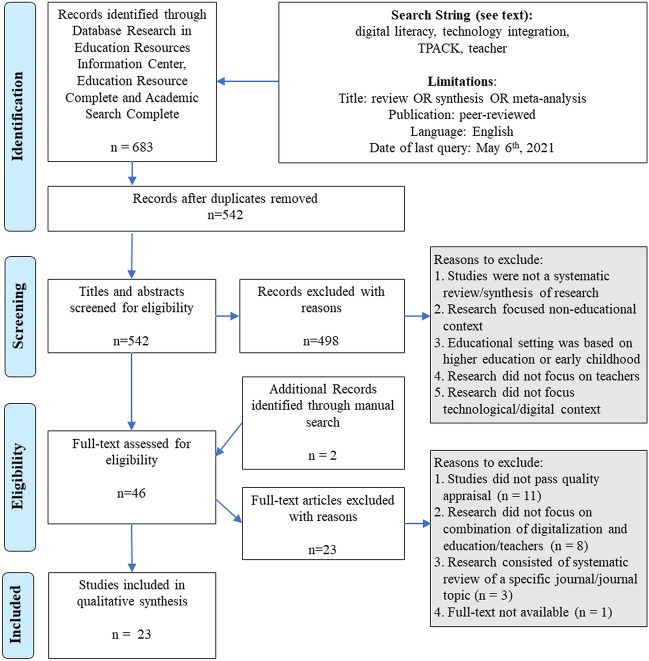
“1 3 Next, the methodological quality of the remaining 34 articles was assessed with an appraisal checklist based on the JBI Critical Appraisal Checklist for Systematic Reviews and Research Syntheses (Aromataris et al., 2015; Moher et al., 2009) as well as Gessler and Siemer (2020).”
Those Who Understand: Knowledge Growth in Teaching
SHULMAN, L. S. (1986) · Educational Researcher · doi:10.3102/0013189x015002004 · Cited by 18,546 · cited 1×
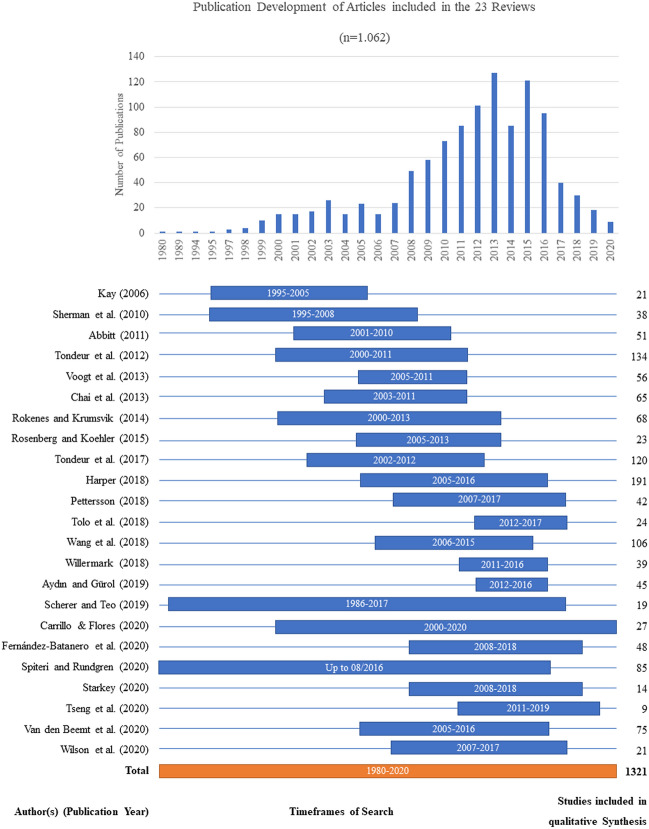
“The reviews report (in broad agreement) on the emergence and publication development of the TPACK model based on the original contribution of Shulman (1986) and the contributions of Mishra and Koehler (Koehler & Mishra, 2008; Mishra & Koehler, 2006).”
MethodTechnological Pedagogical Content Knowledge: A Framework for Teacher Knowledge
Mishra, P., & Koehler, M. J. (2006) · Teachers College Record: The Voice of Scholarship in Education · doi:10.1111/j.1467-9620.2006.00684.x · Cited by 12,604
A typology of reviews: an analysis of 14 review types and associated methodologies
Grant, M. J., & Booth, A. (2009) · Health Information & Libraries Journal · doi:10.1111/j.1471-1842.2009.00848.x · Cited by 10,817 · cited 1×
“Due to the emerging nature of our research topic, we include all available review types and articles (Grant & Booth, 2009).”
MethodCritical Inquiry in a Text-Based Environment: Computer Conferencing in Higher Education
Garrison, D. R., Anderson, T., & Archer, W. (1999) · The Internet and Higher Education · doi:10.1016/s1096-7516(00)00016-6 · Cited by 6,619 · cited 2×
“Three further frameworks were applied in individual studies; Carrillo and Flores (2020) used the Community of Inquiry Framework (Garrison et al., 1999) as an analytical tool, Scherer and Teo (2019) analyzed and discussed the variables of the technology acceptance model (TAM) (Davis, 1986) in their…”
MethodConstructing 21st-Century Teacher Education
Darling-Hammond, L. (2006) · Journal of Teacher Education · doi:10.1177/0022487105285962 · Cited by 2,593 · cited 1×
“In line with Darling-Hammond (2006), we argue that theory must be applied to strengthen the field’s legitimacy to inform future policy development in education.”
Aromataris, E., Fernandez, R., Godfrey, C. M., Holly, C., Khalil, H., & Tungpunkom, P. (2015) · International Journal of Evidence-Based Healthcare · doi:10.1097/xeb.0000000000000055 · Cited by 2,587 · cited 4×
“Next, the methodological quality of the remaining 34 articles was assessed with an appraisal checklist based on the JBI Critical Appraisal Checklist for Systematic Reviews and Research Syntheses (Aromataris et al., 2015; Moher et al., 2009) as well as Gessler and Siemer (2020).”
BackgroundMethodResultInfluentialTeacher Technology Change: How Knowledge, Confidence, Beliefs, and Culture Intersect
Ertmer, P. A., & Ottenbreit-Leftwich, A. T. (2010) · Journal of Research on Technology in Education · doi:10.1080/15391523.2010.10782551 · Cited by 2,556 · cited 1×
“Moreover, the role of teachers in digitalizing education must be recognized as a complex, holistic phenomenon (Ertmer & Ottenbreit-Leftwich, 2010).”
Schmidt, D. A., Baran, E., Thompson, A. D., Mishra, P., Koehler, M. J., & Shin, T. S. (2009) · Journal of Research on Technology in Education · doi:10.1080/15391523.2009.10782544 · Cited by 1,853 · cited 1×
“The survey instrument developed and validated by Schmidt et al. (2009) to measure self-perceived TPACK is explicitly highlighted in five of the eight reviews.”
Research works printed but not linked: 3
- Davis, F. (1986). A technology acceptance model for empirically testing new end-user information systems: Theory and results [Unpublished doctoral dissertation]. Massachusetts Institute of Technology
- Drossel, K., Eickelmann, B., Schaumburg, H., & Labusch, A. (2019). Nutzung digitaler Medien und Prädiktoren aus der Perspektive der Lehrerinnen und Lehrer im internationalen Vergleich [Use of digital media and predictors from the perspective of teachers in an international comparison]. In B. Eickelmann, W. Bos, & J. Gerick (Eds.), ICILS 2018 #Deutschland [#Germany]: Computer- und informationsbezogene Kompetenzen von Schülerinnen und Schülern im zweiten internationalen Vergleich und Kompetenzen im Bereich Computational Thinking [Computer and information-related competencies of students in the second international comparison and competencies in computational thinking] (pp. 205–240). Waxmann
- Koehler, M. J., & Mishra, P. P. (2008). Introducing TPCK. In AACTE Committee on Technology and Innovation (Ed.), Handbook of technological pedagogical content knowledge (TPCK) for educators (pp. 3–29). Springer
Cited by
A systematic review of industrial wastewater management: Evaluating challenges and enablers
Singh, B. J., Chakraborty, A., & Sehgal, R. (2023) · Journal of Environmental Management · doi:10.1016/j.jenvman.2023.119230 · Cited by 610
“Similarly, the integration of umbrella review and critical literature review, in this work finds resonance in the approach adopted by Wohlfart and Wagner (2023) in their comprehensive study of wastewater management enablers.”
BackgroundKreijkes, P., & Greatorex, J. (2024) · Review of Education · doi:10.1002/rev3.3465 · Cited by 77
Wohlfart, O., & Wagner, I. (2024) · Education and Information Technologies · doi:10.1007/s10639-024-12954-y · Cited by 74
“The pivotal role of teachers in driving the digital transformation of education is well recognized as a complex phenomenon (Wohlfart & Wagner, 2023; Wohlfart et al., 2023; Ertmer & Ottenbreit-Leftwich, 2010).”
InfluentialSelf-citationHan, R., Alibakhshi, G., Lu, L., & Labbafi, A. (2024) · Heliyon · doi:10.1016/j.heliyon.2024.e25213 · Cited by 68
“This requires teachers to be more adaptable and innovative in their teaching strategies [7], as well as to be able to provide constructive feedback to students in a digital environment [8].”
BackgroundRawal, D. M. (2024) · Journal of Professional Capital and Community · doi:10.1108/jpcc-01-2024-0016 · Cited by 61
Aleksieva, L. (2025) · Education Sciences · doi:10.3390/educsci15040404 · Cited by 68
Digital tools in secondary chemistry education – added value or modern gimmicks?
Wohlfart, O., Wagner, A. L., & Wagner, I. (2023) · Frontiers in Education · doi:10.3389/feduc.2023.1197296 · Cited by 55
“As the advantages and possible barriers of implementing more general digital classroom tools have previously been presented and discussed to a high degree (cf. Bresler, 2016; Granić and Marangunić, 2019; Scherer et al., 2019; Wohlfart et al., 2021; Wohlfart and Wagner, 2022), our analysis focused subject-specific acce…”
BackgroundSelf-citationHow and Why Teachers Use Technology: Distinct Integration Practices in K-12 Education
Raave, D. K., Saks, K., Pedaste, M., & Roldan-Roa, E. (2024) · Education Sciences · doi:10.3390/educsci14121301 · Cited by 51
A Systematic Review of the UTAUT and UTAUT2 Among K-12 Educators
Kittinger, L. I., & Law, V. (2024) · Journal of Information Technology Education Research · doi:10.28945/5246 · Cited by 41
“Teacher ’s digital literacy plays a critical role in technology adoption (Wohlfart & Wagner, 202 3).”
BackgroundCao, X., Huang, Z., Li, M., & He, T. (2025) · Teaching and Teacher Education · doi:10.1016/j.tate.2025.105270 · Cited by 39
Wohlfart, O., Mödinger, M., & Wagner, I. (2023) · European Physical Education Review · doi:10.1177/1356336x231193556 · Cited by 30
“Since the TPACK model fi rst emerged, over 380 related peer-reviewed studies and at least seven systematic reviews have been published, making it the most widely used conceptual framework in studies of digitalization and digital literacy in education (Wohlfart and Wagner, 2023).”
InfluentialSelf-citationFeng, S., & Carolus, A. (2026) · Computers and Education Artificial Intelligence · doi:10.1016/j.caeai.2026.100551 · Cited by 37
Maghfiroh, A., Styati, E. W., Fachriza, A., Khoiriyah, K., Simpol, W., Syaputra, R. A., & Lathifah, L. (2024) · Indonesian Journal on Learning and Advanced Education (IJOLAE) · doi:10.23917/ijolae.v6i1.23081 · Cited by 37
Rundquist, R., Holmberg, K., Rack, J. P., Mohseni, Z. A., & Masiello, I. (2024) · Journal of Learning Analytics · doi:10.18608/jla.2024.8299 · Cited by 30
“This framework is well established in research about digitalization and education (Wohlfart & Wagner, 2023), where technology, content, and pedagogical considerations can be taken into focus simultaneously.”
The stressors affecting teacher burnout in emergency remote teaching context
Emir, G., Saral, N. Ç., Saçan, B. M., & Özmen, K. S. (2023) · Teaching and Teacher Education · doi:10.1016/j.tate.2023.104313 · Cited by 25
Digitalization of Higher Education: Students’ Perspectives
Potočan, V., Nedelko, Z., & Rosi, M. (2025) · Education Sciences · doi:10.3390/educsci15070847 · Cited by 26
Shabira, Q., Baharudin, & Yanti, Y. (2024) · Jurnal Penelitian Pendidikan IPA · doi:10.29303/jppipa.v10i9.8731 · Cited by 28
“Teachers’ readiness to implement these technologies depends not only on their individual technological competencies but also on strong administrative support and comprehensive professional development programs (Spiteri & Chang Rundgren, 2020; Wohlfart & Wagner, 2023).”
BackgroundSomabut, A., Tuamsuk, K., Lowatcharin, G., Traiyarach, S., & Kwangmuang, P. (2025) · Social Sciences & Humanities Open · doi:10.1016/j.ssaho.2025.102259 · Cited by 22
Digital technology and language learning: insights from teachers of adult migrant learners
Maahs, I., DeCapua, A., & Triulzi, M. (2025) · ReCALL · doi:10.1017/s0958344024000338 · Cited by 17
MODERN APPROACHES TO ENSURING SUSTAINABLE DEVELOPMENT
Петренко, Л. М., & Зеліковська, О. О. (2023) · doi:10.54264/m020 · Cited by 16
Digitalization and school leadership: a scoping review
Nagel, I., Haugsbakken, H., Pettersson, F., & Lindqvist, M. H. (2026) · Frontiers in Education · doi:10.3389/feduc.2026.1828426 · Cited by 14
“Paradoxically, although an extensive body of research examines teachers’ roles in digitalized educational settings (e.g., Nilsberth et al., 2021; Wohlfart and Wagner 2023), the research literature on digital leadership among school leaders is limited and conceptually unsettled.”
Classroom disruptions in digital teaching during the pandemic – an interview study
Meinokat, P., & Wagner, I. (2024) · Frontiers in Education · doi:10.3389/feduc.2024.1335249 · Cited by 15
“The importance of their role in the process of managing the classroom and digitalizing the education process is obvious (Wohlfart and Wagner, 2023), leaving questions open for current research which competences, skills, and roles teachers need (Sepúlveda-Vallejos et al., 2023).”
BackgroundSelf-citationAnnemann, C., Menge, C., & Gerick, J. (2025) · Education Sciences · doi:10.3390/educsci15040486 · Cited by 19
Xu, L., He, X., Wu, J., Hwang, G., & Wu, H.-H. (2025) · Education and Information Technologies · doi:10.1007/s10639-025-13641-2 · Cited by 12
“Diverse strategies, including peer feedback (Wang et al., 2023), teacher modeling (Wohlfart & Wagner, 2022), self-regulated learning (Huang et al., 2022), technology-enhanced learning activity design (Jang & Tsai, 2012; Rets et al., 2023), and reflective practices (Nils - son, 2022), have been…”
Händel, M., Berges, M., Gläser‐Zikuda, M., Kammerl, R., Kudlich, H., Martschinke, S., & Pirner, M. L. (2025) · Education and Information Technologies · doi:10.1007/s10639-025-13714-2 · Cited by 15
“…of media (Van Stekelenburg et al., 2024 ; Warnick et al., 2016 ), but they will also have the responsibility of educating and sensitizing young people to the risks associated with media use, such as sharing sensitive data or images of others (Rubach & Backfisch, 2023 ; Wohlfart & Wagner, 2023 ).”
Insights from an Umbrella Review of Flipped Learning in Higher Education
ElGamal, H., & Zawacki‐Richter, O. (2025) · The International Review of Research in Open and Distributed Learning · doi:10.19173/irrodl.v26i4.8301 · Cited by 14
Hoch, E., Scheiter, K., & Sassenberg, K. (2024) · Scientific Reports · doi:10.1038/s41598-024-73463-z · Cited by 8
“Teachers have been shown to deal with and respond to educational change differently depending on their individual dispositions 25 , thereby being key to determining the course of a change process 26 .”
BackgroundChen, K.-Z., Tseng, J.-Y., & Oakley, B. (2025) · The Asia-Pacific Education Researcher · doi:10.1007/s40299-024-00954-y · Cited by 5
“It is essential to address these challenges, as professional development in online teaching goes beyond merely acquiring skills (Wohlfart & Wagner, 2023).”
Mulyoto, M., Rugaiyah, R., & Susanto, T. T. D. (2024) · Edelweiss Applied Science and Technology · doi:10.55214/25768484.v8i6.3845 · Cited by 5
Enhancing AI-Powered PowerPoint Skills: Training Impact on Vocational Teachers in Surakarta
Subarno, A., Indrawati, C. D. S., Ninghardjanti, P., Winarno, W., & Umam, M. C. (2025) · SPEKTA (Jurnal Pengabdian Kepada Masyarakat Teknologi dan Aplikasi) · doi:10.12928/spekta.v6i1.13056 · Cited by 6
Isa, N. A. F. M., Mustaffa, N. A., Muda, N., Balian, S. R. C., Latif, A. W. A., & Zawawi, S. A. (2025) · International Journal of Academic Research in Progressive Education and Development · doi:10.6007/ijarped/v14-i4/26695 · Cited by 6
Wohlfart, O., & Wagner, I. (2024) · Zeitschrift für Hochschulentwicklung · doi:10.21240/zfhe/19-01/08 · Cited by 5
“Finally, it is important to acknowledge the critical discourse surrounding the TPACK framework within the German-speaking academic community (Wohlfart & Wagner, 2022b).”
BackgroundMethodInfluentialSelf-citationExploring the Effects of Online Learning Complications on Mathematics Achievement
Joshi, D. R., Khadka, J., Adhikari, K. P., Khanal, B. P., & Belbase, S. (2024) · International Journal of Instruction · doi:10.29333/iji.2024.1745a · Cited by 5
Digital Technology in Preschool Classrooms: A Qualitative Case Study
Bay, D. N., & Hartman, D. K. (2025) · Early Education and Development · doi:10.1080/10409289.2025.2484824 · Cited by 5
Hernández‐Leo, D., & Ginoyan, K. (2025) · British Journal of Educational Technology · doi:10.1111/bjet.13592 · Cited by 5
Наумова, В. Ю., & Bulvinska, O. (2023) · Continuing Professional Education Theory and Practice · doi:10.28925/1609-8595.2023.3.7 · Cited by 5
Jaya, F. (2024) · IJECA (International Journal of Education and Curriculum Application) · doi:10.31764/ijeca.v7i2.20798 · Cited by 6
“This is in line with research that a strong digital literacy concept will encourage the integration of appropriate technology in learning (Wohlfart & Wagner, 2023).”
Phetsombat, P., & Thanvisitthpon, N. T. (2025) · Evaluation and Program Planning · doi:10.1016/j.evalprogplan.2025.102663 · Cited by 4
Ackerlauer, P., Diego-Mantecón, J. M., & Lavicza, Z. (2026) · Teacher Development · doi:10.1080/13664530.2026.2616491 · Cited by 4
Müller, J., Roth, A.-C., Voss, T., & Wagner, I. (2026) · Teaching and Teacher Education · doi:10.1016/j.tate.2026.105429 · Cited by 4
Self-citationWang, X., & Chen, K. (2026) · Teaching and Teacher Education · doi:10.1016/j.tate.2026.105462 · Cited by 5
Çebi, A., Nebioğlu, N., & Koçhan, A. (2026) · Education and Information Technologies · doi:10.1007/s10639-025-13886-x · Cited by 4
“This conclusion is consistent with the assertion by Wohlfart and Wagner ( 2022 ), who argue that, rather than broad regula - tions for technology integration, it is more effective for schools to develop digital strategies collaboratively with all stakeholders under the leadership of school lead -…”
InfluentialPrasetyo, A. R., Kadiyono, A. L., Sulastiana, M., & Abidin, Z. (2025) · Human Behavior and Emerging Technologies · doi:10.1155/hbe2/6602366 · Cited by 4
Ceyhan, G. D., & Budak, U. S. (2025) · International Journal of Sustainability in Higher Education · doi:10.1108/ijshe-08-2024-0518 · Cited by 4
Empowering Women: Challenges, Progress
Ray, N., Patra, N., Sharma, S., Ghosh, D., Bose, I., & Kler, R. (2025) · Emerald Group Publishing Limited eBooks · doi:10.1108/978-1-83608-068-820251002 · Cited by 3
Reformulation of School Management Strategies in Improving Teachers Digital Competence: A Case Study
Suparno, S., & Pujianto, E. (2025) · Juwara Jurnal Wawasan dan Aksara · doi:10.58740/juwara.v5i1.504 · Cited by 3
Li, D., Hashim, H. B., & Sulaiman, N. A. (2025) · International Journal of Learning Teaching and Educational Research · doi:10.26803/ijlter.24.9.18 · Cited by 3
Mapping scholarship on Bildung in educational research: A systematic research review 1990–2020
Tahirsylaj, A., Rønningen, E., Engen, D. A. A., Corral-Granados, A., Hoveid, H., Hoveid, M. H., Solhaug, S., Veelo, N., & Jensen, M. R. (2025) · European Educational Research Journal · doi:10.1177/14749041251379633 · Cited by 3
Pandra, V., & Fatahilah, A. (2025) · JURNAL CEMERLANG Pengabdian pada Masyarakat · doi:10.31540/jpm.v8i1.3922 · Cited by 3
“Di tengah arus digitalisasi global ini, guru memegang peranan sentral dalam memastikan proses pembelajaran tidak hanya sekadar mentransfer pengetahuan, tetapi juga menumbuhkan kemampuan peserta didik untuk beradaptasi dengan perubahan zaman (Wohlfart & Wagner, 2023).”
Febrino, F., & Iskandi, I. (2026) · JOURNAL OF EDUCATIONAL SCIENCES · doi:10.31258/jes.10.1.p.1937-1952 · Cited by 3
“This is consistent with findings from other studies that emphasize the importance of policy alignment and government support in successful digital education initiatives (Wohlfart & Wagner, 2022).”
Salsabila, A. F., Sutrisno, T., Utama, R. A. P., Ramadayanti, G., Nabilla, C. A. P., Mukmin, M., Sobirin, S., & Malini, R. (2026) · Al Ghazali. · doi:10.69900/ag.v6i4.613 · Cited by 3
Rizza, M., Qurrotu'Ain, S. J. N., Nurdzakiyyah, R., & Nurfadilah, S. R. (2026) · Journal of Multidisciplinary Science MIKAILALSYS · doi:10.58578/mikailalsys.v4i3.12366 · Cited by 3
Chen, K.-Z., Tsai, M.-H., Wu, C.-I., & Tsai, H. (2025) · Computers in the Schools · doi:10.1080/07380569.2024.2441159 · Cited by 3
“Wohlfart and Wagner (2023) emphasize the importance of a clear concept of digital literacy among educators.”
Bönke, N., Kunter, M., & Voss, T. (2025) · Zeitschrift für Pädagogische Psychologie · doi:10.1024/1010-0652/a000396 · Cited by 2
Educational Technology Integration Strategies in Colleges of Teacher Education in Ethiopia
Woldemariam, M. T., Ergado, A. A., & Jimma, W. (2025) · Canadian Journal of Learning and Technology · doi:10.21432/cjlt28880 · Cited by 3
From Evidence to Insight: An Umbrella Review of Computational Thinking Research Syntheses
Zhang, J., Wu, Y., Ning, Y., & Shi, Y. (2025) · Journal of Intelligence · doi:10.3390/jintelligence13120157 · Cited by 3
Redes sociotécnicas en la apropiación tecnológica docente: un análisis desde la Teoría del Actor-Red
Ochoa, R. L. (2026) · ESPACIOS · doi:10.48082/espacios-a26v47n01i07 · Cited by 2
Digital-Based Change Management for Enhancing Vocational Students’ Work Readiness
Muhtadin, M., Hasanah, E., & Sukirman, S. (2026) · AL-TANZIM JURNAL MANAJEMEN PENDIDIKAN ISLAM · doi:10.33650/al-tanzim.v10i1.12307 · Cited by 2
Kurniawan, I., Sugiman, S., Hamdi, S., & Erlangga, F. (2026) · Journal of Education and Training Studies · doi:10.11114/jets.v14i4.8972 · Cited by 2
“…resources, significant differences between school contexts (e.g., cities and villages), and variations in TPACK competencies and teachers' digital skills that lead to minimal or suboptimal use of technology in STEM-based mathematics learning (M. Li et al., 2025a; Wohlfart & Wagner, 2023).”
Experience in the study of the phenomenon of reverse mentoring in the system of general education
Dorokhova, T. S., Galaguzova, Y. N., Matveeva, A. I., & Kruglikova, G. A. (2023) · Perspectives of science and education · doi:10.32744/pse.2023.1.37 · Cited by 2
Rostro de la virtualización en la educación: Ecuador
Rosado, J. U. M., & García, S. J. R. (2024) · doi:10.31876/rcs.v30i4.43002 · Cited by 2
PERAN TEKNOLOGI DALAM PENGELOLAAN PENDIDIKAN INKLUSIF
Setyawati, Majdji, A. H., & Hariyadi, A. (2025) · Equity In Education Journal · doi:10.37304/eej.v7i1.18956 · Cited by 2
Santos, D. F., & Cruz, M. J. B. (2023) · Seven Editora eBooks · doi:10.56238/connexpemultidisdevolpfut-060 · Cited by 1
Menzinger, J., Sura, I., & Mahlau, K. (2024) · QfI - Qualifizierung für Inklusion Online-Zeitschrift zur Forschung über Aus- Fort- und Weiterbildung pädagogischer Fachkräfte · doi:10.21248/qfi.154 · Cited by 1
“Bei der Umsetzung der Vorga-ben in die Praxis spielen Lehrer:innen eine zentrale Rolle, welcher in den letzten vier Jahrzehn-ten zunehmend Aufmerksamkeit in der Forschung zukommt (Wohlfahrt & Wagner, 2022).”
BackgroundInfluentialKarasová, E., & Doty, B. W. (2024) · Media & Marketing Identity · doi:10.34135/mmidentity-2024-32 · Cited by 1
Instructors’ Experiences of Burnout During the COVID-19 Pandemic
Codilla, C. J. P. (2025) · Journal of interdisciplinary perspectives · doi:10.69569/jip.2025.130 · Cited by 3
Penna, I. Y. S., Olaya-Marín, E. J., & Morales, C. O. J. (2025) · Estudios y Perspectivas Revista Científica y Académica · doi:10.61384/r.c.a..v5i3.1346 · Cited by 1
Othman, N., Sarkam, N. A., Baharun, N., Hoon, T. S., Masrom, S., Razi, N. F. M., & Rahman, A. S. A. (2025) · International Journal of Evaluation and Research in Education (IJERE) · doi:10.11591/ijere.v14i6.32613 · Cited by 1
Sun, L., Li, A., Li, S., Liu, Q., & Lu, J. (2025) · Frontiers in Psychology · doi:10.3389/fpsyg.2025.1650566 · Cited by 1
Furtáková, L., & Hossová, M. P. (2025) · Media & Marketing Identity · doi:10.34135/mmidentity-2025-11 · Cited by 1
Development of Powtoon-Based History Animation Videos on Japanese Occupation in Indonesia
Najuah, N., Sidiq, R., Lukitoyo, P. S., & Ribawati, E. (2025) · Advances in Social Science, Education and Humanities Research/Advances in social science, education and humanities research · doi:10.2991/978-2-38476-499-0_36 · Cited by 1
Aprianto, R., Lestari, I. D., Aini, R. Q., Merdekawaty, A., & Noviati, W. (2025) · Jurnal Pengembangan Masyarakat Lokal · doi:10.58406/jpml.v8i2.2073 · Cited by 1
“Keberhasilan integrasi tersebut sangat bergantung pada literasi digital guru, sehingga program pengembangan profesional berkelanjutan dan kepemimpinan sekolah yang holistik mutlak diperlukan (Wohlfart & Wagner, 2022; Stringer et al ., 2022).”
Wang, J., Li, Y., Wang, M., Zhang, J., Hutchinson, J., Defang, S., & Zeng, W. (2026) · Frontiers in Psychology · doi:10.3389/fpsyg.2026.1786873 · Cited by 2
“Empirical studies indicate that school-based training support plays a crucial role in promoting teachers’ acceptance of digital technologies and supporting their technical adaptation (Wohlfart and Wagner, 2023).”
Thanh, V. T. (2026) · Social science and human research bulletin. · doi:10.55677/sshrb/2026-3050-0501 · Cited by 1
Oktafia, A., Mardiana, & Supianto (2026) · Jurnal Ilmiah Sekolah Dasar · doi:10.23887/jisd.v10i1.106423 · Cited by 1
Teacher Self-Efficacy and Technology-Integrated Pedagogy: Mediating Roles of Motivation and ICT
Amenda, A., Adanan, M., Sumarno, S., & Suarman, S. (2026) · F1000Research · doi:10.12688/f1000research.179525.1 · Cited by 1
Yu, Y. (2026) · Journal on Computing and Cultural Heritage · doi:10.1145/3828733 · Cited by 2
Петренко, Л. М., Kucheriavyi, O. H., & Лавріненко, О. А. (2024) · Digital Library NAES of Ukraine (National Academy of Educational Sciences of Ukraine) · doi:10.55056/petrenko_742808 · Cited by 1
A Comprehensive Factors Framework for Digital Transformation in Basic Education: A Systematic Review
Fang, Y., Dantes, G. R., Suwastini, N. K. A., & Wahyuni, D. S. (2026) · Education Sciences · doi:10.3390/educsci16071138 · Cited by 1
Feyertag, F., Herunter, E., Stabler, E., Seifert, S., & Paleczek, L. (2026) · Frontiers in Education · doi:10.3389/feduc.2026.1849603 · Cited by 1
Teacher Readiness, Barriers, and Training Needs for Digital Assessment in Early Childhood Education
Adhe, K. R., Chear, S. L. S., Anggraeni, N., Yunishtara, N. W., & Jasmine, A. M. (2026) · Educative Jurnal Ilmiah Pendidikan · doi:10.70437/educative.v4i1.1819 · Cited by 1
Jamli, M. R., Mohamad, E., & Romlay, M. A. M. (2026) · International Journal of Research and Innovation in Social Science · doi:10.47772/ijriss.2026.100800322 · Cited by 1
Silaban, A., Sitanggang, D. R., Tarigan, M. C. F., Sembiring, J., & Dewi, R. C. (2026) · Educational Journal · doi:10.63822/zksxy504 · Cited by 1
Bae, Y., & Yang, S. (2023) · Korean Journal of Child Studies · doi:10.5723/kjcs.2023.44.4.485 · Cited by 1
Racheva, V., & Aleksieva, L. (2025) · AIP conference proceedings · doi:10.1063/5.0245997 · Cited by 1
Digital Immunity Framework for Higher Education Institution
Pikulhom, P., Piriyasurawong, P., & Wannapiroon, P. (2025) · Lecture notes in educational technology · doi:10.1007/978-981-96-8931-6_22 · Cited by 1
Digital Media in Teacher Professional Development: Where Do We Stand and Where Do We Want to Go?
Munk, S., Ziernwald, L., Mitsostergios, G., & Holzberger, D. (2025) · Zeitschrift für Psychologie · doi:10.1027/2151-2604/a000595 · Cited by 1
Unpacking teachers' data literacy: A conceptual reviewPreprint
Palsa, L., Fagerlund, J., & Mertala, P. (2025) · EdArXiv (OSF Preprints) · doi:10.35542/osf.io/xs3dr_v2 · Cited by 2
Sportunterricht im Kontext digitaler Transformation
Mödinger, M. (2024) · Repository KITopen (Karlsruhe Institute of Technology) · doi:10.5445/ir/1000175155 · Cited by 1
A Study of Teachers’ Attitudes towards Digital Educational Technologies: a Qualitative Analysis
Bushina, E. V., Karimova, A. M., & Fakhretdinova, A. P. (2026) · Population and Economics · doi:10.3897/popecon.10.e149104
“Consistent with previous studies (Kolykhmatov 2020; Wohlfart and Wagner 2023), our findings highlight the key role of digitalization in facilitating teachers’ work and enhancing both the accessibility and quality of education.”
Anugraha, N., Bara, R. V., Abigail, O., Muchtar, N. A., Aprialliani, N., Angelin Marici, B., Aman, A., Qadri, M., & Wardhani, D. U. Y. (2024) · Jurnal Abdimas Cendekiawan Indonesia · doi:10.56134/jaci.v1i1.75
“Teachers' role is crucial in the era of technology and its impact on education (Mahini et al., 2012; Wohlfart & Wagner, 2023).”
BackgroundO PERFIL DOCENTE NOS MODELOS PEDAGÓGICOS DA EDUCAÇÃO A DISTÂNCIA (EaD)
Filho, J. M. D. S., Carvalho, D. F., & Rolim, A. T. (2025) · Revista Foco · doi:10.54751/revistafoco.v18n4-123
Yang, L., Zeng, L., Smith, J., Xiong, T., & Yang, T. (2025) · Leadership and Policy in Schools · doi:10.1080/15700763.2025.2503749 · Cited by 2
Gabay, P. J. V., & Amolo, R. C. (2025) · doi:10.38124/ijisrt/25jun372
Determinants of the ICT Skill Levels of the Secondary Level School Teachers of Bangladesh
Islam, M. R. (2025) · Journal of Scientific and Technological Research · doi:10.59738/jstr.v6i1.24(59-69).vree5759
Developing Communicative Competence Through Informal Digital Learning of English
Altınsoy, E. (2025) · IGI Global eBooks · doi:10.4018/979-8-3693-9067-2.ch009
The Difficulties Faced by Teachers in Implementing the Smart Schools Project in Iraq
Al-Bayati, T. S. A. (2025) · FIKROTUNA Jurnal Pendidikan dan Manajemen Islam · doi:10.32806/jf.v14i2.882
ПРОФЕСІЙНА КУЛЬТУРА МАЙБУТНІХ УЧИТЕЛІВ ТЕХНОЛОГІЙ: ВІТЧИЗНЯНИЙ І ЗАРУБІЖНИЙ ДИСКУРС
Марюхніч, Т. (2025) · Педагогічні науки теорія історія інноваційні технології · doi:10.24139/2312-5993/2025.03/187-198
Serious Games: Changing the Environments in the Classrooms
França, C. S., Betencourt, G., Gonçalves, F., & Campos, P. (2025) · IFIP advances in information and communication technology · doi:10.1007/978-3-031-95334-7_7
Effectiveness of Gender Education Campaigns for Girls in Mountainous Regions
Thuan, N. D., Tho, N. M., & Linh, P. G. (2025) · Journal of Economics Finance and Management Studies · doi:10.47191/jefms/v8-i9-19
Metadata
- Authors
- Wohlfart, O., & Wagner, I.
- Affiliations
- Karlsruhe Institute of Technology (DE)
- Corresponding author
- Wohlfart, Olivia
- Venue
- Educational technology research and development
- Published
- 2022-10-31
- Volume
- 71
- Issue
- 2
- Pages
- 339-365
- ISSN
- 1042-1629 (ISSN-L)
- 1556-6501
- PMC
- PMC9628337
- OpenAlex
- W4307918325
- Cited by
- 96
- References
- 48
- Citations by year
- 2026: 41 · 2025: 32 · 2024: 15 · 2023: 8
- FWCI
- 13.62
- Type
- journal article
- Language
- en
- Update notices
- correction (2024-06-19)
- Open access
- hybrid
- doi.org
- Licence
- cc-by
- creativecommons.org/licenses/by/4.0 (tdm)
- creativecommons.org/licenses/by/4.0 (vor)
- Locations
- Educational Technology Research and Development (publishedVersion, cc-by)
- PubMed Central (publishedVersion, cc-by)
- PubMed (publishedVersion)
- Repository KITopen (Karlsruhe Institute of Technology) (submittedVersion, cc-by)
- KITopen (cc-by)
- Funders
- Bundesministerium für Bildung und Forschung (2017-1-DK01-KA203-034270)
- Karlsruher Institut für Technologie (KIT)
- Topics
- Social Sciences › Education › Digital literacy in education
- Social Sciences › Education › Education and Technology Integration
- Social Sciences › Education › Teacher Education and Leadership Studies
- Keywords
- teacher role, digitalization of education, technology integration, digital literacy, TPACK framework, teacher professional development, in-service teacher professional development, barriers to technology integration, digital technologies in teaching
About these checks
Registry, retraction, Cites and statistics results are computed, not judged, with one exception: a printed reference that no index lists is read once by a model before it counts as a citation error. Claims are extracted by a model and kept only when their quote appears verbatim in the text; each cited source is then checked, with a model’s help, for whether it says what the claim relies on. Those verdicts can be wrong — read the claim’s quote and the cited source before relying on one.
Statistics and arithmetic are recomputed, not judged.
Confidence bands are shown only for fields calibrated on our annotated test set. None is calibrated yet, so no band is shown.
What counts as a claim ›How we measure confidence ›How we check this ›
Are you an author, or do you see a problem with this page? Request a review
Data sources
Bibliographic data: Semantic Scholar, OpenAlex, Crossref.
Contains information from the Semantic Scholar Academic Graph Datasets, made available under the ODC Attribution License (ODC-BY 1.0).
Semantic Scholar’s data is described in: Kinney, R., et al. (2023). The Semantic Scholar Open Data Platform. arXiv:2301.10140.
