

Teachers’ role in digitalizing education: an umbrella review
Open accessThe DOI matches its Crossref record; 48 of the 48 references it cites were found in a registry or an index.
Abstract
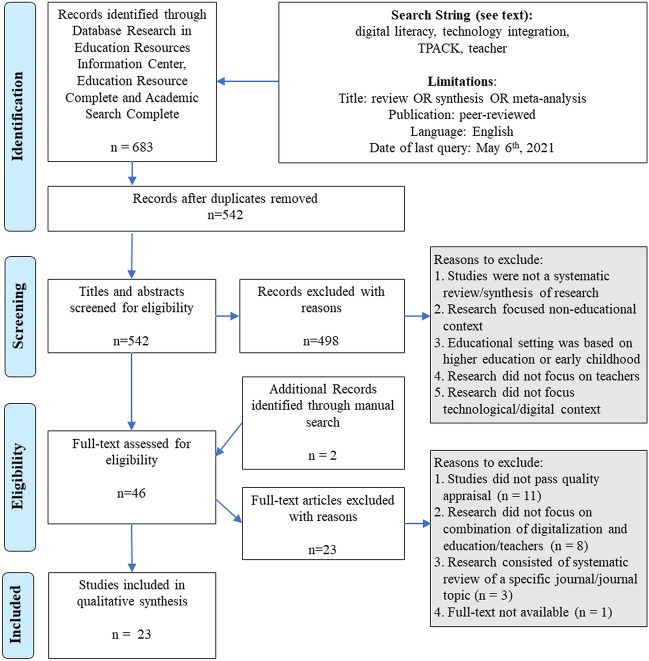
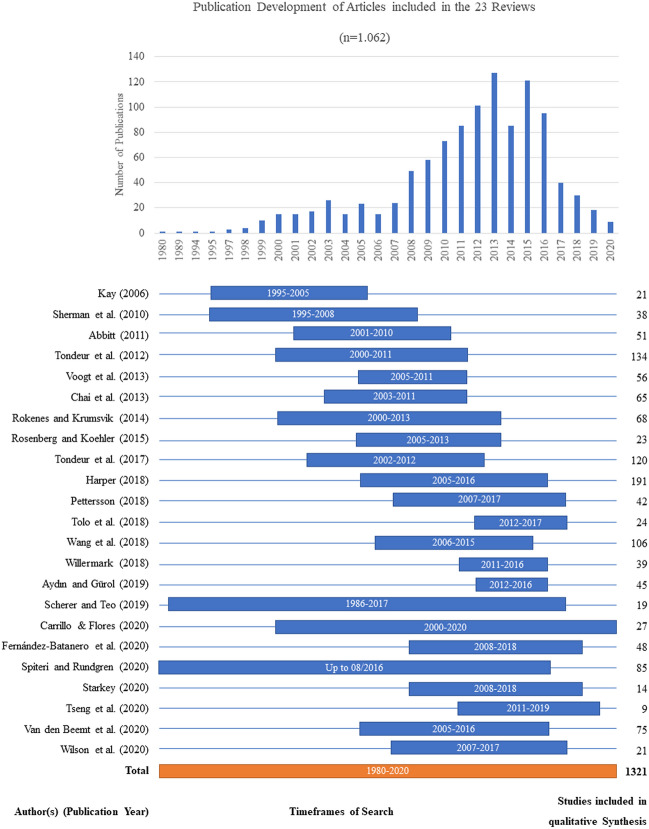
As teachers are central to digitalizing education, we summarize 40 years of research on their role in that process within a systematic umbrella review that includes 23 systematic reviews with a total of 1062 primary studies focusing technology integration and aspects of digital literacy. Our findings highlight the international acceptance of the TPACK framework as well as the need for a clear concept of digital literacy. It is unique that we identify and discuss parallels in developing teachers’ digital literacy and integrating digital technologies in the teaching profession as well as barriers to those goals. We conclude by suggesting future directions for research and describing the implications for schools, teacher education, and institutions providing professional development to in-service teachers.
Overview
The claims and statistics of this paper haven’t been checked yet.
Free: it reads the open-access text and checks the first 5 claims that cite a source we can check. Create a free account to check every claim.
Integrity signals
Registry
Cites
Statistics
Figures
Verification
Claims the paper makes
The claims and statistics of this paper haven’t been checked yet.
Free: it reads the open-access text and checks the first 5 claims that cite a source we can check. Create a free account to check every claim.
Claims other papers make about this one
Each is checked against this paper’s own text: does it say what the citing paper says it does?
The source backs part of the claim, not all of it — or backs it for a different population, condition or comparison.
In the citing paper
“However, beyond the pandemic's immediate challenges, the ongoing digital transformation in education-including the advent of generative AI and other emerging technologiesreshapes teaching and learning paradigms (Fütterer et al., 2023;Wohlfart & Wagner, 2023).”
From Transforming Online Teacher Training Through Expansive Learning: A Case Study Applying Cultural-Historical Activity Theory and the Change Laboratory Method (2025) · cites this paper as Wohlfart & Wagner, 2023
Experimental — accuracy not yet measuredThe check wasn’t confident either way, so it gives no verdict — never disputed.
In the citing paper
“Consistent with previous studies (Kolykhmatov 2020; Wohlfart and Wagner 2023), our findings highlight the key role of digitalization infacilitating teachers' work and enhancing both the accessibility and quality ofeducation.”
From A Study of Teachers’ Attitudes towards Digital Educational Technologies: a Qualitative Analysis (2026) · cites this paper as Wohlfart and Wagner 2023
Experimental — accuracy not yet measured
Self-check
Percentages, sums and reported differences re-computed from the paper’s own numbers.
The self-check needs the paper’s full text.
Citations
Cites
Using thematic analysis in psychology
Braun, V., & Clarke, V. (2006) · Qualitative Research in Psychology · doi:10.1191/1478088706qp063oa · Cited by 194,414
Preferred Reporting Items for Systematic Reviews and Meta-Analyses: The PRISMA Statement
Moher, D., Liberati, A., Tetzlaff, J., Altman, D. G., & The PRISMA Group (2009) · PLoS Medicine · doi:10.1371/journal.pmed.1000097 · Cited by 64,042 · cited 3×
“1 3 Next, the methodological quality of the remaining 34 articles was assessed with an appraisal checklist based on the JBI Critical Appraisal Checklist for Systematic Reviews and Research Syntheses (Aromataris et al., 2015; Moher et al., 2009) as well as Gessler and Siemer (2020).”
Those Who Understand: Knowledge Growth in Teaching
SHULMAN, L. S. (1986) · Educational Researcher · doi:10.3102/0013189x015002004 · Cited by 18,546 · cited 1×
“The reviews report (in broad agreement) on the emergence and publication development of the TPACK model based on the original contribution of Shulman (1986) and the contributions of Mishra and Koehler (Koehler & Mishra, 2008; Mishra & Koehler, 2006).”
MethodTechnological Pedagogical Content Knowledge: A Framework for Teacher Knowledge
Mishra, P., & Koehler, M. J. (2006) · Teachers College Record: The Voice of Scholarship in Education · doi:10.1111/j.1467-9620.2006.00684.x · Cited by 12,604
A typology of reviews: an analysis of 14 review types and associated methodologies
Grant, M. J., & Booth, A. (2009) · Health Information & Libraries Journal · doi:10.1111/j.1471-1842.2009.00848.x · Cited by 10,817 · cited 1×
“Due to the emerging nature of our research topic, we include all available review types and articles (Grant & Booth, 2009).”
MethodCritical Inquiry in a Text-Based Environment: Computer Conferencing in Higher Education
Garrison, D. R., Anderson, T., & Archer, W. (1999) · The Internet and Higher Education · doi:10.1016/s1096-7516(00)00016-6 · Cited by 6,619 · cited 2×
“Three further frameworks were applied in individual studies; Carrillo and Flores (2020) used the Community of Inquiry Framework (Garrison et al., 1999) as an analytical tool, Scherer and Teo (2019) analyzed and discussed the variables of the technology acceptance model (TAM) (Davis, 1986) in their…”
MethodConstructing 21st-Century Teacher Education
Darling-Hammond, L. (2006) · Journal of Teacher Education · doi:10.1177/0022487105285962 · Cited by 2,593 · cited 1×
“In line with Darling-Hammond (2006), we argue that theory must be applied to strengthen the field’s legitimacy to inform future policy development in education.”
Aromataris, E., Fernandez, R., Godfrey, C. M., Holly, C., Khalil, H., & Tungpunkom, P. (2015) · International Journal of Evidence-Based Healthcare · doi:10.1097/xeb.0000000000000055 · Cited by 2,587 · cited 4×
“Next, the methodological quality of the remaining 34 articles was assessed with an appraisal checklist based on the JBI Critical Appraisal Checklist for Systematic Reviews and Research Syntheses (Aromataris et al., 2015; Moher et al., 2009) as well as Gessler and Siemer (2020).”
BackgroundMethodResultInfluentialTeacher Technology Change: How Knowledge, Confidence, Beliefs, and Culture Intersect
Ertmer, P. A., & Ottenbreit-Leftwich, A. T. (2010) · Journal of Research on Technology in Education · doi:10.1080/15391523.2010.10782551 · Cited by 2,556 · cited 1×
“Moreover, the role of teachers in digitalizing education must be recognized as a complex, holistic phenomenon (Ertmer & Ottenbreit-Leftwich, 2010).”
Schmidt, D. A., Baran, E., Thompson, A. D., Mishra, P., Koehler, M. J., & Shin, T. S. (2009) · Journal of Research on Technology in Education · doi:10.1080/15391523.2009.10782544 · Cited by 1,853 · cited 1×
“The survey instrument developed and validated by Schmidt et al. (2009) to measure self-perceived TPACK is explicitly highlighted in five of the eight reviews.”
Niess, M. L. (2005) · Teaching and Teacher Education · doi:10.1016/j.tate.2005.03.006 · Cited by 1,430 · cited 2×
“In addition, the studies of Pierson (2001) and Niess (2005) play a special role.”
DIGCOMP: A Framework for Developing and Understanding Digital Competence in Europe.
(2013) · Joint Research Centre (European Commission) · doi:10.2788/52966 · Cited by 1,394 · cited 3×
“…include areas of digital literacy as proposed by the European Commission’s framework for developing and understanding digital competence in Europe (Ferrari, 2013; Starkey, 2020) C a rr ill o a nd F l o r e s ( 2020 ) a pp l y t h e C o mm un it y o f I nqu i r y F r a m e w o r k ( G a rr i s on…”
BackgroundTechnology acceptance model in educational context: A systematic literature review
Granić, A., & Marangunić, N. (2019) · British Journal of Educational Technology · doi:10.1111/bjet.12864 · Cited by 1,204 · cited 1×
“Previous research on the role of teachers in this process has often focused either on their (perceived) digital literacy or on their willingness and ability to integrate technology (e.g., Granić & Marangunić, 2019; McKnight et al., 2016).”
A review of technological pedagogical content knowledge
Chai, C. S., Koh, J. H. L., & Tsai, C. (2013) · Educational Technology & Society · Cited by 1,147
Tondeur, J., van Braak, J., Ertmer, P. A., & Ottenbreit-Leftwich, A. (2017) · Educational Technology Research and Development · doi:10.1007/s11423-016-9481-2 · Cited by 1,131 · cited 4×
“…interventional or experimental designs (Aydın & Gürol, 2019; Kay, 2006), research using mixed methods (Aydın & Gürol, 2019; Chai et al., 2013; Tondeur et al., 2017; van den Beemt et al., 2020; Wang et al., 2018; Willermark, 2018), and research employing longitudinal designs (Scherer & Teo,…”
InfluentialTechnological pedagogical content knowledge – a review of the literature
Voogt, J., Fisser, P., Pareja Roblin, N., Tondeur, J., & van Braak, J. (2013) · Journal of Computer Assisted Learning · doi:10.1111/j.1365-2729.2012.00487.x · Cited by 1,095 · cited 4×
“, 2013) as well as their dynamic and changeable nature over time (Abbitt, 2011; Voogt et al., 2013; Wang et al., 2018).”
InfluentialTondeur, J., van Braak, J., Sang, G., Voogt, J., Fisser, P., & Ottenbreit-Leftwich, A. (2012) · Computers & Education · doi:10.1016/j.compedu.2011.10.009 · Cited by 1,057 · cited 5×
“Tondeur et al. (2012), meanwhile, discuss the advantages of specific technology education courses in transferring and implementing specific digital tools in future classrooms.”
InfluentialCOVID-19 and teacher education: a literature review of online teaching and learning practices
Carrillo, C., & Flores, M. A. (2020) · European Journal of Teacher Education · doi:10.1080/02619768.2020.1821184 · Cited by 1,019 · cited 5×
“Three further frameworks were applied in individual studies; Carrillo and Flores (2020) used the Community of Inquiry Framework (Garrison et al., 1999) as an analytical tool, Scherer and Teo (2019) analyzed and discussed the variables of the technology acceptance model (TAM) (Davis, 1986) in their…”
InfluentialTeaching in a Digital Age: How Educators Use Technology to Improve Student Learning
McKnight, K., O'Malley, K., Ruzic, R., Horsley, M. K., Franey, J. J., & Bassett, K. (2016) · Journal of Research on Technology in Education · doi:10.1080/15391523.2016.1175856 · Cited by 531 · cited 3×
“Previous research on the role of teachers in this process has often focused either on their (perceived) digital literacy or on their willingness and ability to integrate technology (e.g., Granić & Marangunić, 2019; McKnight et al., 2016).”
Technology Integration Practice as a Function of Pedagogical Expertise
Pierson, M. E. (2001) · Journal of Research on Computing in Education · doi:10.1080/08886504.2001.10782325 · Cited by 502 · cited 1×
“In addition, the studies of Pierson (2001) and Niess (2005) play a special role.”
A review of research exploring teacher preparation for the digital age
Starkey, L. (2020) · Cambridge Journal of Education · doi:10.1080/0305764x.2019.1625867 · Cited by 492 · cited 4×
“…factors (may) influence teachers’ digital literacy and/or willingness to integrate digital tools (Chai et al., 2013; Rokenes & Krumsvik, 2014; Rosenberg & Koehler, 2015; Scherer & Teo, 2019; Sherman et al., 2010; Starkey, 2020; Tondeur et al., 2017; van den Beemt et al., 2020; Voogt et al., 2013).”
BackgroundInfluentialKay, R. H. (2006) · Journal of Research on Technology in Education · doi:10.1080/15391523.2006.10782466 · Cited by 482 · cited 4×
“More specifically, the results highlight the need for more case studies, interventional or experimental designs (Aydın & Gürol, 2019; Kay, 2006), research using mixed methods (Aydın & Gürol, 2019; Chai et al.”
InfluentialContext and Technological Pedagogical Content Knowledge (TPACK): A Systematic Review
Rosenberg, J. M., & Koehler, M. J. (2015) · Journal of Research on Technology in Education · doi:10.1080/15391523.2015.1052663 · Cited by 473 · cited 3×
“An exception is Rosenberg and Koehler’ (2015) context-specific review, which discusses the meaning and presence of context in TPACK research based on Porras-Hernández and Salinas-Amescua’s (2013) conceptual framework for context at three levels (micro, meso, and macro) and among two groups of…”
On the issues of digital competence in educational contexts – a review of literature
Pettersson, F. (2018) · Education and Information Technologies · doi:10.1007/s10639-017-9649-3 · Cited by 473 · cited 7×
“A variety of stakeholders must be mutually committed to creating digitally competent schools (Pettersson, 2018; Sailer et al., 2021), and teachers are seen as crucial to this process of digitalization (Bridwell-Mitchell, 2015; Lockton & Fargason, 2019).”
InfluentialDigital competences for teacher professional development. Systematic review
Fernández-Batanero, J. M., Montenegro-Rueda, M., Fernández-Cerero, J., & García-Martínez, I. (2022) · European Journal of Teacher Education · doi:10.1080/02619768.2020.1827389 · Cited by 435 · cited 3×
“…include areas of digital literacy as proposed by the European Commission’s framework for developing and understanding digital competence in Europe (Ferrari, 2013; Starkey, 2020) C a rr ill o a nd F l o r e s ( 2020 ) a pp l y t h e C o mm un it y o f I nqu i r y F r a m e w o r k ( G a rr i s on…”
Abbitt, J. T. (2011) · Journal of Research on Technology in Education · doi:10.1080/15391523.2011.10782573 · Cited by 321 · cited 4×
“, 2013) as well as their dynamic and changeable nature over time (Abbitt, 2011; Voogt et al., 2013; Wang et al., 2018).”
InfluentialLiterature Review on the Factors Affecting Primary Teachers’ Use of Digital Technology
Spiteri, M., & Chang Rundgren, S.-N. (2020) · Technology, Knowledge and Learning · doi:10.1007/s10758-018-9376-x · Cited by 302
Unpacking teachers’ intentions to integrate technology: A meta-analysis
Scherer, R., & Teo, T. (2019) · Educational Research Review · doi:10.1016/j.edurev.2019.03.001 · Cited by 302 · cited 7×
“…applied in individual studies; Carrillo and Flores (2020) used the Community of Inquiry Framework (Garrison et al., 1999) as an analytical tool, Scherer and Teo (2019) analyzed and discussed the variables of the technology acceptance model (TAM) (Davis, 1986) in their meta-analysis, and Tolo…”
InfluentialWillermark, S. (2018) · Journal of Educational Computing Research · doi:10.1177/0735633117713114 · Cited by 258
Porras-Hernández, L. H., & Salinas-Amescua, B. (2013) · Journal of Educational Computing Research · doi:10.2190/ec.48.2.f · Cited by 245
Development of Student Teachers’ Digital Competence in Teacher Education - A Literature Review
Røkenes, F. M., & Krumsvik, R. J. (2014) · Nordic Journal of Digital Literacy · doi:10.18261/issn1891-943x-2014-04-03 · Cited by 240
Preservice Teachers' TPACK Development: A Review of Literature
Wang, W., Schmidt-Crawford, D., & Jin, Y. (2018) · Journal of Digital Learning in Teacher Education · doi:10.1080/21532974.2018.1498039 · Cited by 229 · cited 5×
“The role of teacher educators and their training is also highlighted in this context (Tondeur et al., 2012), as poor modelling on the part of teacher educators may negatively impact preservice teachers’ TPACK development (Wang et al., 2018).”
InfluentialTowards an understanding of social media use in the classroom: a literature review
Van Den Beemt, A., Thurlings, M., & Willems, M. (2020) · Technology, Pedagogy and Education · doi:10.1080/1475939x.2019.1695657 · Cited by 225 · cited 5×
“…or experimental designs (Aydın & Gürol, 2019; Kay, 2006), research using mixed methods (Aydın & Gürol, 2019; Chai et al., 2013; Tondeur et al., 2017; van den Beemt et al., 2020; Wang et al., 2018; Willermark, 2018), and research employing longitudinal designs (Scherer & Teo, 2019; Tondeur et al.,…”
BackgroundMethodInfluentialTseng, J.-J., Chai, C. S., Tan, L., & Park, M. (2022) · Computer Assisted Language Learning · doi:10.1080/09588221.2020.1868531 · Cited by 225 · cited 2×
“…describe a lack of critical reflection in the included studies concerning the processes and specific outcomes of strategies and interventions related to teachers’ role in digitalization (Abbitt, 2011; Carrillo & Flores, 2020; Sherman et al., 2010; Tseng et al., 2020; van den Beemt et al., 2020).”
Digital learning in schools: What does it take beyond digital technology?
Sailer, M., Murböck, J., & Fischer, F. (2021) · Teaching and Teacher Education · doi:10.1016/j.tate.2021.103346 · Cited by 216 · cited 3×
“A variety of stakeholders must be mutually committed to creating digitally competent schools (Pettersson, 2018; Sailer et al., 2021), and teachers are seen as crucial to this process of digitalization (Bridwell-Mitchell, 2015; Lockton & Fargason, 2019).”
BackgroundMethodTechnology and Teacher–Student Interactions: A Review of Empirical Research
Harper, B. (2018) · Journal of Research on Technology in Education · doi:10.1080/15391523.2018.1450690 · Cited by 152 · cited 2×
“…a nd d i s c u ss t h e v a r i a b l e s o f t h e T A M ( D a v i s , 19 8 6 ) t h r ough a m e t a - a n a l y s i s , a nd T o l o e t a l ., ( 2018 ) c on s i d e r a s p ec t s o f c l a ss r oo m a ss e ss m e n t p r ac ti ce s und e r t h e i r t h e o r e ti ca l fr a m e w o r k , “ A…”
Bridwell-Mitchell, E. N. (2015) · Sociology of Education · doi:10.1177/0038040715575559 · Cited by 136 · cited 2×
“A variety of stakeholders must be mutually committed to creating digitally competent schools (Pettersson, 2018; Sailer et al., 2021), and teachers are seen as crucial to this process of digitalization (Bridwell-Mitchell, 2015; Lockton & Fargason, 2019).”
Wilson, M. L., Ritzhaupt, A. D., & Cheng, L. (2020) · Computers & Education · doi:10.1016/j.compedu.2020.103941 · Cited by 131 · cited 4×
“, 2018; Willermark, 2018), and research employing longitudinal designs (Scherer & Teo, 2019; Tondeur et al., 2017; Wilson et al., 2020).”
InfluentialHopfenbeck, T. N., Flórez Petour, M. T., & Tolo, A. (2015) · Assessment in Education: Principles, Policy & Practice · doi:10.1080/0969594x.2014.996524 · Cited by 104 · cited 4×
“Additionally, Chai et al. (2013) propose the “Technological Learning Content Knowledge” (TLCK) framework as a revision of the TPACK framework to include the learner perspective, addressing criticism of the examined studies and contributing to the further development of the model.”
BackgroundInfluentialHappe, J., Bühnová, B., Koziolek, A., & Wagner, I. (2020) · Education and Information Technologies · doi:10.1007/s10639-020-10379-x · Cited by 91 · cited 1×
“While the systematically selected reviews might align in topic, the reviews potentially examine a variety of different research questions, include different target groups, and differ in their timeline coverage and hence, might not be fully exhaustive (Happe et al., 2021).”
Self-citationGessler, M., & Siemer, C. (2020) · International Journal for Research in Vocational Education and Training · doi:10.13152/ijrvet.7.1.5 · Cited by 72
Wohlfart, O., Trumler, T., & Wagner, I. (2021) · Education and Information Technologies · doi:10.1007/s10639-021-10574-4 · Cited by 64 · cited 1×
“…be a driving force of digitalization, but the COVID-19 pandemic and associated distance teaching/learning have also made teachers prisoners of the rapid digitalization of society and of the associated expectations for education as they are forced to use digital technologies (Wohlfart et al., 2021).”
Self-citationLockton, M., & Fargason, S. (2019) · Journal of Educational Change · doi:10.1007/s10833-019-09351-5 · Cited by 61 · cited 1×
“A variety of stakeholders must be mutually committed to creating digitally competent schools (Pettersson, 2018; Sailer et al., 2021), and teachers are seen as crucial to this process of digitalization (Bridwell-Mitchell, 2015; Lockton & Fargason, 2019).”
BackgroundMullins, M. M., DeLuca, J. B., Crepaz, N., & Lyles, C. M. (2014) · Research Synthesis Methods · doi:10.1002/jrsm.1098 · Cited by 39 · cited 1×
“As the number of publications per year relentlessly increases, it has become difficult to stay abreast of current findings, but literature reviews have the advantage of systematically structuring and summarizing the previous literature on a specific topic (Mullins et al., 2014).”
Teaching in middle school Technology Education: a review of recent practices
Sherman, T. M., Sanders, M., & Kwon, H. (2009) · International Journal of Technology and Design Education · doi:10.1007/s10798-009-9090-z · Cited by 38 · cited 2×
“(2) Process and outcome Several reviews describe a lack of critical reflection in the included studies concerning the processes and specific outcomes of strategies and interventions related to teachers’ role in digitalization (Abbitt, 2011; Carrillo & Flores, 2020; Sherman et al., 2010; Tseng et al., 2020; van den Bee…”
A Systematic Review of Critical Factors Regarding ICT Use in Teaching and Learning
Aydın, M., & Gürol, M. (2019) · International Journal of Progressive Education · doi:10.29329/ijpe.2019.203.9 · Cited by 12 · cited 3×
“…highlight the need for more case studies, interventional or experimental designs (Aydın & Gürol, 2019; Kay, 2006), research using mixed methods (Aydın & Gürol, 2019; Chai et al., 2013; Tondeur et al., 2017; van den Beemt et al., 2020; Wang et al., 2018; Willermark, 2018), and research…”
Cracking the Code of Education Reform: Creative Compliance and Ethical Leadership
Tienken, C. H. (2020) · Corwin eBooks · doi:10.4135/9781544368252 · Cited by 7 · cited 1×
“Before 2020, some institutions were still discussing data protection guidelines while others were already trying to “crack the code of education reform” (Tienken & Starr, 2020).”
Tolo, A., Chan, J., & Hopfenbeck, T. N. (2018) · AERA Online Paper Repository · Cited by 1
Research works printed but not linked: 3
- Davis, F. (1986). A technology acceptance model for empirically testing new end-user information systems: Theory and results [Unpublished doctoral dissertation]. Massachusetts Institute of Technology
- Drossel, K., Eickelmann, B., Schaumburg, H., & Labusch, A. (2019). Nutzung digitaler Medien und Prädiktoren aus der Perspektive der Lehrerinnen und Lehrer im internationalen Vergleich [Use of digital media and predictors from the perspective of teachers in an international comparison]. In B. Eickelmann, W. Bos, & J. Gerick (Eds.), ICILS 2018 #Deutschland [#Germany]: Computer- und informationsbezogene Kompetenzen von Schülerinnen und Schülern im zweiten internationalen Vergleich und Kompetenzen im Bereich Computational Thinking [Computer and information-related competencies of students in the second international comparison and competencies in computational thinking] (pp. 205–240). Waxmann
- Koehler, M. J., & Mishra, P. P. (2008). Introducing TPCK. In AACTE Committee on Technology and Innovation (Ed.), Handbook of technological pedagogical content knowledge (TPCK) for educators (pp. 3–29). Springer
Cited by
A systematic review of industrial wastewater management: Evaluating challenges and enablers
Singh, B. J., Chakraborty, A., & Sehgal, R. (2023) · Journal of Environmental Management · doi:10.1016/j.jenvman.2023.119230 · Cited by 610
“Similarly, the integration of umbrella review and critical literature review, in this work finds resonance in the approach adopted by Wohlfart and Wagner (2023) in their comprehensive study of wastewater management enablers.”
BackgroundKreijkes, P., & Greatorex, J. (2024) · Review of Education · doi:10.1002/rev3.3465 · Cited by 77
Wohlfart, O., & Wagner, I. (2024) · Education and Information Technologies · doi:10.1007/s10639-024-12954-y · Cited by 74
“The pivotal role of teachers in driving the digital transformation of education is well recognized as a complex phenomenon (Wohlfart & Wagner, 2023; Wohlfart et al., 2023; Ertmer & Ottenbreit-Leftwich, 2010).”
InfluentialSelf-citationHan, R., Alibakhshi, G., Lu, L., & Labbafi, A. (2024) · Heliyon · doi:10.1016/j.heliyon.2024.e25213 · Cited by 68
“This requires teachers to be more adaptable and innovative in their teaching strategies [7], as well as to be able to provide constructive feedback to students in a digital environment [8].”
BackgroundRawal, D. M. (2024) · Journal of Professional Capital and Community · doi:10.1108/jpcc-01-2024-0016 · Cited by 61
Metadata
- Authors
- Wohlfart, O., & Wagner, I.
- Affiliations
- Karlsruhe Institute of Technology (DE)
- Corresponding author
- Wohlfart, Olivia
- Venue
- Educational technology research and development
- Published
- 2022-10-31
- Volume
- 71
- Issue
- 2
- Pages
- 339-365
- ISSN
- 1042-1629 (ISSN-L)
- 1556-6501
- PMC
- PMC9628337
- OpenAlex
- W4307918325
- Cited by
- 96
- References
- 48
- Citations by year
- 2026: 41 · 2025: 32 · 2024: 15 · 2023: 8
- FWCI
- 13.62
- Type
- journal article
- Language
- en
- Update notices
- correction (2024-06-19)
- Open access
- hybrid
- doi.org
- Licence
- cc-by
- creativecommons.org/licenses/by/4.0 (tdm)
- creativecommons.org/licenses/by/4.0 (vor)
- Locations
- Educational Technology Research and Development (publishedVersion, cc-by)
- PubMed Central (publishedVersion, cc-by)
- PubMed (publishedVersion)
- Repository KITopen (Karlsruhe Institute of Technology) (submittedVersion, cc-by)
- KITopen (cc-by)
- Funders
- Bundesministerium für Bildung und Forschung (2017-1-DK01-KA203-034270)
- Karlsruher Institut für Technologie (KIT)
- Topics
- Social Sciences › Education › Digital literacy in education
- Social Sciences › Education › Education and Technology Integration
- Social Sciences › Education › Teacher Education and Leadership Studies
- Keywords
- teacher role, digitalization of education, technology integration, digital literacy, TPACK framework, teacher professional development, in-service teacher professional development, barriers to technology integration, digital technologies in teaching
About these checks
Registry, retraction, Cites and statistics results are computed, not judged, with one exception: a printed reference that no index lists is read once by a model before it counts as a citation error. Claims are extracted by a model and kept only when their quote appears verbatim in the text; each cited source is then checked, with a model’s help, for whether it says what the claim relies on. Those verdicts can be wrong — read the claim’s quote and the cited source before relying on one.
Statistics and arithmetic are recomputed, not judged.
Confidence bands are shown only for fields calibrated on our annotated test set. None is calibrated yet, so no band is shown.
What counts as a claim ›How we measure confidence ›How we check this ›
Are you an author, or do you see a problem with this page? Request a review
Data sources
Bibliographic data: Semantic Scholar, OpenAlex, Crossref.
Contains information from the Semantic Scholar Academic Graph Datasets, made available under the ODC Attribution License (ODC-BY 1.0).
Semantic Scholar’s data is described in: Kinney, R., et al. (2023). The Semantic Scholar Open Data Platform. arXiv:2301.10140.
