

The HeDiCom framework: higher education teachers' digital competencies for the future
Open accessThe DOI matches its Crossref record; 48 of the 48 references it cites were found in a registry or an index.
Abstract
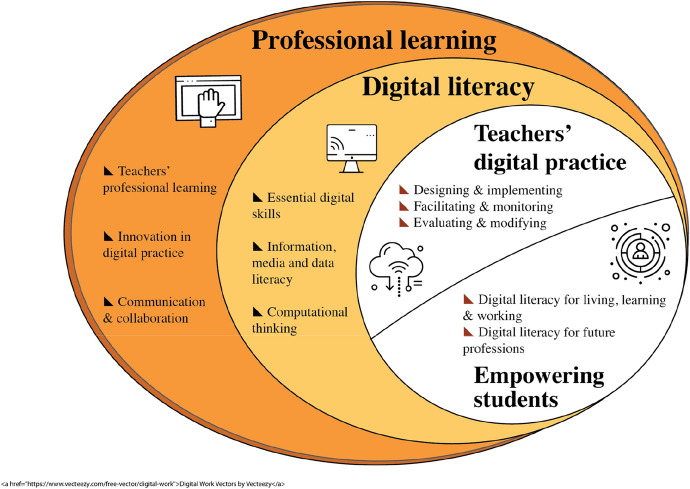
There is little consensus about the nature of teachers’ digital competencies in Higher Education. Moreover, existing digital competence frameworks have largely been developed for teachers in secondary education. In response to this, the current study focuses on developing and validating a framework of digital competencies for teachers in Higher Education. First, a review was conducted to determine the state of digital competence research regarding dimensions and definition of digital competence. In a next step, similarities and differences between existing digital competence frameworks were identified. Based on the outcomes of the review and the framework comparison, a framework was developed in an iterative process through expert meetings with policy makers, experts in the field of educational technology, and validated with practitioners. The new framework includes four dimensions of teachers’ digital competencies: (1) Teaching practice, (2) Empowering students for a digital society, (3) Teachers’ digital literacy, and (4) Teachers’ professional development. The resulting Higher Education Digital Competence (HeDiCom) framework will provide guidance and clearer expectations of teachers’ digital competency. Ultimately, improving teachers’ digital competencies will contribute to improving the quality of digital competencies of the students.
Overview
The claims and statistics of this paper haven’t been checked yet.
Free: it reads the open-access text and checks the first 5 claims that cite a source we can check. Create a free account to check every claim.
Integrity signals
Registry
Cites
Statistics
Figures
Verification
Claims the paper makes
The claims and statistics of this paper haven’t been checked yet.
Free: it reads the open-access text and checks the first 5 claims that cite a source we can check. Create a free account to check every claim.
Claims other papers make about this one
Each is checked against this paper’s own text: does it say what the citing paper says it does?
The source backs part of the claim, not all of it — or backs it for a different population, condition or comparison.
In the citing paper
“Existing studies show that the focus of research on university teachers’ digital competence is shifting from whether they can use digital tools to whether they can develop stable, reflective, and transferable digital teaching practices within specific disciplinary and instructional contexts (4–7).”
From Reframing faculty development for digital transformation and generative AI in higher education (2026) · cites this paper as [4]
Experimental — accuracy not yet measuredThe source backs part of the claim, not all of it — or backs it for a different population, condition or comparison.
In the citing paper
“Relevant research has shown that the development of teachers’ digital competence is jointly shaped by career stage, institutional environment, resource support, and opportunities for professional learning; therefore, tiered support is more effective than uniform training in improving the efficiency of faculty development (4).”
From Reframing faculty development for digital transformation and generative AI in higher education (2026) · cites this paper as [4]
Experimental — accuracy not yet measuredThe source backs part of the claim, not all of it — or backs it for a different population, condition or comparison.
In the citing paper
“In constructing its framework, HeDiCom has already incorporated ethical competence in digital society as a key dimension, indicating that digitally mature teachers must not only be capable of innovation, but also be able to discern technological risks (4).”
From Reframing faculty development for digital transformation and generative AI in higher education (2026) · cites this paper as [4]
Experimental — accuracy not yet measuredThe source backs part of the claim, not all of it — or backs it for a different population, condition or comparison.
In the citing paper
“Only in this way can teachers truly develop digital teaching innovation capacities that are disciplinary, transferable, and demonstrable (4, 14).”
From Reframing faculty development for digital transformation and generative AI in higher education (2026) · cites this paper as [4]
Experimental — accuracy not yet measuredThe source backs part of the claim, not all of it — or backs it for a different population, condition or comparison.
In the citing paper
“The HeDiCom framework explicitly states that the mature form of faculty digital competence is manifested not merely in individual technical proficiency, but in the ability to embed digital practices into teaching innovation, student empowerment, and systems of professional learning for faculty (4).”
From Reframing faculty development for digital transformation and generative AI in higher education (2026) · cites this paper as [4]
Experimental — accuracy not yet measured
4 more claims about this paper
Create a free account to see every claim other papers make about this one.
Self-check
Percentages, sums and reported differences re-computed from the paper’s own numbers.
The self-check needs the paper’s full text.
Citations
Cites
Wing, J. M. (2006) · Communications of the ACM · doi:10.1145/1118178.1118215 · Cited by 8,102
Systematic Reviews in the Social Sciences: A Practical Guide
Petticrew, M., & Roberts, H. (2006) · doi:10.1002/9780470754887 · Cited by 3,586
From digital literacy to digital competence: the teacher digital competency (TDC) framework
Falloon, G. (2020) · Educational Technology Research and Development · doi:10.1007/s11423-020-09767-4 · Cited by 1,372
European Framework for the Digital Competence of Educators: DigCompEdu
(2017) · RePEc: Research Papers in Economics · doi:10.2760/178382 · Cited by 1,276
Carretero, S., Riina, V., & Punie, Y. (2017) · RePEc: Research Papers in Economics · doi:10.2760/38842 · Cited by 1,074 · cited 1×
“Carretero et al. (2017) for instance indicate that teachers must be able to analyze and compare both the information and the sources of digital content for reliability and credibility.”
BackgroundKebritchi, M., Lipschuetz, A., & Santiague, L. (2017) · Journal of Educational Technology Systems · doi:10.1177/0047239516661713 · Cited by 967 · cited 2×
“To become a competent online teacher, there is a need for professional development and sufficient time to design and practice online and blended learning environments (see also Kebritchi et al., 2017).”
BackgroundSpante, M., Hashemi, S. S., Lundin, M., & Algers, A. (2018) · Cogent Education · doi:10.1080/2331186x.2018.1519143 · Cited by 832 · cited 2×
“According to Spante et al. (2018), also the assessment of a specific digital competence requires the understanding of related constructs.”
BackgroundMethodThe current landscape of learning analytics in higher education
Viberg, O., Hatakka, M., Bälter, O., & Mavroudi, A. (2018) · Computers in Human Behavior · doi:10.1016/j.chb.2018.07.027 · Cited by 766 · cited 1×
“A review by Viberg et al. (2018) for instance shows that there is much potential for using and analyzing this data to improve the learning process, but that this rarely takes place in practice.”
BackgroundDigital competence – an emergent boundary concept for policy and educational research
Ilomäki, L., Paavola, S., Lakkala, M., & Kantosalo, A. (2016) · Education and Information Technologies · doi:10.1007/s10639-014-9346-4 · Cited by 689 · cited 3×
“Moreover, it is expected that students will soon enter the workforce and there is a need for them to perform as knowledge workers, which requires a high level of digital competence (Ilomäki et al., 2016).”
BackgroundMethodInfluentialDigital competence in higher education research: a systematic literature review
Zhao, Y., Pinto Llorente, A. M., & Sánchez Gómez, M. C. (2021) · Computers & Education · doi:10.1016/j.compedu.2021.104212 · Cited by 653 · cited 8×
“According to Zhao et al. (2021), the most frequently identified competencies were the use of digital technologies, knowledge of digital technologies, the Internet and technological related capacities, digital experiences and attitudes.”
BackgroundInfluentialProfiling teachers' readiness for online teaching and learning in higher education: Who's ready?
Scherer, R., Howard, S. K., Tondeur, J., & Siddiq, F. (2021) · Computers in Human Behavior · doi:10.1016/j.chb.2020.106675 · Cited by 543 · cited 5×
“Teachers need to continuously develop their ability to design, implement and evaluate innovative educational practices (e.g., Scherer et al., 2021; Tondeur et al., 2021).”
BackgroundInfluentialSelf-citationTeachers’ digital competencies in higher education: a systematic literature review
Basilotta-Gómez-Pablos, V., Matarranz, M., Casado-Aranda, L.-A., & Otto, A. (2022) · International Journal of Educational Technology in Higher Education · doi:10.1186/s41239-021-00312-8 · Cited by 517 · cited 3×
“The problem is that it is not always clear which digital competencies HE teachers should possess to adequately integrate ICT into their educational practice, and they lack guidance on developing their digital competence (Basilotta-Gómez-Pablos et al., 2022; Bennett, 2014; Tondeur et al., 2018).”
BackgroundMartin, F., Ritzhaupt, A., Kumar, S., & Budhrani, K. (2019) · The Internet and Higher Education · doi:10.1016/j.iheduc.2019.04.001 · Cited by 385 · cited 1×
“Moreover, HE teachers need to familiarize themselves with innovative practices by experimenting with digital technology and reflecting on their possible benefits in their teaching practice (see Martin et al., 2019).”
BackgroundA multilevel analysis of what matters in the training of pre-service teacher's ICT competencies
Tondeur, J., Aesaert, K., Prestridge, S., & Consuegra, E. (2018) · Computers & Education · doi:10.1016/j.compedu.2018.03.002 · Cited by 352 · cited 6×
“An often-mentioned example of communication is teachers’ participation in online learning networks in order to be able to learn from the wider education community (see e.g., Tondeur et al., 2018).”
BackgroundInfluentialSelf-citationTondeur, J., Scherer, R., Baran, E., Siddiq, F., Valtonen, T., & Sointu, E. (2019) · British Journal of Educational Technology · doi:10.1111/bjet.12748 · Cited by 341 · cited 7×
“According to Kral et al. (2019), Tondeur et al. (2019), teachers need to be able to continue to develop professionally in a manner that reflects the educational context and their own professional beliefs about education.”
BackgroundMethodInfluentialSelf-citationTondeur, J., Aesaert, K., Pynoo, B., van Braak, J., Fraeyman, N., & Erstad, O. (2017) · British Journal of Educational Technology · doi:10.1111/bjet.12380 · Cited by 325 · cited 2×
“Research evidence from the review has shown that teachers’ digital literacy is related to the quality of their educational practice using technology (see e.g., Tondeur et al., 2017) and can be considered as a prerequisite for students’ digital literacy (Falloon, 2020).”
BackgroundSelf-citationTeachers’ information and communication technology competences: A structural approach
Almerich, G., Orellana, N., Suárez-Rodríguez, J., & Díaz-García, I. (2016) · Computers & Education · doi:10.1016/j.compedu.2016.05.002 · Cited by 236 · cited 3×
“First, information literacy can comprise searching for information, the organization of information, and the assessment of information (Almerich et al., 2016).”
BackgroundMethodGurley, L. E. (2018) · Online Learning · doi:10.24059/olj.v22i2.1255 · Cited by 236 · cited 1×
“Teaching with digital technologies requires digital competencies but also different pedagogical approaches than for instance teaching face-to-face (Gurley, 2018).”
BackgroundZarei, S., & Mohammadi, S. (2021) · Environmental Science and Pollution Research · doi:10.1007/s11356-021-14647-2 · Cited by 208 · cited 1×
“This Great Online Transition (Scherer et al., 2021; Tondeur et al., 2021) has transformed most HE from traditional to online and blended teaching and learning (see also Zarei & Mohammadi, 2022).”
BackgroundCabero-Almenara, J., Gutiérrez-Castillo, J.-J., Palacios-Rodríguez, A., & Barroso-Osuna, J. (2020) · Sustainability · doi:10.3390/su12156094 · Cited by 204
Computational thinking in higher education: A review of the literature
Lyon, J. A., & Magana, A. J. (2020) · Computer Applications in Engineering Education · doi:10.1002/cae.22295 · Cited by 198 · cited 1×
“During the validation, experts and practitioners argued that computational thinking will become more important in jobs (Lyon & Magana, 2020).”
BackgroundTømte, C., Enochsson, A.-B., Buskqvist, U., & Kårstein, A. (2015) · Computers & Education · doi:10.1016/j.compedu.2015.01.005 · Cited by 191 · cited 1×
“As stated before, a debate exists concerning the nature of teachers’ digital competencies and how they can be best developed in Higher Education (Falloon, 2020; Tømte et al., 2015).”
BackgroundExploring Adaptive Teaching Competencies in Big Data Era
Huda, M., Maseleno, A., Shahrıll, M., Jasmi, K. A., Mustari, I., & Basiron, B. B. (2017) · International Journal of Emerging Technologies in Learning (iJET) · doi:10.3991/ijet.v12i03.6434 · Cited by 172 · cited 1×
“This requires certain competencies in analytical treatment based on data mining, for the extraction of useful, valuable and meaningful information from large volumes of data (Huda et al., 2017).”
BackgroundTeachers’ professional reasoning about their pedagogical use of technology
Heitink, M., Voogt, J., Verplanken, L., van Braak, J., & Fisser, P. (2016) · Computers & Education · doi:10.1016/j.compedu.2016.05.009 · Cited by 167 · cited 1×
“…change through the use of ICT, it is important for teachers to be aware of how and why they want to integrate digital technologies in a specific context, while ensuring alignment between learning objectives, learning activities, learning resources and assessment (see Heitink et al., 2016).”
BackgroundAll the same or different? Revisiting measures of teachers' technology acceptance
Scherer, R., Siddiq, F., & Tondeur, J. (2019) · Computers & Education · doi:10.1016/j.compedu.2019.103656 · Cited by 164 · cited 4×
“Teachers, most of whom had never fully taught online, were asked to redesign their teaching practice to support their students in an online environment (see Scherer et al., 2020).”
BackgroundInfluentialSelf-citationInternational Journal of Education and Information Technologies
(2020) · International Journal of Education and Information Technologies · doi:10.46300/9109 · Cited by 141
Tondeur, J., Petko, D., Christensen, R. W., Drossel, K., Starkey, L., Knezek, G., & Schmidt-Crawford, D. A. (2021) · Educational Technology Research and Development · doi:10.1007/s11423-020-09911-0 · Cited by 127
Self-citationVanderlinde, R., van Braak, J., & Dexter, S. L. (2011) · Computers & Education · doi:10.1016/j.compedu.2011.12.007 · Cited by 126 · cited 1×
“In a best-case scenario the HeDiCom Framework can serve as a blueprint for ICT policy planning in Higher Education institutions (cf. Vanderlinde et al., 2012).”
BackgroundAlayyar, G. M., Fisser, P., & Voogt, J. (2012) · Australasian Journal of Educational Technology · doi:10.14742/ajet.773 · Cited by 120 · cited 1×
“Other examples of collaboration are design teams, learning communities or communities of practice (Alayyar et al., 2012).”
BackgroundExperienced online instructors: beliefs and preferred supports regarding online teaching
McGee, P., Windes, D. L., & Torres, M. C. C. (2017) · Journal of Computing in Higher Education · doi:10.1007/s12528-017-9140-6 · Cited by 116 · cited 3×
“, 2016) by depicting articulated digital competencies and hence support the development of expertise (McGee et al., 2017).”
BackgroundMethodDegrees of Digital Division: Reconsidering Digital Inequalities and Contemporary Higher Education
Selwyn, N. (2010) · RUSC Universities and Knowledge Society Journal · doi:10.7238/rusc.v7i1.660 · Cited by 106 · cited 1×
“Higher Education institutions are “rich in technology resources and technology-based activities” (Selwyn, 2010, p. 2), but the risk of digital divisions among students in regard to what they use and how they use it is high.”
BackgroundLearning from the early adopters: developing the Digital Practitioner
Bennett, L. (2014) · Research in Learning Technology · doi:10.3402/rlt.v22.21453 · Cited by 98 · cited 3×
“The problem is that it is not always clear which digital competencies HE teachers should possess to adequately integrate ICT into their educational practice, and they lack guidance on developing their digital competence (Basilotta-Gómez-Pablos et al., 2022; Bennett, 2014; Tondeur et al., 2018).”
BackgroundKimmons, R. M., & Hall, C. S. (2017) · TechTrends · doi:10.1007/s11528-017-0227-8 · Cited by 81 · cited 1×
“According to Kimmons and Hall (2018), a good framework reduces complexity, and should be easily learned and remembered.”
BackgroundEducation at a Glance 2002: OECD Indicators
OECD (2002) · Education at a glance. OECD indicators/Education at a glance · doi:10.1787/eag-2002-en · Cited by 81
Schneckenberg, D. (2010) · British Journal of Educational Technology · doi:10.1111/j.1467-8535.2009.01046.x · Cited by 71 · cited 1×
“Some studies also highlight that ICT can act as a catalyst for innovation in practice, for example to create more flexible, personalized and self-regulated learning (Schneckenberg, 2010).”
BackgroundBarriers in teacher perception about the use of technology for evaluation in Higher Education
Alonso, R. R., Plaza, I. R., & Orfali, C. H. (2019) · Digital Education Review · doi:10.1344/der.2019.35.170-185 · Cited by 65
Trends in Using ICT Resources by Professors in HEIs (Higher Education Institutions)
Barreto, C. R., Jabba, D., Solano, H. L., Santodomingo, J. M. P., Acevedo, C. M. A., Acevedo, P., Navarro, C. P. B., & Villa, S. M. V. (2020) · Journal of Information Technology Education Research · doi:10.28945/4601 · Cited by 62 · cited 1×
“Teaching should be aligned with the needs of students, for instance to ensure more flexible and personalized learning and greater student self-regulation (Cabero-Almenara et al., 2020) and to facilitate collaborative learning (Ricardo-Barreto et al., 2020).”
BackgroundAnalytical Competences of Teachers in Big Data in the Era of Digitalized Learning
López-Belmonte, J., Pozo-Sánchez, S., Fuentes-Cabrera, A., & Trujillo-Torres, J.-M. (2019) · Education Sciences · doi:10.3390/educsci9030177 · Cited by 60 · cited 3×
“They therefore need the necessary competencies to actively, creatively and critically use and understand data (López-Belmonte et al., 2019).”
BackgroundGuillén‐Gámez, F. D., & Mayorga-Fernández, M. J. (2020) · Education Sciences · doi:10.3390/educsci10100276 · Cited by 60 · cited 1×
“Other activities emerging from the analysis are encouraging students to create their own content or using digital technology to collaborate and communicate with others or to solve problems using digital tools (Cabero-Almenara et al., 2020; Guillén-Gámez & Mayorga-Fernández, 2020).”
MethodCastaño‐Muñoz, J., Pokropek, A., & Garcia, L. W. (2022) · British Journal of Educational Technology · doi:10.1111/bjet.13222 · Cited by 45 · cited 1×
“A concrete example of such an instrument in the context of compulsory education is SELFIE, an online tool based on the DigCompEdu framework that aims to help schools diagnose, reflect and take actions on their use of digital technologies in different areas (Castaño Muñoz et al., 2022).”
MethodEnfoque sociológico del uso del b-learning en la educación digital del docente universitario
Berrocoso, J. V., & Burgos, J. A. B. (2017) · Sophía · doi:10.17163/soph.n23.2017.04 · Cited by 39
Lin, L., & Johnson, T. E. (2021) · Educational Technology Research and Development · doi:10.1007/s11423-021-09960-z · Cited by 35 · cited 1×
“In this respect, Lin and Johnson (2021) have called for more research that is directly applicable to the specific teaching and learning context.”
BackgroundTechnology Integrated on Media Literacy in Economic Studies on Higher Education.
Mukhtar, S., & Putri, . Y. S. (2021) · Journal of Social Studies Education Research · Cited by 31
ICT Competence and Needs of Turkish EFL Instructors: The Role of Gender, Institution and Experience
Ardıç, Ö., & Çiftçi, H. (2019) · Eurasian Journal of Applied Linguistics · doi:10.32601/ejal.543791 · Cited by 28
Diaconu, M., Racovita-Szilagyi, L., Muñoz, D. C., & Faubert, S. J. (2019) · Social Work Education · doi:10.1080/02615479.2019.1683155 · Cited by 25 · cited 4×
“Furthermore, according to Diaconu et al. (2020), HE teachers should support students in learning how digital tools are used in their profession and teach them to critically assess their use in the future job market.”
BackgroundResultInfluentialThe E‐Revolution in Higher Education: E‐Learning and E‐Leaders
Cordie, L., & Lin, X. Y. (2018) · Journal of Leadership Studies · doi:10.1002/jls.21602 · Cited by 18 · cited 1×
“Moreover, HE institutions that cultivate elites for our society, should be committing to innovate and to effectively integrate educational technologies (Cordie & Lin, 2018).”
BackgroundLeidinggeven aan onderwijsinnovatie met ict. Sturen op beweging.
Kral, M. H., van Loon, M. J. A. P., Gorissen, P., & Uerz, D. C. (2018) · Data Archiving and Networked Services (DANS) · Cited by 1
Self-citationLeidinggeven aan onderwijsinnovatie met ict
Kral, M. H., van Loon, M. J. A. P., Gorissen, P., & Uerz, D. C. (2019) · Data Archiving and Networked Services (DANS) · Cited by 1
Self-citation
Research works printed but not linked: 3
- 17. Howard, S. K., Tondeur, J., Hutchison, N., Scherer, R., & Siddiq, F. (2022). A t(r)opical journey: Using text mining to explore teachers' experiences in the Great Online Transition. In Society for information tech- nology & teacher education international conference.
- 32. Redecker, C., & Punie, Y. (2017). Digital competence of educators: DigCompEdu. Publications Office of the European Union. https:// doi. org/ 10. 2760/ 159770 · doi:10.2760/159770
- 37. Schleicher, A. (2020). The impact of COVID-19 on education: Insights from "Education at a Glance 2020." OECD Publishing.
Cited by
Ji, L., Aziku, M., Qiang, F., & Bin, Z. (2024) · International Journal of STEM Education · doi:10.1186/s40594-024-00513-3 · Cited by 193
“…that many teachers exhibit degrees of reluctance in employing digital technologies in their instruction, stemming from a lack of digital competencies as well as a heisitant mindset that is often skeptical about the affordances of digital technologies (Tondeur et al., 2023; Zhang et al., 2023).”
Tondeur, J., Trevisan, O., Howard, S. K., & van Braak, J. (2025) · Computers & Education · doi:10.1016/j.compedu.2025.105262 · Cited by 142
Self-citationShahid, M. K., Zia, T., Liu, B., Iqbal, Z., & Ahmad, F. (2024) · The International Journal of Management Education · doi:10.1016/j.ijme.2024.100967 · Cited by 91
Aleksieva, L. (2025) · Education Sciences · doi:10.3390/educsci15040404 · Cited by 66
Setyadi, A., Pawirosumarto, S., Damaris, A., & Dharma, R. (2025) · Education and Information Technologies · doi:10.1007/s10639-025-13380-4 · Cited by 51
“This evolution underscores the growing importance of comprehensive digital literacy in education (Handley, 2018; Tondeur et al., 2023).”
Metadata
- Authors
- Tondeur, J., Howard, S., Van Zanten, M., Gorissen, P., Van der Neut, I., Uerz, D., & Kral, M.
- Affiliations
- Vrije Universiteit Brussel (BE)
- HAN University of Applied Sciences (NL)
- Corresponding author
- Tondeur, Jo
- Venue
- Educational technology research and development
- Published
- 2023-02
- Volume
- 71
- Issue
- 1
- Pages
- 33-53
- ISSN
- 1042-1629 (ISSN-L)
- 1556-6501
- PMC
- PMC10032264
- OpenAlex
- W4360985255
- Cited by
- 115
- References
- 47
- Citations by year
- 2026: 54 · 2025: 30 · 2024: 24 · 2023: 7
- FWCI
- 26.99
- Type
- journal article
- Language
- en
- Open access
- hybrid
- doi.org
- Licence
- cc-by
- creativecommons.org/licenses/by/4.0 (tdm)
- creativecommons.org/licenses/by/4.0 (vor, 49 d)
- Locations
- Educational Technology Research and Development (publishedVersion, cc-by)
- PubMed Central (publishedVersion, cc-by)
- PubMed (publishedVersion)
- VUBIR (Vrije Universiteit Brussel) (submittedVersion, cc-by)
- Research Online (University of Wollongong) (submittedVersion)
- Topics
- Social Sciences › Education › Digital literacy in education
- Social Sciences › Education › Digital Storytelling and Education
- Social Sciences › Education › Higher Education Teaching and Evaluation
- Keywords
- digital competence of teachers, higher education teachers, digital competence framework, digital literacy, teacher professional development, teaching practice, framework validation
About these checks
Registry, retraction, Cites and statistics results are computed, not judged, with one exception: a printed reference that no index lists is read once by a model before it counts as a citation error. Claims are extracted by a model and kept only when their quote appears verbatim in the text; each cited source is then checked, with a model’s help, for whether it says what the claim relies on. Those verdicts can be wrong — read the claim’s quote and the cited source before relying on one.
Statistics and arithmetic are recomputed, not judged.
Confidence bands are shown only for fields calibrated on our annotated test set. None is calibrated yet, so no band is shown.
What counts as a claim ›How we measure confidence ›How we check this ›
Are you an author, or do you see a problem with this page? Request a review
Data sources
Bibliographic data: Semantic Scholar, OpenAlex, Crossref.
Contains information from the Semantic Scholar Academic Graph Datasets, made available under the ODC Attribution License (ODC-BY 1.0).
Semantic Scholar’s data is described in: Kinney, R., et al. (2023). The Semantic Scholar Open Data Platform. arXiv:2301.10140.
