

The HeDiCom framework: higher education teachers' digital competencies for the future
Open accessThe DOI matches its Crossref record; 48 of the 48 references it cites were found in a registry or an index.
Abstract
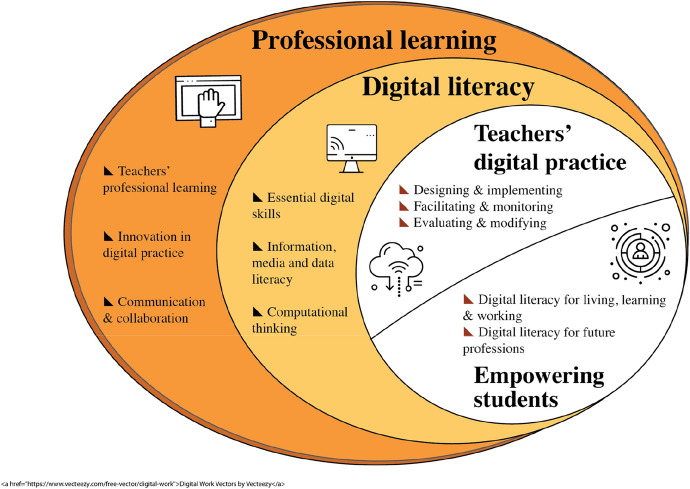
There is little consensus about the nature of teachers’ digital competencies in Higher Education. Moreover, existing digital competence frameworks have largely been developed for teachers in secondary education. In response to this, the current study focuses on developing and validating a framework of digital competencies for teachers in Higher Education. First, a review was conducted to determine the state of digital competence research regarding dimensions and definition of digital competence. In a next step, similarities and differences between existing digital competence frameworks were identified. Based on the outcomes of the review and the framework comparison, a framework was developed in an iterative process through expert meetings with policy makers, experts in the field of educational technology, and validated with practitioners. The new framework includes four dimensions of teachers’ digital competencies: (1) Teaching practice, (2) Empowering students for a digital society, (3) Teachers’ digital literacy, and (4) Teachers’ professional development. The resulting Higher Education Digital Competence (HeDiCom) framework will provide guidance and clearer expectations of teachers’ digital competency. Ultimately, improving teachers’ digital competencies will contribute to improving the quality of digital competencies of the students.
Overview
The claims and statistics of this paper haven’t been checked yet.
Free: it reads the open-access text and checks the first 5 claims that cite a source we can check. Create a free account to check every claim.
Integrity signals
Registry
Cites
Statistics
Figures
Verification
Claims the paper makes
The claims and statistics of this paper haven’t been checked yet.
Free: it reads the open-access text and checks the first 5 claims that cite a source we can check. Create a free account to check every claim.
Claims other papers make about this one
Each is checked against this paper’s own text: does it say what the citing paper says it does?
The source backs part of the claim, not all of it — or backs it for a different population, condition or comparison.
In the citing paper
“Existing studies show that the focus of research on university teachers’ digital competence is shifting from whether they can use digital tools to whether they can develop stable, reflective, and transferable digital teaching practices within specific disciplinary and instructional contexts (4–7).”
From Reframing faculty development for digital transformation and generative AI in higher education (2026) · cites this paper as [4]
Experimental — accuracy not yet measuredThe source backs part of the claim, not all of it — or backs it for a different population, condition or comparison.
In the citing paper
“Relevant research has shown that the development of teachers’ digital competence is jointly shaped by career stage, institutional environment, resource support, and opportunities for professional learning; therefore, tiered support is more effective than uniform training in improving the efficiency of faculty development (4).”
From Reframing faculty development for digital transformation and generative AI in higher education (2026) · cites this paper as [4]
Experimental — accuracy not yet measuredThe source backs part of the claim, not all of it — or backs it for a different population, condition or comparison.
In the citing paper
“In constructing its framework, HeDiCom has already incorporated ethical competence in digital society as a key dimension, indicating that digitally mature teachers must not only be capable of innovation, but also be able to discern technological risks (4).”
From Reframing faculty development for digital transformation and generative AI in higher education (2026) · cites this paper as [4]
Experimental — accuracy not yet measuredThe source backs part of the claim, not all of it — or backs it for a different population, condition or comparison.
In the citing paper
“Only in this way can teachers truly develop digital teaching innovation capacities that are disciplinary, transferable, and demonstrable (4, 14).”
From Reframing faculty development for digital transformation and generative AI in higher education (2026) · cites this paper as [4]
Experimental — accuracy not yet measuredThe source backs part of the claim, not all of it — or backs it for a different population, condition or comparison.
In the citing paper
“The HeDiCom framework explicitly states that the mature form of faculty digital competence is manifested not merely in individual technical proficiency, but in the ability to embed digital practices into teaching innovation, student empowerment, and systems of professional learning for faculty (4).”
From Reframing faculty development for digital transformation and generative AI in higher education (2026) · cites this paper as [4]
Experimental — accuracy not yet measured
4 more claims about this paper
Create a free account to see every claim other papers make about this one.
Self-check
Percentages, sums and reported differences re-computed from the paper’s own numbers.
The self-check needs the paper’s full text.
Citations
Cites
Wing, J. M. (2006) · Communications of the ACM · doi:10.1145/1118178.1118215 · Cited by 8,102
Systematic Reviews in the Social Sciences: A Practical Guide
Petticrew, M., & Roberts, H. (2006) · doi:10.1002/9780470754887 · Cited by 3,586
From digital literacy to digital competence: the teacher digital competency (TDC) framework
Falloon, G. (2020) · Educational Technology Research and Development · doi:10.1007/s11423-020-09767-4 · Cited by 1,372
European Framework for the Digital Competence of Educators: DigCompEdu
(2017) · RePEc: Research Papers in Economics · doi:10.2760/178382 · Cited by 1,276
Carretero, S., Riina, V., & Punie, Y. (2017) · RePEc: Research Papers in Economics · doi:10.2760/38842 · Cited by 1,074 · cited 1×
“Carretero et al. (2017) for instance indicate that teachers must be able to analyze and compare both the information and the sources of digital content for reliability and credibility.”
BackgroundKebritchi, M., Lipschuetz, A., & Santiague, L. (2017) · Journal of Educational Technology Systems · doi:10.1177/0047239516661713 · Cited by 967 · cited 2×
“To become a competent online teacher, there is a need for professional development and sufficient time to design and practice online and blended learning environments (see also Kebritchi et al., 2017).”
BackgroundSpante, M., Hashemi, S. S., Lundin, M., & Algers, A. (2018) · Cogent Education · doi:10.1080/2331186x.2018.1519143 · Cited by 832 · cited 2×
“According to Spante et al. (2018), also the assessment of a specific digital competence requires the understanding of related constructs.”
BackgroundMethodThe current landscape of learning analytics in higher education
Viberg, O., Hatakka, M., Bälter, O., & Mavroudi, A. (2018) · Computers in Human Behavior · doi:10.1016/j.chb.2018.07.027 · Cited by 766 · cited 1×
“A review by Viberg et al. (2018) for instance shows that there is much potential for using and analyzing this data to improve the learning process, but that this rarely takes place in practice.”
BackgroundDigital competence – an emergent boundary concept for policy and educational research
Ilomäki, L., Paavola, S., Lakkala, M., & Kantosalo, A. (2016) · Education and Information Technologies · doi:10.1007/s10639-014-9346-4 · Cited by 689 · cited 3×
“Moreover, it is expected that students will soon enter the workforce and there is a need for them to perform as knowledge workers, which requires a high level of digital competence (Ilomäki et al., 2016).”
BackgroundMethodInfluentialDigital competence in higher education research: a systematic literature review
Zhao, Y., Pinto Llorente, A. M., & Sánchez Gómez, M. C. (2021) · Computers & Education · doi:10.1016/j.compedu.2021.104212 · Cited by 653 · cited 8×
“According to Zhao et al. (2021), the most frequently identified competencies were the use of digital technologies, knowledge of digital technologies, the Internet and technological related capacities, digital experiences and attitudes.”
BackgroundInfluential
Research works printed but not linked: 3
- 17. Howard, S. K., Tondeur, J., Hutchison, N., Scherer, R., & Siddiq, F. (2022). A t(r)opical journey: Using text mining to explore teachers' experiences in the Great Online Transition. In Society for information tech- nology & teacher education international conference.
- 32. Redecker, C., & Punie, Y. (2017). Digital competence of educators: DigCompEdu. Publications Office of the European Union. https:// doi. org/ 10. 2760/ 159770 · doi:10.2760/159770
- 37. Schleicher, A. (2020). The impact of COVID-19 on education: Insights from "Education at a Glance 2020." OECD Publishing.
Cited by
Ji, L., Aziku, M., Qiang, F., & Bin, Z. (2024) · International Journal of STEM Education · doi:10.1186/s40594-024-00513-3 · Cited by 193
“…that many teachers exhibit degrees of reluctance in employing digital technologies in their instruction, stemming from a lack of digital competencies as well as a heisitant mindset that is often skeptical about the affordances of digital technologies (Tondeur et al., 2023; Zhang et al., 2023).”
Tondeur, J., Trevisan, O., Howard, S. K., & van Braak, J. (2025) · Computers & Education · doi:10.1016/j.compedu.2025.105262 · Cited by 142
Self-citationShahid, M. K., Zia, T., Liu, B., Iqbal, Z., & Ahmad, F. (2024) · The International Journal of Management Education · doi:10.1016/j.ijme.2024.100967 · Cited by 91
Aleksieva, L. (2025) · Education Sciences · doi:10.3390/educsci15040404 · Cited by 68
Setyadi, A., Pawirosumarto, S., Damaris, A., & Dharma, R. (2025) · Education and Information Technologies · doi:10.1007/s10639-025-13380-4 · Cited by 51
“This evolution underscores the growing importance of comprehensive digital literacy in education (Handley, 2018; Tondeur et al., 2023).”
Ličen, S., & Prosen, M. (2024) · Sustainability · doi:10.3390/su16229937 · Cited by 44
Afonso, A. P., Morgado, L., Noguera, I., Sepúlveda-Parrini, P., Hernández‐Leo, D., Alkhasawneh, S. N., Spilker, M. J., & Carvalho, I. C. (2025) · Education Sciences · doi:10.3390/educsci15070934 · Cited by 34
“The newly developed digital competencies for teachers in the Higher Education framework specifically address higher education teachers’ digital competencies, encompassing teaching practice, empowering students, digital literacy, and professional development (Tondeur et al., 2023).”
Maghfiroh, A., Styati, E. W., Fachriza, A., Khoiriyah, K., Simpol, W., Syaputra, R. A., & Lathifah, L. (2024) · Indonesian Journal on Learning and Advanced Education (IJOLAE) · doi:10.23917/ijolae.v6i1.23081 · Cited by 37
“…facilitators for their students, it is vital for them to be equipped with the digital competence necessary for all citizens to be able to adapt and actively participate in a digital society (Redecker & Punie, 2017; Asiyah, 2018) and to prepare them for future workforce (Tondeur et al., 2023).”
BackgroundBitakou, E., Ntaliani, M. S., Demestichas, K. P., & Costopoulou, C. I. (2023) · Education Sciences · doi:10.3390/educsci13090900 · Cited by 27
Artificial intelligence in the context of teacher education: emerging themes and critical issues
Carrillo, C., Flores, M. A., & Mena, J. (2025) · European Journal of Teacher Education · doi:10.1080/02619768.2025.2584283 · Cited by 27
“Given that self-efficacy is essential to teacher identity and that professional identity is shaped in part by confidence in digital competence (Tondeur et al. 2023), increased digital self-efficacy reinforces the enactment of teacher identity in AI-integrated contexts.”
Azimkhan, S., Abildinova, G., Khamzina, A., Karymsakova, A., & Karaca, C. (2025) · International Journal of Engineering Pedagogy (iJEP) · doi:10.3991/ijep.v15i3.51653 · Cited by 23
Analytical Herald in the Sphere of Education and Science : Reference Bulletin. Issue 17, 2023
Ростока, М., Коваленко, І., Годецька, Т. І., Кірієнко, У., Гуралюк, А., Пономаренко, Л. О., Ilina, T., & Мерзлякова, О. (2023) · Digital Library NAES of Ukraine (National Academy of Educational Sciences of Ukraine) · doi:10.33407/lib.naes.737306 · Cited by 24
Bhandari, V., & Mohite, V. M. (2024) · Library Hi Tech · doi:10.1108/lht-12-2023-0639 · Cited by 23
Jēkabsone, I., & Anohina-Naumeca, A. (2024) · Journal of Open Innovation Technology Market and Complexity · doi:10.1016/j.joitmc.2024.100409 · Cited by 28
Ko, H. (2026) · Journal of Intelligence · doi:10.3390/jintelligence14020031 · Cited by 19
“…cultivation of student autonomy through learning experiences that balance structured guidance with space for self-directed exploration, helping students develop the regulatory skills needed to sustain productive IDLE in complex digital land-scapes (Srivastava & Dangwal, 2021; Tondeur et al., 2023).”
Teaching teachers to teach with technology: teacher educators’ practices
Uerz, D. C., van Zanten, M., Korte, K. D., Volman, M. L. L., & Kral, M. (2024) · Teachers and Teaching · doi:10.1080/13540602.2024.2342862 · Cited by 14
“Several recent studies have emphasised that, to prepare PSTs for the challenges of their future classrooms, the focus on the use of educational digital tools is too narrow (Falloon, 2020; Nagel et al., 2023; Tondeur et al., 2023).”
Self-citationAssessing Digital Competence Among Health Science Undergraduates: a Critical Analysis
Herrera-Lillo, A., & Urrejola-Contreras, G. P. (2024) · Revista de Investigación e Innovación en Ciencias de la Salud · doi:10.46634/riics.349 · Cited by 17
“By observing the development of these skills in more advanced stages of academic training, it will be possible to identify growth patterns and assess the evolution of digital competencies in more specialized contexts [56].”
Lubuva, E. E., Ndibalema, P. M., & Mbwambo, E. (2024) · Arab Gulf Journal of Scientific Research · doi:10.1108/agjsr-05-2023-0191 · Cited by 16
Wang, H., & Liu, M. (2025) · Journal of Computational Methods in Sciences and Engineering · doi:10.1177/14727978251321337 · Cited by 11
Synthesizing Digital Teacher Competencies for Teaching Profession Students in Higher Education
Bojukrapan, S., Laoha, R., & Jantakoon, T. (2023) · Higher Education Studies · doi:10.5539/hes.v13n4p227 · Cited by 12
“Jo Tondeur et al. (2023) developed the Higher Education Digital Competency Framework (HeDiCom).”
BackgroundA Digital Competency Framework for University Teachers: Towards Agile and Sustainable Curriculum
Albashiry, N. M., Belhadj, H., & AL-Smadi, M. (2024) · ASU International Conference in Emerging Technologies for Sustainability and Intelligent Systems (ICETSIS) · doi:10.1109/icetsis61505.2024.10459701 · Cited by 15
“This framework was developed by a group of researchers and includes four competency dimensions, with 11 subdimensions under which several capabilities are listed [18].”
MethodReframing Digital Literacy in ELT: Integrating SAMR, AI-TPACK, and Connectivism in the Global South
Nualprasert, B., Punkhoom, W., & Jehma, H. (2025) · International Journal of Interactive Mobile Technologies (iJIM) · doi:10.3991/ijim.v19i20.56333 · Cited by 9
Nwaigwe, H. C., Ayanwale, M. A., Ukeje, I. O., Ngene, I. A., Ekwunife, R. A., Atukpa, E. I., Nwigwe, C. N., & Egba, V. N. (2026) · Sustainability · doi:10.3390/su18105125 · Cited by 9
THE INFLUENCE OF DIGITAL COMPETENCE, MOTIVATION AND WORK DISCIPLINE ON EMPLOYEE PERFORMANCE
Chaedir, C., Anwar, S. M., Pajarianto, H., & Tahie, I. (2024) · International Journal of Entrepreneurship and Management Practices · doi:10.35631/ijemp.727029 · Cited by 7
Yechkalo, Y. V., Tkachuk, V. V., Semerikov, S. O., Khotskina, S. M., Маркова, О. М., & Kravets, A. S. (2025) · Educational Dimension · doi:10.31812/ed.8370 · Cited by 7
“Research has shown that the successful implementation of DigCompEdu requires individual teacher development, institutional support, and systemic change [35].”
Nikolova, N., Kirilova, B., Mihnev, P., Zafirova-Malcheva, T., & Petkova, M. (2026) · Education Sciences · doi:10.3390/educsci16020272 · Cited by 7
Zhu, X., Pei, R., & Su, Z. (2026) · Sustainable Futures · doi:10.1016/j.sftr.2026.101723 · Cited by 8
Co-teaching in EFL classroom: lessons from collaborative teaching practice in Thailand schools
Maghfiroh, A., Prayitno, H. J., Yusof, N., Simpol, W., Suhendar, U., Asiyah, S., & Yulianti, D. B. (2024) · Journal of Education and Learning (EduLearn) · doi:10.11591/edulearn.v19i2.21594 · Cited by 6
“Another challenge is that to teach in the 21st century, teachers really need mastery of digital technology [8]–[10], teachers mostly had low proficiency in digital technology mastery [11]–[13].”
BackgroundKania, N., Arifin, Z., Rismayani, R., & Bonyah, E. (2025) · Progressive of Cognitive and Ability · doi:10.56855/jpr.v4i1.1310 · Cited by 6
“These technologies provide interactive and captivating approaches to instructing intricate mathematical ideas, enabling customised learning encounters catered to the specific needs of each student (Benali & Mak, 2022; Cook et al., 2023; Tondeur et al., 2023).”
Psychometric properties of the digital competences scale in regular basic education teachers
Campos, L. A. G., Rosales-Gomero, R. A., Soria, J. J., & Saintila, J. (2024) · International Journal of Educational Research Open · doi:10.1016/j.ijedro.2024.100327 · Cited by 10
Gen AI Adoption Among Tech Savvy: Examining Moderated Mediated Model of Knowledge Sharing
Zamrudi, Z., Wicaksono, T., Mardiana, M., Khuzaini, K., & Lihu, D. C. K. (2025) · Manajemen dan Bisnis · doi:10.24123/mabis.v24i1.862 · Cited by 9
Low, D. Y. S., Shaw, K. M., & Balan, P. (2025) · Sustainable Development · doi:10.1002/sd.70446 · Cited by 5
Digital Competence in Quebec’s Teacher Education Programs: Toward a Critical Perspective
Marín, V. I., & Mendoza, G. A. A. (2025) · Journal of Teaching and Learning · doi:10.22329/jtl.v19i5.8957 · Cited by 6
Cortés, R. J. (2025) · Revista Interuniversitaria de Formación del Profesorado Continuación de la antigua Revista de Escuelas Normales · doi:10.47553/rifop.v100ine.104843 · Cited by 5
Lin, C., Shengtao, Y., Hao, D., & Li, N. (2025) · Scientific Reports · doi:10.1038/s41598-025-08679-8 · Cited by 6
“These include professional knowledge 67–69, professionalism 28,70–72, teamwork 10,16,73–77 and communication skills 78–82 .”
Ruiz, C. J. G., Gómez, S. M., Gaite, S. O., & Rodríguez, M. I. P. (2025) · Education Sciences · doi:10.3390/educsci15111555 · Cited by 4
“In most of the works reviewed (Bond et al., 2021; Watermeyer et al., 2020; Basilotta-Gómez-Pablos et al., 2022; Cook et al., 2023; Tondeur et al., 2023; Jämsä et al., 2024), the evidence shows that the vast majority of research on Emergency Remote Teaching (ERT) has focused on the subjective…”
An exploration of teachers' perspectives on computational thinking in mathematics learning
Hartawan, I. G. N. Y., Pujawan, I. G. N., & Wibawa, N. A. (2026) · Indonesian Journal of Educational Development (IJED) · doi:10.59672/ijed.v6i4.5594 · Cited by 4
“On the other hand, teachers' limited digital literacy makes it difficult for them to use technology-based learning resources, which have the potential to enhance students' CT skills (Liu et al., 2024; Nouri et al., 2020; Tondeur et al., 2023).”
Crompton, H., Burke, D., & Nickel, C. E. (2026) · International Journal of Educational Technology in Higher Education · doi:10.1186/s41239-026-00584-y · Cited by 5
“This study followed the call from scholars (Basilotta-Gomez-Pablo et al., 2022, Sobeida et al., 2024, Tondeur et al., 2023), organizations (HLC, 2023; AASCU, 2023), and institutions (IUFACET, 2025; UCFDDL, 2025) to address the gap in scholarly knowledge regarding the lack of technology standards…”
InfluentialStudents’ multimodal prompting practices as epistemic work in AI literacy development
Hashemi, S. S. (2026) · Computers and Education Artificial Intelligence · doi:10.1016/j.caeai.2026.100635 · Cited by 4
Suryanto, E., Trihantoyo, S., & Rifqi, A. (2025) · Jurnal Manajemen Pendidikan · doi:10.34125/jmp.v10i4.937 · Cited by 7
Kardiyem, K., Bandi, B., Kristiani, K., & Setyowibowo, F. (2023) · Jurnal Kependidikan Jurnal Hasil Penelitian dan Kajian Kepustakaan di Bidang Pendidikan Pengajaran dan Pembelajaran · doi:10.33394/jk.v9i3.8637 · Cited by 6
“9 A framework for digital competences of lecturers (Australia) Designing, Implementing and Evaluating Education; Professional Behavior as A Lecturer, Lecturers’ Digital Literacy, Students Empowerment for A Digital Society Tondeur et al., (2022)”
BackgroundInfluentialMatamala, C., Hinostroza, J. E., Preiss, D. D., Carmona, B., & Labbé, C. (2023) · Education and Information Technologies · doi:10.1007/s10639-023-12311-5 · Cited by 5
“They also are a determining factor in life-long learning and employ-ability (Lucas et al., 2022; Morgan et al., 2022; OECD, 2022; Tondeur et al., 2023).”
Training Needs Analysis for Digital Assessment in Higher Education
Sava, S., Grosseck, G., & Maliţa, L. (2024) · Lecture notes in educational technology · doi:10.1007/978-981-97-6136-4_1 · Cited by 4
Competência Digital Docente no Ensino Superior em Frameworks
Bressan, D. F., Santos, C., & Kfouri da Silva, S. F. (2025) · Scientific Repository of Open Access of Portugal (RCAAP) · doi:10.25749/sis.41209 · Cited by 5
Validación de un instrumento para evaluar la alfabetización digital de estudiantes mexicanos
Reyes, W., & Sosa, J. E. P. (2024) · Edutec Revista Electrónica de Tecnología Educativa · doi:10.21556/edutec.2024.88.3131 · Cited by 5
Diagnóstico de competencias digitales docentes en una institución de educación superior
Rodriguez-Rivas, J. G. (2024) · Sociedad & Tecnología · doi:10.51247/st.v7i3.446 · Cited by 4
Ketphommavong, V., & Wasuntarasophit, S. (2024) · LEARN Journal : Language Education and Acquisition Research Network · doi:10.70730/goeu2092 · Cited by 5
Digitalization of Educational Technologies in Ukraine: Challenges and Perspectives
Smutchak, Z., Burlaienko, T., Dubinina, O., Maryna, M., & Postoieva, O. (2024) · Studies in systems, decision and control · doi:10.1007/978-3-031-70399-7_39 · Cited by 4
Evaluating the Impact of an Online Course for Technology Mentors in Reverse Mentoring
Çevik, Y. D., Şen, U. U., & Avcı, D. (2025) · Journal of Learning and Teaching in Digital Age · doi:10.53850/joltida.1627427 · Cited by 4
Castañeda, L., Vanaclocha, N., Velasco, J. R., Ruiz-Martínez, P. M., Ruiz‐Martínez, A., & Pereira, E. (2025) · Edutec Revista Electrónica de Tecnología Educativa · doi:10.21556/edutec.2025.93.3917 · Cited by 3
Nasrullah, M., & Arhas, S. H. (2025) · QALAMUNA Jurnal Pendidikan Sosial dan Agama · doi:10.37680/qalamuna.v17i2.7599 · Cited by 3
“This framework highlights dimensions beyond classroom practice, such as professional collaboration, digital ethics, and teachers' ability to empower students to be able to participate actively in the digital society actively (Tondeur et al., 2023).”
The role of digital teaching skills in the contemporary university
Mahdavi-Zargari, S. (2025) · Revista Metropolitana de Ciencias Aplicadas · doi:10.62452/8reb2p79 · Cited by 3
Kokoç, M., Karaca, B., & Fatma Zeynep, E. R. (2026) · European Journal of Teacher Education · doi:10.1080/02619768.2026.2662594 · Cited by 3
Reframing school leadership for the digital age
Cochrane, J., Tan, S. C., Phillips, M., Eickelmann, B., Kral, M., Chammon, J., & Pangeni, S. K. (2026) · Computers and Education Open · doi:10.1016/j.caeo.2026.100404 · Cited by 3
Self-citationMrykhina, O., Didukh, N., Корицька, О., & Stepura, T. М. (2024) · IEEE International Conference on Computer Sciences and Information Technologies (CSIT) · doi:10.1109/csit65290.2024.10982611 · Cited by 3
“…potential and difficulties of development of information and communication technologies in higher education [12], organization of the educational process using artificial intelligence [13], the professional readiness of higher education teachers to use software products of digital progress [14].”
ENHANCING SPEAKING SKILLS IN HIGHER EDUCATION THROUGH CANVAS LMS: A STUDY IN BANDA ACEH
Firdaus, Yusuf, Y. Q., Samad, I. A., & Delavari, H. (2025) · English Review Journal of English Education · doi:10.25134/erjee.v13i2.11561 · Cited by 3
Angita, D. P., & Ritonga, R. M. (2025) · JIIP - Jurnal Ilmiah Ilmu Pendidikan · doi:10.54371/jiip.v8i8.9353 · Cited by 3
Akınlar, A., & KAVGAOĞLU, D. (2024) · Yaşadıkça Eğitim · doi:10.33308/26674874.2024383781 · Cited by 2
“…pertinent literature, various studies have been discovered that highlight the significance of providing in - service training to academic and administrative staff to empower them (Chen et al., 2023; Gormaz - Lobos et al., 2021; Martinez et al., 2022; Martinez et al., 2023, Tondeur et al., 2023).”
BackgroundPerifanou, M. A. (2024) · Communications in computer and information science · doi:10.1007/978-3-031-73990-3_1 · Cited by 2
Sutacio, M. P., & Ubayubay, R. M. (2025) · INTERNATIONAL JOURNAL OF MULTIDISCIPLINARY RESEARCH AND ANALYSIS · doi:10.47191/ijmra/v8-i05-11 · Cited by 2
“Method compatibility, participant training, material quality, and efficacy were all important factors in improving the effectiveness of teaching methods during this difficult time (Tondeur et al., 2023).”
Güngör, B. A., & Saraçoğlu, S. (2025) · Özgür Yayınları eBooks · doi:10.58830/ozgur.pub773.c3201 · Cited by 2
Adiprasetio, J., Tasyarani, N. M., Paramahamsa, I. P. G. R., Yudhapramesti, P., & Kusmayadi, I. M. (2025) · Journalism & Mass Communication Educator · doi:10.1177/10776958251374257 · Cited by 3
“As Tondeur et al. (2023) emphasize, digital competence must extend beyond tool usage to encompass the pedagogical ability to empower students, foster critical thinking, and engage in continuous professional development.”
Global Research Trends on 21st Century Teacher Competency Using Bibliometric Analysis
Chotijah, H. Y., Suparman, S., Kusumaningtyas, D. A., & Raman, A. L. (2025) · Studies in Learning and Teaching · doi:10.46627/silet.v6i2.573 · Cited by 2
“These intersections suggest fertile g round for future inquiry, especially in relation to teacher education programs and school leadership initiatives (Izzati et al., 2023; Tondeur et al., 2023).”
Bi, Q., Chen, Y., Wang, W., Deveci, M., & Delen, D. (2025) · Applied Soft Computing · doi:10.1016/j.asoc.2025.114276 · Cited by 2
Analisis Persepsi Guru Terhadap Penerapan 4 Kompetensi di Sekolah
Hidayah, A. N., & Mulyawati, I. M. (2025) · JURNAL PENDIDIKAN · doi:10.32585/jp.v34i3.7386 · Cited by 2
“Di Peru, Suyo-Vega et al. (2022) menunjukkan sebagian besar guru masih berada pada tingkat menengah dalam penggunaan teknologi pembelajaran, sedangkan Tondeur et al. (2023)menemukan dosen masih kurang optimal memanfaatkan sumber daya digital karena resistensi terhadap perubahan.”
Rivamonte, J. P., & Santos, J. M. (2025) · INTI JOURNAL. · doi:10.61453/intij.202567 · Cited by 2
Mandić, D., Miščević, G., Starijaš, G., Bujišić, L., & Petrović, I. M. (2025) · Research in Pedagogy · doi:10.5937/istrped2502395m · Cited by 2
A Conceptual Framework for Digital Competency Development and Alignment in Higher Education
Setiadi, F., Muhaemin, Rubhasy, A., Budiardjo, E. K., & Hasibuan, Z. A. (2025) · International Conference on Informatics and Computing (ICIC) · doi:10.1109/icic68054.2025.11309595 · Cited by 2
“Several frameworks, such as The HeDiCom framework [9], The Global Framework for Educational Competence in the Digital Age (GFECDA) [10], Jisc Building Digital Capabilities Framework[11], UNESCO ICT Competency Framework for Teachers: version 3 [12] and The DigCompEdu Framework [13] have been…”
Nurahmad, M., Zulkhaeriyah, Z. Z., Aliah, N., & Natsir, N. (2025) · AL-ISHLAH Jurnal Pendidikan · doi:10.35445/alishlah.v17i4.8301 · Cited by 2
Ansori, A. H., & Sudi, D. M. (2026) · Attractive Innovative Education Journal · doi:10.51278/aj.v8i1.2154 · Cited by 2
于, 善., & Li, M. (2026) · International Journal of Mobile and Blended Learning · doi:10.4018/ijmbl.408632 · Cited by 2
Liu, S. (2026) · European Journal of Education · doi:10.1111/ejed.70664 · Cited by 2
Tanghe, E., Goeman, K., Raes, A., Rotsaert, T., Schellens, T., Struyven, K., Tondeur, J., & Herremans, A. (2026) · Computers & Education · doi:10.1016/j.compedu.2026.105699 · Cited by 3
Self-citationInternational Research Hotspots of Teachers' Digital Literacy/Competence
Xu, J., Zhang, Y., & Chen, Y. (2023) · International Conference of Educational Innovation through Technology (EITT) · doi:10.1109/eitt61659.2023.00026 · Cited by 3
The Power of Personalization: A New Paradigm for ICT Integration and Literacy Resilience in Teaching
Amir, A. (2024) · IntechOpen eBooks · doi:10.5772/intechopen.1006751 · Cited by 2
Inga Cerda, P. S. (2025) · Revista Arbitrada de Educación Contemporánea · doi:10.5281/zenodo.16653416 · Cited by 2
Herasymiuk, L. S., & ТАРАСЮК, Л. М. (2024) · АКАДЕМІЧНІ СТУДІЇ СЕРІЯ «ПЕДАГОГІКА» · doi:10.52726/as.pedagogy/2023.3.1 · Cited by 2
Kostolányová, K., Javorčík, T., Barot, T., & Šimonová, I. (2024) · Communications in computer and information science · doi:10.1007/978-981-96-0205-6_3 · Cited by 1
Akademisyenlerin Dijitalleşme Algısı Ölçeği’nin Geliştirilmesi
Tekir, E., & Yıldız, N. (2024) · Türk Eğitim Bilimleri Dergisi · doi:10.37217/tebd.1566386 · Cited by 1
Morfaki, C., & Morfaki, A. (2025) · IGI Global eBooks · doi:10.4018/979-8-3693-9040-5.ch019 · Cited by 3
KAPUCU, N. K., Adnan, M., & Duman, B. (2025) · Journal of Qualitative Research in Education · doi:10.14689/enad.43.2076 · Cited by 1
Basit, A., Soomro, R. B. K., Sahito, Z., Bugti, S. M., & Aftab, S. K. (2025) · Social Education Research · doi:10.37256/ser.7120266702 · Cited by 1
“…Addressing digital competency gaps (Dias-Trindade et al., 2021) Additionally, the emergence of frameworks like the HeDiCom framework is helpful to develop a guideline to determine and facilitate the existing and preferred competencies for higher education teachers (Tondeur et al., 2023).”
Shaikhanova, A. K. (2025) · International Journal of Apllied Mathematics · doi:10.12732/ijam.v38i10s.1041 · Cited by 1
Agaliyeva, X. N. (2025) · Advances in Science and Education · doi:10.70728/edu.v01.i11.042 · Cited by 1
Professionally Digital Skills for Teaching Work Performances: A Critical Review
Mustapha, R., & Huda, M. (2026) · Lecture notes in networks and systems · doi:10.1007/978-3-032-00549-6_18 · Cited by 1
Shaikhanova, A. K., Tokkuliyeva, A., Uvaliyeva, I., Myrzakhanov, K. E., & Smailova, B. T. (2026) · Bulletin of Shakarim University Technical Sciences · doi:10.53360/2788-7995-2025-4(20)-7 · Cited by 1
Preparing Early Childhood Educators: Developing Digital Teaching Competences
Ncube, S. E. (2026) · IGI Global eBooks · doi:10.4018/979-8-3373-6269-4.ch002 · Cited by 1
Nurmala, U. I. Z., Aulia, P., Irmawati, W., & Muwafiqi, M. Z. (2025) · Bidayatuna Jurnal Pendidikan Guru Mandrasah Ibtidaiyah · doi:10.54471/bidayatuna.v8i2.3787 · Cited by 2
“This perspective is consistent with the recent Scopus-indexed literature that frames digital competence as an ethical, social, and technical capability, rather than an instrumental one (Kimmons et al., 2020; Tondeur et al., 2023).”
Measuring the Digital Competency Levels of Faculty Members: A Scale Development Study
KAPUCU, N. K., Duman, B., & Adnan, M. (2026) · International Journal of Educational Studies and Policy · doi:10.63612/ijesp.1835329 · Cited by 1
Gui, Q., Omar, M. K., & Harithuddin, A. S. M. (2026) · Scientific Reports · doi:10.1038/s41598-026-51428-8 · Cited by 1
Alam, A. (2026) · IGI Global eBooks · doi:10.4018/979-8-3373-6289-2.ch010 · Cited by 1
A qualitative comparison of competence frameworks for teacher educators’ digital competence
Lachmann, C., & Rücker, M. T. (2026) · Discover Education · doi:10.1007/s44217-026-01770-w · Cited by 1
“They are aimed at teachers in general [32], university lecturers [30, 31, 36, 38], or explicitly at teacher educators [16, 17, 29, 37].”
Competencia digital docente en universidades públicas mexicanas
Marin-Marin, A., Romero, M. I. H., Ucán, J. L. B., & Estrada, M. B. (2026) · LATAM Revista Latinoamericana de Ciencias Sociales y Humanidades · doi:10.56712/latam.v7i3.6056 · Cited by 1
Digital Readiness for Online Teaching and Assessment: Insights from Pakistani University Teachers
Safdar, G., Aftab, M., Yusuf, S., Mahmoud, A. S., & Islam, M. M. (2026) · Journal of Education and Training Studies · doi:10.11114/jets.v14i4.8890 · Cited by 1
“…that frame the digital competence of teachers around teaching practice, digital literacy, student empowerment, and professional growth, the multidimensional factor structure found in the current study can be related to (Basilotta-Gómez-Pablos et al., 2022; Tondeur et al., 2023; Zhao et al., 2021).”
InfluentialCeldrán, M. G. (2026) · REVISTA INTERNACIONAL DE EDUCACIÓN MUSICAL · doi:10.1177/23074841261479143 · Cited by 1
Suratman, S., & Sugiyono, S. (2025) · Business and Applied Management Journal. · doi:10.61987/bamj.v3i2.1646 · Cited by 5
“Finally, the evolving nature of digital competence frameworks, which are increasingly focused on emerging technologies such as artificial intelligence, underscores the need to continuously redefine digital skills to meet the demands of modern education (Howard & Tondeur, 2023; Baron & Kenny, 1986).”
Мирошниченко, В., Matviienko, H., & Клименко, О. (2023) · Економіка та суспільство · doi:10.32782/2524-0072/2023-57-37 · Cited by 1
Tan, P. C. W. (2024) · Journal of Electrical Systems · doi:10.52783/jes.1307 · Cited by 1
“There is little consensus about the nature of teachers' digital competencies in Higher Education [7].”
BackgroundPardon, M. K., Somoray, K., Law, K. H., & Ahern, T. (2024) · Journal of Further and Higher Education · doi:10.1080/0309877x.2024.2407423 · Cited by 1
Robin, K., Sharif, S., Shaafi, N. F., & Tan, C. K. (2024) · International Journal of Modern Education · doi:10.35631/ijmoe.623041 · Cited by 1
Metadata
- Authors
- Tondeur, J., Howard, S., Van Zanten, M., Gorissen, P., Van der Neut, I., Uerz, D., & Kral, M.
- Affiliations
- Vrije Universiteit Brussel (BE)
- HAN University of Applied Sciences (NL)
- Corresponding author
- Tondeur, Jo
- Venue
- Educational technology research and development
- Published
- 2023-02
- Volume
- 71
- Issue
- 1
- Pages
- 33-53
- ISSN
- 1042-1629 (ISSN-L)
- 1556-6501
- PMC
- PMC10032264
- OpenAlex
- W4360985255
- Cited by
- 115
- References
- 47
- Citations by year
- 2026: 54 · 2025: 30 · 2024: 24 · 2023: 7
- FWCI
- 26.99
- Type
- journal article
- Language
- en
- Open access
- hybrid
- doi.org
- Licence
- cc-by
- creativecommons.org/licenses/by/4.0 (tdm)
- creativecommons.org/licenses/by/4.0 (vor, 49 d)
- Locations
- Educational Technology Research and Development (publishedVersion, cc-by)
- PubMed Central (publishedVersion, cc-by)
- PubMed (publishedVersion)
- VUBIR (Vrije Universiteit Brussel) (submittedVersion, cc-by)
- Research Online (University of Wollongong) (submittedVersion)
- Topics
- Social Sciences › Education › Digital literacy in education
- Social Sciences › Education › Digital Storytelling and Education
- Social Sciences › Education › Higher Education Teaching and Evaluation
- Keywords
- digital competence of teachers, higher education teachers, digital competence framework, digital literacy, teacher professional development, teaching practice, framework validation
About these checks
Registry, retraction, Cites and statistics results are computed, not judged, with one exception: a printed reference that no index lists is read once by a model before it counts as a citation error. Claims are extracted by a model and kept only when their quote appears verbatim in the text; each cited source is then checked, with a model’s help, for whether it says what the claim relies on. Those verdicts can be wrong — read the claim’s quote and the cited source before relying on one.
Statistics and arithmetic are recomputed, not judged.
Confidence bands are shown only for fields calibrated on our annotated test set. None is calibrated yet, so no band is shown.
What counts as a claim ›How we measure confidence ›How we check this ›
Are you an author, or do you see a problem with this page? Request a review
Data sources
Bibliographic data: Semantic Scholar, OpenAlex, Crossref.
Contains information from the Semantic Scholar Academic Graph Datasets, made available under the ODC Attribution License (ODC-BY 1.0).
Semantic Scholar’s data is described in: Kinney, R., et al. (2023). The Semantic Scholar Open Data Platform. arXiv:2301.10140.
