

Fairness of artificial intelligence in healthcare: review and recommendations
Open accessThe DOI matches its Crossref record; 128 of the 128 references it cites were found in a registry or an index; 19 of the 73 sources its claims cite were checked for support.
Abstract
In this review, we address the issue of fairness in the clinical integration of artificial intelligence (AI) in the medical field. As the clinical adoption of deep learning algorithms, a subfield of AI, progresses, concerns have arisen regarding the impact of AI biases and discrimination on patient health. This review aims to provide a comprehensive overview of concerns associated with AI fairness; discuss strategies to mitigate AI biases; and emphasize the need for cooperation among physicians, AI researchers, AI developers, policymakers, and patients to ensure equitable AI integration. First, we define and introduce the concept of fairness in AI applications in healthcare and radiology, emphasizing the benefits and challenges of incorporating AI into clinical practice. Next, we delve into concerns regarding fairness in healthcare, addressing the various causes of biases in AI and potential concerns such as misdiagnosis, unequal access to treatment, and ethical considerations. We then outline strategies for addressing fairness, such as the importance of diverse and representative data and algorithm audits. Additionally, we discuss ethical and legal considerations such as data privacy, responsibility, accountability, transparency, and explainability in AI. Finally, we present the Fairness of Artificial Intelligence Recommendations in healthcare (FAIR) statement to offer best practices. Through these efforts, we aim to provide a foundation for discussing the responsible and equitable implementation and deployment of AI in healthcare.
Overview
CoChat Summary
TL;DR
This narrative review examines fairness and bias in clinical artificial intelligence (AI), especially radiology, and proposes the FAIR statement of 10 best-practice recommendations for equitable implementation. It synthesizes sources of bias, mitigation strategies, ethical/legal issues, and stakeholder collaboration, without presenting original empirical data.
Key findings
- Fairness in healthcare AI is multidimensional, requiring equitable distribution of resources, opportunities, and outcomes; biases arise from data, algorithms, clinician–AI interactions, and patient–AI interactions.
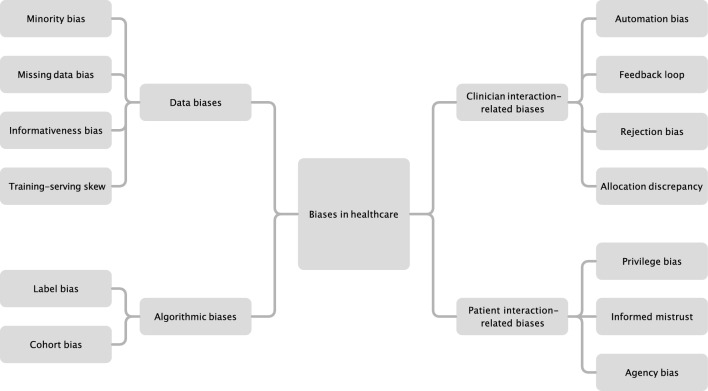
- Data biases include minority bias, missing data bias, informativeness bias, and training–serving skew; algorithmic biases include label bias and cohort bias. Examples include cardiovascular risk algorithms trained primarily on male patient data, a pneumonia chest X-ray model performing better on internal than external data, and a commercial healthcare-needs algorithm using cost as a proxy that underestimated the needs of Black patients.
- Mitigation strategies include diverse and representative data, independent algorithm audits and validation, and education for clinicians and patients; ethical/legal considerations include data privacy and security, liability and accountability, and transparency and explainability.
- The FAIR statement contains 10 recommendations: diverse data; independent audits; education; privacy/security; liability/accountability; transparency/explainability; collaboration between physicians, AI researchers, and developers; policymaker/regulatory involvement; patient/advocacy group participation; and professional association support.
Methods
- Narrative review; no systematic search strategy, inclusion criteria, data extraction, or quantitative synthesis is described.
- Synthesizes prior literature and examples across healthcare and radiology AI fairness; no original dataset, sample, or empirical analysis is reported.
- Main output is a conceptual framework and the FAIR recommendations.
Limitations
- The paper states that implementing each best practice is difficult, AI technology is still evolving with new challenges, explainable AI has limitations such as confirmation bias, and independent bias research is difficult because large-scale deployed algorithms are generally proprietary.
- Evident from the text: as a narrative review, it lacks a systematic search and quality appraisal and does not empirically test the FAIR recommendations; no original quantitative evidence is reported.
Model-written summary. Check it against the paper before relying on it.
Integrity signals
Registry
Cites
Statistics
Figures
Verification
Claims the paper makes
8 Valid · 0 Not valid · 34 Not checked · 13 Own results and interpretations
The cited sources support only part of this claim — read each source’s verdict below.
In the paper
“Another bias related to interactions is the feedback loop [80]. This occurs when clinicians accept AI recommendations even if they are incorrect, leading the algorithm to relearn and perpetuate the same mistakes.”
§ Fairness of artificial intelligence in healthcare: review and recommendations > Fairness concerns in healthcare > Clinician interaction-related biases
What the sources say
- Partly supportedcites [80] Walsh CG Chaudhry B Dua P Goodman KW Kaplan B Kavuluru R Stigma, biomarkers, and algorithmic bias: recommendations for precision behavioral health with artificial intelligence JAMIA Open 2020 3 9 15 10.1093/jamiaopen/ooz054 32607482 PMC7309258 sourceExperimental — accuracy not yet measured
Our copy does identify a 'harmful feedback loop' as a critical issue in algorithmic bias (CHALLENGES > Potential for algorithmic bias), but the mechanism it describes is different from the claim's: existing disparities lead to unrepresentative training data, bias seeps into predictive models, and biased predictions further exacerbate disparities — not clinicians accepting incorrect AI recommendations which the algorithm then relearns. The paper's closest related point is the recommendation that users have channels to disagree with recommendations so algorithms and designers can learn from those disagreements (RECOMMENDATIONS > Foster trust through education and transparency), plus a warning that providers 'might feel compelled to respond' to high-risk designations (CHALLENGES > Inappropriate use, interpretability/explainability, and trust); neither states the relearning/perpetuation loop the citing sentence attributes. So the existence of a feedback-loop bias is supported while the specific clinician-over-reliance mechanism is not. (LLM, conf=0.70)
plainstates a cause- Asserted: passes — The authors put it forward as true.
- Checkable: passes — It can be checked against evidence.
- Load-bearing: unclear — It is unclear whether the paper’s conclusions depend on it.
- Based: passes — The paper gives a reason why it holds.
- Partly supported
The cited sources support only part of this claim — read each source’s verdict below.
In the paper
“In a study training AI to diagnose pneumonia from chest X-rays, the performance on unseen data from the institution where the training data were collected was significantly higher than its performance on data collected from external hospitals [72].”
§ Fairness of artificial intelligence in healthcare: review and recommendations > Fairness concerns in healthcare > Data biases
What the sources say
- Partly supportedcites [72] Zech JR Badgeley MA Liu M Costa AB Titano JJ Oermann EK Variable generalization performance of a deep learning model to detect pneumonia in chest radiographs: a cross-sectional study PLOS Med 2018 10.1371/journal.pmed.1002683 30399157 PMC6219764 sourceExperimental — accuracy not yet measured
Split into 2 atoms — 1 confirmed, 1 partially supported, 0 disputed, 0 misattributed, 0 unverifiable. Expand the claim to see per-atom verdicts.
plainstates an association- Asserted: passes — The authors put it forward as true.
- Checkable: passes — It can be checked against evidence.
- Load-bearing: passes — The paper’s conclusions depend on it.
- Based: passes — The paper gives a reason why it holds.
- Partly supported
None of the sources cited for this claim have been checked yet.
In the paper
“For example, identifying melanoma from images of patients with dark skin is more challenging than those with light skin [70, 71].”
§ Fairness of artificial intelligence in healthcare: review and recommendations > Fairness concerns in healthcare > Data biases
What the sources say
- Not checked yetcites [70] Adamson AS Smith A Machine learning and health care disparities in dermatology JAMA Dermatol 2018 154 1247 1248 10.1001/jamadermatol.2018.2348 30073260 source
- Could not verifycites [71] Navarrete-Dechent C Dusza SW Liopyris K Marghoob AA Halpern AC Marchetti MA Automated dermatological diagnosis: hype or reality? J Invest Dermatol 2018 138 2277 2279 10.1016/j.jid.2018.04.040 29864435 PMC7701995 sourceExperimental — accuracy not yet measured
The main text (page unavailable) reports differences in algorithm performance between Asian and Caucasian datasets, but does not say which performed better or compare dark and light skin. Its melanoma test used images only from Caucasian patients. A search for a dark-versus-light-skin comparison found no passage supporting the claimed direction of difficulty. (LLM, conf=0.74)
plainstates an association- Asserted: passes — The authors put it forward as true.
- Checkable: passes — It can be checked against evidence.
- Load-bearing: unclear — It is unclear whether the paper’s conclusions depend on it.
- Based: passes — The paper gives a reason why it holds.
Every source the paper cites for this claim was checked and supports it.
In the paper
“For example, significant racial bias has been observed in commercially available algorithms used to predict patients' healthcare needs.”
§ Fairness of artificial intelligence in healthcare: review and recommendations > Fairness concerns in healthcare > Algorithmic biases
What the sources say
- Supportedcites [76] Obermeyer Z Powers B Vogeli C Mullainathan S Dissecting racial bias in an algorithm used to manage the health of populations Science 2019 366 447 453 10.1126/science.aax2342 31649194 source
The paper states on p. 2 that a widely used commercial prediction algorithm for identifying patients with complex health needs exhibits significant racial bias. The citing sentence presents this as an example, rather than claiming that the paper tested every commercial algorithm. (LLM, conf=0.92)
plainstates an association- Asserted: passes — The authors put it forward as true.
- Checkable: passes — It can be checked against evidence.
- Load-bearing: passes — The paper’s conclusions depend on it.
- Based: passes — The paper gives a reason why it holds.
- Supported
The cited sources support only part of this claim — read each source’s verdict below.
In the paper
“When healthcare professionals interact with AI, biases related to interactions can occur, potentially affecting the algorithm's performance, fairness, and adoption [11].”
§ Fairness of artificial intelligence in healthcare: review and recommendations > Fairness concerns in healthcare > Clinician interaction-related biases
What the sources say
- Partly supportedcites [11] Rajkomar A Hardt M Howell MD Corrado G Chin MH Ensuring fairness in machine learning to advance health equity Ann Intern Med 2018 169 866 872 10.7326/M18-1990 30508424 PMC6594166 sourceExperimental — accuracy not yet measured
In “What Can Cause a Machine-Learning System to Be Unfair?” (page unavailable), the paper describes automation and dismissal biases when clinicians trust or ignore model predictions, and says these interactions can affect patient outcomes and resource allocation. It does not say those interactions change the algorithm’s predictive performance or address their effect on AI adoption. (LLM, conf=0.86)
plainstates a possible cause- Asserted: passes — The authors put it forward as true.
- Checkable: passes — It can be checked against evidence.
- Load-bearing: passes — The paper’s conclusions depend on it.
- Based: passes — The paper gives a reason why it holds.
- Partly supported
9 more claims
Create a free account to see all 55 claims and to verify the 54 references still open.
- Probably not a substantial claim. 31
- It may state two separate claims as one. 24
Claims other papers make about this one
Each is checked against this paper’s own text: does it say what the citing paper says it does?
The source backs part of the claim, not all of it — or backs it for a different population, condition or comparison.
In the citing paper
“This deployment bias has been shown to lead to the dismissal of appropriate critical warnings, with potential risk of patient harm47,49.”
From Bias recognition and mitigation strategies in artificial intelligence healthcare applications (2025) · cites this paper as [49]
Experimental — accuracy not yet measuredThe source backs part of the claim, not all of it — or backs it for a different population, condition or comparison.
In the citing paper
“Studies27,29,30,42 provide empirical evidence that GenAI tools can significantly improve clinical accuracy, workflow efficiency, and decision-support capacity when implemented under structured supervision.”
From Generative Artificial Intelligence in Healthcare: Automation Bias, Deskilling, and Cognitive Implications – A Systematic Review (2026) · cites this paper as [30]
Experimental — accuracy not yet measuredThe source backs part of the claim, not all of it — or backs it for a different population, condition or comparison.
In the citing paper
“Systematic reviews of AI fairness in healthcare have demonstrated that models trained on demographically skewed datasets can produce reduced accuracy and exacerbate health disparities in underrepresented groups412.”
From Artificial intelligence-driven multi-omics approaches in Alzheimer's disease: Progress, challenges, and future directions (2025) · cites this paper as [412]
Experimental — accuracy not yet measuredThe source backs part of the claim, not all of it — or backs it for a different population, condition or comparison.
In the citing paper
“Governance frameworks that incorporate ethics boards and patient advocacy representatives throughout the development lifecycle also play a critical role in ensuring transparency, addressing algorithmic bias, and promoting equitable use of AI systems412.”
From Artificial intelligence-driven multi-omics approaches in Alzheimer's disease: Progress, challenges, and future directions (2025) · cites this paper as [412]
Experimental — accuracy not yet measuredThe source backs part of the claim, not all of it — or backs it for a different population, condition or comparison.
In the citing paper
“However, many of these guidelines neglect the importance of addressing bias at multiple stages of model development.”
From Advancing Health Equity through Multi-Level Fairness in Health Informatics (2026) · cites this paper as [7]
Experimental — accuracy not yet measured
2 more claims about this paper
Create a free account to see every claim other papers make about this one.
Citations
Cites
Meyer, I. H. (2003) · Psychological Bulletin · doi:10.1037/0033-2909.129.5.674 · Cited by 14,736
Arrieta, A. B., Díaz-Rodríguez, N., Del Ser, J., Bennetot, A., Tabik, S., Barbado, A., García, S., Gil-López, S., Molina, D., Benjamins, R., et al. (2019) · arXiv · doi:10.48550/arxiv.1910.10045 · Cited by 11,321 · cited 1×
“Fostering transparency and account‑ ability in AI is also an important aspect of their respon‑ sibilities [5, 116].”
BackgroundRudin, C. (2019) · Nature Machine Intelligence · doi:10.1038/s42256-019-0048-x · Cited by 10,561
High-performance medicine: the convergence of human and artificial intelligence
Topol, E. J. (2019) · Nature Medicine · doi:10.1038/s41591-018-0300-7 · Cited by 10,450 · cited 1×
“Collaboration among physicians, AI researchers, and AI developers is essential to address fairness concerns in AI [108, 110].”
BackgroundBarredo Arrieta, A., Díaz-Rodríguez, N., Del Ser, J., Bennetot, A., Tabik, S., Barbado, A., Garcia, S., Gil-Lopez, S., Molina, D., Benjamins, R., et al. (2020) · Information Fusion · doi:10.1016/j.inffus.2019.12.012 · Cited by 10,423 · cited 1×
“Fostering transparency and account‑ ability in AI is also an important aspect of their respon‑ sibilities [5, 116].”
BackgroundDissecting racial bias in an algorithm used to manage the health of populations
Obermeyer, Z., Powers, B., Vogeli, C., & Mullainathan, S. (2019) · Science · doi:10.1126/science.aax2342 · Cited by 7,137 · cited 2×
“Although several biases were affected, a major contributing factor to this algorithm’s bias was its design, which used cost as a proxy for healthcare needs, leading to an underestimation of the needs of Black patients compared with those who are White with similar conditions [76].”
BackgroundThe global landscape of AI ethics guidelines
Jobin, A., Ienca, M., & Vayena, E. (2019) · Nature Machine Intelligence · doi:10.1038/s42256-019-0088-2 · Cited by 6,220 · cited 1×
“This will ensure that AI systems can better recognize, diagnose, and treat a wide range of patient conditions, reducing disparities and promoting equity in healthcare outcomes 2.”
BackgroundA Survey on Bias and Fairness in Machine Learning
Mehrabi, N., Morstatter, F., Saxena, N., Lerman, K., & Galstyan, A. (2022) · ACM Computing Surveys · doi:10.1145/3457607 · Cited by 5,812
A Survey on Bias and Fairness in Machine Learning
Mehrabi, N., Morstatter, F., Saxena, N., Lerman, K., & Galstyan, A. (2019) · arXiv · doi:10.48550/arxiv.1908.09635 · Cited by 5,812
Lipton, Z. C. (2018) · Queue · doi:10.1145/3236386.3241340 · Cited by 5,427 · cited 1×
“However, recognizing the limitations of explainability is important [104–107].”
Background
Research works printed but not linked: 4
- Binns R. Fairness in machine learning: Lessons from political philosophy. In: Friedler SA, Wilson C, editors. Proceedings of the 1st conference on fairness, accountability and transparency. PMLR; 2018. p. 149–59
- Minkler M, Wallerstein N. Community-based participatory research for health: From process to outcomes. John Wiley & Sons; 2011
- Buolamwini J, Gebru T. Gender shades: Intersectional accuracy disparities in commercial gender classification. In: Friedler SA, Wilson C, editors. Proceedings of the 1st conference on fairness, accountability and transparency. PMLR; 2018. p. 77–91
- Coulter A Collins A Making shared decision-making a reality: No decision about me, without me 2011 London The King’s Fund 621
Cited by
Items 201–300 of 728
Imran, M., & Lee, Y. (2026) · IEEE Access · doi:10.1109/access.2026.3656368 · Cited by 15
“Healthcare-focused fairness studies provide actionable guidance, including demographic-parity assessments, continuous bias surveillance, and culturally sensitive explanations to support equitable use across populations [100].”
InfluentialUngureanu, A., Matei, S.-C., & Malita, D. C. (2025) · Diagnostics · doi:10.3390/diagnostics15020230 · Cited by 11
“In this way, trust in AI systems is ensured, patient autonomy is maintained, and statutory ethical and legal standards are adhered to [62].”
InfluentialRamesh, D., Manickavel, P., Ghosh, S., & Bhat, M. (2025) · Journal of Clinical and Experimental Hepatology · doi:10.1016/j.jceh.2025.102611 · Cited by 11
AI in Healthcare for Resource Limited Settings: An Exploration and Ethical Evaluation
Zhao, R. C., & Yuan, X. (2025) · International World Wide Web Conference (WWW) · doi:10.1145/3701716.3717747 · Cited by 13
Motegi, M., Shino, M., Kuwabara, M., Takahashi, H., Matsuyama, T., Tada, H., Hagiwara, H., & Chikamatsu, K. (2025) · Scientific Reports · doi:10.1038/s41598-025-06769-1 · Cited by 10
Mechael, P. (2025) · Women s Health Nursing · doi:10.4069/whn.2025.06.25 · Cited by 10
Artificial intelligence in prostate cancer
Li, W., Hu, R., Zhang, Q., Yu, Z., Deng, L., Zhu, X., Xia, Y., Song, Z., Cimadamore, A., Chen, F., et al. (2025) · Chinese Medical Journal · doi:10.1097/cm9.0000000000003689 · Cited by 11
Human-in/on-the-Loop Design for Human Controllability
Cheruvu, R. (2025) · Springer eBooks · doi:10.1007/978-981-97-8440-0_75-1 · Cited by 12
Deng, W., Zhang, L., Yue, J.-R., & Huang, X.-L. (2026) · Frontiers in Public Health · doi:10.3389/fpubh.2025.1691682 · Cited by 11
Consorti, G., Catarzi, L., Frosolini, A., Vaira, L. A., Committeri, U., & Cirignaco, G. (2026) · International Journal of Oral and Maxillofacial Surgery · doi:10.1016/j.ijom.2026.02.020 · Cited by 12
Divergent impacts of explainable AI for dermatological diagnosis on clinicians versus lay people
Xu, X., Hu, H.-Y., Zhang, H., Wang, W., Wang, R., Soenksen, L., Badri, O., Jafry, S., Burger, E., Nwandu, L., et al. (2026) · Nature Medicine · doi:10.1038/s41591-026-04553-w · Cited by 3
“4e and Supplementary Table 29), which could result from a lower level of critical thinking ( P = 0.028, measured by critical thinking questionnaire 36 ; see details in Methods).”
InfluentialJain, H., Marsool, M. D. M., Odat, R. M., Noori, H., Jain, J., Shakhatreh, Z., Patel, N., Goyal, A., Gole, S., & Passey, S. (2024) · Cardiology in Review · doi:10.1097/crd.0000000000000708 · Cited by 12
Thieme, A., Rajamohan, A., Cooper, B., Groombridge, H., Simister, R., Wong, B., Woznitza, N., Pinnock, M. A., Wetscherek, M. T., Morrison, C., et al. (2024) · arXiv · doi:10.48550/arxiv.2405.05299 · Cited by 10
Zalewa, K., Olszak, J., Kapłan, W., Orłowska, D., Bartoszek, L., Kaus, M., & Klepacz, N. (2025) · Journal of Education Health and Sport · doi:10.12775/jehs.2025.77.56893 · Cited by 13
An AI-based system for fully automated knee alignment assessment in standard AP knee radiographs
Cullen, D., Thompson, P. L., Johnson, D. S., & Lindner, C. (2025) · The Knee · doi:10.1016/j.knee.2025.02.013 · Cited by 9
Wang, H., Sambamoorthi, N., Hoot, N. R., Bryant, D., & Sambamoorthi, U. (2025) · PLOS Digital Health · doi:10.1371/journal.pdig.0000751 · Cited by 13
“[16,17] In our study, we developed an XGBoost ML prediction model, and our initial performance evaluation indicated the overall acceptable feasibility and reliability of using the model to predict prolonged wait times in the ED.”
Artificial Intelligence in Nephrology: Pioneering Precision with Multimodal Intelligence
Jayaraman, P., Vasudev, I., Bhardwaj, A., Nadkarni, G. N., Sakhuja, A., & Meena, P. (2025) · Indian Journal of Nephrology · doi:10.25259/ijn_496_2024 · Cited by 11
“70,72,73 Real-time trial adjustments using AI-driven analytics.”
Cautious optimism: public voices on medical AI and sociotechnical harm
Townsend, B., Hodge, J., Richardson, H., Călinescu, R., & Arvind, T. (2025) · Frontiers in Digital Health · doi:10.3389/fdgth.2025.1625747 · Cited by 11
Dehghani, F., de Paiva, P. V. V., Malik, N., Lin, J., Bayat, S., & Bento, M. (2025) · Information and Software Technology · doi:10.1016/j.infsof.2025.107896 · Cited by 10
Conscious artificial intelligence in service
Breidbach, C. F., Ferm, L. C., Maglio, P. P., Beverungen, D., Wirtz, J., & Twigg, A. (2025) · Journal of service management · doi:10.1108/josm-12-2024-0536 · Cited by 10
Garcia-Bañol, D. F., Arias-Choles, A. M., Aldana-Pérez, S. E., Aroca, G., Musso, C. G., Quiroz, R. N., Domínguez-Vargas, A., & González-Torres, H. J. (2025) · Frontiers in Medicine · doi:10.3389/fmed.2025.1686057 · Cited by 9
Artificial superintelligence alignment in healthcare
Ueda, D., Walston, S. L., Kurokawa, R., Saida, T., Honda, M., Iima, M., Watabe, T., Yanagawa, M., Nishioka, K., Sofue, K., et al. (2025) · Japanese Journal of Radiology · doi:10.1007/s11604-025-01907-1 · Cited by 10
“The principle of informed consent, fundamental to medical ethics, extends naturally to AI-assisted care [ 25 , 42 , 55 ].”
InfluentialSelf-citationAI-based neoadjuvant immunotherapy response prediction across pan-cancer: a comprehensive review
Deng, Y., Li, T., Wang, Y., Chen, S., Tang, F., Zhu, T., Ran, J., Yang, B., Zhang, X., Xu, R., et al. (2025) · Cancer Cell International · doi:10.1186/s12935-025-04063-8 · Cited by 12
“Moreover, biases in data collection, such as disparities in imaging quality between well-funded and resource-limited healthcare settings, can further exacerbate these issues [271, 272].”
Artificial intelligence in pulmonary hypertension: a systematic review
Kramer, T., Krämer, M., Hagist, C., & Spinler, S. (2025) · European journal of medical research · doi:10.1186/s40001-025-03557-5 · Cited by 9
“These challenges require collaborative strategies, including representative data selection and transparent model auditing [82].”
Cavallucci, M., Andalò, A., Danesi, V., Gentili, N., Massa, I., Scarpi, E., Restuccia, M., Vespignani, R., Conficconi, A., Palleschi, M., et al. (2025) · International Journal of Medical Informatics · doi:10.1016/j.ijmedinf.2025.106237 · Cited by 10
Trustworthy AI in digital health: a comprehensive review of robustness and explainability
Mamun, A., Soumma, S. B., & Ghasemzadeh, H. G. (2026) · Progress in Biomedical Engineering · doi:10.1088/2516-1091/ae4e74 · Cited by 12
Ueda, D., Walston, S. L., Takita, H., Mitsuyama, Y., & Miki, Y. (2024) · Japanese Journal of Radiology · doi:10.1007/s11604-024-01716-y · Cited by 9
“This collaborative approach is particularly crucial in healthcare, where diverse patient populations and varying clinical contexts require robust solutions that can only emerge from extensive testing and refinement across multiple research groups [4].”
Self-citationHoriuchi, D., Tatekawa, H., Oura, T., Oue, S., Walston, S. L., Takita, H., Matsushita, S., Mitsuyama, Y., Shimono, T., Miki, Y., et al. (2023) · medRxiv · doi:10.1101/2023.08.28.23294607 · Cited by 9
“Artificial intelligence has already been applied to clinical applications in the field of radiology, showing remarkable benefits [6-8].”
BackgroundSelf-citationEmploying large language models safely and effectively as a practicing neurosurgeon
Patil, A., Serrato, P., Cleaver, G., Limbania, D., See, A. P., & Huang, K. T. (2025) · Acta Neurochirurgica · doi:10.1007/s00701-025-06515-6 · Cited by 9
A Comparative Study of Supervised and Unsupervised Learning Approaches
(2025) · IMRJR · doi:10.17148/imrjr.2025.020411 · Cited by 10
Deiner, M. S., Deiner, R. Y., Fathy, C. A., Deiner, N. A., Hristidis, V., McLeod, S. D., Bukowski, T., Doan, T. A., Seitzman, G. D., Lietman, T. M., et al. (2025) · Journal of Medical Internet Research · doi:10.2196/65226 · Cited by 9
“The application of AI in public health surveillance, while promising, raises important ethical considerations that warrant careful attention [80-82].”
Representation of Demographics in Otolaryngology by Artificial Intelligence Text‐to‐Image Platforms
Shaari, A. L., Saad, A. M., Patel, A. M., & Filimonov, A. (2025) · Laryngoscope Investigative Otolaryngology · doi:10.1002/lio2.70152 · Cited by 8
Harnessing machine learning for improved diagnosis, drug discovery, and patient care
Paul, J. K., Azmal, M., Talukder, O. F., Haque, A. S. N. B., Meem, M., & Ghosh, A. (2025) · Computational and Structural Biotechnology Reports · doi:10.1016/j.csbr.2025.100051 · Cited by 10
Domain adaptive FL for edge-enabled privacy-preserving MRI analysis
Iqbal, S., Choudhry, I. A., Ullah, I., Kaur, K., Choi, B. J., & Hassan, M. M. (2025) · Alexandria Engineering Journal · doi:10.1016/j.aej.2025.05.007 · Cited by 8
Kim, P. E., Ha, S. Y., Lee, M., Kim, N., Ryu, W., Sunwoo, L., Kim, B. J., & Kim, B. J. (2025) · Journal of Clinical Neurology · doi:10.3988/jcn.2024.0560 · Cited by 8
Sakata, A., Fushimi, Y., Oshima, S., Uto, M., Mineharu, Y., Nakajima, S., Okuchi, S., Yamamoto, T., Otani, S., Ikeda, S., et al. (2025) · Japanese Journal of Radiology · doi:10.1007/s11604-025-01821-6 · Cited by 11
Self-citationAssessing AI-Driven Personalization in Smart Cities Using Hybrid Machine Learning and MCDM Approach
Faisal, M., Sahabuddin, Hasiri, E. M., Darniati, D., Rahman, T. K. A., Ida, I., Asrul, B. E. W., Wahyuni, S., & Widia, I. D. M. (2025) · HighTech and Innovation Journal · doi:10.28991/hij-2025-06-03-03 · Cited by 9
Mansouri, O., Yusuf, N., & Kooli, C. (2025) · Next research. · doi:10.1016/j.nexres.2025.101087 · Cited by 10
Large language models in obesity: a systematic review
Suenghataiphorn, T., Tribuddharat, N., Danpanichkul, P., & Kulthamrongsri, N. (2025) · International Journal of Obesity · doi:10.1038/s41366-025-01992-2 · Cited by 8
Wang, X., Wang, Q., Ding, G., Wang, J., Tang, Y., & Feng, Y. (2026) · iScience · doi:10.1016/j.isci.2026.114627 · Cited by 12
Artificial intelligence in Traditional Chinese Medicine herbs: a survey
Wu, J., He, Q., Yang, D., Cai, Y., Zhang, J., Lü, X., & Zhu, H. (2026) · Artificial Intelligence Review · doi:10.1007/s10462-026-11513-w · Cited by 9
Dimitri, P., van Dommelen, P., Banerjee, I., Bellazzi, R., Ciaccio, M., Muñoz, A. D. A., Loche, S., Zaini, A. A., Halabi, A., Bagha, M., et al. (2024) · Frontiers in Endocrinology · doi:10.3389/fendo.2024.1436778 · Cited by 9
Hatabu, H., Yanagawa, M., Yamada, Y., Hino, T., Yamasaki, Y., Hata, A., Ueda, D., Nakamura, Y., Ozawa, Y., Jinzaki, M., et al. (2025) · Japanese Journal of Radiology · doi:10.1007/s11604-025-01735-3 · Cited by 8
“However, careful validation through larger, prospective studies remains essential to establish the clinical utility of these novel applications [82].”
Self-citationDonkor, A., Kumi, D., Amponsah, E., & Atuwo-Ampoh, V. D. (2025) · Radiography · doi:10.1016/j.radi.2025.102953 · Cited by 8
FAIR: a recipe for ensuring fairness in healthcare artificial intelligence
Yoshiura, T., & Kiryu, S. (2023) · Japanese Journal of Radiology · doi:10.1007/s11604-023-01478-z · Cited by 8
A Systematic Review of Predictive Analytics Applications in Early Disease Detection and Diagnosis
Independent Researcher, R., Kolawole, T. O., Mustapha, A. Y., Kwara State Ministry of Health, N., Mbata, A. O., Kaybat Pharmacy and Stores, B., Tomoh, B. O., Independent Researcher, C., Forkuo, A. Y., Independent Researcher, U., et al. (2025) · Engineering and Technology Journal · doi:10.47191/etj/v10i03.35 · Cited by 8
Ethical and Legal Considerations of Medical Artificial Intelligence
Montalbano, P. (2025) · Primary Care Clinics in Office Practice · doi:10.1016/j.pop.2025.07.009 · Cited by 8
Eskandar, K. (2025) · Revista Española de Cirugía Ortopédica y Traumatología · doi:10.1016/j.recot.2025.09.005 · Cited by 8
The double-edged sword: artificial intelligence’s promise and perils in anesthesia patient safety
Maloney, J. A., Johnson, B. W., & Harbell, M. W. (2025) · Current Opinion in Anaesthesiology · doi:10.1097/aco.0000000000001580 · Cited by 8
The role of artificial intelligence in sarcopenia: Advances, applications, and future directions
Yousaf, M. W., Nadeem, A. H., Nadeem, M. F., & Qaisar, R. (2026) · Computational Biology and Chemistry · doi:10.1016/j.compbiolchem.2026.108930 · Cited by 7
ATEŞ, A. Y., & ÇETİN, G. (2026) · Public Health Nursing · doi:10.1111/phn.70080 · Cited by 7
Chen, H., Alfred, M. C., Brown, A. D., Atinga, A., & Cohen, E. (2024) · JMIR Formative Research · doi:10.2196/59045 · Cited by 8
“Besides interpretability and performance, fairness is another important dimension when considering adopting deep learning–based diagnostic tools for detecting CXR pathologies [31,32].”
Assessing Bias in Large Language Models: A Comparative Study of ChatGPT, Gemini, and Claude
Shetty, P., Rao, V. S., & N., M. S. (2024) · International Conference on Modeling, Simulation & Intelligent Computing (MoSICom) · doi:10.1109/mosicom63082.2024.10881888 · Cited by 9
Nozaki, T., Hashimoto, M., Ueda, D., Fujita, S., Fushimi, Y., Kamagata, K., Matsui, Y., Ito, R., Tsuboyama, T., Tatsugami, F., et al. (2025) · La radiologia medica · doi:10.1007/s11547-024-01947-z · Cited by 7
Self-citationEthical insights into AI-driven caries detection: a scoping review
Yousuf, T., Khan, M., & Ghafoor, R. (2025) · BDJ Open · doi:10.1038/s41405-025-00366-0 · Cited by 7
Datta, D., Ray, S., Martinez, L. A., Newman, D. M., Dalmida, S. G., Hashemi, J., Sareli, C., & Eckardt, P. (2024) · Diagnostics · doi:10.3390/diagnostics14171866 · Cited by 9
“Re-designing the prospective study may help eliminate ‘patient selection’, ‘patient interaction’, and ‘clinician reporting’ biases [74].”
BackgroundAl-Anezi, F. M. (2026) · Journal of Healthcare Leadership · doi:10.2147/jhl.s590498 · Cited by 6
“Beheshti et al 34 proposed an Adjusted Accuracy Metric to standardize LLM performance evaluations, whereas Ueda et al 30 and Yu et al 27 advocated for adaptive calibration systems that customize AI support to clinician proficiency.”
Vrettos, K., Giouroukou, K., Isaac, A., Raissaki, M., & Klontzas, M. E. (2025) · Pediatric Radiology · doi:10.1007/s00247-025-06497-8 · Cited by 7
Zhang, Y., Kirchler, T., & Wang, A. (2026) · Journal of Medical Systems · doi:10.1007/s10916-026-02376-3 · Cited by 7
Billingsley, L., Calderon, A., & Agosta, L. J. (2024) · Journal of Radiology Nursing · doi:10.1016/j.jradnu.2024.04.002 · Cited by 6
Leveraging Synthetic Data as a Tool to Combat Bias in Artificial Intelligence (AI) Model Training
Fabuyi, J. A. (2024) · Journal of Engineering Research and Reports · doi:10.9734/jerr/2024/v26i121337 · Cited by 8
Innovative AI Solutions for Mental Health: Bridging Detection and Therapy
Zainab, H., Khan, A. R. A., Khan, M. I., & Arif, A. (2025) · Global Journal of Emerging AI and Computing · doi:10.70445/gjeac.1.1.2025.51-58 · Cited by 19
Chaotic gradient based optimization with fuzzy temporal optimized CNN for heart failure prediction
Kumar, G., & Muthurajkumar, S. (2025) · Scientific Reports · doi:10.1038/s41598-025-88277-w · Cited by 6
Saxena, S., Gisselbaek, M., Berger‐Estilita, J., & Rubulotta, F. M. (2025) · Anesthesia & Analgesia · doi:10.1213/ane.0000000000007471 · Cited by 6
Artificial Intelligence perspectives in advancing Persian Herbal Medicine: A systematic review
Soltani, S., Khodaie, L., & Surana, V. (2025) · Advances in Integrative Medicine · doi:10.1016/j.aimed.2025.03.001 · Cited by 7
Feng, C. H., Deng, F., Disis, M. L., Gao, N., & Zhang, L. (2025) · Briefings in Bioinformatics · doi:10.1093/bib/bbaf398 · Cited by 7
“Indeed, data sources and recruiting more patients of race, age-and gender-minority have been recommended [45–48].”
Biswas, R. (2024) · IntechOpen eBooks · doi:10.5772/intechopen.1007466 · Cited by 7
Regulatory Insights in Digital Health
Bharadwaj, M. S. (2024) · Advances in healthcare information systems and administration book series · doi:10.4018/979-8-3693-0928-5.ch006 · Cited by 6
Kamagata, K., & Naganawa, S. (2024) · Japanese Journal of Radiology · doi:10.1007/s11604-024-01580-w · Cited by 6
Self-citationRole of Artificial Intelligence in Nanomedicine and Organ-specific Therapy: An Updated Review
Rajpoot, K. (2025) · Current Drug Targets · doi:10.2174/0113894501394785250715165404 · Cited by 5
Khalifa, A., & Hussein, R. (2026) · Journal of Medical Systems · doi:10.1007/s10916-026-02391-4 · Cited by 5
Kurokawa, R., Hagiwara, A., Ueda, D., Ito, R., Saida, T., Honda, M., Nishioka, K., Sakata, A., Yanagawa, M., Takumi, K., et al. (2025) · La radiologia medica · doi:10.1007/s11547-025-02078-9 · Cited by 5
Self-citationTowards a transparent and interpretable AI model for medical image classifications
Wen, B., Wu, Y., Daqqaq, T. S., & Chaddad, A. (2025) · Cognitive Neurodynamics · doi:10.1007/s11571-025-10343-w · Cited by 7
“Nevertheless, transparency and predictive ability are usually not a trade-off, so it is not an excellent choice to blindly improve the transparency of the model [122].”
Oncology in the AI Era: Transforming Cancer Care Through Intelligent Diagnosis and Treatment
Joshi, S. G., Nadaf, H. K., Jabade, M., & Pimpalekar, S. (2025) · Springer eBooks · doi:10.1007/978-3-031-94302-7_42 · Cited by 7
Advancing Medicinal Plant Research with Artificial Intelligence: Key Applications and Benefits
Ydyrys, A., Nurtayeva, M., & Yerkebayeva, M. (2025) · Natural Resources for Human Health · doi:10.53365/nrfhh/206025 · Cited by 6
“To guarantee fair access to these developments in healthcare, ethical issues pertaining to data privacy and the possibility of bias in AI algorithms must also be resolved (Ueda et al., 2024).”
Artificial Intelligence-Based Methods and Omics for Mental Illness Diagnosis: A Review
de Oliveira, G. S., Rodrigues, F. H. D. S., Pontes, J. G. D. M., & Tasić, L. (2025) · Bioengineering · doi:10.3390/bioengineering12101039 · Cited by 9
“Clinicians, psychologists, and counsellors are more likely to adopt AI as a diagnostic assistant when they understand how a model arrives at its conclusions, enhancing and supporting human decision-making [36,37].”
Patient safety in AI-powered diagnostic pathology
Rugge, M., Fraschini, M., Orvieto, E., Didaci, L., Sandonà, L., D’Amuri, A., Saba, L., & Faa, G. (2025) · Journal of Clinical Pathology · doi:10.1136/jcp-2025-210231 · Cited by 6
The dangers of AI friendship: Adolescent mental health and ethical oversight
Katoch, H., & Sandhu, D. (2025) · Elsevier eBooks · doi:10.1016/b978-0-443-41660-6.00016-8 · Cited by 5
Kaur, A. P., Cherukuri, S. P., Handral, M. S., Kukunoor, H. R., Kc, R., Godugu, S., Lee, J., Yerrapragada, G., Elangovan, P., Shariff, M. N., et al. (2025) · Journal of Clinical Medicine · doi:10.3390/jcm14238500 · Cited by 8
“AI models trained predominantly on data from specific regions or populations may fail to perform adequately in underrepresented communities [139].”
Zhang, Z., Ma, Y., Xiao, Y., Dai, Y., Lin, Q., Лю, Ч., Wang, C., Tu, T., & Liu, Q. (2025) · Scientific Reports · doi:10.1038/s41598-025-32602-w · Cited by 6
“From a policy perspective, regulatory authorities may consider credentialing standards for AI similar to those for drugs and devices, including model validation, periodic recertification, and post-deployment monitoring for bias or performance degradation 22 .”
Is the public sector Africa’s hidden force for AI-driven healthcare transformation?
Nyamawe, A. S. (2025) · Telematics and Informatics Reports · doi:10.1016/j.teler.2025.100258 · Cited by 7
Enhancing Fairness in Skin Lesion Classification for Medical Diagnosis Using Prune Learning
Paxton, K., Aslansefat, K., Thakker, D., Papadopoulos, Y. I., & Maslekar, T. (2026) · IEEE Journal of Biomedical and Health Informatics · doi:10.1109/jbhi.2026.3652910 · Cited by 7
“…is challenging due to difficulties in classifying skin tones, high computational demands, and the complexity of objectively verifying fairness, given the continuous and context-dependent nature of skin tone and the dependence of fairness conclusions on metric choice and subgroup representation.”
Wenderott, K., Krups, J., & Weigl, M. (2026) · BMJ Open Quality · doi:10.1136/bmjoq-2025-003639 · Cited by 6
Varzideh, F., Pande, S., Jankauskas, S. S., Mone, P., Kansakar, U., & Santulli, G. (2026) · Frontiers in Neuroscience · doi:10.3389/fnins.2026.1788653 · Cited by 6
AI-Driven Healthcare in France
-, R. E. (2024) · International Journal For Multidisciplinary Research · doi:10.36948/ijfmr.2024.v06i03.22936 · Cited by 7
“Stringent data protection standards set by the General Data Protection Regulation (GDPR) impose rigorous constraints on how patient data must be handled, complicating the deployment of AI systems that depend heavily on large-scale data analysis [59].”
BackgroundGadwal, A. N., Cerdas, M. G., Khan, A., Khan, Z., Carluccio, M. D., Nimmagadda, S. P., Rizvi, S. M. A., Aljallawi, S. M., Jaryal, S., Tasgaonkar, N., et al. (2025) · Cureus · doi:10.7759/cureus.79409 · Cited by 5
Ali, S. G., Yang, X., Masood, S., Ghazanfar, Z., Jung, Y., Chen, T., & Wang, X. (2025) · The Visual Computer · doi:10.1007/s00371-025-04024-2 · Cited by 6
Artificial Intelligence in Reconstructive Implant Dentistry—Current Perspectives
Afrashtehfar, K. I., Abuzayeda, M., & Murray, C. A. (2024) · Prosthesis · doi:10.3390/prosthesis6040054 · Cited by 5
“Moreover, ethical considerations, including data privacy and the potential for algorithmic biases [20,21], must be addressed to fully integrate AI into clinical practice.”
BackgroundSingh, S. S. (2025) · Preprints.org · doi:10.20944/preprints202501.0620.v1 · Cited by 8
Ethical Considerations and Bias in AI Applications in Healthcare
Ali, A. (2025) · Information systems engineering and management · doi:10.1007/978-3-031-84404-1_7 · Cited by 6
Hussein, N. S. A., Pradhan, P., Haug, F. W., Moukheiber, D., Moukheiber, L., Moukheiber, M., Moukheiber, S., Weishaupt, L. L., Ellen, J., D’Couto, H. T., et al. (2025) · Frontiers in Medicine · doi:10.3389/fmed.2025.1606254 · Cited by 4
Zafeer, H. M. I., Maqbool, S., & Maqbool, S. (2025) · International Journal of Pharmaceutical and Healthcare Marketing · doi:10.1108/ijphm-04-2025-0042 · Cited by 5
Threshold-Optimized and Calibrated Logistic Regression for Breast Cancer Classification
Watrianthos, R., Rayendra, R., Asri, E., Yuhefizar, Y., & Humaira, H. (2025) · Salud Ciencia y Tecnología · doi:10.56294/saludcyt20252241 · Cited by 8
Delpino, F. M., Pimenta, L. P., Gonzalez, D. F., Victor, A., Araujo, C. F., Araújo‐Moura, K., Miranda, J. J., Batista, S. R., Filho, A. D. P. C., & Nunes, B. P. (2025) · Scientific Reports · doi:10.1038/s41598-025-26714-6 · Cited by 9
Zabala, G., Pruitt, Z. M., Fairbanks, R. J. T., & Ratwani, R. M. (2025) · Journal of Patient Safety · doi:10.1097/pts.0000000000001428 · Cited by 5
Ethical Use of Artificial Intelligence for Processing Medical Images
Fedorchenko, Y., & Zimba, O. (2025) · Journal of Korean Medical Science · doi:10.3346/jkms.2025.40.e341 · Cited by 7
Brown, K. E., Wrenn, J. O., Jackson, N. J., Cauley, M. R., Collins, B. X., Novak, L. L., Malin, B., & Ancker, J. S. (2026) · Journal of the American Medical Informatics Association · doi:10.1093/jamia/ocaf235 · Cited by 5
“12 Of further concern, recent work has shown that clinicians interacting with such systems may perpetuate algorithmic unfairness within their own decision-making by over-relying on the ML system and failing to recognize predictions with and without bias.”
Multimodal Representation Learning for Parsing Biological Heterogeneity in Psychiatric Neuroimaging
Grosenick, L., & Liston, C. M. (2026) · Biological Psychiatry · doi:10.1016/j.biopsych.2026.01.023 · Cited by 5
Yiu, C. H., Lau, E. C. Y., Le, C. T. T., & Lu, C. Y. (2026) · JCO Clinical Cancer Informatics · doi:10.1200/cci-25-00323 · Cited by 5
Pepito, J. A., Babate, F. J., Ismael, J. D., Al‐Jumayile, S. S., & Siddique, M. K. B. (2026) · SAGE Open Nursing · doi:10.1177/23779608261433312 · Cited by 5
Metadata
- Authors
- Ueda, D., Kakinuma, T., Fujita, S., Kamagata, K., Fushimi, Y., Ito, R., Matsui, Y., Nozaki, T., Nakaura, T., Fujima, N., Tatsugami, F., Yanagawa, M., Hirata, K., Yamada, A., Tsuboyama, T., Kawamura, M., Fujioka, T., & Naganawa, S.
- Affiliations
- Osaka Metropolitan University (JP)
- The University of Tokyo (JP)
- Juntendo University (JP)
- Kyoto University (JP)
- Nagoya University (JP)
- Okayama University (JP)
- Keio University (JP)
- Kumamoto University (JP)
- Hokkaido University Hospital (JP)
- Hiroshima University (JP)
- The University of Osaka (JP)
- Hokkaido University (JP)
- Shinshu University (JP)
- Tokyo Medical and Dental University (JP)
- Corresponding author
- Ueda, Daiju
- ORCID
- Venue
- Japanese Journal of Radiology
- Published
- 2023-08-04
- Volume
- 42
- Issue
- 1
- Pages
- 3-15
- ISSN
- 1867-1071 (ISSN-L)
- 1867-108X
- PMC
- PMC10764412
- OpenAlex
- W4385564466
- Semantic Scholar
- a8c6a60f0b44ec06344d6b7a9570369dc3484465
- Cited by
- 607
- References
- 120
- Citations by year
- 2026: 191 · 2025: 267 · 2024: 137 · 2023: 11
- FWCI
- 7.12
- Type
- journal article
- Language
- en
- Open access
- hybrid
- doi.org
- Licence
- cc-by
- creativecommons.org/licenses/by/4.0 (tdm)
- creativecommons.org/licenses/by/4.0 (vor)
- Locations
- Japanese Journal of Radiology (publishedVersion, cc-by)
- PubMed Central (publishedVersion, cc-by)
- PubMed (publishedVersion)
- Institutional Repositories DataBase (IRDB) (submittedVersion, cc-by)
- Kyoto University Research Information Repository (Kyoto University) (submittedVersion, cc-by)
- Topics
- Health Sciences › Medicine › Health Informatics › Artificial Intelligence in Healthcare and Education
- Physical Sciences › Computer Science › Artificial Intelligence › Ethics and Social Impacts of AI
- Physical Sciences › Computer Science › Artificial Intelligence › Explainable Artificial Intelligence (XAI)
- Keywords
- algorithmic fairness, algorithmic bias, artificial intelligence in healthcare, deep learning, radiology, bias mitigation, algorithmic auditing, explainability, transparency, accountability, data privacy, legal and ethical considerations, misdiagnosis
- MeSH terms
- Radiologists, Algorithms, Artificial Intelligence, Delivery of Health Care, Humans, Radiology
About these checks
Registry, retraction, Cites and statistics results are computed, not judged, with one exception: a printed reference that no index lists is read once by a model before it counts as a citation error. Claims are extracted by a model and kept only when their quote appears verbatim in the text; each cited source is then checked, with a model’s help, for whether it says what the claim relies on. Those verdicts can be wrong — read the claim’s quote and the cited source before relying on one.
The claim verdicts this report counts are experimental: their accuracy is not yet measured.
A language model drew the claims from the paper on 2026-10-05, under version 3 of the claim definition (model deepseek-v4.1-flash, prompt extract-v3).
A second model labelled each claim on 2026-10-05 (model jev-1.13-20260917, definition revision gold-guideline-v0.2).
Cited sources are checked with a language model’s help (qwen3.8-omni-flash and gpt-6-sol).
Statistics and arithmetic are recomputed, not judged.
Confidence bands are shown only for fields calibrated on our annotated test set. None is calibrated yet, so no band is shown.
What counts as a claim ›How we measure confidence ›How we check this ›
Are you an author, or do you see a problem with this page? Request a review
Data sources
Bibliographic data: Semantic Scholar, OpenAlex, Crossref.
Contains information from the Semantic Scholar Academic Graph Datasets, made available under the ODC Attribution License (ODC-BY 1.0).
Semantic Scholar’s data is described in: Kinney, R., et al. (2023). The Semantic Scholar Open Data Platform. arXiv:2301.10140.
