

Fairness of artificial intelligence in healthcare: review and recommendations
Open accessThe DOI matches its Crossref record; 128 of the 128 references it cites were found in a registry or an index; 19 of the 73 sources its claims cite were checked for support.
Abstract
In this review, we address the issue of fairness in the clinical integration of artificial intelligence (AI) in the medical field. As the clinical adoption of deep learning algorithms, a subfield of AI, progresses, concerns have arisen regarding the impact of AI biases and discrimination on patient health. This review aims to provide a comprehensive overview of concerns associated with AI fairness; discuss strategies to mitigate AI biases; and emphasize the need for cooperation among physicians, AI researchers, AI developers, policymakers, and patients to ensure equitable AI integration. First, we define and introduce the concept of fairness in AI applications in healthcare and radiology, emphasizing the benefits and challenges of incorporating AI into clinical practice. Next, we delve into concerns regarding fairness in healthcare, addressing the various causes of biases in AI and potential concerns such as misdiagnosis, unequal access to treatment, and ethical considerations. We then outline strategies for addressing fairness, such as the importance of diverse and representative data and algorithm audits. Additionally, we discuss ethical and legal considerations such as data privacy, responsibility, accountability, transparency, and explainability in AI. Finally, we present the Fairness of Artificial Intelligence Recommendations in healthcare (FAIR) statement to offer best practices. Through these efforts, we aim to provide a foundation for discussing the responsible and equitable implementation and deployment of AI in healthcare.
Overview
CoChat Summary
TL;DR
This narrative review examines fairness and bias in clinical artificial intelligence (AI), especially radiology, and proposes the FAIR statement of 10 best-practice recommendations for equitable implementation. It synthesizes sources of bias, mitigation strategies, ethical/legal issues, and stakeholder collaboration, without presenting original empirical data.
Key findings
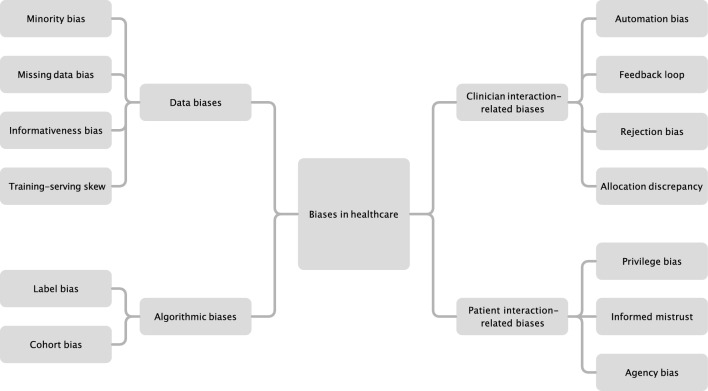
- Fairness in healthcare AI is multidimensional, requiring equitable distribution of resources, opportunities, and outcomes; biases arise from data, algorithms, clinician–AI interactions, and patient–AI interactions.
- Data biases include minority bias, missing data bias, informativeness bias, and training–serving skew; algorithmic biases include label bias and cohort bias. Examples include cardiovascular risk algorithms trained primarily on male patient data, a pneumonia chest X-ray model performing better on internal than external data, and a commercial healthcare-needs algorithm using cost as a proxy that underestimated the needs of Black patients.
- Mitigation strategies include diverse and representative data, independent algorithm audits and validation, and education for clinicians and patients; ethical/legal considerations include data privacy and security, liability and accountability, and transparency and explainability.
- The FAIR statement contains 10 recommendations: diverse data; independent audits; education; privacy/security; liability/accountability; transparency/explainability; collaboration between physicians, AI researchers, and developers; policymaker/regulatory involvement; patient/advocacy group participation; and professional association support.
Methods
- Narrative review; no systematic search strategy, inclusion criteria, data extraction, or quantitative synthesis is described.
- Synthesizes prior literature and examples across healthcare and radiology AI fairness; no original dataset, sample, or empirical analysis is reported.
- Main output is a conceptual framework and the FAIR recommendations.
Limitations
- The paper states that implementing each best practice is difficult, AI technology is still evolving with new challenges, explainable AI has limitations such as confirmation bias, and independent bias research is difficult because large-scale deployed algorithms are generally proprietary.
- Evident from the text: as a narrative review, it lacks a systematic search and quality appraisal and does not empirically test the FAIR recommendations; no original quantitative evidence is reported.
Model-written summary. Check it against the paper before relying on it.
Integrity signals
Registry
Cites
Statistics
Figures
Verification
Claims the paper makes
8 Valid · 0 Not valid · 34 Not checked · 13 Own results and interpretations
The cited sources support only part of this claim — read each source’s verdict below.
In the paper
“Another bias related to interactions is the feedback loop [80]. This occurs when clinicians accept AI recommendations even if they are incorrect, leading the algorithm to relearn and perpetuate the same mistakes.”
§ Fairness of artificial intelligence in healthcare: review and recommendations > Fairness concerns in healthcare > Clinician interaction-related biases
What the sources say
- Partly supportedcites [80] Walsh CG Chaudhry B Dua P Goodman KW Kaplan B Kavuluru R Stigma, biomarkers, and algorithmic bias: recommendations for precision behavioral health with artificial intelligence JAMIA Open 2020 3 9 15 10.1093/jamiaopen/ooz054 32607482 PMC7309258 sourceExperimental — accuracy not yet measured
Our copy does identify a 'harmful feedback loop' as a critical issue in algorithmic bias (CHALLENGES > Potential for algorithmic bias), but the mechanism it describes is different from the claim's: existing disparities lead to unrepresentative training data, bias seeps into predictive models, and biased predictions further exacerbate disparities — not clinicians accepting incorrect AI recommendations which the algorithm then relearns. The paper's closest related point is the recommendation that users have channels to disagree with recommendations so algorithms and designers can learn from those disagreements (RECOMMENDATIONS > Foster trust through education and transparency), plus a warning that providers 'might feel compelled to respond' to high-risk designations (CHALLENGES > Inappropriate use, interpretability/explainability, and trust); neither states the relearning/perpetuation loop the citing sentence attributes. So the existence of a feedback-loop bias is supported while the specific clinician-over-reliance mechanism is not. (LLM, conf=0.70)
plainstates a cause- Asserted: passes — The authors put it forward as true.
- Checkable: passes — It can be checked against evidence.
- Load-bearing: unclear — It is unclear whether the paper’s conclusions depend on it.
- Based: passes — The paper gives a reason why it holds.
- Partly supported
The cited sources support only part of this claim — read each source’s verdict below.
In the paper
“In a study training AI to diagnose pneumonia from chest X-rays, the performance on unseen data from the institution where the training data were collected was significantly higher than its performance on data collected from external hospitals [72].”
§ Fairness of artificial intelligence in healthcare: review and recommendations > Fairness concerns in healthcare > Data biases
What the sources say
- Partly supportedcites [72] Zech JR Badgeley MA Liu M Costa AB Titano JJ Oermann EK Variable generalization performance of a deep learning model to detect pneumonia in chest radiographs: a cross-sectional study PLOS Med 2018 10.1371/journal.pmed.1002683 30399157 PMC6219764 sourceExperimental — accuracy not yet measured
Split into 2 atoms — 1 confirmed, 1 partially supported, 0 disputed, 0 misattributed, 0 unverifiable. Expand the claim to see per-atom verdicts.
plainstates an association- Asserted: passes — The authors put it forward as true.
- Checkable: passes — It can be checked against evidence.
- Load-bearing: passes — The paper’s conclusions depend on it.
- Based: passes — The paper gives a reason why it holds.
- Partly supported
None of the sources cited for this claim have been checked yet.
In the paper
“For example, identifying melanoma from images of patients with dark skin is more challenging than those with light skin [70, 71].”
§ Fairness of artificial intelligence in healthcare: review and recommendations > Fairness concerns in healthcare > Data biases
What the sources say
- Not checked yetcites [70] Adamson AS Smith A Machine learning and health care disparities in dermatology JAMA Dermatol 2018 154 1247 1248 10.1001/jamadermatol.2018.2348 30073260 source
- Could not verifycites [71] Navarrete-Dechent C Dusza SW Liopyris K Marghoob AA Halpern AC Marchetti MA Automated dermatological diagnosis: hype or reality? J Invest Dermatol 2018 138 2277 2279 10.1016/j.jid.2018.04.040 29864435 PMC7701995 sourceExperimental — accuracy not yet measured
The main text (page unavailable) reports differences in algorithm performance between Asian and Caucasian datasets, but does not say which performed better or compare dark and light skin. Its melanoma test used images only from Caucasian patients. A search for a dark-versus-light-skin comparison found no passage supporting the claimed direction of difficulty. (LLM, conf=0.74)
plainstates an association- Asserted: passes — The authors put it forward as true.
- Checkable: passes — It can be checked against evidence.
- Load-bearing: unclear — It is unclear whether the paper’s conclusions depend on it.
- Based: passes — The paper gives a reason why it holds.
Every source the paper cites for this claim was checked and supports it.
In the paper
“For example, significant racial bias has been observed in commercially available algorithms used to predict patients' healthcare needs.”
§ Fairness of artificial intelligence in healthcare: review and recommendations > Fairness concerns in healthcare > Algorithmic biases
What the sources say
- Supportedcites [76] Obermeyer Z Powers B Vogeli C Mullainathan S Dissecting racial bias in an algorithm used to manage the health of populations Science 2019 366 447 453 10.1126/science.aax2342 31649194 source
The paper states on p. 2 that a widely used commercial prediction algorithm for identifying patients with complex health needs exhibits significant racial bias. The citing sentence presents this as an example, rather than claiming that the paper tested every commercial algorithm. (LLM, conf=0.92)
plainstates an association- Asserted: passes — The authors put it forward as true.
- Checkable: passes — It can be checked against evidence.
- Load-bearing: passes — The paper’s conclusions depend on it.
- Based: passes — The paper gives a reason why it holds.
- Supported
The cited sources support only part of this claim — read each source’s verdict below.
In the paper
“When healthcare professionals interact with AI, biases related to interactions can occur, potentially affecting the algorithm's performance, fairness, and adoption [11].”
§ Fairness of artificial intelligence in healthcare: review and recommendations > Fairness concerns in healthcare > Clinician interaction-related biases
What the sources say
- Partly supportedcites [11] Rajkomar A Hardt M Howell MD Corrado G Chin MH Ensuring fairness in machine learning to advance health equity Ann Intern Med 2018 169 866 872 10.7326/M18-1990 30508424 PMC6594166 sourceExperimental — accuracy not yet measured
In “What Can Cause a Machine-Learning System to Be Unfair?” (page unavailable), the paper describes automation and dismissal biases when clinicians trust or ignore model predictions, and says these interactions can affect patient outcomes and resource allocation. It does not say those interactions change the algorithm’s predictive performance or address their effect on AI adoption. (LLM, conf=0.86)
plainstates a possible cause- Asserted: passes — The authors put it forward as true.
- Checkable: passes — It can be checked against evidence.
- Load-bearing: passes — The paper’s conclusions depend on it.
- Based: passes — The paper gives a reason why it holds.
- Partly supported
9 more claims
Create a free account to see all 55 claims and to verify the 54 references still open.
- Probably not a substantial claim. 31
- It may state two separate claims as one. 24
Claims other papers make about this one
Each is checked against this paper’s own text: does it say what the citing paper says it does?
The source backs part of the claim, not all of it — or backs it for a different population, condition or comparison.
In the citing paper
“This deployment bias has been shown to lead to the dismissal of appropriate critical warnings, with potential risk of patient harm47,49.”
From Bias recognition and mitigation strategies in artificial intelligence healthcare applications (2025) · cites this paper as [49]
Experimental — accuracy not yet measuredThe source backs part of the claim, not all of it — or backs it for a different population, condition or comparison.
In the citing paper
“Studies27,29,30,42 provide empirical evidence that GenAI tools can significantly improve clinical accuracy, workflow efficiency, and decision-support capacity when implemented under structured supervision.”
From Generative Artificial Intelligence in Healthcare: Automation Bias, Deskilling, and Cognitive Implications – A Systematic Review (2026) · cites this paper as [30]
Experimental — accuracy not yet measuredThe source backs part of the claim, not all of it — or backs it for a different population, condition or comparison.
In the citing paper
“Systematic reviews of AI fairness in healthcare have demonstrated that models trained on demographically skewed datasets can produce reduced accuracy and exacerbate health disparities in underrepresented groups412.”
From Artificial intelligence-driven multi-omics approaches in Alzheimer's disease: Progress, challenges, and future directions (2025) · cites this paper as [412]
Experimental — accuracy not yet measuredThe source backs part of the claim, not all of it — or backs it for a different population, condition or comparison.
In the citing paper
“Governance frameworks that incorporate ethics boards and patient advocacy representatives throughout the development lifecycle also play a critical role in ensuring transparency, addressing algorithmic bias, and promoting equitable use of AI systems412.”
From Artificial intelligence-driven multi-omics approaches in Alzheimer's disease: Progress, challenges, and future directions (2025) · cites this paper as [412]
Experimental — accuracy not yet measuredThe source backs part of the claim, not all of it — or backs it for a different population, condition or comparison.
In the citing paper
“However, many of these guidelines neglect the importance of addressing bias at multiple stages of model development.”
From Advancing Health Equity through Multi-Level Fairness in Health Informatics (2026) · cites this paper as [7]
Experimental — accuracy not yet measured
2 more claims about this paper
Create a free account to see every claim other papers make about this one.
Citations
Cites
Meyer, I. H. (2003) · Psychological Bulletin · doi:10.1037/0033-2909.129.5.674 · Cited by 14,736
Arrieta, A. B., Díaz-Rodríguez, N., Del Ser, J., Bennetot, A., Tabik, S., Barbado, A., García, S., Gil-López, S., Molina, D., Benjamins, R., et al. (2019) · arXiv · doi:10.48550/arxiv.1910.10045 · Cited by 11,321 · cited 1×
“Fostering transparency and account‑ ability in AI is also an important aspect of their respon‑ sibilities [5, 116].”
BackgroundRudin, C. (2019) · Nature Machine Intelligence · doi:10.1038/s42256-019-0048-x · Cited by 10,561
High-performance medicine: the convergence of human and artificial intelligence
Topol, E. J. (2019) · Nature Medicine · doi:10.1038/s41591-018-0300-7 · Cited by 10,450 · cited 1×
“Collaboration among physicians, AI researchers, and AI developers is essential to address fairness concerns in AI [108, 110].”
BackgroundBarredo Arrieta, A., Díaz-Rodríguez, N., Del Ser, J., Bennetot, A., Tabik, S., Barbado, A., Garcia, S., Gil-Lopez, S., Molina, D., Benjamins, R., et al. (2020) · Information Fusion · doi:10.1016/j.inffus.2019.12.012 · Cited by 10,423 · cited 1×
“Fostering transparency and account‑ ability in AI is also an important aspect of their respon‑ sibilities [5, 116].”
BackgroundDissecting racial bias in an algorithm used to manage the health of populations
Obermeyer, Z., Powers, B., Vogeli, C., & Mullainathan, S. (2019) · Science · doi:10.1126/science.aax2342 · Cited by 7,137 · cited 2×
“Although several biases were affected, a major contributing factor to this algorithm’s bias was its design, which used cost as a proxy for healthcare needs, leading to an underestimation of the needs of Black patients compared with those who are White with similar conditions [76].”
BackgroundThe global landscape of AI ethics guidelines
Jobin, A., Ienca, M., & Vayena, E. (2019) · Nature Machine Intelligence · doi:10.1038/s42256-019-0088-2 · Cited by 6,220 · cited 1×
“This will ensure that AI systems can better recognize, diagnose, and treat a wide range of patient conditions, reducing disparities and promoting equity in healthcare outcomes 2.”
BackgroundA Survey on Bias and Fairness in Machine Learning
Mehrabi, N., Morstatter, F., Saxena, N., Lerman, K., & Galstyan, A. (2022) · ACM Computing Surveys · doi:10.1145/3457607 · Cited by 5,812
A Survey on Bias and Fairness in Machine Learning
Mehrabi, N., Morstatter, F., Saxena, N., Lerman, K., & Galstyan, A. (2019) · arXiv · doi:10.48550/arxiv.1908.09635 · Cited by 5,812
Lipton, Z. C. (2018) · Queue · doi:10.1145/3236386.3241340 · Cited by 5,427 · cited 1×
“However, recognizing the limitations of explainability is important [104–107].”
BackgroundThe Mythos of Model Interpretability
Lipton, Z. C. (2016) · arXiv · doi:10.48550/arxiv.1606.03490 · Cited by 5,422 · cited 1×
“However, recognizing the limitations of explainability is important [104–107].”
BackgroundExplanation in Artificial Intelligence: Insights from the Social Sciences
Miller, T. (2017) · arXiv · doi:10.48550/arxiv.1706.07269 · Cited by 5,338
Explanation in artificial intelligence: Insights from the social sciences
Miller, T. (2019) · Artificial Intelligence · doi:10.1016/j.artint.2018.07.007 · Cited by 5,302
Rajkomar, A., Dean, J., & Kohane, I. (2019) · New England Journal of Medicine · doi:10.1056/nejmra1814259 · Cited by 4,579
The ethics of algorithms: Mapping the debate
Mittelstadt, B. D., Allo, P., Taddeo, M., Wachter, S., & Floridi, L. (2016) · Big Data & Society · doi:10.1177/2053951716679679 · Cited by 4,567
Predicting the future - big data, machine learning, and clinical medicine
Obermeyer, Z., & Emanuel, E. J. (2016) · New England Journal of Medicine · doi:10.1056/nejmp1606181 · Cited by 3,652 · cited 1×
“Collaboration among physicians, AI researchers, and AI developers is essential to address fairness concerns in AI [108, 110].”
BackgroundHow the machine “thinks”: Understanding opacity in machine learning algorithms
Burrell, J. (2016) · Big Data & Society · doi:10.1177/2053951715622512 · Cited by 3,196 · cited 1×
“Additionally, empirical research on AI biases is often difficult for independent researchers to analyze as large‑scale deployed algorithms are generally proprietary [112].”
BackgroundWynants, L., Van Calster, B., Bonten, M. M., Collins, G. S., Debray, T. P., De Vos, M., Haller, M. C., Heinze, G., Moons, K. G., Riley, R. D., et al. (2020) · doi:10.1101/2020.03.24.20041020 · Cited by 3,070 · cited 1×
“Furthermore, owing to the coronavirus disease 2019 (COVID‑19) pandemic, the number of COVID‑19‑related studies from Japan has increased [54–61], with a signifi‑ cant increase in such research focusing on AI [62–64].”
BackgroundPROBAST: A Tool to Assess the Risk of Bias and Applicability of Prediction Model Studies
Wolff, R. F., Moons, K. G. M., Riley, R. D., Whiting, P. F., Westwood, M., Collins, G. S., Reitsma, J. B., Kleijnen, J., Mallett, S., & for the PROBAST Group† (2019) · Annals of Internal Medicine · doi:10.7326/m18-1376 · Cited by 2,984 · cited 1×
“This common scenario means that estimations of AI performance based on internal test data may overestimate its real‑world performance on external data [73–75].”
BackgroundWhat Makes Clinical Research Ethical?
Emanuel, E. J. (2000) · JAMA · doi:10.1001/jama.283.20.2701 · Cited by 2,710 · cited 1×
“One such issue is obtaining informed consent for data use [96, 97].”
BackgroundExplaining Explanations: An Overview of Interpretability of Machine Learning
Gilpin, L. H., Bau, D., Yuan, B. Z., Bajwa, A., Specter, M., & Kagal, L. (2018) · 2018 IEEE 5th International Conference on Data Science and Advanced Analytics (DSAA) · doi:10.1109/dsaa.2018.00018 · Cited by 2,507 · cited 2×
“By improving transparency and account‑ ability in AI in healthcare, both healthcare professionals and patients can be supported in making informed deci‑ sions, and ethical and legal concerns associated with the use of AI in healthcare can be addressed [104].”
BackgroundGebru, T., Morgenstern, J., Vecchione, B., Vaughan, J. W., Wallach, H., Daumé, H., & Crawford, K. (2018) · arXiv · doi:10.48550/arxiv.1803.09010 · Cited by 2,474 · cited 2×
“Data bias refers to problems arising from the collection and organization of data used in AI training that can poten‑ tially have harmful effects on fairness and accuracy [67].”
BackgroundMethodGebru, T., Morgenstern, J., Vecchione, B., Vaughan, J. W., Wallach, H., III, H. D., & Crawford, K. (2021) · Communications of the ACM · doi:10.1145/3458723 · Cited by 2,469 · cited 2×
“Data bias refers to problems arising from the collection and organization of data used in AI training that can poten‑ tially have harmful effects on fairness and accuracy [67].”
BackgroundMethodGPTs are GPTs: An Early Look at the Labor Market Impact Potential of Large Language Models
Eloundou, T., Manning, S., Mishkin, P., & Rock, D. (2023) · arXiv · doi:10.48550/arxiv.2303.10130 · Cited by 2,330
Implementing Machine Learning in Health Care — Addressing Ethical Challenges
Char, D. S., Shah, N. H., & Magnus, D. (2018) · New England Journal of Medicine · doi:10.1056/nejmp1714229 · Cited by 1,857 · cited 1×
“Policymakers and regulatory authorities play a crucial role in ensuring AI fairness through establishing comprehensive guidelines, standards, and regulations that govern the devel‑ opment and deployment of AI in healthcare [95, 113–115].”
BackgroundZech, J. R., Badgeley, M. A., Liu, M., Costa, A. B., Titano, J. J., & Oermann, E. K. (2018) · PLOS Medicine · doi:10.1371/journal.pmed.1002683 · Cited by 1,719 · cited 2×
“In a study training AI to diagnose pneumonia from chest X‑rays, the performance on unseen data from the institu‑ tion where the training data were collected was signifi‑ cantly higher than its performance on data collected from external hospitals [72].”
BackgroundFairness and Abstraction in Sociotechnical Systems
Selbst, A. D., Boyd, D., Friedler, S. A., Venkatasubramanian, S., & Vertesi, J. (2019) · Proceedings of the Conference on Fairness, Accountability, and Transparency · doi:10.1145/3287560.3287598 · Cited by 1,631
Privacy in the age of medical big data
Price, W. N., & Cohen, I. G. (2019) · Nature Medicine · doi:10.1038/s41591-018-0272-7 · Cited by 1,522 · cited 2×
“Policymakers and regulatory authorities play a crucial role in ensuring AI fairness through establishing comprehensive guidelines, standards, and regulations that govern the devel‑ opment and deployment of AI in healthcare [95, 113–115].”
BackgroundEnsuring fairness in machine learning to advance health equity.
Rajkomar, A., Hardt, M., Howell, M. D., Corrado, G., & Chin, M. H. (2018) · Annals of Internal Medicine · doi:10.7326/m18-1990 · Cited by 1,341 · cited 6×
“When healthcare professionals interact with AI, biases related to interactions can occur, potentially affecting the algorithm's performance, fairness, and adoption [11].”
BackgroundInfluentialExplainable artificial intelligence (XAI) in deep learning-based medical image analysis
van der Velden, B. H. M., Kuijf, H. J., Gilhuijs, K. G. A., & Viergever, M. A. (2022) · Medical Image Analysis · doi:10.1016/j.media.2022.102470 · Cited by 1,328 · cited 1×
“Transparency and accountability are essential elements of ethical AI as they enable healthcare professionals and patients to understand the basis of AI‑generated predictions and foster trust in AI [102].”
BackgroundUnder the shadow of Tuskegee: African Americans and health care.
Gamble, V. N. (1997) · American Journal of Public Health · doi:10.2105/ajph.87.11.1773 · Cited by 1,263 · cited 2×
“Informed mistrust refers to the skepticism protected groups may have toward AI owing to historical exploitation and unethical practices in healthcare [84, 85].”
BackgroundEffectiveness of strategies for informing, educating, and involving patients
Coulter, A., & Ellins, J. (2007) · BMJ · doi:10.1136/bmj.39246.581169.80 · Cited by 1,128 · cited 1×
“…with patients and advocacy groups, physicians, AI researchers, and AI developers can gain a deeper understanding of the unique challenges and concerns faced by various patient populations and promote the development of more equitable and effective AI solu‑ tions tailored to individual needs [119].”
BackgroundThe ethics of AI in health care: A mapping review
Morley, J., Machado, C. C. V., Burr, C., Cowls, J., Joshi, I., Taddeo, M., & Floridi, L. (2020) · Social Science & Medicine · doi:10.1016/j.socscimed.2020.113172 · Cited by 1,105
Marmot, M., & Bell, R. (2012) · Public Health · doi:10.1016/j.puhe.2012.05.014 · Cited by 1,060 · cited 1×
“Fairness in healthcare is a multidimensional concept that includes the equitable distribution of resources, opportuni‑ ties, and outcomes among diverse patient populations [65].”
Background(2010) · Nursing Standard · doi:10.7748/ns2010.10.25.6.30.p4603 · Cited by 1,043
Human Decisions and Machine Predictions
Kleinberg, J., Lakkaraju, H., Leskovec, J., Ludwig, J., & Mullainathan, S. (2018) · The Quarterly Journal of Economics · doi:10.1093/qje/qjx032 · Cited by 1,040
Machine learning in medicine: Addressing ethical challenges
Vayena, E., Blasimme, A., & Cohen, I. G. (2018) · PLOS Medicine · doi:10.1371/journal.pmed.1002689 · Cited by 912 · cited 1×
“Respecting patient autonomy and protect‑ ing confidential medical information is the foundation of ethical AI implementation, which can only be achieved by addressing important issues related to data privacy [94, 95].”
BackgroundPark, S. H., & Han, K. (2018) · Radiology · doi:10.1148/radiol.2017171920 · Cited by 894
Why the nation needs a policy push on patient-centered health care
Epstein, R. M., Fiscella, K., Lesser, C. S., & Stange, K. C. (2010) · Health Affairs · doi:10.1377/hlthaff.2009.0888 · Cited by 866 · cited 1×
“Policymakers and regulatory authorities play a crucial role in ensuring AI fairness through establishing comprehensive guidelines, standards, and regulations that govern the devel‑ opment and deployment of AI in healthcare [95, 113–115].”
BackgroundThe Clinician and Dataset Shift in Artificial Intelligence
Finlayson, S. G., Subbaswamy, A., Singh, K., Bowers, J., Kupke, A., Zittrain, J., Kohane, I. S., & Saria, S. (2021) · New England Journal of Medicine · doi:10.1056/nejmc2104626 · Cited by 855 · cited 2×
“The models should be monitored regularly to address biases that may emerge over time [89].”
BackgroundRace and trust in the health care system
Boulware, L. E., Cooper, L. A., Ratner, L. E., LaVeist, T. A., & Powe, N. R. (2003) · Public Health Reports · doi:10.1016/s0033-3549(04)50262-5 · Cited by 842 · cited 2×
“Informed mistrust refers to the skepticism protected groups may have toward AI owing to historical exploitation and unethical practices in healthcare [84, 85].”
BackgroundBig healthcare data: preserving security and privacy
Abouelmehdi, K., Beni-Hessane, A., & Khaloufi, H. (2018) · Journal of Big Data · doi:10.1186/s40537-017-0110-7 · Cited by 738 · cited 1×
“Protecting data storage and transmission is an important aspect of data privacy [98].”
BackgroundThe ethics of big data: current and foreseeable issues in biomedical contexts
Mittelstadt, B. D., & Floridi, L. (2016) · Science and Engineering Ethics · doi:10.1007/s11948-015-9652-2 · Cited by 714 · cited 1×
“They can provide valuable insights into the needs and preferences of diverse patient populations, ensuring that AI addresses the specific challenges faced by various communities [86, 117, 118].”
BackgroundDiagnostic Accuracy of Digital Screening Mammography With and Without Computer-Aided Detection
Lehman, C. D., Wellman, R. D., Buist, D. S. M., Kerlikowske, K., Tosteson, A. N. A., & Miglioretti, D. L. (2015) · JAMA Internal Medicine · doi:10.1001/jamainternmed.2015.5231 · Cited by 678 · cited 1×
“Alert fatigue is a manifestation of this bias, as clini‑ cians may ignore important alerts owing to an overwhelm‑ ing number of false alarms [81, 82].”
BackgroundMachine Learning and Health Care Disparities in Dermatology
Adamson, A. S., & Smith, A. (2018) · JAMA Dermatology · doi:10.1001/jamadermatol.2018.2348 · Cited by 639
Sex differences in cardiovascular risk factors and disease prevention
Appelman, Y., van Rijn, B. B., ten Haaf, M. E., Boersma, E., & Peters, S. A. E. (2015) · Atherosclerosis · doi:10.1016/j.atherosclerosis.2015.01.027 · Cited by 588 · cited 1×
“For example, many cardiovascular risk prediction algorithms have a his‑ tory of being trained primarily on male patient data [68, 69].”
BackgroundPotential liability for physicians using artificial intelligence
Price, W. N., Gerke, S., & Cohen, I. G. (2019) · JAMA · doi:10.1001/jama.2019.15064 · Cited by 579
Transparency and reproducibility in artificial intelligence
Haibe-Kains, B., Adam, G. A., Hosny, A., Khodakarami, F., Massive Analysis Quality Control (MAQC) Society Board of Directors, Shraddha, T., Kusko, R., Sansone, S.-A., Tong, W., Wolfinger, R. D., et al. (2020) · Nature · doi:10.1038/s41586-020-2766-y · Cited by 540
Enduring and Emerging Challenges of Informed Consent
Grady, C. (2015) · New England Journal of Medicine · doi:10.1056/nejmra1411250 · Cited by 465
Feng, J., Phillips, R. V., Malenica, I., Bishara, A., Hubbard, A. E., Celi, L. A., & Pirracchio, R. (2022) · npj Digital Medicine · doi:10.1038/s41746-022-00611-y · Cited by 423 · cited 2×
“The establishment of a dedicated department within hospitals for algorithm quality con‑ trol has been advocated [90].”
BackgroundThe ethics of algorithms: key problems and solutions
Tsamados, A., Aggarwal, N., Cowls, J., Morley, J., Roberts, H., Taddeo, M., & Floridi, L. (2022) · AI & SOCIETY · doi:10.1007/s00146-021-01154-8 · Cited by 384 · cited 3×
“Establish a dedicated system within hospitals for algorithm quality control to continuously monitor AI performance, identify potential biases, and update algorithms accord‑ ingly 3.”
BackgroundDratsch, T., Chen, X., Rezazade Mehrizi, M., Kloeckner, R., Mähringer-Kunz, A., Püsken, M., Baeßler, B., Sauer, S., Maintz, D., & Pinto dos Santos, D. (2023) · Radiology · doi:10.1148/radiol.222176 · Cited by 369
Deep learning with convolutional neural network in radiology
Yasaka, K., Akai, H., Kunimatsu, A., Kiryu, S., & Abe, O. (2018) · Japanese Journal of Radiology · doi:10.1007/s11604-018-0726-3 · Cited by 368 · cited 1×
“Recent AI, developed to utilize images [14, 111], and radiologists are particularly well matched.”
BackgroundHealth Disparities Based on Socioeconomic Inequities: Implications for Urban Health Care
Fiscella, K., & Williams, D. R. (2004) · Academic Medicine · doi:10.1097/00001888-200412000-00004 · Cited by 359 · cited 1×
“Privilege bias occurs when certain populations cannot access AI in care settings or when these algorithms require technology or sensors that are not available to all populations [83].”
BackgroundBluemke, D. A., Moy, L., Bredella, M. A., Ertl-Wagner, B. B., Fowler, K. J., Goh, V. J., Halpern, E. F., Hess, C. P., Schiebler, M. L., & Weiss, C. R. (2020) · Radiology · doi:10.1148/radiol.2019192515 · Cited by 343 · cited 1×
“This common scenario means that estimations of AI performance based on internal test data may overestimate its real‑world performance on external data [73–75].”
BackgroundAutomation Bias in Intelligent Time Critical Decision Support Systems
Cummings, M. (2004) · AIAA 1st Intelligent Systems Technical Conference · doi:10.2514/6.2004-6313 · Cited by 269 · cited 1×
“Clinicians aware of AI biases can avoid overreli‑ ance on AI‑generated results and make decisions based on more accurate information [91].”
BackgroundGoebel, R., Chander, A., Holzinger, K., Lecue, F., Akata, Z., Stumpf, S., Kieseberg, P., & Holzinger, A. (2018) · Lecture Notes in Computer Science · doi:10.1007/978-3-319-99740-7_21 · Cited by 259 · cited 1×
“To enhance the accountability of AI, developing interpretable algorithms, visualizing decision‑making processes, and provid‑ ing comprehensible explanations for AI predictions are important [103].”
Radiology artificial intelligence: a systematic review and evaluation of methods (RAISE)
Kelly, B. S., Judge, C., Bollard, S. M., Clifford, S. M., Healy, G. M., Aziz, A., Mathur, P., Islam, S., Yeom, K. W., Lawlor, A., et al. (2022) · European Radiology · doi:10.1007/s00330-022-08784-6 · Cited by 252 · cited 1×
“AI research in radiology is an active field in healthcare owing to its affinity for imaging [14], with the number of AI‑related publications and medical device certifications increasing annually [15–17].”
BackgroundArtificial intelligence: Who is responsible for the diagnosis?
Neri, E., Coppola, F., Miele, V., Bibbolino, C., & Grassi, R. (2020) · La radiologia medica · doi:10.1007/s11547-020-01135-9 · Cited by 240 · cited 1×
“This includes determining the roles and responsibilities of various stakeholders, such as physicians, AI developers, and healthcare institutions, in cases where misdiagnoses or other patient harm occur [100, 101].”
BackgroundPhansalkar, S., van der Sijs, H., Tucker, A. D., Desai, A. A., Bell, D. S., Teich, J. M., Middleton, B., & Bates, D. W. (2013) · Journal of the American Medical Informatics Association · doi:10.1136/amiajnl-2012-001089 · Cited by 239 · cited 1×
“Alert fatigue is a manifestation of this bias, as clini‑ cians may ignore important alerts owing to an overwhelm‑ ing number of false alarms [81, 82].”
BackgroundDeep Learning for MR Angiography: Automated Detection of Cerebral Aneurysms
Ueda, D., Yamamoto, A., Nishimori, M., Shimono, T., Doishita, S., Shimazaki, A., Katayama, Y., Fukumoto, S., Choppin, A., Shimahara, Y., et al. (2019) · Radiology · doi:10.1148/radiol.2018180901 · Cited by 233
Self-citationArtificial Intelligence in Low- and Middle-Income Countries: Innovating Global Health Radiology
Mollura, D. J., Culp, M. P., Pollack, E., Battino, G., Scheel, J. R., Mango, V. L., Elahi, A., Schweitzer, A., & Dako, F. (2020) · Radiology · doi:10.1148/radiol.2020201434 · Cited by 228
Roles for computing in social change
Abebe, R., Barocas, S., Kleinberg, J., Levy, K., Raghavan, M., & Robinson, D. G. (2020) · Proceedings of the 2020 Conference on Fairness, Accountability, and Transparency · doi:10.1145/3351095.3372871 · Cited by 219
Addressing fairness in artificial intelligence for medical imaging
Ricci Lara, M. A., Echeveste, R., & Ferrante, E. (2022) · Nature Communications · doi:10.1038/s41467-022-32186-3 · Cited by 204 · cited 1×
“Achieving this fairness requires a comprehensive understanding of the potential causes of bias in AI and development of strategies to mitigate these biases [66].”
BackgroundRadiologist shortage leaves patient care at risk, warns royal college
Rimmer, A. (2017) · BMJ · doi:10.1136/bmj.j4683 · Cited by 193 · cited 1×
“One important reason for this is the global shortage of radiologists [18–21].”
BackgroundGroup Privacy: New Challenges of Data Technologies
(2017) · Springer eBooks · doi:10.1007/978-3-319-46608-8 · Cited by 193
Democratizing Algorithmic Fairness
Wong, P.-H. (2020) · Philosophy & Technology · doi:10.1007/s13347-019-00355-w · Cited by 182 · cited 1×
“Encourage active participation of AI companies to support independent research on AI biases and improve algorithm fairness 8.”
BackgroundWenger, N. K. (2012) · Circulation · doi:10.1161/circulationaha.111.086892 · Cited by 176 · cited 1×
“For example, many cardiovascular risk prediction algorithms have a his‑ tory of being trained primarily on male patient data [68, 69].”
BackgroundPolicy implications of big data in the health sector
Vayena, E., Dzenowagis, J., Brownstein, J. S., & Sheikh, A. (2018) · Bulletin of the World Health Organization · doi:10.2471/blt.17.197426 · Cited by 164 · cited 1×
“They can provide valuable insights into the needs and preferences of diverse patient populations, ensuring that AI addresses the specific challenges faced by various communities [86, 117, 118].”
BackgroundShimazaki, A., Ueda, D., Choppin, A., Yamamoto, A., Honjo, T., Shimahara, Y., & Miki, Y. (2022) · Scientific Reports · doi:10.1038/s41598-021-04667-w · Cited by 160
Self-citationZhu, S., Gilbert, M., Chetty, I., & Siddiqui, F. (2022) · International Journal of Medical Informatics · doi:10.1016/j.ijmedinf.2022.104828 · Cited by 131
Automated Dermatological Diagnosis: Hype or Reality?
Navarrete-Dechent, C., Dusza, S. W., Liopyris, K., Marghoob, A. A., Halpern, A. C., & Marchetti, M. A. (2018) · Journal of Investigative Dermatology · doi:10.1016/j.jid.2018.04.040 · Cited by 129
Walsh, C. G., Chaudhry, B., Dua, P., Goodman, K. W., Kaplan, B., Kavuluru, R., Solomonides, A., & Subbian, V. (2020) · JAMIA Open · doi:10.1093/jamiaopen/ooz054 · Cited by 118 · cited 1×
“Another bias related to interactions is the feedback loop [80].”
BackgroundGround-glass opacity (GGO): a review of the differential diagnosis in the era of COVID-19
Cozzi, D., Cavigli, E., Moroni, C., Smorchkova, O., Zantonelli, G., Pradella, S., & Miele, V. (2021) · Japanese Journal of Radiology · doi:10.1007/s11604-021-01120-w · Cited by 112 · cited 1×
“Furthermore, owing to the coronavirus disease 2019 (COVID‑19) pandemic, the number of COVID‑19‑related studies from Japan has increased [54–61], with a signifi‑ cant increase in such research focusing on AI [62–64].”
BackgroundTechnical and clinical overview of deep learning in radiology
Ueda, D., Shimazaki, A., & Miki, Y. (2019) · Japanese Journal of Radiology · doi:10.1007/s11604-018-0795-3 · Cited by 100
Self-citationNakajima, Y., Yamada, K., Imamura, K., & Kobayashi, K. (2008) · Radiation Medicine · doi:10.1007/s11604-008-0259-2 · Cited by 97
How Should AI Be Developed, Validated, and Implemented in Patient Care?
(2019) · AMA Journal of Ethics · doi:10.1001/amajethics.2019.125 · Cited by 73
Ichikawa, Y., Kanii, Y., Yamazaki, A., Nagasawa, N., Nagata, M., Ishida, M., Kitagawa, K., & Sakuma, H. (2021) · Japanese Journal of Radiology · doi:10.1007/s11604-021-01089-6 · Cited by 68 · cited 1×
“In par‑ ticular, Japan has numerous publications on AI use in the field of radiology, including X‑ray [22–25], mammography [26–30], US [31], CT [32–40], MRI [41–50], and PET [51, 52].”
BackgroundEnduring and Emerging Challenges of Informed Consent
(2015) · New England Journal of Medicine · doi:10.1056/nejmc1503813 · Cited by 65 · cited 1×
“One such issue is obtaining informed consent for data use [96, 97].”
BackgroundUeda, D., Yamamoto, A., Shimazaki, A., Walston, S. L., Matsumoto, T., Izumi, N., Tsukioka, T., Komatsu, H., Inoue, H., Kabata, D., et al. (2021) · BMC Cancer · doi:10.1186/s12885-021-08847-9 · Cited by 60 · cited 1×
“Given this unique position, the radiology community has a vital responsibility to share its experience in actively integrating AI into medicine [124–126], providing invalu‑ able guidance and insight for other medical specialties.”
BackgroundSelf-citationImpact of deep learning reconstruction on intracranial 1.5 T magnetic resonance angiography
Yasaka, K., Akai, H., Sugawara, H., Tajima, T., Akahane, M., Yoshioka, N., Kabasawa, H., Miyo, R., Ohtomo, K., Abe, O., et al. (2021) · Japanese Journal of Radiology · doi:10.1007/s11604-021-01225-2 · Cited by 50
Kumamaru, K. K., Machitori, A., Koba, R., Ijichi, S., Nakajima, Y., & Aoki, S. (2018) · Japanese Journal of Radiology · doi:10.1007/s11604-018-0724-5 · Cited by 46 · cited 1×
“This surge in Radiological AI publications in Japan could be related to Japan having both the lowest number of radiologists per capita and the highest number of CT and MRI machines per capita among the Organization for Eco‑ nomic Co‑operation and Development (OECD) countries [53].”
BackgroundEvaluating GPT-4-based ChatGPT’s Clinical Potential on the NEJM Quiz
Ueda, D., Walston, S. L., Matsumoto, T., Deguchi, R., Tatekawa, H., & Miki, Y. (2023) · doi:10.1101/2023.05.04.23289493 · Cited by 45
Self-citationEvaluating GPT-4-based ChatGPT's clinical potential on the NEJM quiz
Ueda, D., Walston, S. L., Matsumoto, T., Deguchi, R., Tatekawa, H., & Miki, Y. (2024) · BMC Digital Health · doi:10.1186/s44247-023-00058-5 · Cited by 44 · cited 1×
“The emergence of tools like Chat Generative Pre‑trained Transformer (ChatGPT) is expected to greatly change white‑collar jobs, and physicians are no exception [120–122].”
MethodSelf-citationOzaki, J., Fujioka, T., Yamaga, E., Hayashi, A., Kujiraoka, Y., Imokawa, T., Takahashi, K., Okawa, S., Yashima, Y., Mori, M., et al. (2022) · Japanese Journal of Radiology · doi:10.1007/s11604-022-01261-6 · Cited by 43 · cited 1×
“In par‑ ticular, Japan has numerous publications on AI use in the field of radiology, including X‑ray [22–25], mammography [26–30], US [31], CT [32–40], MRI [41–50], and PET [51, 52].”
BackgroundSelf-citationÇay, N., Mendi, B. A. R., Batur, H., & Erdoğan, F. (2022) · Japanese Journal of Radiology · doi:10.1007/s11604-022-01278-x · Cited by 39 · cited 1×
“In par‑ ticular, Japan has numerous publications on AI use in the field of radiology, including X‑ray [22–25], mammography [26–30], US [31], CT [32–40], MRI [41–50], and PET [51, 52].”
BackgroundNakai, H., Fujimoto, K., Yamashita, R., Sato, T., Someya, Y., Taura, K., Isoda, H., & Nakamoto, Y. (2021) · Japanese Journal of Radiology · doi:10.1007/s11604-021-01106-8 · Cited by 38
Artificial intelligence-based detection of aortic stenosis from chest radiographs
Ueda, D., Yamamoto, A., Ehara, S., Iwata, S., Abo, K., Walston, S. L., Matsumoto, T., Shimazaki, A., Yoshiyama, M., & Miki, Y. (2021) · European Heart Journal - Digital Health · doi:10.1093/ehjdh/ztab102 · Cited by 36
Self-citationUeda, D., Yamamoto, A., Onoda, N., Takashima, T., Noda, S., Kashiwagi, S., Morisaki, T., Fukumoto, S., Shiba, M., Morimura, M., et al. (2022) · PLoS ONE · doi:10.1371/journal.pone.0265751 · Cited by 35
Self-citationIwamura, M., Ide, S., Sato, K., Kakuta, A., Tatsuo, S., Nozaki, A., Wakayama, T., Ueno, T., Haga, R., Kakizaki, M., et al. (2023) · Magnetic Resonance in Medical Sciences · doi:10.2463/mrms.mp.2022-0112 · Cited by 32 · cited 1×
“In par‑ ticular, Japan has numerous publications on AI use in the field of radiology, including X‑ray [22–25], mammography [26–30], US [31], CT [32–40], MRI [41–50], and PET [51, 52].”
BackgroundMatsukiyo, R., Ohno, Y., Matsuyama, T., Nagata, H., Kimata, H., Ito, Y., Ogawa, Y., Murayama, K., Kato, R., & Toyama, H. (2020) · Japanese Journal of Radiology · doi:10.1007/s11604-020-01045-w · Cited by 31
Wong, L. M., Ai, Q. Y. H., Mo, F. K. F., Poon, D. M. C., & King, A. D. (2021) · Japanese Journal of Radiology · doi:10.1007/s11604-021-01092-x · Cited by 30
Ueda, D., Yamamoto, A., Takashima, T., Onoda, N., Noda, S., Kashiwagi, S., Morisaki, T., Honjo, T., Shimazaki, A., & Miki, Y. (2021) · JCO Precision Oncology · doi:10.1200/po.20.00176 · Cited by 29 · cited 1×
“In par‑ ticular, Japan has numerous publications on AI use in the field of radiology, including X‑ray [22–25], mammography [26–30], US [31], CT [32–40], MRI [41–50], and PET [51, 52].”
BackgroundSelf-citationUematsu, T., Nakashima, K., Harada, T. L., Nasu, H., & Igarashi, T. (2022) · Japanese Journal of Radiology · doi:10.1007/s11604-022-01327-5 · Cited by 29
Anomaly detection in chest 18F-FDG PET/CT by Bayesian deep learning
Nakao, T., Hanaoka, S., Nomura, Y., Hayashi, N., & Abe, O. (2022) · Japanese Journal of Radiology · doi:10.1007/s11604-022-01249-2 · Cited by 27 · cited 1×
“In par‑ ticular, Japan has numerous publications on AI use in the field of radiology, including X‑ray [22–25], mammography [26–30], US [31], CT [32–40], MRI [41–50], and PET [51, 52].”
BackgroundAoki, R., Iwasawa, T., Hagiwara, E., Komatsu, S., Utsunomiya, D., & Ogura, T. (2021) · Japanese Journal of Radiology · doi:10.1007/s11604-020-01085-2 · Cited by 26
Kaga, T., Noda, Y., Mori, T., Kawai, N., Miyoshi, T., Hyodo, F., Kato, H., & Matsuo, M. (2022) · Japanese Journal of Radiology · doi:10.1007/s11604-022-01259-0 · Cited by 26
Anai, K., Hayashida, Y., Ueda, I., Hozuki, E., Yoshimatsu, Y., Tsukamoto, J., Hamamura, T., Onari, N., Aoki, T., & Korogi, Y. (2022) · Japanese Journal of Radiology · doi:10.1007/s11604-022-01298-7 · Cited by 25 · cited 1×
“In par‑ ticular, Japan has numerous publications on AI use in the field of radiology, including X‑ray [22–25], mammography [26–30], US [31], CT [32–40], MRI [41–50], and PET [51, 52].”
BackgroundYuba, M., & Iwasaki, K. (2022) · Scientific Reports · doi:10.1038/s41598-022-21426-7 · Cited by 25
Ishihara, M., Shiiba, M., Maruno, H., Kato, M., Ohmoto‐Sekine, Y., Choppin, A., & Ouchi, Y. (2022) · Japanese Journal of Radiology · doi:10.1007/s11604-022-01341-7 · Cited by 24
Okuma, T., Hamamoto, S., Maebayashi, T., Taniguchi, A., Hirakawa, K., Matsushita, S., Matsushita, K., Murata, K., Manabe, T., & Miki, Y. (2021) · Japanese Journal of Radiology · doi:10.1007/s11604-021-01134-4 · Cited by 23
Kitahara, H., Nagatani, Y., Otani, H., Nakayama, R., Kida, Y., Sonoda, A., & Watanabe, Y. (2021) · Japanese Journal of Radiology · doi:10.1007/s11604-021-01184-8 · Cited by 23
Ueda, D., Ehara, S., Yamamoto, A., Iwata, S., Abo, K., Walston, S. L., Matsumoto, T., Shimazaki, A., Yoshiyama, M., & Miki, Y. (2022) · Radiology Artificial Intelligence · doi:10.1148/ryai.210221 · Cited by 23
Self-citationOhno, Y., Aoyagi, K., Arakita, K., Doi, Y., Kondo, M., Banno, S., Kasahara, K., Ogawa, T., Kato, H., Hase, R., et al. (2022) · Japanese Journal of Radiology · doi:10.1007/s11604-022-01270-5 · Cited by 22
Can medical algorithms be fair? Three ethical quandaries and one dilemma
Bærøe, K., Gundersen, T., Henden, E., & Rommetveit, K. (2022) · BMJ Health & Care Informatics · doi:10.1136/bmjhci-2021-100445 · Cited by 22
Artificial intelligence-based detection of atrial fibrillation from chest radiographs
Matsumoto, T., Ehara, S., Walston, S. L., Mitsuyama, Y., Miki, Y., & Ueda, D. (2022) · European Radiology · doi:10.1007/s00330-022-08752-0 · Cited by 21 · cited 1×
“In par‑ ticular, Japan has numerous publications on AI use in the field of radiology, including X‑ray [22–25], mammography [26–30], US [31], CT [32–40], MRI [41–50], and PET [51, 52].”
BackgroundSelf-citationZhu, Q.-Q., Gong, T., Huang, G.-Q., Niu, Z.-F., Yue, T., Xu, F.-Y., Chen, C., & Wang, G.-B. (2021) · Japanese Journal of Radiology · doi:10.1007/s11604-021-01094-9 · Cited by 20
Ueda, D., Yamamoto, A., Takashima, T., Onoda, N., Noda, S., Kashiwagi, S., Morisaki, T., Tsutsumi, S., Honjo, T., Shimazaki, A., et al. (2020) · Japanese Journal of Radiology · doi:10.1007/s11604-020-01070-9 · Cited by 19 · cited 1×
“In par‑ ticular, Japan has numerous publications on AI use in the field of radiology, including X‑ray [22–25], mammography [26–30], US [31], CT [32–40], MRI [41–50], and PET [51, 52].”
BackgroundSelf-citationDavis, M. A., Lim, N., Jordan, J., Yee, J., Gichoya, J. W., & Lee, R. (2023) · American Journal of Roentgenology · doi:10.2214/ajr.22.28802 · Cited by 19 · cited 1×
“The medi‑ cal field has not remained untouched by this wave of change, with radiology particularly poised to harness the power of AI [123].”
BackgroundToda, N., Hashimoto, M., Iwabuchi, Y., Nagasaka, M., Takeshita, R., Yamada, M., Yamada, Y., & Jinzaki, M. (2022) · Japanese Journal of Radiology · doi:10.1007/s11604-022-01330-w · Cited by 17 · cited 1×
“In par‑ ticular, Japan has numerous publications on AI use in the field of radiology, including X‑ray [22–25], mammography [26–30], US [31], CT [32–40], MRI [41–50], and PET [51, 52].”
BackgroundHonjo, T., Ueda, D., Katayama, Y., Shimazaki, A., Jogo, A., Kageyama, K., Murai, K., Tatekawa, H., Fukumoto, S., Yamamoto, A., et al. (2022) · European Journal of Radiology · doi:10.1016/j.ejrad.2022.110433 · Cited by 15
Self-citationMatsumoto, T., Walston, S. L., Walston, M., Kabata, D., Miki, Y., Shiba, M., & Ueda, D. (2022) · Journal of Digital Imaging · doi:10.1007/s10278-022-00691-y · Cited by 15
Self-citationUpdate on the Use of Artificial Intelligence in Hepatobiliary MR Imaging
Nakaura, T., Kobayashi, N., Yoshida, N., Shiraishi, K., Uetani, H., Nagayama, Y., Kidoh, M., & Hirai, T. (2023) · Magnetic Resonance in Medical Sciences · doi:10.2463/mrms.rev.2022-0102 · Cited by 14
Self-citationKoretsune, Y., Sone, M., Sugawara, S., Wakatsuki, Y., Ishihara, T., Hattori, C., Fujisawa, Y., & Kusumoto, M. (2022) · Japanese Journal of Radiology · doi:10.1007/s11604-022-01339-1 · Cited by 13
Pulse Sequences and Reconstruction in Fast MR Imaging of the Liver
Kabasawa, H., & Kiryu, S. (2023) · Magnetic Resonance in Medical Sciences · doi:10.2463/mrms.rev.2022-0114 · Cited by 13
UK radiologist staffing crisis reaches critical levels
Gourd, E. (2017) · The Lancet Oncology · doi:10.1016/s1470-2045(17)30806-9 · Cited by 12
MR Imaging of Endolymphatic Hydrops in Five Minutes
Naganawa, S., Ito, R., Kawai, H., Kawamura, M., Taoka, T., Sakai, M., Ichikawa, K., Yoshida, T., & Sone, M. (2021) · Magnetic Resonance in Medical Sciences · doi:10.2463/mrms.ici.2021-0022 · Cited by 12
Self-citationNai, Y., Loi, H. Y., O’Doherty, S., Tan, T. H., & Reilhac, A. (2022) · Japanese Journal of Radiology · doi:10.1007/s11604-022-01311-z · Cited by 12 · cited 1×
“In par‑ ticular, Japan has numerous publications on AI use in the field of radiology, including X‑ray [22–25], mammography [26–30], US [31], CT [32–40], MRI [41–50], and PET [51, 52].”
BackgroundNomura, Y., Hanaoka, S., Nakao, T., Hayashi, N., Yoshikawa, T., Miki, S., Watadani, T., & Abe, O. (2021) · Japanese Journal of Radiology · doi:10.1007/s11604-021-01153-1 · Cited by 11
Walston, S. L., Matsumoto, T., Miki, Y., & Ueda, D. (2022) · The British Journal of Radiology · doi:10.1259/bjr.20220058 · Cited by 9
Self-citationFukuda, A., Yanagawa, N., Sekiya, N., Ohyama, K., Yomota, M., Inui, T., Fujiwara, S., Kawai, S., Fukushima, K., Tanaka, M., et al. (2021) · Japanese Journal of Radiology · doi:10.1007/s11604-021-01118-4 · Cited by 8
Dynamic changes on chest CT of COVID-19 patients with solitary pulmonary lesion in initial CT
Zhuang, Y., Lin, L., Xu, X., Xia, T., Yu, H., Fu, G., Yang, Y., Wang, M., & Sun, H. (2021) · Japanese Journal of Radiology · doi:10.1007/s11604-020-01037-w · Cited by 7
Özer, H., Kılınçer, A., Uysal, E., Yormaz, B., Cebeci, H., Durmaz, M. S., & Koplay, M. (2021) · Japanese Journal of Radiology · doi:10.1007/s11604-021-01128-2 · Cited by 7
Inui, S., Fujikawa, A., Gonoi, W., Kawano, S., Sakurai, K., Uchida, Y., Ishida, M., & Abe, O. (2022) · Japanese Journal of Radiology · doi:10.1007/s11604-022-01301-1 · Cited by 7
Kanayama, A., Tsuchihashi, Y., Otomi, Y., Enomoto, H., Arima, Y., Takahashi, T., Kobayashi, Y., Kaku, K., Sunagawa, T., Suzuki, M., et al. (2022) · Japanese Journal of Radiology · doi:10.1007/s11604-022-01300-2 · Cited by 7
Fukuda, A., Yanagawa, N., Sekiya, N., Ohyama, K., Yomota, M., Inui, T., Fujiwara, S., Kawai, S., Fukushima, K., Tanaka, M., et al. (2021) · Japanese Journal of Radiology · doi:10.1007/s11604-021-01182-w · Cited by 6
Miki, S., Nakao, T., Nomura, Y., Okimoto, N., Nyunoya, K., Nakamura, Y., Kurokawa, R., Amemiya, S., Yoshikawa, T., Hanaoka, S., et al. (2021) · Japanese Journal of Radiology · doi:10.1007/s11604-021-01099-4 · Cited by 4
OpenAI, Achiam, J., Adler, S., Agarwal, S., Ahmad, L., Akkaya, I., Aleman, F. L., Almeida, D., Altenschmidt, J., Altman, S., et al. (2023) · arXiv · doi:10.48550/arxiv.2303.08774 · cited 1×
“The emergence of tools like Chat Generative Pre‑trained Transformer (ChatGPT) is expected to greatly change white‑collar jobs, and physicians are no exception [120–122].”
Method
Research works printed but not linked: 4
- Binns R. Fairness in machine learning: Lessons from political philosophy. In: Friedler SA, Wilson C, editors. Proceedings of the 1st conference on fairness, accountability and transparency. PMLR; 2018. p. 149–59
- Minkler M, Wallerstein N. Community-based participatory research for health: From process to outcomes. John Wiley & Sons; 2011
- Buolamwini J, Gebru T. Gender shades: Intersectional accuracy disparities in commercial gender classification. In: Friedler SA, Wilson C, editors. Proceedings of the 1st conference on fairness, accountability and transparency. PMLR; 2018. p. 77–91
- Coulter A Collins A Making shared decision-making a reality: No decision about me, without me 2011 London The King’s Fund 621
Cited by
Lekadir, K., Frangi, A. F., Porras, A. R., Glocker, B., Cintas, C., Langlotz, C. P., Weicken, E., Asselbergs, F. W., Prior, F., Collins, G. S., et al. (2025) · BMJ · doi:10.1136/bmj-2024-081554 · Cited by 957
AI in diagnostic imaging: Revolutionising accuracy and efficiency
Khalifa, M., & Albadawy, M. (2024) · Computer Methods and Programs in Biomedicine Update · doi:10.1016/j.cmpbup.2024.100146 · Cited by 517
Fahim, Y. A., Hasani, I. W., Kabba, S., & Ragab, W. M. (2025) · European Journal of Medical Research · doi:10.1186/s40001-025-03196-w · Cited by 329
“Furthermore, managing sensitive patient data raises privacy concerns, where breaches threaten both ethical and legal standards [160].”
Bias recognition and mitigation strategies in artificial intelligence healthcare applications
Hasanzadeh, F., Josephson, C. B., Waters, G., Adedinsewo, D., Azizi, Z., & White, J. A. (2025) · npj Digital Medicine · doi:10.1038/s41746-025-01503-7 · Cited by 320
Ethical and legal considerations in healthcare AI: innovation and policy for safe and fair use
Pham, T. (2025) · Royal Society Open Science · doi:10.1098/rsos.241873 · Cited by 261
Metadata
- Authors
- Ueda, D., Kakinuma, T., Fujita, S., Kamagata, K., Fushimi, Y., Ito, R., Matsui, Y., Nozaki, T., Nakaura, T., Fujima, N., Tatsugami, F., Yanagawa, M., Hirata, K., Yamada, A., Tsuboyama, T., Kawamura, M., Fujioka, T., & Naganawa, S.
- Affiliations
- Osaka Metropolitan University (JP)
- The University of Tokyo (JP)
- Juntendo University (JP)
- Kyoto University (JP)
- Nagoya University (JP)
- Okayama University (JP)
- Keio University (JP)
- Kumamoto University (JP)
- Hokkaido University Hospital (JP)
- Hiroshima University (JP)
- The University of Osaka (JP)
- Hokkaido University (JP)
- Shinshu University (JP)
- Tokyo Medical and Dental University (JP)
- Corresponding author
- Ueda, Daiju
- ORCID
- Venue
- Japanese Journal of Radiology
- Published
- 2023-08-04
- Volume
- 42
- Issue
- 1
- Pages
- 3-15
- ISSN
- 1867-1071 (ISSN-L)
- 1867-108X
- PMC
- PMC10764412
- OpenAlex
- W4385564466
- Semantic Scholar
- a8c6a60f0b44ec06344d6b7a9570369dc3484465
- Cited by
- 607
- References
- 120
- Citations by year
- 2026: 191 · 2025: 267 · 2024: 137 · 2023: 11
- FWCI
- 7.12
- Type
- journal article
- Language
- en
- Open access
- hybrid
- doi.org
- Licence
- cc-by
- creativecommons.org/licenses/by/4.0 (tdm)
- creativecommons.org/licenses/by/4.0 (vor)
- Locations
- Japanese Journal of Radiology (publishedVersion, cc-by)
- PubMed Central (publishedVersion, cc-by)
- PubMed (publishedVersion)
- Institutional Repositories DataBase (IRDB) (submittedVersion, cc-by)
- Kyoto University Research Information Repository (Kyoto University) (submittedVersion, cc-by)
- Topics
- Health Sciences › Medicine › Health Informatics › Artificial Intelligence in Healthcare and Education
- Physical Sciences › Computer Science › Artificial Intelligence › Ethics and Social Impacts of AI
- Physical Sciences › Computer Science › Artificial Intelligence › Explainable Artificial Intelligence (XAI)
- Keywords
- algorithmic fairness, algorithmic bias, artificial intelligence in healthcare, deep learning, radiology, bias mitigation, algorithmic auditing, explainability, transparency, accountability, data privacy, legal and ethical considerations, misdiagnosis
- MeSH terms
- Radiologists, Algorithms, Artificial Intelligence, Delivery of Health Care, Humans, Radiology
About these checks
Registry, retraction, Cites and statistics results are computed, not judged, with one exception: a printed reference that no index lists is read once by a model before it counts as a citation error. Claims are extracted by a model and kept only when their quote appears verbatim in the text; each cited source is then checked, with a model’s help, for whether it says what the claim relies on. Those verdicts can be wrong — read the claim’s quote and the cited source before relying on one.
The claim verdicts this report counts are experimental: their accuracy is not yet measured.
A language model drew the claims from the paper on 2026-10-05, under version 3 of the claim definition (model deepseek-v4.1-flash, prompt extract-v3).
A second model labelled each claim on 2026-10-05 (model jev-1.13-20260917, definition revision gold-guideline-v0.2).
Cited sources are checked with a language model’s help (qwen3.8-omni-flash and gpt-6-sol).
Statistics and arithmetic are recomputed, not judged.
Confidence bands are shown only for fields calibrated on our annotated test set. None is calibrated yet, so no band is shown.
What counts as a claim ›How we measure confidence ›How we check this ›
Are you an author, or do you see a problem with this page? Request a review
Data sources
Bibliographic data: Semantic Scholar, OpenAlex, Crossref.
Contains information from the Semantic Scholar Academic Graph Datasets, made available under the ODC Attribution License (ODC-BY 1.0).
Semantic Scholar’s data is described in: Kinney, R., et al. (2023). The Semantic Scholar Open Data Platform. arXiv:2301.10140.
