

Fairness of artificial intelligence in healthcare: review and recommendations
Open accessThe DOI matches its Crossref record; 128 of the 128 references it cites were found in a registry or an index; 19 of the 73 sources its claims cite were checked for support.
Abstract
In this review, we address the issue of fairness in the clinical integration of artificial intelligence (AI) in the medical field. As the clinical adoption of deep learning algorithms, a subfield of AI, progresses, concerns have arisen regarding the impact of AI biases and discrimination on patient health. This review aims to provide a comprehensive overview of concerns associated with AI fairness; discuss strategies to mitigate AI biases; and emphasize the need for cooperation among physicians, AI researchers, AI developers, policymakers, and patients to ensure equitable AI integration. First, we define and introduce the concept of fairness in AI applications in healthcare and radiology, emphasizing the benefits and challenges of incorporating AI into clinical practice. Next, we delve into concerns regarding fairness in healthcare, addressing the various causes of biases in AI and potential concerns such as misdiagnosis, unequal access to treatment, and ethical considerations. We then outline strategies for addressing fairness, such as the importance of diverse and representative data and algorithm audits. Additionally, we discuss ethical and legal considerations such as data privacy, responsibility, accountability, transparency, and explainability in AI. Finally, we present the Fairness of Artificial Intelligence Recommendations in healthcare (FAIR) statement to offer best practices. Through these efforts, we aim to provide a foundation for discussing the responsible and equitable implementation and deployment of AI in healthcare.
Overview
CoChat Summary
TL;DR
This narrative review examines fairness and bias in clinical artificial intelligence (AI), especially radiology, and proposes the FAIR statement of 10 best-practice recommendations for equitable implementation. It synthesizes sources of bias, mitigation strategies, ethical/legal issues, and stakeholder collaboration, without presenting original empirical data.
Key findings
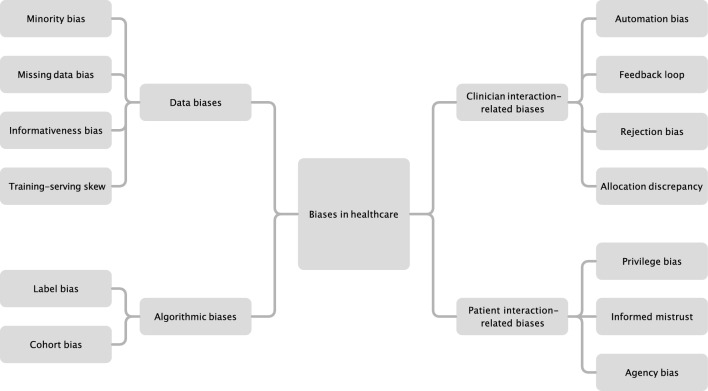
- Fairness in healthcare AI is multidimensional, requiring equitable distribution of resources, opportunities, and outcomes; biases arise from data, algorithms, clinician–AI interactions, and patient–AI interactions.
- Data biases include minority bias, missing data bias, informativeness bias, and training–serving skew; algorithmic biases include label bias and cohort bias. Examples include cardiovascular risk algorithms trained primarily on male patient data, a pneumonia chest X-ray model performing better on internal than external data, and a commercial healthcare-needs algorithm using cost as a proxy that underestimated the needs of Black patients.
- Mitigation strategies include diverse and representative data, independent algorithm audits and validation, and education for clinicians and patients; ethical/legal considerations include data privacy and security, liability and accountability, and transparency and explainability.
- The FAIR statement contains 10 recommendations: diverse data; independent audits; education; privacy/security; liability/accountability; transparency/explainability; collaboration between physicians, AI researchers, and developers; policymaker/regulatory involvement; patient/advocacy group participation; and professional association support.
Methods
- Narrative review; no systematic search strategy, inclusion criteria, data extraction, or quantitative synthesis is described.
- Synthesizes prior literature and examples across healthcare and radiology AI fairness; no original dataset, sample, or empirical analysis is reported.
- Main output is a conceptual framework and the FAIR recommendations.
Limitations
- The paper states that implementing each best practice is difficult, AI technology is still evolving with new challenges, explainable AI has limitations such as confirmation bias, and independent bias research is difficult because large-scale deployed algorithms are generally proprietary.
- Evident from the text: as a narrative review, it lacks a systematic search and quality appraisal and does not empirically test the FAIR recommendations; no original quantitative evidence is reported.
Model-written summary. Check it against the paper before relying on it.
Integrity signals
Registry
Cites
Statistics
Figures
Verification
Claims the paper makes
8 Valid · 0 Not valid · 34 Not checked · 13 Own results and interpretations
The cited sources support only part of this claim — read each source’s verdict below.
In the paper
“Another bias related to interactions is the feedback loop [80]. This occurs when clinicians accept AI recommendations even if they are incorrect, leading the algorithm to relearn and perpetuate the same mistakes.”
§ Fairness of artificial intelligence in healthcare: review and recommendations > Fairness concerns in healthcare > Clinician interaction-related biases
What the sources say
- Partly supportedcites [80] Walsh CG Chaudhry B Dua P Goodman KW Kaplan B Kavuluru R Stigma, biomarkers, and algorithmic bias: recommendations for precision behavioral health with artificial intelligence JAMIA Open 2020 3 9 15 10.1093/jamiaopen/ooz054 32607482 PMC7309258 sourceExperimental — accuracy not yet measured
Our copy does identify a 'harmful feedback loop' as a critical issue in algorithmic bias (CHALLENGES > Potential for algorithmic bias), but the mechanism it describes is different from the claim's: existing disparities lead to unrepresentative training data, bias seeps into predictive models, and biased predictions further exacerbate disparities — not clinicians accepting incorrect AI recommendations which the algorithm then relearns. The paper's closest related point is the recommendation that users have channels to disagree with recommendations so algorithms and designers can learn from those disagreements (RECOMMENDATIONS > Foster trust through education and transparency), plus a warning that providers 'might feel compelled to respond' to high-risk designations (CHALLENGES > Inappropriate use, interpretability/explainability, and trust); neither states the relearning/perpetuation loop the citing sentence attributes. So the existence of a feedback-loop bias is supported while the specific clinician-over-reliance mechanism is not. (LLM, conf=0.70)
plainstates a cause- Asserted: passes — The authors put it forward as true.
- Checkable: passes — It can be checked against evidence.
- Load-bearing: unclear — It is unclear whether the paper’s conclusions depend on it.
- Based: passes — The paper gives a reason why it holds.
- Partly supported
The cited sources support only part of this claim — read each source’s verdict below.
In the paper
“In a study training AI to diagnose pneumonia from chest X-rays, the performance on unseen data from the institution where the training data were collected was significantly higher than its performance on data collected from external hospitals [72].”
§ Fairness of artificial intelligence in healthcare: review and recommendations > Fairness concerns in healthcare > Data biases
What the sources say
- Partly supportedcites [72] Zech JR Badgeley MA Liu M Costa AB Titano JJ Oermann EK Variable generalization performance of a deep learning model to detect pneumonia in chest radiographs: a cross-sectional study PLOS Med 2018 10.1371/journal.pmed.1002683 30399157 PMC6219764 sourceExperimental — accuracy not yet measured
Split into 2 atoms — 1 confirmed, 1 partially supported, 0 disputed, 0 misattributed, 0 unverifiable. Expand the claim to see per-atom verdicts.
plainstates an association- Asserted: passes — The authors put it forward as true.
- Checkable: passes — It can be checked against evidence.
- Load-bearing: passes — The paper’s conclusions depend on it.
- Based: passes — The paper gives a reason why it holds.
- Partly supported
None of the sources cited for this claim have been checked yet.
In the paper
“For example, identifying melanoma from images of patients with dark skin is more challenging than those with light skin [70, 71].”
§ Fairness of artificial intelligence in healthcare: review and recommendations > Fairness concerns in healthcare > Data biases
What the sources say
- Not checked yetcites [70] Adamson AS Smith A Machine learning and health care disparities in dermatology JAMA Dermatol 2018 154 1247 1248 10.1001/jamadermatol.2018.2348 30073260 source
- Could not verifycites [71] Navarrete-Dechent C Dusza SW Liopyris K Marghoob AA Halpern AC Marchetti MA Automated dermatological diagnosis: hype or reality? J Invest Dermatol 2018 138 2277 2279 10.1016/j.jid.2018.04.040 29864435 PMC7701995 sourceExperimental — accuracy not yet measured
The main text (page unavailable) reports differences in algorithm performance between Asian and Caucasian datasets, but does not say which performed better or compare dark and light skin. Its melanoma test used images only from Caucasian patients. A search for a dark-versus-light-skin comparison found no passage supporting the claimed direction of difficulty. (LLM, conf=0.74)
plainstates an association- Asserted: passes — The authors put it forward as true.
- Checkable: passes — It can be checked against evidence.
- Load-bearing: unclear — It is unclear whether the paper’s conclusions depend on it.
- Based: passes — The paper gives a reason why it holds.
Every source the paper cites for this claim was checked and supports it.
In the paper
“For example, significant racial bias has been observed in commercially available algorithms used to predict patients' healthcare needs.”
§ Fairness of artificial intelligence in healthcare: review and recommendations > Fairness concerns in healthcare > Algorithmic biases
What the sources say
- Supportedcites [76] Obermeyer Z Powers B Vogeli C Mullainathan S Dissecting racial bias in an algorithm used to manage the health of populations Science 2019 366 447 453 10.1126/science.aax2342 31649194 source
The paper states on p. 2 that a widely used commercial prediction algorithm for identifying patients with complex health needs exhibits significant racial bias. The citing sentence presents this as an example, rather than claiming that the paper tested every commercial algorithm. (LLM, conf=0.92)
plainstates an association- Asserted: passes — The authors put it forward as true.
- Checkable: passes — It can be checked against evidence.
- Load-bearing: passes — The paper’s conclusions depend on it.
- Based: passes — The paper gives a reason why it holds.
- Supported
The cited sources support only part of this claim — read each source’s verdict below.
In the paper
“When healthcare professionals interact with AI, biases related to interactions can occur, potentially affecting the algorithm's performance, fairness, and adoption [11].”
§ Fairness of artificial intelligence in healthcare: review and recommendations > Fairness concerns in healthcare > Clinician interaction-related biases
What the sources say
- Partly supportedcites [11] Rajkomar A Hardt M Howell MD Corrado G Chin MH Ensuring fairness in machine learning to advance health equity Ann Intern Med 2018 169 866 872 10.7326/M18-1990 30508424 PMC6594166 sourceExperimental — accuracy not yet measured
In “What Can Cause a Machine-Learning System to Be Unfair?” (page unavailable), the paper describes automation and dismissal biases when clinicians trust or ignore model predictions, and says these interactions can affect patient outcomes and resource allocation. It does not say those interactions change the algorithm’s predictive performance or address their effect on AI adoption. (LLM, conf=0.86)
plainstates a possible cause- Asserted: passes — The authors put it forward as true.
- Checkable: passes — It can be checked against evidence.
- Load-bearing: passes — The paper’s conclusions depend on it.
- Based: passes — The paper gives a reason why it holds.
- Partly supported
9 more claims
Create a free account to see all 55 claims and to verify the 54 references still open.
- Probably not a substantial claim. 31
- It may state two separate claims as one. 24
Claims other papers make about this one
Each is checked against this paper’s own text: does it say what the citing paper says it does?
The source backs part of the claim, not all of it — or backs it for a different population, condition or comparison.
In the citing paper
“This deployment bias has been shown to lead to the dismissal of appropriate critical warnings, with potential risk of patient harm47,49.”
From Bias recognition and mitigation strategies in artificial intelligence healthcare applications (2025) · cites this paper as [49]
Experimental — accuracy not yet measuredThe source backs part of the claim, not all of it — or backs it for a different population, condition or comparison.
In the citing paper
“Studies27,29,30,42 provide empirical evidence that GenAI tools can significantly improve clinical accuracy, workflow efficiency, and decision-support capacity when implemented under structured supervision.”
From Generative Artificial Intelligence in Healthcare: Automation Bias, Deskilling, and Cognitive Implications – A Systematic Review (2026) · cites this paper as [30]
Experimental — accuracy not yet measuredThe source backs part of the claim, not all of it — or backs it for a different population, condition or comparison.
In the citing paper
“Systematic reviews of AI fairness in healthcare have demonstrated that models trained on demographically skewed datasets can produce reduced accuracy and exacerbate health disparities in underrepresented groups412.”
From Artificial intelligence-driven multi-omics approaches in Alzheimer's disease: Progress, challenges, and future directions (2025) · cites this paper as [412]
Experimental — accuracy not yet measuredThe source backs part of the claim, not all of it — or backs it for a different population, condition or comparison.
In the citing paper
“Governance frameworks that incorporate ethics boards and patient advocacy representatives throughout the development lifecycle also play a critical role in ensuring transparency, addressing algorithmic bias, and promoting equitable use of AI systems412.”
From Artificial intelligence-driven multi-omics approaches in Alzheimer's disease: Progress, challenges, and future directions (2025) · cites this paper as [412]
Experimental — accuracy not yet measuredThe source backs part of the claim, not all of it — or backs it for a different population, condition or comparison.
In the citing paper
“However, many of these guidelines neglect the importance of addressing bias at multiple stages of model development.”
From Advancing Health Equity through Multi-Level Fairness in Health Informatics (2026) · cites this paper as [7]
Experimental — accuracy not yet measured
2 more claims about this paper
Create a free account to see every claim other papers make about this one.
Citations
Cites
Meyer, I. H. (2003) · Psychological Bulletin · doi:10.1037/0033-2909.129.5.674 · Cited by 14,736
Arrieta, A. B., Díaz-Rodríguez, N., Del Ser, J., Bennetot, A., Tabik, S., Barbado, A., García, S., Gil-López, S., Molina, D., Benjamins, R., et al. (2019) · arXiv · doi:10.48550/arxiv.1910.10045 · Cited by 11,321 · cited 1×
“Fostering transparency and account‑ ability in AI is also an important aspect of their respon‑ sibilities [5, 116].”
BackgroundRudin, C. (2019) · Nature Machine Intelligence · doi:10.1038/s42256-019-0048-x · Cited by 10,561
High-performance medicine: the convergence of human and artificial intelligence
Topol, E. J. (2019) · Nature Medicine · doi:10.1038/s41591-018-0300-7 · Cited by 10,450 · cited 1×
“Collaboration among physicians, AI researchers, and AI developers is essential to address fairness concerns in AI [108, 110].”
BackgroundBarredo Arrieta, A., Díaz-Rodríguez, N., Del Ser, J., Bennetot, A., Tabik, S., Barbado, A., Garcia, S., Gil-Lopez, S., Molina, D., Benjamins, R., et al. (2020) · Information Fusion · doi:10.1016/j.inffus.2019.12.012 · Cited by 10,423 · cited 1×
“Fostering transparency and account‑ ability in AI is also an important aspect of their respon‑ sibilities [5, 116].”
BackgroundDissecting racial bias in an algorithm used to manage the health of populations
Obermeyer, Z., Powers, B., Vogeli, C., & Mullainathan, S. (2019) · Science · doi:10.1126/science.aax2342 · Cited by 7,137 · cited 2×
“Although several biases were affected, a major contributing factor to this algorithm’s bias was its design, which used cost as a proxy for healthcare needs, leading to an underestimation of the needs of Black patients compared with those who are White with similar conditions [76].”
BackgroundThe global landscape of AI ethics guidelines
Jobin, A., Ienca, M., & Vayena, E. (2019) · Nature Machine Intelligence · doi:10.1038/s42256-019-0088-2 · Cited by 6,220 · cited 1×
“This will ensure that AI systems can better recognize, diagnose, and treat a wide range of patient conditions, reducing disparities and promoting equity in healthcare outcomes 2.”
BackgroundA Survey on Bias and Fairness in Machine Learning
Mehrabi, N., Morstatter, F., Saxena, N., Lerman, K., & Galstyan, A. (2022) · ACM Computing Surveys · doi:10.1145/3457607 · Cited by 5,812
A Survey on Bias and Fairness in Machine Learning
Mehrabi, N., Morstatter, F., Saxena, N., Lerman, K., & Galstyan, A. (2019) · arXiv · doi:10.48550/arxiv.1908.09635 · Cited by 5,812
Lipton, Z. C. (2018) · Queue · doi:10.1145/3236386.3241340 · Cited by 5,427 · cited 1×
“However, recognizing the limitations of explainability is important [104–107].”
Background
Research works printed but not linked: 4
- Binns R. Fairness in machine learning: Lessons from political philosophy. In: Friedler SA, Wilson C, editors. Proceedings of the 1st conference on fairness, accountability and transparency. PMLR; 2018. p. 149–59
- Minkler M, Wallerstein N. Community-based participatory research for health: From process to outcomes. John Wiley & Sons; 2011
- Buolamwini J, Gebru T. Gender shades: Intersectional accuracy disparities in commercial gender classification. In: Friedler SA, Wilson C, editors. Proceedings of the 1st conference on fairness, accountability and transparency. PMLR; 2018. p. 77–91
- Coulter A Collins A Making shared decision-making a reality: No decision about me, without me 2011 London The King’s Fund 621
Cited by
Items 401–500 of 728
Post-processing Methods for Improving Accuracy in MRI Inpainting
Kulkarni, N., Iyer, K., Tapp, A., Parida, A., Capellán-Martín, D., Jiang, Z., Ledesma‐Carbayo, M. J., Anwar, S. M., & Linguraru, M. G. (2026) · Lecture notes in computer science · doi:10.1007/978-3-032-16370-7_13 · Cited by 1
“Thus, streamlined, ensembled methodologies pave the way for building equity in model deployment [27].”
Ethics, economics, and patient-centered outcomes of spinal cord stimulation
D'Souza, R. S., & Shanthanna, H. (2025) · Current Opinion in Anaesthesiology · doi:10.1097/aco.0000000000001592 · Cited by 1
Automated Detection and Classification of Newborn Crying with Machine Learning
Özdemir, S., & Yılmaz, E. Ç. (2025) · Journal of Voice · doi:10.1016/j.jvoice.2025.10.041 · Cited by 1
Doherty, T. M., Kelley, A. M., Kim, E., & Salik, I. (2025) · World Journal of Clinical Pediatrics · doi:10.5409/wjcp.v14.i4.107127 · Cited by 1
Future perspectives of artificial intelligence in vascular surgery
Lareyre, F., Weaver, M. L., Afifi, R. O., Kiang, S. C., & Raffort, J. (2025) · The Journal of Cardiovascular Surgery · doi:10.23736/s0021-9509.25.13473-3 · Cited by 1
Challenges and opportunities for smart healthcare systems
Mazhar, T., & Hamam, H. (2025) · Elsevier eBooks · doi:10.1016/b978-0-443-33439-9.00005-2 · Cited by 1
Ethical considerations in artificial intelligence-powered patient counseling
Patne, A. Y., & Suryawanshic, M. (2025) · Elsevier eBooks · doi:10.1016/b978-0-443-43823-3.00011-x · Cited by 2
Dhull, A., Kataria, A., Kalra, M., & Singh, A. (2025) · Springer series in reliability engineering · doi:10.1007/978-3-031-98728-1_15 · Cited by 1
Borges, L. P., Kumaraswamy, A., Ponnusamy, S., Gopalsamy, R. G., & Devassy, S. M. (2025) · EXCLI journal · doi:10.17179/excli2025-8737 · Cited by 1
“However, successfully balancing AI chatbot use with traditional mental health services can promote more inclusive and comprehensive care (Ueda et al., 2024).”
A survey on mathematics behind AI models for disease prediction and diagnosis in healthcare
Mythatha, E., & Jenicka, S. (2025) · Network Modeling Analysis in Health Informatics and Bioinformatics · doi:10.1007/s13721-025-00671-6 · Cited by 1
An Overview of the Implementation of Artificial Intelligence in Clinical Pathways
Murazzano, L., & Landa, P. (2025) · Springer proceedings in mathematics & statistics · doi:10.1007/978-3-031-95659-1_4 · Cited by 1
A State of the Art on Applications, Recent Challenges, and Future Trends of Artificial Intelligence
Kumari, S. S., & Priyadharsini, S. S. (2025) · International Conference on Power, Instrumentation, Control and Computing (PICC) · doi:10.1109/picc67314.2025.11291239 · Cited by 1
Application of Intelligent Systems in Biomedicine
Badnjević, A., & Spahić, L. (2026) · Series in bioengineering · doi:10.1007/978-3-032-14785-1_2 · Cited by 3
Responsible Machine Learning Deployment: Imperative Framework for Ethical Action
León, M. (2026) · WSEAS TRANSACTIONS ON COMPUTER RESEARCH · doi:10.37394/232018.2026.14.12 · Cited by 2
Bouderhem, R. (2026) · Springer eBooks · doi:10.1007/978-981-96-7448-0_29-1 · Cited by 2
Cavalcante, M. F. A. D. F., Cavalcante, J. G. F., Feitosa, A. S., da Rocha, E. P., Neta, M. R. D., do Nascimento, L. A., dos Reis, L. N., Santos, F. D. C. B., Santos, M. B., Aguiar, F. D. C. D. S., et al. (2026) · Revista Ibero-Americana de Humanidades, Ciências e Educação · doi:10.51891/rease.v12i1.23937 · Cited by 1
Artificial intelligence in oncology: Current status and possibilities (Review)
Roy, A., Bhoyar, A., Ahirwar, A. K., Pawade, Y., & Chandra, N. (2026) · Medicine International · doi:10.3892/mi.2026.304 · Cited by 4
“concerns regarding data privacy, accountability and equity have become increasingly prominent (9).”
Vaezi, A., Ashby, T., Kadir, S., Schweitzer, M. D., Hadeh, A., Sen, P., Seeram, V. K., & Mirsaeidi, M. S. (2026) · ATS Scholar · doi:10.1093/atsscholar/aapag001 · Cited by 2
Exploring Mental Health Professionals’ Perceptions and Acceptance of AI-based Screening Tools
Chandini, Siddharth Shetty, A., & Rao, A. (2026) · IIUM Medical Journal Malaysia · doi:10.31436/imjm.v25i01.3217 · Cited by 2
Data warehousing in healthcare: enhancing resource allocation and decision-making in Botswana
Mabina, A., Malema, G., & Kombe, C. (2026) · Oxford Open Digital Health · doi:10.1093/oodh/oqag006 · Cited by 1
“Ethical guardrails fairness, accountability, and transparency are essential to avoid biased allocation and to foster trust among managers, aligning with best practices for health DSS in LMICs (Ueda et al. 2024).”
Aly, S., Young, H., Rimmer, J. H., & Mehta, T. S. (2026) · Healthcare · doi:10.3390/healthcare14060781 · Cited by 1
“Previous studies have highlighted that algorithms may unintentionally reproduce disparities if such variables are interpreted without appropriate context [50,51].”
Ethical oversight of AI-driven paediatric trials: a proactive, risk-sensitive interim review model
Wong, C., & Hsu, T.-W. (2026) · Frontiers in Digital Health · doi:10.3389/fdgth.2026.1782692 · Cited by 1
Zeb-Obipi, V. A. (2026) · International Journal of Applied Resilience and Sustainability · doi:10.70593/deepsci.0202050 · Cited by 1
Dele-Rotimi, A. O. (2026) · International Journal of Applied Resilience and Sustainability · doi:10.70593/deepsci.0202052 · Cited by 2
“Big DataAnalytics, Predictive Analytics, Recommendation Engine, and Real-Time Analytics are all growing in usage after being adopted by organizations to turn fragmented data about customers into Customer Insights that can be acted upon [98-101].”
Blessing, E. (2026) · International Journal of Applied Resilience and Sustainability · doi:10.70593/deepsci.0203002 · Cited by 2
“These technologies are also on the rise in the creation of case studies, anatomy diagrams, radiology images, assessment questions, and virtual patient interactions [9,33-35].”
Zhang, Y. (2026) · Discover Artificial Intelligence · doi:10.1007/s44163-026-01236-w · Cited by 1
Barrett, A. K., & Uhey, H. (2026) · Health Communication · doi:10.1080/10410236.2026.2666572 · Cited by 1
Kindt, R. M. B., dos Reis, T. S., da Silva, L. D., Duarte, R. C., Cassiolato, H. M. P., Carneiro, V., da Costa, J. C. T., Pinheiro, F. D. S., Simas, L., de Oliveira, Y. T. F. H., et al. (2026) · Derecho y cambio social. · doi:10.54899/dcs.v23i90.5717 · Cited by 1
Mariotti, F., Cacioppa, L. M., Rossini, N., Bruno, A., Francavilla, G., Felicioli, A., Macchini, M., Coppola, A., Cellina, M. I., & Floridi, C. (2026) · Journal of Imaging · doi:10.3390/jimaging12060274 · Cited by 1
“As emphasized in recent policy discussions, the deployment of AI in healthcare requires not only technical validation but also governance frameworks that ensure safety, accountability, and fairness [188–190].”
Hajjo, R., Abusara, O. H., Sabbah, D. A., Zidan, R., & Bardaweel, S. K. (2026) · Journal of the American Pharmacists Association · doi:10.1016/j.japh.2026.103490 · Cited by 1
Liu, R., Arena, R. A., Vasile, V. C., Arruda-Olson, A. M., & Popović, D. (2026) · Progress in Cardiovascular Diseases · doi:10.1016/j.pcad.2026.08.012 · Cited by 1
Chi, H., Liu, X., Yan, Y., Wang, L., Luo, P., Su, L., Jiang, L., Zhou, X., Huang, G., Jiang, Y., et al. (2026) · Genes & Diseases · doi:10.1016/j.gendis.2026.102480 · Cited by 1
AI algorithms and external validation: promises, pitfalls, and a practical blueprint
Thambiraj, G., & Armoundas, A. A. (2026) · European Heart Journal · doi:10.1093/eurheartj/ehag816 · Cited by 2
ChatGPT, GPT-4, and Bard and official board examination: comment
Daungsupawong, H., & Wiwanitkit, V. (2023) · Japanese Journal of Radiology · doi:10.1007/s11604-023-01508-w · Cited by 1
“It should address AI bias problems, such as misdiagnosis and unequal access to treatment, and investigate solutions to mitigate these biases, such as varied and representative data and algorithm audits [2].”
InfluentialIntroduction: Data, Data, and More Data
Ibrahim, I. A. (2024) · Global Journal of Comparative Law · doi:10.1163/2211906x-13020001 · Cited by 1
Cychnerski, J., & Dziubich, T. (2024) · Proceedings of the International Conference on Information Systems Development · doi:10.62036/isd.2024.18 · Cited by 1
“Treating both fields separately, numerous publications on best practices can be found in the literature, e.g. [9, 21].”
Introduction to AI and Privacy Issues for Healthcare Systems
Gupta, S., Kapoor, M., & Debnath, S. K. (2025) · Springer eBooks · doi:10.1007/978-3-031-82810-2_1 · Cited by 1
Ethical Insights into AI-Driven Caries Detection: A Scoping Review (Preprint)
Yousuf, T., Khan, M., & Ghafoor, R. (2024) · Journal of Medical Internet Research · doi:10.2196/69486 · Cited by 1
Revolutionizing Scientific Research: The Role of AI and the Metaverse in Modern Discovery
Asrifan, A., & Ingilan, S. S. (2025) · Advances in computational intelligence and robotics book series · doi:10.4018/979-8-3373-0340-6.ch001 · Cited by 2
Pagidoju, V. (2025) · ISCSITR- INTERNATIONAL JOURNAL OF COMPUTER SCIENCE AND ENGINEERING · doi:10.63397/iscsitr-ijcse_2025_06_03_003 · Cited by 1
Singh, S. P., Kaur, S., Aggarwal, A. D., Walia, D. S., & Singh, P. (2024) · Journal of Punjab Academy of Forensic Medicine & Toxicology · doi:10.5958/0974-083x.2024.00048.2 · Cited by 1
Artificial intelligence/machine learning in the management of diabetes mellitus
Sonia, T. A., & Sharma, C. P. (2025) · Elsevier eBooks · doi:10.1016/b978-0-443-30272-5.00010-x · Cited by 1
Hubungan Hukum Dalam Pelayanan Kesehatan
Widjaja, G., & Mailinda, N. (2024) · Bulletin of Community Engagement · doi:10.51278/bce.v4i1.1062 · Cited by 1
Nakaura, T., & Hirai, T. (2024) · Japanese Journal of Radiology · doi:10.1007/s11604-024-01577-5 · Cited by 1
“Although there are still some challenges to overcome before their full integration into clinical practice [3], given the rapid development of language models, it is reasonable to expect that their performance will continue to improve significantly [4].”
Self-citationSolaiman, B. (2024) · SSRN Electronic Journal · doi:10.2139/ssrn.4886518 · Cited by 1
Alluri, P., Chen, Z., Marrero, W. J., Jacobson, N. C., & Thesen, T. (2024) · medRxiv · doi:10.1101/2024.12.10.24318825 · Cited by 1
Primary Care Diagnoses as a Reliable Predictor for Orthopedic Surgical InterventionsPreprint
Verma, K., Michels, A., Gumusaneli, E., Chitnis, S., Kumar, S. S., Thompson, C. M., Esmail, L., Srinivasan, G., Panchada, C., Guha, S., et al. (2025) · arXiv (Cornell University) · doi:10.48550/arxiv.2502.04423 · Cited by 1
AI Is Not IntelligentPreprint
Opara, E. (2025) · SSRN Electronic Journal · doi:10.20944/preprints202501.1953.v1 · Cited by 2
Hasan, H. H. (2025) · medRxiv · doi:10.1101/2025.09.10.25335333 · Cited by 4
Rahman, M. H., Hossain, M. D., Hossan, K. M. R., Uddin, M. K. S., Zaiem, A. A., & Ullah, B. (2025) · SSRN Electronic Journal · doi:10.2139/ssrn.5437834 · Cited by 2
Application of Artificial Intelligence in Gastrointestinal Disease
Zhao, K. (2026) · Diagnostics · doi:10.3390/diagnostics16050723 · Cited by 1
“Even with standard anonymization practices, the risk of re-identification persists as datasets grow in scale and detail, necessitating stringent data security measures and strict compliance with regulations such as the General Data Protection Regulation (GDPR) [18,19].”
Advancing Health Equity through Multi-Level Fairness in Health Informatics
Souligne, N., & Subbian, V. (2026) · arXiv · doi:10.48550/arxiv.2608.16902
Ataş, P. K. (2024) · Scientific Journal of Biology & Life Sciences · doi:10.33552/sjbls.2024.03.000563
Walston, S. L., Tatekawa, H., Takita, H., Miki, Y., & Ueda, D. (2024) · American Journal of Neuroradiology · doi:10.3174/ajnr.a8211
Self-citationNakaura, T., & Naganawa, S. (2024) · Japanese Journal of Radiology · doi:10.1007/s11604-024-01594-4
Self-citationEnhancing Self-Supervised Learning for Rare Diseases in OCT
Walston, S. L., Sato, S., & Ueda, D. (2024) · JAMA Ophthalmology · doi:10.1001/jamaophthalmol.2024.1870
Self-citationSeeking Details on Artificial Intelligence Diagnosis for Acute Otitis Media
Walston, S. L., Sato, S., & Ueda, D. (2024) · Archives of Pediatrics and Adolescent Medicine · doi:10.1001/jamapediatrics.2024.1740
Self-citationCarrillo-Larco, R. M. (2024) · Pediatric Cardiology · doi:10.1007/s00246-024-03561-2
Walston, S. L., & Ueda, D. (2024) · European Radiology · doi:10.1007/s00330-024-10874-6
Self-citationElsabbagh, M. (2024) · International Journal of Applied Science and Research · doi:10.56293/ijasr.2024.6023
Clarifications on the Differentiation of Vertebral Fractures Using Deep Learning Models
Walston, S. L., Sato, S., Mitsuyama, Y., Takita, H., & Ueda, D. (2024) · Radiology · doi:10.1148/radiol.241162
Self-citationKim, Y. K., Choi, I., Seo, W.-D., Kim, G. C., Song, H. S., & Lee, M. (2024) · doi:10.2196/preprints.68323
Mori, T., & Shimada, Y. (2024) · Criminal Justice and Behavior · doi:10.1177/00938548241297280
“The forensic adoption of deep learning algorithms, a subfield of AI, is progressing, and concerns have arisen regarding the impact of AI biases and discrimination on patient health (Ueda et al., 2024).”
Hardin, C. M. (2024) · Advances in human resources management and organizational development book series · doi:10.4018/979-8-3693-8562-3.ch011
Ethical Frameworks and Spiritual Values in the Age of AI in Healthcare
Khan, R., & Salim, H. (2024) · Advances in healthcare information systems and administration book series · doi:10.4018/979-8-3693-7051-3.ch022
Feature Dimensions of Artificial Intelligences Challenges and Techniques - A Survey
Hemalatha, S., Adavala, K. M., N, C. S. S., & Ahmad, K. S. F. (2024) · International Journal of Electronics and Communication Engineering · doi:10.14445/23488549/ijece-v11i12p111
AI Integration in Medical Imaging: Advanced Analysis of Chest X-ray
Bandara, D., Sutharssan, T., & Sharif, M. S. (2024) · International Conference on Innovation and Intelligence for Informatics, Computing, and Technologies (3ICT) · doi:10.1109/3ict64318.2024.10824281 · Cited by 2
“This variety of datasets is critical for constructing an AI model that can generalize across multiple demographic patient groups ensuring greater efficiency while avoiding demographic biases [10].”
Spor Pazarlamasının Lisansüstü Tezlerdeki İzdüşümünü Takip Etmek: Bibliyometrik Bir Perspektif
Akyüz, İ., & Tuzcuoğlu, A. (2024) · Bidge Yayınları eBooks · doi:10.70269/10.70269/5495874326
AI IS NOT INTELLIGENTPreprint
C., M. O. E. (2025) · doi:10.22541/au.173809708.82643278/v1
AI IN ONCOLOGY: FROM GENOMICS TO CLINICAL APPLICATIONS
(2025) · International Journal of Progressive Research in Engineering Management and Science · doi:10.58257/ijprems36167
Bogatsa, E., Karamitrousis, E., Liontos, M., & Tsoukalas, N. (2023) · Forum of Clinical Oncology · doi:10.2478/fco-2023-0042
International Comparative Research of Governance against “unwanted bias” of AI-based Medical Devices
Arima, H., & Kano, S. (2025) · Transactions of the Japanese Society for Artificial Intelligence · doi:10.1527/tjsai.40-2_d-o96
AI to the Rescue: Revolutionizing Early Melanoma Detection with Machine Learning
Herrick, G., Susla, L., Frasier, K. M., Hassan, H., Salisbury, S., Esquivel, E., Jani, Y., & Grand, Z. A. (2025) · ARC Journal of Dermatology · doi:10.20431/2456-0022.0801005
“If an AI system produces an incorrect diagnosis or recommendation, questions often arise regarding who is responsible—the algorithm’s developer, the clinician utilizing the system, or the institution deploying the technology [31].”
Balancing Innovation and Safety in Digital Healthcare
Sharma, S., Singh, M. P., & Pradhan, K. B. (2025) · Global Clinical Engineering Journal · doi:10.31354/globalce.v7i1.262
AI for Imaging Diagnosis in Breast Cancer Screening
Kataoka, M., Fujioka, T., Inoue, K., Hayashida, T., & Suzuki, T. (2025) · Nihon Nyugan Kenshin Gakkaishi (Journal of Japan Association of Breast Cancer Screening) · doi:10.3804/jjabcs.34.15
Self-citationPujari, A. J., Das, N. K., & Mukhida, S. S. (2025) · Journal of the Scientific Society · doi:10.4103/jss.jss_336_24
AI in Healthcare: Transforming Patient Care, Diagnosis, And Treatment
Ansari, M. N., & Tasleem, N. (2024) · Journal of Artificial Intelligence General science (JAIGS) · doi:10.60087/jaigs.v6i1.353 · Cited by 8
Bhardwaj, N., Bhardwaj, A., & Garg, L. (2025) · International Conference on Integrated Circuits and Communication Systems (ICICACS) · doi:10.1109/icicacs65178.2025.10967861 · Cited by 2
“In healthcare, biased generative models may not produce realistic data for underrepresented populations, compromising their utility in diagnostics and research [19].”
AI in Cancer Research: Challenges, Applications, and Future Directions
Selimovic, M., Almisreb, A. A., Ismail, N., & Toksanovna, A. S. (2025) · Lecture notes in networks and systems · doi:10.1007/978-3-031-82881-2_13
Kasali, K. (2025) · International Journal of Latest Technology in Engineering Management & Applied Science · doi:10.51583/ijltemas.2025.140400031
Jiang, J., Liu, X., & Wang, W. (2025) · SSRN Electronic Journal · doi:10.2139/ssrn.5251805 · Cited by 1
Rahman, M. H., Hossan, K. M. R., Hassain, M. D., & Uddin, M. K. S. (2023) · International Journal of Novel Research and Development · doi:10.56975/ijnrd.v8i12.306720
Balachander, R., Yohalakshmi, G., & Kavitha, A. R. (2025) · International Conference on Data Science, Agents & Artificial Intelligence (ICDSAAI) · doi:10.1109/icdsaai65575.2025.11011788
“Studies said that the photos taken with some apparatus, such as the [25] smartphone versus D-SLR, inject variability that significantly affects AI performance, particularly when the situation is inadequately lit or are high-resolution.”
Application of AI to Detect Brain Tumors
Kalita, K., Mall, P., & Raina, D. (2025) · Springer eBooks · doi:10.1007/978-981-96-4241-0_15
Creativity in the Age of AI: Comparing Human and Machine Performance Using Standardised Tests
Grassini, S., Grødem, S., Gunnarskog, T., & Sevre, I. T. (2025) · Springer series on cultural computing · doi:10.1007/978-3-031-86551-0_3
Artificial intelligence in Nursing: A scoping review (Preprint)Preprint
Udoji, A., & Sanusi, I. T. (2025) · doi:10.2196/preprints.79310
Karanam, S. R., Kumar, A., Yandrapati, P. B., Goud, B. P., Vijaykumar, S., & Swamy, I. M. K. (2025) · BENTHAM SCIENCE PUBLISHERS eBooks · doi:10.2174/9789815322583125010004
A Survey on AI-Powered Ophthalmology: A Revolution in Eye Care and Disease Management
Schweisthal, B., Bonciog, D.-D., Lascu, M. R., & Ordodi, V. L. (2025) · International Conference on Bio-engineering for Smart Technologies (BioSMART) · doi:10.1109/biosmart66413.2025.11046181
“The lack of predefined criteria for the validation of AI systems presents yet another rationale for the sparse use of such technology in ophthalmology [40].”
Ethical Challenges in Implementing AI-driven Diagnostics in Healthcare
Kotte, G. (2025) · Journal of Informatics Education and Research · doi:10.52783/jier.v5i2.3096
Fetal Precision Medicine: Ai-Driven Approaches for Early Detection of Congenital Anomalies
Najim, H. A., Habib, L. A. K., & Barakat, F. M. H. (2025) · European Journal of Medical and Health Research · doi:10.59324/ejmhr.2025.3(4).19
Hybrid Machine Learning Optimization Models for Disease Prediction
Kotha, K. K., Rajasekhar, E. S. K., Bukke, S. P. N., Veluru, H., & Kumarachari, R. K. (2025) · Advances in computational intelligence and robotics book series · doi:10.4018/979-8-3373-5137-7.ch003
Role of AI in the Healthcare Industry: Revolutionizing Healthcare or Threatening Privacy?
Sanjaya, K., & Kumar, A. B. (2025) · IGI Global eBooks · doi:10.4018/979-8-3693-9137-2.ch012
Artificial Intelligence-Supported Colon Capsule Endoscopy
Schelde‐Olesen, B., & Bjørsum‐Meyer, T. (2025) · Springer eBooks · doi:10.1007/978-3-031-93937-2_11
Ethics in AI-Based Mental Health Care
Halder, S., Samajdar, S., & Basak, S. (2025) · Advances in computational intelligence and robotics book series · doi:10.4018/979-8-3373-0467-0.ch008 · Cited by 1
Nozaki, T., Hashimoto, M., Ueda, D., & Naganawa, S. (2025) · La radiologia medica · doi:10.1007/s11547-025-02097-6
Self-citationAI's Healing Touch: Transforming Healthcare from Diagnosis to Recovery
Sowjanya, C., Shaik, S. B., & Maddikari, S. Y. (2025) · Jordan Journal of Pharmaceutical Sciences · doi:10.35516/jjps.v18i3.3120
“As technology progresses, AI is poised to play an increasingly central role in improving patient care and advancing medical knowledge [15].”
Analysis of AI-Bias in Modern Healthcare Systems
Kumar, A., & Singh, D. (2025) · Transactions on computer systems and networks · doi:10.1007/978-981-96-6703-1_14 · Cited by 1
Artificial Intelligence in Healthcare: Real-World Integration, Cybersecurity Risks and Challenges
Buzdugan, A., & Buzdugan, A. (2025) · World Congress on Medical Physics and Biomedical Engineering, September 7 - 12, 2009, Munich, Germany · doi:10.1007/978-3-032-06497-4_32
Deep Learning Algorithms and Techniques
Syed, M., Chauhan, V., Mathur, B., Goyal, S., Narad, P., & Sengupta, A. (2025) · Medical virology · doi:10.1007/978-981-96-8919-4_3
Dashdorj, T., & Miller, A. D. (2025) · International Journal of Social Science and Education Research · doi:10.33545/26649845.2025.v7.i2f.395
Metadata
- Authors
- Ueda, D., Kakinuma, T., Fujita, S., Kamagata, K., Fushimi, Y., Ito, R., Matsui, Y., Nozaki, T., Nakaura, T., Fujima, N., Tatsugami, F., Yanagawa, M., Hirata, K., Yamada, A., Tsuboyama, T., Kawamura, M., Fujioka, T., & Naganawa, S.
- Affiliations
- Osaka Metropolitan University (JP)
- The University of Tokyo (JP)
- Juntendo University (JP)
- Kyoto University (JP)
- Nagoya University (JP)
- Okayama University (JP)
- Keio University (JP)
- Kumamoto University (JP)
- Hokkaido University Hospital (JP)
- Hiroshima University (JP)
- The University of Osaka (JP)
- Hokkaido University (JP)
- Shinshu University (JP)
- Tokyo Medical and Dental University (JP)
- Corresponding author
- Ueda, Daiju
- ORCID
- Venue
- Japanese Journal of Radiology
- Published
- 2023-08-04
- Volume
- 42
- Issue
- 1
- Pages
- 3-15
- ISSN
- 1867-1071 (ISSN-L)
- 1867-108X
- PMC
- PMC10764412
- OpenAlex
- W4385564466
- Semantic Scholar
- a8c6a60f0b44ec06344d6b7a9570369dc3484465
- Cited by
- 607
- References
- 120
- Citations by year
- 2026: 191 · 2025: 267 · 2024: 137 · 2023: 11
- FWCI
- 7.12
- Type
- journal article
- Language
- en
- Open access
- hybrid
- doi.org
- Licence
- cc-by
- creativecommons.org/licenses/by/4.0 (tdm)
- creativecommons.org/licenses/by/4.0 (vor)
- Locations
- Japanese Journal of Radiology (publishedVersion, cc-by)
- PubMed Central (publishedVersion, cc-by)
- PubMed (publishedVersion)
- Institutional Repositories DataBase (IRDB) (submittedVersion, cc-by)
- Kyoto University Research Information Repository (Kyoto University) (submittedVersion, cc-by)
- Topics
- Health Sciences › Medicine › Health Informatics › Artificial Intelligence in Healthcare and Education
- Physical Sciences › Computer Science › Artificial Intelligence › Ethics and Social Impacts of AI
- Physical Sciences › Computer Science › Artificial Intelligence › Explainable Artificial Intelligence (XAI)
- Keywords
- algorithmic fairness, algorithmic bias, artificial intelligence in healthcare, deep learning, radiology, bias mitigation, algorithmic auditing, explainability, transparency, accountability, data privacy, legal and ethical considerations, misdiagnosis
- MeSH terms
- Radiologists, Algorithms, Artificial Intelligence, Delivery of Health Care, Humans, Radiology
About these checks
Registry, retraction, Cites and statistics results are computed, not judged, with one exception: a printed reference that no index lists is read once by a model before it counts as a citation error. Claims are extracted by a model and kept only when their quote appears verbatim in the text; each cited source is then checked, with a model’s help, for whether it says what the claim relies on. Those verdicts can be wrong — read the claim’s quote and the cited source before relying on one.
The claim verdicts this report counts are experimental: their accuracy is not yet measured.
A language model drew the claims from the paper on 2026-10-05, under version 3 of the claim definition (model deepseek-v4.1-flash, prompt extract-v3).
A second model labelled each claim on 2026-10-05 (model jev-1.13-20260917, definition revision gold-guideline-v0.2).
Cited sources are checked with a language model’s help (qwen3.8-omni-flash and gpt-6-sol).
Statistics and arithmetic are recomputed, not judged.
Confidence bands are shown only for fields calibrated on our annotated test set. None is calibrated yet, so no band is shown.
What counts as a claim ›How we measure confidence ›How we check this ›
Are you an author, or do you see a problem with this page? Request a review
Data sources
Bibliographic data: Semantic Scholar, OpenAlex, Crossref.
Contains information from the Semantic Scholar Academic Graph Datasets, made available under the ODC Attribution License (ODC-BY 1.0).
Semantic Scholar’s data is described in: Kinney, R., et al. (2023). The Semantic Scholar Open Data Platform. arXiv:2301.10140.
