

Fairness of artificial intelligence in healthcare: review and recommendations
Open accessThe DOI matches its Crossref record; 128 of the 128 references it cites were found in a registry or an index; 19 of the 73 sources its claims cite were checked for support.
Abstract
In this review, we address the issue of fairness in the clinical integration of artificial intelligence (AI) in the medical field. As the clinical adoption of deep learning algorithms, a subfield of AI, progresses, concerns have arisen regarding the impact of AI biases and discrimination on patient health. This review aims to provide a comprehensive overview of concerns associated with AI fairness; discuss strategies to mitigate AI biases; and emphasize the need for cooperation among physicians, AI researchers, AI developers, policymakers, and patients to ensure equitable AI integration. First, we define and introduce the concept of fairness in AI applications in healthcare and radiology, emphasizing the benefits and challenges of incorporating AI into clinical practice. Next, we delve into concerns regarding fairness in healthcare, addressing the various causes of biases in AI and potential concerns such as misdiagnosis, unequal access to treatment, and ethical considerations. We then outline strategies for addressing fairness, such as the importance of diverse and representative data and algorithm audits. Additionally, we discuss ethical and legal considerations such as data privacy, responsibility, accountability, transparency, and explainability in AI. Finally, we present the Fairness of Artificial Intelligence Recommendations in healthcare (FAIR) statement to offer best practices. Through these efforts, we aim to provide a foundation for discussing the responsible and equitable implementation and deployment of AI in healthcare.
Overview
CoChat Summary
TL;DR
This narrative review examines fairness and bias in clinical artificial intelligence (AI), especially radiology, and proposes the FAIR statement of 10 best-practice recommendations for equitable implementation. It synthesizes sources of bias, mitigation strategies, ethical/legal issues, and stakeholder collaboration, without presenting original empirical data.
Key findings
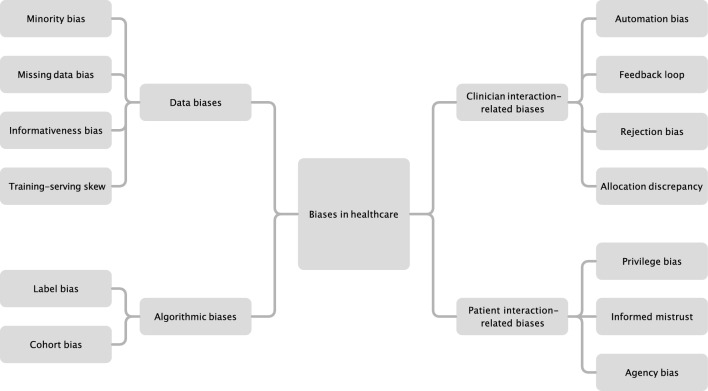
- Fairness in healthcare AI is multidimensional, requiring equitable distribution of resources, opportunities, and outcomes; biases arise from data, algorithms, clinician–AI interactions, and patient–AI interactions.
- Data biases include minority bias, missing data bias, informativeness bias, and training–serving skew; algorithmic biases include label bias and cohort bias. Examples include cardiovascular risk algorithms trained primarily on male patient data, a pneumonia chest X-ray model performing better on internal than external data, and a commercial healthcare-needs algorithm using cost as a proxy that underestimated the needs of Black patients.
- Mitigation strategies include diverse and representative data, independent algorithm audits and validation, and education for clinicians and patients; ethical/legal considerations include data privacy and security, liability and accountability, and transparency and explainability.
- The FAIR statement contains 10 recommendations: diverse data; independent audits; education; privacy/security; liability/accountability; transparency/explainability; collaboration between physicians, AI researchers, and developers; policymaker/regulatory involvement; patient/advocacy group participation; and professional association support.
Methods
- Narrative review; no systematic search strategy, inclusion criteria, data extraction, or quantitative synthesis is described.
- Synthesizes prior literature and examples across healthcare and radiology AI fairness; no original dataset, sample, or empirical analysis is reported.
- Main output is a conceptual framework and the FAIR recommendations.
Limitations
- The paper states that implementing each best practice is difficult, AI technology is still evolving with new challenges, explainable AI has limitations such as confirmation bias, and independent bias research is difficult because large-scale deployed algorithms are generally proprietary.
- Evident from the text: as a narrative review, it lacks a systematic search and quality appraisal and does not empirically test the FAIR recommendations; no original quantitative evidence is reported.
Model-written summary. Check it against the paper before relying on it.
Integrity signals
Registry
Cites
Statistics
Figures
Verification
Claims the paper makes
8 Valid · 0 Not valid · 34 Not checked · 13 Own results and interpretations
The cited sources support only part of this claim — read each source’s verdict below.
In the paper
“Another bias related to interactions is the feedback loop [80]. This occurs when clinicians accept AI recommendations even if they are incorrect, leading the algorithm to relearn and perpetuate the same mistakes.”
§ Fairness of artificial intelligence in healthcare: review and recommendations > Fairness concerns in healthcare > Clinician interaction-related biases
What the sources say
- Partly supportedcites [80] Walsh CG Chaudhry B Dua P Goodman KW Kaplan B Kavuluru R Stigma, biomarkers, and algorithmic bias: recommendations for precision behavioral health with artificial intelligence JAMIA Open 2020 3 9 15 10.1093/jamiaopen/ooz054 32607482 PMC7309258 sourceExperimental — accuracy not yet measured
Our copy does identify a 'harmful feedback loop' as a critical issue in algorithmic bias (CHALLENGES > Potential for algorithmic bias), but the mechanism it describes is different from the claim's: existing disparities lead to unrepresentative training data, bias seeps into predictive models, and biased predictions further exacerbate disparities — not clinicians accepting incorrect AI recommendations which the algorithm then relearns. The paper's closest related point is the recommendation that users have channels to disagree with recommendations so algorithms and designers can learn from those disagreements (RECOMMENDATIONS > Foster trust through education and transparency), plus a warning that providers 'might feel compelled to respond' to high-risk designations (CHALLENGES > Inappropriate use, interpretability/explainability, and trust); neither states the relearning/perpetuation loop the citing sentence attributes. So the existence of a feedback-loop bias is supported while the specific clinician-over-reliance mechanism is not. (LLM, conf=0.70)
plainstates a cause- Asserted: passes — The authors put it forward as true.
- Checkable: passes — It can be checked against evidence.
- Load-bearing: unclear — It is unclear whether the paper’s conclusions depend on it.
- Based: passes — The paper gives a reason why it holds.
- Partly supported
The cited sources support only part of this claim — read each source’s verdict below.
In the paper
“In a study training AI to diagnose pneumonia from chest X-rays, the performance on unseen data from the institution where the training data were collected was significantly higher than its performance on data collected from external hospitals [72].”
§ Fairness of artificial intelligence in healthcare: review and recommendations > Fairness concerns in healthcare > Data biases
What the sources say
- Partly supportedcites [72] Zech JR Badgeley MA Liu M Costa AB Titano JJ Oermann EK Variable generalization performance of a deep learning model to detect pneumonia in chest radiographs: a cross-sectional study PLOS Med 2018 10.1371/journal.pmed.1002683 30399157 PMC6219764 sourceExperimental — accuracy not yet measured
Split into 2 atoms — 1 confirmed, 1 partially supported, 0 disputed, 0 misattributed, 0 unverifiable. Expand the claim to see per-atom verdicts.
plainstates an association- Asserted: passes — The authors put it forward as true.
- Checkable: passes — It can be checked against evidence.
- Load-bearing: passes — The paper’s conclusions depend on it.
- Based: passes — The paper gives a reason why it holds.
- Partly supported
None of the sources cited for this claim have been checked yet.
In the paper
“For example, identifying melanoma from images of patients with dark skin is more challenging than those with light skin [70, 71].”
§ Fairness of artificial intelligence in healthcare: review and recommendations > Fairness concerns in healthcare > Data biases
What the sources say
- Not checked yetcites [70] Adamson AS Smith A Machine learning and health care disparities in dermatology JAMA Dermatol 2018 154 1247 1248 10.1001/jamadermatol.2018.2348 30073260 source
- Could not verifycites [71] Navarrete-Dechent C Dusza SW Liopyris K Marghoob AA Halpern AC Marchetti MA Automated dermatological diagnosis: hype or reality? J Invest Dermatol 2018 138 2277 2279 10.1016/j.jid.2018.04.040 29864435 PMC7701995 sourceExperimental — accuracy not yet measured
The main text (page unavailable) reports differences in algorithm performance between Asian and Caucasian datasets, but does not say which performed better or compare dark and light skin. Its melanoma test used images only from Caucasian patients. A search for a dark-versus-light-skin comparison found no passage supporting the claimed direction of difficulty. (LLM, conf=0.74)
plainstates an association- Asserted: passes — The authors put it forward as true.
- Checkable: passes — It can be checked against evidence.
- Load-bearing: unclear — It is unclear whether the paper’s conclusions depend on it.
- Based: passes — The paper gives a reason why it holds.
Every source the paper cites for this claim was checked and supports it.
In the paper
“For example, significant racial bias has been observed in commercially available algorithms used to predict patients' healthcare needs.”
§ Fairness of artificial intelligence in healthcare: review and recommendations > Fairness concerns in healthcare > Algorithmic biases
What the sources say
- Supportedcites [76] Obermeyer Z Powers B Vogeli C Mullainathan S Dissecting racial bias in an algorithm used to manage the health of populations Science 2019 366 447 453 10.1126/science.aax2342 31649194 source
The paper states on p. 2 that a widely used commercial prediction algorithm for identifying patients with complex health needs exhibits significant racial bias. The citing sentence presents this as an example, rather than claiming that the paper tested every commercial algorithm. (LLM, conf=0.92)
plainstates an association- Asserted: passes — The authors put it forward as true.
- Checkable: passes — It can be checked against evidence.
- Load-bearing: passes — The paper’s conclusions depend on it.
- Based: passes — The paper gives a reason why it holds.
- Supported
The cited sources support only part of this claim — read each source’s verdict below.
In the paper
“When healthcare professionals interact with AI, biases related to interactions can occur, potentially affecting the algorithm's performance, fairness, and adoption [11].”
§ Fairness of artificial intelligence in healthcare: review and recommendations > Fairness concerns in healthcare > Clinician interaction-related biases
What the sources say
- Partly supportedcites [11] Rajkomar A Hardt M Howell MD Corrado G Chin MH Ensuring fairness in machine learning to advance health equity Ann Intern Med 2018 169 866 872 10.7326/M18-1990 30508424 PMC6594166 sourceExperimental — accuracy not yet measured
In “What Can Cause a Machine-Learning System to Be Unfair?” (page unavailable), the paper describes automation and dismissal biases when clinicians trust or ignore model predictions, and says these interactions can affect patient outcomes and resource allocation. It does not say those interactions change the algorithm’s predictive performance or address their effect on AI adoption. (LLM, conf=0.86)
plainstates a possible cause- Asserted: passes — The authors put it forward as true.
- Checkable: passes — It can be checked against evidence.
- Load-bearing: passes — The paper’s conclusions depend on it.
- Based: passes — The paper gives a reason why it holds.
- Partly supported
9 more claims
Create a free account to see all 55 claims and to verify the 54 references still open.
- Probably not a substantial claim. 31
- It may state two separate claims as one. 24
Claims other papers make about this one
Each is checked against this paper’s own text: does it say what the citing paper says it does?
The source backs part of the claim, not all of it — or backs it for a different population, condition or comparison.
In the citing paper
“This deployment bias has been shown to lead to the dismissal of appropriate critical warnings, with potential risk of patient harm47,49.”
From Bias recognition and mitigation strategies in artificial intelligence healthcare applications (2025) · cites this paper as [49]
Experimental — accuracy not yet measuredThe source backs part of the claim, not all of it — or backs it for a different population, condition or comparison.
In the citing paper
“Studies27,29,30,42 provide empirical evidence that GenAI tools can significantly improve clinical accuracy, workflow efficiency, and decision-support capacity when implemented under structured supervision.”
From Generative Artificial Intelligence in Healthcare: Automation Bias, Deskilling, and Cognitive Implications – A Systematic Review (2026) · cites this paper as [30]
Experimental — accuracy not yet measuredThe source backs part of the claim, not all of it — or backs it for a different population, condition or comparison.
In the citing paper
“Systematic reviews of AI fairness in healthcare have demonstrated that models trained on demographically skewed datasets can produce reduced accuracy and exacerbate health disparities in underrepresented groups412.”
From Artificial intelligence-driven multi-omics approaches in Alzheimer's disease: Progress, challenges, and future directions (2025) · cites this paper as [412]
Experimental — accuracy not yet measuredThe source backs part of the claim, not all of it — or backs it for a different population, condition or comparison.
In the citing paper
“Governance frameworks that incorporate ethics boards and patient advocacy representatives throughout the development lifecycle also play a critical role in ensuring transparency, addressing algorithmic bias, and promoting equitable use of AI systems412.”
From Artificial intelligence-driven multi-omics approaches in Alzheimer's disease: Progress, challenges, and future directions (2025) · cites this paper as [412]
Experimental — accuracy not yet measuredThe source backs part of the claim, not all of it — or backs it for a different population, condition or comparison.
In the citing paper
“However, many of these guidelines neglect the importance of addressing bias at multiple stages of model development.”
From Advancing Health Equity through Multi-Level Fairness in Health Informatics (2026) · cites this paper as [7]
Experimental — accuracy not yet measured
2 more claims about this paper
Create a free account to see every claim other papers make about this one.
Citations
Cites
Meyer, I. H. (2003) · Psychological Bulletin · doi:10.1037/0033-2909.129.5.674 · Cited by 14,736
Arrieta, A. B., Díaz-Rodríguez, N., Del Ser, J., Bennetot, A., Tabik, S., Barbado, A., García, S., Gil-López, S., Molina, D., Benjamins, R., et al. (2019) · arXiv · doi:10.48550/arxiv.1910.10045 · Cited by 11,321 · cited 1×
“Fostering transparency and account‑ ability in AI is also an important aspect of their respon‑ sibilities [5, 116].”
BackgroundRudin, C. (2019) · Nature Machine Intelligence · doi:10.1038/s42256-019-0048-x · Cited by 10,561
High-performance medicine: the convergence of human and artificial intelligence
Topol, E. J. (2019) · Nature Medicine · doi:10.1038/s41591-018-0300-7 · Cited by 10,450 · cited 1×
“Collaboration among physicians, AI researchers, and AI developers is essential to address fairness concerns in AI [108, 110].”
BackgroundBarredo Arrieta, A., Díaz-Rodríguez, N., Del Ser, J., Bennetot, A., Tabik, S., Barbado, A., Garcia, S., Gil-Lopez, S., Molina, D., Benjamins, R., et al. (2020) · Information Fusion · doi:10.1016/j.inffus.2019.12.012 · Cited by 10,423 · cited 1×
“Fostering transparency and account‑ ability in AI is also an important aspect of their respon‑ sibilities [5, 116].”
BackgroundDissecting racial bias in an algorithm used to manage the health of populations
Obermeyer, Z., Powers, B., Vogeli, C., & Mullainathan, S. (2019) · Science · doi:10.1126/science.aax2342 · Cited by 7,137 · cited 2×
“Although several biases were affected, a major contributing factor to this algorithm’s bias was its design, which used cost as a proxy for healthcare needs, leading to an underestimation of the needs of Black patients compared with those who are White with similar conditions [76].”
BackgroundThe global landscape of AI ethics guidelines
Jobin, A., Ienca, M., & Vayena, E. (2019) · Nature Machine Intelligence · doi:10.1038/s42256-019-0088-2 · Cited by 6,220 · cited 1×
“This will ensure that AI systems can better recognize, diagnose, and treat a wide range of patient conditions, reducing disparities and promoting equity in healthcare outcomes 2.”
BackgroundA Survey on Bias and Fairness in Machine Learning
Mehrabi, N., Morstatter, F., Saxena, N., Lerman, K., & Galstyan, A. (2022) · ACM Computing Surveys · doi:10.1145/3457607 · Cited by 5,812
A Survey on Bias and Fairness in Machine Learning
Mehrabi, N., Morstatter, F., Saxena, N., Lerman, K., & Galstyan, A. (2019) · arXiv · doi:10.48550/arxiv.1908.09635 · Cited by 5,812
Lipton, Z. C. (2018) · Queue · doi:10.1145/3236386.3241340 · Cited by 5,427 · cited 1×
“However, recognizing the limitations of explainability is important [104–107].”
Background
Research works printed but not linked: 4
- Binns R. Fairness in machine learning: Lessons from political philosophy. In: Friedler SA, Wilson C, editors. Proceedings of the 1st conference on fairness, accountability and transparency. PMLR; 2018. p. 149–59
- Minkler M, Wallerstein N. Community-based participatory research for health: From process to outcomes. John Wiley & Sons; 2011
- Buolamwini J, Gebru T. Gender shades: Intersectional accuracy disparities in commercial gender classification. In: Friedler SA, Wilson C, editors. Proceedings of the 1st conference on fairness, accountability and transparency. PMLR; 2018. p. 77–91
- Coulter A Collins A Making shared decision-making a reality: No decision about me, without me 2011 London The King’s Fund 621
Cited by
Lekadir, K., Frangi, A. F., Porras, A. R., Glocker, B., Cintas, C., Langlotz, C. P., Weicken, E., Asselbergs, F. W., Prior, F., Collins, G. S., et al. (2025) · BMJ · doi:10.1136/bmj-2024-081554 · Cited by 957
AI in diagnostic imaging: Revolutionising accuracy and efficiency
Khalifa, M., & Albadawy, M. (2024) · Computer Methods and Programs in Biomedicine Update · doi:10.1016/j.cmpbup.2024.100146 · Cited by 517
Fahim, Y. A., Hasani, I. W., Kabba, S., & Ragab, W. M. (2025) · European Journal of Medical Research · doi:10.1186/s40001-025-03196-w · Cited by 329
“Furthermore, managing sensitive patient data raises privacy concerns, where breaches threaten both ethical and legal standards [160].”
Bias recognition and mitigation strategies in artificial intelligence healthcare applications
Hasanzadeh, F., Josephson, C. B., Waters, G., Adedinsewo, D., Azizi, Z., & White, J. A. (2025) · npj Digital Medicine · doi:10.1038/s41746-025-01503-7 · Cited by 320
Ethical and legal considerations in healthcare AI: innovation and policy for safe and fair use
Pham, T. (2025) · Royal Society Open Science · doi:10.1098/rsos.241873 · Cited by 261
Abbas, S. R., Abbas, Z., Zahir, A., & Lee, S. W. (2024) · Healthcare · doi:10.3390/healthcare12242587 · Cited by 228
Takita, H., Kabata, D., Walston, S. L., Tatekawa, H., Saito, K., Tsujimoto, Y., Miki, Y., & Ueda, D. (2025) · npj Digital Medicine · doi:10.1038/s41746-025-01543-z · Cited by 203
Self-citationThe Role of AI in Nursing Education and Practice: Umbrella Review
El Arab, R. A., Al Moosa, O. A., Abuadas, F. H., & Somerville, J. (2025) · Journal of Medical Internet Research · doi:10.2196/69881 · Cited by 202
“The FAIR (Fairness of Artificial Intelligence Recommendations) framework emphasizes independent audits, stakeholder engagement, and algorithmic accountability to ensure fairness and inclusivity [54].”
Harishbhai Tilala, M., Kumar Chenchala, P., Choppadandi, A., Kaur, J., Naguri, S., Saoji, R., & Devaguptapu, B. (2024) · Cureus · doi:10.7759/cureus.62443 · Cited by 198
AI-driven healthcare: A review on ensuring fairness and mitigating bias
Chinta, S. V., Wang, Z., Palikhe, A., Zhang, X., Kashif, A., Smith, M. A., Liu, J., & Zhang, W. (2025) · PLOS Digital Health · doi:10.1371/journal.pdig.0000864 · Cited by 171
“It arises when algorithms magnify existing biases in the training data or when they are inherently biased due to their design [69].”
Koçak, B., Ponsiglione, A., Stanzione, A., Bluethgen, C., Santinha, J., Ugga, L., Huisman, M., Klontzas, M. E., Cannella, R., & Cuocolo, R. (2024) · Diagnostic and Interventional Radiology · doi:10.4274/dir.2024.242854 · Cited by 168
“37 Additionally, improper utilization by end-users can also arise when utilizing systems to analyze images from anatomical districts or imaging modalities that differ from those they have been trained and validated with-for example, employing abdominal computed tomography images instead of…”
Alhuwaydi, A. M. (2024) · Risk Management and Healthcare Policy · doi:10.2147/rmhp.s461562 · Cited by 187
“68,69 According to Golden et al, the progress of AI models alone is insufficient to eliminate structural racism and tackle healthcare inequities.”
BackgroundUeda, D., Walston, S. L., Fujita, S., Fushimi, Y., Tsuboyama, T., Kamagata, K., Yamada, A., Yanagawa, M., Ito, R., Fujima, N., et al. (2024) · Diagnostic and Interventional Imaging · doi:10.1016/j.diii.2024.06.002 · Cited by 174
Self-citationEthical Framework for Harnessing the Power of AI in Healthcare and Beyond
Nasir, S., Khan, R. A., & Bai, S. (2024) · IEEE Access · doi:10.1109/access.2024.3369912 · Cited by 152
“Achieving fairness requires addressing biased training data, navigating complex interactions, and making trade-offs between fairness and accuracy [66].”
BackgroundCesaro, A., Hoffman, S. C., Das, P., & de la Fuente‐Núñez, C. (2025) · npj Antimicrobials and Resistance · doi:10.1038/s44259-024-00068-x · Cited by 168
Nakaura, T., Ito, R., Ueda, D., Nozaki, T., Fushimi, Y., Matsui, Y., Yanagawa, M., Yamada, A., Tsuboyama, T., Fujima, N., et al. (2024) · Japanese Journal of Radiology · doi:10.1007/s11604-024-01552-0 · Cited by 152
“The output generated by LLM can be inaccurate and misleading due to these limitations and can lead to misguided clinical problems [38], and LLM output should be carefully evaluated by professionals.”
BackgroundSelf-citationParvin, N., Joo, S., Jung, J. H., & Mandal, T. K. (2025) · Nanomaterials · doi:10.3390/nano15120895 · Cited by 154
“Furthermore, implementing regular audits and evaluations of AI systems can help identify and mitigate biases, promoting fairness in healthcare delivery [167].”
Artsi, Y., Sorin, V., Glicksberg, B. S., Korfiatis, P. D., Nadkarni, G. N., & Klang, E. (2025) · Frontiers in Digital Health · doi:10.3389/fdgth.2025.1659134 · Cited by 152
Cai, Y., Cai, Y.-Q., Tang, L.-Y., Wang, Y.-H., Gong, M., Jing, T.-C., Li, H.-J., Li-Ling, J., Hu, W., Yin, Z., et al. (2024) · BMC Medicine · doi:10.1186/s12916-024-03273-7 · Cited by 122
Rahman, M. A., Victoros, E., Ernest, J., Davis, R., Shanjana, Y., & Islam, M. R. (2024) · Clinical Pathology · doi:10.1177/2632010x241226887 · Cited by 122
“35,36 It is imperative that patients are fully aware when AI is processing their information, and that they fully consent to the use of their information for ML. Slowly, as AI improves information processing in healthcare, there could potentially be fewer mistakes than with actual humans.”
BackgroundDigital Literacy 5.0 to Enhance Multicultural Education
Anurogo, D., Ramba, H. L., Putri, N. D., & Putri, U. M. P. (2023) · Multicultural Islamic Education Review · doi:10.23917/mier.v1i2.3414 · Cited by 148
Ren, F., Wei, J., Chen, Q., Hu, M., Yu, L., Mi, J., Zhou, X., Qin, D., Wu, J., & Wu, A. (2025) · Acta Pharmaceutica Sinica B · doi:10.1016/j.apsb.2025.07.030 · Cited by 97
Wang, W., Zhiguang, C., & Kuang, J. (2025) · Foods · doi:10.3390/foods14060976 · Cited by 113
“Recent studies indicate that although AI models may outperform humans in certain tasks across various industries, concerns about potential risks, data privacy, and ethical issues can significantly influence consumers’ willingness to trust AI systems [100,101].”
Rony, M. K. K., Numan, S. M., Akter, K., Tushar, H., Debnath, M., Johra, F. T., Akter, F., Mondal, S., Das, M., Uddin, M. J., et al. (2024) · Heliyon · doi:10.1016/j.heliyon.2024.e36702 · Cited by 93
“Patient empowerment through technology emerges as a promising avenue for enhancing patient engagement and autonomy in healthcare decision-making [76].”
BackgroundScipion, C. E. A., Manchester, M., Federman, A. D., Wang, Y., & Arias, J. J. (2025) · BMJ Open · doi:10.1136/bmjopen-2024-092624 · Cited by 103
“While these insights offer direction for AI integration based on healthcare contexts, further evaluation is needed to inform formal policy and practice recommendations.”
Mohammed, S. A. A. Q., Osman, Y. M. M., Ibrahim, A. M., & Shaban, M. (2025) · International Nursing Review · doi:10.1111/inr.70010 · Cited by 105
A scoping review and evidence gap analysis of clinical AI fairness
Liu, M., Ning, Y., Teixayavong, S., Liu, X., Mertens, M., Shang, Y., Li, X., Miao, D., Liao, J., Xu, J., et al. (2025) · npj Digital Medicine · doi:10.1038/s41746-025-01667-2 · Cited by 113
Ali, M., Ali, S., Abbas, Q., Abbas, Z., & Lee, S. (2025) · Digital Health · doi:10.1177/20552076251395548 · Cited by 116
Babu, A., & Joseph, A. P. (2024) · Frontiers in Psychology · doi:10.3389/fpsyg.2024.1378904 · Cited by 101
Badawy, W., Zinhom, H., & Shaban, M. (2025) · International Nursing Review · doi:10.1111/inr.13059 · Cited by 80
Rony, M. K. K., Akter, K., Nesa, L., Islam, M. T., Johra, F. T., Akter, F., Uddin, M. J., Begum, J., Noor, M. A., Ahmad, S., et al. (2024) · Heliyon · doi:10.1016/j.heliyon.2024.e40775 · Cited by 92
“The dynamic intersection of healthcare and technology has ushered in a new era marked by transformative advancements, with artificial intelligence (AI) emerging as a pivotal force reshaping the landscape of medical practice [1,2].”
Poursaeed, R., Mohammadzadeh, M., & Safaei, A. A. (2024) · BMC Cancer · doi:10.1186/s12885-024-13320-4 · Cited by 91
“Data protection measures, including secure storage and anonymization techniques, are essential for maintaining patient privacy and ensuring the responsible use of AI in healthcare [132].”
The Algorithmic Divide: A Systematic Review on AI-Driven Racial Disparities in Healthcare
Haider, S. A., Borna, S., Gomez-Cabello, C. A., Pressman, S. M., Haider, C. R., & Forte, A. J. (2024) · Journal of Racial and Ethnic Health Disparities · doi:10.1007/s40615-024-02237-0 · Cited by 94
“Without transparency, evaluating these dataset’s quality, representativeness, and potential biases is complex [68].”
Informed Consent for Ambient Documentation Using Generative AI in Ambulatory Care
Lawrence, K. S., Kuram, V., Levine, D. L., Sharif, S., Polet, C., Malhotra, K., & Owens, K. (2025) · JAMA Network Open · doi:10.1001/jamanetworkopen.2025.22400 · Cited by 84
AI in radiology: From promise to practice − A guide to effective integration
Katal, S., York, B. R., & Gholamrezanezhad, A. (2024) · European Journal of Radiology · doi:10.1016/j.ejrad.2024.111798 · Cited by 82
Mitsuyama, Y., Tatekawa, H., Takita, H., Sasaki, F., Tashiro, A., Oue, S., Walston, S. L., Nonomiya, Y., Shintani, A., Miki, Y., et al. (2024) · European Radiology · doi:10.1007/s00330-024-11032-8 · Cited by 62
Self-citationAldhafeeri, F. M. (2025) · Diagnostics · doi:10.3390/diagnostics15182300 · Cited by 85
“…of both datasets and model outputs to ensure equitable and trustworthy deployment of AI in clinical imaging [25,33,50] Moreover, there is an urgent need for the continuous monitoring and adaptation of ethical standards to keep pace with the rapid evolution of AI technology in healthcare [35].”
Hughes, L., Mavi, R. K., Aghajani, M., Fitzpatrick, K., Senali, M. G., Shekarabi, S. A. H., Hughes, R., Khanfar, A. A. A., Khatavakhotan, A. S., Mavi, N. K., et al. (2025) · Journal of Innovation & Knowledge · doi:10.1016/j.jik.2025.100772 · Cited by 88
Hashmi, E., Yamin, M. M., & Yayilgan, S. Y. (2024) · AI and Ethics · doi:10.1007/s43681-024-00529-z · Cited by 91
“In healthcare, fair AI contributes to unbiased diagnostics, treatment recommendations, and resource allocation [27, 126], ensuring equitable healthcare access for diverse populations.”
Leading with AI in critical care nursing: challenges, opportunities, and the human factor
Hassan, E. A., & El-Ashry, A. M. (2024) · BMC Nursing · doi:10.1186/s12912-024-02363-4 · Cited by 72
“A study by Ueda et al., (2023) [37] further reinforced the importance of addressing bias, which found that biased AI algorithms could lead to significant disparities in healthcare outcomes.”
BackgroundHoriuchi, D., Tatekawa, H., Oura, T., Oue, S., Walston, S. L., Takita, H., Matsushita, S., Mitsuyama, Y., Shimono, T., Miki, Y., et al. (2024) · Clinical Neuroradiology · doi:10.1007/s00062-024-01426-y · Cited by 81
Self-citationArtificial Intelligence Applications in Smart Healthcare: A Survey
Gao, X., He, P., Zhou, Y. X., & Qin, X. (2024) · Future Internet · doi:10.3390/fi16090308 · Cited by 93
“Addressing AI bias is essential to avoid discriminatory practices and ensure that AI systems serve all patient groups equitably [139].”
Mapari, S. A., Shrivastava, D., Dave, A., Bedi, G. N., Gupta, A., Sachani, P., Kasat, P. R., & Pradeep, U. (2024) · Cureus · doi:10.7759/cureus.69555 · Cited by 91
“This approach will help ensure that AI-driven solutions contribute to equitable maternal health outcomes for all expectant mothers, regardless of their background [50].”
BackgroundMa, C., Zhang, H., Rao, Y., Jiang, X., Liu, B., Sun, Z., Song, Z., Gao, Y., Cui, Y., Liu, X., et al. (2025) · npj Digital Medicine · doi:10.1038/s41746-025-02198-6 · Cited by 76
Arab, R. A. E., Moosa, O. A. A., & Sagbakken, M. (2025) · Frontiers in Public Health · doi:10.3389/fpubh.2025.1617138 · Cited by 67
Alatawi, A. D., Hetta, H. F., Ali, M. A. S., Ramadan, Y. N., Alaqyli, A. B., Alansari, W. K., Aldhaheri, N. H., Selim, T. A. B., Merdad, S. A., Alharbi, M. O., et al. (2025) · Diagnostics · doi:10.3390/diagnostics15172244 · Cited by 70
“Data standardization across institutions, algorithm interpretability, and the risk of automation bias remain barriers to clinician trust and widespread adoption [111,112].”
Dai, Q., Li, M., Yang, M., Shi, S., Wang, Z., Liao, J., Li, Z., Weinan, E., Tao, L., & Tang, Y. (2025) · Journal of Medical Internet Research · doi:10.2196/75343 · Cited by 67
The Pursuit of Fairness in Artificial Intelligence Models: A SurveyPreprint
Kheya, T. A., Bouadjenek, M. R., & Aryal, S. (2024) · arXiv (Cornell University) · doi:10.48550/arxiv.2403.17333 · Cited by 65
ARTIFICIAL INTELLIGENCE IN HEALTHCARE: A REVIEW OF ETHICAL DILEMMAS AND PRACTICAL APPLICATIONS
Anyanwu, E. C., Okongwu, C. C., Olorunsogo, T. O., Ayo-Farai, O., Osasona, F., & Daraojimba, O. D. (2024) · International Medical Science Research Journal · doi:10.51594/imsrj.v4i2.755 · Cited by 83
O'Reilly, D., McGrath, J., & Martin-Loeches, I. (2024) · Journal of Intensive Medicine · doi:10.1016/j.jointm.2023.10.001 · Cited by 55
Kumar, A. R., Nanthaamornphong, A., Selvi, R. A., Venkatesh, J., Alsharif, M. H., Uthansakul, P., & Uthansakul, M. (2023) · Alexandria Engineering Journal · doi:10.1016/j.aej.2023.10.065 · Cited by 52
Kaur, N., & Gupta, L. (2025) · Sensors · doi:10.3390/s25030854 · Cited by 59
“The absence of transparency not only hampers Sensors 2025 , 25 , 854 3 of 32 accountability and collaboration but also heightens the risk of overlooking critical threats or misinterpreting security alerts [18].”
Algorithmic individual fairness and healthcare: a scoping review
Anderson, J. W., & Visweswaran, S. (2024) · JAMIA Open · doi:10.1093/jamiaopen/ooae149 · Cited by 60
AI in Orthopedic Research: A Comprehensive Review
Mısır, A., & Yuce, A. (2025) · Journal of Orthopaedic Research® · doi:10.1002/jor.26109 · Cited by 53
“When certain demographic groups are inadequately represented, AI models risk producing skewed or less accurate outcomes for those populations, which may exacerbate existing healthcare disparities [115, 116].”
Wen, B., Norel, R., Liu, J. C., Stappenbeck, T. S., Zulkernine, F. H., & Chen, H. (2024) · IEEE International Conference on Digital Health (ICDH) · doi:10.1109/icdh62654.2024.00027 · Cited by 59
“Mitigating bias and promoting fairness in LLM outputs is another essential priority, necessitating diverse training datasets, regular auditing, and inclusive development practices [44].”
BackgroundPrescribing the Future: The Role of Artificial Intelligence in Pharmacy
Allam, H. (2025) · Information · doi:10.3390/info16020131 · Cited by 48
Orhan, F., & Kurutkan, M. N. (2025) · BMC Health Services Research · doi:10.1186/s12913-025-12502-5 · Cited by 53
“Establishing regulatory frameworks and ethical guidelines is crucial to ensuring equi-table and responsible AI integration in healthcare policy [77, 78].”
Artificial intelligence in ophthalmology: Progress, challenges, and ethical implications
Savastano, M. C., Rizzo, C., Fossataro, C., Bacherini, D., Giansanti, F., Savastano, A., Arcuri, G., Rizzo, S., & Faraldi, F. (2025) · Progress in Retinal and Eye Research · doi:10.1016/j.preteyeres.2025.101374 · Cited by 52
Evaluating GPT-4-based ChatGPT's clinical potential on the NEJM quiz
Ueda, D., Walston, S. L., Matsumoto, T., Deguchi, R., Tatekawa, H., & Miki, Y. (2024) · BMC Digital Health · doi:10.1186/s44247-023-00058-5 · Cited by 44
“Lastly, potential biases in GPT-4’s training data, as well as potential clinician biases for or against AI-provided results, may lead to disparities in the quality and accuracy of AI-driven recommendations for specific clinical scenarios or populations [21].”
BackgroundSelf-citationAI in Context: Harnessing Domain Knowledge for Smarter Machine Learning
Miller, T. I., Durlik, I., Łobodzińska, A., Dorobczyński, L., & Jasionowski, R. (2024) · Applied Sciences · doi:10.3390/app142411612 · Cited by 56
Artificial Intelligence in Aesthetic Medicine: Applications, Challenges, and Future Directions
Al‐Dhubaibi, M. S., Mohammed, G. F., Atef, L. M., Bahaj, S. S., Al‐Dhubaibi, A. M., & Bukhari, A. M. (2025) · Journal of Cosmetic Dermatology · doi:10.1111/jocd.70241 · Cited by 51
“Informed consent processes should disclose data use and algorithmic involvement [52].”
Precision Medicine in Inflammatory Bowel Disease: A Spotlight on Emerging Molecular Biomarkers
Meštrović, A., Perković, N., Božić, D., Kumrić, M., Vilović, M., & Božić, J. (2024) · Biomedicines · doi:10.3390/biomedicines12071520 · Cited by 46
Oura, T., Tatekawa, H., Horiuchi, D., Matsushita, S., Takita, H., Atsukawa, N., Mitsuyama, Y., Yoshida, A., Murai, K., Tanaka, R., et al. (2024) · Japanese Journal of Radiology · doi:10.1007/s11604-024-01633-0 · Cited by 48
“First, the questions used in this study may have been included in the training data of VLMs, which could introduce potential bias [23].”
Self-citationNavigating the Ethical Terrain of AI-Generated Text Tools: A Review
Mohamed, Y. A., Mohamed, A. H. H. M., Khanan, A., Bashir, M., Adiel, M. A. E., & Elsadig, M. A. (2024) · IEEE Access · doi:10.1109/access.2024.3521945 · Cited by 54
Brintrup, A. M., Baryannis, G., Tiwari, A., Ratchev, S. M., Martínez-Arellano, G., & Singh, J. (2025) · Data-Centric Engineering · doi:10.1017/dce.2025.10032 · Cited by 49
Evaluating GPT-4-based ChatGPT’s Clinical Potential on the NEJM Quiz
Ueda, D., Walston, S. L., Matsumoto, T., Deguchi, R., Tatekawa, H., & Miki, Y. (2023) · doi:10.1101/2023.05.04.23289493 · Cited by 45
Self-citationLu, H. J., Alhaskawi, A., Dong, Y., Zou, X., Zhou, H., Ezzi, S. H. A., Kota, V. G., Abdulla, M. H. A. H., & Abdalbary, S. A. (2024) · INQUIRY The Journal of Health Care Organization Provision and Financing · doi:10.1177/00469580241266364 · Cited by 57
“32,33 In essence, the incorporation of AI into medical education necessitates a comprehensive and multidimensional approach.”
BackgroundAI‐Powered Sustainable Tourism: Unlocking Circular Economies and Overcoming Resistance to Change
Hwang, B., Jitanugoon, S., & Puntha, P. (2025) · Business Strategy and the Environment · doi:10.1002/bse.4276 · Cited by 46
Jeon, K., Park, W. Y., Kahn, C. E., Nagy, P. G., You, S. C., & Yoon, S. H. (2024) · Investigative Radiology · doi:10.1097/rli.0000000000001106 · Cited by 45
The ethics of using artificial intelligence in medical research
Yu, S., Lee, S., & Hwang, H. (2024) · Kosin Medical Journal · doi:10.7180/kmj.24.140 · Cited by 47
Artificial intelligence in global health: An unfair future for health in Sub-Saharan Africa?
Victor, A. (2025) · Health Affairs Scholar · doi:10.1093/haschl/qxaf023 · Cited by 45
Sanpablo, A. I. P., Quinzaños-Fresnedo, J., Gutiérrez-Martínez, J., Rodríguez, I. G. L., & Roldán-Valadéz, E. (2025) · Current Medical Imaging Formerly Current Medical Imaging Reviews · doi:10.2174/0115734056370620250403030638 · Cited by 52
Alsabt, R., Adenle, Y. A., & Alshuwaikhat, H. M. (2024) · Sustainability · doi:10.3390/su16083389 · Cited by 41
Abdulazeem, H. M., Meckawy, R., Schwarz, S., Novillo-Ortiz, D., & Klug, S. J. (2025) · International Journal of Medical Informatics · doi:10.1016/j.ijmedinf.2025.105945 · Cited by 41
Ethics of trustworthy AI in healthcare: Challenges, principles, and practical pathways
Ahadian, P., Xu, W. F., Liu, D., & Guan, Q. (2025) · Neurocomputing · doi:10.1016/j.neucom.2025.131942 · Cited by 45
Lim, B., Seth, I., Cuomo, R., Kenney, P. S., Ross, R. J., Sofiadellis, F., Pentangelo, P., Ceccaroni, A., Alfano, C., & Rozen, W. M. (2024) · Aesthetic Plastic Surgery · doi:10.1007/s00266-024-04157-0 · Cited by 38
Ueda, D., Matsumoto, T., Yamamoto, A., Walston, S. L., Mitsuyama, Y., Takita, H., Asai, K., Watanabe, T., Abo, K., Kimura, T., et al. (2024) · The Lancet Digital Health · doi:10.1016/s2589-7500(24)00113-4 · Cited by 37
Self-citationState-of-the-Art in Responsible, Explainable, and Fair AI for Medical Image Analysis
Amirian, S., Gao, F., Littlefield, N. G., Hill, J. H., Yates, A. J., Plate, J. F., Pantanowitz, L., Rashidi, H. H., & Tafti, A. P. (2025) · IEEE Access · doi:10.1109/access.2025.3555543 · Cited by 38
“This application reduces trial dropout rates and enables more precise tracking of intervention effects, advancing research quality and paving the way for broader application in clinical practice [23], [24], [69], [70], [71], [72], [73], [74].”
Belbase, P., Bhusal, R., Ghimire, S. S., Sharma, S., & Banskota, B. (2024) · Frontiers in Artificial Intelligence · doi:10.3389/frai.2024.1442254 · Cited by 40
Harnessing AI for enhanced evidence-based laboratory medicine (EBLM)
Pillay, T. S., Topçu, D. İ., & Yenice, S. (2025) · Clinica Chimica Acta · doi:10.1016/j.cca.2025.120181 · Cited by 38
Ethical and practical challenges of generative AI in healthcare and proposed solutions: a survey
Tung, T., Hasnaeen, S. M. N., & Zhao, X. (2025) · Frontiers in Digital Health · doi:10.3389/fdgth.2025.1692517 · Cited by 44
The Limitations of Artificial Intelligence in Head and Neck Oncology
Rao, K. N., Fernandez-Alvarez, V., Guntinas-Lichius, O., Sreeram, M. P., de Bree, R., Kowalski, L. P., Forastiere, A., Pace-Asciak, P., Rodrigo, J. P., Saba, N. F., et al. (2025) · Advances in Therapy · doi:10.1007/s12325-025-03198-4 · Cited by 33
“Efforts to mitigate bias in AI algorithms are also crucial for ensuring equity in cancer care, which can be achieved by using diverse and representative datasets in training, along with regular audits and independent validations to identify and address biases [54].”
Ethical and social issues related to AI in healthcare
Mondal, H., & Mondal, S. (2024) · Methods in microbiology · doi:10.1016/bs.mim.2024.05.009 · Cited by 44
Kim, Y. K., Seo, W.-D., Lee, S. J., Koo, J. H., Kim, G. C., Song, H. S., & Lee, M. (2024) · Journal of Medical Internet Research · doi:10.2196/62890 · Cited by 37
“To counter cohort bias, which may arise when different group levels are not adequately considered, we evaluated both patients with heart disease and the broader population using different databases [30].”
Suksaeree, J. (2025) · Sci · doi:10.3390/sci7040179 · Cited by 47
“…governance, and circular sustainability will determine whether AI becomes a transient accelerator or a stable pillar of pharmaceutical innovation, shaping drug delivery systems that are not only intelligent and adaptive, but also equitable, transparent, and environmentally responsible [27,66].”
Molena, K. F., Macedo, A. P., Ijaz, A., de Carvalho, F. K., Gallo, M. J. D., Paula‐Silva, F. W. G., ROSSI, A. D., Mezzomo, L. A., Mugayar, L. R. F., & de Queiroz, A. M. (2024) · Cureus · doi:10.7759/cureus.65658 · Cited by 38
“However, AI can demonstrate prejudice due to its intrinsic design or learning mechanisms, even with representative data devoid of bias [16].”
BackgroundMethodInfluentialLin, Y., Luo, Z., Ye, Z., Zhong, N., Zhao, L., Zhang, L., Li, X., Chen, Z., & Chen, Y. (2025) · JMIR Medical Education · doi:10.2196/71125 · Cited by 58
“Fairness assessments of these tools should be carried out by multidisciplinary committees, which include clinicians, ethicists, and community representatives [190].”
Chemical management in electronics manufacturing: Protecting worker health and the environment
Obiuto, N. C., Olu-lawal, K. A., Ani, E. C., gwuanyi, E. D., & Ninduwezuor-Ehiobu, N. (2024) · World Journal of Advanced Research and Reviews · doi:10.30574/wjarr.2024.21.3.0648 · Cited by 31
Rony, M. K. K., Akter, K., Debnath, M., Rahman, M. M., Johra, F. T., Akter, F., Das, D. C., Mondal, S., Das, M., Uddin, M. J., et al. (2024) · Journal of Medicine Surgery and Public Health · doi:10.1016/j.glmedi.2024.100113 · Cited by 34
Revolutionizing Healthcare Platforms: The Impact of AI on Patient Engagement and Treatment Efficacy
Manishkumar, P. B. D. (2024) · International Journal of Science and Research (IJSR) · doi:10.21275/sr24201070211 · Cited by 43
“AI in healthcare isn‟t a piece of technology: it‟s a new chapter in the history of medicine; a new way to tell a story about how we learn the art of living in and with the human body [7] [8].”
Chauhan, A. S., Singh, R., Priyadarshi, N., Twala, B., Suthar, S., & Swami, S. (2024) · Discover Artificial Intelligence · doi:10.1007/s44163-024-00161-0 · Cited by 37
“The report highlights five top emerging themes for AI identified by stakeholders and summarizes areas for further exploration in the context of the themes identified [128].”
RetractedFrom AI to the Era of Explainable AI in Healthcare 5.0: Current State and Future Outlook
Rahman, A., Kundu, D., Debnath, T., Rahman, M., Das, U. K., Miah, A. S. M., & Muhammad, G. (2025) · Expert Systems · doi:10.1111/exsy.70060 · Cited by 32
Pendyala, V. S., & Kim, H. (2024) · Electronics · doi:10.3390/electronics13061025 · Cited by 32
“Explainability and fairness have been recommended for AI models used in healthcare in what the authors of [11] call “the FAIR principles”.”
Methodde Simone, B. D., Deeken, G., & Catena, F. (2025) · Journal of Clinical Medicine · doi:10.3390/jcm14093111 · Cited by 28
“Addressing these biases requires large, diverse, and inclusive datasets, rigorous validation, and continuous monitoring of AI performance across different patient populations [25,26].”
Spiegel, P., Martinez, E., Abrahim, O., Undie, C., Altare, C., Schmid, B., Abbara, A., Bahattab, A. A. S., Bojórquez, I., Cantor, D. J., et al. (2026) · The Lancet · doi:10.1016/s0140-6736(26)00564-7 · Cited by 30
Data set terminology of deep learning in medicine: a historical review and recommendation
Walston, S. L., Seki, H., Takita, H., Mitsuyama, Y., Sato, S., Hagiwara, A., Ito, R., Hanaoka, S., Miki, Y., & Ueda, D. (2024) · Japanese Journal of Radiology · doi:10.1007/s11604-024-01608-1 · Cited by 29
“The integration of deep learning, a subset of artificial intelligence (AI), into medical research has revolutionized the landscape of medical technology, with applications spanning from medical imaging to predictive modeling and clinical decision support [1–16].”
Self-citationAutomatic Classification of Cardiac Arrhythmias Using Deep Learning Techniques: A Systematic Review
Vásquez-Iturralde, F., Flores-Calero, M. J., Grijalva, F., & Rosales, A. (2024) · IEEE Access · doi:10.1109/access.2024.3408282 · Cited by 28
“As the clinical adoption of deep learning algorithms progresses, concerns have arisen regarding the impact of AI biases and discrimination on patient health [126].”
BackgroundArtificial intelligence in gastroenterology: Ethical and diagnostic challenges in clinical practice
Ramoni, D., Scuricini, A., Carbone, F., Liberale, L., & Montecucco, F. (2025) · World Journal of Gastroenterology · doi:10.3748/wjg.v31.i10.102725 · Cited by 29
“As AI-based diagnostic tools like multi-lesion classification models become more embedded in clinical practice, they necessitate robust frameworks to protect patient privacy, especially given their reliance on extensive data for training and operational efficacy[24].”
Building digital patient pathways for the management and treatment of multiple sclerosis
Wenk, J., Voigt, I., Inojosa, H., Schlieter, H., & Ziemssen, T. (2024) · Frontiers in Immunology · doi:10.3389/fimmu.2024.1356436 · Cited by 27
Yoshida, K., Nagayama, Y., Funama, Y., Ishiuchi, S., MOTOHARA, T., Masuda, T., Nakaura, T., Ishiko, T., Hirai, T., & Beppu, T. (2024) · European Radiology · doi:10.1007/s00330-024-10793-6 · Cited by 26
Self-citation
Metadata
- Authors
- Ueda, D., Kakinuma, T., Fujita, S., Kamagata, K., Fushimi, Y., Ito, R., Matsui, Y., Nozaki, T., Nakaura, T., Fujima, N., Tatsugami, F., Yanagawa, M., Hirata, K., Yamada, A., Tsuboyama, T., Kawamura, M., Fujioka, T., & Naganawa, S.
- Affiliations
- Osaka Metropolitan University (JP)
- The University of Tokyo (JP)
- Juntendo University (JP)
- Kyoto University (JP)
- Nagoya University (JP)
- Okayama University (JP)
- Keio University (JP)
- Kumamoto University (JP)
- Hokkaido University Hospital (JP)
- Hiroshima University (JP)
- The University of Osaka (JP)
- Hokkaido University (JP)
- Shinshu University (JP)
- Tokyo Medical and Dental University (JP)
- Corresponding author
- Ueda, Daiju
- ORCID
- Venue
- Japanese Journal of Radiology
- Published
- 2023-08-04
- Volume
- 42
- Issue
- 1
- Pages
- 3-15
- ISSN
- 1867-1071 (ISSN-L)
- 1867-108X
- PMC
- PMC10764412
- OpenAlex
- W4385564466
- Semantic Scholar
- a8c6a60f0b44ec06344d6b7a9570369dc3484465
- Cited by
- 607
- References
- 120
- Citations by year
- 2026: 191 · 2025: 267 · 2024: 137 · 2023: 11
- FWCI
- 7.12
- Type
- journal article
- Language
- en
- Open access
- hybrid
- doi.org
- Licence
- cc-by
- creativecommons.org/licenses/by/4.0 (tdm)
- creativecommons.org/licenses/by/4.0 (vor)
- Locations
- Japanese Journal of Radiology (publishedVersion, cc-by)
- PubMed Central (publishedVersion, cc-by)
- PubMed (publishedVersion)
- Institutional Repositories DataBase (IRDB) (submittedVersion, cc-by)
- Kyoto University Research Information Repository (Kyoto University) (submittedVersion, cc-by)
- Topics
- Health Sciences › Medicine › Health Informatics › Artificial Intelligence in Healthcare and Education
- Physical Sciences › Computer Science › Artificial Intelligence › Ethics and Social Impacts of AI
- Physical Sciences › Computer Science › Artificial Intelligence › Explainable Artificial Intelligence (XAI)
- Keywords
- algorithmic fairness, algorithmic bias, artificial intelligence in healthcare, deep learning, radiology, bias mitigation, algorithmic auditing, explainability, transparency, accountability, data privacy, legal and ethical considerations, misdiagnosis
- MeSH terms
- Radiologists, Algorithms, Artificial Intelligence, Delivery of Health Care, Humans, Radiology
About these checks
Registry, retraction, Cites and statistics results are computed, not judged, with one exception: a printed reference that no index lists is read once by a model before it counts as a citation error. Claims are extracted by a model and kept only when their quote appears verbatim in the text; each cited source is then checked, with a model’s help, for whether it says what the claim relies on. Those verdicts can be wrong — read the claim’s quote and the cited source before relying on one.
The claim verdicts this report counts are experimental: their accuracy is not yet measured.
A language model drew the claims from the paper on 2026-10-05, under version 3 of the claim definition (model deepseek-v4.1-flash, prompt extract-v3).
A second model labelled each claim on 2026-10-05 (model jev-1.13-20260917, definition revision gold-guideline-v0.2).
Cited sources are checked with a language model’s help (qwen3.8-omni-flash and gpt-6-sol).
Statistics and arithmetic are recomputed, not judged.
Confidence bands are shown only for fields calibrated on our annotated test set. None is calibrated yet, so no band is shown.
What counts as a claim ›How we measure confidence ›How we check this ›
Are you an author, or do you see a problem with this page? Request a review
Data sources
Bibliographic data: Semantic Scholar, OpenAlex, Crossref.
Contains information from the Semantic Scholar Academic Graph Datasets, made available under the ODC Attribution License (ODC-BY 1.0).
Semantic Scholar’s data is described in: Kinney, R., et al. (2023). The Semantic Scholar Open Data Platform. arXiv:2301.10140.
