

A Re-conceptualization of Access for 21st Century Healthcare
Open accessThe DOI matches its Crossref record; 60 of the 60 references it cites were found in a registry or an index.
Abstract
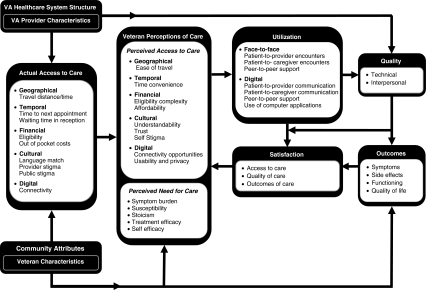
Many e-health technologies are available to promote virtual patient-provider communication outside the context of face-to-face clinical encounters. Current digital communication modalities include cell phones, smartphones, interactive voice response, text messages, e-mails, clinic-based interactive video, home-based web-cams, mobile smartphone two-way cameras, personal monitoring devices, kiosks, dashboards, personal health records, web-based portals, social networking sites, secure chat rooms, and on-line forums. Improvements in digital access could drastically diminish the geographical, temporal, and cultural access problems faced by many patients. Conversely, a growing digital divide could create greater access disparities for some populations. As the paradigm of healthcare delivery evolves towards greater reliance on non-encounter-based digital communications between patients and their care teams, it is critical that our theoretical conceptualization of access undergoes a concurrent paradigm shift to make it more relevant for the digital age. The traditional conceptualizations and indicators of access are not well adapted to measure access to health services that are delivered digitally outside the context of face-to-face encounters with providers. This paper provides an overview of digital "encounterless" utilization, discusses the weaknesses of traditional conceptual frameworks of access, presents a new access framework, provides recommendations for how to measure access in the new framework, and discusses future directions for research on access.
Overview
The claims and statistics of this paper haven’t been checked yet.
Free: it reads the open-access text and checks the first 5 claims that cite a source we can check. Create a free account to check every claim.
Integrity signals
Registry
Cites
Statistics
Figures
Verification
Claims the paper makes
The claims and statistics of this paper haven’t been checked yet.
Free: it reads the open-access text and checks the first 5 claims that cite a source we can check. Create a free account to check every claim.
Claims other papers make about this one
Each is checked against this paper’s own text: does it say what the citing paper says it does?
The cited source says what the claim attributes to it.
In the citing paper
“As described by Fortney et. al., access is a multidimensional concept including geographic, temporal, financial, digital, and cultural domains, and barriers to care can be considered within these areas.42”
From Receipt of Glucagon-Like Peptide-1 Receptor Agonists Among Rural Patients with Obstructive Sleep Apnea and Excess Weight (2026) · cites this paper as [42]
Self-check
Percentages, sums and reported differences re-computed from the paper’s own numbers.
The self-check needs the paper’s full text.
Citations
Cites
The theory of planned behavior
Ajzen, I. (1991) · Organizational Behavior and Human Decision Processes · doi:10.1016/0749-5978(91)90020-t · Cited by 134,657
Self-efficacy mechanism in human agency
Bandura, A. (1982) · American Psychologist · doi:10.1037/0003-066x.37.2.122 · Cited by 15,975
Evaluating the quality of medical care
DONABEDIAN, A. (2005) · The Milbank Quarterly · doi:10.1111/j.1468-0009.2005.00397.x · Cited by 6,102
Social Learning Theory and the Health Belief Model
Rosenstock, I. M., Strecher, V. J., & Becker, M. H. (1988) · Health Education Quarterly · doi:10.1177/109019818801500203 · Cited by 5,564 · cited 1×
“18 Perceived need is broadly conceptualized here as perceptions about symptom burden, susceptibility, stoicism, self efficacy, and treatment efficacy.”
BackgroundThe Concept of Access: Definition and Relationship to Consumer Satisfaction
Penchansky, R., & Thomas, J. W. (1981) · Medical Care · doi:10.1097/00005650-198102000-00001 · Cited by 3,437 · cited 1×
“5 As described in Figure 1, we propose the following dimensions of access: geographical, temporal, financial, cultural and digital.”
BackgroundThe definition of quality and approaches to its assessment
Donabedian, A. (1980) · Health Administration Press eBooks · Cited by 2,618
Internet-based cognitive behaviour therapy for symptoms of depression and anxiety: A meta-analysis
SPEK, V., CUIJPERS, P., NYKLÍČEK, I., RIPER, H., KEYZER, J., & POP, V. (2007) · Psychological Medicine · doi:10.1017/s0033291706008944 · Cited by 1,586
Healthcare via Cell Phones: A Systematic Review
Krishna, S., Boren, S. A., & Balas, E. A. (2009) · Telemedicine and e-Health · doi:10.1089/tmj.2008.0099 · Cited by 882 · cited 1×
“46 Another important type of asynchronous digital patient-to-provider encounter includes remote monitoring involving the entering/forwarding of clinical information by the patient to their provider via smartphones, kiosks, web-based portals hosted by the healthcare organization (e.g., MyHealtheVet…”
BackgroundBerwick, D. M. (2009) · Health Affairs · doi:10.1377/hlthaff.28.4.w555 · Cited by 869
Bethell, C. D., Read, D., Stein, R. E. K., Blumberg, S. J., Wells, N., & Newacheck, P. W. (2002) · Ambulatory Pediatrics · doi:10.1367/1539-4409(2002)002<0038:icwshc>2.0.co;2 · Cited by 698
Research works printed but not linked: 5
- Rosenstock IM Strecher VJ Becker MH Social learning theory and the Health Belief Model Health Educ Q 1988 15 2 175 183 10.1177/109019818801500203 3378902 · DOI · Paper page
- Ricketts TC Goldsmith LJ Access in health services research: The battle of the frameworks Nurs Outlook 2005 53 6 274 280 10.1016/j.outlook.2005.06.007 16360698 · DOI · Paper page
- Ricketts TC Goldsmith LJ Access in health services research: The battle of the frameworks Nurs Outlook 2005 53 6 274 280 10.1016/j.outlook.2005.06.007 16360698 · DOI · Paper page
- Sarasohn-Kahn J How Smartphones are Changing Health Care for Consumers and Providers 2010 CA Oakland
- Sarasohn-Kahn J How Smartphones are Changing Health Care for Consumers and Providers 2010 CA Oakland
Cited by
Items 201–300 of 312
Usability Assessment of a Post-Traumatic Stress Disorder (PTSD) mHealth App
Rodriguez-Paras, C., & Sasangohar, F. (2017) · Proceedings of the Human Factors and Ergonomics Society Annual Meeting · doi:10.1177/1541931213601937 · Cited by 4
Lin, M., MacDonald, L.-Q. L., Jin, J., & Reddy, A. (2020) · Healthcare · doi:10.1016/j.hjdsi.2020.100412 · Cited by 4
Temporal Access Barriers among Rural-Residing Veterans with Multiple Chronic Conditions
Hulen, E., Ono, S. S., Edwards, S. T., Pleasant, T., Lovejoy, T. I., & Coultas, D. (2024) · Practicing Anthropology · doi:10.1080/08884552.2023.2295197 · Cited by 4
Schmidt, D., Hedin, J., Pelegrina, A., Weyland, S., Rittmann, L.-M., & Jekauc, D. (2025) · Journal of Occupational Rehabilitation · doi:10.1007/s10926-025-10284-5 · Cited by 5
Exploring the advantages of using social network sites (SNSs) in dental medicine organisations
Franco, M., & Pais, L. (2017) · International Journal of Health Care Quality Assurance · doi:10.1108/ijhcqa-09-2016-0142 · Cited by 4
The Effects of Telephone Visits and Rurality on Veterans Perceptions of Access to Primary Care
Lampman, M. A., Stockdale, S. E., Kaboli, P. J., Jaske, E. L., Wood, G. B., Clinton, W. L., & Stewart, G. L. (2019) · The Journal of the American Board of Family Medicine · doi:10.3122/jabfm.2019.05.190047 · Cited by 4
“The use of telephone visits is 1 strategy being promoted to enhance access to primary care that does not require in-person visits.(2,3) A recent study from the Veterans Health Administration (VHA) found that the use of telephone communication is strongly associated with higher patient perceptions of access.”
BackgroundSelf-citationZamora, K. A., Abraham, T. H., Koenig, C. J., Hill, C., Pyne, J. M., & Seal, K. H. (2020) · Qualitative Research in Medicine & Healthcare · doi:10.4081/qrmh.2020.8977 · Cited by 4
Mujeres inmigrantes: ¿mujeres vulnerables?
Abreu, M. L. M. (2008) · Papeles de relaciones ecosociales y cambio global · Cited by 4
Bugs in the Virtual Clinic: Confronting Telemedicine’s Challenges Through Empathy and Support
Crotty, B. H., & Somai, M. M. (2022) · Journal of Participatory Medicine · doi:10.2196/25688 · Cited by 5
“Unless our profession achieves equal access and experiences for all our patients, digital and video visits may amplify the divide in care quality between those able to easily access care and those who face major barriers: older or differently abled populations, underserved populations, and racial and ethnic minority p…”
BackgroundShannon, E. M., Steers, W. N., & Washington, D. L. (2023) · Health Services Research · doi:10.1111/1475-6773.14260 · Cited by 3
“7,28,47,48 Further, using a behavioral measure, such as the number of PACT visits, would be imprecise as we could not determine the indication for such visits in our data.”
MethodDevelopment and Test of a Text-Messaging Follow-Up Program After Sexual Assault
Downing, N. R., Bogue, R. J., Terrill, P., & Tucker, S. (2021) · Violence Against Women · doi:10.1177/10778012211014567 · Cited by 6
“Text messaging is emerging as an improved method of follow-up care in other patient populations (Fortney et al., 2011; Krishna et al., 2009).”
MethodUniversal Access to a Percutaneous Coronary Intervention Hospital: Is It Feasible or Desirable?
Girotra, S. R., & Cram, P. M. (2012) · Circulation Cardiovascular Quality and Outcomes · doi:10.1161/circoutcomes.111.964270 · Cited by 4
Leonhard, A. G., Josey, K., Castaneda, J. M., Chee, M., Duan, K. I., Nadeem, H., Plumley, R., Triplette, M., Smith, N. L., Au, D. H., et al. (2026) · Annals of the American Thoracic Society · doi:10.1093/annalsats/aaoag047 · Cited by 3
Rural Veteran Perceptions of a Virtual Health Resource Center in a Community-Based Setting
Marcotte, L. M., Theis, M., Geyer, J. R., Sayre, G. G., Rao, M., Pho, K., Gunnink, E. J., & Reddy, A. (2025) · Journal of General Internal Medicine · doi:10.1007/s11606-025-09980-y · Cited by 3
“26 From the framework, we used constructs of actual access to care, perceived access to care, and perceived utilization of care to develop an interview guide (Appendix 1).”
Adaji, A., Newcomb, R. D., Wang, Z., & Williams, M. (2017) · Journal of Occupational and Environmental Medicine · doi:10.1097/jom.0000000000001173 · Cited by 3
The Feasibility of a Family-Focused CBT Skills Self-Help App
Kriegshauser, K. D., Sexton, C. C., Bozsik, F. M., Blossom, J. B., Wiese, A. D., Larsen, M. A., & Hale, L. R. (2022) · Cognitive and Behavioral Practice · doi:10.1016/j.cbpra.2022.09.001 · Cited by 3
Laird, B., Zuniga, S. G., Hook, J. N., Tongeren, D. R. V., Joeman, L., & Huberty, J. (2024) · JMIR Formative Research · doi:10.2196/52560 · Cited by 3
“Others have reported that perceived access may be no less valid than actual access and may be a stronger predictor of use than actual access [67,74].”
BackgroundLeung, L. B., Santos, J. J., Escarce, J. J., Ettner, S. L., Der‐Martirosian, C., Raja, P. V., McCourt, A. D., Fortney, J. C., & McGinty, E. E. (2024) · PLoS ONE · doi:10.1371/journal.pone.0312665 · Cited by 6
Self-citationSafeguarding Virtual Healthcare: A Novel Attacker-Centric Model for Data Security and Privacy
Herath, S., Gelman, H., Hastings, J., & Wang, Y. (2024) · International Conference on Computer and Applications (ICCA) · doi:10.1109/icca62237.2024.10927870 · Cited by 3
“There are several benefits of adopting VHM [5], [6].”
Experience of the Veterans Health Administration in Massachusetts After State Health Care Reform
Chan, S. H., Burgess, J. F., Clark, J. A., & Mayo‐Smith, M. F. (2014) · Military Medicine · doi:10.7205/milmed-d-14-00093 · Cited by 3
Self-citationAbraham, T. H., McBain, S. A., Goudie, A., Hudson, T. J., & Thompson, J. W. (2020) · INQUIRY The Journal of Health Care Organization Provision and Financing · doi:10.1177/0046958020981169 · Cited by 3
Cannon, N. J., Jurski, K., & Ulferts, G. W. (2014) · American Journal of Health Sciences (AJHS) · doi:10.19030/ajhs.v5i2.8961 · Cited by 4
Katon, J. G., Bossick, A. S., Tartaglione, E. V., Enquobahrie, D. A., Haeger, K. O., Johnson, A. M., Ma, E. W., Savitz, D. A., Shaw, J. G., Todd-Stenberg, J., et al. (2023) · Journal of Women s Health · doi:10.1089/jwh.2022.0507 · Cited by 4
PTSD Coach Usability Testing: A Mobile Health App for Post-Traumatic Stress Disorder (PTSD)
Rodriguez-Paras, C., & Sasangohar, F. (2017) · Proceedings of the International Symposium on Human Factors and Ergonomics in Health Care · doi:10.1177/2327857917061001 · Cited by 3
“Connected Access”: Titrating the Right Dose of Access in the Digital Age
Vigilante, K. C., & Khan, M. M. (2019) · Journal of Ambulatory Care Management · doi:10.1097/jac.0000000000000304 · Cited by 3
Deka, M. A. (2020) · Journal of Agromedicine · doi:10.1080/1059924x.2020.1765930 · Cited by 3
“Degrees of accessibility were quantified as being excessively distant at a threshold of greater than 30minutes, as recommended by Fortney et al.(34) and by the United States Department of Health and Human Services.”
BackgroundWong, E. S., Maciejewski, M. L., Hebert, P. L., Fortney, J. C., & Liu, C. (2018) · Administration and Policy in Mental Health and Mental Health Services Research · doi:10.1007/s10488-018-0900-z · Cited by 3
Self-citationPringle, J. L., Milićević, A. S., Fawcett, J. A., May, J. H., Kearney, S. M., Tjader, Y. C., Vargas, D. L., Vargas, L. G., Radack, J., & Alaigh, P. (2018) · American Journal of Medical Quality · doi:10.1177/1062860618798046 · Cited by 3
Trust and Credibility Perception in E-Health: Interface Contributions
de Sousa, A. P., & Almeida, A. M. P. (2016) · IGI Global eBooks · doi:10.4018/978-1-4666-9978-6.ch086 · Cited by 7
The use, usability and persuasiveness of PAZIO, an online healthcare portal
Boven, R. I.-V. (2013) · Cited by 3
Motivators, Barriers, and Facilitators to Choosing Care in VA Facilities Versus VA-Purchased Care
Slatore, C. G., Scott, J. Y., Hooker, E. R., Disher, N. G., Golden, S. E., Govier, D. J., & Hynes, D. M. (2024) · Medical Care Research and Review · doi:10.1177/10775587241264594 · Cited by 2
“…models of access to health care, care coordination, patient-centered communication, and shared decision-making (Elwyn et al., 2012, 2017; Fortney, Burgess, et al., 2011; Fortney, Kaboli, & Eisen, 2011; Mead & Bower, 2000; Peterson et al., 2018; U.S. Department of Veterans Affairs, 2010;…”
Boykin, D. M., Haney, L., Amspoker, A. B., Walder, A. M., & Hundt, N. E. (2025) · The Journal of Rural Health · doi:10.1111/jrh.70013 · Cited by 3
Humber, M. B., Carlson, C., Peeples, A., TRIVEDI, R. B., Paiko, L., Alfaro, A. J., Lloyd, A. M., & Gould, C. E. (2025) · Journal of Technology in Behavioral Science · doi:10.1007/s41347-025-00554-7 · Cited by 3
Bhat, A. S., Ruben, J. P., Kalidindi, B., Devadass, D., Goud, B. R., Raj, T. D. S., Selvam, S., Navarro-Aguirre, Y., Collins, P. Y., & Srinivasan, K. (2025) · JMIR Formative Research · doi:10.2196/68052 · Cited by 2
“The conceptual model for MITHRA is based on Fortney et al’s [13] access to care model, and MITHRA targets actual and perceived barriers to access identified by patients.”
Ellis‐Griffith, G., Michimi, A., English, G., & Peterson, T. L. (2013) · International Journal of Reliable and Quality E-Healthcare · doi:10.4018/ijrqeh.2013010103 · Cited by 2
de Sousa, A. P., & Almeida, A. M. (2015) · InfoDesign - Revista Brasileira de Design da Informação · doi:10.51358/id.v12i1.351 · Cited by 2
Duranceau, S., Zamorski, M. A., & Carleton, R. N. (2019) · Journal of Military Veteran and Family Health · doi:10.3138/jmvfh.2018-0044 · Cited by 5
Hawkins, E. J., Lott, A. M. K., Danner, A. N., Malte, C. A., Dulin, P. L., Fortney, J. C., Sayre, G. G., & Baer, J. S. (2022) · Psychological Services · doi:10.1037/ser0000716 · Cited by 2
Self-citationAlam, M. S., Tabassum, N. J., & Tokey, A. I. (2023) · ASCE International Conference on Transportation and Development (ICTD) · doi:10.1061/9780784484883.054 · Cited by 2
Williams, C. Y., Owen, J. J., Rousmaniere, T. G., Harris, J., & Goldberg, S. B. (2024) · Professional Psychology Research and Practice · doi:10.1037/pro0000583 · Cited by 3
Unveiling patient-centric interactions in virtual consultation: A comprehensive text mining approach
Shi, Y. V., & Komiak, S. (2025) · Health Informatics Journal · doi:10.1177/14604582251327093 · Cited by 6
“20,21 The ongoing evolution of virtual consultation necessitates continuous research to adapt to emerging challenges and opportunities in the realm of digital health.”
Measures of the Availability and Accessibility of Behavioral Health Services: A Scoping Review
Hooley, C., Adams, D. R., Wendt, C. L. E., & Dennis, C. B. (2025) · Psychiatric Services · doi:10.1176/appi.ps.20240282 · Cited by 3
Hua, Y., Xie, J., Liu, L., & Chen, A. (2015) · Lecture notes in computer science · doi:10.1007/978-3-319-19156-0_13 · Cited by 2
Where does health communication technology fit into allergy practice?
Bender, B. G. (2018) · Annals of Allergy Asthma & Immunology · doi:10.1016/j.anai.2018.05.018 · Cited by 2
Mohamed, W. M. Y., Kutty, S. K., Khedher, A., & Chatterjee, I. (2022) · Neuroscience Research Notes · doi:10.31117/neuroscirn.v5i1.126 · Cited by 4
“Smartphones are cell phones specializing in producing a new generation of clinical research with additional computing capabilities/services (Fortney et al., 2011; Boulos et al., 2011).”
BackgroundOptimal Network of General Hospitals in Slovenia
Blatnik, P., & Bojnec, Š. (2023) · International Journal of Environmental Research and Public Health · doi:10.3390/ijerph20054235 · Cited by 2
“These three different time intervals of accessibility are also the most frequently mentioned time intervals in theory [27].”
BackgroundCrossing Boundaries : Transferring eHealth services across the Northern Periphery
Pesola, U.-M. (2013) · DiVA at Umeå University (Umeå University) · Cited by 4
Fortney, J. C., & Owen, R. R. (2014) · American Journal of Psychiatry · doi:10.1176/appi.ajp.2013.13121701 · Cited by 2
“, Amazon) has increased market share in the retail industry (15).”
BackgroundSelf-citationExamining Trust as a Key Determinant of eHealth Adoption in MalawiPreprint
Gadabu, A., Sunguh, K. K., Arkorful, V. E., Uddin, M. M., & Lukman, S. (2019) · doi:10.21203/rs.2.17368/v1 · Cited by 2
Receipt of weight management services among patients with OSA and obesity
Leonhard, A. G., McDowell, J., Hoerster, K. D., Hayes, S., Picazo, F., Castaneda, J. M., Josey, K., Griffith, M., Ma, J., Duan, K. I., et al. (2025) · CHEST Pulmonary · doi:10.1016/j.chpulm.2025.100156 · Cited by 1
“37 Accordingly, telehealth options are seen as a particularly attractive option for weight management services, extending the reach of such services as lifestyle programs (eg, TeleMOVE”
Chingombe, I., Mapingure, M. P., Balachandra, S., Chipango, T. N., Gambanga, F., Mushavi, A., Apollo, T., Suraratdecha, C., Rogers, J. H., Ruangtragool, L., et al. (2021) · PLoS ONE · doi:10.1371/journal.pone.0256291 · Cited by 1
“Financial barriers hinder access to health services in low- and middleincome countries [12, 13] and are usually related to out-of-pocket expenses and the impact on household budgets [14].”
BackgroundSayat, M., Morgan, T., Wiles, J. L., Morgan, K., & Gott, M. (2024) · Health & Social Care in the Community · doi:10.1155/2024/8659555 · Cited by 3
“Fortney et al. [48] added a “cultural” component to their framework that addresses the provider and consumer’s stigma [48].”
BackgroundJespersen, B. V., Lafferty, M., Montague, K., Ono, S. S., Helfand, M., & Nugent, S. M. (2025) · Journal of General Internal Medicine · doi:10.1007/s11606-025-09352-6 · Cited by 1
Resistance to Switching Health Care Institution Among Veterans Referred for VA-Purchased Care
Slatore, C. G., Disher, N. G., Scott, J. Y., Golden, S. E., Hooker, E. R., Govier, D. J., & Hynes, D. M. (2025) · Journal of General Internal Medicine · doi:10.1007/s11606-025-09404-x · Cited by 1
Nietsch, K. S., Estevez, S. L., Goodsmith, N., Haeger, K. O., Inderstrodt, J. M., Inslicht, S. S., Kosman, K. A., Mu, Q., Nillni, Y. I., Quinn, D. A., et al. (2025) · Health Equity · doi:10.1089/heq.2024.0168 · Cited by 1
Donovan, L. M., Feemster, L. C., Collins, M. P., Gleason, E., Josey, K., Duan, K. I., Plumley, R., Coggeshall, S. S., Wai, T. H., Petrova, V., et al. (2025) · Contemporary Clinical Trials · doi:10.1016/j.cct.2025.107961 · Cited by 1
High Users of Primary Care Secure Messaging in the Veterans Health Administration
Staloff, J. A., Gunnink, E. J., Rojas, J., Wong, E. S., Hagan, S. L., Nelson, K. M., & Reddy, A. (2025) · The Annals of Family Medicine · doi:10.1370/afm.240360 · Cited by 1
Perceived Access, Perceived Need for Treatment, and the Decision to Seek Care for COPD Exacerbations
Fan, V. S., Hebert, P. L., Locke, E. R., Simpson, T. L., Swenson, E. R., Edelman, J. D., Battaglia, C., TRIVEDI, R. B., & Fortney, J. C. (2025) · Journal of General Internal Medicine · doi:10.1007/s11606-025-09786-y · Cited by 1
Self-citationKivelä, A., Aittasalo, M., Renlund, M., Heinonen, S. T., Sarkola, T., Laivuori, H. M., & Jääskeläinen, T. J. (2025) · BMC Digital Health · doi:10.1186/s44247-025-00224-x · Cited by 1
“The rapid development of digital health technologies offers new avenues for delivering such interventions, enhancing patient care, and improving access to health resources [10].”
Govier, D. J., Than, C. T., Danan, E. R., Chawla, N., Hoggatt, K. J., Yano, E. M., & Hynes, D. M. (2025) · Journal of General Internal Medicine · doi:10.1007/s11606-025-09952-2 · Cited by 1
Gray, C. P., Hou, C., Brayton, C. E., Shepardson, R. L., & Leung, L. B. (2026) · Journal of General Internal Medicine · doi:10.1007/s11606-026-10617-x · Cited by 1
Solbi, Z., Shati, M., Amiri, P., Sohrabi, M., Borhaninejad, V., & Mohseny, M. (2026) · BMC Geriatrics · doi:10.1186/s12877-026-07972-z · Cited by 1
“Various frameworks have been proposed over the past decades to determine healthcare accessibility dimensions [22].”
Potential of Mobile Applications in Prevention and Management of Cardio-Metabolic Diseases
Ramadas, A., & Fatt, Q. K. (2017) · Public Health - Open Journal · doi:10.17140/phoj-2-114
Caces, M. F., Delany, P. J., & Cala, M. A. (2019) · Contemporary Rural Social Work Journal · doi:10.61611/2165-4611.1164
“…in the use evidence-based screening and assessment practices and the use of prescription opioid analgesics, alternative pain management strategies, and the use of databases to review patient history prior to prescribing controlled substances (CDC, 2013); Franklin et al., 2015; ONDCP, 2011).”
BackgroundDonovan, L. M., Parsons, E. C., McCall, C., He, K., Sharma, R. K., Gamache, J., Pannick, A. P., McDowell, J., Pai, J., Epler, E. M., et al. (2022) · Sleep And Breathing · doi:10.1007/s11325-022-02608-z · Cited by 1
“In-person visits present geographic and logistical barriers for patients and create space and staffing limitations for health systems [2].”
BackgroundDirontsho, M., Ngwenya, B. N., Kolawole, O. D., Motsholapheko, M. R., & Pagiwa, V. (2022) · Journal of Community Health · doi:10.1007/s10900-022-01172-7 · Cited by 2
“In sum, this paper has unearthed psychosocial factors that could influence the implementation of an effective healthcare delivery in malaria prevention and treatment in the Okavango Delta, Botswana.”
BackgroundInfluentialHooley, C., Adams, D. R., Ng, W. Y., Wendt, C. L. E., & Dennis, C. B. (2024) · Discover Mental Health · doi:10.1007/s44192-024-00068-3 · Cited by 2
“However, using utilization as a proxy for access may lead to misestimates of the reachability of services by the target population [4].”
MethodBaig, M. R., Meraj, A., & Tapia, R. N. (2020) · Psychiatric Quarterly · doi:10.1007/s11126-020-09767-w · Cited by 1
“Unfortunately, barriers to access interferes with rehabilitation efforts and delay recovery process of help-seeking veterans living in rural settings [26].”
BackgroundVanDeusen, A., Zacharek, N., Springer, E., Venkat, A., Cohn, A. E. M., Adams, M. A., Kurlander, J. E., & Saini, S. D. (2020) · Winter Simulation Conference · doi:10.1109/wsc48552.2020.9383970 · Cited by 1
“Geographic distance is a key barrier to care, especially for people living in rural areas and/or those who do not have access to reliable transportation (Penchansky and Thomas 1981; Kullgren et al. 2012; Fortney et al. 2011).”
BackgroundEnhancing Problem-Solving Therapy With Smartphone Technology: A Pilot Randomized Controlled Trial
Grubbs, K. M., Abraham, T. H., Pyne, J. M., Greene, C. J., Teng, E. J., & Fortney, J. C. (2022) · Psychiatric Services · doi:10.1176/appi.ps.201900254 · Cited by 2
Self-citationBranson, T. L. (2013) · DigitalGeorgetown (Georgetown University Library)
Using Telehealth to Expand and Strengthen the Patient Centered Care Model for Veterans
Koperski, D. (2013) · Scholars' Bank (University of Oregon)
Qualitative analysis of Web-based refractive surgery information sessions
Shtein, R. M., & Lee, P. P. (2013) · Journal of Cataract & Refractive Surgery · doi:10.1016/j.jcrs.2013.11.007
“Internet accessibility is increasing with new technology and is often logistically easier than an in-person appointment.(6) People, including older patients, are becoming more comfortable with this technology.”
BackgroundDependência de tecnologia: o desenvolvimento de um website psicoeducativo
Picon, F. A., Moreira, L. M., & Spritzer, D. T. (2012)
Behavioral Health Consultant Core Competencies
Robinson, P. J., & Reiter, J. T. (2015) · Springer eBooks · doi:10.1007/978-3-319-13954-8_5
Listening to Veterans about Access to Care
Wright, S. M. (2015)
Petrescu-Prahova, M. G., Steinman, L. E., Dronen, A., Rigor, S., & Snowden, M. B. (2017) · Military Behavioral Health · doi:10.1080/21635781.2017.1316805
Malebranche, M. (2016) · Digital USD (University of San Diego) · doi:10.22371/07.2016.007
Womens Needs Related to Family Planning: Meta-Synthesis
Pedrosa, E. N. (2018) · World Scientific Research · doi:10.20448/journal.510.2018.51.44.56
“[32] The availability indicates the existence of health resources with sufficient capacity to pay the necessary attention at appropriate time [6, 8, 10].”
BackgroundAccess to contraception: A nonprofit’s community strategy
Sagrestano, L. M., Clay, J. A., Finerman, R. D., Madjlesi, A. F., Gettings, N., & Ashby, S. (2019) · Women s Reproductive Health · doi:10.1080/23293691.2019.1619055
Duranceau, S. (2017) · oURspace (University of Regina) · doi:10.82465/7429
Promoting Health Literacy in Global Health Care
Kasemsap, K. (2016) · IGI Global eBooks · doi:10.4018/978-1-5225-1674-3.ch012
Mohamed, W. M. Y. (2021) · AfricArXiv (OSF Preprints) · doi:10.31730/osf.io/nm3dz
Hilgeman, M. M., Cramer, R. J., Hoch, M. C., Collins, A. N., Zabelski, S., & Heebner, N. R. (2022) · Military Medicine · doi:10.1093/milmed/usac072
Santoyo-Sánchez, G., Reyes‐Morales, H., Flores‐Hernández, S., Pelcastre‐Villafuerte, B. E., & Merino‐Soto, C. (2023) · Evaluation & the Health Professions · doi:10.1177/01632787231158806 · Cited by 1
“Second, it has been suggested that measurements that incorporate user perspectives may shed greater light on the construct of access than those centered on objectively measurable dimensions (Fortney et al., 2011; Ricketts & Goldsmith, 2005).”
BackgroundSilvola, S., Restelli, U., Croce, D., & Danova, M. (2024) · International Journal of Healthcare Management · doi:10.1080/20479700.2024.2440825
Kurkurina, E., Judon, K. M., Hwang, U., Boockvar, K. S., Wisnivesky, J. P., & Augustine, M. R. (2024) · Journal of Geriatric Emergency Medicine · doi:10.17294/2694-4715.1100
Access to Healthcare in the Digital Age: An Urban E-Planning Perspective
Occelli, S. (2024) · Advances in electronic government, digital divide, and regional development book series · doi:10.4018/979-8-3693-5956-3.ch017
Digitale relatie-interventies: stand van zaken in het veld en aanwijzingen voor de toekomst
Knopp, K. C., Schnitzer, J. S., Khalifian, C. E., Grubbs, K. M., Morland, L. A., & Depp, C. A. (2025) · Gezinstherapie Wereldwijd · doi:10.1007/s12440-025-00251-0
“Digitale platforms hebben minder geografische en temporele drempels waardoor het gemakkelijker wordt om toegang tot zorg te krijgen (Fortney et al. 2011).”
Leung, L. B., Brayton, C. E., Shepardson, R. L., Gray, C. P., Lee, M. L., Funderburk, J. S., & Fortney, J. C. (2025) · BMJ Open · doi:10.1136/bmjopen-2024-094624
“We will adapt Fortney et al ’s access framework 37 to guide study variable selection.”
Self-citationToal-Sullivan, D., Dahrouge, S., Tesfaselassie, J., & Olejnik, L. J. (2024) · Figshare · doi:10.6084/m9.figshare.26716516
Zogas, A., Vimalananda, V. G., McCullough, M. B., Linsky, A. M., Chatelain, L., & Mattocks, K. M. (2026) · Medical Care · doi:10.1097/mlr.0000000000002297
Understanding the Links Between Migration, Climate Change and Health
Siegel, M., & Mori, G. (2026) · United Nations University series on regionalism · doi:10.1007/978-3-032-10550-9_2
Hill, R. A., Maden, M., Duarte, R. V., Eldabe, S. S., Golder, S., Chaplin, M., Shaw, B., Sutcliffe, K., Todd, A., Bresnahan, R., et al. (2026) · Health Technology Assessment · doi:10.3310/gdwp3572
Khan, S., & Stansbury, R. C. (2026) · Annals of the American Thoracic Society · doi:10.1093/annalsats/aaoag119
The Factors Associated with Access to Healthcare Services for Cancer Patients in Saudi Arabia
Alakrawi, Z., Al-Kahtani, N. K., Alsaffar, A., Alhamadah, B., Altawal, N., Aljumaia, H., Alakrawi, K., & Mushcab, H. (2026) · Healthcare · doi:10.3390/healthcare14101399
“A study by Fortney et al. (2011) highlights various electronic health technologies that facilitate virtual communication be-tween patients and healthcare providers beyond traditional face-to-face encounters [18,22].”
InfluentialHogan, T. P., Etingen, B., McMahon, N., Escudero, G. S., Calkins, S., Moussa, A., Slightam, C., Zulman, D. M., Shimada, S. L., Robinson, S. A., et al. (2026) · Frontiers in Digital Health · doi:10.3389/fdgth.2026.1677472
Veterans Affairs Clinical Resource Hub Improve Access to Mental Health Services for Rural Veterans
Jaske, E. L., Wheat, C. L., Nelson, K. N., Curtis, I., Wahlberg, L., & Felker, B. L. (2026) · Telemedicine Journal and e-Health · doi:10.1177/15305627261458161
“39,41 These efficiencies enable better resource allocation and cost saving for both Veterans and the health care system, particularly in regions with limited local MH expertise.”
Donovan, L. M., Artis, K. A., Bhatt, S. P., Feemster, L. C., Aaron, S. D., Baldomero, A. K., Duan, K. I., Federman, A. D., Harris, B. A., Henderson, K., et al. (2026) · Annals of the American Thoracic Society · doi:10.1093/annalsats/aaoag184
Metadata
- Authors
- Fortney, J. C., Burgess, J. F., Bosworth, H. B., Booth, B. M., & Kaboli, P. J.
- Affiliations
- Health Services Research & Development (US)
- Boston University (US)
- Duke University (US)
- University of Iowa (US)
- Corresponding author
- Fortney, John C.
- Venue
- Journal of General Internal Medicine
- Published
- 2011-10-12
- Volume
- 26
- Issue
- S2
- Pages
- 639-47
- ISSN
- 0884-8734 (ISSN-L)
- 1525-1497
- PMC
- PMC3191218
- OpenAlex
- W2035798031
- Semantic Scholar
- 817e5e54e16b01a30d49c1789b7ed51a7f5f1b17
- Cited by
- 311
- References
- 59
- Citations by year
- 2026: 23 · 2025: 22 · 2024: 21 · 2023: 23 · 2022: 25 · 2021: 17 · 2020: 22 · 2019: 26 · 2018: 26 · 2017: 20 · 2016: 10 · 2015: 26 · 2014: 12 · 2013: 23 · 2012: 9
- FWCI
- 2.37
- Type
- journal article
- Language
- en
- Open access
- hybrid
- doi.org
- Licence
- cc-by-nc
- creativecommons.org/licenses/by-nc/2.0 (tdm)
- Locations
- Journal of General Internal Medicine (publishedVersion, cc-by-nc)
- Europe PMC (PubMed Central) (publishedVersion, cc-by-nc)
- PubMed Central (publishedVersion, cc-by-nc)
- PubMed (publishedVersion)
- Funders
- U.S. Department of Veterans Affairs (08-027)
- Health Services Research and Development (#08‐027)
- Office of Rural Health
- NIH Clinical Center
- Topics
- Health Sciences › Medicine › Public Health, Environmental and Occupational Health › Telemedicine and Telehealth Implementation
- Health Sciences › Health Professions › General Health Professions › Health Literacy and Information Accessibility
- Health Sciences › Health Professions › Health Information Management › Electronic Health Records Systems
- Keywords
- health care access, e-health, digital health communication, digital divide, access inequality, telemedicine, mobile health
- MeSH terms
- Diffusion of Innovation, Forecasting, Health Services Accessibility, Health Services Needs and Demand, Humans, User-Computer Interface, Telemedicine, Patient-Centered Care, Internet, Biomedical Technology, Veterans Health
About these checks
Registry, retraction, Cites and statistics results are computed, not judged, with one exception: a printed reference that no index lists is read once by a model before it counts as a citation error. Claims are extracted by a model and kept only when their quote appears verbatim in the text; each cited source is then checked, with a model’s help, for whether it says what the claim relies on. Those verdicts can be wrong — read the claim’s quote and the cited source before relying on one.
Statistics and arithmetic are recomputed, not judged.
Confidence bands are shown only for fields calibrated on our annotated test set. None is calibrated yet, so no band is shown.
What counts as a claim ›How we measure confidence ›How we check this ›
Are you an author, or do you see a problem with this page? Request a review
Data sources
Bibliographic data: Semantic Scholar, OpenAlex, Crossref.
Contains information from the Semantic Scholar Academic Graph Datasets, made available under the ODC Attribution License (ODC-BY 1.0).
Semantic Scholar’s data is described in: Kinney, R., et al. (2023). The Semantic Scholar Open Data Platform. arXiv:2301.10140.
