

Deep Industrial Image Anomaly Detection: A Survey
Open accessThe DOI matches its Crossref record; 198 of the 229 references it cites were found in a registry or an index, and 4 are not checked yet; 25 of the 64 sources its claims cite were checked for support.
Abstract
The recent rapid development of deep learning has laid a milestone in industrial image anomaly detection (IAD). In this paper, we provide a comprehensive review of deep learning-based image anomaly detection techniques, from the perspectives of neural network architectures, levels of supervision, loss functions, metrics and datasets. In addition, we extract the promising setting from industrial manufacturing and review the current IAD approaches under our proposed setting. Moreover, we highlight several opening challenges for image anomaly detection. The merits and downsides of representative network architectures under varying supervision are discussed. Finally, we summarize the research findings and point out future research directions.
Verified 2026-11-25 · 4 references not checked yet
Overview
CoChat Summary
TL;DR
This survey reviews deep learning-based industrial image anomaly detection (IAD) across network architectures, supervision levels, loss functions, metrics, and datasets, and proposes an industrial manufacturing setting for evaluation. It finds memory-bank methods strongest for image-level detection, reconstruction-based methods stronger for pixel-level segmentation, and highlights open challenges in datasets, metrics, efficiency, and real-line deployment.
Key findings
- The survey covers 20 IAD datasets and 6 metrics, compared with 9 datasets/3 metrics in Tao et al. and 7 datasets/1 metric in Cui et al. (Table 1); it also states that most deep learning IAD methods are more than 97% accurate.
- Memory bank-based approaches are the most effective neural network design for image-level anomaly detection, but they are inadequate at pixel-level anomalies; ensemble learning can dramatically improve state-of-the-art methods, and SSPCAB can be seamlessly integrated into cutting-edge methods to significantly enhance reconstruction-based methods.
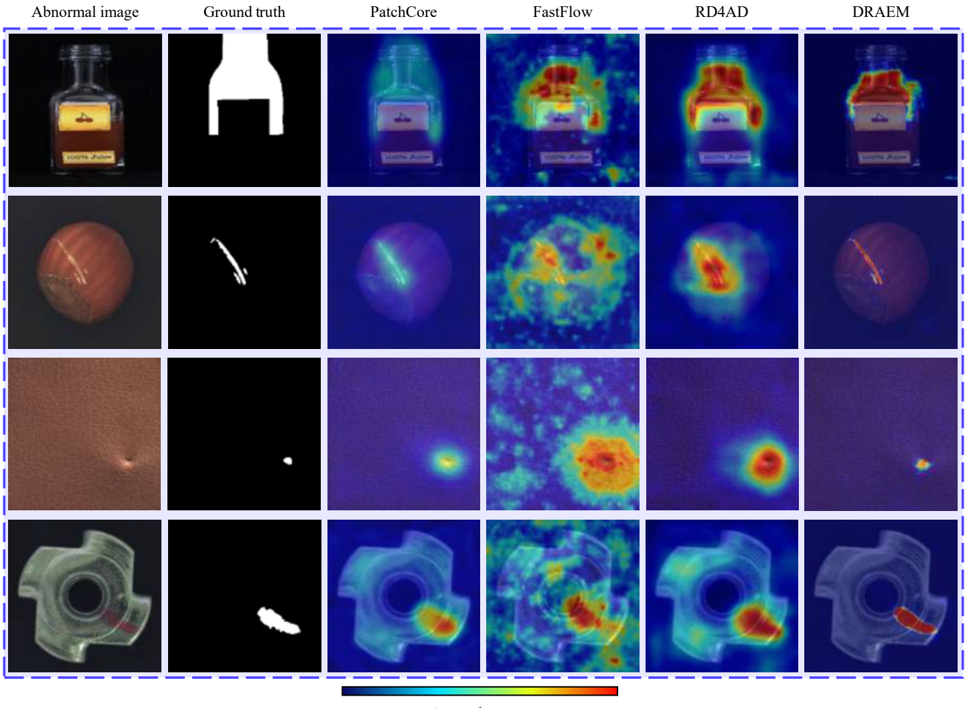
- Without ensemble learning, MemSeg achieved the SOTA result on image-level anomaly classification, attributed mainly to its U-Net framework; DRAEM also uses U-Net and outperformed other methods on pixel-level anomaly segmentation. AU-PR is more valuable than AU-ROC for segmentation tasks, and reconstruction-based methods outperform other methods on pixel AU-PR.
- The gap between few-shot IAD and vanilla IAD is narrowing; segmentation modules are beneficial for anomaly detection even when trained with artificially generated anomalies. Future directions include multi-modality IAD datasets, inference speed, industrial pretrained models, fully supervised pixel-level datasets, abnormal synthesis, lightweight models, and unifying industrial and medical IAD.
Methods
- Literature review/survey; no new primary experiments. It reviews deep learning IAD from the perspectives of neural network architectures, levels of supervision, loss functions, metrics, and datasets, and extracts a promising industrial manufacturing setting.
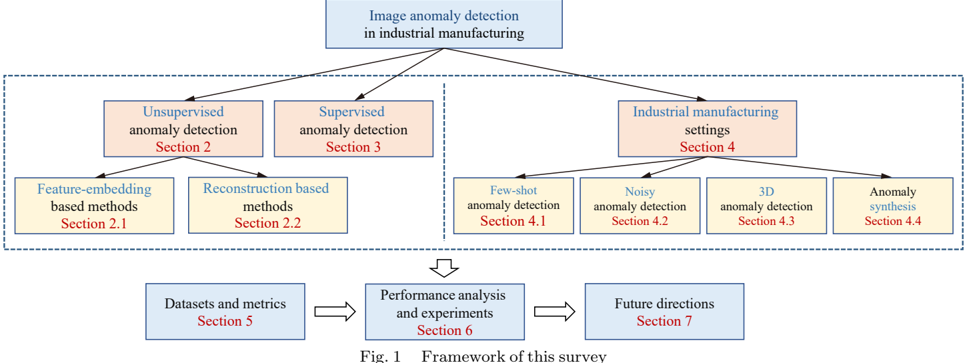
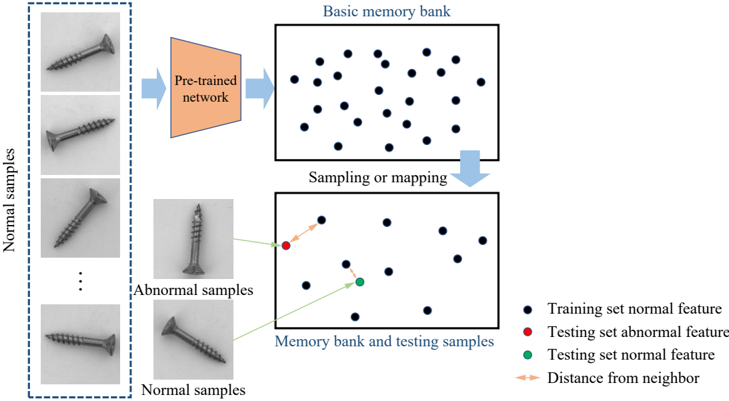
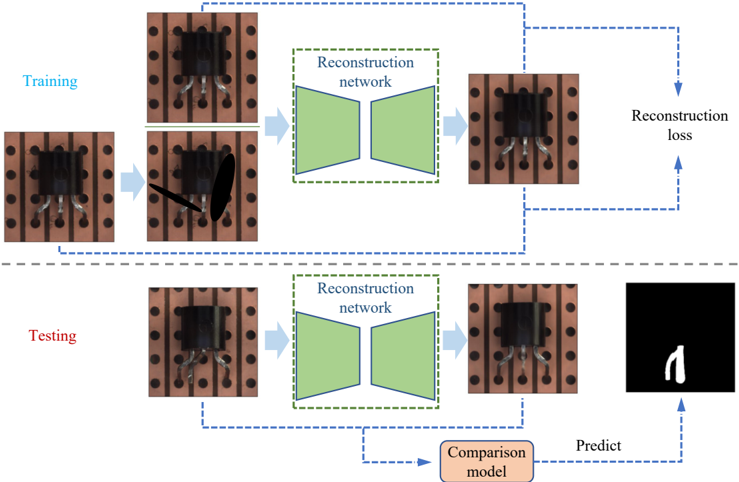
- Taxonomy: unsupervised anomaly detection is divided into feature-embedding methods (teacher-student, one-class classification, distribution map, memory bank) and reconstruction-based methods (autoencoder, GAN, transformer, diffusion); supervised anomaly detection is also reviewed. Industrial settings covered are few-shot anomaly detection, noisy anomaly detection, 3D anomaly detection, and anomaly synthesis.
- Performance analysis: statistical comparison of current IAD methods on MVTec AD using image AUROC and pixel AUROC/AUPR. Results are reported from original papers, with some reproduced by the authors and marked with *.
Limitations
- The paper states that the public cannot access real-world anomalous datasets due to privacy concerns; most open-source IAD datasets generate anomalies from anomaly-free products, so their abnormalities may not occur in actual production lines, and multiple-domain IAD datasets are lacking.
- The paper states that there is no uniform assessment for image-level and pixel-level IAD performance; most metrics shrink the anomalous mask to the feature-map size, reducing assessment precision, and the validity of common metrics for IAD remains to be explored. It also notes that most noisy anomaly detection methods have not been verified on real industrial image datasets, and most 3D IAD methods are specialized for RGB-D images while real-world 3D manufacturing data consists of point clouds.
- Evident from the text: the survey’s performance tables contain many missing entries and rely largely on reported results, with only some reproduced; no new benchmark experiments are conducted. The paper also states that current algorithms often focus on detection accuracy while ignoring storage size and efficiency.
Model-written summary. Check it against the paper before relying on it.
Integrity signals
Registry
Cites
Statistics
Figures






Verification
Claims the paper makes
18 Valid · 21 Not valid · 26 Not checked · 62 Own results and interpretations
Every source the paper cites for this claim was checked and supports it.
In the paper
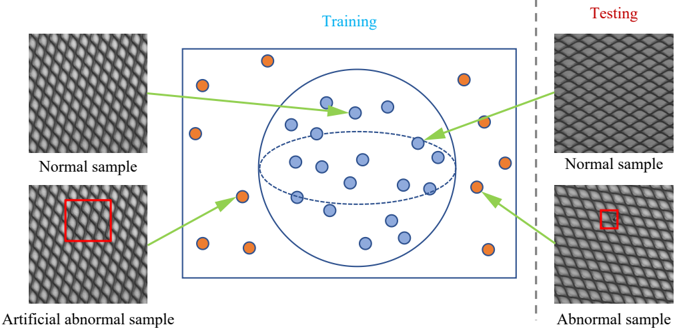
“FCDD [35] is an unsupervised method that synthesizes abnormal samples for training the OCC model.”
What the sources say
- Supportedcites [35] [35] - T. Reiss, Y. Hoshen. Mean-shifted contrastive loss for anomaly detection, [Online], Available: https://arxiv.org/ abs/2106.03844, 2021. source
Section 4.2 (pp. 7–8) describes generating synthetic anomalies with confetti noise for FCDD and evaluates it in an unsupervised setting. Section 3 (p. 4) confirms that synthetic anomalies can be used for training when known anomalies are unavailable. Synthetic anomalies are an option, not a requirement of FCDD. (LLM, conf=0.87)
plainstates a cause- Asserted: passes — The authors put it forward as true.
- Checkable: passes — It can be checked against evidence.
- Load-bearing: unclear — It is unclear whether the paper’s conclusions depend on it.
- Based: passes — The paper gives a reason why it holds.
- Supported
The cited sources support only part of this claim — read each source’s verdict below.
In the paper
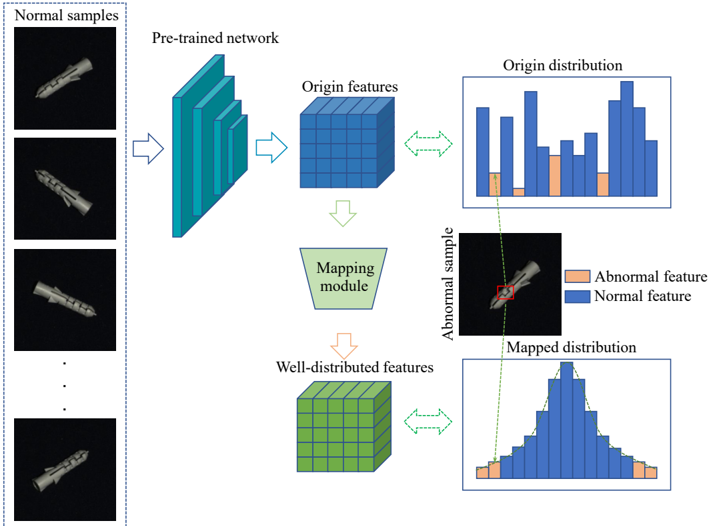
“PaDiM requires the batch-inverse of the multidimensional covariance tensor, which makes it challenging to scale up to larger CNNs due to the increased feature size.”
What the sources say
- Partly supportedcites [73] [73] - J. Jang, E. Hwang, S. H. Park. N-pad: Neighboring pixelbased industrial anomaly detection, [Online], Available: https://arxiv.org/abs/2210.08768, 2022. sourceExperimental — accuracy not yet measured
“Learning of the normality” (p. 3) says PaDiM estimates a covariance matrix for each patch and makes it invertible. “Ablative studies” (pp. 4–5) says larger embedding vectors increase computational and memory complexity. The copy does not say that PaDiM requires a batch-inverse operation or that this makes scaling to larger CNNs challenging; “Scalability gain” (p. 6) instead describes choosing the backbone and embedding size to fit resource limits. (LLM, conf=0.85)
plainstates a cause- Asserted: passes — The authors put it forward as true.
- Checkable: passes — It can be checked against evidence.
- Load-bearing: unclear — It is unclear whether the paper’s conclusions depend on it.
- Based: passes — The paper gives a reason why it holds.
- Partly supported
Every source the paper cites for this claim was checked and supports it.
In the paper
“Since the relative positions of the features of each image layer do not change during the convolution process, FCDD yields more interpretable results than alternative methods.”
What the sources say
- Supportedcites [35] [35] - T. Reiss, Y. Hoshen. Mean-shifted contrastive loss for anomaly detection, [Online], Available: https://arxiv.org/ abs/2106.03844, 2021. source
Section 3 (p. 3) says convolutional layers preserve the relative positions of receptive fields and that FCDD’s fully convolutional network preserves spatial information. The Introduction (p. 1) reports that FCDD’s anomaly heatmaps are less noisy and more structured than those of the baselines, while Section 4.2 (p. 8) reports better quantitative explanation performance than its competitors. (LLM, conf=0.90)
plainstates a cause- Asserted: passes — The authors put it forward as true.
- Checkable: passes — It can be checked against evidence.
- Load-bearing: unclear — It is unclear whether the paper’s conclusions depend on it.
- Based: passes — The paper gives a reason why it holds.
- Supported
The sources with a verdict support this claim; the rest weren’t checked yet, have no full text we could read, or their verdicts aren’t rated yet.
In the paper
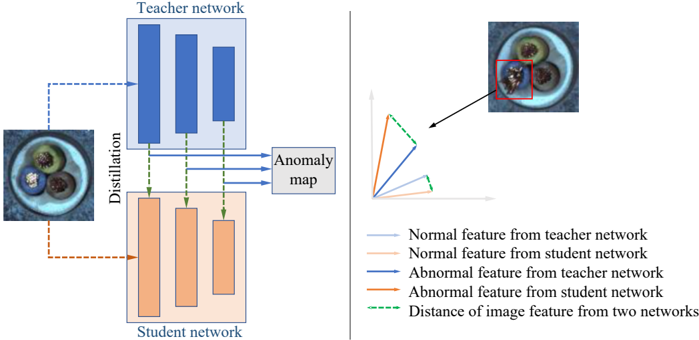
“The performance of these methods is outstanding, but they depend on pre-trained models such as ResNet [7] VGG [8] and EfficientNet [9] .”
What the sources say
- Not checked yetcites [7] [7] - K. Simonyan. A. Zisserman. Very deep convolutional networks for large-scale image recognition. In Proceedings of the 3rd International Conference on Learning Representations, San Diego, USA, 2015. DOI: 10.48550/arXiv.1409. 1556. source
Checked before — its earlier verdict is held back until a new check runs.
- Supportedcites [8] [8] - M. X. Tan, Q. Le. EfficientNet: Rethinking model scaling for convolutional neural networks. In Proceedings of the 36th International conference on machine learning, Long Beach, USA, pp. 6105 -6114, 2019. source
The citation is attached to VGG as an example of a pre-trained model, not to the broader claim about teacher-student methods. In “Generalisation of Very Deep Features” (pp. 11–12), the paper identifies its method as VGG and describes using its ConvNets pre-trained on ILSVRC. (LLM, conf=0.92)
- Supportedcites [9] [9] - P. Bergmann, M. Fauser, D. Sattlegger, C. Steger. Uninformed students: Student-teacher anomaly detection with discriminative latent embeddings. In Proceedings of IEEE/CVF Conference on Computer Vision and Pattern Recognition, Seattle, USA, pp. 4182 -4191, 2020. DOI: 10. 1109/CVPR42600.2020.00424. source
Citation [9] is attached to EfficientNet as an example of a pre-trained model. Section 5.3 (p. 8) identifies the authors’ EfficientNet models and describes using ImageNet-pretrained checkpoints for transfer learning. (LLM, conf=0.90)
plainstates a cause- Asserted: passes — The authors put it forward as true.
- Checkable: passes — It can be checked against evidence.
- Load-bearing: unclear — It is unclear whether the paper’s conclusions depend on it.
- Based: passes — The paper gives a reason why it holds.
- Not checked yet
The cited sources support only part of this claim — read each source’s verdict below.
In the paper
“Few-shot anomaly detection (FSAD) [139, 140] is still in its infancy.”
What the sources say
- Not checked — no full text of the sourcecites [139] [139] - A. M. Kamoona, A. K. Gostar, A. Bab-Hadiashar, R. Hoseinnezhad. Anomaly detection of defect using energy of point pattern features within random finite set framework, [Online], Available: https://arxiv.org/abs/2108. 12159, 2021. source
- Partly supportedcites [140] [140] - C. Q. Huang, H. Y. Guan, A. F. Jiang, Y. Zhang, M. Spratling, Y. F. Wang. Registration based few-shot anomaly detection. In Proceedings of the 17th European Conference on Computer Vision, Springer, Tel Aviv, Israel, pp. 303 -319, 2022. DOI: 10.1007/978-3-031-200533 \_ 18. sourceExperimental — accuracy not yet measured
The few-shots learning experiments (p. 9) show that this paper studies anomaly detection with limited normal samples, supporting its citation as an example of FSAD. That passage does not assess whether FSAD is still in its infancy, so the maturity claim is not supported by this source. (LLM, conf=0.82)
plain- Asserted: passes — The authors put it forward as true.
- Checkable: passes — It can be checked against evidence.
- Load-bearing: unclear — It is unclear whether the paper’s conclusions depend on it.
- Based: passes — The paper gives a reason why it holds.
46 more claims · 2 with their cited sources checked
Create a free account to see all 127 claims and to verify the 24 references still open.
- It may state two separate claims as one. 26
- Probably not a substantial claim. 64
Self-check
Percentages, sums and reported differences re-computed from the paper’s own numbers.
Each contradiction between two passages listed here was confirmed by an independent check.
Rated minor: it would not touch a result — a value no result rests on, a p-value that stays on the same side of the significance level, or a conflict that is clerical, resolved elsewhere in the paper, or outside its own findings.
In the paper
§ 2.1.4 Memory bank · p. 8
“Npad [74] allows for the possibility of marginal misalignment”
§ 2.1.4 Memory bank · p. 8
“| N-pad [71] | Mahalanobis distance, log- likelihood | ResNet | The paper allows for possible edge misalignment by estimating a nominal distribution for each pixel using the pixel ′ s neighborhood features. |”
Rated minor: it would not touch a result — a value no result rests on, a p-value that stays on the same side of the significance level, or a conflict that is clerical, resolved elsewhere in the paper, or outside its own findings.
In the paper
§ 2.1.4 Memory bank · p. 8
“The primary distinction between memory bank-based methods and OCC-based methods, is that memory-based methods, such as SVDD, require additional memory space to store image features.”
§ 2.1.2 One-class classification · p. 4
“SVDD [34] is a classic algorithm in the OCC problem”
Rated minor: it would not touch a result — a value no result rests on, a p-value that stays on the same side of the significance level, or a conflict that is clerical, resolved elsewhere in the paper, or outside its own findings.
In the paper
§ 4.3 3D anomaly detection · p. 15
“Since the release of MVTec 3D-AD [6] dataset”
§ 5 Datasets and metrics · p. 16
“| MVTec 3D-AD [174] | 10 | 2 904 | 948 | 3 852 | Segmentation mask | Real |”
Rated minor: it would not touch a result — a value no result rests on, a p-value that stays on the same side of the significance level, or a conflict that is clerical, resolved elsewhere in the paper, or outside its own findings.
In the paper
§ 2.1.2 One-class classification · p. 4
“with the exception of MemSeg [18] , the training of other methods relies on SVDD and cross-entropy loss.”
§ 2.1.2 One-class classification · p. 5
“| CPC-AD [33] | InfoNCE | - | The paper applies contrastive predictive coding (CPC) model to AD and gets an anomaly score through pixel-wise loss. |”
Citations
Cites
Items 201–229 of 229
HaloAE: An HaloNet based Local Transformer Auto-Encoder for Anomaly Detection and Localization
Mathian, É., Liu, H.-D., Fernandez-Cuesta, L., Samaras, D., Foll, M., & Chen, L.-M. (2022) · VISIGRAPP · doi:10.5220/0011865900003417 · Cited by 16
Ferrari, V., Fisher, B., Schmid, C., & Trucco, E. (2020) · Lecture notes in computer science · doi:10.1007/978-3-030-58520-4 · Cited by 16
Consistent estimation of the max-flow problem: Towards unsupervised image segmentation
Iquebal, A. S., & Bukkapatnam, S. T. S. (2020) · IEEE Transactions on Pattern Analysis and Machine Intelligence · doi:10.1109/tpami.2020.3039745 · Cited by 15 · cited 1×
“[43] demonstrate that the maximum posterior estimation of image labels can be formulated as a continuous max-flow problem.”
HaloAE: An HaloNet based Local Transformer Auto-Encoder for Anomaly Detection and LocalizationPreprint
Mathian, É., Liu, H., Fernandez‐Cuesta, L., Samaras, D., Foll, M., & Chen, L. (2022) · arXiv (Cornell University) · doi:10.48550/arxiv.2208.03486 · Cited by 15
Self-Supervised Guided Segmentation Framework for Unsupervised Anomaly DetectionPreprint
Xing, P., Sun, Y., & Li, Z. (2022) · arXiv (Cornell University) · doi:10.48550/arxiv.2209.12440 · Cited by 14
Self-Supervised Training with Autoencoders for Visual Anomaly DetectionPreprint
Bauer, A., Nakajima, S., & Müller, K.-R. (2022) · arXiv · doi:10.48550/arxiv.2206.11723 · Cited by 11
Avidan, S., Brostow, G., Cissé, M., et al. (2022) · Lecture notes in computer science · doi:10.1007/978-3-031-19821-2 · Cited by 11
Defective samples simulation through neural style transfer for automatic surface defect segment
Wei, T., Cao, D., Jiang, X., Zheng, C., & Liu, L. (2020) · 2019 International Conference on Optical Instruments and Technology: Optoelectronic Measurement Technology and Systems · doi:10.1117/12.2540464 · Cited by 10 · cited 1×
“[157] propose a model named DST to simulate defect samples.”
BackgroundA Multi-Scale A Contrario method for Unsupervised Image Anomaly Detection
Tailanian, M., Muse, P., & Pardo, A. (2021) · 2021 20th IEEE International Conference on Machine Learning and Applications (ICMLA) · doi:10.1109/icmla52953.2021.00035 · Cited by 10
Defect Detection of Metal Nuts Applying Convolutional Neural Networks
Sauter, D., Schmitz, A., Dikici, F., Baumgartl, H., & Buettner, R. (2021) · IEEE Annual International Computer Software and Applications Conference (COMPSAC) · doi:10.1109/compsac51774.2021.00043 · Cited by 9 · cited 2×
“[23] Cross-Entropy Xception [24] The paper uses Xception to train a classification network.”
PNI : Industrial Anomaly Detection using Position and Neighborhood InformationPreprint
Bae, J., Lee, J.-H., & Kim, S. (2022) · arXiv (Cornell University) · doi:10.48550/arxiv.2211.12634 · Cited by 8
Yang, M., Wu, P., Liu, J., et al. (2022) · arXiv (Cornell University) · doi:10.48550/arxiv.2205.00908 · Cited by 8
Self-citationImage Analysis and Processing – ICIAP 2022
(2022) · Lecture notes in computer science · doi:10.1007/978-3-031-06430-2 · Cited by 8
Yan, R., Zhang, F., Huang, M., Liu, W., Hu, D., Li, J., Liu, Q., Jiang, J., Guo, Q., & Zheng, L. (2022) · arXiv · doi:10.48550/arxiv.2206.01992 · Cited by 6
MAEDAY: MAE for few and zero shot AnomalY-DetectionPreprint
Schwartz, E., Arbelle, A., Karlinsky, L., et al. (2022) · arXiv (Cornell University) · doi:10.48550/arxiv.2211.14307 · Cited by 3
Tanveer, M., Agarwal, S., Ozawa, S., et al. (2023) · Lecture notes in computer science · doi:10.1007/978-3-031-30111-7 · Cited by 3
MIAD: A Maintenance Inspection Dataset for Unsupervised Anomaly DetectionPreprint
Bao, T., Chen, J., Li, W., et al. (2022) · arXiv (Cornell University) · doi:10.48550/arxiv.2211.13968 · Cited by 2
Avidan, S., Brostow, G., Cissé, M., et al. (2022) · Lecture notes in computer science · doi:10.1007/978-3-031-20053-3 · Cited by 2
Anomaly Detection via Self-organizing MapPreprint
Li, N., Jiang, K., Ma, Z., Wei, X., Hong, X., & Gong, Y. (2021) · arXiv (Cornell University) · doi:10.48550/arxiv.2107.09903 · Cited by 2
Iterative Image Inpainting with Structural Similarity Mask for Anomaly Detection
Nakanishi, H., Suzuki, M., & Matsuo, Y. (2021) · Cited by 1
Kim, Y., Jang, H., Lee, D., & Choi, H.-J. (2022) · arXiv · doi:10.48550/arxiv.2210.14913 · Cited by 1
IM-IAD: Industrial Image Anomaly Detection Benchmark in ManufacturingPreprint
Xie, G., Wang, J., Liu, J., et al. (2023) · arXiv (Cornell University) · doi:10.48550/arxiv.2301.13359 · Cited by 1
Self-citationFAPM: Fast Adaptive Patch Memory for Real-time Industrial Anomaly DetectionPreprint
Kim, D., Park, C., Cho, S., et al. (2022) · arXiv (Cornell University) · doi:10.48550/arxiv.2211.07381 · Cited by 1
Ishikawa, H., Liu, C.-L., Pajdla, T., et al. (2021) · Lecture notes in computer science · doi:10.1007/978-3-030-69544-6 · Cited by 1
N-pad : Neighboring Pixel-based Industrial Anomaly DetectionPreprint
Jang, J., Hwang, E., & Park, S.-H. (2022) · arXiv (Cornell University) · doi:10.48550/arxiv.2210.08768
Omni-frequency Channel-selection Representations for Unsupervised Anomaly Detection
Liang, Y., Zhang, J., Zhao, S., et al. (2022) · arXiv · doi:10.48550/arxiv.2203.00259
DFR: Deep Feature Reconstruction for Unsupervised Anomaly Segmentation
Yang, J., Shi, Y., & Qi, Z. (2020) · arXiv · doi:10.48550/arxiv.2012.07122
Self-Supervised Masked Convolutional Transformer Block for Anomaly Detection
Madan, N., Ristea, N.-C., Ionescu, R. T., et al. (2022) · arXiv · doi:10.48550/arxiv.2209.12148
Ferguson, M., Ak, R., Lee, Y.-T. T., et al. (2018) · arXiv · doi:10.48550/arxiv.1808.02518
Research works printed but not linked: 4
- [11] - G. D. Wang, S. M. Han, E. R. Ding, D. Huang. Studentteacher feature pyramid matching for anomaly detection. In Proceedings of 32nd British Machine Vision Conference 2021, 2021.
- [85] - Z. Y. Li, N. Li, K. T. Jiang, Z. H. Ma, X. Wei, X. P. Hong, Y. H. Gong. Superpixel masking and inpainting for selfsupervised anomaly detection. In Proceedings of the 31st British Machine Vision Conference 2020, BMVC, 2020.
- [146] - J. Yoon, K. Sohn, C. L. Li, S. Ö . Arik, C. Y. Lee, T. Pfister. Self-supervise, refine, repeat: Improving unsupervised anomaly detection. Transactions on Machine Learning Research, to be published.
- [162] - M. Bi ń kowski, D. J. Sutherland, M. Arbel, A. Gretton. Demystifying MMD GANs. In Proceedings of the 6th International Conference on Learning Representations, Vancouver, Canada, 2018.
Cited by
A Diffusion-Based Framework for Multi-Class Anomaly Detection
He, H., Zhang, J., Chen, H., Chen, X., Li, Z., Chen, X., Wang, Y., Wang, C., & Xie, L. (2024) · Proceedings of the AAAI Conference on Artificial Intelligence · doi:10.1609/aaai.v38i8.28690 · Cited by 212
“Anomaly detection is a crucial task in computer vision and industrial applications (Tao et al. 2022; Salehi et al. 2022; Liu et al. 2023), which goal of visual anomaly detection is to determine anomalous images and locate the regions of anomaly accurately.”
BackgroundMethodSelf-citationReal-IAD: A Real-World Multi-View Dataset for Benchmarking Versatile Industrial Anomaly Detection
Wang, C., Zhu, W., Gao, B.-B., Gan, Z., Zhang, J., Gu, Z., Qian, S., Chen, M., & Ma, L. (2024) · IEEE Computer Society Conference on Computer Vision and Pattern Recognition/Proceedings - IEEE Computer Society Conference on Computer Vision and Pattern Recognition/Proceedings · doi:10.1109/cvpr52733.2024.02159 · Cited by 359
Self-citationA survey of deep learning for industrial visual anomaly detection
Li, Z., Yan, Y., Wang, X., Ge, Y., & Meng, L. (2025) · Artificial Intelligence Review · doi:10.1007/s10462-025-11287-7 · Cited by 200
IM-IAD: Industrial Image Anomaly Detection Benchmark in Manufacturing
Xie, G., Wang, J., Liu, J., Lyu, J., Liu, Y., Wang, C., Zheng, F., & Jin, Y. (2024) · IEEE Transactions on Cybernetics · doi:10.1109/tcyb.2024.3357213 · Cited by 164
“Unsupervised IAD: There are two streams methods on unsupervised IAD [50], namely, feature embedding-based methods [4], [14], [67], and reconstruction-based meth-ods [86], [95], [100].”
MethodSelf-citationChen, Q., Luo, H., Lv, C., & Zhang, Z. (2024) · Lecture notes in computer science · doi:10.1007/978-3-031-72855-6_3 · Cited by 230
Metadata
- Authors
- Liu, J., Xie, G., Wang, J., Li, S., Wang, C., Zheng, F., & Jin, Y.
- Affiliations
- Southern University of Science and Technology (CN)
- University of Surrey (GB)
- Tencent (China) (CN)
- Bielefeld University (DE)
- Corresponding author
- Zheng, Feng
- Jin, Yaochu
- Venue
- Machine Intelligence Research
- Published
- 2024-01-15
- Volume
- 21
- Issue
- 1
- Pages
- 104-135
- ISSN
- 1476-8186 (ISSN-L)
- 2731-538X
- 2731-5398
- OpenAlex
- W4390875033
- Semantic Scholar
- 230c875f7563abf2e11bc79c0ae8855bfa52123c
- Cited by
- 463
- References
- 172
- Citations by year
- 2026: 193 · 2025: 178 · 2024: 81
- FWCI
- 92.07
- Type
- journal article
- Language
- en
- Open access
- hybrid
- doi.org
- Licence
- cc-by
- creativecommons.org/licenses/by/4.0 (tdm)
- creativecommons.org/licenses/by/4.0 (vor)
- Locations
- Machine Intelligence Research (publishedVersion, cc-by)
- arXiv (Cornell University) (submittedVersion, cc-by-nc-sa)
- PUB – Publications at Bielefeld University (Bielefeld University) (submittedVersion, cc-by)
- arXiv (Cornell University)
- Funders
- National Natural Science Foundation of China (62206122, 62122035)
- Bundesministerium für Bildung und Forschung
- Universität Bielefeld
- Topics
- Physical Sciences › Engineering › Industrial and Manufacturing Engineering › Industrial Vision Systems and Defect Detection
- Physical Sciences › Computer Science › Artificial Intelligence › Anomaly Detection Techniques and Applications
- Physical Sciences › Engineering › Civil and Structural Engineering › Infrastructure Maintenance and Monitoring
- Keywords
- deep learning, neural network architecture, supervised and unsupervised learning, loss functions, evaluation metrics, manufacturing industry, quality inspection
About these checks
Registry, retraction, Cites and statistics results are computed, not judged, with one exception: a printed reference that no index lists is read once by a model before it counts as a citation error. Claims are extracted by a model and kept only when their quote appears verbatim in the text; each cited source is then checked, with a model’s help, for whether it says what the claim relies on. Those verdicts can be wrong — read the claim’s quote and the cited source before relying on one.
The claim verdicts this report counts are experimental: their accuracy is not yet measured.
A language model drew the claims from the paper on 2026-10-10, under version 3 of the claim definition (model deepseek-v4.1-flash, prompt extract-v3).
A second model labelled each claim on 2026-10-10 (model jev-1.13-20260917, definition revision gold-guideline-v0.2).
Cited sources are checked with a language model’s help (gpt-6-sol).
Statistics and arithmetic are recomputed, not judged.
Confidence bands are shown only for fields calibrated on our annotated test set. None is calibrated yet, so no band is shown.
What counts as a claim ›How we measure confidence ›How we check this ›
Are you an author, or do you see a problem with this page? Request a review
Data sources
Bibliographic data: Semantic Scholar, OpenAlex, Crossref.
Contains information from the Semantic Scholar Academic Graph Datasets, made available under the ODC Attribution License (ODC-BY 1.0).
Semantic Scholar’s data is described in: Kinney, R., et al. (2023). The Semantic Scholar Open Data Platform. arXiv:2301.10140.
