

Deep Industrial Image Anomaly Detection: A Survey
Open accessThe DOI matches its Crossref record; 198 of the 229 references it cites were found in a registry or an index, and 4 are not checked yet; 25 of the 64 sources its claims cite were checked for support.
Abstract
The recent rapid development of deep learning has laid a milestone in industrial image anomaly detection (IAD). In this paper, we provide a comprehensive review of deep learning-based image anomaly detection techniques, from the perspectives of neural network architectures, levels of supervision, loss functions, metrics and datasets. In addition, we extract the promising setting from industrial manufacturing and review the current IAD approaches under our proposed setting. Moreover, we highlight several opening challenges for image anomaly detection. The merits and downsides of representative network architectures under varying supervision are discussed. Finally, we summarize the research findings and point out future research directions.
Verified 2026-11-22 · 4 references not checked yet
Overview
CoChat Summary
TL;DR
This survey reviews deep learning-based industrial image anomaly detection (IAD) across network architectures, supervision levels, loss functions, metrics, and datasets, and proposes an industrial manufacturing setting for evaluation. It finds memory-bank methods strongest for image-level detection, reconstruction-based methods stronger for pixel-level segmentation, and highlights open challenges in datasets, metrics, efficiency, and real-line deployment.
Key findings
- The survey covers 20 IAD datasets and 6 metrics, compared with 9 datasets/3 metrics in Tao et al. and 7 datasets/1 metric in Cui et al. (Table 1); it also states that most deep learning IAD methods are more than 97% accurate.
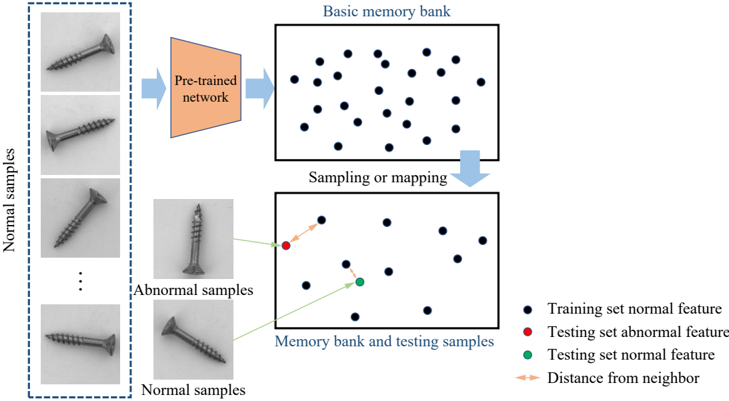
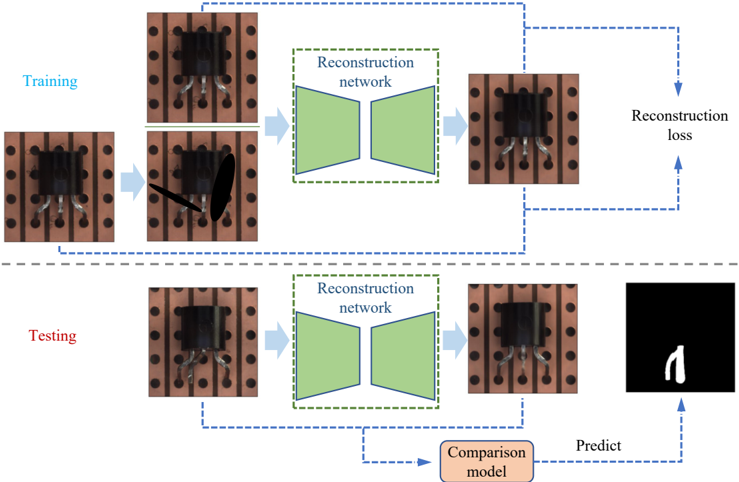
- Memory bank-based approaches are the most effective neural network design for image-level anomaly detection, but they are inadequate at pixel-level anomalies; ensemble learning can dramatically improve state-of-the-art methods, and SSPCAB can be seamlessly integrated into cutting-edge methods to significantly enhance reconstruction-based methods.
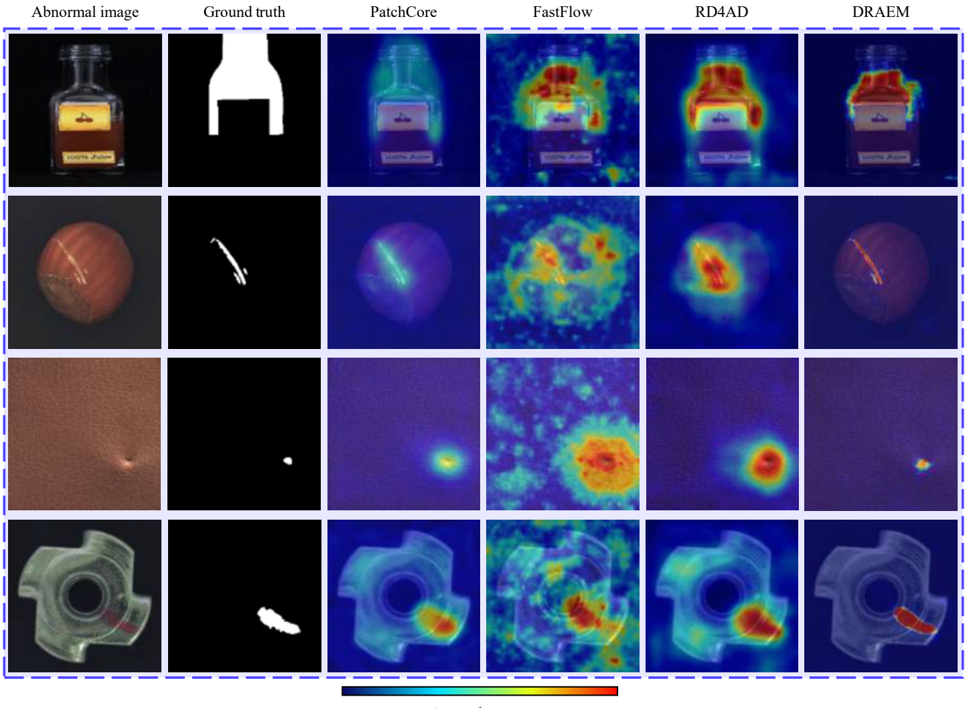
- Without ensemble learning, MemSeg achieved the SOTA result on image-level anomaly classification, attributed mainly to its U-Net framework; DRAEM also uses U-Net and outperformed other methods on pixel-level anomaly segmentation. AU-PR is more valuable than AU-ROC for segmentation tasks, and reconstruction-based methods outperform other methods on pixel AU-PR.
- The gap between few-shot IAD and vanilla IAD is narrowing; segmentation modules are beneficial for anomaly detection even when trained with artificially generated anomalies. Future directions include multi-modality IAD datasets, inference speed, industrial pretrained models, fully supervised pixel-level datasets, abnormal synthesis, lightweight models, and unifying industrial and medical IAD.
Methods
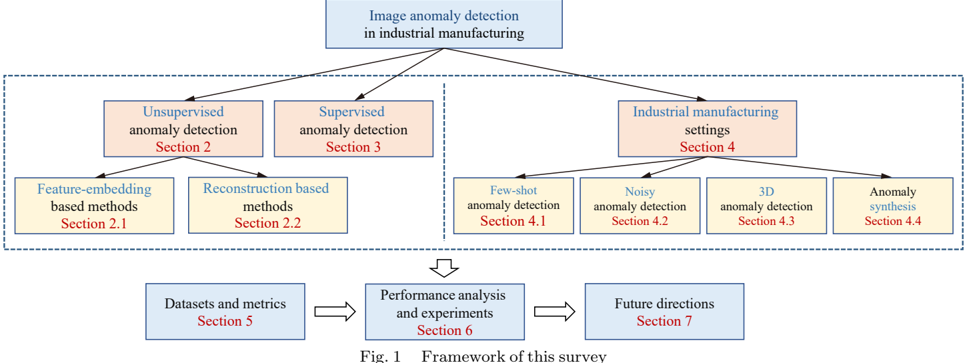
- Literature review/survey; no new primary experiments. It reviews deep learning IAD from the perspectives of neural network architectures, levels of supervision, loss functions, metrics, and datasets, and extracts a promising industrial manufacturing setting.
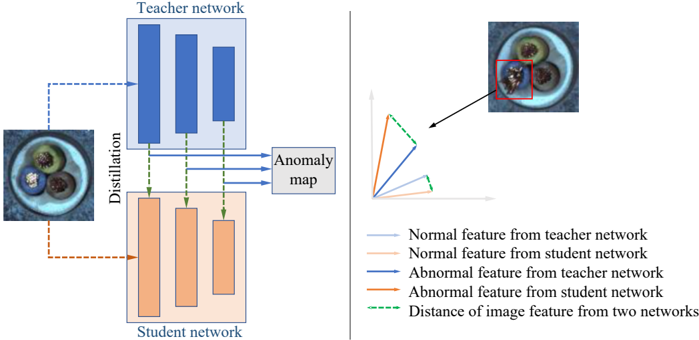
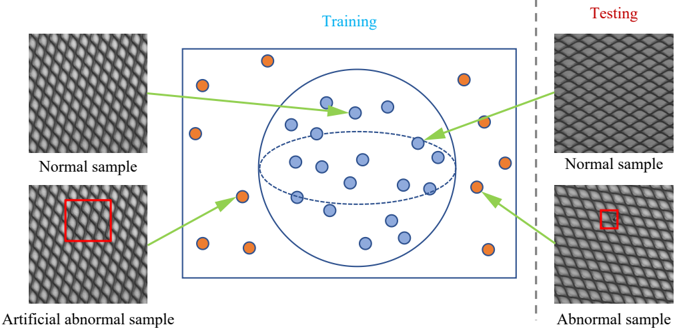
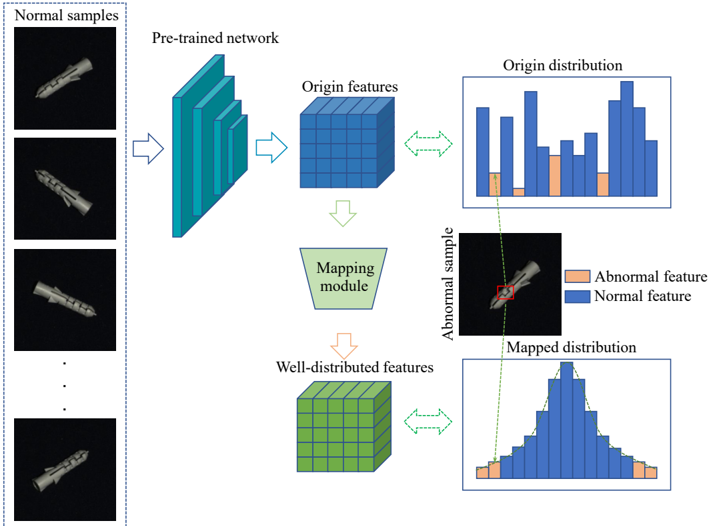
- Taxonomy: unsupervised anomaly detection is divided into feature-embedding methods (teacher-student, one-class classification, distribution map, memory bank) and reconstruction-based methods (autoencoder, GAN, transformer, diffusion); supervised anomaly detection is also reviewed. Industrial settings covered are few-shot anomaly detection, noisy anomaly detection, 3D anomaly detection, and anomaly synthesis.
- Performance analysis: statistical comparison of current IAD methods on MVTec AD using image AUROC and pixel AUROC/AUPR. Results are reported from original papers, with some reproduced by the authors and marked with *.
Limitations
- The paper states that the public cannot access real-world anomalous datasets due to privacy concerns; most open-source IAD datasets generate anomalies from anomaly-free products, so their abnormalities may not occur in actual production lines, and multiple-domain IAD datasets are lacking.
- The paper states that there is no uniform assessment for image-level and pixel-level IAD performance; most metrics shrink the anomalous mask to the feature-map size, reducing assessment precision, and the validity of common metrics for IAD remains to be explored. It also notes that most noisy anomaly detection methods have not been verified on real industrial image datasets, and most 3D IAD methods are specialized for RGB-D images while real-world 3D manufacturing data consists of point clouds.
- Evident from the text: the survey’s performance tables contain many missing entries and rely largely on reported results, with only some reproduced; no new benchmark experiments are conducted. The paper also states that current algorithms often focus on detection accuracy while ignoring storage size and efficiency.
Model-written summary. Check it against the paper before relying on it.
Integrity signals
Registry
Cites
Statistics
Figures






Verification
Claims the paper makes
18 Valid · 21 Not valid · 26 Not checked · 62 Own results and interpretations
Every source the paper cites for this claim was checked and supports it.
In the paper
“FCDD [35] is an unsupervised method that synthesizes abnormal samples for training the OCC model.”
What the sources say
- Supportedcites [35] [34] - P. Liznerski, L. Ruff, R. A. Vandermeulen, B. J. Franks, M. Kloft, K. R. Muller. Explainable deep one-class classification. In Proceedings of the 9th International Conference on Learning Representations, 2021. source
Section 4.2 (pp. 7–8) describes generating synthetic anomalies with confetti noise for FCDD and evaluates it in an unsupervised setting. Section 3 (p. 4) confirms that synthetic anomalies can be used for training when known anomalies are unavailable. Synthetic anomalies are an option, not a requirement of FCDD. (LLM, conf=0.87)
plainstates a cause- Asserted: passes — The authors put it forward as true.
- Checkable: passes — It can be checked against evidence.
- Load-bearing: unclear — It is unclear whether the paper’s conclusions depend on it.
- Based: passes — The paper gives a reason why it holds.
- Supported
The cited sources support only part of this claim — read each source’s verdict below.
In the paper
“PaDiM requires the batch-inverse of the multidimensional covariance tensor, which makes it challenging to scale up to larger CNNs due to the increased feature size.”
What the sources say
- Partly supportedcites [73] [72] - T. Defard, A. Setkov, A. Loesch, R. Audigier. PaDiM: A patch distribution modeling framework for anomaly detection and localization. In Proceedings of Intemational Conference on Pattern Recognition -ICPR International Workshops and Challenges, Springer, Milano, Italy, pp. 475 -489, 2021. DOI: 10.1007/978-3-030-68799-1 \_ 35. sourceExperimental — accuracy not yet measured
“Learning of the normality” (p. 3) says PaDiM estimates a covariance matrix for each patch and makes it invertible. “Ablative studies” (pp. 4–5) says larger embedding vectors increase computational and memory complexity. The copy does not say that PaDiM requires a batch-inverse operation or that this makes scaling to larger CNNs challenging; “Scalability gain” (p. 6) instead describes choosing the backbone and embedding size to fit resource limits. (LLM, conf=0.85)
plainstates a cause- Asserted: passes — The authors put it forward as true.
- Checkable: passes — It can be checked against evidence.
- Load-bearing: unclear — It is unclear whether the paper’s conclusions depend on it.
- Based: passes — The paper gives a reason why it holds.
- Partly supported
Every source the paper cites for this claim was checked and supports it.
In the paper
“Since the relative positions of the features of each image layer do not change during the convolution process, FCDD yields more interpretable results than alternative methods.”
What the sources say
- Supportedcites [35] [34] - P. Liznerski, L. Ruff, R. A. Vandermeulen, B. J. Franks, M. Kloft, K. R. Muller. Explainable deep one-class classification. In Proceedings of the 9th International Conference on Learning Representations, 2021. source
Section 3 (p. 3) says convolutional layers preserve the relative positions of receptive fields and that FCDD’s fully convolutional network preserves spatial information. The Introduction (p. 1) reports that FCDD’s anomaly heatmaps are less noisy and more structured than those of the baselines, while Section 4.2 (p. 8) reports better quantitative explanation performance than its competitors. (LLM, conf=0.90)
plainstates a cause- Asserted: passes — The authors put it forward as true.
- Checkable: passes — It can be checked against evidence.
- Load-bearing: unclear — It is unclear whether the paper’s conclusions depend on it.
- Based: passes — The paper gives a reason why it holds.
- Supported
The sources with a verdict support this claim; the rest weren’t checked yet, have no full text we could read, or their verdicts aren’t rated yet.
In the paper
“The performance of these methods is outstanding, but they depend on pre-trained models such as ResNet [7] VGG [8] and EfficientNet [9] .”
What the sources say
- Not checked yetcites [7] [6] - K. M. He, X. Y. Zhang, S. Q. Ren, J. Sun. Deep residual learning for image recognition. In Proceedings of IEEE Conference on Computer Vision and Pattern Recognition, Las Vegas, USA, pp. 770 -778, 2016. DOI: 10.1109/ CVPR.2016.90. source
Checked before — its earlier verdict is held back until a new check runs.
- Supportedcites [8] [7] - K. Simonyan. A. Zisserman. Very deep convolutional networks for large-scale image recognition. In Proceedings of the 3rd International Conference on Learning Representations, San Diego, USA, 2015. DOI: 10.48550/arXiv.1409. 1556. source
The citation is attached to VGG as an example of a pre-trained model, not to the broader claim about teacher-student methods. In “Generalisation of Very Deep Features” (pp. 11–12), the paper identifies its method as VGG and describes using its ConvNets pre-trained on ILSVRC. (LLM, conf=0.92)
- Supportedcites [9] [8] - M. X. Tan, Q. Le. EfficientNet: Rethinking model scaling for convolutional neural networks. In Proceedings of the 36th International conference on machine learning, Long Beach, USA, pp. 6105 -6114, 2019. source
Citation [9] is attached to EfficientNet as an example of a pre-trained model. Section 5.3 (p. 8) identifies the authors’ EfficientNet models and describes using ImageNet-pretrained checkpoints for transfer learning. (LLM, conf=0.90)
plainstates a cause- Asserted: passes — The authors put it forward as true.
- Checkable: passes — It can be checked against evidence.
- Load-bearing: unclear — It is unclear whether the paper’s conclusions depend on it.
- Based: passes — The paper gives a reason why it holds.
- Not checked yet
The cited sources support only part of this claim — read each source’s verdict below.
In the paper
“Few-shot anomaly detection (FSAD) [139, 140] is still in its infancy.”
What the sources say
- Not checked — no full text of the sourcecites [139] [138] - J. C. Wu, D. J. Chen, C. S. Fuh, T. L. Liu. Learning unsupervised metaformer for anomaly detection. In Proceedings of IEEE/CVF International Conference on Computer Vision, Montreal, Canada, pp. 4349 -4358, 2021. DOI: 10.1109/ICCV48922.2021.00433. source
- Partly supportedcites [140] [139] - A. M. Kamoona, A. K. Gostar, A. Bab-Hadiashar, R. Hoseinnezhad. Anomaly detection of defect using energy of point pattern features within random finite set framework, [Online], Available: https://arxiv.org/abs/2108. 12159, 2021. sourceExperimental — accuracy not yet measured
The few-shots learning experiments (p. 9) show that this paper studies anomaly detection with limited normal samples, supporting its citation as an example of FSAD. That passage does not assess whether FSAD is still in its infancy, so the maturity claim is not supported by this source. (LLM, conf=0.82)
plain- Asserted: passes — The authors put it forward as true.
- Checkable: passes — It can be checked against evidence.
- Load-bearing: unclear — It is unclear whether the paper’s conclusions depend on it.
- Based: passes — The paper gives a reason why it holds.
46 more claims · 2 with their cited sources checked
Create a free account to see all 127 claims and to verify the 18 references still open.
- It may state two separate claims as one. 26
- Probably not a substantial claim. 64
Self-check
Percentages, sums and reported differences re-computed from the paper’s own numbers.
Each contradiction between two passages listed here was confirmed by an independent check.
Rated minor: it would not touch a result — a value no result rests on, a p-value that stays on the same side of the significance level, or a conflict that is clerical, resolved elsewhere in the paper, or outside its own findings.
In the paper
§ 2.1.4 Memory bank · p. 8
“Npad [74] allows for the possibility of marginal misalignment”
§ 2.1.4 Memory bank · p. 8
“| N-pad [71] | Mahalanobis distance, log- likelihood | ResNet | The paper allows for possible edge misalignment by estimating a nominal distribution for each pixel using the pixel ′ s neighborhood features. |”
Rated minor: it would not touch a result — a value no result rests on, a p-value that stays on the same side of the significance level, or a conflict that is clerical, resolved elsewhere in the paper, or outside its own findings.
In the paper
§ 2.1.4 Memory bank · p. 8
“The primary distinction between memory bank-based methods and OCC-based methods, is that memory-based methods, such as SVDD, require additional memory space to store image features.”
§ 2.1.2 One-class classification · p. 4
“SVDD [34] is a classic algorithm in the OCC problem”
Rated minor: it would not touch a result — a value no result rests on, a p-value that stays on the same side of the significance level, or a conflict that is clerical, resolved elsewhere in the paper, or outside its own findings.
In the paper
§ 4.3 3D anomaly detection · p. 15
“Since the release of MVTec 3D-AD [6] dataset”
§ 5 Datasets and metrics · p. 16
“| MVTec 3D-AD [174] | 10 | 2 904 | 948 | 3 852 | Segmentation mask | Real |”
Rated minor: it would not touch a result — a value no result rests on, a p-value that stays on the same side of the significance level, or a conflict that is clerical, resolved elsewhere in the paper, or outside its own findings.
In the paper
§ 2.1.2 One-class classification · p. 4
“with the exception of MemSeg [18] , the training of other methods relies on SVDD and cross-entropy loss.”
§ 2.1.2 One-class classification · p. 5
“| CPC-AD [33] | InfoNCE | - | The paper applies contrastive predictive coding (CPC) model to AD and gets an anomaly score through pixel-wise loss. |”
Citations
Cites
Deep Residual Learning for Image Recognition
He, K., Zhang, X., Ren, S., & Sun, J. (2016) · 2016 IEEE Conference on Computer Vision and Pattern Recognition (CVPR) · doi:10.1109/cvpr.2016.90 · Cited by 235,474 · cited 20×
“CFA [69] SVDD ResNet The paper improves PatchCore so that image features are distributed on a hypersphere.”
InfluentialVery Deep Convolutional Networks for Large-Scale Image Recognition
Simonyan, K., & Zisserman, A. (2014) · arXiv · doi:10.48550/arxiv.1409.1556 · Cited by 114,148 · cited 1×
“The performance of these methods is outstanding, but they depend on pre-trained models such as ResNet [7] VGG [8] and EfficientNet [ ?”
U-Net: Convolutional Networks for Biomedical Image SegmentationPreprint
Ronneberger, O., Fischer, P., & Brox, T. (2015) · International Conference on Medical Image Computing and Computer-Assisted Intervention · doi:10.48550/arxiv.1505.04597 · Cited by 105,781
U-Net: Convolutional Networks for Biomedical Image Segmentation
Ronneberger, O., Fischer, P., & Brox, T. (2015) · Lecture notes in computer science · doi:10.1007/978-3-319-24574-4_28 · Cited by 99,404 · cited 8×
“DREAM [91] L 2 , SSIM, Focal - ThepaperdesignsamethodtogenerateabnormalimagesandusesU-Net[92]todistinguishanomaliesafterreconstruction.”
InfluentialAn Image is Worth 16x16 Words: Transformers for Image Recognition at Scale
Dosovitskiy, A., Beyer, L., Kolesnikov, A., Weissenborn, D., Zhai, X., Unterthiner, T., Dehghani, M., Minderer, M., Heigold, G., Gelly, S., et al. (2020) · arXiv · doi:10.48550/arxiv.2010.11929 · Cited by 47,472
Squeeze-and-Excitation Networks
Hu, J., Shen, L., & Sun, G. (2018) · 2018 IEEE/CVF Conference on Computer Vision and Pattern Recognition · doi:10.1109/cvpr.2018.00745 · Cited by 35,667 · cited 3×
“This paper replaces the SE-layer in SSPCAB with transformer architecture.”
Swin Transformer: Hierarchical Vision Transformer using Shifted Windows
Liu, Z., Lin, Y., Cao, Y., Hu, H., Wei, Y., Zhang, Z., Lin, S., & Guo, B. (2021) · 2021 IEEE/CVF International Conference on Computer Vision (ICCV) · doi:10.1109/iccv48922.2021.00986 · Cited by 35,534 · cited 3×
“NF methods extract features from normal images from a pre-trained model, such as ResNet [59] or Swin Transformer [60], and transform the feature distribution as a Gaussian distribution during the training phase.”
CBAM: Convolutional Block Attention Module
Woo, S., Park, J., Lee, J.-Y., & Kweon, I. S. (2018) · Lecture Notes in Computer Science · doi:10.1007/978-3-030-01234-2_1 · Cited by 25,853
Grad-CAM: Visual Explanations from Deep Networks via Gradient-Based Localization
Selvaraju, R. R., Cogswell, M., Das, A., Vedantam, R., Parikh, D., & Batra, D. (2017) · 2017 IEEE International Conference on Computer Vision (ICCV) · doi:10.1109/iccv.2017.74 · Cited by 24,513
Unpaired image-to-image translation using cycle-consistent adversarial networks
Zhu, J.-Y., Park, T., Isola, P., & Efros, A. A. (2017) · 2017 IEEE International Conference on Computer Vision (ICCV) · doi:10.1109/iccv.2017.244 · Cited by 23,602
Xception: Deep Learning with Depthwise Separable Convolutions
Chollet, F. (2017) · 2017 IEEE Conference on Computer Vision and Pattern Recognition (CVPR) · doi:10.1109/cvpr.2017.195 · Cited by 20,380
EfficientNet: Rethinking Model Scaling for Convolutional Neural Networks
Tan, M., & Le, Q. V. (2019) · arXiv · doi:10.48550/arxiv.1905.11946 · Cited by 17,072
Learning Transferable Visual Models From Natural Language Supervision
Radford, A., Kim, J. W., Hallacy, C., Ramesh, A., Goh, G., Agarwal, S., Sastry, G., Askell, A., Mishkin, P., Clark, J., et al. (2021) · arXiv · doi:10.48550/arxiv.2103.00020 · Cited by 15,293
Denoising Diffusion Probabilistic Models
Ho, J., Jain, A., & Abbeel, P. (2020) · arXiv · doi:10.48550/arxiv.2006.11239 · Cited by 8,712 · cited 1×
“Diffusion model [119] is a recently popular generative model that can also be utilized for reconstruction-based anomaly detection.”
Masked Autoencoders Are Scalable Vision Learners
He, K., Chen, X., Xie, S., Li, Y., Dollar, P., & Girshick, R. (2022) · 2022 IEEE/CVF Conference on Computer Vision and Pattern Recognition (CVPR) · doi:10.1109/cvpr52688.2022.01553 · Cited by 8,489
GANs Trained by a Two Time-Scale Update Rule Converge to a Local Nash Equilibrium
Heusel, M., Ramsauer, H., Unterthiner, T., Nessler, B., & Hochreiter, S. (2017) · arXiv · doi:10.48550/arxiv.1706.08500 · Cited by 8,365
CBAM: Convolutional Block Attention Module
Woo, S., Park, J., Lee, J.-Y., & Kweon, I. S. (2018) · arXiv · doi:10.48550/arxiv.1807.06521 · Cited by 6,261
Representation Learning with Contrastive Predictive Coding
Oord, A. V. D., Li, Y., & Vinyals, O. (2018) · arXiv · doi:10.48550/arxiv.1807.03748 · Cited by 6,242
Deep Residual Learning for Image Recognition
He, K., Zhang, X., Ren, S., & Sun, J. (2015) · arXiv · doi:10.48550/arxiv.1512.03385 · Cited by 4,196
Fast Point Feature Histograms (FPFH) for 3D registration
Rusu, R. B., Blodow, N., & Beetz, M. (2009) · 2009 IEEE International Conference on Robotics and Automation · doi:10.1109/robot.2009.5152473 · Cited by 3,878 · cited 1×
“[151] propose BTF, a method that combines hand-crafted 3D representations (FPFH [152]) with the representation method of 2D features (PatchCore [69]).”
Support Vector Data Description
Tax, D. M. J., & Duin, R. P. W. (2004) · Machine Learning · doi:10.1023/b:mach.0000008084.60811.49 · Cited by 3,512
Perlin, K. (1985) · ACM SIGGRAPH Computer Graphics · doi:10.1145/325165.325247 · Cited by 2,525
MVTec AD — A Comprehensive Real-World Dataset for Unsupervised Anomaly Detection
Bergmann, P., Fauser, M., Sattlegger, D., & Steger, C. (2019) · 2019 IEEE/CVF Conference on Computer Vision and Pattern Recognition (CVPR) · doi:10.1109/cvpr.2019.00982 · Cited by 2,203
Towards Total Recall in Industrial Anomaly Detection
Roth, K., Pemula, L., Zepeda, J., Scholkopf, B., Brox, T., & Gehler, P. (2022) · 2022 IEEE/CVF Conference on Computer Vision and Pattern Recognition (CVPR) · doi:10.1109/cvpr52688.2022.01392 · Cited by 1,810 · cited 18×
“PatchCore [68], SPADE [63], PaDim [73] conduct the ablation study on 16 normal training samples.”
InfluentialPaDiM: A Patch Distribution Modeling Framework for Anomaly Detection and Localization
Defard, T., Setkov, A., Loesch, A., & Audigier, R. (2021) · Lecture Notes in Computer Science · doi:10.1007/978-3-030-68799-1_35 · Cited by 1,415 · cited 4×
“PatchCore [69], SPADE [64], PaDim [74] conduct the ablation study on 16 normal training samples.”
InfluentialVariational Inference with Normalizing Flows
Rezende, D. J., & Mohamed, S. (2015) · arXiv (Cornell University) · doi:10.48550/arxiv.1505.05770 · Cited by 1,253
CutPaste: Self-Supervised Learning for Anomaly Detection and Localization
Li, C.-L., Sohn, K., Yoon, J., & Pfister, T. (2021) · 2021 IEEE/CVF Conference on Computer Vision and Pattern Recognition (CVPR) · doi:10.1109/cvpr46437.2021.00954 · Cited by 1,107 · cited 5×
“Both CutPaste [31] and CAVGA [42] treat anomaly detection as a classification problem, while GradCAM is used for pixel-level anomaly localization.”
InfluentialDRÆM – A discriminatively trained reconstruction embedding for surface anomaly detection
Zavrtanik, V., Kristan, M., & Skocaj, D. (2021) · 2021 IEEE/CVF International Conference on Computer Vision (ICCV) · doi:10.1109/iccv48922.2021.00822 · Cited by 1,086 · cited 16×
“The paper generates abnormal samples in feature level and perform better than DRAEM.”
MethodInfluentialSong, K., & Yan, Y. (2013) · Applied Surface Science · doi:10.1016/j.apsusc.2013.09.002 · Cited by 1,026 · cited 1×
“Dataset Class Normal Abnormal Total Annotation Level Real or Synthetic AITEX [138] 1 140 105 245 Segmentation mask Real BTAD [97] 3 2,830 Segmentation mask Real DAGM [139] 10 11,500 Segmentation mask Synthetic DEEPPCB [140] 1 1,500 Bounding box Synthetic Eycandies [141] 10 13,250 2,250 15,500 Segmentation mask Synthet…”
Uninformed Students: Student-Teacher Anomaly Detection With Discriminative Latent Embeddings
Bergmann, P., Fauser, M., Sattlegger, D., & Steger, C. (2020) · 2020 IEEE/CVF Conference on Computer Vision and Pattern Recognition (CVPR) · doi:10.1109/cvpr42600.2020.00424 · Cited by 990 · cited 1×
“Bergmann et al. [9] is the first to use teacher-student architecture for anomaly detection.”
2021 IEEE/CVF International Conference on Computer Vision (ICCV)
(2021) · doi:10.1109/iccv48922.2021 · Cited by 985
Optimizing Intersection-Over-Union in Deep Neural Networks for Image Segmentation
Rahman, M. A., & Wang, Y. (2016) · Lecture Notes in Computer Science · doi:10.1007/978-3-319-50835-1_22 · Cited by 910
Segmentation-based deep-learning approach for surface-defect detection
Tabernik, D., Šela, S., Skvarč, J., & Skočaj, D. (2020) · Journal of Intelligent Manufacturing · doi:10.1007/s10845-019-01476-x · Cited by 898
Anomaly Detection via Reverse Distillation from One-Class Embedding
Deng, H., & Li, X. (2022) · 2022 IEEE/CVF Conference on Computer Vision and Pattern Recognition (CVPR) · doi:10.1109/cvpr52688.2022.00951 · Cited by 892 · cited 6×
“RD4AD [14] Cosine Similarity ResNet The paper designs the teacher-student model of reverse distillation in a similar way to reconstruction.”
InfluentialManufacture by selective laser melting and mechanical behavior of commercially pure titanium
Attar, H., Calin, M., Zhang, L. C., Scudino, S., & Eckert, J. (2014) · Materials Science and Engineering: A · doi:10.1016/j.msea.2013.11.038 · Cited by 744 · cited 1×
“The technique shows its adaptability using a dataset for metal additive manufacturing anomaly detection [36].”
MethodReconstruction by inpainting for visual anomaly detection
Zavrtanik, V., Kristan, M., & Skočaj, D. (2021) · Pattern Recognition · doi:10.1016/j.patcog.2020.107706 · Cited by 732 · cited 6×
“RIAD [87] randomly masks a portion of the training set image at the patch level and reconstructs it using a U-Net encoder-decoder network [92].”
MethodInfluentialA Geometric Framework for Unsupervised Anomaly Detection: Detecting Intrusions in Unlabeled Data
Eskin, E., Arnold, A., Prerau, M., Portnoy, L., & Stolfo, S. (2002) · Advances in Information Security · doi:10.1007/978-1-4615-0953-0_4 · Cited by 683
Gudovskiy, D., Ishizaka, S., & Kozuka, K. (2022) · 2022 IEEE/CVF Winter Conference on Applications of Computer Vision (WACV) · doi:10.1109/wacv51458.2022.00188 · Cited by 669 · cited 8×
“In addition, CFlow-AD [53] analyzes in depth why the multivariate Gaussian assumption is a reasonable prior in earlier models and why the more general NF framework aims to converge to similar results with less computation.”
InfluentialSPot-the-Difference Self-supervised Pre-training for Anomaly Detection and Segmentation
Zou, Y., Jeong, J., Pemula, L., Zhang, D., & Dabeer, O. (2022) · Lecture Notes in Computer Science · doi:10.1007/978-3-031-20056-4_23 · Cited by 651
2020 25th International Conference on Pattern Recognition (ICPR)
(2021) · doi:10.1109/icpr48806.2021 · Cited by 649
Bergmann, P., Batzner, K., Fauser, M., Sattlegger, D., & Steger, C. (2021) · International Journal of Computer Vision · doi:10.1007/s11263-020-01400-4 · Cited by 602 · cited 1×
“Per-Region Overlap (PRO) [154] ↑ PRO = 1 N ∑”
WinCLIP: Zero-/Few-Shot Anomaly Classification and Segmentation
Jeong, J., Zou, Y., Kim, T., Zhang, D., Ravichandran, A., & Dabeer, O. (2023) · 2023 IEEE/CVF Conference on Computer Vision and Pattern Recognition (CVPR) · doi:10.1109/cvpr52729.2023.01878 · Cited by 585 · cited 1×
“WinCLIP [144] utilizes another large model called CLIP [145] for ZSAD.”
Patch SVDD: Patch-Level SVDD for Anomaly Detection and Segmentation
Yi, J., & Yoon, S. (2021) · Lecture Notes in Computer Science · doi:10.1007/978-3-030-69544-6_23 · Cited by 551 · cited 6×
“PatchSVDD [18] divides the image into uniform patches and sends them to the model for training, which significantly enhances the model’s ability to detect anomalies.”
InfluentialGDXray: The Database of X-ray Images for Nondestructive Testing
Mery, D., Riffo, V., Zscherpel, U., Mondragón, G., Lillo, I., Zuccar, I., Lobel, H., & Carrasco, M. (2015) · Journal of Nondestructive Evaluation · doi:10.1007/s10921-015-0315-7 · Cited by 492
Same Same But DifferNet: Semi-Supervised Defect Detection with Normalizing Flows
Rudolph, M., Wandt, B., & Rosenhahn, B. (2021) · 2021 IEEE Winter Conference on Applications of Computer Vision (WACV) · doi:10.1109/wacv48630.2021.00195 · Cited by 489
Automatic Metallic Surface Defect Detection and Recognition with Convolutional Neural Networks
Tao, X., Zhang, D., Ma, W., Liu, X., & Xu, D. (2018) · Applied Sciences · doi:10.3390/app8091575 · Cited by 471
VT-ADL: A Vision Transformer Network for Image Anomaly Detection and Localization
Mishra, P., Verk, R., Fornasier, D., Piciarelli, C., & Foresti, G. L. (2021) · 2021 IEEE 30th International Symposium on Industrial Electronics (ISIE) · doi:10.1109/isie45552.2021.9576231 · Cited by 462 · cited 4×
“(3) Transformer Model VT-ADL [107] L2, SSIM, Log-Likelihood The paper proposes a transformer-based framework to reconstruct images and detects anomalies.”
InfluentialScaling Local Self-Attention for Parameter Efficient Visual Backbones
Vaswani, A., Ramachandran, P., Srinivas, A., Parmar, N., Hechtman, B., & Shlens, J. (2021) · 2021 IEEE/CVF Conference on Computer Vision and Pattern Recognition (CVPR) · doi:10.1109/cvpr46437.2021.01270 · Cited by 453
AnoDDPM: Anomaly Detection with Denoising Diffusion Probabilistic Models using Simplex Noise
Wyatt, J., Leach, A., Schmon, S. M., & Willcocks, C. G. (2022) · 2022 IEEE/CVF Conference on Computer Vision and Pattern Recognition Workshops (CVPRW) · doi:10.1109/cvprw56347.2022.00080 · Cited by 442
Visual-Based Defect Detection and Classification Approaches for Industrial Applications—A SURVEY
Czimmermann, T., Ciuti, G., Milazzo, M., Chiurazzi, M., Roccella, S., Oddo, C. M., & Dario, P. (2020) · Sensors · doi:10.3390/s20051459 · Cited by 441 · cited 4×
“Czimmermann [1] Tao [2] Cui [ 1 demonstrates clearly the merits of our survey in terms of dataset, metric, neural network architecture, levels of supervision and promising setting for industrial manufacturing.”
BackgroundInfluentialSurface defect saliency of magnetic tile
Huang, Y., Qiu, C., & Yuan, K. (2020) · The Visual Computer · doi:10.1007/s00371-018-1588-5 · Cited by 438 · cited 1×
“Dataset Class Normal Abnormal Total Annotation Level Real or Synthetic AITEX [138] 1 140 105 245 Segmentation mask Real BTAD [97] 3 2,830 Segmentation mask Real DAGM [139] 10 11,500 Segmentation mask Synthetic DEEPPCB [140] 1 1,500 Bounding box Synthetic Eycandies [141] 10 13,250 2,250 15,500 Segmentation mask Synthet…”
Salient Object Detection via Integrity Learning
Zhuge, M., Fan, D.-P., Liu, N., Zhang, D., Xu, D., & Shao, L. (2022) · IEEE Transactions on Pattern Analysis and Machine Intelligence · doi:10.1109/tpami.2022.3179526 · Cited by 403
Mixed supervision for surface-defect detection: From weakly to fully supervised learning
Božič, J., Tabernik, D., & Skočaj, D. (2021) · Computers in Industry · doi:10.1016/j.compind.2021.103459 · Cited by 377 · cited 2×
“[113] examine the influence of image-level supervision information, mixed supervision information, and pixel-level supervision information on surface defect detection tasks within the same deep learning framework.”
BackgroundSub-Image Anomaly Detection with Deep Pyramid Correspondences
Cohen, N., & Hoshen, Y. (2020) · arXiv · doi:10.48550/arxiv.2005.02357 · Cited by 372 · cited 6×
“PatchCore [68], SPADE [63], PaDim [73] conduct the ablation study on 16 normal training samples.”
InfluentialReal-time detection of steel strip surface defects based on improved yolo detection network
Li, J., Su, Z., Geng, J., & Yin, Y. (2018) · IFAC-PapersOnLine · doi:10.1016/j.ifacol.2018.09.412 · Cited by 371
Ježek, Š., Jonák, M., Bürget, R., Dvořák, P., & Skotak, M. (2021) · International Congress on Ultra Modern Telecommunications and Control Systems and Workshops (ICUMT) · doi:10.1109/icumt54235.2021.9631567 · Cited by 365
(2018) · Lecture notes in computer science · doi:10.1007/978-3-030-01234-2 · Cited by 353
Fully Convolutional Cross-Scale-Flows for Image-based Defect Detection
Rudolph, M., Wehrbein, T., Rosenhahn, B., & Wandt, B. (2022) · 2022 IEEE/CVF Winter Conference on Applications of Computer Vision (WACV) · doi:10.1109/wacv51458.2022.00189 · Cited by 348
CFA: Coupled-Hypersphere-Based Feature Adaptation for Target-Oriented Anomaly Localization
Lee, S., Lee, S., & Song, B. C. (2022) · IEEE Access · doi:10.1109/access.2022.3193699 · Cited by 340
Improving Unsupervised Defect Segmentation by Applying Structural Similarity to Autoencoders
Bergmann, P., Löwe, S., Fauser, M., Sattlegger, D., & Steger, C. (2019) · Proceedings of the 14th International Joint Conference on Computer Vision, Imaging and Computer Graphics Theory and Applications · doi:10.5220/0007364500002108 · Cited by 336 · cited 3×
“[68] investigate the influence of Structure Similarity Index Measure (SSIM) and L2 loss on AE reconstruction and anomaly segmentation, providing numerous suggestions for future research.”
BackgroundMethodInfluentialSelf-Supervised Predictive Convolutional Attentive Block for Anomaly Detection
Ristea, N.-C., Madan, N., Ionescu, R. T., Nasrollahi, K., Khan, F. S., Moeslund, T. B., & Shah, M. (2022) · 2022 IEEE/CVF Conference on Computer Vision and Pattern Recognition (CVPR) · doi:10.1109/cvpr52688.2022.01321 · Cited by 315 · cited 9×
“This paper replaces the SE-layer in SSPCAB with transformer architecture.”
InfluentialA Unified Model for Multi-Class Anomaly Detection
You, Z., Cui, L., Shen, Y., Yang, K., Lu, X., Zheng, Y., & Le, X. (2022) · Advances in Neural Information Processing Systems 35 · doi:10.52202/068431-0330 · Cited by 303
Synthetic data augmentation for surface defect detection and classification using deep learning
Jain, S., Seth, G., Paruthi, A., Soni, U., & Kumar, G. (2022) · Journal of Intelligent Manufacturing · doi:10.1007/s10845-020-01710-x · Cited by 302 · cited 1×
“[159] try to use DCGAN, ACGCN and InfoGAN to generate defect images by adding noise, which improves the accuracy of classification.”
MethodTowards Visually Explaining Variational Autoencoders
Liu, W., Li, R., Zheng, M., Karanam, S., Wu, Z., Bhanu, B., Radke, R. J., & Camps, O. (2020) · 2020 IEEE/CVF Conference on Computer Vision and Pattern Recognition (CVPR) · doi:10.1109/cvpr42600.2020.00867 · Cited by 294 · cited 5×
“Liu et al. [153] propose a model designed to generate defects on defect-free fabric images for training semantic segmentation.”
InfluentialCross-modality deep feature learning for brain tumor segmentation
Zhang, D., Huang, G., Zhang, Q., Han, J., Han, J., & Yu, Y. (2021) · Pattern Recognition · doi:10.1016/j.patcog.2020.107562 · Cited by 292
Registration based Few-Shot Anomaly Detection
Huang, C., Guan, H., Jiang, A., et al. (2022) · European Conference on Computer Vision · doi:10.48550/arxiv.2207.07361 · Cited by 290
Online PCB Defect Detector On A New PCB Defect DatasetPreprint
Tang, S., He, F., Huang, X., & Yang, J. (2019) · arXiv (Cornell University) · doi:10.48550/arxiv.1902.06197 · Cited by 288
Beyond Dents and Scratches: Logical Constraints in Unsupervised Anomaly Detection and Localization
Bergmann, P., Batzner, K., Fauser, M., Sattlegger, D., & Steger, C. (2022) · International Journal of Computer Vision · doi:10.1007/s11263-022-01578-9 · Cited by 286 · cited 3×
“Current popular IAD datasets, like MVTec AD [5] and MVTec LOCO [6], consist of numerous classes but not multiple domains.”
BackgroundMethodStudent-Teacher Feature Pyramid Matching for Anomaly Detection
Wang, G., Han, S., Ding, E., & Huang, D. (2021) · Proceedings of the British Machine Vision Conference 2021 · doi:10.5244/c.35.349 · Cited by 286
PANDA: Adapting Pretrained Features for Anomaly Detection and Segmentation
Reiss, T., Cohen, N., Bergman, L., & Hoshen, Y. (2021) · 2021 IEEE/CVF Conference on Computer Vision and Pattern Recognition (CVPR) · doi:10.1109/cvpr46437.2021.00283 · Cited by 281 · cited 6×
“PANDA [25] examines the migration method of pre-trained features and introduces the early stopping mechanism to the OCC problem.”
InfluentialAsymmetric Student-Teacher Networks for Industrial Anomaly Detection
Rudolph, M., Wehrbein, T., Rosenhahn, B., & Wandt, B. (2023) · 2023 IEEE/CVF Winter Conference on Applications of Computer Vision (WACV) · doi:10.1109/wacv56688.2023.00262 · Cited by 280 · cited 6×
“AST [15] employs RGB image with depth information to enhance anomaly detection performance.”
InfluentialFerguson, M., Ak, R., Lee, Y.-T. T., & Law, K. H. (2018) · Smart and Sustainable Manufacturing Systems · doi:10.1520/ssms20180033 · Cited by 274 · cited 1×
“[132] use Mask Region-based CNN architecture to detect and segment defects in X-ray images simultaneously.”
Applications of Data Mining in Computer Security
(2002) · Advances in Information Security · doi:10.1007/978-1-4615-0953-0 · Cited by 272
Yang, M., Wu, P., & Feng, H. (2023) · Engineering Applications of Artificial Intelligence · doi:10.1016/j.engappai.2023.105835 · Cited by 257
Modeling the Distribution of Normal Data in Pre-Trained Deep Features for Anomaly Detection
Rippel, O., Mertens, P., & Merhof, D. (2021) · 2020 25th International Conference on Pattern Recognition (ICPR) · doi:10.1109/icpr48806.2021.9412109 · Cited by 254 · cited 1×
“[46] Cross-Entropy ResNet, EfficientNet The paper establishes a model of normality by fitting a multivariate Gaussian to feature representations of a pre-trained network.”
Defect Image Sample Generation With GAN for Improving Defect Recognition
Niu, S., Li, B., Wang, X., & Lin, H. (2020) · IEEE Transactions on Automation Science and Engineering · doi:10.1109/tase.2020.2967415 · Cited by 251 · cited 1×
“By improving the style transfer network, SDGAN [156] achieves better results than CycleGAN.”
ResultMultistage GAN for Fabric Defect Detection
Liu, J., Wang, C., Su, H., Du, B., & Tao, D. (2020) · IEEE Transactions on Image Processing · doi:10.1109/tip.2019.2959741 · Cited by 247 · cited 1×
“[154] propose a model designed to generate defects on defect-free fabric images for training semantic segmentation.”
Self-citationAttention Guided Anomaly Localization in Images
Venkataramanan, S., Peng, K.-C., Singh, R. V., & Mahalanobis, A. (2020) · Lecture Notes in Computer Science · doi:10.1007/978-3-030-58520-4_29 · Cited by 247 · cited 6×
“Both CutPaste [31] and CAVGA [42] treat anomaly detection as a classification problem, while GradCAM is used for pixel-level anomaly localization.”
InfluentialDSR - A dual subspace re-projection network for surface anomaly detection
Zavrtanik, V., Kristan, M., & Skočaj, D. (2022) · European Conference on Computer Vision · doi:10.48550/arxiv.2208.01521 · Cited by 246
Back to the Feature: Classical 3D Features are (Almost) All You Need for 3D Anomaly Detection
Horwitz, E., & Hoshen, Y. (2023) · IEEE/CVF Conference on Computer Vision and Pattern Recognition Workshops (CVPRW) · doi:10.1109/cvprw59228.2023.00298 · Cited by 239 · cited 1×
“[151] propose BTF, a method that combines hand-crafted 3D representations (FPFH [152]) with the representation method of 2D features (PatchCore [69]).”
A Hierarchical Extractor-Based Visual Rail Surface Inspection System
Gan, J., Li, Q., Wang, J., & Yu, H. (2017) · IEEE Sensors Journal · doi:10.1109/jsen.2017.2761858 · Cited by 236 · cited 1×
“Dataset Class Normal Abnormal Total Annotation Level Real or Synthetic AITEX [165] 1 140 105 245 Segmentation mask Real BTAD [107] 3 2,830 Segmentation mask Real DAGM [166] 10 11,500 Segmentation mask Synthetic DEEPPCB [167] 1 1,500 Bounding box Synthetic Eycandies [168] 10 13,250 2,250 15,500 Segmentation mask Synthe…”
Self-citationDeep Learning for Unsupervised Anomaly Localization in Industrial Images: A Survey
Tao, X., Gong, X., Zhang, X., Yan, S., & Adak, C. (2022) · IEEE Transactions on Instrumentation and Measurement · doi:10.1109/tim.2022.3196436 · Cited by 228 · cited 3×
“Firstly, our study uses twice as many IAD datasets as Tao et al. [2].”
BackgroundMethodInpainting transformer for anomaly detection
Pirnay, J., & Chai, K. (2022) · Lecture Notes in Computer Science · doi:10.1007/978-3-031-06430-2_33 · Cited by 227 · cited 2×
“[111] propose Inpainting Transformer (InTra), which integrates information from larger regions of the input image.”
Saliency-Based Defect Detection in Industrial Images by Using Phase Spectrum
Bai, X., Fang, Y., Lin, W., Wang, L., & Ju, B.-F. (2014) · IEEE Transactions on Industrial Informatics · doi:10.1109/tii.2014.2359416 · Cited by 225 · cited 2×
“[28] proposed to use Fourier transform to detect salient regions of images, and compare the salient”
Natural Synthetic Anomalies for Self-supervised Anomaly Detection and Localization
Schlüter, H. M., Tan, J., Hou, B., & Kainz, B. (2022) · Lecture Notes in Computer Science · doi:10.1007/978-3-031-19821-2_27 · Cited by 218
Registration Based Few-Shot Anomaly Detection
Huang, C., Guan, H., Jiang, A., Zhang, Y., Spratling, M., & Wang, Y.-F. (2022) · Lecture Notes in Computer Science · doi:10.1007/978-3-031-20053-3_18 · Cited by 216
FastFlow: Unsupervised Anomaly Detection and Localization via 2D Normalizing Flows
Yu, J., Zheng, Y., Wang, X., Li, W., Wu, Y., Zhao, R., & Wu, L. (2021) · arXiv · doi:10.48550/arxiv.2111.07677 · Cited by 210 · cited 2×
“FastFlow [57] introduces an alternate stacking of large and small convolution kernels in the NF module to model global and local distribution efficiently.”
Defect-GAN: High-Fidelity Defect Synthesis for Automated Defect Inspection
Zhang, G., Cui, K., Hung, T.-Y., & Lu, S. (2021) · 2021 IEEE Winter Conference on Applications of Computer Vision (WACV) · doi:10.1109/wacv48630.2021.00257 · Cited by 200 · cited 1×
“DefectGAN [164] also believes that defects and normal backgrounds can be layered, and that defects are foreground.”
The MVTec 3D-AD Dataset for Unsupervised 3D Anomaly Detection and Localization
Bergmann, P., Jin, X., Sattlegger, D., & Steger, C. (2022) · Proceedings of the 17th International Joint Conference on Computer Vision, Imaging and Computer Graphics Theory and Applications · doi:10.5220/0010865000003124 · Cited by 198 · cited 2×
“Saturated Per-Region Overlap (sPRO) [148] ↑ sPRO(P ) = 1 m m ∑”
Catching Both Gray and Black Swans: Open-set Supervised Anomaly Detection
Ding, C., Pang, G., & Shen, C. (2022) · 2022 IEEE/CVF Conference on Computer Vision and Pattern Recognition (CVPR) · doi:10.1109/cvpr52688.2022.00724 · Cited by 197 · cited 14×
“The paper generates abnormal samples in feature level and perform better than DRAEM.”
InfluentialDivide-and-Assemble: Learning Block-wise Memory for Unsupervised Anomaly Detection
Hou, J., Zhang, Y., Zhong, Q., Xie, D., Pu, S., & Zhou, H. (2021) · 2021 IEEE/CVF International Conference on Computer Vision (ICCV) · doi:10.1109/iccv48922.2021.00867 · Cited by 191
Masked Swin Transformer Unet for Industrial Anomaly Detection
Jiang, J., Zhu, J., Bilal, M., Cui, Y., Kumar, N., Dou, R., Su, F., & Xu, X. (2023) · IEEE Transactions on Industrial Informatics · doi:10.1109/tii.2022.3199228 · Cited by 191 · cited 2×
“MSTUnet [112] L2, SSIM, Focal The paper uses swin transformer for inpainting masked images and detects anomalies.”
Exploring Task Structure for Brain Tumor Segmentation From Multi-Modality MR Images
Zhang, D., Huang, G., Zhang, Q., Han, J., Han, J., Wang, Y., & Yu, Y. (2020) · IEEE Transactions on Image Processing · doi:10.1109/tip.2020.3023609 · Cited by 188
Explainable Deep One-Class Classification
Liznerski, P., Ruff, L., Vandermeulen, R. A., Franks, B. J., Kloft, M., & Müller, K.-R. (2020) · arXiv · doi:10.48550/arxiv.2007.01760 · Cited by 185
Deep One-Class Classification via Interpolated Gaussian Descriptor
Chen, Y., Tian, Y., Pang, G., & Carneiro, G. (2022) · Proceedings of the AAAI Conference on Artificial Intelligence · doi:10.1609/aaai.v36i1.19915 · Cited by 181
Learning Semantic Context from Normal Samples for Unsupervised Anomaly Detection
Yan, X., Zhang, H., Xu, X., Hu, X., & Heng, P.-A. (2021) · Proceedings of the AAAI Conference on Artificial Intelligence · doi:10.1609/aaai.v35i4.16420 · Cited by 177 · cited 5×
“During training, Semantic Context based Anomaly Detection Network (SCADN) [94] masks a portion of the image and reconstructs it with GAN.”
BackgroundInfluentialA Public Fabric Database for Defect Detection Methods and Results
Silvestre-Blanes, J., Albero-Albero, T., Miralles, I., Pérez-Llorens, R., & Moreno, J. (2019) · Autex Research Journal · doi:10.2478/aut-2019-0035 · Cited by 175 · cited 1×
“Dataset Class Normal Abnormal Total Annotation Level Real or Synthetic AITEX [138] 1 140 105 245 Segmentation mask Real BTAD [97] 3 2,830 Segmentation mask Real DAGM [139] 10 11,500 Segmentation mask Synthetic DEEPPCB [140] 1 1,500 Bounding box Synthetic Eycandies [141] 10 13,250 2,250 15,500 Segmentation mask Synthet…”
Anomaly Detection in 3D Point Clouds using Deep Geometric Descriptors
Bergmann, P., & Sattlegger, D. (2023) · IEEE Winter Conference on Applications of Computer Vision · doi:10.1109/wacv56688.2023.00264 · Cited by 166 · cited 1×
“Bergmann [150] introduces a teacher-student model for 3D anomaly detection.”
DSR – A Dual Subspace Re-Projection Network for Surface Anomaly Detection
Zavrtanik, V., Kristan, M., & Skočaj, D. (2022) · Lecture Notes in Computer Science · doi:10.1007/978-3-031-19821-2_31 · Cited by 162
Deep Learning Based Steel Pipe Weld Defect Detection
Yang, D., Cui, Y., Yu, Z., & Yuan, H. (2021) · Applied Artificial Intelligence · doi:10.1080/08839514.2021.1975391 · Cited by 161 · cited 1×
“Dataset Class Normal Abnormal Total Annotation Level Real or Synthetic AITEX [138] 1 140 105 245 Segmentation mask Real BTAD [97] 3 2,830 Segmentation mask Real DAGM [139] 10 11,500 Segmentation mask Synthetic DEEPPCB [140] 1 1,500 Bounding box Synthetic Eycandies [141] 10 13,250 2,250 15,500 Segmentation mask Synthet…”
SoftPatch: Unsupervised Anomaly Detection with Noisy Data
Jiang, X., Liu, J., Wang, J., Nie, Q., Wu, K., Liu, Y., Wang, C., & Zheng, F. (2022) · neural information processing systems · doi:10.52202/068431-1123 · Cited by 161
Self-citationSelf-Supervised Masked Convolutional Transformer Block for Anomaly Detection
Madan, N., Ristea, N.-C., Ionescu, R. T., Nasrollahi, K., Khan, F. S., Moeslund, T. B., & Shah, M. (2023) · IEEE Transactions on Pattern Analysis and Machine Intelligence · doi:10.1109/tpami.2023.3322604 · Cited by 156
Unsupervised Saliency Detection of Rail Surface Defects using Stereoscopic Images
Niu, M., Song, K., Huang, L., wang, Q., Yan, Y., & Meng, Q. (2020) · IEEE Transactions on Industrial Informatics · doi:10.1109/tii.2020.3004397 · Cited by 155 · cited 2×
“[29] L1, L2 This paper uses saliency detection to obtain object contours to assist anomaly detection.”
A Survey on Unsupervised Anomaly Detection Algorithms for Industrial Images
Cui, Y., Liu, Z., & Lian, S. (2022) · arXiv · doi:10.48550/arxiv.2204.11161 · Cited by 154 · cited 3×
“Nevertheless, Cui et al. [3] and Tao et al. [2] only employ image level metrics, neglecting the anomalies localization performance of IAD.”
Encoding Structure-Texture Relation with P-Net for Anomaly Detection in Retinal Images
Zhou, K., Xiao, Y., Yang, J., Cheng, J., Liu, W., Luo, W., Gu, Z., Liu, J., & Gao, S. (2020) · Lecture Notes in Computer Science · doi:10.1007/978-3-030-58565-5_22 · Cited by 146 · cited 2×
“[81] introduce P-Net to compare the difference in structure between the original and reconstruction images.”
Self-citationExplainable Deep Few-shot Anomaly Detection with Deviation NetworksPreprint
Pang, G., Ding, C., Shen, C., & van den Hengel, A. (2021) · arXiv (Cornell University) · doi:10.48550/arxiv.2108.00462 · Cited by 142
Song, G., Song, K., & Yan, Y. (2020) · Optics and Lasers in Engineering · doi:10.1016/j.optlaseng.2019.106000 · Cited by 139 · cited 1×
“[128] regarded the abnormal part as the salient area of the image, and proposed an effective saliency propagation algorithm for anomaly detection.”
BackgroundUnsupervised Anomaly Detection for Surface Defects With Dual-Siamese Network
Tao, X., Zhang, D., Ma, W., Hou, Z., Lu, Z., & Adak, C. (2022) · IEEE Transactions on Industrial Informatics · doi:10.1109/tii.2022.3142326 · Cited by 136 · cited 2×
“[83] also operate at the feature level; they employ a dense feature fusion module to obtain a dense feature representation of double input in order to help reconstruction in the dual-Siamese framework.”
Defect Detection in SEM Images of Nanofibrous Materials
Carrera, D., Manganini, F., Boracchi, G., & Lanzarone, E. (2017) · IEEE Transactions on Industrial Informatics · doi:10.1109/tii.2016.2641472 · Cited by 133 · cited 1×
“Dataset Class Normal Abnormal Total Annotation Level Real or Synthetic AITEX [165] 1 140 105 245 Segmentation mask Real BTAD [107] 3 2,830 Segmentation mask Real DAGM [166] 10 11,500 Segmentation mask Synthetic DEEPPCB [167] 1 1,500 Bounding box Synthetic Eycandies [168] 10 13,250 2,250 15,500 Segmentation mask Synthe…”
Weakly Supervised Object Detection Using Proposal- and Semantic-Level Relationships
Zhang, D., Zeng, W., Yao, J., & Han, J. (2022) · IEEE Transactions on Pattern Analysis and Machine Intelligence · doi:10.1109/tpami.2020.3046647 · Cited by 132
Anomaly detection using improved deep SVDD model with data structure preservation
Zhang, Z., & Deng, X. (2021) · Pattern Recognition Letters · doi:10.1016/j.patrec.2021.04.020 · Cited by 130 · cited 5×
“DSPSVDD [19] designs an improved comprehensive optimization objective for the deep SVDD model that simultaneously considers hypersphere volume minimization and network reconstruction error minimization to extract deep data features more effectively.”
BackgroundInfluentialInformative knowledge distillation for image anomaly segmentation
Cao, Y., Wan, Q., Shen, W., & Gao, L. (2022) · Knowledge-Based Systems · doi:10.1016/j.knosys.2022.108846 · Cited by 130 · cited 3×
“By incorporating the Context Similarity Loss (CSL) and Adaptive Hard Sample Mining (AHSM) modules, Informative Knowledge Distillation (IKD) [15] hopes to reduce overfitting.”
BackgroundMethodInfluentialFabric inspection based on the Elo rating method
Tsang, C. S. C., Ngan, H. Y. T., & Pang, G. K. H. (2015) · Pattern Recognition · doi:10.1016/j.patcog.2015.09.022 · Cited by 129 · cited 1×
“Dataset Class Normal Abnormal Total Annotation Level Real or Synthetic AITEX [138] 1 140 105 245 Segmentation mask Real BTAD [97] 3 2,830 Segmentation mask Real DAGM [139] 10 11,500 Segmentation mask Synthetic DEEPPCB [140] 1 1,500 Bounding box Synthetic Eycandies [141] 10 13,250 2,250 15,500 Segmentation mask Synthet…”
2021 IEEE Winter Conference on Applications of Computer Vision (WACV)
(2021) · doi:10.1109/wacv48630.2021 · Cited by 129
Lee, Y., & Kang, P. (2022) · arXiv · doi:10.48550/arxiv.2203.10808 · Cited by 123
Lee, Y., & Kang, P. (2022) · IEEE Access · doi:10.1109/access.2022.3171559 · Cited by 122 · cited 2×
“AnoViT [109] L2 ViT The paper uses a pre-trained ViT to extract features and reconstruct images.”
A Lightweight Spatial and Temporal Multi-Feature Fusion Network for Defect Detection
Hu, B., Gao, B., Woo, W. L., Ruan, L., Jin, J., Yang, Y., & Yu, Y. (2020) · IEEE Transactions on Image Processing · doi:10.1109/tip.2020.3036770 · Cited by 120 · cited 1×
“[131] propose a hybrid multi-dimensional space and”
Unsupervised Image Anomaly Detection and Segmentation Based on Pretrained Feature Mapping
Wan, Q., Gao, L., Li, X., & Wen, L. (2023) · IEEE Transactions on Industrial Informatics · doi:10.1109/tii.2022.3182385 · Cited by 120
Synthesizing Supervision for Learning Deep Saliency Network without Human Annotation
Zhang, D., Han, J., Zhang, Y., & Xu, D. (2020) · IEEE Transactions on Pattern Analysis and Machine Intelligence · doi:10.1109/tpami.2019.2900649 · Cited by 118
MOCCA: Multilayer One-Class Classification for Anomaly Detection
Massoli, F. V., Falchi, F., Kantarcı, A., Aktı, Ş., Ekenel, H. K., & Amato, G. M. (2021) · IEEE Transactions on Neural Networks and Learning Systems · doi:10.1109/tnnls.2021.3130074 · Cited by 113
Self-Supervised Masking for Unsupervised Anomaly Detection and Localization
Huang, C., Xu, Q., Wang, Y., Wang, Y., & Zhang, Y. (2023) · IEEE Transactions on Multimedia · doi:10.1109/tmm.2022.3175611 · Cited by 112 · cited 6×
“SSM adds skip-connections to the reconstruction network and predicts the mask region as the training target.”
InfluentialCollin, A.-S., & De Vleeschouwer, C. (2021) · 2020 25th International Conference on Pattern Recognition (ICPR) · doi:10.1109/icpr48806.2021.9412842 · Cited by 106 · cited 2×
“[82] L1, L2 The paper adds skip-connection in reconstruction network and adds noise during training to improve reconstruction sharpness.”
Student-Teacher Feature Pyramid Matching for Anomaly DetectionPreprint
Wang, G., Han, S., Ding, E., et al. (2021) · arXiv (Cornell University) · doi:10.48550/arxiv.2103.04257 · Cited by 105 · cited 7×
“While STPM [11] and MKD [10] both use multi-scale features under different network layers for distillation, they do so in different ways.”
InfluentialA Hierarchical Transformation-Discriminating Generative Model for Few Shot Anomaly Detection
Sheynin, S., Benaim, S., & Wolf, L. (2021) · 2021 IEEE/CVF International Conference on Computer Vision (ICCV) · doi:10.1109/iccv48922.2021.00838 · Cited by 103
Reliable Mutual Distillation for Medical Image Segmentation Under Imperfect Annotations
Fang, C., Wang, Q., Cheng, L., Gao, Z., Pan, C., Cao, Z., Zheng, Z., & Zhang, D. (2023) · IEEE Transactions on Medical Imaging · doi:10.1109/tmi.2023.3237183 · Cited by 102
Deep Nearest Neighbor Anomaly Detection
Bergman, L., Cohen, N., & Hoshen, Y. (2020) · arXiv (Cornell University) · doi:10.48550/arxiv.2002.10445 · Cited by 100
ADTR: Anomaly Detection Transformer with Feature Reconstruction
You, Z., Yang, K., Luo, W., Cui, L., Zheng, Y., & Le, X. (2023) · Lecture notes in computer science · doi:10.1007/978-3-031-30111-7_26 · Cited by 99
Densely nested top-down flows for salient object detection
Fang, C., Tian, H., Zhang, D., Zhang, Q., Han, J., & Han, J. (2022) · Science China Information Sciences · doi:10.1007/s11432-021-3384-y · Cited by 98
The Eyecandies Dataset for Unsupervised Multimodal Anomaly Detection and Localization
Bonfiglioli, L., Toschi, M., Silvestri, D., Fioraio, N., & Gregorio, D. D. (2023) · Lecture notes in computer science · doi:10.1007/978-3-031-26348-4_27 · Cited by 98
Notice of Removal: Multiresolution Knowledge Distillation for Anomaly Detection
Salehi, M., Sadjadi, N., Baselizadeh, S., Rohban, M. H., & Rabiee, H. R. (2021) · 2021 IEEE/CVF Conference on Computer Vision and Pattern Recognition (CVPR) · doi:10.1109/cvpr46437.2021.01466 · Cited by 97 · cited 1×
“While STPM [11] and MKD [10] both use multi-scale features under different network layers for distillation, they do so in different ways.”
Learning and Evaluating Representations for Deep One-class Classification
Sohn, K., Li, C., Yoon, J., Jin, M., & Pfister, T. (2020) · arXiv (Cornell University) · doi:10.48550/arxiv.2011.02578 · Cited by 96 · cited 3×
“872 [26] - - - - - - - - - - - - - - - 0.”
BackgroundInfluentialThe Eyecandies Dataset for Unsupervised Multimodal Anomaly Detection and Localization
Bonfiglioli, L., Toschi, M., Silvestri, D., Fioraio, N., & Gregorio, D. D. (2022) · Asian Conference on Computer Vision · doi:10.48550/arxiv.2210.04570 · Cited by 96
Industrial Image Anomaly Localization Based on Gaussian Clustering of Pretrained Feature
Wan, Q., Gao, L., Li, X., & Wen, L. (2022) · IEEE Transactions on Industrial Electronics · doi:10.1109/tie.2021.3094452 · Cited by 94
Scribble-Supervised Video Object Segmentation
Huang, P., Han, J., Liu, N., Ren, J., & Zhang, D. (2021) · IEEE/CAA Journal of Automatica Sinica · doi:10.1109/jas.2021.1004210 · Cited by 93
Learning Unsupervised Metaformer for Anomaly Detection
Wu, J.-C., Chen, D.-J., Fuh, C.-S., & Liu, T.-L. (2021) · 2021 IEEE/CVF International Conference on Computer Vision (ICCV) · doi:10.1109/iccv48922.2021.00433 · Cited by 91
Weakly Supervised Learning for Industrial Optical Inspection
Wieler, M., Hahn, T., & Hamprecht, F. A. (2007) · Zenodo (CERN European Organization for Nuclear Research) · doi:10.5281/zenodo.8086135 · Cited by 90
Glaucoma Detection with Retinal Fundus Images Using Segmentation and Classification
Shyamalee, T., & Meedeniya, D. (2022) · Machine Intelligence Research · doi:10.1007/s11633-022-1354-z · Cited by 88
CutPaste: Self-Supervised Learning for Anomaly Detection and Localization
Li, C., Sohn, K., Yoon, J., & Pfister, T. (2021) · arXiv (Cornell University) · doi:10.48550/arxiv.2104.04015 · Cited by 84
Simple and effective Frequency-aware Image Restoration for industrial visual anomaly detection
Liu, T., Li, B., Du, X., Jiang, B., Geng, L., Wang, F., & Zhao, Z. (2024) · Advanced Engineering Informatics · doi:10.1016/j.aei.2024.103064 · Cited by 83
Gaussian Anomaly Detection by Modeling the Distribution of Normal Data in Pretrained Deep Features
Rippel, O., Mertens, P., Konig, E., & Merhof, D. (2021) · IEEE Transactions on Instrumentation and Measurement · doi:10.1109/tim.2021.3098381 · Cited by 82
Zheng, Y., Wang, X., Deng, R., Bao, T., Zhao, R., & Wu, L. (2022) · 2022 IEEE International Conference on Multimedia and Expo (ICME) · doi:10.1109/icme52920.2022.9859925 · Cited by 80
Tan, D. S., Chen, Y.-C., Chen, T. P.-C., & Chen, W.-C. (2021) · 2021 IEEE Winter Conference on Applications of Computer Vision (WACV) · doi:10.1109/wacv48630.2021.00032 · Cited by 74
Latent Outlier Exposure for Anomaly Detection with Contaminated DataPreprint
Qiu, C., Li, A., Kloft, M., Rudolph, M., & Mandt, S. (2022) · arXiv (Cornell University) · doi:10.48550/arxiv.2202.08088 · Cited by 74 · cited 2×
“937 [147] - - - - - - - - - - - - - - - 0.”
BackgroundImage Anomaly Detection Using Normal Data Only by Latent Space Resampling
Wang, L., Zhang, D., Guo, J., & Han, Y. (2020) · Applied Sciences · doi:10.3390/app10238660 · Cited by 73 · cited 2×
“[93] L2, Cross-Entropy The paper uses VQ-VAE to construct a discrete latent space and reconstructs images based on the latent space.”
MethodMulti-Scale Patch-Based Representation Learning for Image Anomaly Detection and Segmentation
Tsai, C.-C., Wu, T.-H., & Lai, S.-H. (2022) · 2022 IEEE/CVF Winter Conference on Applications of Computer Vision (WACV) · doi:10.1109/wacv51458.2022.00312 · Cited by 72 · cited 3×
“MSPB [66] Kmeans, Cosine Similarity, SVDD”
A Review of Predictive and Contrastive Self-supervised Learning for Medical Images
Wang, W.-C., Ahn, E., Feng, D. D., & Kim, J. (2023) · Machine Intelligence Research · doi:10.1007/s11633-022-1406-4 · Cited by 72
Anomaly localization by modeling perceptual featuresPreprint
Dehaene, D., & Eline, P. (2020) · arXiv (Cornell University) · doi:10.48550/arxiv.2008.05369 · Cited by 68
Liu, T., Li, B., Zhao, Z., Du, X., Jiang, B., & Geng, L. (2022) · arXiv (Cornell University) · doi:10.48550/arxiv.2210.14485 · Cited by 65
Reference-Based Defect Detection Network
Zeng, Z., Liu, B., Fu, J., & Chao, H. (2021) · IEEE Transactions on Image Processing · doi:10.1109/tip.2021.3096067 · Cited by 64 · cited 1×
“[128] view anomaly detection as a subset of target detection and designed a Reference-based Defect Detection Network (RDDN) to detect anomalies using template reference and context reference.”
ADTR: Anomaly Detection Transformer with Feature Reconstruction
You, Z., Yang, K., Luo, W., Cui, L., Zheng, Y., & Le, X. (2022) · arXiv · doi:10.48550/arxiv.2209.01816 · Cited by 63 · cited 4×
“[108] propose ADTR for reconstructing pre-trained features.”
InfluentialReconstruction Student with Attention for Student-Teacher Pyramid MatchingPreprint
Yamada, S., & Hotta, K. (2021) · arXiv (Cornell University) · doi:10.48550/arxiv.2111.15376 · Cited by 62
Yan, Y., Wang, D., Zhou, G., & Chen, Q. (2021) · IEEE Transactions on Instrumentation and Measurement · doi:10.1109/tim.2021.3107586 · Cited by 60
Reconstructed Student-Teacher and Discriminative Networks for Anomaly Detection
Yamada, S., Kamiya, S., & Hotta, K. (2022) · IEEE/RSJ International Conference on Intelligent Robots and Systems (IROS) · doi:10.1109/iros47612.2022.9981509 · Cited by 58 · cited 5×
“Based on STPM, RSTPM [13, 17] adds a pair of teacher-student networks.”
InfluentialMIAD: A Maintenance Inspection Dataset for Unsupervised Anomaly Detection
Bao, T., Chen, J., Li, W., Wang, X., Fei, J., Wu, L., Zhao, R. J., & Ye, Z. (2023) · IEEE International Conference on Computer Vision Workshops · doi:10.1109/iccvw60793.2023.00106 · Cited by 58 · cited 1×
“Dataset Class Normal Abnormal Total Annotation Level Real or Synthetic AITEX [165] 1 140 105 245 Segmentation mask Real BTAD [107] 3 2,830 Segmentation mask Real DAGM [166] 10 11,500 Segmentation mask Synthetic DEEPPCB [167] 1 1,500 Bounding box Synthetic Eycandies [168] 10 13,250 2,250 15,500 Segmentation mask Synthe…”
Patch SVDD: Patch-level SVDD for Anomaly Detection and SegmentationPreprint
Yi, J., & Yoon, S. (2020) · arXiv (Cornell University) · doi:10.48550/arxiv.2006.16067 · Cited by 58
FAPM: Fast Adaptive Patch Memory for Real-Time Industrial Anomaly Detection
Kim, D., Park, C., Cho, S., & Lee, S. (2023) · ICASSP 2023 - 2023 IEEE International Conference on Acoustics, Speech and Signal Processing (ICASSP) · doi:10.1109/icassp49357.2023.10096400 · Cited by 56 · cited 5×
“FAPM [70] - ResNet The paper puts different position features of the image into different memory banks to speed up retrieval.”
InfluentialSuperpixel Masking and Inpainting for Self-Supervised Anomaly Detection
Li, Z., Li, N., Jiang, K., Ma, Z., Wei, X., Hong, X., & Gong, Y. (2020) · Proceedings of the British Machine Vision Conference 2020 · doi:10.5244/c.34.77 · Cited by 53 · cited 6×
“SMAI performs masking and inpainting superpixel-by-superpixel on the test image during inference, and then compares the reconstruction image to the test image to distinguish abnormal regions.”
MethodInfluentialDeep Generative Model Using Unregularized Score for Anomaly Detection With Heterogeneous Complexity
Matsubara, T., Sato, K., Hama, K., Tachibana, R., & Uehara, K. (2020) · IEEE Transactions on Cybernetics · doi:10.1109/tcyb.2020.3027724 · Cited by 47 · cited 2×
“[101], datasets are commonly heterogeneous rather than regularized, and non-regularized objective functions are more suitable for training VAE models on heterogeneous datasets.”
Unsupervised Two-Stage Anomaly DetectionPreprint
Liu, Y., Zhuang, C., & Lu, F. (2021) · arXiv (Cornell University) · doi:10.48550/arxiv.2103.11671 · Cited by 47
An Effective Framework of Automated Visual Surface Defect Detection for Metal Parts
Qiu, K., Luo, T., & Wang, P. (2021) · IEEE Sensors Journal · doi:10.1109/jsen.2021.3095410 · Cited by 46 · cited 1×
“[126] for image registration and surface defect detection.”
Anomaly Detection Via Self-Organizing Map
Li, N., Jiang, K., Ma, Z., Wei, X., Hong, X., & Gong, Y. (2021) · 2021 IEEE International Conference on Image Processing (ICIP) · doi:10.1109/icip42928.2021.9506433 · Cited by 44 · cited 5×
“SOMAD [65] ResNet The paper maintains normal characteristics by using topological memory based on multi-scale features.”
InfluentialSindagi, V. A., & Srivastava, S. (2016) · International Journal of Computer Vision · doi:10.1007/s11263-016-0953-y · Cited by 43 · cited 1×
“[117] investigate the domain transfer problem of datasets for anomaly detection in various settings.”
BackgroundFerrari, V., Fisher, B., Schmid, C., & Trucco, E. (2020) · Lecture notes in computer science · doi:10.1007/978-3-030-58574-7 · Cited by 43
Masked Transformer for Image Anomaly Localization
Nardin, A. D., Mishra, P. K., Foresti, G. L., & Piciarelli, C. (2022) · International Journal of Neural Systems · doi:10.1142/s0129065722500307 · Cited by 41 · cited 4×
“MeTAL [113] L1, SSIM The paper uses information from neighbor patches to inpainting images, better accounting for local structural information.”
InfluentialN-pad : Neighboring Pixel-based Industrial Anomaly Detection
Jang, J., Hwang, E., & Park, S.-H. (2023) · IEEE/CVF Conference on Computer Vision and Pattern Recognition Workshops (CVPRW) · doi:10.1109/cvprw59228.2023.00459 · Cited by 41 · cited 1×
“N-pad [75] allows for the possibility of marginal misalignment by estimating a per-pixel nominal distribution using neighboring and target pixel features.”
Ferrari, V., Fisher, B., Schmid, C., et al. (2020) · Lecture notes in computer science · doi:10.1007/978-3-030-58565-5 · Cited by 41
Interleaved Deep Artifacts-Aware Attention Mechanism for Concrete Structural Defect Classification
Bhattacharya, G., Mandal, B., & Puhan, N. B. (2021) · IEEE Transactions on Image Processing · doi:10.1109/tip.2021.3100556 · Cited by 40
Semi-orthogonal Embedding for Efficient Unsupervised Anomaly Segmentation
Kim, J.-H., Kim, D.-H., Yi, S., & Lee, T. (2021) · arXiv · doi:10.48550/arxiv.2105.14737 · Cited by 40
Self-Supervised Learning for Anomaly Detection With Dynamic Local Augmentation
Yoa, S., Lee, S., Kim, C., & Kim, H. J. (2021) · IEEE Access · doi:10.1109/access.2021.3124525 · Cited by 38 · cited 2×
“[32] presents a novel dynamic local augmentation to generate negative image pairs from a normal training dataset, which is effective for anomaly detection.”
Defect Transfer GAN: Diverse Defect Synthesis for Data AugmentationPreprint
Wang, R., Hoppe, S., Monari, E., & Huber, M. F. (2023) · arXiv (Cornell University) · doi:10.48550/arxiv.2302.08366 · Cited by 37
AnoSeg: Anomaly Segmentation Network Using Self-Supervised Learning
Song, J. W., Kong, K., Park, Y. I., Kim, S. G., & Kang, S. (2021) · arXiv (Cornell University) · doi:10.48550/arxiv.2110.03396 · Cited by 37
SoftPatch: Unsupervised Anomaly Detection with Noisy DataPreprint
Jiang, X., Chen, Y., Nie, Q., et al. (2024) · arXiv (Cornell University) · doi:10.48550/arxiv.2403.14233 · Cited by 36
Self-citationUnsupervised Anomaly Detection Using Style Distillation
Chung, H., Park, J., Keum, J., Ki, H., & Kang, S. (2020) · IEEE Access · doi:10.1109/access.2020.3043473 · Cited by 35
Anomaly Detection Requires Better Representations
Reiss, T., Cohen, N., Horwitz, E., Abutbul, R., & Hoshen, Y. (2023) · Lecture notes in computer science · doi:10.1007/978-3-031-25069-9_4 · Cited by 35
Neural Batch Sampling with Reinforcement Learning for Semi-supervised Anomaly Detection
Chu, W.-H., & Kitani, K. M. (2020) · Lecture Notes in Computer Science · doi:10.1007/978-3-030-58574-7_45 · Cited by 34
Generalized Weakly Supervised Object Localization
Zhang, D., Guo, G., Zeng, W., Li, L., & Han, J. (2022) · IEEE Transactions on Neural Networks and Learning Systems · doi:10.1109/tnnls.2022.3204337 · Cited by 33
Position Encoding Enhanced Feature Mapping for Image Anomaly Detection
Wan, Q., Cao, Y., Gao, L., Shen, W., & Li, X. (2022) · IEEE International Conference on Automation Science and Engineering (CASE) · doi:10.1109/case49997.2022.9926547 · Cited by 30 · cited 4×
“In addition, Wan et al. [49] add position encoding to the PFM framework and propose a novel Position Encoding enhanced Feature Mapping (PEFM) [49] to further enhance PFM. FYD [50] introduces registration to industrial image AD for the first time.”
InfluentialBebis, G., Boyle, R., Parvin, B., et al. (2016) · Lecture notes in computer science · doi:10.1007/978-3-319-50835-1 · Cited by 28
Contrastive Predictive Coding for Anomaly DetectionPreprint
de Haan, P., & Löwe, S. (2021) · arXiv (Cornell University) · doi:10.48550/arxiv.2107.07820 · Cited by 26
A Semantic-Enhanced Method Based On Deep SVDD for Pixel-Wise Anomaly Detection
Hu, C., Chen, K., & Shao, H. (2021) · 2021 IEEE International Conference on Multimedia and Expo (ICME) · doi:10.1109/icme51207.2021.9428370 · Cited by 24 · cited 5×
“SE-SVDD [21] SVDD ResNet The paper proposes a Semantic Correlation module (SCB) to represent abnormal semantics information.”
InfluentialGAN-based Defect Synthesis for Anomaly Detection in Fabrics
Rippel, O., Muller, M., & Merhof, D. (2020) · 2020 25th IEEE International Conference on Emerging Technologies and Factory Automation (ETFA) · doi:10.1109/etfa46521.2020.9212099 · Cited by 22 · cited 1×
“[155] use CycleGAN [156] containing ResNet/U-Net as a generator as the basic architecture to transfer defects from one fabric to another.”
Qiu, Y., Tang, L., Li, B., Niu, S., & Niu, T. (2020) · IEEE Access · doi:10.1109/access.2020.3032108 · Cited by 22 · cited 3×
“UISDI [30] L1, L2, Log-Likelihood The paper uses salient object detection to segment the foreground and foreground to obtain abnormal regions.”
InfluentialPEDENet: Image anomaly localization via patch embedding and density estimation
Zhang, K., Wang, B., & Kuo, C.-C. J. (2022) · Pattern Recognition Letters · doi:10.1016/j.patrec.2021.11.030 · Cited by 22 · cited 5×
“PEDENet [47] Log-Likelihood,Cross-Entropy,Regularization -”
BackgroundMethodInfluentialLogit Inducing With Abnormality Capturing for Semi-Supervised Image Anomaly Detection
Wan, Q., Gao, L., & Li, X. (2022) · IEEE Transactions on Instrumentation and Measurement · doi:10.1109/tim.2022.3205674 · Cited by 22 · cited 1×
“[123] propose a Logit Inducing Loss (LIS) for training with imbalanced data distribution and an Abnormality Capturing Module (ACM) for characterizing anomalous features in order to effectively utilize a small amount of anomalous information.”
A simulation-based few samples learning method for surface defect segmentation
Wei, T., Cao, D., Zheng, C., & Yang, Q. (2020) · Neurocomputing · doi:10.1016/j.neucom.2020.06.090 · Cited by 21 · cited 1×
“[158] propose a model named DSS, which uses conventional GAN to reconstruct defect structures in designated regions of defect-free samples, and then uses DST for style transfer to blend simulated defects into the background.”
MethodUnsupervised Visual Defect Detection with Score-Based Generative ModelPreprint
Teng, Y., Li, H., Cai, F., Shao, M., & Xia, S. (2022) · arXiv (Cornell University) · doi:10.48550/arxiv.2211.16092 · Cited by 21
Iterative energy-based projection on a normal data manifold for anomaly localization
Dehaene, D., Frigo, O., Combrexelle, S., & Eline, P. (2020) · arXiv (Cornell University) · doi:10.48550/arxiv.2002.03734 · Cited by 20
Spatial Contrastive Learning for Anomaly Detection and Localization
Kim, D.-H., Jeong, D., Kim, H., Chong, K., Kim, S., & Cho, H. (2022) · IEEE Access · doi:10.1109/access.2022.3149130 · Cited by 19 · cited 5×
“During training, PAE achieves progressive learning by gradually increasing the input image’s resolution.”
InfluentialMean-Shifted Contrastive Loss for Anomaly DetectionPreprint
Reiss, T., & Hoshen, Y. (2021) · arXiv (Cornell University) · doi:10.48550/arxiv.2106.03844 · Cited by 19
Kamoona, A. M., Gostar, A. K., Bab-Hadiashar, A., & Hoseinnezhad, R. (2021) · arXiv · doi:10.48550/arxiv.2108.12159 · Cited by 19
Towards Visually Explaining Variational AutoencodersPreprint
Liu, W., Li, R., Zheng, M., et al. (2019) · arXiv (Cornell University) · doi:10.48550/arxiv.1911.07389 · Cited by 19
Fabric defect detection using tactile information
Long, X., Fang, B., Zhang, Y., Luo, G., & Sun, F. (2021) · Proceedings - IEEE International Conference on Robotics and Automation/Proceedings · doi:10.1109/icra48506.2021.9561092 · Cited by 18 · cited 1×
“[130] investigate defect detection in a tactile image, which has obvious benefits for fabric structure defect detection in RGB images.”
Transmission Line Insulator Defect Detection Based on Swin Transformer and Context
Xi, Y., Zhou, K., Meng, L., Chen, B., Chen, H., & Zhang, J. (2023) · Machine Intelligence Research · doi:10.1007/s11633-022-1355-y · Cited by 18
(2021) · Lecture notes in computer science · doi:10.1007/978-3-030-68799-1 · Cited by 18
Transfer Learning Gaussian Anomaly Detection by Fine-tuning Representations
Rippel, O., Chavan, A., Lei, C., & Merhof, D. (2022) · Proceedings of the 2nd International Conference on Image Processing and Vision Engineering · doi:10.5220/0011063900003209 · Cited by 17 · cited 3×
“953 [39] - - - - - - - - - - - - - - - 0.”
BackgroundInfluentialComputer Vision – ECCV 2022 Workshops
Karlinsky, L., Michaeli, T., & Nishino, K. (2023) · Lecture notes in computer science · doi:10.1007/978-3-031-25069-9 · Cited by 17
Research works printed but not linked: 4
- [11] - G. D. Wang, S. M. Han, E. R. Ding, D. Huang. Studentteacher feature pyramid matching for anomaly detection. In Proceedings of 32nd British Machine Vision Conference 2021, 2021.
- [85] - Z. Y. Li, N. Li, K. T. Jiang, Z. H. Ma, X. Wei, X. P. Hong, Y. H. Gong. Superpixel masking and inpainting for selfsupervised anomaly detection. In Proceedings of the 31st British Machine Vision Conference 2020, BMVC, 2020.
- [146] - J. Yoon, K. Sohn, C. L. Li, S. Ö . Arik, C. Y. Lee, T. Pfister. Self-supervise, refine, repeat: Improving unsupervised anomaly detection. Transactions on Machine Learning Research, to be published.
- [162] - M. Bi ń kowski, D. J. Sutherland, M. Arbel, A. Gretton. Demystifying MMD GANs. In Proceedings of the 6th International Conference on Learning Representations, Vancouver, Canada, 2018.
Cited by
A Diffusion-Based Framework for Multi-Class Anomaly Detection
He, H., Zhang, J., Chen, H., Chen, X., Li, Z., Chen, X., Wang, Y., Wang, C., & Xie, L. (2024) · Proceedings of the AAAI Conference on Artificial Intelligence · doi:10.1609/aaai.v38i8.28690 · Cited by 212
“Anomaly detection is a crucial task in computer vision and industrial applications (Tao et al. 2022; Salehi et al. 2022; Liu et al. 2023), which goal of visual anomaly detection is to determine anomalous images and locate the regions of anomaly accurately.”
BackgroundMethodSelf-citationReal-IAD: A Real-World Multi-View Dataset for Benchmarking Versatile Industrial Anomaly Detection
Wang, C., Zhu, W., Gao, B.-B., Gan, Z., Zhang, J., Gu, Z., Qian, S., Chen, M., & Ma, L. (2024) · IEEE Computer Society Conference on Computer Vision and Pattern Recognition/Proceedings - IEEE Computer Society Conference on Computer Vision and Pattern Recognition/Proceedings · doi:10.1109/cvpr52733.2024.02159 · Cited by 359
Self-citationA survey of deep learning for industrial visual anomaly detection
Li, Z., Yan, Y., Wang, X., Ge, Y., & Meng, L. (2025) · Artificial Intelligence Review · doi:10.1007/s10462-025-11287-7 · Cited by 200
IM-IAD: Industrial Image Anomaly Detection Benchmark in Manufacturing
Xie, G., Wang, J., Liu, J., Lyu, J., Liu, Y., Wang, C., Zheng, F., & Jin, Y. (2024) · IEEE Transactions on Cybernetics · doi:10.1109/tcyb.2024.3357213 · Cited by 163
“Unsupervised IAD: There are two streams methods on unsupervised IAD [50], namely, feature embedding-based methods [4], [14], [67], and reconstruction-based meth-ods [86], [95], [100].”
MethodSelf-citationChen, Q., Luo, H., Lv, C., & Zhang, Z. (2024) · Lecture notes in computer science · doi:10.1007/978-3-031-72855-6_3 · Cited by 230
Metadata
- Authors
- Liu, J., Xie, G., Wang, J., Li, S., Wang, C., Zheng, F., & Jin, Y.
- Affiliations
- Southern University of Science and Technology (CN)
- University of Surrey (GB)
- Tencent (China) (CN)
- Bielefeld University (DE)
- Corresponding author
- Zheng, Feng
- Jin, Yaochu
- Venue
- Machine Intelligence Research
- Published
- 2024-01-15
- Volume
- 21
- Issue
- 1
- Pages
- 104-135
- ISSN
- 1476-8186 (ISSN-L)
- 2731-538X
- 2731-5398
- OpenAlex
- W4390875033
- Semantic Scholar
- 230c875f7563abf2e11bc79c0ae8855bfa52123c
- Cited by
- 463
- References
- 172
- Citations by year
- 2026: 193 · 2025: 178 · 2024: 81
- FWCI
- 92.07
- Type
- journal article
- Language
- en
- Open access
- hybrid
- doi.org
- Licence
- cc-by
- creativecommons.org/licenses/by/4.0 (tdm)
- creativecommons.org/licenses/by/4.0 (vor)
- Locations
- Machine Intelligence Research (publishedVersion, cc-by)
- arXiv (Cornell University) (submittedVersion, cc-by-nc-sa)
- PUB – Publications at Bielefeld University (Bielefeld University) (submittedVersion, cc-by)
- arXiv (Cornell University)
- Funders
- National Natural Science Foundation of China (62206122, 62122035)
- Bundesministerium für Bildung und Forschung
- Universität Bielefeld
- Topics
- Physical Sciences › Engineering › Industrial and Manufacturing Engineering › Industrial Vision Systems and Defect Detection
- Physical Sciences › Computer Science › Artificial Intelligence › Anomaly Detection Techniques and Applications
- Physical Sciences › Engineering › Civil and Structural Engineering › Infrastructure Maintenance and Monitoring
- Keywords
- deep learning, neural network architecture, supervised and unsupervised learning, loss functions, evaluation metrics, manufacturing industry, quality inspection
About these checks
Registry, retraction, Cites and statistics results are computed, not judged, with one exception: a printed reference that no index lists is read once by a model before it counts as a citation error. Claims are extracted by a model and kept only when their quote appears verbatim in the text; each cited source is then checked, with a model’s help, for whether it says what the claim relies on. Those verdicts can be wrong — read the claim’s quote and the cited source before relying on one.
The claim verdicts this report counts are experimental: their accuracy is not yet measured.
A language model drew the claims from the paper on 2026-10-10, under version 3 of the claim definition (model deepseek-v4.1-flash, prompt extract-v3).
A second model labelled each claim on 2026-10-10 (model jev-1.13-20260917, definition revision gold-guideline-v0.2).
Cited sources are checked with a language model’s help (gpt-6-sol).
Statistics and arithmetic are recomputed, not judged.
Confidence bands are shown only for fields calibrated on our annotated test set. None is calibrated yet, so no band is shown.
What counts as a claim ›How we measure confidence ›How we check this ›
Are you an author, or do you see a problem with this page? Request a review
Data sources
Bibliographic data: Semantic Scholar, OpenAlex, Crossref.
Contains information from the Semantic Scholar Academic Graph Datasets, made available under the ODC Attribution License (ODC-BY 1.0).
Semantic Scholar’s data is described in: Kinney, R., et al. (2023). The Semantic Scholar Open Data Platform. arXiv:2301.10140.
