

The DOI matches its Crossref record; 50 of the 50 references it cites were found in a registry or an index.
Synapse Pathology in Psychiatric and Neurologic Disease
Open accessAbstract
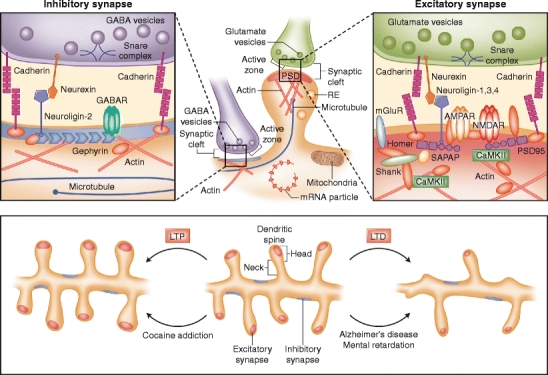
Inhibitory and excitatory synapses play a fundamental role in information processing in the brain. Excitatory synapses usually are situated on dendritic spines, small membrane protrusions that harbor glutamate receptors and postsynaptic density components and help transmit electrical signals. In recent years, it has become evident that spine morphology is intimately linked to synapse function--smaller spines have smaller synapses and support reduced synaptic transmission. The relationship between synaptic signaling, spine shape, and brain function is never more apparent than when the brain becomes dysfunctional. Many psychiatric and neurologic disorders, ranging from mental retardation and autism to Alzheimer's disease and addiction, are accompanied by alterations in spine morphology and synapse number. In this review, we highlight the structure and molecular organization of synapses and discuss functional effects of synapse pathology in brain disease.
Overview
The claims and statistics of this paper haven’t been checked yet.
Run the check — free, no account needed. It reads the open-access text and checks the sources it cites.
Integrity signals
Registry
Cites
Statistics
Figures
Verification
Claims the paper makes
The claims and statistics of this paper haven’t been checked yet.
Run the check — free, no account needed. It reads the open-access text and checks the sources it cites.
Claims other papers make about this one
Each is checked against this paper’s own text: does it say what the citing paper says it does?
The source backs part of the claim, not all of it — or backs it for a different population, condition or comparison.
In the citing paper
“changes in morphological complexity, dendritic spine number, shape and plasticity are associated with several neuropsychiatric and neurological disorders, including SCZ, ASD, ID and epilepsy.16, 17, 18, 19”
From The autism and schizophrenia associated gene CYFIP1 is critical for the maintenance of dendritic complexity and the stabilization of mature spines (2014) · cites this paper as [19]
Experimental — accuracy not yet measuredThe source backs part of the claim, not all of it — or backs it for a different population, condition or comparison.
In the citing paper
“A disruption in any of these processes produces network-wide deficits in neuronal connectivity”
From The autism and schizophrenia associated gene CYFIP1 is critical for the maintenance of dendritic complexity and the stabilization of mature spines (2014) · cites this paper as [19]
Experimental — accuracy not yet measured
Self-check
Percentages, sums and reported differences re-computed from the paper’s own numbers.
The self-check needs the paper’s full text.
Citations
Cites
Alzheimer's Disease Is a Synaptic Failure
Selkoe, D. J. (2002) · Science · doi:10.1126/science.1074069 · Cited by 4,420
Shankar, G. M., Li, S., Mehta, T. H., Garcia-Munoz, A., Shepardson, N. E., Smith, I., Brett, F. M., Farrell, M. A., Rowan, M. J., Lemere, C. A., et al. (2008) · Nature Medicine · doi:10.1038/nm1782 · Cited by 3,685
AMPA Receptor Trafficking and Synaptic Plasticity
Malinow, R., & Malenka, R. C. (2002) · Annual Review of Neuroscience · doi:10.1146/annurev.neuro.25.112701.142758 · Cited by 2,588
Südhof, T. C. (2004) · Annual Review of Neuroscience · doi:10.1146/annurev.neuro.26.041002.131412 · Cited by 2,491
Experience-dependent structural synaptic plasticity in the mammalian brain
Holtmaat, A., & Svoboda, K. (2009) · Nature Reviews Neuroscience · doi:10.1038/nrn2699 · Cited by 1,934
Advances in autism genetics: on the threshold of a new neurobiology
Abrahams, B. S., & Geschwind, D. H. (2008) · Nature Reviews Genetics · doi:10.1038/nrg2346 · Cited by 1,866
Neuroligins and neurexins link synaptic function to cognitive disease
Südhof, T. C. (2008) · Nature · doi:10.1038/nature07456 · Cited by 1,849
Amyloid-β Dynamics Are Regulated by Orexin and the Sleep-Wake Cycle
Kang, J.-E., Lim, M. M., Bateman, R. J., Lee, J. J., Smyth, L. P., Cirrito, J. R., Fujiki, N., Nishino, S., & Holtzman, D. M. (2009) · Science · doi:10.1126/science.1180962 · Cited by 1,565
Synaptic plasticity and addiction
Kauer, J. A., & Malenka, R. C. (2007) · Nature Reviews Neuroscience · doi:10.1038/nrn2234 · Cited by 1,397
The glutamate homeostasis hypothesis of addiction
Kalivas, P. W. (2009) · Nature Reviews Neuroscience · doi:10.1038/nrn2515 · Cited by 1,350
Cited by
Sorted by citations
Exercise-enhanced neuroplasticity targeting motor and cognitive circuitry in Parkinson's disease
Petzinger, G. M., Fisher, B. E., McEwen, S., Beeler, J. A., Walsh, J. P., & Jakowec, M. W. (2013) · The Lancet Neurology · doi:10.1016/s1474-4422(13)70123-6 · Cited by 798
The Indispensable Roles of Microglia and Astrocytes during Brain Development
Reemst, K., Noctor, S. C., Lucassen, P. J., & Hol, E. M. (2016) · Frontiers in Human Neuroscience · doi:10.3389/fnhum.2016.00566 · Cited by 516
Tau Protein Modifications and Interactions: Their Role in Function and Dysfunction
Mietelska‐Porowska, A., Wasik, U., Goras, M., Filipek, A., & Niewiadomska, G. (2014) · International Journal of Molecular Sciences · doi:10.3390/ijms15034671 · Cited by 431
Raven, F., Van der Zee, E. A., Meerlo, P., & Havekes, R. (2018) · Sleep Medicine Reviews · doi:10.1016/j.smrv.2017.05.002 · Cited by 331
Sphingolipids: membrane microdomains in brain development, function and neurological diseases
Olsen, A. S. B., & Færgeman, N. J. (2017) · Open Biology · doi:10.1098/rsob.170069 · Cited by 338
Metadata
- Authors
- van Spronsen, M., & Hoogenraad, C. C.
- Affiliations
- Erasmus MC (NL)
- Corresponding author
- Hoogenraad, Casper C.
- Venue
- Current Neurology and Neuroscience Reports
- Published
- 2010-03-18
- Volume
- 10
- Issue
- 3
- Pages
- 207-214
- ISSN
- 1528-4042 (ISSN-L)
- 1534-6293
- PMC
- PMC2857788
- OpenAlex
- W2098229885
- Cited by
- 345
- References
- 50
- Citations by year
- 2026: 5 · 2025: 14 · 2024: 13 · 2023: 16 · 2022: 22 · 2021: 18 · 2020: 21 · 2019: 20 · 2018: 29 · 2017: 21 · 2016: 25 · 2015: 26 · 2014: 22 · 2013: 24 · 2012: 38
- FWCI
- 2.66
- Type
- journal article
- Language
- en
- Open access
- hybrid
- doi.org
- Licence
- cc-by-nc
- Locations
- Current Neurology and Neuroscience Reports (publishedVersion, cc-by-nc)
- PubMed Central (publishedVersion, cc-by-nc)
- PubMed (publishedVersion)
- EUR Research Repository (Erasmus University Rotterdam) (submittedVersion, other-oa)
- RePub (Erasmus University Rotterdam) (submittedVersion, other-oa)
- RePub (Erasmus University Rotterdam) (submittedVersion)
- Funders
- ZonMw
- Nederlandse Organisatie voor Wetenschappelijk Onderzoek
- Topics
- Life Sciences › Neuroscience › Cellular and Molecular Neuroscience › Neuroscience and Neuropharmacology Research
- Life Sciences › Biochemistry, Genetics and Molecular Biology › Genetics › Genetics and Neurodevelopmental Disorders
- Health Sciences › Medicine › Pharmacology (medical) › Treatment of Major Depression
- Keywords
- dendritic spines, dendritic spine morphology, excitatory synapses, inhibitory synapses, synaptic transmission, postsynaptic density, glutamate receptors, mental illness, neurological disorders, autism spectrum disorder, intellectual disability, Alzheimer's disease, addiction, synapse number
- MeSH terms
- Mental Disorders, Humans, Models, Biological, Nervous System Diseases, Neuronal Plasticity, Neurons, Synapses, Dendritic Spines
About these checks
Registry, retraction, Cites and statistics results are computed, not judged, with one exception: a printed reference that no index lists is read once by a model before it counts as a citation error. Claims are extracted by a model and kept only when their quote appears verbatim in the text; each cited source is then checked, with a model’s help, for whether it says what the claim relies on. Those verdicts can be wrong — read the claim’s quote and the cited source before relying on one.
Statistics and arithmetic are recomputed, not judged.
Confidence bands are shown only for fields calibrated on our annotated test set. None is calibrated yet, so no band is shown.
What counts as a claim ›How we measure confidence ›How we check this ›
Are you an author, or do you see a problem with this page? Request a review
