

The DOI matches its Crossref record; 50 of the 50 references it cites were found in a registry or an index.
Synapse Pathology in Psychiatric and Neurologic Disease
Open accessAbstract
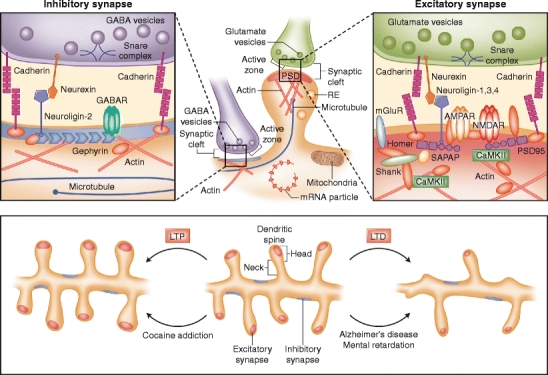
Inhibitory and excitatory synapses play a fundamental role in information processing in the brain. Excitatory synapses usually are situated on dendritic spines, small membrane protrusions that harbor glutamate receptors and postsynaptic density components and help transmit electrical signals. In recent years, it has become evident that spine morphology is intimately linked to synapse function--smaller spines have smaller synapses and support reduced synaptic transmission. The relationship between synaptic signaling, spine shape, and brain function is never more apparent than when the brain becomes dysfunctional. Many psychiatric and neurologic disorders, ranging from mental retardation and autism to Alzheimer's disease and addiction, are accompanied by alterations in spine morphology and synapse number. In this review, we highlight the structure and molecular organization of synapses and discuss functional effects of synapse pathology in brain disease.
Overview
The claims and statistics of this paper haven’t been checked yet.
Run the check — free, no account needed. It reads the open-access text and checks the sources it cites.
Integrity signals
Registry
Cites
Statistics
Figures
Verification
Claims the paper makes
The claims and statistics of this paper haven’t been checked yet.
Run the check — free, no account needed. It reads the open-access text and checks the sources it cites.
Claims other papers make about this one
Each is checked against this paper’s own text: does it say what the citing paper says it does?
The source backs part of the claim, not all of it — or backs it for a different population, condition or comparison.
In the citing paper
“changes in morphological complexity, dendritic spine number, shape and plasticity are associated with several neuropsychiatric and neurological disorders, including SCZ, ASD, ID and epilepsy.16, 17, 18, 19”
From The autism and schizophrenia associated gene CYFIP1 is critical for the maintenance of dendritic complexity and the stabilization of mature spines (2014) · cites this paper as [19]
Experimental — accuracy not yet measuredThe source backs part of the claim, not all of it — or backs it for a different population, condition or comparison.
In the citing paper
“A disruption in any of these processes produces network-wide deficits in neuronal connectivity”
From The autism and schizophrenia associated gene CYFIP1 is critical for the maintenance of dendritic complexity and the stabilization of mature spines (2014) · cites this paper as [19]
Experimental — accuracy not yet measured
Self-check
Percentages, sums and reported differences re-computed from the paper’s own numbers.
The self-check needs the paper’s full text.
Citations
Cites
Alzheimer's Disease Is a Synaptic Failure
Selkoe, D. J. (2002) · Science · doi:10.1126/science.1074069 · Cited by 4,420
Shankar, G. M., Li, S., Mehta, T. H., Garcia-Munoz, A., Shepardson, N. E., Smith, I., Brett, F. M., Farrell, M. A., Rowan, M. J., Lemere, C. A., et al. (2008) · Nature Medicine · doi:10.1038/nm1782 · Cited by 3,685
AMPA Receptor Trafficking and Synaptic Plasticity
Malinow, R., & Malenka, R. C. (2002) · Annual Review of Neuroscience · doi:10.1146/annurev.neuro.25.112701.142758 · Cited by 2,588
Südhof, T. C. (2004) · Annual Review of Neuroscience · doi:10.1146/annurev.neuro.26.041002.131412 · Cited by 2,491
Experience-dependent structural synaptic plasticity in the mammalian brain
Holtmaat, A., & Svoboda, K. (2009) · Nature Reviews Neuroscience · doi:10.1038/nrn2699 · Cited by 1,934
Advances in autism genetics: on the threshold of a new neurobiology
Abrahams, B. S., & Geschwind, D. H. (2008) · Nature Reviews Genetics · doi:10.1038/nrg2346 · Cited by 1,866
Neuroligins and neurexins link synaptic function to cognitive disease
Südhof, T. C. (2008) · Nature · doi:10.1038/nature07456 · Cited by 1,849
Amyloid-β Dynamics Are Regulated by Orexin and the Sleep-Wake Cycle
Kang, J.-E., Lim, M. M., Bateman, R. J., Lee, J. J., Smyth, L. P., Cirrito, J. R., Fujiki, N., Nishino, S., & Holtzman, D. M. (2009) · Science · doi:10.1126/science.1180962 · Cited by 1,565
Synaptic plasticity and addiction
Kauer, J. A., & Malenka, R. C. (2007) · Nature Reviews Neuroscience · doi:10.1038/nrn2234 · Cited by 1,397
The glutamate homeostasis hypothesis of addiction
Kalivas, P. W. (2009) · Nature Reviews Neuroscience · doi:10.1038/nrn2515 · Cited by 1,350
Morphological Changes in Dendritic Spines Associated with Long-Term Synaptic Plasticity
Yuste, R., & Bonhoeffer, T. (2001) · Annual Review of Neuroscience · doi:10.1146/annurev.neuro.24.1.1071 · Cited by 1,269
NMDA receptor trafficking in synaptic plasticity and neuropsychiatric disorders
Lau, C. G., & Zukin, R. S. (2007) · Nature Reviews Neuroscience · doi:10.1038/nrn2153 · Cited by 1,159 · cited 1×
“Moreover, alterations in synaptic receptor trafficking, abnormal spine morphology, and defects in synaptic function have been reported in animal models of neuropsychiatric disorders including addiction and schizophrenia [8, 34 ], as well as in models of mental retardation, such as FXS [35].”
BackgroundX-ray structure, symmetry and mechanism of an AMPA-subtype glutamate receptor
Sobolevsky, A. I., Rosconi, M. P., & Gouaux, E. (2009) · Nature · doi:10.1038/nature08624 · Cited by 1,052
Fragile X Syndrome: Loss of Local mRNA Regulation Alters Synaptic Development and Function
Bassell, G. J., & Warren, S. T. (2008) · Neuron · doi:10.1016/j.neuron.2008.10.004 · Cited by 1,051
AMPAR Removal Underlies Aβ-Induced Synaptic Depression and Dendritic Spine Loss
Hsieh, H., Boehm, J., Sato, C., Iwatsubo, T., Tomita, T., Sisodia, S., & Malinow, R. (2006) · Neuron · doi:10.1016/j.neuron.2006.10.035 · Cited by 1,042
The Postsynaptic Architecture of Excitatory Synapses: A More Quantitative View
Sheng, M., & Hoogenraad, C. C. (2007) · Annual Review of Biochemistry · doi:10.1146/annurev.biochem.76.060805.160029 · Cited by 1,003
Self-citationA Neuroligin-3 Mutation Implicated in Autism Increases Inhibitory Synaptic Transmission in Mice
Tabuchi, K., Blundell, J., Etherton, M. R., Hammer, R. E., Liu, X., Powell, C. M., & Südhof, T. C. (2007) · Science · doi:10.1126/science.1146221 · Cited by 997
Common genetic variants on 5p14.1 associate with autism spectrum disorders
Wang, K., Zhang, H., Ma, D., Bucan, M., Glessner, J. T., Abrahams, B. S., Salyakina, D., Imielinski, M., Bradfield, J. P., Sleiman, P. M. A., et al. (2009) · Nature · doi:10.1038/nature07999 · Cited by 989
Balancing Structure and Function at Hippocampal Dendritic Spines
Bourne, J. N., & Harris, K. M. (2008) · Annual Review of Neuroscience · doi:10.1146/annurev.neuro.31.060407.125646 · Cited by 916
Cortico-striatal synaptic defects and OCD-like behaviours in Sapap3-mutant mice
Welch, J. M., Lu, J., Rodriguiz, R. M., Trotta, N. C., Peca, J., Ding, J.-D., Feliciano, C., Chen, M., Adams, J. P., Luo, J., et al. (2007) · Nature · doi:10.1038/nature06104 · Cited by 852
Structure-stability-function relationships of dendritic spines
Kasai, H., Matsuzaki, M., Noguchi, J., Yasumatsu, N., & Nakahara, H. (2003) · Trends in Neurosciences · doi:10.1016/s0166-2236(03)00162-0 · Cited by 847
Synaptic plasticity and dysconnection in schizophrenia
Stephan, K. E., Baldeweg, T., & Friston, K. J. (2006) · Biological Psychiatry · doi:10.1016/j.biopsych.2005.10.005 · Cited by 841
GABAA receptor trafficking and its role in the dynamic modulation of neuronal inhibition
Jacob, T. C., Moss, S. J., & Jurd, R. (2008) · Nature Reviews Neuroscience · doi:10.1038/nrn2370 · Cited by 695
Animal models of Alzheimer's disease and frontotemporal dementia
Götz, J., & Ittner, L. M. (2008) · Nature Reviews Neuroscience · doi:10.1038/nrn2420 · Cited by 676
Dynamic microtubules regulate dendritic spine morphology and synaptic plasticity
Jaworski, J., Kapitein, L. C., Gouveia, S. M., Dortland, B. R., Wulf, P. S., Grigoriev, I., Camera, P., Spangler, S. A., Di Stefano, P., Demmers, J., et al. (2009) · Neuron · doi:10.1016/j.neuron.2008.11.013 · Cited by 643
Self-citationEndocytosis Is Required for Synaptic Activity-Dependent Release of Amyloid-β In Vivo
Cirrito, J. R., Kang, J.-E., Lee, J., Stewart, F. R., Verges, D. K., Silverio, L. M., Bu, G., Mennerick, S., & Holtzman, D. M. (2008) · Neuron · doi:10.1016/j.neuron.2008.02.003 · Cited by 635
Molecular mechanisms of dendritic spine morphogenesis
Tada, T., & Sheng, M. (2006) · Current Opinion in Neurobiology · doi:10.1016/j.conb.2005.12.001 · Cited by 615
Lord, C., Cook, E. H., Leventhal, B. L., & Amaral, D. G. (2000) · Neuron · doi:10.1016/s0896-6273(00)00115-x · Cited by 555
Myosin Vb mobilizes recycling endosomes and AMPA receptors for postsynaptic plasticity
Wang, Z., Edwards, J. G., Riley, N., Provance, D. W., Karcher, R., Li, X.-D., Davison, I. G., Ikebe, M., Mercer, J. A., Kauer, J. A., et al. (2008) · Cell · doi:10.1016/j.cell.2008.09.057 · Cited by 470
Failure of neuronal homeostasis results in common neuropsychiatric phenotypes
Ramocki, M. B., & Zoghbi, H. Y. (2008) · Nature · doi:10.1038/nature07457 · Cited by 399
A new function for the fragile X mental retardation protein in regulation of PSD-95 mRNA stability
Zalfa, F., Eleuteri, B., Dickson, K. S., Mercaldo, V., Rubeis, S. D., di Penta, A., Tabolacci, E., Chiurazzi, P., Neri, G., Grant, S. G. N., et al. (2007) · Nature Neuroscience · doi:10.1038/nn1893 · Cited by 370
Rho GTPases, dendritic structure, and mental retardation
Newey, S. E., Velamoor, V., Govek, E., & Van Aelst, L. (2005) · Journal of Neurobiology · doi:10.1002/neu.20153 · Cited by 351
Calabresi, P., Picconi, B., Parnetti, L., & Filippo, M. D. (2006) · The Lancet Neurology · doi:10.1016/s1474-4422(06)70600-7 · Cited by 343
Organization of the core structure of the postsynaptic density
Chen, X., Winters, C. A., Azzam, R. N., Li, X., Galbraith, J. A., Leapman, R. D., & Reese, T. S. (2008) · Proceedings of the National Academy of Sciences · doi:10.1073/pnas.0800897105 · Cited by 299
Dendritic spine formation and stabilization
Yoshihara, Y., De Roo, M., & Muller, D. (2009) · Current Opinion in Neurobiology · doi:10.1016/j.conb.2009.05.013 · Cited by 292
In Vivo Cocaine Experience Generates Silent Synapses
Huang, Y. H., Lin, Y., Mu, P., Lee, B. R., Brown, T. E., Wayman, G. A., Marie, H., Liu, W., Yan, Z., Sorg, B. A., et al. (2009) · Neuron · doi:10.1016/j.neuron.2009.06.007 · Cited by 291
Cadherins and catenins at synapses: Roles in synaptogenesis and synaptic plasticity.
Arikkath, J., & Reichardt, L. F. (2008) · Trends in Neurosciences · doi:10.1016/j.tins.2008.07.001 · Cited by 289
Integration of biochemical signalling in spines
Kennedy, M. B., Beale, H. C., Carlisle, H. J., & Washburn, L. R. (2005) · Nature Reviews Neuroscience · doi:10.1038/nrn1685 · Cited by 286
Role for metabotropic glutamate receptor 5 (mGluR5) in the pathogenesis of fragile X syndrome
Dölen, G., & Bear, M. F. (2008) · The Journal of Physiology · doi:10.1113/jphysiol.2008.150722 · Cited by 278
Molecular mechanisms of α-synuclein neurodegeneration
Waxman, E. A., & Giasson, B. I. (2008) · Biochimica et Biophysica Acta (BBA) - Molecular Basis of Disease · doi:10.1016/j.bbadis.2008.09.013 · Cited by 247
The State of Synapses in Fragile X Syndrome
Pfeiffer, B. E., & Huber, K. M. (2009) · The Neuroscientist · doi:10.1177/1073858409333075 · Cited by 216
Blanpied, T. A., & Ehlers, M. (2004) · Biological Psychiatry · doi:10.1016/j.biopsych.2003.10.006 · Cited by 187
Molecular Mechanisms of Presynaptic Differentiation
Jin, Y., & Garner, C. C. (2008) · Annual Review of Cell and Developmental Biology · doi:10.1146/annurev.cellbio.23.090506.123417 · Cited by 186
Control of neuronal polarity and plasticity – a renaissance for microtubules?
Hoogenraad, C. C., & Bradke, F. (2009) · Trends in Cell Biology · doi:10.1016/j.tcb.2009.08.006 · Cited by 173
Self-citationHow to build a central synapse: clues from cell culture
Craig, A. M., Graf, E. R., & Linhoff, M. W. (2005) · Trends in Neurosciences · doi:10.1016/j.tins.2005.11.002 · Cited by 170
Microsatellite repeat instability and neurological disease
Brouwer, J. R., Willemsen, R., & Oostra, B. A. (2009) · BioEssays · doi:10.1002/bies.080122 · Cited by 144
Recent advances in fragile X: a model for autism and neurodegeneration
Hagerman, R. J., Ono, M. Y., & Hagerman, P. J. (2005) · Current Opinion in Psychiatry · doi:10.1097/01.yco.0000179485.39520.b0 · Cited by 116
LIMK1 and CLIP‐115: linking cytoskeletal defects to Williams syndrome
Hoogenraad, C. C., Akhmanova, A. S., Galjart, N., & Zeeuw, C. I. D. (2004) · BioEssays · doi:10.1002/bies.10402 · Cited by 109
Self-citationMolecular dynamics of postsynaptic receptors and scaffold proteins
Renner, M. L., Specht, C. G., & Triller, A. (2008) · Current Opinion in Neurobiology · doi:10.1016/j.conb.2008.09.009 · Cited by 101
Basic mechanisms for recognition and transport of synaptic cargos
Schlager, M. A., & Hoogenraad, C. C. (2009) · Molecular Brain · doi:10.1186/1756-6606-2-25 · Cited by 100
Self-citation
Cited by
Sorted by citations
Exercise-enhanced neuroplasticity targeting motor and cognitive circuitry in Parkinson's disease
Petzinger, G. M., Fisher, B. E., McEwen, S., Beeler, J. A., Walsh, J. P., & Jakowec, M. W. (2013) · The Lancet Neurology · doi:10.1016/s1474-4422(13)70123-6 · Cited by 798
The Indispensable Roles of Microglia and Astrocytes during Brain Development
Reemst, K., Noctor, S. C., Lucassen, P. J., & Hol, E. M. (2016) · Frontiers in Human Neuroscience · doi:10.3389/fnhum.2016.00566 · Cited by 516
Tau Protein Modifications and Interactions: Their Role in Function and Dysfunction
Mietelska‐Porowska, A., Wasik, U., Goras, M., Filipek, A., & Niewiadomska, G. (2014) · International Journal of Molecular Sciences · doi:10.3390/ijms15034671 · Cited by 431
Raven, F., Van der Zee, E. A., Meerlo, P., & Havekes, R. (2018) · Sleep Medicine Reviews · doi:10.1016/j.smrv.2017.05.002 · Cited by 331
Sphingolipids: membrane microdomains in brain development, function and neurological diseases
Olsen, A. S. B., & Færgeman, N. J. (2017) · Open Biology · doi:10.1098/rsob.170069 · Cited by 338
Metadata
- Authors
- van Spronsen, M., & Hoogenraad, C. C.
- Affiliations
- Erasmus MC (NL)
- Corresponding author
- Hoogenraad, Casper C.
- Venue
- Current Neurology and Neuroscience Reports
- Published
- 2010-03-18
- Volume
- 10
- Issue
- 3
- Pages
- 207-214
- ISSN
- 1528-4042 (ISSN-L)
- 1534-6293
- PMC
- PMC2857788
- OpenAlex
- W2098229885
- Cited by
- 345
- References
- 50
- Citations by year
- 2026: 5 · 2025: 14 · 2024: 13 · 2023: 16 · 2022: 22 · 2021: 18 · 2020: 21 · 2019: 20 · 2018: 29 · 2017: 21 · 2016: 25 · 2015: 26 · 2014: 22 · 2013: 24 · 2012: 38
- FWCI
- 2.66
- Type
- journal article
- Language
- en
- Open access
- hybrid
- doi.org
- Licence
- cc-by-nc
- Locations
- Current Neurology and Neuroscience Reports (publishedVersion, cc-by-nc)
- PubMed Central (publishedVersion, cc-by-nc)
- PubMed (publishedVersion)
- EUR Research Repository (Erasmus University Rotterdam) (submittedVersion, other-oa)
- RePub (Erasmus University Rotterdam) (submittedVersion, other-oa)
- RePub (Erasmus University Rotterdam) (submittedVersion)
- Funders
- ZonMw
- Nederlandse Organisatie voor Wetenschappelijk Onderzoek
- Topics
- Life Sciences › Neuroscience › Cellular and Molecular Neuroscience › Neuroscience and Neuropharmacology Research
- Life Sciences › Biochemistry, Genetics and Molecular Biology › Genetics › Genetics and Neurodevelopmental Disorders
- Health Sciences › Medicine › Pharmacology (medical) › Treatment of Major Depression
- Keywords
- dendritic spines, dendritic spine morphology, excitatory synapses, inhibitory synapses, synaptic transmission, postsynaptic density, glutamate receptors, mental illness, neurological disorders, autism spectrum disorder, intellectual disability, Alzheimer's disease, addiction, synapse number
- MeSH terms
- Mental Disorders, Humans, Models, Biological, Nervous System Diseases, Neuronal Plasticity, Neurons, Synapses, Dendritic Spines
About these checks
Registry, retraction, Cites and statistics results are computed, not judged, with one exception: a printed reference that no index lists is read once by a model before it counts as a citation error. Claims are extracted by a model and kept only when their quote appears verbatim in the text; each cited source is then checked, with a model’s help, for whether it says what the claim relies on. Those verdicts can be wrong — read the claim’s quote and the cited source before relying on one.
Statistics and arithmetic are recomputed, not judged.
Confidence bands are shown only for fields calibrated on our annotated test set. None is calibrated yet, so no band is shown.
What counts as a claim ›How we measure confidence ›How we check this ›
Are you an author, or do you see a problem with this page? Request a review
