

Osteocyte Mechanotransduction in Orthodontic Tooth Movement
Open accessThe DOI matches its Crossref record; 109 of the 109 references it cites were found in a registry or an index.
Abstract
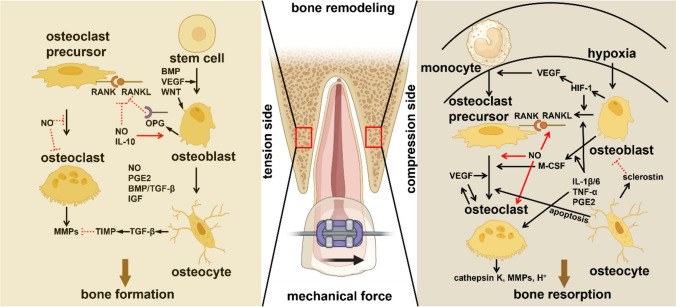
PURPOSE OF REVIEW: Orthodontic tooth movement is characterized by periodontal tissue responses to mechanical loading, leading to clinically relevant functional adaptation of jaw bone. Since osteocytes are significant in mechanotransduction and orchestrate osteoclast and osteoblast activity, they likely play a central role in orthodontic tooth movement. In this review, we attempt to shed light on the impact and role of osteocyte mechanotransduction during orthodontic tooth movement. RECENT FINDINGS: Mechanically loaded osteocytes produce signaling molecules, e.g., bone morphogenetic proteins, Wnts, prostaglandins, osteopontin, nitric oxide, sclerostin, and RANKL, which modulate the recruitment, differentiation, and activity of osteoblasts and osteoclasts. The major signaling pathways activated by mechanical loading in osteocytes are the wingless-related integration site (Wnt)/β-catenin and RANKL pathways, which are key regulators of bone metabolism. Moreover, osteocytes are capable of orchestrating bone adaptation during orthodontic tooth movement. A better understanding of the role of osteocyte mechanotransduction is crucial to advance orthodontic treatment. The optimal force level on the periodontal tissues for orthodontic tooth movement producing an adequate biological response, is debated. This review emphasizes that both mechanoresponses and inflammation are essential for achieving tooth movement clinically. To fully comprehend the role of osteocyte mechanotransduction in orthodontic tooth movement, more knowledge is needed of the biological pathways involved. This will contribute to optimization of orthodontic treatment and enhance patient outcomes.
Overview
The claims and statistics of this paper haven’t been checked yet.
Free: it reads the open-access text and checks the first 5 claims that cite a source we can check. Create a free account to check every claim.
Integrity signals
Registry
Cites
Statistics
Figures
Verification
Claims the paper makes
The claims and statistics of this paper haven’t been checked yet.
Free: it reads the open-access text and checks the first 5 claims that cite a source we can check. Create a free account to check every claim.
Claims other papers make about this one
Each is checked against this paper’s own text: does it say what the citing paper says it does?
In the citing paper
“PGs, which are produced by hepatocytes, are cytokines that regulate the recruitment, differentiation, and activity of osteoblasts and osteoclasts [150].”
From Emerging role of liver-bone axis in osteoporosis (2024) · cites this paper as [150]
Self-check
Percentages, sums and reported differences re-computed from the paper’s own numbers.
The self-check needs the paper’s full text.
Citations
Cites
Wnt/β-catenin signaling and disease
Clevers, H., & Nusse, R. (2012) · Cell · doi:10.1016/j.cell.2012.05.012 · Cited by 5,554 · cited 3×
“The Wnt-sensitive signaling pathway is separated into the canonical signaling pathway which depends on the function of β-catenin (the so-called Wnt/β-catenin pathway) and the non-canonical pathway [65].”
BackgroundInfluentialWNT signaling in bone homeostasis and disease: From human mutations to treatments
Baron, R., & Kneissel, M. (2013) · Nature Medicine · doi:10.1038/nm.3074 · Cited by 2,093 · cited 1×
“Wnt signaling pathways have different roles in skeletal homeostasis [64].”
BackgroundTherapeutic Approaches to Bone Diseases
Rodan, G. A., & Martin, T. J. (2000) · Science · doi:10.1126/science.289.5484.1508 · Cited by 1,767 · cited 3×
“Bone matrix is continuously resorbed (degraded) by osteoclasts and rebuilt by osteoblasts at approximately 1–2 million microscopic sites in every adult skeleton [26].”
BackgroundInfluentialHADJIDAKIS, D. J., & ANDROULAKIS, I. I. (2006) · Annals of the New York Academy of Sciences · doi:10.1196/annals.1365.035 · Cited by 1,360 · cited 4×
“Osteocytes sense and respond to bone tissue strain, resulting in enhanced bone remodeling activity by osteoclasts at locations where bone remodeling is needed [12].”
BackgroundInfluentialBIOMECHANICAL AND MOLECULAR REGULATION OF BONE REMODELING
Robling, A. G., Castillo, A. B., & Turner, C. H. (2006) · Annual Review of Biomedical Engineering · doi:10.1146/annurev.bioeng.8.061505.095721 · Cited by 1,343 · cited 1×
“The balance between bone formation and resorption is affected by several factors, most notably ageing, hormones, and mechanical loading [28].”
BackgroundBone graft materials. An overview of the basic science.
Bauer, T. W., & Muschler, G. F. (2000) · PubMed · Cited by 1,073
Bone Graft Materials: An Overview of the Basic Science
Bauer, T. W., & Muschler, G. F. (2000) · Clinical Orthopaedics and Related Research · doi:10.1097/00003086-200002000-00003 · Cited by 998 · cited 1×
“This process of functional bone adaptation serves to acquire bones that unite a suitable resistance against mechanical failure with a minimum use of material [23, 24].”
BackgroundThree rules for bone adaptation to mechanical stimuli
Turner, C. H. (1998) · Bone · doi:10.1016/s8756-3282(98)00118-5 · Cited by 969 · cited 1×
“Bone is able to adapt its mass and structure to mechanical loading [17].”
BackgroundThe Promise and Perils of Wnt Signaling Through β-Catenin
Moon, R. T., Bowerman, B., Boutros, M., & Perrimon, N. (2002) · Science · doi:10.1126/science.1071549 · Cited by 969 · cited 1×
“The canonical signaling pathway includes critical molecular for cellular metabolism [102].”
BackgroundSclerostin is a delayed secreted product of osteocytes that inhibits bone formation
Poole, K. E. S., Van Bezooijen, R. L., Loveridge, N., Hamersma, H., Papapoulos, S. E., Löwik, C. W., & Reeve, J. (2005) · The FASEB Journal · doi:10.1096/fj.05-4221fje · Cited by 965
Research works printed but not linked: 3
- Pereira Alexandre L Nava Lopes Cançado L Renato Jordão C Absolute orthodontic anchorage: A brief review Int J Appl Dent Sci. 2019 5 152 155
- Robling AG Castillo AB Turner CH Biomechanical and molecular regulation of bone remodeling Annu Rev Biomed Eng 2006 8 455 498 10.1146/annurev.bioeng.8.061505.095721 16834564 · DOI · Paper page
- Wasserman E. Differentially load-regulated gene expression in mouse trabecular osteocytes, Dissertation ETH Zurich, No. 18938, 2010.
Cited by
Emerging role of liver-bone axis in osteoporosis
Gao, H., Peng, X., Li, N., Gou, L., Xu, T., Wang, Y., Qin, J., Liang, H., Ma, P., Li, S., et al. (2024) · Journal of Orthopaedic Translation · doi:10.1016/j.jot.2024.07.008 · Cited by 36
“PGs, which are produced by hepatocytes, are cytokines that regulate the recruitment, differentiation, and activity of osteoblasts and osteoclasts [150].”
BackgroundThe central mechanotransducer in osteoporosis pathogenesis and therapy
Liu, C., Yang, J., Dong, Z., Zhao, S., Tian, Z., Li, Y., Hao, Y., & Wang, M. (2025) · Frontiers in Endocrinology · doi:10.3389/fendo.2025.1658967 · Cited by 25
“Mechanical loading activates Wnt/ b -catenin signaling, promoting osteoblast differentiation, while suppressing RANKL-mediated osteoclastogenesis (40).”
Liao, X.-M., Yang, Z.-J., Li, Y., Cui, Y., Ma, L., Liang, C., Guan, Z., & Hu, J. (2025) · Free Radical Biology and Medicine · doi:10.1016/j.freeradbiomed.2025.05.425 · Cited by 14
Emerging Technologies in Bone Tissue Engineering: A Review
Rastogi, S., Verma, R., Gouru, S. A., Venkatesan, K., Pandian, P. M., Khan, M. I., Deka, T., & Kumar, P. (2025) · Journal of Bionic Engineering · doi:10.1007/s42235-025-00765-x · Cited by 13
Cai, D., Shao, J., & Xiao, Y. (2026) · Dental Research · doi:10.1016/j.dtrs.2026.100025 · Cited by 9
Mechanical Force Promotes Mitochondrial Transfer From Macrophages to BMSCs to Enhance Bone Formation
Li, Y., Yan, Z., Dai, Y., Cai, H., Chen, Y., Chen, Y., Jin, R., Sun, W. S., & Wang, H. (2025) · Cell Proliferation · doi:10.1111/cpr.70121 · Cited by 15
Recent Advances in the Role of Osteocytes in Orthodontic Tooth Movement
Marahleh, A., Ohori, F., Ma, J., Fan, Z., Lin, A., Narita, K., Murakami, K., & Kitaura, H. (2025) · International Journal of Molecular Sciences · doi:10.3390/ijms26199396 · Cited by 8
“Central to this remodeling is the osteocyte, a highly specialized and mechanosensitive terminally differentiated cell embedded within the bone matrix [7,8].”
Hu, J., Song, Y., Zhang, Y., Yang, P., Chen, S., Wu, Z., & Zhang, J. (2024) · Drug Design Development and Therapy · doi:10.2147/dddt.s482969 · Cited by 7
“2,5,6 At the end of OTM, teeth tend to return to their original position or deviate, producing a new malocclusion known as relapse.”
BackgroundBone tissue regeneration: role of osteocyte mechanosensing and mechanotransduction
Seddiqi, H., Klein‐Nulend, J., & Jin, J. (2026) · Stem Cells Translational Medicine · doi:10.1093/stcltm/szag017 · Cited by 7
Self-citationThe liver-bone axis: an emerging player in disease pathogenesis and therapeutic intervention
Han, S., Wei, Y., Yu, G., Jia, W., Liao, W., He, Y., Cheng, K., Zhao, J., Xiang, S., Zhang, W., et al. (2026) · Science China Life Sciences · doi:10.1007/s11427-025-3207-5 · Cited by 5
Kuc, A. E., Kotuła, J., Sybilski, K., Saternus, S., Małachowski, J., Kuc, N., Hajduk, G., Lis, J., Kawala, B., Sarul, M., et al. (2026) · Journal of Functional Biomaterials · doi:10.3390/jfb17010047 · Cited by 4
“This dual effect—biomechanical and biological—may explain the unexpected reinforcement of the buccal phenotype reported under tensile-driven conditions [49,96–98].”
Yang, H., Zhao, T., Zhao, P., Cao, C., Fang, F., & Liu, X. (2026) · Biomaterials · doi:10.1016/j.biomaterials.2026.124305 · Cited by 5
M2-exo promote orthodontic bone remodeling via the MeCP2-TCF20-HDAC1 axis
Chen, M., Li, Y., Yang, Z.-J., Chen, M., Li, J., Bao, G., Ma, L., & Hu, J. (2025) · Stem Cell Research & Therapy · doi:10.1186/s13287-025-04633-7 · Cited by 4
Jiang, Y., Zhou, J., Huang, Y. H., Bai, Y., Chen, X., & Huang, L. (2025) · Progress in Orthodontics · doi:10.1186/s40510-025-00588-w · Cited by 5
“Orthodontic therapy induces controlled mechanical stimulation to achieve dentoalveolar remodeling, yet the molecular mechanisms underlying cellular mechano-transduction and osteoimmune crosstalk remain incompletely understood [1, 2].”
Lv, H., Qi, Y., Huang, Q., Pan, G., Yu, X., & Tayyebi, M. (2026) · Journal of Materials Research and Technology · doi:10.1016/j.jmrt.2026.07.015 · Cited by 4
Adult Scissor Bite Case Treatment With Moving Teeth Through Maxillary Sinus
Lee, S., Park, J. H., Huh, H., Yu, J., & Chung, D. (2025) · Journal of Esthetic and Restorative Dentistry · doi:10.1111/jerd.13424 · Cited by 2
Yu, H., Wei, X., Wu, Z., Jiang, H., Qi, H., Zhang, Y., & Hu, M. (2025) · BMC Oral Health · doi:10.1186/s12903-025-05491-8 · Cited by 4
Yang, L., Yang, G., Yang, Q., & Zheng, L. (2025) · Scientific Reports · doi:10.1038/s41598-025-18603-9 · Cited by 4
Wong, H., Huang, Y., & Yang, P. (2025) · European journal of medical research · doi:10.1186/s40001-025-02503-9 · Cited by 2
“…mainly involves two steps, that is, the pressure exerted by the appliance induces the activation of osteoclasts on the “compression side” and promotes bone resorption; moreover, the recruitment of osteoblasts on the “tension side” causes bone formation, which accelerates tooth movement [41].”
MMPs at Work: Deciphering Their Role in the Cellular Mechanisms of Orthodontic Tooth Movement
Patrão, M. R., Pereira, P. M., Caldeira, J., & Salema‐Oom, M. (2026) · International Journal of Molecular Sciences · doi:10.3390/ijms27010542 · Cited by 3
“…located on the surfaces of these cells are activated and an intracellular cascade is triggered, culminating in the production of molecules such as FGF-23, which plays a role in phosphate homeostasis [190], as well as nitric oxide and IGF-1, involved in the differentiation of osteoblasts [191,192].”
Yamashita, A., Tenshin, H., Matsuki, S., Nishino, G., Ser-Od, S., Saito, F. M., Hiasa, M., & Tanaka, E. I. (2026) · JBMR Plus · doi:10.1093/jbmrpl/ziag014 · Cited by 2
“43 Recently, it was reportedthatanincreasednumberofPDLCsexhibitedsenescence and produced inflammatory cytokines mediated by SASP.”
Yang, T., Dong, Z., Chen, L., & Kou, X. (2026) · Bioactive Materials · doi:10.1016/j.bioactmat.2026.05.050 · Cited by 2
Rogers, M. L., Rossouw, P. E., & Javed, F. (2025) · Dentistry Journal · doi:10.3390/dj13110513 · Cited by 1
“Moreover, osteocytes act as “mechanotransductors” by responding to mechanical stimuli through a series of biological signaling cascades by modulating their release of sclerostin [13,21,22].”
Santos, M. L., Ribeiro, J. P. R., Costa, A., Fernandes, M. T., Almeida, I. M., & Carvalho, R. A. (2024) · Asian Journal of Periodontics and Orthodontics · doi:10.51847/lu1fr1pecr · Cited by 2
IGF-1 c.258 A > G synonymous mutation ameliorates senile osteoporosis
Wang, Z., Dai, D., Wang, S., Zhang, L., Li, Y., Zhang, X., Cheng, Y., & Hao, L. (2024) · Communications Biology · doi:10.1038/s42003-024-07369-x
“…can produce signaling molecules, such as Wnts, OPG and RANKL, which modulate the recruitment, differentiation, and activity of osteoblasts and osteoclasts 39 RANKLcanpromoteboneresorptionthroughstimulatingtheproliferationanddifferentiationofosteoclastsbycombiningwithRANKexpressedinosteoclasts .”
Methods of Stem Cells’ Utilization in Accelerated Orthodontic Tooth Movement: A Review
Khan, A., Sarkissian, A., Bilasy, S. E., & Javadi, S. (2025) · Journal of the California Dental Association · doi:10.1080/19424396.2025.2474838
Reed, T. B., Sherif, A. K. E., & Petrenko, O. V. (2025) · Asian Journal of Periodontics and Orthodontics · doi:10.51847/bymbjppnbg · Cited by 2
Mechanistic Model of Periodontal Inflammation and Orthodontic Force Interactions
Brown, O. S., Rahman, A. F., & Sherif, A. K. E. (2025) · Asian Journal of Periodontics and Orthodontics · doi:10.51847/cn2ajnoes0
Kuc, A. E., Kotuła, J., Sybilski, K., Hajduk, G., Lis, J., Kawala, B., Sarul, M., & Sulewska, M. E. (2026) · Journal of Clinical Medicine · doi:10.3390/jcm15020721
“…patients with a thin buccal plate during uncontrolled expansion. https://doi.org/10.3390/jcm15020721 In contrast, the tension side promotes osteoblastic differentiation, increased production of type I collagen, osteocalcin, and osteopontin, and deposition of new extracellular matrix [62,64,70,71].”
InfluentialSirri, M. R., Namera, M. O., Alasbahi, M. Y. S., & Alswaidan, Z. (2026) · International Journal of Dentistry · doi:10.1155/ijod/7774426 · Cited by 1
“These fi ndings suggest that VA-OTM may modulate force-loaded alveolar tissues through mechanotransduction pathways that regulate bone remodeling during tooth movement [5].”
Kuc, A. E., Kotuła, J., Kuc, N., Lis, J., Kawala, B., Sarul, M., & Sulewska, M. E. (2026) · Frontiers in Bioengineering and Biotechnology · doi:10.3389/fbioe.2026.1771800
“…2005), Wnt/ β -catenin stabilization (Bonewald, 2006; Bonewald, 2002; Bonewald, 2005; Bonewald, 2017; Nicolella et al., 2008; Duan et al., 2016; Seddiqi et al., 2023; Geoghegan et al., 2019; Li et al., 2021), and hypoxia-inducible factor-1 α (HIF-1 α )/vascular endothelial growth factor…”
Nie, J., Zhang, Y., Ma, J., Hu, M., & Qi, H. (2026) · Genes & Diseases · doi:10.1016/j.gendis.2026.102123 · Cited by 1
From mechanical force to cellular response: the role of autophagy in orthodontic tooth movement
Dong, Y., Liu, Y., Hu, Z., & Qu, C. (2026) · Frontiers in Physiology · doi:10.3389/fphys.2026.1783943
“Osteocytes sense mechanical loading and transduce signaling molecules to stimulate osteoclastic bone resorption, or osteoblastic bone formation (Seddiqi et al., 2023).”
Tanaka, H., Sato, Y., Mori, K., & Okabe, R. (2025) · Annals of dental specialty · doi:10.51847/egbnapjpg0
Tobias-López, L. F., Trejo-Iriarte, C. G., García-Muñoz, A., & Gómez‐Clavel, J. F. (2026) · Journal of Oral Biology and Craniofacial Research · doi:10.1016/j.jobcr.2026.101445
El-Salam, S. A., Aboalnaga, A. A., Tawfik, W. A., & Fayed, M. M. S. (2026) · BMC Oral Health · doi:10.1186/s12903-026-08243-4
Zhang, Y., Lu, J., Lu, X., Hsu, P., & Ouyang, Y. (2026) · Materials Research Express · doi:10.1088/2053-1591/ae654b · Cited by 1
Sui, X., Li, L., Zhong, B.-W., Cao, Z.-H., Yang, D.-F., Zhuang, Y., Ren, J.-M., Yan, T.-T., Han, B., & Liu, Z. (2026) · Materials Today Bio · doi:10.1016/j.mtbio.2026.103204
“Increased periodontal ligament tension on the traction side causes bone growth by transferring the pulling energy to the alveolar bone [14,15].”
The role of AXIN2 gene variant in hypodontia: a case-control study
Qalandarzehi, B., Arabshahi, A., Tehrani, P., Piroozan, Y., Faqih, M., Alijani, E., Farshad, M. M., Akhtar, R., & Shahriari, H. (2026) · Egyptian Journal of Medical Human Genetics · doi:10.1186/s43042-026-00889-7
Hussein, A. M., Yassir, Y. A., Al-Hasani, N. R., McIntyre, G. T., RUSSO, D., Uzunçıbuk, H., Marrapodi, M. M., & Minervini, G. (2026) · European Journal of Dentistry · doi:10.1055/s-0046-1824438
Hu, J., An, N., Chang, S., Zhao, S., Su, R., & Huang, J. (2026) · International Dental Journal · doi:10.1016/j.identj.2026.109676
DNA methylation changes following rapid maxillary expansion in children
Ishiyama, T., Takahashi, M., Kamura, H., Kawai, T., Tajima, A., & Yamaguchi, T. (2026) · Scientific Reports · doi:10.1038/s41598-026-66231-8
“…metabolism and autophagy play critical roles in maintaining cellular homeostasis in response to mechanical stimulation, suggesting that these pathways may reflect general cellular stress responses associated with mechanical stimulation rather than RME-specific biological mechanisms 15,37 .”
Avila, K. J. P., Cavero, R. M., Marin, A. M. M., Rojas, Y., & Dumont, M. (2026) · Cureus · doi:10.7759/cureus.114888
Du, T., Zhao, J., Shao, X., Zhao, M., Weng, W., Zhu, R., Feng, Z., Liu, Z., & Qi, K. (2026) · Antioxidants · doi:10.3390/antiox15101292
“According to the widely accepted pressure–tension theory [5], orthodontic force generates two distinct tissue compartments: the tension side, where osteoblast-mediated bone formation pre-dominates, and the compression side, where osteoclast-driven bone resorption occurs [6].”
Saatchi, A., Seddiqi, H., Amoabediny, G., Zamani, Y., Jin, J.-F., Helder, M., Klein-Nulend, J., & Zandieh-Doulabi, B. (2026) · Mechanobiology in Medicine · doi:10.1016/j.mbm.2026.100221
Self-citationEffect of FMOD on orthodontic tooth movement and associated root resorption
Guo, W., Duan, Q., Ning, B., & Mei, Y. (2026) · Journal of Stomatology Oral and Maxillofacial Surgery · doi:10.1016/j.jormas.2026.103028
Metadata
- Authors
- Seddiqi, H., Klein-Nulend, J., & Jin, J.
- Affiliations
- Academic Center for Dentistry Amsterdam (NL)
- Corresponding author
- Jin, Jianfeng
- Venue
- Current Osteoporosis Reports
- Published
- 2023-10-04
- Volume
- 21
- Issue
- 6
- Pages
- 731-742
- ISSN
- 1544-1873 (ISSN-L)
- 1544-2241
- PMC
- PMC10724326
- OpenAlex
- W4387326649
- Cited by
- 46
- References
- 109
- Citations by year
- 2026: 26 · 2025: 16 · 2024: 4
- FWCI
- 2.62
- Type
- journal article
- Language
- en
- Open access
- hybrid
- doi.org
- Licence
- cc-by
- creativecommons.org/licenses/by/4.0 (tdm)
- creativecommons.org/licenses/by/4.0 (vor)
- Locations
- Current Osteoporosis Reports (publishedVersion, cc-by)
- PubMed Central (publishedVersion, cc-by)
- PubMed (publishedVersion)
- VU Research Portal (submittedVersion, other-oa)
- Funders
- Health-Holland (LSHM19016, “BB”)
- Topics
- Health Sciences › Dentistry › Orthodontics › Orthodontics and Dentofacial Orthopedics
- Life Sciences › Biochemistry, Genetics and Molecular Biology › Molecular Biology › Bone Metabolism and Diseases
- Life Sciences › Biochemistry, Genetics and Molecular Biology › Cell Biology › Cellular Mechanics and Interactions
- Keywords
- osteocyte mechanotransduction, orthodontic tooth movement, periodontal tissue response, mechanical loading, Wnt/β-catenin signaling, RANKL signaling, bone remodeling, osteoblasts, osteoclasts, sclerostin, RANKL, bone morphogenetic proteins, prostaglandins, osteopontin, nitric oxide, bone adaptation, periodontal inflammation
- MeSH terms
- Humans, Osteoblasts, Osteoclasts, Osteocytes, Tooth Movement Techniques, Bone Remodeling, Mechanotransduction, Cellular
About these checks
Registry, retraction, Cites and statistics results are computed, not judged, with one exception: a printed reference that no index lists is read once by a model before it counts as a citation error. Claims are extracted by a model and kept only when their quote appears verbatim in the text; each cited source is then checked, with a model’s help, for whether it says what the claim relies on. Those verdicts can be wrong — read the claim’s quote and the cited source before relying on one.
Statistics and arithmetic are recomputed, not judged.
Confidence bands are shown only for fields calibrated on our annotated test set. None is calibrated yet, so no band is shown.
What counts as a claim ›How we measure confidence ›How we check this ›
Are you an author, or do you see a problem with this page? Request a review
Data sources
Bibliographic data: Semantic Scholar, OpenAlex, Crossref.
Contains information from the Semantic Scholar Academic Graph Datasets, made available under the ODC Attribution License (ODC-BY 1.0).
Semantic Scholar’s data is described in: Kinney, R., et al. (2023). The Semantic Scholar Open Data Platform. arXiv:2301.10140.
