

The DOI matches its Crossref record; 23 of the 23 references it cites were found in a registry or an index.
The Reach, Effectiveness, Adoption, Implementation, and Maintenance of Digital Mental Health Interventions for College Students: A Systematic Review
Abstract
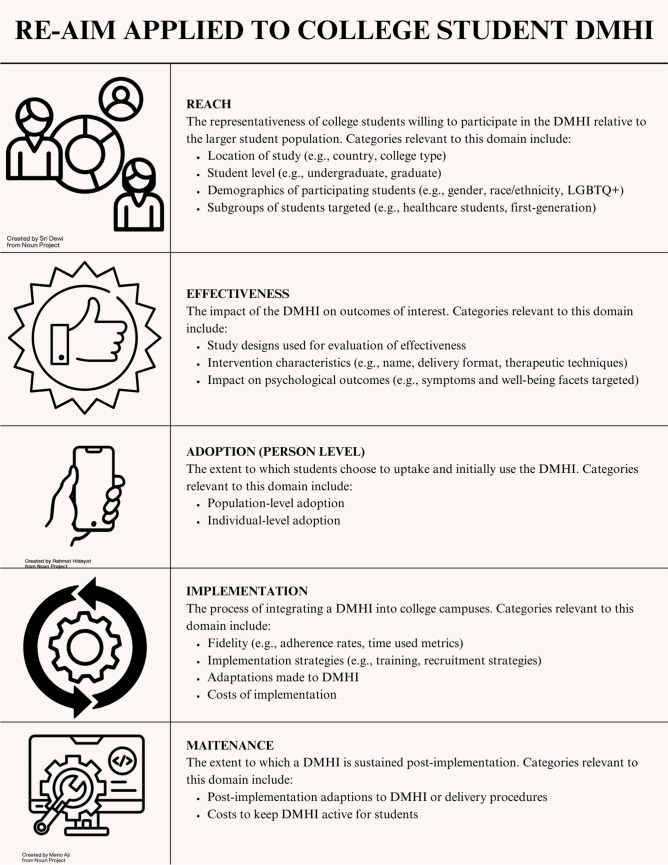
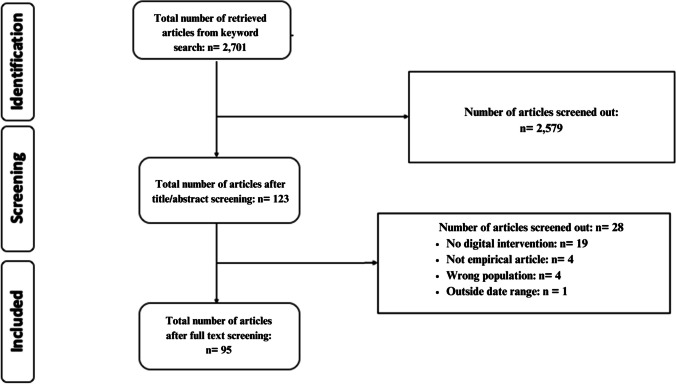
Purpose of Review: We evaluated the impact of digital mental health interventions (DMHIs) for college students. We organized findings using the RE-AIM framework to include reach, effectiveness, adoption, implementation, and maintenance. Recent Findings: We conducted a systematic literature review of recent findings from 2019–2024. Our search identified 2,701 articles, of which 95 met inclusion criteria. In the reach domain, student samples were overwhelmingly female and White. In the effectiveness domain, over 80% of DMHIs were effective or partially effective at reducing their primary outcome. In the adoption domain, studies reported modest uptake for DMHIs. In the implementation and maintenance domains, studies reported high adherence rates to DMHI content. While recruitment methods were commonly reported, adaptations and costs of implementation and maintenance were rarely reported. Summary: DMHIs for college students are effective for many psychological outcomes. Future work should address diversifying samples and considering implementation in a variety of college settings.
Overview
The claims and statistics of this paper haven’t been checked yet.
Run the check — free, no account needed. It reads the open-access text and checks the sources it cites.
Integrity signals
Registry
Cites
Statistics
Figures
Verification
Claims the paper makes
The claims and statistics of this paper haven’t been checked yet.
Run the check — free, no account needed. It reads the open-access text and checks the sources it cites.
Claims other papers make about this one
Each is checked against this paper’s own text: does it say what the citing paper says it does?
In the citing paper
“several colleges have increasingly adopted remote service delivery through digital interventions and apps (Taylor et al., 2024).”
From Research Review: Help‐seeking intentions, behaviors, and barriers in college students – a systematic review and meta‐analysis (2025) · cites this paper as Taylor et al., 2024
Self-check
Percentages, sums and reported differences re-computed from the paper’s own numbers.
The self-check needs the paper’s full text.
Citations
Cites
Evaluating the public health impact of health promotion interventions: the RE-AIM framework.
Glasgow, R. E., Vogt, T. M., & Boles, S. M. (1999) · American Journal of Public Health · doi:10.2105/ajph.89.9.1322 · Cited by 7,217
Measuring mindfulness—The Freiburg Mindfulness Inventory (FMI)
Walach, H., Buchheld, N., Buttenmüller, V., Kleinknecht, N., & Schmidt, S. (2006) · Personality and Individual Differences · doi:10.1016/j.paid.2005.11.025 · Cited by 1,475
Lipson, S. K., Lattie, E. G., & Eisenberg, D. (2019) · Psychiatric Services · doi:10.1176/appi.ps.201800332 · Cited by 947
Self-citationLipson, S. K., Zhou, S., Abelson, S., Heinze, J., Jirsa, M., Morigney, J., Patterson, A., Singh, M., & Eisenberg, D. (2022) · Journal of Affective Disorders · doi:10.1016/j.jad.2022.03.038 · Cited by 877
Self-citationLattie, E. G., Adkins, E. C., Winquist, N., Stiles-Shields, C., Wafford, Q. E., & Graham, A. K. (2019) · Journal of Medical Internet Research · doi:10.2196/12869 · Cited by 843
Davies, E. B., Morriss, R., & Glazebrook, C. (2014) · Journal of Medical Internet Research · doi:10.2196/jmir.3142 · Cited by 499
Huberty, J., Green, J., Glissmann, C., Larkey, L., Puzia, M., & Lee, C. (2019) · JMIR mHealth and uHealth · doi:10.2196/14273 · Cited by 488
Harrer, M., Adam, S. H., Baumeister, H., Cuijpers, P., Karyotaki, E., Auerbach, R. P., Kessler, R. C., Bruffaerts, R., Berking, M., & Ebert, D. D. (2019) · International Journal of Methods in Psychiatric Research · doi:10.1002/mpr.1759 · Cited by 445
Garrido, S., Millington, C., Cheers, D., Boydell, K., Schubert, E., Meade, T., & Nguyen, Q. V. (2019) · Frontiers in Psychiatry · doi:10.3389/fpsyt.2019.00759 · Cited by 400
Mohr, D. C., Weingardt, K. R., Reddy, M., & Schueller, S. M. (2017) · Psychiatric Services · doi:10.1176/appi.ps.201600541 · Cited by 365
Self-citationUse of Digital Mental Health for Marginalized and Underserved Populations
Schueller, S. M., Hunter, J. F., Figueroa, C., & Aguilera, A. (2019) · Current Treatment Options in Psychiatry · doi:10.1007/s40501-019-00181-z · Cited by 268
Self-citationImplementation strategies for digital mental health interventions in health care settings.
Graham, A. K., Lattie, E. G., Powell, B. J., Lyon, A. R., Smith, J. D., Schueller, S. M., Stadnick, N. A., Brown, C. H., & Mohr, D. C. (2020) · American Psychologist · doi:10.1037/amp0000686 · Cited by 236
Self-citationRamos, G., & Chavira, D. A. (2022) · Cognitive and Behavioral Practice · doi:10.1016/j.cbpra.2019.10.004 · Cited by 143
Ponzo, S., Morelli, D., Kawadler, J. M., Hemmings, N. R., Bird, G., & Plans, D. (2020) · JMIR mHealth and uHealth · doi:10.2196/17767 · Cited by 100
Salamanca-Sanabria, A., Richards, D., Timulak, L., Connell, S., Mojica Perilla, M., Parra-Villa, Y., & Castro-Camacho, L. (2020) · JMIR Mental Health · doi:10.2196/13392 · Cited by 83
Smartphone App to Address Loneliness Among College Students: Pilot Randomized Controlled Trial
Bruehlman-Senecal, E., Hook, C. J., Pfeifer, J. H., FitzGerald, C., Davis, B., Delucchi, K. L., Haritatos, J., & Ramo, D. E. (2020) · JMIR Mental Health · doi:10.2196/21496 · Cited by 80
Wiljer, D., Shi, J., Lo, B., Sanches, M., Hollenberg, E., Johnson, A., Abi-Jaoudé, A., Chaim, G., Cleverley, K., Henderson, J., et al. (2020) · Journal of Medical Internet Research · doi:10.2196/20790 · Cited by 78
Krifa, I., Hallez, Q., van Zyl, L. E., Braham, A., Sahli, J., Ben Nasr, S., & Shankland, R. (2022) · Applied Psychology: Health and Well-Being · doi:10.1111/aphw.12332 · Cited by 58
Dai, Z., Jing, S., Wang, H., Xiao, W., Huang, Y., Chen, X., Fu, J., Pan, C., Tang, Q., Wang, H., et al. (2022) · Frontiers in Psychiatry · doi:10.3389/fpsyt.2022.949477 · Cited by 44
Chung, J., Mundy, M. E., Hunt, I., Coxon, A., Dyer, K. R., & McKenzie, S. (2021) · Frontiers in Psychology · doi:10.3389/fpsyg.2021.752060 · Cited by 26
Ditton, E., Knott, B., Hodyl, N., Horton, G., Oldmeadow, C., Walker, F. R., & Nilsson, M. (2023) · JMIR Mental Health · doi:10.2196/42566 · Cited by 22
Kajitani, K., Higashijima, I., Kaneko, K., Matsushita, T., Fukumori, H., & Kim, D. (2020) · PLOS ONE · doi:10.1371/journal.pone.0239592 · Cited by 22
Kleiman, E. M., Bentley, K. H., Wacha-Montes, A., Taylor, M. E., Lozy, O., Conti, K., & Reese Mayer, W. (2022) · Behavior Therapy · doi:10.1016/j.beth.2022.04.008 · Cited by 12
Self-citation
Research works printed but not linked: 41
- American College Health Association. American College Health Association-National College Health Assessment III: Undergraduate Student Reference Group Data Report Spring 2023. Silver Spring, MD: American College Health Association; 2023.
- Schueller SM, Torous J. Scaling evidence-based treatments through digital mental health. Am Psychol. 2020;75(8):1093. https://doi.org/10.1037/amp0000654. · DOI
- Moghimi E, Stephenson C, Gutierrez G, et al. Mental health challenges, treatment experiences, and care needs of post-secondary students: a cross-sectional mixed-methods study. BMC Public Health. 2023;23(1):655. https://doi.org/10.1186/s12889-023-15452-x. · DOI
- Pandya A, Lodha P. Mental health consequences of COVID-19 pandemic among college students and coping approaches adapted by higher education institutions: A scoping review. SSM - Mental Health. 2022;2:100122. https://doi.org/10.1016/j.ssmmh.2022.100122. · DOI
- Brown N, Johnson R, Strayhorn T, et al. Psychosocial impacts of #BlackLivesMatter protests and police killings on undergraduate students in STEM. Teach Coll Rec. 2022. Accessed from: https://www.researchgate.net/publication/362184388
- Huynh J, Chien J, Nguyen AT, et al. The mental health of Asian American adolescents and young adults amid the rise of anti-Asian racism. Front Public Health. 2023;10:958517. https://doi.org/10.3389/fpubh.2022.958517. · DOI
- Wasfi R, Poirier Stephens Z, Sones M, et al. Recruiting participants for population health intervention research: effectiveness and costs of recruitment methods for a cohort study. J Med Internet Res. 2021;23(11):e21142. https://doi.org/10.2196/21142. · DOI
- • Lipschitz JM, Pike CK, Hogan TP, et al. The engagement problem: a review of engagement with digital mental health interventions and recommendations for a path forward. Curr Treat Options Psychiatry. 2023;10(3):119–35. https://doi.org/10.1007/s40501-023-00297-3. (This article provides a comprehensive overview of different ways to measure engagement for DMHI.) · DOI
- Bohrer BK, Chen Y, Christensen KA, et al. A pilot multiple-baseline study of a mobile cognitive behavioral therapy for the treatment of eating disorders in university students. Int J Eat Disord. 2023;56(8):1623–36. https://doi.org/10.1002/eat.23987. · DOI
- Holden S, O’Connell KA. Using meditation to reduce stress, anxiety, and depression in nursing students. J Nurs Educ. 2023;62(8):443–9. https://doi.org/10.3928/01484834-20230612-02. · DOI
- O’Driscoll M, Byrne S, Byrne H, et al. An online mindfulness-based intervention for undergraduate pharmacy students: results of a mixed methods feasibility study. Curr Pharm Teach Learn. 2019;11(9):858–75. https://doi.org/10.1016/j.cptl.2019.05.013. · DOI
- Wang L, Guo Y, Liu Y, et al. The effects of a mobile phone-based psychological intervention program on stress, anxiety and self-efficacy among undergraduate nursing students during clinical practice: a randomized controlled trial. J Prof Nurs. 2022;42:219–24. https://doi.org/10.1016/j.profnurs.2022.07.016. · DOI
- Glass NE, Clough A, Messing JT, et al. Longitudinal impact of the myPlan app on health and safety among college women experiencing partner violence. J Interpers Violence. 2022;37(13–14):NP11436–59. https://doi.org/10.1177/0886260521991880. · DOI
- Kim SY, Suh H, Oh W, et al. Daily change patterns in mindfulness and psychological health: a pilot intervention. J Clin Psychol. 2021;77(3):496–515. https://doi.org/10.1002/jclp.23043. · DOI · Paper page
- Son C, Hegde S, Markert C, et al. Use of a mobile biofeedback app to provide health coaching for stress self-management: pilot quasi-experiment. JMIR Form Res. 2023;7:e41018. https://doi.org/10.2196/41018. · DOI
- Benjet C, Albor Y, Alvis-Barranco LC, et al. Internet-delivered cognitive behavior therapy versus treatment as usual for anxiety and depression among Latin American university students: a randomized clinical trial. J Consult Clin Psychol. 2023;91(12):694. · DOI
- Crosby ES, Witte TK. A pilot study of Sleep Scholar: a single-session, internet-based insomnia intervention for college students with a history of suicide ideation. J Am Coll Health. 2021;71(7):1984–98. https://doi.org/10.1080/07448481.2021.1953028. · DOI
- • Gatto AJ, Elliott TJ, Briganti JS, et al. Development and feasibility of an online brief emotion regulation training (BERT) program for emerging adults. Front Public Health. 2022;10:858370. https://doi.org/10.3389/fpubh.2022.858370. (This article serves as a model for how to use the RE-AIM framework to develop and evaluate a DMHI for college students.) · DOI
- Sauer-Zavala S, Tirpak JW, Eustis EH, et al. Unified protocol for the transdiagnostic prevention of emotional disorders: evaluation of a brief, online course for college freshmen. Behav Ther. 2021;52(1):64–76. https://doi.org/10.1016/j.beth.2020.01.010. · DOI · Paper page
- Sturgill R, Martinasek M, Schmidt T, et al. A novel artificial intelligence-powered emotional intelligence and mindfulness app (Ajivar) for the college student population during the COVID-19 pandemic: quantitative questionnaire study. JMIR Form Res. 2021;5(1):e25372. https://doi.org/10.2196/25372. · DOI
- Vereschagin M, Wang AY, Richardson CG, et al. Effectiveness of the Minder mobile mental health and substance use intervention for university students: randomized controlled trial. J Med Internet Res. 2024;26:e54287. https://doi.org/10.2196/54287. · DOI
- • Fitzsimmons-Craft EE, Firebaugh M-L, Graham AK, et al. State-wide university implementation of an online platform for eating disorders screening and intervention. Psychol Serv. 2019;16(2):239–49. https://doi.org/10.1037/ser0000264. (This study details outcomes for one of the largest DMHI implementation projects undertaken at universities over the past 5 years.) · DOI
- King CA, Eisenberg D, Pistorello J, et al. Electronic bridge to mental health for college students: a randomized controlled intervention trial. J Consult Clin Psychol. 2022;90(2):172–83. https://doi.org/10.1037/ccp0000709. · DOI
- • Lattie EG, Cohen KA, Hersch ED, et al. Uptake and effectiveness of a self-guided mobile app platform for college student mental health. Internet Interv. 2022;27:100493. https://doi.org/10.1016/j.invent.2021.100493. (This article models how to evaluate uptake of a DMHI on college campuses post-implementation.) · DOI
- Shih C, Pudipeddi R, Uthayakumar A, et al. A local community-based social network for mental health and well-being (Quokka): exploratory feasibility study. JMIRx Med. 2021;2(4):e24972. https://doi.org/10.2196/24972. · DOI
- Ghosh A, Cohen KA, Jans L, et al. A digital single-session intervention (Project Engage) to address fear of negative evaluation among college students: Pilot randomized controlled trial. JMIR Ment Health. 2023;10:e48926. https://doi.org/10.2196/48926. · DOI
- • Wasil AR, Taylor ME, Franzen RE, Steinberg JS, DeRubeis RJ. Promoting graduate student mental health during COVID-19: Acceptability, feasibility, and perceived utility of an online single-session intervention. Front Psychol. 2021;12:569785. https://doi.org/10.3389/fpsyg.2021.569785. (This study provides a good example of how DMHI can be adapted for use with college students.) · DOI
- Purkayastha S, Addepally SA, Bucher S. Engagement and usability of a cognitive behavioral therapy mobile app compared with web-based cognitive behavioral therapy among college students: Randomized heuristic trial. JMIR Hum Factors. 2020;7(1):e14146. https://doi.org/10.2196/14146. · DOI
- Oliveira C, Maia M, Vairinhos M, et al. A social anxiety mobile intervention for college students attending therapy: A usability and acceptability study. Int J Hum Comput Interact. 2022;38(14):1333–44. https://doi.org/10.1080/10447318.2021.2002042. · DOI
- Räsänen P, Muotka J, Lappalainen R. Examining coaches’ asynchronous written feedback in two blended ACT-based interventions for enhancing university students’ wellbeing and reducing psychological distress: A randomized study. J Contextual Behav Sci. 2023;29:98–108. https://doi.org/10.1016/j.jcbs.2023.06.006. · DOI
- Strehli I, Burns RD, Bai Y, et al. Development of an online mind-body physical activity intervention for young adults during COVID-19: A pilot study. Int J Environ Res Public Health. 2023;20(5):4562. https://doi.org/10.3390/ijerph20054562. · DOI
- Pankow K, King N, Li M, et al. Acceptability and utility of digital well-being and mental health support for university students: A pilot study. Early Interv Psychiatry. 2024;18(3):226–36. https://doi.org/10.1111/eip.13458. · DOI
- • Davis CH, Klimczak K, Aller TB, et al. Reach, adoption, and maintenance of online acceptance and commitment therapy at a university: An implementation case study. Psychol Serv. 2024. https://doi.org/10.1037/ser0000834. (This study is one of the only DMHI implementation studies to consider maintenance factors post-DMHI implementation.) · DOI
- Borghouts J, Eikey EV, Mark G, et al. Understanding mental health app use among community college students: Web-based survey study. J Med Internet Res. 2021;23(9):e27745. https://doi.org/10.2196/27745. · DOI
- Adu-Brimpong J, Pugh J, Darko DA, et al. Examining diversity in digital therapeutics clinical trials: Descriptive analysis. J Med Internet Res. 2023;25:e37447. https://doi.org/10.2196/37447. · DOI · Paper page
- Chou T, Bry LJ, Comer JS. Overcoming traditional barriers only to encounter new ones: Doses of caution and direction as technology-enhanced treatments begin to “go live.” Clin Psychol Sci Prac. 2017;24:241–4. https://doi.org/10.1111/cpsp.12196. · DOI
- Rafal G, Gatto A, DeBate R. Mental health literacy, stigma, and help-seeking behaviors among male college students. J Am Coll Health. 2018;66(4):284–91. https://doi.org/10.1080/07448481.2018.1434780. · DOI
- Lipson SK, Lattie EG, Eisenberg D. Increased rates of mental health service utilization by U.S. college students: 10-year population-level trends (2007–2017). Psychiatr Serv. 2019;70(1):60–3. https://doi.org/10.1176/appi.ps.201800332. · DOI · Paper page
- Kodish T, Schueller SM, Lau AS. Barriers and strategies to improve digital mental health intervention uptake among college students of color: A modified Delphi study. J Behav Cogn Ther. 2023;33(1):10–23. https://doi.org/10.1016/j.jbct.2022.12.002. · DOI
- Beidas RS, Saldana L, Shelton RC. Testing psychosocial interventions in the contexts they are meant to be delivered. J Consult Clin Psychol. 2023;91(4):189. https://doi.org/10.1037/ccp0000797. · DOI
- Liu M, Schueller SM. Moving evidence-based mental health interventions into practice: Implementation of digital mental health interventions. Curr Treat Options Psychiatry. 2023;10:333–45. https://doi.org/10.1007/s40501-023-00298-2. · DOI
Cited by
Sorted by citations
Zhao, R., Amanvermez, Y., Pei, J., Castro‐Ramirez, F., Rapsey, C., Garcia, C., Ebert, D. D., Haro, J. M., Fodor, L. A., David, O. A., et al. (2025) · Journal of Child Psychology and Psychiatry · doi:10.1111/jcpp.14145 · Cited by 110
Metadata
- Authors
- Taylor, M. E., Liu, M., Abelson, S., Eisenberg, D., Lipson, S. K., & Schueller, S. M.
- ORCID
- Venue
- Current Psychiatry Reports
- Published
- 2024-10-11
- Volume
- 26
- Issue
- 12
- Pages
- 683-693
- ISSN
- 1523-3812
- 1535-1645
- PMC
- PMC11706926
- Cited by
- 54
- References
- 23
- Language
- en
About these checks
Registry, retraction, Cites and statistics results are computed, not judged, with one exception: a printed reference that no index lists is read once by a model before it counts as a citation error. Claims are extracted by a model and kept only when their quote appears verbatim in the text; each cited source is then checked, with a model’s help, for whether it says what the claim relies on. Those verdicts can be wrong — read the claim’s quote and the cited source before relying on one.
Statistics and arithmetic are recomputed, not judged.
Confidence bands are shown only for fields calibrated on our annotated test set. None is calibrated yet, so no band is shown.
What counts as a claim ›How we measure confidence ›How we check this ›
Are you an author, or do you see a problem with this page? Request a review
