

Towards Transparency by Design for Artificial Intelligence
Open accessThe DOI matches its Crossref record; 122 of the 122 references it cites were found in a registry or an index.
Abstract
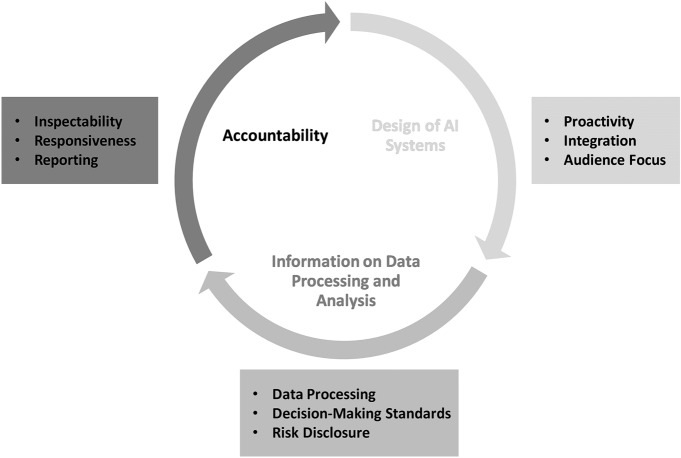
In this article, we develop the concept of Transparency by Design that serves as practical guidance in helping promote the beneficial functions of transparency while mitigating its challenges in automated-decision making (ADM) environments. With the rise of artificial intelligence (AI) and the ability of AI systems to make automated and self-learned decisions, a call for transparency of how such systems reach decisions has echoed within academic and policy circles. The term transparency, however, relates to multiple concepts, fulfills many functions, and holds different promises that struggle to be realized in concrete applications. Indeed, the complexity of transparency for ADM shows tension between transparency as a normative ideal and its translation to practical application. To address this tension, we first conduct a review of transparency, analyzing its challenges and limitations concerning automated decision-making practices. We then look at the lessons learned from the development of Privacy by Design, as a basis for developing the Transparency by Design principles. Finally, we propose a set of nine principles to cover relevant contextual, technical, informational, and stakeholder-sensitive considerations. Transparency by Design is a model that helps organizations design transparent AI systems, by integrating these principles in a step-by-step manner and as an ex-ante value, not as an afterthought.
Overview
The claims and statistics of this paper haven’t been checked yet.
Free: it reads the open-access text and checks the first 5 claims that cite a source we can check. Create a free account to check every claim.
Integrity signals
Registry
Cites
Statistics
Figures
Verification
Claims the paper makes
The claims and statistics of this paper haven’t been checked yet.
Free: it reads the open-access text and checks the first 5 claims that cite a source we can check. Create a free account to check every claim.
Claims other papers make about this one
Each is checked against this paper’s own text: does it say what the citing paper says it does?
The cited source says what the claim attributes to it.
In the citing paper
“We agree with the H. Felzmann et al. that transparency shall be a holistic concept and be considered at the earliest stages of AI development31.”
From Transparency of AI in Healthcare as a Multilayered System of Accountabilities: Between Legal Requirements and Technical Limitations (2022) · cites this paper as Felzmann et al., 2020
Experimental — accuracy not yet measured
Self-check
Percentages, sums and reported differences re-computed from the paper’s own numbers.
The self-check needs the paper’s full text.
Citations
Cites
Principles of Biomedical Ethics
(2012) · Thieves of Virtue · doi:10.7551/mitpress/9079.003.0009 · Cited by 13,453
Agency Theory: An Assessment and Review
Eisenhardt, K. M. (1989) · The Academy of Management Review · doi:10.5465/amr.1989.4279003 · Cited by 13,338 · cited 1×
“The informational approach to transparency aligns with the principal-agent theory, where the principal, who delegated certain tasks to an agent, needs to obtain information in order to check if the agent holds up their part of the contract (Eisenhardt 1989).”
BackgroundExit, Voice and Loyalty: Responses to Decline in Firms, Organizations, and States.
Tullock, G., & Hirschman, A. O. (1970) · The Journal of Finance · doi:10.2307/2325604 · Cited by 10,904
Not So Different After All: A Cross-Discipline View Of Trust
Rousseau, D. M., Sitkin, S. B., Burt, R. S., & Camerer, C. (1998) · Academy of Management Review · doi:10.5465/amr.1998.926617 · Cited by 10,274
Understanding Information Systems Continuance: An Expectation-Confirmation Model1
Bhattacherjee, A. (2001) · MIS Quarterly · doi:10.2307/3250921 · Cited by 8,767 · cited 1×
“Trust involves a trustor’s/principal’s assessment of the trustee/agent’s trustworthiness in terms of ability, benevolence, and integrity (Bhattacherjee 2001; Jones 1996).”
BackgroundPeeking Inside the Black-Box: A Survey on Explainable Artificial Intelligence (XAI)
Adadi, A., & Berrada, M. (2018) · IEEE Access · doi:10.1109/access.2018.2870052 · Cited by 6,294
The global landscape of AI ethics guidelines
Jobin, A., Ienca, M., & Vayena, E. (2019) · Nature Machine Intelligence · doi:10.1038/s42256-019-0088-2 · Cited by 6,220
Explanation in Artificial Intelligence: Insights from the Social Sciences
Miller, T. (2017) · arXiv · doi:10.48550/arxiv.1706.07269 · Cited by 5,338
Explanation in artificial intelligence: Insights from the social sciences
Miller, T. (2019) · Artificial Intelligence · doi:10.1016/j.artint.2018.07.007 · Cited by 5,302
The ethics of algorithms: Mapping the debate
Mittelstadt, B. D., Allo, P., Taddeo, M., Wachter, S., & Floridi, L. (2016) · Big Data & Society · doi:10.1177/2053951716679679 · Cited by 4,567
Research works printed but not linked: 10
- 3. ACM (2017). Statement on algorithmic transparency and accountability. Retrieved January 10, 2020, from https ://www.acm.org/binar ies/conte nt/asset s/publi c-polic y/2017_usacm _state ment_algor ithms .pdf.
- ICDPPC (International Conference of Data Protection and Privacy Commissioners). (2018). Declaration on ethics and data protection in artificial intelligence. Retrieved November 11, 2020, from https://icdppc.org/wp-content/uploads/2018/10/20180922_ICDPPC-40th_AI-Declaration_ADOPTED.pdf.
- 62. ICDPPC (International Conference of Data Protection and Privacy Commissioners). (2018). Declara- tion on ethics and data protection in artificial intelligence. Retrieved November 11, 2020, from https ://icdpp c.org/wp-conte nt/uploa ds/2018/10/20180 922_ICDPP C-40th_AI-Decla ratio n_ADOPT ED.pdf. ICO. (2020). What is automated individual decision-making and profiling? Retrieved August 19, 2020, from https ://ico.org.uk/for-organ isati ons/guide -to-data-prote ction /guide -to-the-gener al-data-prote ction -regul ation -gdpr/autom ated-decis ion-makin g-and-profi ling/what-is-autom ated-indiv idual -decis ion-makin g-and-profi ling/. IEEE. (2019). Ethically aligned design (version 2). Retrieved November 11, 2020, from https ://stand ards. ieee.org/conte nt/dam/ieee-stand ards/stand ards/web/docum ents/other /ead_v2.pdf.
- 80. Meijer, A. (2014). Transparency. In M. Bovens, R. E. Goodin, & T. Schillemans (Eds.), The Oxford hand- book of public accountability (pp. 507-524). Oxford: Oxford University Press.
- 81. Merchant, B. (2019). Tech journalism's 'on background' scourge. Columbia Journalism Review, July 17 2019. Retrieved November 11, 2020, from https ://www.cjr.org/opini on/tech-journ alism -on-backg round .php.
- 89. O'Neill, O. (2002). A question of trust: The BBC Reith Lectures 2002. Cambridge: Cambridge University Press.
- 110. Tielenburg, D. S. (2018). The 'dark sides' of transparency: Rethinking information disclosure as a social praxis. Master's thesis, Utrecht University. Retrieved October 20, 2020, from https ://dspac e.libra ry.uu.nl/handl e/1874/36952
- 113. Van Otterlo, M. (2013). A machine learning view on profiling. In M. Hildebrandt & K. de Vries (Eds.), Privacy, due process and the computational turn: Philosophers of law meet philosophers of tech- nology (pp. 41-64). London: Routledge.
- 118. Weller, A. (2017). Challenges for transparency. arXiv preprint arXiv :1708.01870 . · arXiv
- 121. Zarsky, T. Z. (2013). Transparent predictions. University of Illinois Law Review, 4, 1503-1570.
Cited by
Items 301–400 of 717
Öge, K., & Quintin, M. (2026) · JCMS Journal of Common Market Studies · doi:10.1111/jcms.70078 · Cited by 5
Centring dignity in algorithm development: testing a Dignity Lens
Ruster, L. P., Oliva‐Altamirano, P., & Daniell, K. A. (2022) · Australian Conference on Human-Computer Interaction (OzCHI) · doi:10.1145/3572921.3572938 · Cited by 5
“To date, much of the work to operationalise AI ethics principles focuses on principles such as fairness [26], accountability [39], and transparency [11, 38, 55].”
BackgroundEbert, I. L. (2024) · Big Data & Society · doi:10.1177/20539517241232638 · Cited by 6
“Transparency remains “ a fuzzy concept that de fi es precise linearity ” (Felzmann et al., 2020: 3353).”
Zhang, L., Zhan, J., Kwok, V. W. W., & Wang, Y. (2024) · IEEE Access · doi:10.1109/access.2024.3454213 · Cited by 8
“First, transparency ‘‘requires full disclosure of all relevant information in a timely manner’’, and it serves as a vital tool for overcoming information asymmetries [29].”
BackgroundApplying Knowledge Management to Support Artificial Intelligence Chatbot Applications
Oliveira, G. P., Argôlo, M., Barbosa, C. E., Lima, Y., Santos, H. D., Lyra, A. D. O., & de Souza, J. M. (2024) · European Conference on Knowledge Management · doi:10.34190/eckm.25.1.2482 · Cited by 7
“Transparency enables users to understand the underlyi ng basis and sources of their responses, allowing them to verify the accuracy of the provided information (Felzmann et al. , 2020) .”
Omutoko, L., Chingarande, G. R., Botes, M., Moyana, F., Singh, S., Jaoko, W. G., Sevene, E., Mtande, T., Edwin, A. K., Matandika, L., et al. (2024) · Research Ethics · doi:10.1177/17470161241274809 · Cited by 7
“…the South African Protection of Personal Information Act (POPIA) being modelled on the GDPR, it is silent on ‘transparency by design’ requirements for informed consent forms to address clarity for the intended audience (Eiband et al., 2018; Felzmann et al., 2020; Lnenicka and Nikiforova, 2021).”
AI arbitration – Charting the ethical and legal course
Choudhary, A., & Surbhi, A. (2024) · AIP conference proceedings · doi:10.1063/5.0234731 · Cited by 8
Privacy-Friendly and Trustworthy Technology for Society
Fedosov, A., Tamò‐Larrieux, A., Lutz, C., Fosch‐Villaronga, E., & Čartolovni, A. (2025) · Digital Society · doi:10.1007/s44206-025-00167-w · Cited by 6
“…(Tamò-Larrieux, 2018), interpersonal and systems trust (Fedosov et al., 2023), overtrust (Aroyo et al., 2021), transparency-by-design (Felzmann et al., 2020), and 1 See the Ageing well in the information society: The Ambient Assisted Living (AAL) Programme at: h t t p s : / / e u r -…”
Self-citationAI-Powered Cybersecurity Governance: The Role of Business Analysts in Ethical AI Deployment
Adaji, C. C., Bello, A. A., Ukatu, C. E., Okika, N., Agboola, O. K., & Amomo, C. G. (2025) · doi:10.38124//ijisrt/25mar924 · Cited by 6
Pedersen, M., Pardoe, H., de Weger, A., Hutchison, D. M., Abbott, D. F., Verspoor, K. M., & Jackson, G. D. (2025) · Artificial Intelligence in Medicine · doi:10.1016/j.artmed.2025.103192 · Cited by 5
Meleouni, C., & Efthymiou, I.-P. (2024) · Journal of Politics and Ethics in New Technologies and AI · doi:10.12681/jpentai.37847 · Cited by 5
Bhuiyan, M. F. A., & Saurav, K. R. H. (2025) · Journal of Knowledge Learning and Science Technology · doi:10.60087/jklst.vol4.n4.012 · Cited by 6
“…transparency is also enhanced by the usage of AI that allows predictive analytics and timely decision-making, so that all participants in the producers, transport, and regulating industries can have instant access to the available information that is both accurate and valid (Felzmann et al., 2020).”
Data Transparency Design in Internet of Things: A Systematic Review
Long, Y., Luo, X., Zhu, Y., Lee, K.-P., & Wang, S. J. (2023) · International Journal of Human-Computer Interaction · doi:10.1080/10447318.2023.2228997 · Cited by 5
“With the presentation of data transparency, users might become resistant to IoT technologies and affect the real performance of IoT (Felzmann et al., 2020; Velsberg et al., 2020).”
Masotina, M., Musi, E., & Spagnolli, A. (2023) · Biannual Conference of the Italian SIGCHI Chapter (CHItaly) · doi:10.1145/3605390.3605413 · Cited by 6
“[11] take into account the lifecycle of an AI and identify the transparency principles needed during the design of the AI system, the analysis of the system in use, or the accountability of its functions to stakeholders.”
BackgroundHow to Make an Artificial Intelligence Algorithm “Ecological”? Insights from a holistic perspective
Mascio, T. D., Caruso, F., & Peretti, S. (2023) · Biannual Conference of the Italian SIGCHI Chapter (CHItaly) · doi:10.1145/3605390.3605398 · Cited by 6
“More transparency and accountability are necessary to build trust in AI algorithms and ensure they align with human values and goals [15].”
BackgroundGutierrez, R. (2023) · Advances in computational intelligence and robotics book series · doi:10.4018/979-8-3693-0368-9.ch005 · Cited by 5
Exploring Ethical Dimensions of AI Assistants and Chatbots
Porna, S. B., Ahmad, M., Vallejo, R. G., Shahzadi, I., & Rahman, M. A. (2024) · Advances in computational intelligence and robotics book series · doi:10.4018/979-8-3693-9173-0.ch011 · Cited by 6
Ethical AI in Entrepreneurship: Balancing Innovation With Responsible AI Practices
Sahoo, D. K., Hung, T. H., Kumar, A., & Kanwal, P. (2024) · Advances in business strategy and competitive advantage book series · doi:10.4018/979-8-3693-1495-1.ch007 · Cited by 5
Erdélyi, G., Erdélyi, O. J., & Estivill‐Castro, V. (2021) · arXiv (Cornell University) · doi:10.48550/arxiv.2111.07545 · Cited by 5
Sinap, V. (2025) · Gazi Üniversitesi Fen Bilimleri Dergisi Part C Tasarım ve Teknoloji · doi:10.29109/gujsc.1544987 · Cited by 4
Ethical Considerations and Bias in AI Applications in Healthcare
Ali, A. (2025) · Information systems engineering and management · doi:10.1007/978-3-031-84404-1_7 · Cited by 6
Re-Thinking Algorithmic Control: Common Assumptions, Controversies, Misconceptions
Mettler, T. (2025) · International Conference on eDemocracy & eGovernment · doi:10.1109/icedeg65568.2025.11081667 · Cited by 4
“Different scholars therefore argue that, if algorithms are engineered with transparency as an objective in mind [62, 63], they could potentially be more understandable and open to explanation and independent validation compared to human decisions.”
Scalable XAI: Towards Explainable Machine Learning Models in Distributed Systems
Mienye, I. D., Swart, T. G., & Obaido, G. (2025) · Lecture notes of the Institute for Computer Sciences, Social Informatics and Telecommunications Engineering · doi:10.1007/978-3-031-94439-0_1 · Cited by 5
Embarak, O. H. (2025) · Procedia Computer Science · doi:10.1016/j.procs.2025.07.158 · Cited by 6
Reimagining Autonomy: Agentic AI in the Age of Human-Centric Innovation
Poornima, G., & Ahamed, N. N. (2025) · Springer eBooks · doi:10.1007/978-3-031-89424-4_19 · Cited by 7
Algorithmic Knowability: A Unified Approach to Explanations in the AI Act
Sapienza, S., & Palmirani, M. (2025) · Communications in computer and information science · doi:10.1007/978-3-032-08317-3_9 · Cited by 8
Fan, G. F., Liu, D., & Huang, Y. (2025) · International Journal of Human-Computer Interaction · doi:10.1080/10447318.2025.2574513 · Cited by 4
“Trust in AI depends on perceived competence, transparency, provenance, and sociocultural context (Felzmann et al., 2020; Skraaning & Jamieson, 2021; Sohn & Kwon, 2020; Von Eschenbach, 2021; Yuan et al., 2023).”
Rosário, A. T., & Dias, J. C. (2025) · Information · doi:10.3390/info16121044 · Cited by 5
Lutz, C., Newlands, G., & Jarrahi, M. H. (2025) · Springer eBooks · doi:10.1007/978-981-97-8440-0_87-1 · Cited by 8
Self-citationJiang, Y., & Duan, X. (2026) · International Journal of Human-Computer Interaction · doi:10.1080/10447318.2026.2631679 · Cited by 4
“Users are more inclined to comprehend the mechanism by which the system generates tailored responses when the degree of AI trans-parency is high (Felzmann et al., 2020).”
Craig, K., Grover, V., & Thatcher, J. B. (2023) · Journal of Information Technology Case and Application Research · doi:10.1080/15228053.2023.2265786 · Cited by 5
“Leaders in the artificial intelligence industry are already using and refining frameworks such as Transparency by Design (Felzmann et al., 2020) to build transparency into all phases of IS development (Craig & Sadovykh, 2022).”
MethodRegulatory Strategies for Fostering Responsible AI Innovation in African Economies
Shao, D. D., Marwa, N. W., & Didas, M. (2023) · International Conference on the Advancements of Artificial Intelligence in African Context (AAIAC) · doi:10.1109/aaiac60008.2023.10465404 · Cited by 6
“Accountability and transparency are intertwined, requiring developers of AI systems to be accountable for their creation and the consequences they might have [56], [57].”
BackgroundRole of Artificial Intelligence and Machine Learning Algorithms in Detecting Financial Frauds
Dar, B. I., & Jaiswal, S. (2024) · Advances in finance, accounting, and economics book series · doi:10.4018/979-8-3693-3633-5.ch011 · Cited by 4
Ferraz, T. P., Duarte, C. H. D., Ribeiro, M. F., Takayanagi, G. G. B., Alcoforado, A., Lopes, R. D. D., & Susi, M. (2024) · Estudos Avançados · doi:10.1590/s0103-4014.202438111.020 · Cited by 8
Generative Artificial Intelligence Model Inspiring Personalization in Automotive Product Design
Shan, P., Luo, S., Cui, Z., & Zhang, J. (2024) · International Conference on Intelligent Human-Machine Systems and Cybernetics · doi:10.1109/ihmsc62065.2024.00044 · Cited by 4
“Felzmann et al. [4] investigated the role of transparency in automated decision-making practices and proposed that system design principles should prioritize audience-centric approaches.”
BackgroundProlonged Usage of AI Assistant for Improving Multitasking Performance
Talypova, D., Lingler, A., & Wintersberger, P. (2024) · International Conference on Human-Agent Interaction (HAI) · doi:10.1145/3687272.3690898 · Cited by 5
“Despite AI being increasingly utilized, the public’s understanding of these systems often remains shallow [4, 13, 29].”
Limitations of Artificial Intelligence in Orthodontics. Literature Review
Naureen, S. (2025) · Journal of Bahria University Medical and Dental College · doi:10.51985/jbumdc2024-452 · Cited by 4
Cai-xia, Y., Jiang, J., & Gao, M. (2025) · International Conference on Educational and Information Technology · doi:10.1109/iceit64364.2025.10976098 · Cited by 4
“For schools, intelligent analysis can help school leaders grasp the overall development of the school, predict potential problems, and provide scientific reference for adjusting the direction of teaching and optimizing curriculum design[19].”
Zheng, Y., Zhang, J., Shukla, K. N., O’Leary, M., Wang, D. X., & Xu, J. (2025) · Discover Data · doi:10.1007/s44248-025-00065-z · Cited by 4
Ruiz, F. J. B. (2022) · Anales de la Cátedra Francisco Suárez · doi:10.30827/acfs.v56i.21677 · Cited by 11
AI Assistants for Tour and Travel Operation
Talukder, M. B., & Muhsina, K. (2024) · Advances in business strategy and competitive advantage book series · doi:10.4018/979-8-3693-3498-0.ch013 · Cited by 5
A dynamical systems approach to optimal foraging
Chaturvedi, S., El-Gazzar, A., & van Gerven, M. A. J. (2024) · PLOS complex systems. · doi:10.1371/journal.pcsy.0000018 · Cited by 4
Designing transparent and accountable AI systems for healthcare
Sharma, T., Dhull, A., Singh, A., & Singh, K. K. (2024) · Elsevier eBooks · doi:10.1016/b978-0-443-24788-0.00004-2 · Cited by 5
Wang, S., Schneider, M. Y., Volcke, E. I. P., & Wu, D. (2025) · Water Research X · doi:10.1016/j.wroa.2025.100343 · Cited by 4
Fakhri, M. M., Jannah, D. M., Isma, A., Dewantara, H., & Nirmala S., A. (2025) · Journal of Applied Science, Engineering, Technology, and Education · doi:10.35877/454ri.asci3802 · Cited by 4
Reséndez, V., Kieslich, K., Helberger, N., & de Vreese, C. H. (2025) · Journalism Studies · doi:10.1080/1461670x.2025.2505001 · Cited by 6
“However, by describing the rationale of an algorithmic news recommender system, several scholars agree that explanations can impact news readers to trust the system (Felzmann et al. 2020; Papagni et al. 2023; Riedl 2019).”
Rehak, R., Ullrich, A., & Vladova, G. (2025) · International Conference on Information Technology for Social Good (GoodIT) · doi:10.1145/3748699.3749795 · Cited by 5
“…open source AI systems (e.g. Llama, RHEL AI or Granite LLM) [65, 77] such as increasing comprehen-sibility of the inner workings via transparency regarding inner weightings, training data or open documentation [18, 28, 56], but there are also allegations of open-washing practices [64, 71].”
A Multi-criteria Evaluation Framework For Facial Expression Recognition Models
Mouakher, A., Chatry, S., & Yacoubi, S. E. (2023) · IEEE/ACS International Conference on Computer Systems and Applications (AICCSA) · doi:10.1109/aiccsa59173.2023.10479285 · Cited by 4
“In response to the ethical concerns arising from this opacity, international organizations such as UNESCO have placed a significant emphasis on the necessity of transparency in arti-ficial intelligence [7].”
BackgroundAn Approach and General Overview to Framing the Structure of the Court System and Case Management
Ragone, Á. P. (2023) · Contemporary Chinese Civil and Commercial Law · doi:10.1007/978-981-19-8673-4_5 · Cited by 5
Stroud, A. M., Miller, J. E., & Barry, B. A. (2025) · The American Journal of Bioethics · doi:10.1080/15265161.2025.2457775 · Cited by 4
“This practical approach to transparency is often complicated by diverse target audiences—in this context patients—who have varying needs for receiving, interpreting, and understanding information (Felzmann et al. 2020).”
Kpodzro, S., Kim, J. Y., Hasan, A., Thomas, C., Draugelis, M. E., Jeffries, S. M., Beecy, A., Stroum, C., Valladares, A., Eigen, Z. J., et al. (2026) · NEJM AI · doi:10.1056/aip2500985 · Cited by 4
A Process for Evaluating Explanations for Transparent and Trustworthy AI Prediction Models
Pisirir, E., Wohlgemut, J. M., Kyrimi, E., Stoner, R. S., Perkins, Z., Tai, N. R. M., & Marsh, W. (2023) · IEEE International Conference on Healthcare Informatics (ICHI) · doi:10.1109/ichi57859.2023.00058 · Cited by 4
Nezhad, M. H., Castro, F. E. V., Woolf, B. P., & Arroyo, I. (2024) · Lecture notes in computer science · doi:10.1007/978-3-031-72315-5_21 · Cited by 3
Redefining the boundaries: The psychological contract in fluid work arrangements in the digital era
Asfahani, A. M., & Alharbi, A. S. (2024) · Journal of Infrastructure Policy and Development · doi:10.24294/jipd9570 · Cited by 5
“In the context of the psychological contract, the integration of AI and algorithms in decision-making processes can lead to feelings of detachment or lack of agency among fluid workers (Felzmann et al., 2020).”
Digitalisation of Law Symposium 2024
AllahRakha, N. (2024) · Uzbek journal of law and digital policy. · doi:10.59022/ujldp.269 · Cited by 3
Collectivism and individualism political bias in large language models: A two-step approach
Xiao-bo, S. H. A. N., Teng, Y., Wang, Y., Zhao, H., & Wang, Y. (2025) · Big Data & Society · doi:10.1177/20539517251343861 · Cited by 7
“Although these models have made signi fi cant breakthroughs in general abilities and complex reasoning, they have also introduced concerns related to bias (Coeckelbergh, 2020; Felzmann et al., 2020; van Nood and Yeomans, 2021).”
Balancing Innovation and Regulation: Ethical Frameworks for AI Policy and Governance
Kumar, D., & Suthar, N. (2025) · Advances in computational intelligence and robotics book series · doi:10.4018/979-8-3373-1210-1.ch007 · Cited by 4
Liu, J., Shen, L., & Huang, W. (2025) · Journal of International Development · doi:10.1002/jid.4007 · Cited by 4
Sayer, H., Polajnar, T., & Spence, R. (2025) · The Police Journal Theory Practice and Principles · doi:10.1177/0032258x251372357 · Cited by 3
“To ful fi l the intended purpose of an algorithm and help to ensure transparency and auditability, Felzmann et al. (2020) advocate a transparency-by-design approach, requiring discussion and agreement of what data speci fi cally is needed.”
Navigating ethics in wireless sensor networks for sustainable agriculture
Han, M.-L., Benson, A., & Abon, J. E. O. (2025) · Frontiers in Sustainable Food Systems · doi:10.3389/fsufs.2025.1634643 · Cited by 5
Big data reporting: a driver of financial stability?
Lawati, H. A., & Sanad, Z. (2025) · Asian Review of Accounting · doi:10.1108/ara-03-2025-0078 · Cited by 3
Driving Transparency and Efficiency in Value-Based Care Through Bundled Episodes and Technology
Kodan, A. (2025) · Cureus · doi:10.7759/cureus.97752 · Cited by 3
When AI Gives Advice: Evaluating AI and Human Responses to Online Advice-Seeking for Well-Being
Kumar, H., Chahal, J., Zhao, Y., Zhang, Z., Wei, A. Z., Tay, L., & Anderson, A. (2026) · CHI Conference on Human Factors in Computing Systems · doi:10.1145/3772318.3791233 · Cited by 5
“Transparency methods for disclosing these human-AI hybrid pipelines should be further investigated [5, 16].”
¿Prejuicios en la IA? Análisis del sesgo algorítmico y una propuesta de solución
Duhart, P. D. R. (2025) · Medicina y Ética · doi:10.36105/mye.2025v36n4.02 · Cited by 3
“Según Felzmann et al. (37), la adopción de los principios de “Trans - parencia por Diseño” puede ayudar a las organizaciones, empresas y a programadores de algoritmos a integrar prácticas, de manera siste-mática, que aseguren que la rendición de cuentas sea una prioridad desde la planeación y…”
Ethical Implications of AI-driven Digital Twin in Human Resources Management
Bhattacharjee, R. K., Chanda, S., & Mazumder, Z. (2026) · Emerald Group Publishing Limited eBooks · doi:10.1108/978-1-83708-112-720261004 · Cited by 3
Correa, T., Luco, F., Hernández-Estrada, Y., Oyarzún-Merino, I., & López, C. (2026) · International Journal of Human-Computer Studies · doi:10.1016/j.ijhcs.2026.103769 · Cited by 5
Chen, B., & Ahmed, S. (2026) · International Journal of Human-Computer Interaction · doi:10.1080/10447318.2026.2623213 · Cited by 3
“Felzmann et al. (2020) argued that the transparency framework in AI systems should incorporate legal, ethical, and contextual requirements.”
Дзюндзюк, Б. В., & Дзюндзюк, В. (2026) · International Review of Administrative Sciences · doi:10.1177/00208523261419342 · Cited by 5
Sharma, N., & Sharma, M. (2026) · Leadership & Organization Development Journal · doi:10.1108/lodj-06-2025-0419 · Cited by 3
Law and AI in Hiring: Lessons from the EU on Reconceptualizing Risks and Rights
Rigotti, C., Potocka-Sionek, N., Aloisi, A., & Fosch‐Villaronga, E. (2026) · Industrial and Labor Relations Review · doi:10.1177/00197939261429875 · Cited by 4
Self-citationKumar, P., & Kumar, S. (2026) · Advances in computational intelligence and robotics book series · doi:10.4018/979-8-3373-8187-9.ch001 · Cited by 5
Garcia, M. B. (2026) · Evaluation Review · doi:10.1177/0193841x261451124 · Cited by 5
Discrimination DRIFT: A Practical Framework for Responsible AI
Wyer, S. (2026) · AI and Ethics · doi:10.1007/s43681-026-01211-2 · Cited by 3
“To address the challenges of implementing transparency in AI systems, the concept of Transparency by Design has been proposed, offering practi - cal guidance through nine principles that cover contextual, technical, informational, and stakeholder-sensitive considerations [51].”
SUSTAINABILITY TRANSPARENCY: SCOPE FOR DIGITAL SERVICES
Nicastro, M. L., & dos SANTOS, A. (2023) · MIX Sustentável · doi:10.29183/2447-3073.mix2023.v9.n3.181-199 · Cited by 3
Applying Ethics in AI-Based Research: Opportunities and Challenges
Hashem, T. N., Ahmad, A., Kumar, A., & Alotoum, F. J. (2025) · Advances in computational intelligence and robotics book series · doi:10.4018/979-8-3373-0340-6.ch012 · Cited by 3
Critical Thinking Skills and Artificial Intelligence (AI)
Kaddouri, M., Chniete, I., Mhamdi, K., Bouamri, A., & Atmani, K. (2025) · Advances in computational intelligence and robotics book series · doi:10.4018/979-8-3373-4576-5.ch010 · Cited by 4
Algocracy in the Judiciary: Challenging Trust in the System
Rojas, M. L. F. (2025) · Revista de Estudios Sociales · doi:10.7440/res93.2025.06 · Cited by 3
Lane, L. (2023) · Critical criminological perspectives · doi:10.1007/978-3-031-19149-7_8 · Cited by 3
KI-Realitäten: Modelle, Praktiken und Topologien maschinellen Lernens
Groß, R., & Jordan, R. (2023) · AI critique · doi:10.1515/9783839466605 · Cited by 3
Building a Predictive Model for Legal Studies through Ensemble Learning Techniques
Qutieshat, E. M. A., Qtaishat, A., & Quteishat, A. M. A. (2024) · International Journal of Religion · doi:10.61707/497t9n49 · Cited by 4
Theoretical perspectives on predictive analytics in it service management: Enhancing service quality
Familoni, B. T. (2024) · International Journal of Frontiers in Engineering and Technology Research · doi:10.53294/ijfetr.2024.6.1.0028 · Cited by 6
Aelgani, V., Gupta, S. K., & Narayana, V. A. (2024) · International Conference on Emerging Systems and Intelligent Computing (ESIC) · doi:10.1109/esic60604.2024.10481671 · Cited by 3
“[2].”
Unravelling AI Ethics: A Bibliometric Journey Through Scholarly Publications
Subaveerapandiyan, A., Radhakrishnan, S., Kumari, M., & Chama, A. (2024) · Advances in library and information science (ALIS) book series · doi:10.4018/979-8-3693-5593-0.ch001 · Cited by 3
Educating artificial intelligence following the child learning development trajectories
Peretti, S., Caruso, F., Valente, G., Pomante, L., & Mascio, T. D. (2025) · Behaviour and Information Technology · doi:10.1080/0144929x.2025.2455390 · Cited by 4
A brief Review on the Role of Context in Explainable AI
Baruah, R. D., & Organero, M. M. (2024) · 2024 IEEE International Conference on Evolving and Adaptive Intelligent Systems (EAIS) · doi:10.1109/eais58494.2024.10570037 · Cited by 2
“At an individual level, transparency entails users affected by a content moderation decision receive adequate and contextually relevant explanations detailing how and why the decision was reached [19].”
BackgroundRought Set: Effective Method for Determining Scholarship Recipients
Andin, S., & Defit, S. (2024) · Jurnal Penelitian Pendidikan IPA · doi:10.29303/jppipa.v10i4.7088 · Cited by 2
“So , a system is needed that can predict the number of scholarship recipients (Felzmann et al., 2020).”
BackgroundMarwala, T. (2024) · Springer eBooks · doi:10.1007/978-981-97-9251-1_5 · Cited by 4
Countering flaws in algorithm design and applications: a Delphi study
Gokhale, A. A. (2024) · AI & Society · doi:10.1007/s00146-024-02124-6 · Cited by 2
“Deciding just how much transparency to provide about a proprietary algorithmic system is a critical consideration that can determine how much users will trust the system and its predictions (Felzmann et al. 2020).”
Shahzad, A., & Sunawar, L. (2024) · Qlantic journal of social sciences. · doi:10.55737/qjss.v-iv.24069 · Cited by 2
Bianchi, V., Misuriello, F., Piras, E., Nesci, C., Chiarello, M. M., & Brisinda, G. (2025) · International Journal of Surgery · doi:10.1097/js9.0000000000002347 · Cited by 4
“Transparency can be addressed by providing source codes, used data, lists of limitations, and potential consequences and using nontechnical terms to bridge between the developers, investors, service providers, and the end-users of AI [ 70 , 71 ] .”
Chen, C., & Goh, D. H. (2025) · Communications in computer and information science · doi:10.1007/978-3-031-94153-5_16 · Cited by 4
Göksal, Ş. İ., & Joamets, K. (2025) · Bratislava Law Review · doi:10.46282/blr.2025.9.1.949 · Cited by 2
A comprehensive survey of AI trust frameworks in healthcare: current state and future directions
Eke, C. I., Shuib, L. M., & Phiri, M. (2025) · Health Services and Outcomes Research Methodology · doi:10.1007/s10742-025-00351-y · Cited by 2
Bag, A., Tandon, B., & Maria, A. V. (2025) · Accounting, finance, sustainability, governance & fraud · doi:10.1007/978-981-96-7434-3_4 · Cited by 2
Li, H., & Sun, Z. (2025) · Governance · doi:10.1111/gove.70067 · Cited by 2
AI-Assisted Designers or Designer-Assisted AI? Human-AI Collaboration in Service Design
Park, H. (2025) · ServDes Service Design and Innovation Conference (ServDes) · doi:10.21606/servdes2025.122 · Cited by 2
Epistemic virtues and ethics of explanation in machine learning
Naser, M. Z., & Naser, Z. K. (2025) · AI and Ethics · doi:10.1007/s43681-025-00869-4 · Cited by 4
Nicholle, M. (2025) · Jaksa Jurnal Kajian Ilmu Hukum dan Politik · doi:10.51903/ejr3ep34 · Cited by 3
Ghosh, O., & Kumar, B. (2025) · IGI Global eBooks · doi:10.4018/979-8-3373-1235-4.ch001 · Cited by 3
Gu, C., Zhuo, X., & Jiang, K. (2025) · International Journal of Human-Computer Interaction · doi:10.1080/10447318.2025.2601278 · Cited by 2
“This clarity of understanding helps boost their confidence (Felzmann et al., 2020).”
Metadata
- Authors
- Felzmann, H., Fosch-Villaronga, E., Lutz, C., & Tamò-Larrieux, A.
- Affiliations
- Ollscoil na Gaillimhe – University of Galway (IE)
- BI Norwegian Business School (NO)
- Venue
- Science and Engineering Ethics
- Published
- 2020-11-16
- Volume
- 26
- Issue
- 6
- Pages
- 3333-3361
- ISSN
- 1353-3452 (ISSN-L)
- 1471-5546
- PMC
- PMC7755865
- OpenAlex
- W3103319283
- Cited by
- 588
- References
- 122
- Citations by year
- 2026: 154 · 2025: 173 · 2024: 145 · 2023: 71 · 2022: 27 · 2021: 18
- FWCI
- 11.40
- Type
- journal article
- Language
- en
- Open access
- hybrid
- doi.org
- Licence
- cc-by
- creativecommons.org/licenses/by/4.0 (tdm)
- creativecommons.org/licenses/by/4.0 (vor)
- Locations
- Science and Engineering Ethics (publishedVersion, cc-by)
- PubMed Central (publishedVersion, cc-by)
- PubMed (publishedVersion)
- Leiden Repository (Leiden University) (submittedVersion)
- NORA - Norwegian Open Research Archives (submittedVersion, cc-by)
- Data Archiving and Networked Services (DANS) (submittedVersion)
- Funders
- H2020 Marie Skłodowska-Curie Actions (707404)
- Research Council of Norway (275347)
- Leiden University
- Topics
- Physical Sciences › Computer Science › Artificial Intelligence › Explainable Artificial Intelligence (XAI)
- Physical Sciences › Computer Science › Artificial Intelligence › Ethics and Social Impacts of AI
- Social Sciences › Law › Digitalization, Law, and Regulation
- Keywords
- transparency, artificial intelligence, automated decision-making, privacy by design, AI system design, transparency principle, algorithmic accountability, stakeholder considerations
- MeSH terms
- Artificial Intelligence, Humans
About these checks
Registry, retraction, Cites and statistics results are computed, not judged, with one exception: a printed reference that no index lists is read once by a model before it counts as a citation error. Claims are extracted by a model and kept only when their quote appears verbatim in the text; each cited source is then checked, with a model’s help, for whether it says what the claim relies on. Those verdicts can be wrong — read the claim’s quote and the cited source before relying on one.
Statistics and arithmetic are recomputed, not judged.
Confidence bands are shown only for fields calibrated on our annotated test set. None is calibrated yet, so no band is shown.
What counts as a claim ›How we measure confidence ›How we check this ›
Are you an author, or do you see a problem with this page? Request a review
Data sources
Bibliographic data: Semantic Scholar, OpenAlex, Crossref.
Contains information from the Semantic Scholar Academic Graph Datasets, made available under the ODC Attribution License (ODC-BY 1.0).
Semantic Scholar’s data is described in: Kinney, R., et al. (2023). The Semantic Scholar Open Data Platform. arXiv:2301.10140.
