

Towards Transparency by Design for Artificial Intelligence
Open accessThe DOI matches its Crossref record; 122 of the 122 references it cites were found in a registry or an index.
Abstract
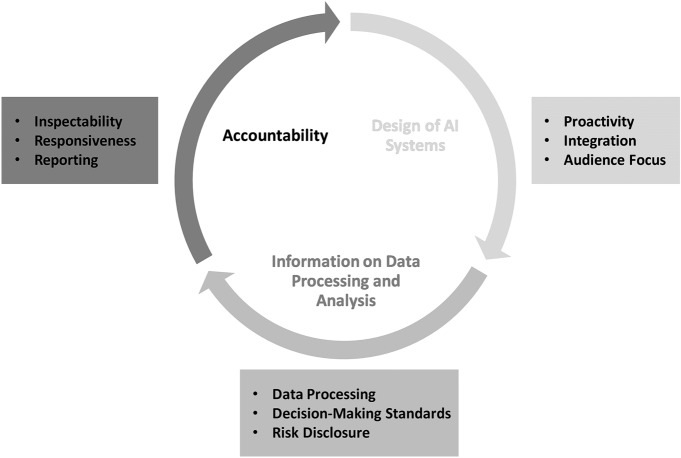
In this article, we develop the concept of Transparency by Design that serves as practical guidance in helping promote the beneficial functions of transparency while mitigating its challenges in automated-decision making (ADM) environments. With the rise of artificial intelligence (AI) and the ability of AI systems to make automated and self-learned decisions, a call for transparency of how such systems reach decisions has echoed within academic and policy circles. The term transparency, however, relates to multiple concepts, fulfills many functions, and holds different promises that struggle to be realized in concrete applications. Indeed, the complexity of transparency for ADM shows tension between transparency as a normative ideal and its translation to practical application. To address this tension, we first conduct a review of transparency, analyzing its challenges and limitations concerning automated decision-making practices. We then look at the lessons learned from the development of Privacy by Design, as a basis for developing the Transparency by Design principles. Finally, we propose a set of nine principles to cover relevant contextual, technical, informational, and stakeholder-sensitive considerations. Transparency by Design is a model that helps organizations design transparent AI systems, by integrating these principles in a step-by-step manner and as an ex-ante value, not as an afterthought.
Overview
The claims and statistics of this paper haven’t been checked yet.
Free: it reads the open-access text and checks the first 5 claims that cite a source we can check. Create a free account to check every claim.
Integrity signals
Registry
Cites
Statistics
Figures
Verification
Claims the paper makes
The claims and statistics of this paper haven’t been checked yet.
Free: it reads the open-access text and checks the first 5 claims that cite a source we can check. Create a free account to check every claim.
Claims other papers make about this one
Each is checked against this paper’s own text: does it say what the citing paper says it does?
The cited source says what the claim attributes to it.
In the citing paper
“We agree with the H. Felzmann et al. that transparency shall be a holistic concept and be considered at the earliest stages of AI development31.”
From Transparency of AI in Healthcare as a Multilayered System of Accountabilities: Between Legal Requirements and Technical Limitations (2022) · cites this paper as Felzmann et al., 2020
Experimental — accuracy not yet measured
Self-check
Percentages, sums and reported differences re-computed from the paper’s own numbers.
The self-check needs the paper’s full text.
Citations
Cites
Principles of Biomedical Ethics
(2012) · Thieves of Virtue · doi:10.7551/mitpress/9079.003.0009 · Cited by 13,453
Agency Theory: An Assessment and Review
Eisenhardt, K. M. (1989) · The Academy of Management Review · doi:10.5465/amr.1989.4279003 · Cited by 13,338 · cited 1×
“The informational approach to transparency aligns with the principal-agent theory, where the principal, who delegated certain tasks to an agent, needs to obtain information in order to check if the agent holds up their part of the contract (Eisenhardt 1989).”
BackgroundExit, Voice and Loyalty: Responses to Decline in Firms, Organizations, and States.
Tullock, G., & Hirschman, A. O. (1970) · The Journal of Finance · doi:10.2307/2325604 · Cited by 10,904
Not So Different After All: A Cross-Discipline View Of Trust
Rousseau, D. M., Sitkin, S. B., Burt, R. S., & Camerer, C. (1998) · Academy of Management Review · doi:10.5465/amr.1998.926617 · Cited by 10,274
Understanding Information Systems Continuance: An Expectation-Confirmation Model1
Bhattacherjee, A. (2001) · MIS Quarterly · doi:10.2307/3250921 · Cited by 8,767 · cited 1×
“Trust involves a trustor’s/principal’s assessment of the trustee/agent’s trustworthiness in terms of ability, benevolence, and integrity (Bhattacherjee 2001; Jones 1996).”
BackgroundPeeking Inside the Black-Box: A Survey on Explainable Artificial Intelligence (XAI)
Adadi, A., & Berrada, M. (2018) · IEEE Access · doi:10.1109/access.2018.2870052 · Cited by 6,294
The global landscape of AI ethics guidelines
Jobin, A., Ienca, M., & Vayena, E. (2019) · Nature Machine Intelligence · doi:10.1038/s42256-019-0088-2 · Cited by 6,220
Explanation in Artificial Intelligence: Insights from the Social Sciences
Miller, T. (2017) · arXiv · doi:10.48550/arxiv.1706.07269 · Cited by 5,338
Explanation in artificial intelligence: Insights from the social sciences
Miller, T. (2019) · Artificial Intelligence · doi:10.1016/j.artint.2018.07.007 · Cited by 5,302
The ethics of algorithms: Mapping the debate
Mittelstadt, B. D., Allo, P., Taddeo, M., Wachter, S., & Floridi, L. (2016) · Big Data & Society · doi:10.1177/2053951716679679 · Cited by 4,567
Research works printed but not linked: 10
- 3. ACM (2017). Statement on algorithmic transparency and accountability. Retrieved January 10, 2020, from https ://www.acm.org/binar ies/conte nt/asset s/publi c-polic y/2017_usacm _state ment_algor ithms .pdf.
- ICDPPC (International Conference of Data Protection and Privacy Commissioners). (2018). Declaration on ethics and data protection in artificial intelligence. Retrieved November 11, 2020, from https://icdppc.org/wp-content/uploads/2018/10/20180922_ICDPPC-40th_AI-Declaration_ADOPTED.pdf.
- 62. ICDPPC (International Conference of Data Protection and Privacy Commissioners). (2018). Declara- tion on ethics and data protection in artificial intelligence. Retrieved November 11, 2020, from https ://icdpp c.org/wp-conte nt/uploa ds/2018/10/20180 922_ICDPP C-40th_AI-Decla ratio n_ADOPT ED.pdf. ICO. (2020). What is automated individual decision-making and profiling? Retrieved August 19, 2020, from https ://ico.org.uk/for-organ isati ons/guide -to-data-prote ction /guide -to-the-gener al-data-prote ction -regul ation -gdpr/autom ated-decis ion-makin g-and-profi ling/what-is-autom ated-indiv idual -decis ion-makin g-and-profi ling/. IEEE. (2019). Ethically aligned design (version 2). Retrieved November 11, 2020, from https ://stand ards. ieee.org/conte nt/dam/ieee-stand ards/stand ards/web/docum ents/other /ead_v2.pdf.
- 80. Meijer, A. (2014). Transparency. In M. Bovens, R. E. Goodin, & T. Schillemans (Eds.), The Oxford hand- book of public accountability (pp. 507-524). Oxford: Oxford University Press.
- 81. Merchant, B. (2019). Tech journalism's 'on background' scourge. Columbia Journalism Review, July 17 2019. Retrieved November 11, 2020, from https ://www.cjr.org/opini on/tech-journ alism -on-backg round .php.
- 89. O'Neill, O. (2002). A question of trust: The BBC Reith Lectures 2002. Cambridge: Cambridge University Press.
- 110. Tielenburg, D. S. (2018). The 'dark sides' of transparency: Rethinking information disclosure as a social praxis. Master's thesis, Utrecht University. Retrieved October 20, 2020, from https ://dspac e.libra ry.uu.nl/handl e/1874/36952
- 113. Van Otterlo, M. (2013). A machine learning view on profiling. In M. Hildebrandt & K. de Vries (Eds.), Privacy, due process and the computational turn: Philosophers of law meet philosophers of tech- nology (pp. 41-64). London: Routledge.
- 118. Weller, A. (2017). Challenges for transparency. arXiv preprint arXiv :1708.01870 . · arXiv
- 121. Zarsky, T. Z. (2013). Transparent predictions. University of Illinois Law Review, 4, 1503-1570.
Cited by
Items 501–600 of 717
Determinants of Ethical Use of Artificial Intelligence among Tech StartupsPreprint
Agbamoro, J., & Shittu, A. I. (2025) · SSRN Electronic Journal · doi:10.2139/ssrn.5088492 · Cited by 1
Abdallat, M., AlSamhori, J. F., AlSamhori, A. R. F., Shnekat, H. H., AlSamhori, A. F., Abdallat, S., & Murshidi, R. (2023) · Research Square · doi:10.21203/rs.3.rs-3695744/v1 · Cited by 1
Hulicki, M. (2021) · EU and comparative law issues and challenges series · doi:10.25234/eclic/18823 · Cited by 2
McGregor, L. (2022) · Yearbook of international disaster law online · doi:10.1163/26662531_00301_003
AI, Competition and Antitrust Policies
Marino, D. (2023) · Studies in systems, decision and control · doi:10.1007/978-3-031-33461-0_8
Regulatory issues of artificial intelligence in cardiology – international perspective
Grutter, G., & Tozzi, A. E. (2023) · Elsevier eBooks · doi:10.1016/b978-0-323-90534-3.00049-4
Bednarz, Z., & Žalnieriūtė, M. (2023) · Cambridge University Press eBooks · doi:10.1017/9781009334297.003
Transparency in the Publication Etiquette of Public Health, Nutrition, and Dietetics Research
(2021) · Special Journal of Public Health Nutrition & Dietetics · doi:10.61915/pnd.425349
Revolutionizing the Manufacturing Sector a Comprehensive Analysis of AI's Impact on Industry 4.0
Paymode, A., Shukla, J., & Lakshmi, D. (2024) · Advances in computational intelligence and robotics book series · doi:10.4018/979-8-3693-2615-2.ch008
Leveraging OpenAI for Enhanced Multifactor Productivity in Chinese Businesses
Zreık, M. (2024) · Advances in logistics, operations, and management science book series · doi:10.4018/979-8-3693-1198-1.ch004 · Cited by 1
Safeguarding the Future of Artificial Intelligence: An AI Blueprint
Adrowitzer, A., Temper, M., Buchelt, A., Kieseberg, P., & Eigner, O. (2024) · Springer eBooks · doi:10.1007/978-3-031-57452-8_1
The Hierarchical Influence of AI on Human Perception: From Intelligence to IntentionalityPreprint
Ouzounis, C. (2024) · OSF Preprints (OSF Preprints) · doi:10.31219/osf.io/fkep5
Machine learning: A multifaceted exploration of trends, regulations, and global impact
Rishwinder, S. B., Tusharika, S., Santosh, K., & Rakesh, K. (2024) · i-manager’s Journal on Future Engineering and Technology · doi:10.26634/jfet.19.4.20913
Introduction to Human–Robot Interaction and Procedural Issues in Criminal Justice
Gleß, S. (2024) · Cambridge University Press eBooks · doi:10.1017/9781009431453.009 · Cited by 1
Immunotoxicogenomics: Moving from observation to prediction
Muzaffer, U., Nisar, N., Ali, S. I., Kareem, O., & Paul, V. I. (2024) · Elsevier eBooks · doi:10.1016/b978-0-443-18502-1.00007-9 · Cited by 1
AI/ML Approaches in Drug Design
Kırboğa, K. K. (2024) · Wiley eBooks · doi:10.1002/9781394249190.ch11
Transparent Transparency Developing a Scheme for Understanding Transparency Requirements
Baum, D., Baum, K. L., Zamani, S., Bennoit, C., & Werth, D. (2024) · Lecture notes in computer science · doi:10.1007/978-3-031-75434-0_5 · Cited by 1
You Need Authentic Leadership in the AI Age, Here's Why
Sayyadi, M. (2024) · Muma Business Review · doi:10.28945/5348 · Cited by 1
“…act to mitigate any gaps between opaque AI systems and their values of openness that create risks and their values of transparency as core values of authenticity and values of transparency among their audiences (Behl et al., 2023; Hayes et al., 2023; Felzmann et al., 2023; Lukyanenko et al., 2023).”
Pavlidis, G. (2025) · SSRN Electronic Journal · doi:10.2139/ssrn.5008431
Kölzer, D., & Just, V. (2025) · Organisationskompetenz Zukunftsfähigkeit · doi:10.1007/978-3-662-68996-7_2
Jiang, Y., Chen, J., An, S., & Zheng, T. (2025) · SSRN Electronic Journal · doi:10.2139/ssrn.5157744
A magister officiorum és a titkosügynökök kapcsolata a késő római igazgatásban (4-5. század)
Bajáky, A. O. (2025) · Jogelméleti Szemle · doi:10.59558/jesz.2025.1.2 · Cited by 1
Promoting Transparency in Generative AI: A Focus on Africa
Kponyo, J. J., Kemausuor, F., Tchao, E. T., Mensah, H. N., & Adjoe, R. Y. (2025) · Oxford University Press eBooks · doi:10.1093/oxfordhb/9780198940272.013.0015
An Assessment of The Talent Management Practices At Aceh Government: A Way Forward In Leveraging AI
Rinata, V., Othman, M., & Thinakaran, R. (2024) · International Conference on Computing Innovation, Intelligence, Technologies and Education (CIITE) · doi:10.1109/ciite62244.2024.10987583
“Transparency, open communication, and proving the value of artificial intelligence can assist in building confidence and hence reduce this opposition[36].”
Evolution and Future Perspectives in AI Ethics
González-Padilla, P., Fernández-Fernández, M., & Lacárcel, F. J. S. (2025) · Contributions to management science · doi:10.1007/978-3-031-88781-9_4
Maggi, P., Luca, B. D., Landolfo, M., Mastrangelo, S., & Borsci, S. (2025) · Lecture notes in computer science · doi:10.1007/978-3-031-88881-6_12
Enhancing Patient Confidentiality with AI-Based Data De-Identification Methods
Kotte, G. (2024) · International Journal of Enhanced Research In Science Technology & Engineering · doi:10.55948/ijerste.2024.0112
Mechatronic Futures Revisited—An Introduction
Hehenberger, P., & Bradley, D. (2025) · Springer eBooks · doi:10.1007/978-3-031-83571-1_1
Smart Mirrors and Data Protection Regulation
Colonna, L., & Riva, G. M. (2025) · Intelligent systems reference library · doi:10.1007/978-3-031-84158-3_12
Integrating Machine Learning and Data Ethics
Sharma, K., Gupta, D., Gupta, M., & Dhanaraj, R. K. (2025) · Wiley eBooks · doi:10.1002/9781394275311.ch7 · Cited by 1
Challenges and Prospects for Autonomous Robots
Choi, M., & Lee, S. (2025) · Springer eBooks · doi:10.1007/978-981-96-8864-7_7
AI Implementation for Social Benefit. Use Cases in Public Sector
Falco, C. C. D., & Romeo, E. (2025) · Springer proceedings in complexity · doi:10.1007/978-3-031-78623-5_3 · Cited by 1
Transparent AI Without Deception, Limitation, and Guidance
Musker, S. (2025) · IEEE International Symposium on Ethics in Engineering, Science, and Technology (ETHICS) · doi:10.1109/ethics65148.2025.11098293
“Despite the problems with transparency that Nguyen analyses, it has many benefits across multiple domains - including AI transparency [10] and other areas [11], [12].”
Increasing Transparency Through Metaphor Criticism
Nascimento, F., & Chown, E. (2025) · IEEE International Symposium on Ethics in Engineering, Science, and Technology (ETHICS) · doi:10.1109/ethics65148.2025.11098363
“There is a growing number of relevant discussions on how to increase technology transparency due to algorithms and training data opacity ([14]; [15]; [16]; [17]), particularly in AI systems ([18]; [19]; [20]; [21]).”
Explainability of Language Models (XAI and LLM)
Cecco, A. D., & Gianfagna, L. (2025) · Springer eBooks · doi:10.1007/978-3-031-92229-9_8 · Cited by 1
Adopting AI by Design: A Human-Centred Framework for Responsible PracticePreprint
Sakhaee, N., & Ardekani, I. (2025) · doi:10.36227/techrxiv.175439912.20944606/v1
Biden administration executive order tackles AI risks, but lack of privacy laws limits reach
Susarla, A. (2023) · The Conversation · doi:10.64628/aai.sjdeumq6c
Danger of AI in Robotics: A Systematic Analysis of Ethical, Regulatory, and Economic Challenges
Otasowie, J., Blum, A., Ahmed, M., & Brandstötter, M. (2025) · Mechanisms and machine science · doi:10.1007/978-3-032-02106-9_10
Mondragón, J. J. P., & Trujillo, A. E. (2025) · Cureus Journal of Computer Science. · doi:10.7759/s44389-025-07546-x
Autonomous medical diagnosis: How to balance accuracy and accountability?
Gaur, L., & Abraham, A. (2025) · Elsevier eBooks · doi:10.1016/b978-0-443-33124-4.00007-2
Press Freedom in the AI Era: Global Insights & Indian Data Laws
Pradhan, T., & Nanda, C. (2025) · Accounting, finance, sustainability, governance & fraud · doi:10.1007/978-981-96-7434-3_3
Ethical Practices Theories, Frameworks, and Models for Sustainable Digitalisation
Oladinrin, O. T., Aghimien, D. O., & Goodhew, S. (2025) · Springer eBooks · doi:10.1007/978-3-032-00151-1_6
Liebherr, M., Babiker, A., Alshakhsi, S. A. A., Al‐Thani, D., Montag, C., & Ali, R. (2025) · Advances in Human-Computer Interaction · doi:10.1155/ahci/5590506
Obar, J. A., D’Agostino, G., & Akinyemi, M. (2025) · Telecommunications Policy · doi:10.1016/j.telpol.2025.102977 · Cited by 2
Navigating the Paradox of Academic Integrity in the AI Era
Mdunyelwa, V., & Gundu, T. (2025) · Springer eBooks · doi:10.1007/978-981-95-0687-3_6
Expert Survey: AI Reliability & Security Research PrioritiesPreprint
O'Brien, J., Dolan, J., Kim, J., Dykhuizen, J., Sania, J., Becker, S., Kraprayoon, J., & Labrador, C. (2025) · arXiv (Cornell University) · doi:10.48550/arxiv.2505.21664
Almogren, A. S. (2025) · Research Square · doi:10.21203/rs.3.rs-7685621/v1
Explainable prototype-based image classification using adaptive feature extractors in medical images
Vasconcellos, N. C. M., Tavora, L. M. N., Miragaia, R., Grilo, C., & Thomaz, L. A. (2025) · Computers in Biology and Medicine · doi:10.1016/j.compbiomed.2025.111322 · Cited by 2
Reflections on Evolving Approaches for Researching Artificial Intelligence and Journalism
Haim, M., & Portugal, R. L. Q. (2025) · Wiley eBooks · doi:10.1002/9781394250424.ch6
Luttrell, R. M., Davis, J., & Welch, C. (2025) · Wiley eBooks · doi:10.1002/9781394250424.ch23
Park, S. (2025) · IEEE International Symposium on Technology and Society (ISTAS) · doi:10.1109/istas65609.2025.11269653
“Felzmann et al. [8] develop the ‘privacy by design’ approach [9] [10], proposing nine principles of the ‘transparency by design’ as a step-by-step process for automated decision-making systems.”
Casanova, E. A. (2025) · IgualdadES · doi:10.18042/cepc/igdes.13.07
Designing wearables: a Practice-led framework for enhancement technologies
Sanzeni, F. (2025) · Archive of research processes and output produced by RCA (Royal College of Art)
Parts, R. (2024) · Osuva (University of Vaasa)
Τεχνητή νοημοσύνη και βιωσιμότητα
Κατωμέρη, Σ. (2025) · Dione (University of Piraeus)
E. CARATTI, L. G., Caratti, E., & Galluzzo, L. (2024) · Virtual Community of Pathological Anatomy (University of Castilla La Mancha)
Transparency by design : incontro interdisciplinare sul principio di trasparenza dei dati personali
Pasa, B., Sinni, G., Pasa, B., & sinni, G. (2024) · AirIuav (Università Iuav di Venezia)
Investigating some ethical issues of artificial intelligence in art
Ali, A. K. M. (2024) · PhilPapers (PhilPapers Foundation)
Operationalizing Transparency and Explainability in Artificial Intelligence through Standardization
Tamminen, P. (2022) · UTUPub (University of Turku) · Cited by 4
AI och Ekonomisk Prestation : En studie av AI-implementation i svenska teknikföretag
Oldmark, G., & Fellinger, F. (2025) · Uppsala University Publications (Uppsala University)
Marques, M. J. M. (2024) · Portuguese National Funding Agency for Science, Research and Technology (RCAAP Project by FCT)
(2024) · UpSpace Institutional Repository (University of Pretoria) · Cited by 1
Systematisk transparens med AI-system i statliga myndigheter: fallet Bolagsverket
Andén, J. (2024) · Diva portal (Dalarna University Library)
From AI to employment : AI in recruitment and the balance between efficiency and equity
Bergdahl Lugnet, E., & Nyström, L. (2025) · DiVA at Umeå University (Umeå University)
Building Trust in AI Systems: The Impact of Data Handling Transparency
Mihale-Wilson, C., Chen, M., Carl, K. V., & Zibuschka, J. (2025) · AIS Electronic Library (AISeL)
En riskanalys av artificiell intelligens inom redovisning
Hansson Winqvist, A., & Bruzæus Nordström, V. (2024) · DiVA (Linnaeus University)
Nguyen, K. (2024) · UTUPub (University of Turku) · Cited by 3
MSW Portfolio. Finding Purpose: A Journey Toward Meaningful Social Work Practice
Altenhof, S. (2025) · ScholarWorks at University of Montana
Lee, B. H. Z. (2025) · Enlighten: Theses (The University of Glasgow) · doi:10.5525/gla.thesis.85406 · Cited by 5
Eriksson, J. (2025) · DiVA (Luleå University of Technology)
Bauer, C. H. (2025) · LA Referencia (Red Federada de Repositorios Institucionales de Publicaciones Científicas) · doi:10.13140/rg.2.2.26343.10403
Hidayati, N. N., Santosa, A., Nurfadhilah, E., Latief, A. D., Komariah, K. S., Jarin, A., Pebiana, S., Wabula, Y., Fajri, R., & Sampurno, T. (2025) · Advances in computational intelligence and robotics book series · doi:10.4018/979-8-3373-0250-8.ch005 · Cited by 1
Composable ERP Architecture: The Future of a Scalable and Adaptive Enterprise Systems Approach
Mhaskey, S. V. (2025) · European Journal of Computer Science and Information Technology · doi:10.37745/ejcsit.2013/vol13n52112
Hilasaca, J. E. H. (2025) · Interfases · doi:10.26439/interfases2025.n022.8263
“…de deci - sión automatizada, precisión diferenciada por grupos demográficos o evaluaciones prospectivas de impacto en derechos fundamentales —elementos que constituyen el núcleo técnico de la transparencia y la responsabilidad (Brkan & Bonnet, 2020; Felzmann et al., 2020; Winfield et al., 2021).”
Theoretical Principles Underpinning Game-Based and Immersive Learning
Ghosh, O., & Kumar, B. (2025) · IGI Global eBooks · doi:10.4018/979-8-3373-4465-2.ch001
The role of artificial intelligence in the legal system
Katiyar, A., & KATIYAR, P. (2026) · International Journal For Multidisciplinary Research · doi:10.36948/ijfmr.2026.v08i01.65717
Sahu, S., Mallick, N., & Sethi, R. C. (2026) · Advances in computational intelligence and robotics book series · doi:10.4018/979-8-3373-6598-5.ch009
Transparency challenges of AI implementation in public administration: a law enforcement case study
Santos, M. M. A. D. [. (2024) · LA Referencia (Red Federada de Repositorios Institucionales de Publicaciones Científicas)
Rosário, A. T., Cruz, R., & Andrade, L. (2026) · Advances in computational intelligence and robotics book series · doi:10.4018/979-8-3693-9994-1.ch001
AI AS A CO FOUNDER: NAVIGATING THE NEW FRONTIER OF VENTURE BUILDING AND DECISION MAKING
Sharma, N., & L, S. L. S. (2025) · Technix International Journal for Engineering Research · doi:10.56975/tijer.v12i11.160285
AI in Higher Education: An Exploratory Study of Administrative Perspectives
Wu, C., & Carroll, J. M. (2025) · IEEE International Conference on Teaching, Assessment, and Learning for Engineering · doi:10.1109/tale66047.2025.11346765
“It is critical to develop policies and practices that ensure AI systems are deployed and managed in alignment with ethical principles and societal values [1], [2].”
Green artificial intelligence for sustainable and resilient development: A review
Patil, D. R., Rane, N. L., Obizue, M. N., & Rane, J. (2026) · International Journal of Applied Resilience and Sustainability · doi:10.70593/deepsci.0201011 · Cited by 2
“Another sensitive field of application of AI is connected to climate modeling and environmental surveillance, which is based on the idea to gain the full knowledge of the environmental mechanisms and provide an opportunity to detect the threats to the ecological conditions in advance [78-81].”
Artificial intelligence-driven cybersecurity for resilient and sustainable business in Industry 5.0
Malipatil, S., Rane, J., Panda, S. P., & Rane, N. L. (2026) · International Journal of Applied Resilience and Sustainability · doi:10.70593/deepsci.0201008 · Cited by 1
“Resilience has become one of the main pillars of Industry 5.0 as it includes the ability of the industrial systems to predict, withstand, recover, and adapt new undesirable cyber events without critical functions and capabilities deterioration [36-38].”
InfluentialFrom Compliance to Consciousness: Ethical Governance of LLMs in Business Applications Practices
Rismawati, R., Nur, M., Santaria, R., Supriadi, S., & Amir, A. S. (2026) · IGI Global eBooks · doi:10.4018/979-8-3373-3912-2.ch011 · Cited by 1
Zheng, P. (2026) · Research Square · doi:10.21203/rs.3.rs-8662668/v1
Marwala, T. (2026) · Elsevier eBooks · doi:10.1016/b978-0-443-36322-1.00010-9
Marwala, T. (2026) · Elsevier eBooks · doi:10.1016/b978-0-443-36322-1.00017-1
Bayesian approach and artificial intelligence risk
Marwala, T. (2026) · Elsevier eBooks · doi:10.1016/b978-0-443-36322-1.00031-6
Conclusion: shaping a future where artificial intelligence benefits humanity
Marwala, T. (2026) · Elsevier eBooks · doi:10.1016/b978-0-443-36322-1.00027-4
Marwala, T. (2026) · Elsevier eBooks · doi:10.1016/b978-0-443-36322-1.00015-8
Biswas, B., Rane, N. L., & Sarkar, S. (2026) · International Journal of Applied Resilience and Sustainability · doi:10.70593/deepsci.0202012 · Cited by 1
“The applications are involved in the various industry such as manufacturing, agriculture, energy, water management, transportation, construction, and consumer goods [3,20-23].”
ARTIFICIAL INTELLIGENCE DALAM REKRUTMEN SDM MODERN (STRATEGI, SISTEM, DAN TRANSFORMASI ORGANISASI)
Jumarto, J. (., Andriansyah, A. (., Kristyanto, D. (., & Feriandy, F. (. (2025) · Neliti · Cited by 1
The Effects of Automation Transparency on Human Performance
Rajabiyazdi, F. (2023) · TSpace (University of Toronto)
Krishnappa, R., & Gurugopinath, R. (2026) · IGI Global eBooks · doi:10.4018/979-8-3373-4967-1.ch001
InterAI: Interactive AI for Human-Centered Robotics
Fu, D., Zhang, Y., Ma, Y., Kyrarini, M., Chen, C., Jirak, D., Si, W., & Kragić, D. (2026) · ACM/IEEE International Conference on Human-Robot Interaction (HRI) · doi:10.1145/3776734.3789490
Ethical Challenges in Artificial Intelligence: Navigating the Boundaries of Responsible Innovation
Lima, J. C. S., Silva, F. O., & Ferreira, D. D. (2025) · Congresso Brasileiro de Inteligência Computacional (CBIC) · doi:10.21528/cbic2025-1143995
Bürger, V. K., Besouw, M., Fehr, J., Minocher, R., Moorhead, E., Velarde, I., Agha-Mir-Salim, L., Amann, J., Bannach‐Brown, A., Blumenthal, D., et al. (2026) · arXiv (Cornell University) · doi:10.48550/arxiv.2603.13286
“Robustness refers to the reliable performance of AI systems across diverse settings and patient populations 22,23 .”
Xiao, J., & Xu, J. (2026) · Building Research & Information · doi:10.1080/09613218.2026.2644942
Artificial Intelligence and Democracy: A Systematic Literature Review Covering One Decade
Safarpour, A. (2026) · ELTE Law Journal · doi:10.54148/eltelj.2026.1.85 · Cited by 1
Metadata
- Authors
- Felzmann, H., Fosch-Villaronga, E., Lutz, C., & Tamò-Larrieux, A.
- Affiliations
- Ollscoil na Gaillimhe – University of Galway (IE)
- BI Norwegian Business School (NO)
- Venue
- Science and Engineering Ethics
- Published
- 2020-11-16
- Volume
- 26
- Issue
- 6
- Pages
- 3333-3361
- ISSN
- 1353-3452 (ISSN-L)
- 1471-5546
- PMC
- PMC7755865
- OpenAlex
- W3103319283
- Cited by
- 588
- References
- 122
- Citations by year
- 2026: 154 · 2025: 173 · 2024: 145 · 2023: 71 · 2022: 27 · 2021: 18
- FWCI
- 11.40
- Type
- journal article
- Language
- en
- Open access
- hybrid
- doi.org
- Licence
- cc-by
- creativecommons.org/licenses/by/4.0 (tdm)
- creativecommons.org/licenses/by/4.0 (vor)
- Locations
- Science and Engineering Ethics (publishedVersion, cc-by)
- PubMed Central (publishedVersion, cc-by)
- PubMed (publishedVersion)
- Leiden Repository (Leiden University) (submittedVersion)
- NORA - Norwegian Open Research Archives (submittedVersion, cc-by)
- Data Archiving and Networked Services (DANS) (submittedVersion)
- Funders
- H2020 Marie Skłodowska-Curie Actions (707404)
- Research Council of Norway (275347)
- Leiden University
- Topics
- Physical Sciences › Computer Science › Artificial Intelligence › Explainable Artificial Intelligence (XAI)
- Physical Sciences › Computer Science › Artificial Intelligence › Ethics and Social Impacts of AI
- Social Sciences › Law › Digitalization, Law, and Regulation
- Keywords
- transparency, artificial intelligence, automated decision-making, privacy by design, AI system design, transparency principle, algorithmic accountability, stakeholder considerations
- MeSH terms
- Artificial Intelligence, Humans
About these checks
Registry, retraction, Cites and statistics results are computed, not judged, with one exception: a printed reference that no index lists is read once by a model before it counts as a citation error. Claims are extracted by a model and kept only when their quote appears verbatim in the text; each cited source is then checked, with a model’s help, for whether it says what the claim relies on. Those verdicts can be wrong — read the claim’s quote and the cited source before relying on one.
Statistics and arithmetic are recomputed, not judged.
Confidence bands are shown only for fields calibrated on our annotated test set. None is calibrated yet, so no band is shown.
What counts as a claim ›How we measure confidence ›How we check this ›
Are you an author, or do you see a problem with this page? Request a review
Data sources
Bibliographic data: Semantic Scholar, OpenAlex, Crossref.
Contains information from the Semantic Scholar Academic Graph Datasets, made available under the ODC Attribution License (ODC-BY 1.0).
Semantic Scholar’s data is described in: Kinney, R., et al. (2023). The Semantic Scholar Open Data Platform. arXiv:2301.10140.
