

Towards Transparency by Design for Artificial Intelligence
Open accessThe DOI matches its Crossref record; 122 of the 122 references it cites were found in a registry or an index.
Abstract
In this article, we develop the concept of Transparency by Design that serves as practical guidance in helping promote the beneficial functions of transparency while mitigating its challenges in automated-decision making (ADM) environments. With the rise of artificial intelligence (AI) and the ability of AI systems to make automated and self-learned decisions, a call for transparency of how such systems reach decisions has echoed within academic and policy circles. The term transparency, however, relates to multiple concepts, fulfills many functions, and holds different promises that struggle to be realized in concrete applications. Indeed, the complexity of transparency for ADM shows tension between transparency as a normative ideal and its translation to practical application. To address this tension, we first conduct a review of transparency, analyzing its challenges and limitations concerning automated decision-making practices. We then look at the lessons learned from the development of Privacy by Design, as a basis for developing the Transparency by Design principles. Finally, we propose a set of nine principles to cover relevant contextual, technical, informational, and stakeholder-sensitive considerations. Transparency by Design is a model that helps organizations design transparent AI systems, by integrating these principles in a step-by-step manner and as an ex-ante value, not as an afterthought.
Overview
The claims and statistics of this paper haven’t been checked yet.
Free: it reads the open-access text and checks the first 5 claims that cite a source we can check. Create a free account to check every claim.
Integrity signals
Registry
Cites
Statistics
Figures
Verification
Claims the paper makes
The claims and statistics of this paper haven’t been checked yet.
Free: it reads the open-access text and checks the first 5 claims that cite a source we can check. Create a free account to check every claim.
Claims other papers make about this one
Each is checked against this paper’s own text: does it say what the citing paper says it does?
The cited source says what the claim attributes to it.
In the citing paper
“We agree with the H. Felzmann et al. that transparency shall be a holistic concept and be considered at the earliest stages of AI development31.”
From Transparency of AI in Healthcare as a Multilayered System of Accountabilities: Between Legal Requirements and Technical Limitations (2022) · cites this paper as Felzmann et al., 2020
Experimental — accuracy not yet measured
Self-check
Percentages, sums and reported differences re-computed from the paper’s own numbers.
The self-check needs the paper’s full text.
Citations
Cites
Principles of Biomedical Ethics
(2012) · Thieves of Virtue · doi:10.7551/mitpress/9079.003.0009 · Cited by 13,453
Agency Theory: An Assessment and Review
Eisenhardt, K. M. (1989) · The Academy of Management Review · doi:10.5465/amr.1989.4279003 · Cited by 13,338 · cited 1×
“The informational approach to transparency aligns with the principal-agent theory, where the principal, who delegated certain tasks to an agent, needs to obtain information in order to check if the agent holds up their part of the contract (Eisenhardt 1989).”
BackgroundExit, Voice and Loyalty: Responses to Decline in Firms, Organizations, and States.
Tullock, G., & Hirschman, A. O. (1970) · The Journal of Finance · doi:10.2307/2325604 · Cited by 10,904
Not So Different After All: A Cross-Discipline View Of Trust
Rousseau, D. M., Sitkin, S. B., Burt, R. S., & Camerer, C. (1998) · Academy of Management Review · doi:10.5465/amr.1998.926617 · Cited by 10,274
Understanding Information Systems Continuance: An Expectation-Confirmation Model1
Bhattacherjee, A. (2001) · MIS Quarterly · doi:10.2307/3250921 · Cited by 8,767 · cited 1×
“Trust involves a trustor’s/principal’s assessment of the trustee/agent’s trustworthiness in terms of ability, benevolence, and integrity (Bhattacherjee 2001; Jones 1996).”
BackgroundPeeking Inside the Black-Box: A Survey on Explainable Artificial Intelligence (XAI)
Adadi, A., & Berrada, M. (2018) · IEEE Access · doi:10.1109/access.2018.2870052 · Cited by 6,294
The global landscape of AI ethics guidelines
Jobin, A., Ienca, M., & Vayena, E. (2019) · Nature Machine Intelligence · doi:10.1038/s42256-019-0088-2 · Cited by 6,220
Explanation in Artificial Intelligence: Insights from the Social Sciences
Miller, T. (2017) · arXiv · doi:10.48550/arxiv.1706.07269 · Cited by 5,338
Explanation in artificial intelligence: Insights from the social sciences
Miller, T. (2019) · Artificial Intelligence · doi:10.1016/j.artint.2018.07.007 · Cited by 5,302
The ethics of algorithms: Mapping the debate
Mittelstadt, B. D., Allo, P., Taddeo, M., Wachter, S., & Floridi, L. (2016) · Big Data & Society · doi:10.1177/2053951716679679 · Cited by 4,567
Research works printed but not linked: 10
- 3. ACM (2017). Statement on algorithmic transparency and accountability. Retrieved January 10, 2020, from https ://www.acm.org/binar ies/conte nt/asset s/publi c-polic y/2017_usacm _state ment_algor ithms .pdf.
- ICDPPC (International Conference of Data Protection and Privacy Commissioners). (2018). Declaration on ethics and data protection in artificial intelligence. Retrieved November 11, 2020, from https://icdppc.org/wp-content/uploads/2018/10/20180922_ICDPPC-40th_AI-Declaration_ADOPTED.pdf.
- 62. ICDPPC (International Conference of Data Protection and Privacy Commissioners). (2018). Declara- tion on ethics and data protection in artificial intelligence. Retrieved November 11, 2020, from https ://icdpp c.org/wp-conte nt/uploa ds/2018/10/20180 922_ICDPP C-40th_AI-Decla ratio n_ADOPT ED.pdf. ICO. (2020). What is automated individual decision-making and profiling? Retrieved August 19, 2020, from https ://ico.org.uk/for-organ isati ons/guide -to-data-prote ction /guide -to-the-gener al-data-prote ction -regul ation -gdpr/autom ated-decis ion-makin g-and-profi ling/what-is-autom ated-indiv idual -decis ion-makin g-and-profi ling/. IEEE. (2019). Ethically aligned design (version 2). Retrieved November 11, 2020, from https ://stand ards. ieee.org/conte nt/dam/ieee-stand ards/stand ards/web/docum ents/other /ead_v2.pdf.
- 80. Meijer, A. (2014). Transparency. In M. Bovens, R. E. Goodin, & T. Schillemans (Eds.), The Oxford hand- book of public accountability (pp. 507-524). Oxford: Oxford University Press.
- 81. Merchant, B. (2019). Tech journalism's 'on background' scourge. Columbia Journalism Review, July 17 2019. Retrieved November 11, 2020, from https ://www.cjr.org/opini on/tech-journ alism -on-backg round .php.
- 89. O'Neill, O. (2002). A question of trust: The BBC Reith Lectures 2002. Cambridge: Cambridge University Press.
- 110. Tielenburg, D. S. (2018). The 'dark sides' of transparency: Rethinking information disclosure as a social praxis. Master's thesis, Utrecht University. Retrieved October 20, 2020, from https ://dspac e.libra ry.uu.nl/handl e/1874/36952
- 113. Van Otterlo, M. (2013). A machine learning view on profiling. In M. Hildebrandt & K. de Vries (Eds.), Privacy, due process and the computational turn: Philosophers of law meet philosophers of tech- nology (pp. 41-64). London: Routledge.
- 118. Weller, A. (2017). Challenges for transparency. arXiv preprint arXiv :1708.01870 . · arXiv
- 121. Zarsky, T. Z. (2013). Transparent predictions. University of Illinois Law Review, 4, 1503-1570.
Cited by
Items 401–500 of 717
Emotional Intelligence: A Human-Centred AI Perspective
Gámez, M. E. (2026) · Springer eBooks · doi:10.1007/978-981-97-8440-0_109-1 · Cited by 5
Kodan, A. (2026) · Cureus · doi:10.7759/cureus.102219 · Cited by 2
“Finally, the non-English subset was small, and conclusions regarding multilingual robustness should be interpreted as directional [4,6,9-12].”
InfluentialA Comprehensive Risk Analysis Framework for Medical AI: A Mixed‐Methods Approach
Wang, Y., Deng, Z., Deng, Z., & Evans, R. (2026) · Risk Analysis · doi:10.1111/risa.70192 · Cited by 3
“Emphasizing transparency by design enables system developers to develop AI systems with clear and understandable processes, establishing trust throughout the entire system (Felzmann et al. 2020 ).”
Institutionalizing trust in AI governance: from ethical principles to legal design
Lyu, X. (2026) · AI and Ethics · doi:10.1007/s43681-026-01009-2 · Cited by 2
“Moreover, honesty entails establishing participatory mechanisms—such as user feedback channels—that allow governance frameworks to adapt to evolving expectations [ 34 , 51, 93 ].”
Challenges and Ethical Considerations in Integrating AI into Higher Education
Narayanapillai, P. T., Vijayalakshmi, T. I., & Vengadeshwaran, V. (2026) · Springer eBooks · doi:10.1007/978-981-95-5350-1_5 · Cited by 2
AI Safety Evaluations Need to Consider Cascading Effects
Neumann, A., & Singh, J. (2026) · Proceedings of IASEAI Conference · doi:10.1609/iaseai.v2i1.43045 · Cited by 4
Fernandez-Nieto, G. M., Echeverría, V., Li, Y., Tsai, Y., Sha, L., Chen, G., Gašević, D., & Swiecki, Z. (2026) · Behaviour and Information Technology · doi:10.1080/0144929x.2026.2636694 · Cited by 2
Hein, I., Ullrich, D., & Diefenbach, S. (2026) · Computers in Human Behavior Reports · doi:10.1016/j.chbr.2026.101025 · Cited by 2
Şenyapar, H. N. D. (2026) · Management · doi:10.58691/man/220195 · Cited by 2
“Studies consistently report that algorithmic decision-making processes lack transparency, limiting both organizational oversight and public accountability (Felzmann et al., 2020; Von Eschenbach, 2021).”
Towards Explainable Decision Support Using Hybrid Neural Models for Logistic Terminal Automation
D'Elia, R., Termine, A., & Flammini, F. (2026) · Lecture notes in computer science · doi:10.1007/978-3-032-21811-7_6 · Cited by 2
Ni, C., Wang, X., Chen, L., Yang, Y., & Zhang, Z. (2026) · Sustainability · doi:10.3390/su18157766 · Cited by 2
The ethics behind the use of artificial intelligence in architectural design
Kurcjusz, M., Stefańska, A., Cortiços, N. D. C. A., & Carlos, D. (2026) · AI and Ethics · doi:10.1007/s43681-026-01279-w · Cited by 2
“The field can opti - mise the benefits of AI and mitigate potential risks through such measures, leading to more ethical, equitable, and sus - tainable architectural practices [ 13 , 16 , 28 ].”
Louder, J. R. (2026) · Emerald Group Publishing Limited eBooks · doi:10.1108/s1479-36792026000053b005 · Cited by 2
La justicia civil en la era digital y artificial: ¿Hacia una nueva identidad?
Ragone, Á. P. (2021) · Revista Chilena de Derecho · doi:10.7764/r.482.9 · Cited by 20
Ethical issues deriving from the delayed adoption of artificial intelligence in medical imaging
Placidi, G. (2022) · AI and Ethics · doi:10.1007/s43681-022-00139-7 · Cited by 2
“For them, usual transparency is impossible [11, 12] but an effective paradigm exists: move from transparency of the procedures to transparency of the outputs which can be ascertained statistically, not for a single instance, through a systematic approach, similarly to what occurs in evidence-based…”
ResultCarlizzi, D. N., & Quattrone, A. (2022) · Lecture notes in networks and systems · doi:10.1007/978-3-031-14605-3_11 · Cited by 4
Testimonial Injustice in Governmental AI Systems
Gray, C. (2023) · AI critique · doi:10.1515/9783839466605-004 · Cited by 2
AI Used in Electronic Traffic Law Enforcement as Law Enforcement Evidence in Digital Era
Hasibuan, E. S. (2023) · Interdisciplinary Social Studies · doi:10.55324/iss.v2i11.534 · Cited by 2
“Artificial intelligence in a simple sense is a system designed to be able to do human work (Devianto & Dwiasnati, 2020; Felzmann et al., 2020).”
BackgroundRethinking Non-discrimination Law in the Age of Artificial Intelligence
Kumkumoğlu, S. Ç., & Kumkumoğlu, A. K. (2023) · Accounting, finance, sustainability, governance & fraud · doi:10.1007/978-981-99-6327-0_3 · Cited by 3
AI Opacity in the Financial Industry and How to Break It
Bednarz, Z., & Przhedetsky, L. (2023) · Cambridge University Press eBooks · doi:10.1017/9781009334297.007 · Cited by 2
Privacy model for the development and implementation of regulatory technology (RegTech)
Sarabdeen, J. (2024) · Journal of Infrastructure Policy and Development · doi:10.24294/jipd.v8i6.3072 · Cited by 4
“It also could include the monitoring of transparency by other actors (Felzmann et al., 2020).”
BackgroundInfluentialDevelopment and Evaluation of a Transparency Model for the Design of Humanoid Service Robots
Nukovic, L., Kirchhoff, J., & von Stryk, O. (2024) · IEEE RO-MAN · doi:10.1109/ro-man60168.2024.10731364 · Cited by 2
“Transparency, encompassing explainability, interpretability, openness, accessibility, and visibility, is crucial for establishing trust in HRI [5].”
BackgroundOvais, D., & Jain, R. (2024) · Advances in environmental engineering and green technologies book series · doi:10.4018/979-8-3693-7001-8.ch009 · Cited by 3
Xie, Y., Guo, B., Jia, M. Q., Xu, Z., & Tao, X. (2025) · Annals of Nuclear Energy · doi:10.1016/j.anucene.2025.111192 · Cited by 2
Kojouri, D. K. (2025) · Management Strategies and Engineering Sciences · doi:10.61838/msesj.7.1.17 · Cited by 2
Mylonopoulou, V., Černá, K., Weilenmann, A. H., Rost, M., & Holmlund, T. (2025) · JMIR Human Factors · doi:10.2196/65207 · Cited by 2
“This aligns with broader calls [57,58] for designing technologies that foster informed trust.”
The Content of Transparency Matters: Evaluating Verbal Transparency About Robot Capabilities
Jelínek, M., & Fischer, K. (2025) · Lecture notes in computer science · doi:10.1007/978-981-96-3525-2_27 · Cited by 3
Balancing risk and social good: proactive law as a strategy in AI governance
Vági, R. (2025) · TalTech Journal of European Studies · doi:10.2478/bjes-2025-0005 · Cited by 2
Frimpong, V. (2025) · International Journal of Business and Management · doi:10.5539/ijbm.v20n4p26 · Cited by 2
“The “Transparency by Design” approach advocates for integrating transparency protocols into technology development upfront to prevent ethical issues rather than addressing them after deployment (Felzmann et al., 2020).”
Cargas normativas, innovación e inteligencia artificial: dilemas regulatorios
Font, J. L. O. (2025) · Estudios en Derecho a la Información · doi:10.22201/iij.25940082e.2025.20.19491 · Cited by 2
Padmaja, V., Bhanumathi, P., & Patangia, B. (2025) · Emerald Group Publishing Limited eBooks · doi:10.1108/978-1-83549-105-820251010 · Cited by 5
Hiwase, K., Verma, P., Zade, N., Kumar, P., Weerarathna, I. N., & Gundewar, S. K. (2026) · International Journal of Computational Intelligence Systems · doi:10.1007/s44196-026-01164-8 · Cited by 1
Efficient Construction of Interpretable Oblique Decision Trees
Estivill‐Castro, V., & Nabuuso, N. (2026) · Communications in computer and information science · doi:10.1007/978-3-032-15638-9_7 · Cited by 2
Data Management and Enterprise Architectures for Responsible AI Services
Pisoni, G., & Molnár, B. (2023) · Lecture notes in networks and systems · doi:10.1007/978-3-031-42467-0_83 · Cited by 2
Rule of Thumb for Estimating Workforce Allocations (ROT4WFA) for Computer Networking Projects
Nketsiah, R. N., Agbehadji, I. E., Millham, R. C., & Freeman, E. (2024) · Conference on Information Communications Technology and Society (ICTAS) · doi:10.1109/ictas59620.2024.10507124 · Cited by 2
“This transparency fosters better decision-making and ensures that all stakeholders are aligned [44].”
BackgroundParadata as a Tool for Legal Analysis: Utilising Data-on-Data Related Processes
Enqvist, L. (2024) · Knowledge management and organizational learning · doi:10.1007/978-3-031-53946-6_13 · Cited by 2
Andrade Bichara, A. D., Gomes Cascardo Junior, A., & Perazzoni, F. (2024) · Boletim IBCCRIM · doi:10.5281/zenodo.11175557 · Cited by 2
Iannessi, A., Beaumont, H., & Bertrand, A. S. (2021) · Insights into Imaging · doi:10.1186/s13244-021-01022-5 · Cited by 2
The Transparency Paradox in Explainable AI: A Theory of Autonomy Depletion Through Cognitive LoadPreprint
Margondai, A., & Mouloua, M. (2026) · arXiv (Cornell University) · doi:10.48550/arxiv.2601.13973 · Cited by 3
Three Implementation Gaps to Harnessing Inclusive AI in Organizations
Collett, C., Neff, G., & Axente, M. (2024) · Chapman & Hall/CRC eBooks · doi:10.1201/9781003320791-30 · Cited by 2
Human–Robot Interactions and Procedural Law
Gless, S., & Whalen-Bridge, H. (2024) · Cambridge University Press eBooks · doi:10.1017/9781009431453.008 · Cited by 1
Ethical Challenges in the New Era of Intelligent Manufacturing Systems
Stathatos, E., Benardos, P., & Vosniakos, G.-C. (2024) · Emerald Group Publishing Limited eBooks · doi:10.1108/978-1-83797-635-520241004 · Cited by 2
Burhan, B., Nurwidyayanti, Agusniati, A., Baharuddin, B., & Irwandi, A. (2024) · International Journal For Multidisciplinary Research · doi:10.36948/ijfmr.2024.v06i06.34139 · Cited by 1
Integrating Policy, Governance, and Law in Regulating AI for Sustainable Environmental Protection
Sahu, S., Mallick, N., & Patnaik, S. (2025) · Practice, progress, and proficiency in sustainability · doi:10.4018/979-8-3693-8684-2.ch007 · Cited by 1
Different regulatory treatment of generative AI blockchain, cryptocurrency, and NFT
Cheong, B. C. (2025) · Elsevier eBooks · doi:10.1016/b978-0-443-34717-7.00012-x · Cited by 1
Exploring fairness in service robotics
Fosch‐Villaronga, E., Mut-Piña, A., Shaffique, M. R., & Schwed-Shenker, M. (2025) · Cambridge Forum on AI Law and Governance · doi:10.1017/cfl.2025.10012 · Cited by 3
Self-citationThe rise of new pillars for effective knowledge management leadership
Sayyadi, M. (2025) · Business Information Review · doi:10.1177/02663821251364067 · Cited by 1
Cyber Threat Intelligence Automation Using AI in the Financial Sector
Appani, C. (2024) · International Journal of Intelligent Systems and Applications in Engineering · doi:10.17762/ijisae.v12i23s.7760 · Cited by 2
Deng, L., Shi, M., Zhang, M., & Wei, W. (2025) · International Journal of Human-Computer Interaction · doi:10.1080/10447318.2025.2508303 · Cited by 2
“From the market and commercial standpoint, revealing the use of AIGC tools helps the public monitor the operational logic, decision-making patterns, and privacy implications of these tools (Felzmann et al., 2020).”
ETHICAL AND LEGAL ASPECTS OF ARTIFICIAL INTELLIGENCE IN ORAL HEALTH
Darmadi, E. Y., Fauziah, Y. A., Alvin, J. D., Mayfrila, A. A., & Cyntia, W. (2025) · HEARTY · doi:10.32832/hearty.v13i4.18897 · Cited by 1
Quality assessment of online health resources for lipedema: A multimetric analysis
Posso, A. N., Escobar‐Domingo, M. J., Mustoe, A. K., Tobin, M. J., Fanning, J. E., Singhal, D., & Lee, B. T. (2025) · Phlebology The Journal of Venous Disease · doi:10.1177/02683555251372218 · Cited by 1
“52,53 Given the widespread factual de fi - ciencies we identi fi ed in online lipedema resources, there is a risk that misinformation will be disseminated at scale through AI-driven platforms.”
Ethical Entrepreneurship: Navigating the Path to Responsible Business
Kayyali, M. (2025) · Advances in computational intelligence and robotics book series · doi:10.4018/979-8-3373-1107-4.ch007 · Cited by 1
AI-enhanced supply chain management in chemical engineering
Hamaguchi, Y. (2025) · Elsevier eBooks · doi:10.1016/b978-0-443-34076-5.00003-1 · Cited by 1
MACHINE LEARNING FOR STRATEGIC AND OPERATIONAL DECISION-MAKING: A BIBLIOMETRIC PERSPECTIVE
Peovski, F., Kitanovikj, B., & Serafimovska, I. (2025) · BH Ekonomski forum · doi:10.62900/bhef252101005 · Cited by 1
“On the other hand, traditional ML approaches place more emphasis on efficiency and interpretability, with methods such as regression and decision trees providing clear and understandable decision support (Felzmann et al., 2020).”
Bi, C., Zhang, D., Sun, Z., & Yan, J. (2025) · Aslib Journal of Information Management · doi:10.1108/ajim-03-2025-0124 · Cited by 1
Sowing trust in the machine: ethical pathways for large language models in farmer-centered extension
Kabir, K. H. (2025) · AI & Society · doi:10.1007/s00146-025-02788-8 · Cited by 4
“(Felzmann et al. 2020).”
The Challenge of European AI Risk Management: An Iron Cage for Water?
Arnaboldi, M., & Parker, L. D. (2025) · Financial Accountability and Management · doi:10.1111/faam.70025 · Cited by 1
Can AI developers avoid bias in public health applications?
Harms, R. J., Ankeny, R. A., Carter, L., Mankad, A., & Scully, J. L. (2026) · Frontiers in Public Health · doi:10.3389/fpubh.2025.1752729 · Cited by 1
“Being transparent about the strengths and limitations of a given algorithm, including any potential sources of bias, is also critical, particularly given the increasingly hands-on approach that many people take towards their own healthcare (11, 27).”
The History of Accounting and the Revolution of Accounting Activities: Literature Review
Sanya, O. S., & Adegbie, F. F. (2026) · International Journal of Research and Innovation in Social Science · doi:10.47772/ijriss.2025.91200238 · Cited by 1
Büyüközkan, G., & Havle, C. A. (2026) · Afyon Kocatepe Üniversitesi İktisadi ve İdari Bilimler Fakültesi Dergisi · doi:10.33707/akuiibfd.1689304 · Cited by 1
Review of Policies for the Use of Generative Artificial Intelligence in Leading Foreign Universities
Gorlacheva, E. N., Леонидович, О. П., & Андреевна, П. Е. (2026) · University Management Practice and Analysis · doi:10.15826/umpa.2025.04.028 · Cited by 1
Zhang, Y., Wang, W., Li, J., Guo, W., & Sun, X. (2026) · Behaviour and Information Technology · doi:10.1080/0144929x.2026.2626745 · Cited by 2
“It comprises Step 4 (Explanation Generation) , where core causal relationships are extracted, and Step 5 (Explanatory Interface Design) , where these semantic explanations are visualised into UI elements.”
InfluentialLearning Analytics, Artificial Intelligence, and the Future of Democratic Curricular Governance
Carrión, J., Jaramillo, C., & Villarreal, S. N. C. (2026) · Advances in computational intelligence and robotics book series · doi:10.4018/979-8-3373-4480-5.ch015 · Cited by 1
Zhong, S., & Xu, X. (2026) · Risk Analysis · doi:10.1111/risa.70249 · Cited by 1
“Beyond technical performance, officials evaluate AI based on transparency, consistency, and perceived alignment with organizational values (Felzmann et al. 2020 ; Kuziemski and Misuraca 2020 ).”
Towards Human-Centered Agent Authorization: A Landscape Analysis of Commercial AI Agents
Zhang, Y., & Wang, G. (2026) · CHI Conference Extended Abstracts on Human Factors in Computing Systems (CHI EA) · doi:10.1145/3772363.3798851 · Cited by 3
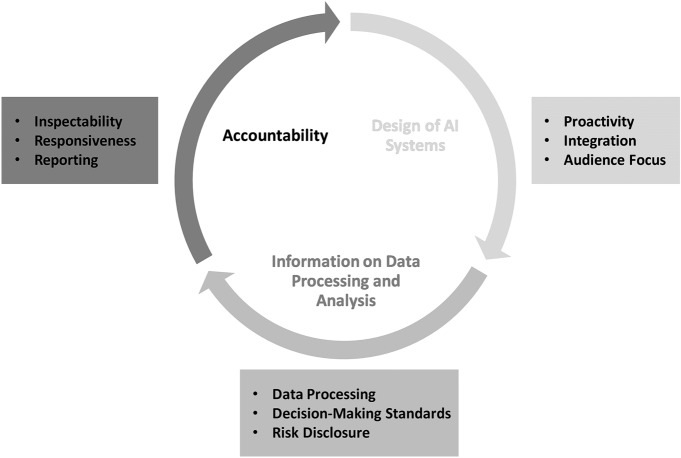
“First, Transparency by Design [14] requires “audience-sensitive” disclosure where information is interpreted and understood, not merely displayed.”
Kallina, E., Leeb, C. M., & Singh, J. (2026) · CHI Conference on Human Factors in Computing Systems · doi:10.1145/3772318.3790959 · Cited by 1
Namvong, A., & wiangwiset, T. (2026) · Advances in computational intelligence and robotics book series · doi:10.4018/979-8-2600-1433-2.ch006 · Cited by 1
Zeb-Obipi, V. A. (2026) · International Journal of Applied Resilience and Sustainability · doi:10.70593/deepsci.0202050 · Cited by 1
Dele-Rotimi, A. O. (2026) · International Journal of Applied Resilience and Sustainability · doi:10.70593/deepsci.0202052 · Cited by 2
“Knowledge Graphs enable companies to visualize the connections between service, preference, transactions, customers and products [57-59].”
Transparency in the datafied workplace: Law, workers, and job applicant perspectives
Rigotti, C., Fernandes, D. A., Mut-Piña, A., & Fosch‐Villaronga, E. (2026) · Technology in Society · doi:10.1016/j.techsoc.2026.103387 · Cited by 1
Self-citationRoukos, C., Chatzitheodoridis, F., Kafetzopoulos, D., Pavloudi, A., & Kontogeorgos, A. (2026) · Food Control · doi:10.1016/j.foodcont.2026.112311 · Cited by 2
Lutz, C., Newlands, G., & Jarrahi, M. H. (2026) · Springer eBooks · doi:10.1007/978-981-95-3658-0_87 · Cited by 1
Self-citationvan Beem, E. H. (2026) · International Review of Law Computers & Technology · doi:10.1080/13600869.2026.2668320 · Cited by 1
AI for humanity: overcoming ethical and technical barriers in humanitarian aid
Omidiji, C., Ogbuju, E., Jimba, J., & Monday, A. M. (2026) · AI and Ethics · doi:10.1007/s43681-026-01158-4 · Cited by 1
Yagmurdur, G., Meng, Y., & Gayaker, S. (2026) · Journal of theoretical and applied electronic commerce research · doi:10.3390/jtaer21050159 · Cited by 2
“A consumer is more likely to purchase a product that is recommended by an algorithm when those recommendations match their personal preferences, as opposed to being recommended for commercial purposes [39].”
InfluentialAI-Generated Marketing Content and Consumer Trust: Examining the Role of AI Disclosure
Kembau, A. S., Putra, I. G. W. S. C., Tampinongkol, F. F., Kumaat, A. P., Sutrisno, J., & Wardhana, A. (2026) · International Conference on Current Research in Artificial Intelligence and Data Science (ICCRAIDS) · doi:10.1109/iccraids67816.2026.11519658 · Cited by 1
“Transparency can mitigate such concern by clarifying content origin and reducing ambiguity [11], [16].”
Lima, A. (2026) · Premier journal of business and management. · doi:10.70389/pjbm.100014 · Cited by 1
Too Smart to Trust? Algorithmic Intelligence and the Erosion of Consumer Autonomy
Hasan, I. F. (2026) · Journal of Global Marketing · doi:10.1080/08911762.2026.2689093 · Cited by 1
Sun, Z., Xu, L., Weijing, X. U., & Wu, Y. (2026) · International Journal of Human-Computer Interaction · doi:10.1080/10447318.2026.2679610 · Cited by 1
AI Transparency: Governance Compliance or Stakeholder Requirements?
Bano, M., & Zowghi, D. (2026) · IEEE International Requirements Engineering Conference (RE) · doi:10.1109/re68928.2026.00021 · Cited by 1
“As these systems influence people’s rights and access to services, transparency has become a central principle of responsible AI governance [3], framed not merely as a desirable system quality but as a mandated governance obligation [4]–[6].”
InfluentialOlalere, P. M., & Adewojo, A. A. (2026) · Digital Education Review · doi:10.1344/der.2026.49.208-221 · Cited by 2
Artificial Intelligence & Human Rights Law: A Thematic Synthesis Review
Prifti, K., Hoppenbrouwers, J., de Leeuw, E., Quintavalla, A., & Temperman, J. (2026) · Minds and Machines · doi:10.1007/s11023-026-09793-w · Cited by 1
“The impact of AI systems complicates these processes due to inherent issues with transparency and explainability (Felzmann et al., 2020 ; Gro - chowski et al., 2021 ).”
Ethically Designing Customer and Employee Experiences in the Age of AI and Knowledge Automation
Nayak, S., Malik, A., & Budhwar, P. (2026) · Australasian Marketing Journal (AMJ) · doi:10.1177/14413582261454384 · Cited by 1
Explainable artificial intelligence as AI literacy scaffolding
Lund, B. D., Teel, Z. A., Porter, B., Chandrasekaran, A., & Patole, S. R. (2026) · Journal of Documentation · doi:10.1108/jd-02-2026-0088 · Cited by 1
When Trust Sharpens Skepticism: Large Language Models in Indonesian Audit Practice
Amarullah, K., Ritchi, H., & Mubarrok, A. Z. (2026) · Dinasti International Journal of Economics Finance & Accounting · doi:10.38035/dijefa.v7i3.7181 · Cited by 1
“…positions perceived transparency and perceived explainability as reflections of the central route, since both require users to engage in argumentative evaluation based on system logic and mechanisms that can be critically examined (Arrieta et al., 2019; Ding et al., 2022; Felzmann et al., 2020).”
Grey is the new black: entrepreneurial agency and transparency of artificial intelligence
Ghadafi, E., Dilaver, Ö., Cheng, Y., Çubukçu, A., Ul‐Durar, S., & Damij, N. (2026) · International Journal of Entrepreneurial Behaviour & Research · doi:10.1108/ijebr-12-2024-1498 · Cited by 1
Akhgar, B., & Bayerl, P. S. (2026) · Security informatics and law enforcement · doi:10.1007/978-3-032-41284-3 · Cited by 1
Vorgehensmodell – Menschzentrierte KI-Entwicklung in der Praxis
Schumann, S., Mayan, J., & Kirschenbaum, A. (2026) · Springer eBooks · doi:10.1007/978-3-658-53428-8_7 · Cited by 1
Korngiebel, D. M., Solomonides, A. E., & Goodman, K. W. (2022) · Cognitive informatics in biomedicine and healthcare · doi:10.1007/978-3-031-09108-7_18 · Cited by 2
Towards a Concrete Implementation of the Principle of Transparency in the Digital Services Act
Carneiro, D. R., & Palumbo, G. (2023) · Advances in intelligent systems and computing · doi:10.1007/978-3-031-38344-1_23 · Cited by 2
Intelligence Augmentation and capability co-elevation in healthcare enabled by reasoned transparency
Carrubbo, L., & Megaro, A. (2024) · ITM Web of Conferences · doi:10.1051/itmconf/20246202002 · Cited by 1
Ruan, X., & Chen, H. (2024) · Frontiers in artificial intelligence and applications · doi:10.3233/faia231505 · Cited by 2
Cognitive Bias and Fairness Challenges in AI Consciousness
Ashwini, P., & Padhy, P. C. (2024) · Advances in computational intelligence and robotics book series · doi:10.4018/979-8-3693-2015-0.ch005 · Cited by 2
Reparations of the horse? Algorithmic reparation and overspecialized remedies
Doyle, C., Alvarez-Garcia, M., Tracey, P., Grill, G., Whitney, C. D., & Chambers, L. M. (2024) · Big Data & Society · doi:10.1177/20539517241270670 · Cited by 1
“As part of a satisfaction method, transparency measures (Corbett and Denton, 2023; Felzmann et al., 2020; Wieringa, 2020) like adherence to explainability standards (Ferreira et al., 2020; Rader et al., 2018; Speith, 2022) could be required.”
A mesterséges intelligencia etikai kihívásai
Papp, R. (2025) · Jogelméleti Szemle · doi:10.59558/jesz.2025.1.51 · Cited by 3
Fairness of AI Systems in the Legal Context
Paternolli, V., Preda, M. D., & Giacobazzi, R. (2025) · Lecture notes in computer science · doi:10.1007/978-3-031-92648-8_4 · Cited by 1
Soriano, A. J. N., & Isa-Jara, R. (2025) · Revista Científica y Tecnológica UPSE · doi:10.26423/rctu.v12i1.885 · Cited by 1
Pasa, B., & Sinni, G. (2024) · AirIuav (Università Iuav di Venezia) · doi:10.25432/9788831241694 · Cited by 1
Implementing Ethical AI : From Principles to AI Governance
Seppälä, A. (2021) · UTUPub (University of Turku) · Cited by 1
The Impact of Transparency and Expert-Framing on Trust in Conversational AiPreprint
Wienrich, C., & Obremski, D. (2024) · SSRN Electronic Journal · doi:10.2139/ssrn.4715193 · Cited by 1
Metadata
- Authors
- Felzmann, H., Fosch-Villaronga, E., Lutz, C., & Tamò-Larrieux, A.
- Affiliations
- Ollscoil na Gaillimhe – University of Galway (IE)
- BI Norwegian Business School (NO)
- Venue
- Science and Engineering Ethics
- Published
- 2020-11-16
- Volume
- 26
- Issue
- 6
- Pages
- 3333-3361
- ISSN
- 1353-3452 (ISSN-L)
- 1471-5546
- PMC
- PMC7755865
- OpenAlex
- W3103319283
- Semantic Scholar
- 03d7cd2475ba417fbc0d5f6b7255f8aa14eb227a
- Cited by
- 588
- References
- 122
- Citations by year
- 2026: 154 · 2025: 173 · 2024: 145 · 2023: 71 · 2022: 27 · 2021: 18
- FWCI
- 11.40
- Type
- journal article
- Language
- en
- Open access
- hybrid
- doi.org
- Licence
- cc-by
- creativecommons.org/licenses/by/4.0 (tdm)
- creativecommons.org/licenses/by/4.0 (vor)
- Locations
- Science and Engineering Ethics (publishedVersion, cc-by)
- PubMed Central (publishedVersion, cc-by)
- PubMed (publishedVersion)
- Leiden Repository (Leiden University) (submittedVersion)
- NORA - Norwegian Open Research Archives (submittedVersion, cc-by)
- Data Archiving and Networked Services (DANS) (submittedVersion)
- Funders
- H2020 Marie Skłodowska-Curie Actions (707404)
- Research Council of Norway (275347)
- Leiden University
- Topics
- Physical Sciences › Computer Science › Artificial Intelligence › Explainable Artificial Intelligence (XAI)
- Physical Sciences › Computer Science › Artificial Intelligence › Ethics and Social Impacts of AI
- Social Sciences › Law › Digitalization, Law, and Regulation
- Keywords
- transparency, artificial intelligence, automated decision-making, privacy by design, AI system design, transparency principle, algorithmic accountability, stakeholder considerations
- MeSH terms
- Artificial Intelligence, Humans
About these checks
Registry, retraction, Cites and statistics results are computed, not judged, with one exception: a printed reference that no index lists is read once by a model before it counts as a citation error. Claims are extracted by a model and kept only when their quote appears verbatim in the text; each cited source is then checked, with a model’s help, for whether it says what the claim relies on. Those verdicts can be wrong — read the claim’s quote and the cited source before relying on one.
Statistics and arithmetic are recomputed, not judged.
Confidence bands are shown only for fields calibrated on our annotated test set. None is calibrated yet, so no band is shown.
What counts as a claim ›How we measure confidence ›How we check this ›
Are you an author, or do you see a problem with this page? Request a review
Data sources
Bibliographic data: Semantic Scholar, OpenAlex, Crossref.
Contains information from the Semantic Scholar Academic Graph Datasets, made available under the ODC Attribution License (ODC-BY 1.0).
Semantic Scholar’s data is described in: Kinney, R., et al. (2023). The Semantic Scholar Open Data Platform. arXiv:2301.10140.
