

Risk of macrosomia remains glucose-dependent in a cohort of women with pregestational type 1 diabetes and good glycemic control
Open accessThe DOI matches its Crossref record; 31 of the 31 references it cites were found in a registry or an index.
Abstract
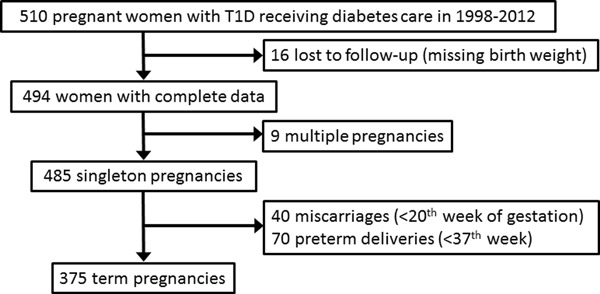
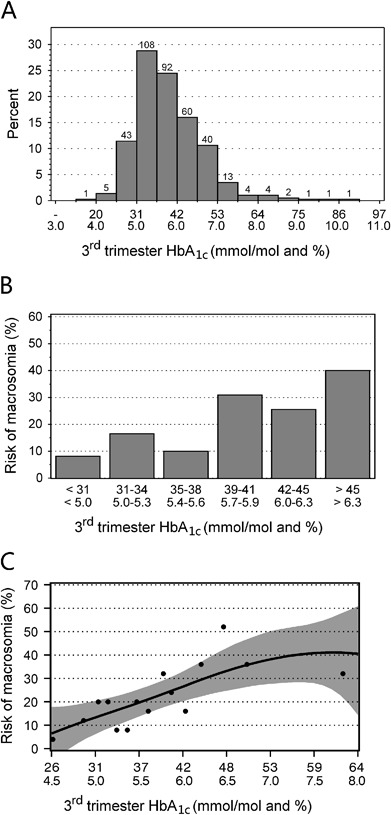
Macrosomia risk remains high in type 1 diabetes (T1DM) complicated pregnancies. A linear relationship between macrosomia risk and glycated hemoglobin A 1c (HbA 1c ) was described; however, low range of HbA 1c has not been studied. We aimed to identify risk factors and examine the impact of HbA 1c on the occurrence of macrosomia in newborns of T1DM women from a cohort with good glycemic control. In this observational retrospective one-center study we analyzed records of 510 consecutive T1DM pregnancies (1998–2012). The analyzed group consisted of 375 term singleton pregnancies. We used multiple regression models to examine the impact of HbA 1c and self-monitored glucose in each trimester on the risk of macrosomia and birth weight. The median age of T1DM women was 28 years, median T1DM duration—11 years, median pregestational BMI—23.3 kg/m 2 . Median birth weight reached 3520 g (1st and 3rd quartiles 3150 and 3960, respectively) at median 39 weeks of gestation. There were 85 (22.7 %) macrosomic (>4000 g) newborns. Median HbA 1c levels in the 1st, 2nd, and 3rd trimester were 6.4, 5.7, and 5.6 %. Third trimester HbA 1c , mean fasting self-monitored glucose and maternal age were independent predictors of birth weight and macrosomia. There was a linear relationship between 3rd trimester HbA 1c and macrosomia risk in HbA 1c range from 4.5 to 7.0 %. Macrosomia in children of T1DM mothers was common despite excellent metabolic control. Glycemia during the 3rd trimester was predominantly responsible for this condition.
Overview
The claims and statistics of this paper haven’t been checked yet.
Free: it reads the open-access text and checks the first 5 claims that cite a source we can check. Create a free account to check every claim.
Integrity signals
Registry
Cites
Statistics
Figures
Verification
Claims the paper makes
The claims and statistics of this paper haven’t been checked yet.
Free: it reads the open-access text and checks the first 5 claims that cite a source we can check. Create a free account to check every claim.
Claims other papers make about this one
Each is checked against this paper’s own text: does it say what the citing paper says it does?
The source backs part of the claim, not all of it — or backs it for a different population, condition or comparison.
In the citing paper
“In the second and third trimesters, A1C <6% (<42 mmol/mol) has the lowest risk of large-for-gestational-age infants (40,43,44), preterm delivery (45), and preeclampsia (1,46).”
From 15. Management of Diabetes in Pregnancy: Standards of Care in Diabetes—2024 (2024) · cites this paper as [44]
Experimental — accuracy not yet measured
Self-check
Percentages, sums and reported differences re-computed from the paper’s own numbers.
The self-check needs the paper’s full text.
Citations
Cites
International Diabetes Federation 2017
Carracher, A. M., Marathe, P. H., & Close, K. L. (2018) · Journal of Diabetes · doi:10.1111/1753-0407.12644 · Cited by 13,418
Hyperglycemia and adverse pregnancy outcomes
(2008) · New England Journal of Medicine · doi:10.1056/nejmoa0707943 · Cited by 5,563
Danaei, G., Finucane, M. M., Lu, Y., Singh, G. M., Cowan, M. J., Paciorek, C. J., Lin, J. K., Farzadfar, F., Khang, Y.-H., Stevens, G. A., et al. (2011) · The Lancet · doi:10.1016/s0140-6736(11)60679-x · Cited by 3,568
A Multicenter, Randomized Trial of Treatment for Mild Gestational Diabetes
Landon, M. B., Spong, C. Y., Thom, E., Carpenter, M. W., Ramin, S. M., Casey, B., Wapner, R. J., Varner, M. W., Rouse, D. J., Thorp, J. M., et al. (2009) · New England Journal of Medicine · doi:10.1056/nejmoa0902430 · Cited by 2,122
Hyperglycemia and Adverse Pregnancy Outcomes: The HAPO Study Cooperative Research Group
(2008) · Obstetrical & Gynecological Survey · doi:10.1097/ogx.0b013e318187b7a2 · Cited by 488
Standards of Medical Care in Diabetes—2015: Summary of Revisions
(2015) · Diabetes Care · doi:10.2337/dc15-s003 · Cited by 382
Bayesian Analysis for Penalized Spline Regression Using WinBUGS
Crainiceanu, C., Ruppert, D., & Wand, M. P. (2005) · Journal of Statistical Software · doi:10.18637/jss.v014.i14 · Cited by 341 · cited 1×
“We used a penalized low-rank thin-plate spline model [21] fitted to a scatter of 15 macrosomia probabilities by mean 3rd trimester HbA1c, with knots placed at a regular distance of a 0.”
MethodBalsells, M., García-Patterson, A., Gich, I., & Corcoy, R. (2009) · The Journal of Clinical Endocrinology & Metabolism · doi:10.1210/jc.2009-1231 · Cited by 306
Suhonen, L., Hiilesmaa, V., & Teramo, K. (2000) · Diabetologia · doi:10.1007/s001250050010 · Cited by 302
I., E., Valk, H. D., B., M., Braak, E. T., & G., V. (2002) · Diabetologia · doi:10.1007/s00125-002-0958-7 · Cited by 279 · cited 1×
“In spite of this, as proven in many clinical observations, macrosomia (defined either as birth weight above 4000 g or above the 90th percentile) is still very common in T1DM pregnancies with prevalence of 20–50 % [5, 8, 23].”
BackgroundPregnancy outcomes in the Diabetes Control and Complications Trial
(1996) · American Journal of Obstetrics and Gynecology · doi:10.1016/s0002-9378(96)70683-x · Cited by 278
French Multicentric Survey of Outcome of Pregnancy in Women With Pregestational Diabetes
Diabetes and Pregnancy Group, F. (2003) · Diabetes Care · doi:10.2337/diacare.26.11.2990 · Cited by 257
Chapter 2: Definition, identification, and prediction of CKD progression
(2013) · Kidney International Supplements · doi:10.1038/kisup.2012.65 · Cited by 223
Bell, R., Bailey, K., Cresswell, T., Hawthorne, G., Critchley, J., Lewis‐Barned, N., & Northern Diabetic Pregnancy Survey Steering Group (2008) · BJOG: An International Journal of Obstetrics & Gynaecology · doi:10.1111/j.1471-0528.2007.01644.x · Cited by 200
Prepregnancy Care and Pregnancy Outcomes in Women With Type 1 Diabetes
Temple, R. C., Aldridge, V. J., & Murphy, H. R. (2006) · Diabetes Care · doi:10.2337/dc05-2265 · Cited by 184
Glycemic targets in the second and third trimester of pregnancy for women with type 1 diabetes
Maresh, M. J. A., Holmes, V. A., Patterson, C. C., Young, I. S., Pearson, D. W. M., Walker, J. D., & McCance, D. R. (2015) · Diabetes Care · doi:10.2337/dc14-1755 · Cited by 175
Weiss, P. A., Scholz, H. S., Haas, J., Tamussino, K. F., Seissler, J., & Borkenstein, M. H. (2000) · Diabetes Care · doi:10.2337/diacare.23.7.905 · Cited by 164
Glinianaia, S., Tennant, P. W. G., Bilous, R., Rankin, J. M., & Bell, R. (2012) · Diabetologia · doi:10.1007/s00125-012-2721-z · Cited by 114
Diabetic fetal macrosomia: Significance of disproportionate growth
Ballard, J. L., Rosenn, B., Khoury, J. C., & Miodovnik, M. (1993) · The Journal of Pediatrics · doi:10.1016/s0022-3476(05)83503-6 · Cited by 87
Klemetti, M. M., Nuutila, M. E., Tikkanen, M., Kari, M. A., Hiilesmaa, V., & Teramo, K. (2012) · Diabetologia · doi:10.1007/s00125-012-2627-9 · Cited by 82 · cited 1×
“Second, there are scientific arguments for such a choice, since the 4 kg cut-off is a clinically important indicator of potential complications [8, 23, 26].”
BackgroundDunne, F. P., Avalos, G., Durkan, M., Mitchell, Y., Gallacher, T., Keenan, M., Hogan, M., Carmody, L. A., Gaffney, G., & collaborators, F. T. A. D. (2009) · Diabetes Care · doi:10.2337/dc09-1118 · Cited by 70
Macrosomia in Infants of Insulin-Dependent Diabetic Mothers
Berk, M. A., Mimouni, F., Miodovnik, M., Hertzberg, V., & Valuck, J. (1989) · Pediatrics · doi:10.1542/peds.83.6.1029 · Cited by 69
Cyganek, K., Hebda-Szydlo, A., Katra, B., Skupien, J., Klupa, T., Janas, I., Kaim, I., Sieradzki, J., Reron, A., & Malecki, M. T. (2010) · Diabetes Technology & Therapeutics · doi:10.1089/dia.2009.0081 · Cited by 65
Self-citationRijpert, M., Evers, I. M., de Vroede, M. A. M. J., de Valk, H. W., Heijnen, C. J., & Visser, G. H. A. (2009) · Diabetes Care · doi:10.2337/dc09-0652 · Cited by 59
Can shoulder dystocia be predicted? Preconceptive and prenatal factors.
Lewis, D. F., Edwards, M. S., Asrat, T., Adair, C. D., Brooks, G. G., & London, S. N. (1998) · PubMed · Cited by 47
Nowak, N., Skupien, J., Cyganek, K., Matejko, B., & Malecki, M. T. (2013) · Diabetologia · doi:10.1007/s00125-013-2830-3 · Cited by 42 · cited 1×
“Alternative markers of hyperglycemia, such as 1,5-anhydroglucitol, which, according to our earlier finding [31], was a better marker of maternal glycemic control and predictor of neonatal birth weight than HbA1c in pregnancies complicated by T1DM, may possibly find wider application.”
BackgroundSelf-citationATLANTIC DIP: Closing the Loop
Owens, L. A., Avalos, G., Kirwan, B., Carmody, L. A., & Dunne, F. (2012) · Diabetes Care · doi:10.2337/dc12-0120 · Cited by 40
Landon, M. B., Thom, E., Spong, C. Y., Carpenter, M., Mele, L., Johnson, F., Tillinghast, J., Anderson, G., & For the Maternal-Fetal Medicine Units Network, T. N. I. O. C. H. A. H. D. (2007) · Diabetes Care · doi:10.2337/dc07-s215 · Cited by 39
O’Kane, M., Lynch, P. L. M., Moles, K. W., & Magee, S. E. (2001) · Clinica Chimica Acta · doi:10.1016/s0009-8981(01)00579-4 · Cited by 35 · cited 1×
“0 % (42 mmol/mol), values comparable with observed in the non-diabetic general population [30] is not feasible in clinical practice.”
BackgroundType 1 Diabetes and Pregnancy: Trends in Birth Weight Over 40 Years at a Single Clinic
Johnstone, F. D., Lindsay, R. S., & Steel, J. (2006) · Obstetrics & Gynecology · doi:10.1097/01.aog.0000218706.38886.10 · Cited by 34
Birth Weight and Maternal Glycated Haemoglobin in Pregnancies Complicated by Type 1 Diabetes
Kernaghan, D., Penney, G., & Pearson, D. W. M. (2007) · Scottish Medical Journal · doi:10.1258/rsmsmj.52.1.9 · Cited by 6
Research works printed but not linked: 1
- Polish Diabetes Association The clinical guidelines in patients with diabetes Diabet. Prakt. 2009 10 A29 A33
Cited by
Practice Bulletin No. 183: postpartum hemorrhage
(2017) · Obstetrics & Gynecology · doi:10.1097/aog.0000000000002351 · Cited by 1,406
15. Management of Diabetes in Pregnancy: Standards of Medical Care in Diabetes—2022
American Diabetes Association Professional Practice Committee (2022) · Diabetes Care · doi:10.2337/dc22-s015 · Cited by 504
ACOG Practice Bulletin No. 201: Pregestational Diabetes Mellitus
(2018) · Obstetrics & Gynecology · doi:10.1097/aog.0000000000002960 · Cited by 470
14. Management of Diabetes in Pregnancy:Standards of Medical Care in Diabetes—2020
American Diabetes Association (2020) · Diabetes Care · doi:10.2337/dc20-s014 · Cited by 381
15. Management of Diabetes in Pregnancy:Standards of Care in Diabetes—2023
ElSayed, N. A., Aleppo, G., Aroda, V. R., Bannuru, R. R., Brown, F. M., Bruemmer, D., Collins, B. S., Hilliard, M. E., Isaacs, D., Johnson, E. L., et al. (2023) · Diabetes Care · doi:10.2337/dc23-s015 · Cited by 284
Metadata
- Authors
- Cyganek, K., Skupien, J., Katra, B., Hebda-Szydlo, A., Janas, I., Trznadel-Morawska, I., Witek, P., Kozek, E., & Malecki, M. T.
- Affiliations
- Szpital Uniwersytecki w Krakowie (PL)
- Jagiellonian University (PL)
- Corresponding author
- Malecki, Maciej T.
- Venue
- Endocrine
- Published
- 2016-10-11
- Volume
- 55
- Issue
- 2
- Pages
- 447-455
- ISSN
- 0969-711X (ISSN-L)
- 1355-008X
- 1559-0100
- PMC
- PMC5272887
- OpenAlex
- W2529958842
- Semantic Scholar
- fde62c398da40a2397ddabcd064891da79a66cca
- Cited by
- 94
- References
- 31
- Citations by year
- 2026: 2 · 2025: 13 · 2024: 12 · 2023: 13 · 2022: 10 · 2021: 14 · 2020: 10 · 2019: 6 · 2018: 11 · 2017: 2
- FWCI
- 8.18
- Type
- journal article
- Language
- en
- Open access
- hybrid
- doi.org
- Locations
- Endocrine (publishedVersion, cc-by)
- PubMed Central (publishedVersion, cc-by)
- PubMed (publishedVersion)
- Jagiellonian University Repository (Jagiellonian University) (submittedVersion, cc-by-nc-nd)
- Homo Politicus (Academy of Humanities and Economics in Lodz) (submittedVersion)
- Funders
- Polish Ministry of Science (N N407 414436)
- Topics
- Health Sciences › Medicine › Obstetrics and Gynecology › Gestational Diabetes Research and Management
- Health Sciences › Medicine › Endocrinology, Diabetes and Metabolism › Diabetes Management and Research
- Health Sciences › Medicine › Public Health, Environmental and Occupational Health › Pregnancy and Medication Impact
- Keywords
- macrosomia, type 1 diabetes, pregestational diabetes, glycemic control, HbA1c, birth weight, maternal age, pregnancy complications
- MeSH terms
- Adult, Birth Weight, Blood Glucose, Diabetes Mellitus, Type 1, Female, Fetal Macrosomia, Humans, Infant, Newborn, Pregnancy, Pregnancy in Diabetics, Retrospective Studies, Risk Factors, Young Adult
About these checks
Registry, retraction, Cites and statistics results are computed, not judged, with one exception: a printed reference that no index lists is read once by a model before it counts as a citation error. Claims are extracted by a model and kept only when their quote appears verbatim in the text; each cited source is then checked, with a model’s help, for whether it says what the claim relies on. Those verdicts can be wrong — read the claim’s quote and the cited source before relying on one.
Statistics and arithmetic are recomputed, not judged.
Confidence bands are shown only for fields calibrated on our annotated test set. None is calibrated yet, so no band is shown.
What counts as a claim ›How we measure confidence ›How we check this ›
Are you an author, or do you see a problem with this page? Request a review
Data sources
Bibliographic data: Semantic Scholar, OpenAlex, Crossref.
Contains information from the Semantic Scholar Academic Graph Datasets, made available under the ODC Attribution License (ODC-BY 1.0).
Semantic Scholar’s data is described in: Kinney, R., et al. (2023). The Semantic Scholar Open Data Platform. arXiv:2301.10140.
