

Risk of macrosomia remains glucose-dependent in a cohort of women with pregestational type 1 diabetes and good glycemic control
Open accessThe DOI matches its Crossref record; 31 of the 31 references it cites were found in a registry or an index.
Abstract
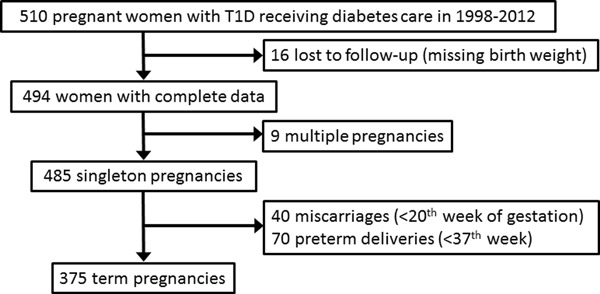
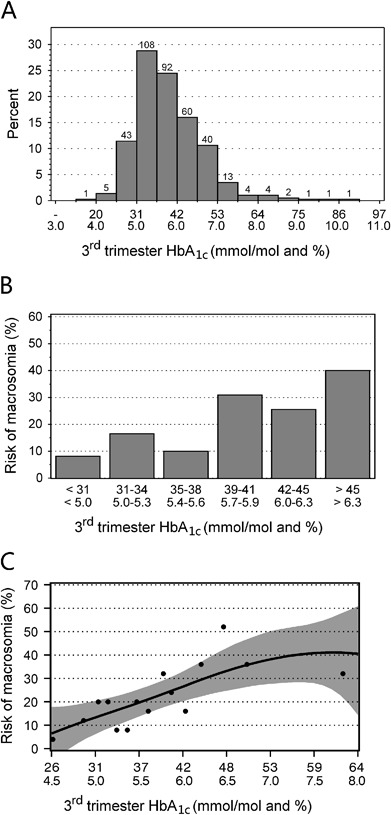
Macrosomia risk remains high in type 1 diabetes (T1DM) complicated pregnancies. A linear relationship between macrosomia risk and glycated hemoglobin A 1c (HbA 1c ) was described; however, low range of HbA 1c has not been studied. We aimed to identify risk factors and examine the impact of HbA 1c on the occurrence of macrosomia in newborns of T1DM women from a cohort with good glycemic control. In this observational retrospective one-center study we analyzed records of 510 consecutive T1DM pregnancies (1998–2012). The analyzed group consisted of 375 term singleton pregnancies. We used multiple regression models to examine the impact of HbA 1c and self-monitored glucose in each trimester on the risk of macrosomia and birth weight. The median age of T1DM women was 28 years, median T1DM duration—11 years, median pregestational BMI—23.3 kg/m 2 . Median birth weight reached 3520 g (1st and 3rd quartiles 3150 and 3960, respectively) at median 39 weeks of gestation. There were 85 (22.7 %) macrosomic (>4000 g) newborns. Median HbA 1c levels in the 1st, 2nd, and 3rd trimester were 6.4, 5.7, and 5.6 %. Third trimester HbA 1c , mean fasting self-monitored glucose and maternal age were independent predictors of birth weight and macrosomia. There was a linear relationship between 3rd trimester HbA 1c and macrosomia risk in HbA 1c range from 4.5 to 7.0 %. Macrosomia in children of T1DM mothers was common despite excellent metabolic control. Glycemia during the 3rd trimester was predominantly responsible for this condition.
Overview
The claims and statistics of this paper haven’t been checked yet.
Free: it reads the open-access text and checks the first 5 claims that cite a source we can check. Create a free account to check every claim.
Integrity signals
Registry
Cites
Statistics
Figures
Verification
Claims the paper makes
The claims and statistics of this paper haven’t been checked yet.
Free: it reads the open-access text and checks the first 5 claims that cite a source we can check. Create a free account to check every claim.
Claims other papers make about this one
Each is checked against this paper’s own text: does it say what the citing paper says it does?
The source backs part of the claim, not all of it — or backs it for a different population, condition or comparison.
In the citing paper
“In the second and third trimesters, A1C <6% (<42 mmol/mol) has the lowest risk of large-for-gestational-age infants (40,43,44), preterm delivery (45), and preeclampsia (1,46).”
From 15. Management of Diabetes in Pregnancy: Standards of Care in Diabetes—2024 (2024) · cites this paper as [44]
Experimental — accuracy not yet measured
Self-check
Percentages, sums and reported differences re-computed from the paper’s own numbers.
The self-check needs the paper’s full text.
Citations
Cites
International Diabetes Federation 2017
Carracher, A. M., Marathe, P. H., & Close, K. L. (2018) · Journal of Diabetes · doi:10.1111/1753-0407.12644 · Cited by 13,418
Hyperglycemia and adverse pregnancy outcomes
(2008) · New England Journal of Medicine · doi:10.1056/nejmoa0707943 · Cited by 5,563
Danaei, G., Finucane, M. M., Lu, Y., Singh, G. M., Cowan, M. J., Paciorek, C. J., Lin, J. K., Farzadfar, F., Khang, Y.-H., Stevens, G. A., et al. (2011) · The Lancet · doi:10.1016/s0140-6736(11)60679-x · Cited by 3,568
A Multicenter, Randomized Trial of Treatment for Mild Gestational Diabetes
Landon, M. B., Spong, C. Y., Thom, E., Carpenter, M. W., Ramin, S. M., Casey, B., Wapner, R. J., Varner, M. W., Rouse, D. J., Thorp, J. M., et al. (2009) · New England Journal of Medicine · doi:10.1056/nejmoa0902430 · Cited by 2,122
Hyperglycemia and Adverse Pregnancy Outcomes: The HAPO Study Cooperative Research Group
(2008) · Obstetrical & Gynecological Survey · doi:10.1097/ogx.0b013e318187b7a2 · Cited by 488
Standards of Medical Care in Diabetes—2015: Summary of Revisions
(2015) · Diabetes Care · doi:10.2337/dc15-s003 · Cited by 382
Bayesian Analysis for Penalized Spline Regression Using WinBUGS
Crainiceanu, C., Ruppert, D., & Wand, M. P. (2005) · Journal of Statistical Software · doi:10.18637/jss.v014.i14 · Cited by 341 · cited 1×
“We used a penalized low-rank thin-plate spline model [21] fitted to a scatter of 15 macrosomia probabilities by mean 3rd trimester HbA1c, with knots placed at a regular distance of a 0.”
MethodBalsells, M., García-Patterson, A., Gich, I., & Corcoy, R. (2009) · The Journal of Clinical Endocrinology & Metabolism · doi:10.1210/jc.2009-1231 · Cited by 306
Suhonen, L., Hiilesmaa, V., & Teramo, K. (2000) · Diabetologia · doi:10.1007/s001250050010 · Cited by 302
I., E., Valk, H. D., B., M., Braak, E. T., & G., V. (2002) · Diabetologia · doi:10.1007/s00125-002-0958-7 · Cited by 279 · cited 1×
“In spite of this, as proven in many clinical observations, macrosomia (defined either as birth weight above 4000 g or above the 90th percentile) is still very common in T1DM pregnancies with prevalence of 20–50 % [5, 8, 23].”
Background
Research works printed but not linked: 1
- Polish Diabetes Association The clinical guidelines in patients with diabetes Diabet. Prakt. 2009 10 A29 A33
Cited by
Practice Bulletin No. 183: postpartum hemorrhage
(2017) · Obstetrics & Gynecology · doi:10.1097/aog.0000000000002351 · Cited by 1,406
15. Management of Diabetes in Pregnancy: Standards of Medical Care in Diabetes—2022
American Diabetes Association Professional Practice Committee (2022) · Diabetes Care · doi:10.2337/dc22-s015 · Cited by 504
ACOG Practice Bulletin No. 201: Pregestational Diabetes Mellitus
(2018) · Obstetrics & Gynecology · doi:10.1097/aog.0000000000002960 · Cited by 470
14. Management of Diabetes in Pregnancy:Standards of Medical Care in Diabetes—2020
American Diabetes Association (2020) · Diabetes Care · doi:10.2337/dc20-s014 · Cited by 381
15. Management of Diabetes in Pregnancy:Standards of Care in Diabetes—2023
ElSayed, N. A., Aleppo, G., Aroda, V. R., Bannuru, R. R., Brown, F. M., Bruemmer, D., Collins, B. S., Hilliard, M. E., Isaacs, D., Johnson, E. L., et al. (2023) · Diabetes Care · doi:10.2337/dc23-s015 · Cited by 284
Feig, D. S., Berger, H., Donovan, L., Godbout, A., Kader, T., Keely, E., & Sanghera, R. (2018) · Canadian Journal of Diabetes · doi:10.1016/j.jcjd.2017.10.038 · Cited by 344
“0%, there is still a linear relationship between third trimester A1C and risk of macrosomia (83).”
Background14. Management of Diabetes in Pregnancy:Standards of Medical Care in Diabetes—2021
American Diabetes Association (2021) · Diabetes Care · doi:10.2337/dc21-s014 · Cited by 268
14. Management of Diabetes in Pregnancy: Standards of Medical Care in Diabetes—2019
American Diabetes Association (2019) · Diabetes Care · doi:10.2337/dc19-s014 · Cited by 265
“In the second and third trimesters, A1C,6% (42 mmol/mol) has the lowest risk of large-for-gestational-age infants (25,28,29), preterm delivery (30), and preeclampsia (1,31).”
Background15. Management of Diabetes in Pregnancy: Standards of Care in Diabetes—2025
American Diabetes Association Professional Practice Committee, ElSayed, N. A., McCoy, R. G., Aleppo, G., Balapattabi, K., Beverly, E. A., Briggs Early, K., Bruemmer, D., Echouffo-Tcheugui, J. B., Ekhlaspour, L., et al. (2025) · Diabetes Care · doi:10.2337/dc25-s015 · Cited by 252
Diabetes: A metabolic and reproductive disorder in women
Thong, E. P., Codner, E., Laven, J. S. E., & Teede, H. (2020) · The Lancet Diabetes & Endocrinology · doi:10.1016/s2213-8587(19)30345-6 · Cited by 242
15. Management of Diabetes in Pregnancy: Standards of Care in Diabetes—2024
American Diabetes Association Professional Practice Committee, ElSayed, N. A., Aleppo, G., Bannuru, R. R., Bruemmer, D., Collins, B. S., Ekhlaspour, L., Hilliard, M. E., Johnson, E. L., Khunti, K., et al. (2024) · Diabetes Care · doi:10.2337/dc24-s015 · Cited by 232
15. Management of Diabetes in Pregnancy: Standards of Care in Diabetes—2026
Bajaj, M. S., McCoy, R. G., Balapattabi, K., Bannuru, R. R., Bellini, N. J., Bennett, A. K., Beverly, E. A., Early, K. B., Brown, F. M., ChallaSivaKanaka, S., et al. (2025) · Diabetes Care · doi:10.2337/dc26-s015 · Cited by 180
Rys, P., Ludwig‐Słomczyńska, A. H., Cyganek, K., & Malecki, M. T. (2018) · European Journal of Endocrinology · doi:10.1530/eje-17-0804 · Cited by 92
Self-citationMcGrath, R. T., Glastras, S. J., HOCKING, S. L., & Fulcher, G. R. (2018) · Diabetes Care · doi:10.2337/dc18-0551 · Cited by 78
Wyckoff, J., Lapolla, A., Asias-Dinh, B. D., Barbour, L. A., Brown, F. M., Catalano, P. M., Corcoy, R., Renzo, G. C. D., Drobycki, N., Kautzky‐Willer, A., et al. (2025) · The Journal of Clinical Endocrinology & Metabolism · doi:10.1210/clinem/dgaf288 · Cited by 62
Venkatesh, K. K., Germann, K., Joseph, J. J., Kiefer, M. K., Buschur, E., Thung, S., Costantine, M. M., Gabbe, S. G., Grobman, W. A., & Fareed, N. (2022) · Obstetrics and Gynecology · doi:10.1097/aog.0000000000004727 · Cited by 53
Time in range in pregnancy: is there a role?
Wyckoff, J. A., & Brown, F. M. (2021) · Diabetes Spectrum · doi:10.2337/ds20-0103 · Cited by 39
Diabetes Technology Use Among Pregnant and Nonpregnant Women with T1D in the T1D Exchange
Polsky, S., Wu, M., Bode, B. W., DuBose, S. N., Goland, R., Maahs, D. M., Foster, N. C., Peters, A. L., Levy, C. J., Shah, V. N., et al. (2018) · Diabetes Technology & Therapeutics · doi:10.1089/dia.2018.0033 · Cited by 37
“Among women with T1D across the world, rates of cesarean section deliveries are 44%– 79%, 11,28–38 of preterm deliveries are 14%–42%, 11,28–34,37 Some retrospective studies have compared differences in outcomes between women using CSII and those using MDI.”
Neurodevelopmental Programming of Adiposity: Contributions to Obesity Risk
Skowronski, A. A., Leibel, R. L., & LeDuc, C. A. (2023) · Endocrine Reviews · doi:10.1210/endrev/bnad031 · Cited by 36
Ott, R., Stupin, J. H., Loui, A., Eilers, E., Melchior, K., Rancourt, R. C., Schellong, K., Ziska, T., Dudenhausen, J. W., Henrich, W., et al. (2018) · BMC Pregnancy and Childbirth · doi:10.1186/s12884-018-1889-8 · Cited by 33
Wyckoff, J., Lapolla, A., Asias-Dinh, B. D., Barbour, L. A., Brown, F. M., Catalano, P. M., Corcoy, R., Renzo, G. C. D., Drobycki, N., Kautzky‐Willer, A., et al. (2025) · European Journal of Endocrinology · doi:10.1093/ejendo/lvaf116 · Cited by 31
Pre-Gestational Diabetes and Pregnancy Outcomes
Ali, D. S., Davern, R., Rutter, E., Coveney, C., Devine, H., Walsh, J., Higgins, M., & Hatunic, M. (2020) · Diabetes Therapy · doi:10.1007/s13300-020-00932-9 · Cited by 28
Maternal and Fetal Outcomes among Pregnant Women with Diabetes
Gojnic, M. G., Todorović, J., Stanisavljevic, D. M., Jotić, A., Lukić, L., Milicic, T. J., Lalic, N. M., Lalic, K. S., Stoiljkovic, M. M., Stanisavljević, T., et al. (2022) · International Journal of Environmental Research and Public Health · doi:10.3390/ijerph19063684 · Cited by 31
“5%), there is no higher risk for LGA infants compared to non-diabetic mothers [15,16].”
BackgroundSibiak, R., Gutaj, P., Mrzewka-Rogacz, B., Mantaj, U., & Wender-Ożegowska, E. (2022) · Diabetes Technology & Therapeutics · doi:10.1089/dia.2021.0194 · Cited by 25
“7 These findings may suggest that additional factors, such as glycemic variability, maternal obesity, or disturbances in lipids levels, could be liable for poor neonatal outcomes in pregnancies complicated by T1D.”
Vézina‐Im, L., Nicklas, T. A., & Baranowski, T. (2018) · Current Nutrition Reports · doi:10.1007/s13668-018-0246-x · Cited by 25
Sushko, K., Strachan, P. H., Butt, M. L., Nerenberg, K. A., & Sherifali, D. (2024) · BMC Nursing · doi:10.1186/s12912-023-01659-1 · Cited by 23
“This finding contrasted with expectations developed from the existing literature showing that women with type 1 and type 2 diabetes have difficulty reaching glycemic targets during pregnancy [24–26].”
ResultRisk of Stillbirth in Pregnancies Complicated by Diabetes, Stratified by Fetal Growth
McElwee, E. R., Oliver, E. A., McFarling, K. M., Haney, A., Cuff, R. D., Head, B., Karanchi, H., Loftley, A., & Finneran, M. M. (2023) · Obstetrics and Gynecology · doi:10.1097/aog.0000000000005102 · Cited by 23
Venkatesh, K. K., Joseph, J. J., Clark, A. D., Gabbe, S. G., Landon, M. B., Thung, S., Yee, L. M., Lynch, C. D.-J., Grobman, W. A., & Walker, D. M. (2022) · Primary care diabetes · doi:10.1016/j.pcd.2022.11.002 · Cited by 20
Morikawa, M., Kato‐Hirayama, E., Mayama, M., Saito, Y., Nakagawa, K., Umazume, T., Chiba, K., Kawaguchi, S., Okuyama, K., & Watari, H. (2020) · PLoS ONE · doi:10.1371/journal.pone.0230488 · Cited by 20
Lasoń, I., Cyganek, K., Witek, P., Matejko, B., Malecki, M. T., & SKUPIEN, J. K. (2021) · Ginekologia Polska · doi:10.5603/gp.a2021.0029 · Cited by 18
“The current findings are concordant with our previous publications [3, 12].”
MethodResultSelf-citationFIELD, C. P., Lynch, C. D.-J., Fareed, N., Joseph, J. J., Wu, J., Thung, S., Gabbe, S. G., Landon, M. B., Grobman, W. A., & Venkatesh, K. K. (2023) · American Journal of Obstetrics & Gynecology MFM · doi:10.1016/j.ajogmf.2023.100898 · Cited by 17
Choo, S., de Vrijer, B., Regnault, T. R. H., Brown, H. K., Stitt, L., & Richardson, B. S. (2023) · Placenta · doi:10.1016/j.placenta.2023.02.008 · Cited by 19
Macrosomia and its predictors in pregnant women with diabetes in Ethiopia
Belay, D. M., Bayih, W. A., Alemu, A. Y., Endalamaw, A., Mekonen, D. K., Ayele, A. S., Aytenew, T. M., Aynew, Y. E., Hailemichael, W., Getu, S., et al. (2021) · Tropical Medicine & International Health · doi:10.1111/tmi.13684 · Cited by 19
“This is corroborated by a study in SouthEastern Poland that showed the mean fasting blood glucose level as an independent predictor of macrosomia [63].”
ResultMcCarthy, E. A., Williamson, R., & Shub, A. (2018) · Australian and New Zealand Journal of Obstetrics and Gynaecology · doi:10.1111/ajo.12913 · Cited by 15
The role of microRNAs in pregnancies complicated by maternal diabetes
Owen, M. D., Kennedy, M., Quilang, R., SCOTT, E. M., & Forbes, K. A. (2024) · Clinical Science · doi:10.1042/cs20230681 · Cited by 15
Meta-analysis of risk factors for recurrent gestational diabetes mellitus
Lu, Y., Huang, J., Yan, J., Wei, Q., He, M., Yuan, C., & Long, Y. (2025) · BMC Pregnancy and Childbirth · doi:10.1186/s12884-025-07367-9 · Cited by 12
“When the mean FPG ≤ 5.6 mmol/L, the incidence of macro-somia can be reduced to a level similar to that of non-GDM pregnant women [54, 55].”
InfluentialInfluence of type 1 diabetes on the postural control of women in the third gestational trimester
Valério, P. M., Gonçalves, V. E., Zordão, C. C., Rezende, M. S., Moisés, E. C. D., & Guirro, E. C. D. O. (2020) · Clinical Biomechanics · doi:10.1016/j.clinbiomech.2020.105062 · Cited by 12
Outcomes, care utilization, and expenditures in adolescent pregnancy complicated by diabetes
Kohn, J. R., Rajan, S. S., Kushner, J. A., & Fox, K. A. (2019) · Pediatric Diabetes · doi:10.1111/pedi.12871 · Cited by 6
“Episodes of care per person 12 (9-17; 1-141) 19 (13-26; 2-54) 30 (27-38; 15-58) .”
Kruit, H., Mertsalmi, S., & Rahkonen, L. (2022) · BMC Pregnancy and Childbirth · doi:10.1186/s12884-022-04510-8 · Cited by 12
Alexander, L. D., TOMLINSON, G. A., & Feig, D. S. (2019) · Canadian Journal of Diabetes · doi:10.1016/j.jcjd.2019.08.015 · Cited by 12
Hauffe, F., Fauzan, R., Schohe, A., Scholle, D., Sedlacek, L., Scherer, K., Klapp, C., Ramsauer, B., Henrich, W., Schlembach, D., et al. (2020) · Diabetic Medicine · doi:10.1111/dme.14350 · Cited by 11
Diabetes Mellitus in Pregnancy
Goodman, J. R. (2023) · NeoReviews · doi:10.1542/neo.24-3-e144 · Cited by 11
Skin Autofluorescence of Pregnant Women With Diabetes Predicts the Macrosomia of Their Children
Foussard, N., Cougnard‐Grégoire, A., Rajaobelina, K., Delcourt, C., Helmer, C., Lamireau, T., Gonzalez, C., Grouthier, V., Haissaguerre, M., Blanco, L., et al. (2019) · Diabetes · doi:10.2337/db18-0906 · Cited by 10
“In patients with T1D, sAF relates to the HbA1c of the previous years (25).”
BackgroundResultInfluentialGordon, H. G., Shub, A., Walker, S. P., Hiscock, R. J., Atkinson, J., Tong, S., Hastie, R. M., Lindquist, A., & Pritchard, N. (2025) · Diabetes Care · doi:10.2337/dc25-0833 · Cited by 10
Cypryk, K., Wender-Ożegowska, E., Cyganek, K., Sieradzki, J., Skoczylas, K., Chen, X., Cordero, T. L., Shin, J., & Cohen, O. (2023) · Acta Diabetologica · doi:10.1007/s00592-022-02020-9 · Cited by 9
Self-citationFIELD, C. P., Bank, T. C., Spees, C., Germann, K., Landon, M. B., Gabbe, S. G., Grobman, W. A., Costantine, M. M., & Venkatesh, K. K. (2023) · American Journal of Reproductive Immunology · doi:10.1111/aji.13779 · Cited by 9
Ludwig‐Słomczyńska, A. H., Seweryn, M. T., Kapusta, P., Pitera, E., Mantaj, U., Cyganek, K., Gutaj, P., Dobrucka, Ł., Wender-Ożegowska, E., Malecki, M. T., et al. (2021) · Molecular Medicine · doi:10.1186/s10020-020-00266-z · Cited by 8
Self-citationFisher, S. A., Huang, J. K., DuBord, A. Y., Xu, N. Y., Beestrum, M., Niznik, C. M., Yeung, A. M., Nguyen, K. T., Klonoff, D. C., & Yee, L. M. (2023) · Journal of Diabetes Science and Technology · doi:10.1177/19322968231186626 · Cited by 7
Aung, N. L. (2023) · Clinical Diabetes · doi:10.2337/cd23-0084 · Cited by 7
Poupon, P., Foussard, N., Helmer, C., Cougnard‐Grégoire, A., Rajaobelina, K., Delcourt, C., Lamireau, T., Haissaguerre, M., Blanco, L., Lugat, A., et al. (2019) · Diabetes & Metabolism · doi:10.1016/j.diabet.2019.07.003 · Cited by 9
Citro, F., Bianchi, C., Nicolì, F., Aragona, M., Marchetti, P., Cianni, G. D., & Bertolotto, A. (2023) · Diabetes Research and Clinical Practice · doi:10.1016/j.diabres.2023.110979 · Cited by 6
Honoki, H., Yagi, K., Tsuda, S., Wada, T., Enkaku, A., Nakagawa‐Yokoyama, M., Kamigishi, M., Shikata, M., Takikawa-Nishiday, A., Fujisaka, S., et al. (2021) · Diabetology International · doi:10.1007/s13340-020-00489-9 · Cited by 5
“Although HbA1c levels in the third trimester present the most prominent risk, maternal BMI and weight gain during pregnancy contribute significantly to macrosomia [22].”
BackgroundOrtega, H., Schaefer-Graf, U. M., & Herrera, E. (2021) · Pediatric Obesity · doi:10.1111/ijpo.12860 · Cited by 4
Rathcke, S. L., Sinding, M., Christensen, T. T., Uldbjerg, N., Christiansen, O. B., Kornblad, J., Søndergaard, K. H., Krogh, S., & Sørensen, A. (2024) · International Journal of Gynecology & Obstetrics · doi:10.1002/ijgo.15711 · Cited by 5
“24 31 Including maternal HbA 1c may therefore further improve the prediction of LGA in diabetic pregnancies.”
Dixon, B. R., Nankervis, A. J., Hopkins, S., & Cade, T. J. (2018) · Obstetric Medicine · doi:10.1177/1753495x18797769 · Cited by 4
A Pragmatic Approach to the Treatment of Women With Type 2 Diabetes in Pregnancy
Bender, W. R., & Durnwald, C. P. (2020) · Clinical Obstetrics & Gynecology · doi:10.1097/grf.0000000000000592 · Cited by 4
Hummel, M., Füchtenbusch, M., Battefeld, W., Bührer, C., Groten, T., Haak, T., Kainer, F., Kautzky‐Willer, A., Lechner, A., Meißner, T., et al. (2022) · Diabetologie und Stoffwechsel · doi:10.1055/a-1901-0499 · Cited by 3
Urinary Incontinence in the Third Trimester of Pregnancy of Type 1 Diabetic Women
Valério, P. M., Zordão, C. C., Gonçalves, V. E., Hasegawa, M. S. R., Ferreira, C. H. J., Moisés, E. C. D., & Guirro, E. C. D. O. (2024) · Reproductive Sciences · doi:10.1007/s43032-024-01488-w · Cited by 3
“The presence of fetal macrosomia is common in diabetic pregnant women [19 ].”
Pregestational Diabetes Mellitus
Zajdenverg, L., & Negrato, C. A. (2021) · Springer eBooks · doi:10.1007/978-3-030-83434-0_22 · Cited by 3
Hummel, M., Füchtenbusch, M., Battefeld, W., Bührer, C., Groten, T., Haak, T., Kainer, F., Kautzky‐Willer, A., Lechner, A., Meißner, T., et al. (2023) · Experimental and Clinical Endocrinology & Diabetes · doi:10.1055/a-1946-3648 · Cited by 3
Gestational Diabetes Mellitus—A Brief Overview and Current Situation in Romania
Salmen, B.-M., & Bohîlțea, R. E. (2025) · Romanian Journal of Preventive Medicine · doi:10.3390/rjpm3010005 · Cited by 2
“Several studies have reported that HbA1 6% in the second and third trimester of pregnancy with DM has been associated with a lower risk of LGA [42,43], preeclampsia [44], and preterm delivery [45].”
Gordon, R. D., Wu, J., Grasch, J. L., Nandam, N., Schneider, P. D., Gabbe, S. G., Landon, M. B., Costantine, M. M., Venkatesh, K. K., & Buschur, E. (2025) · Primary care diabetes · doi:10.1016/j.pcd.2025.11.006 · Cited by 2
Kraus, A. C., Kucirka, L. M., Johnson, J. M., AbouNouar, A., Connelly, S. V., Thel, H. L., Kavi, H. S., Bailey, B. M., Fox, M. K., Malloy, K., et al. (2024) · American Journal of Perinatology · doi:10.1055/a-2414-0932 · Cited by 2
Kamianowska, M., Szczepański, M., Sawicka, E., Bebko, B., & Wasilewska, A. M. (2020) · Archives of Medical Science · doi:10.5114/aoms.2020.95424 · Cited by 2
“There is vast body of evidence that, regardless of diabetes and hyperglycaemia during pregnancy, the risk of adverse events increases [5, 6].”
BackgroundPark, S., Kim, M.-J., Hong, S., Sung, J., Seol, H., Lee, J. H., Kim, S. C., Lee, S.-M., Lee, S., Hwang, H. S., et al. (2025) · Journal of Clinical Medicine · doi:10.3390/jcm14186389 · Cited by 2
“Third, several researchers have reported the predictive value of HbA1c for adverse pregnancy and neonatal outcomes [17–21].”
Rutkowska, K., Czarnik, K., & Cypryk, K. (2026) · Diagnostics · doi:10.3390/diagnostics16121900 · Cited by 1
“While numerous studies have found HbA1c values to have a strong association with pregnancy outcomes [2,10,11], the value is not suitable for monitoring short-term fluctuations in glycaemia or assessing day-to-day glucose variability.”
Prenatal, Obstetric and Perinatal Aspects in Pregnancy Associated with Pregestational Diabetes.
Tetileanu, A. V., Berceanu, C., Paitici, Ș., Ciurea, L. E., & Berceanu, S. (2017) · PubMed Central · doi:10.12865/chsj.43.04.15 · Cited by 1
“hyperglycemia and fetal hyperinsulinism [1,4,15-17].”
Hummel, M., Füchtenbusch, M., Battefeld, W., Bührer, C., Groten, T., Haak, T., Kainer, F., Kautzky‐Willer, A., Lechner, A., Meißner, T., et al. (2023) · Diabetologie und Stoffwechsel · doi:10.1055/a-2076-0040 · Cited by 1
Hummel, M., Füchtenbusch, M., Battefeld, W., Bührer, C., Groten, T., Haak, T., Kainer, F., Kautzky‐Willer, A., Lechner, A., Meißner, T., et al. (2024) · Die Diabetologie · doi:10.1007/s11428-024-01189-7 · Cited by 1
“signifikante Vorteile hinsichtlich des neonatalen Outcomes für einen rtCGM-Einsatz bei Schwangeren mit Typ-1-Diabetes (neonatale Hy-poglykämie, Aufenthaltsdauer Intensivstation, Geburtsgewicht, Dauer Klinikaufenthalt).”
Venugopal, S., Joewono, H. T., & Lestari, P. (2018) · Althea Medical Journal · doi:10.15850/amj.v5n4.1510
Lekšić, G., Baretić, M., & Ivanišević, M. (2020) · American Journal of Therapeutics · doi:10.1097/mjt.0000000000001177
Valério, P. M. (2020) · Digital Library of Theses and Dissertations (Universidade de São Paulo) · doi:10.11606/t.17.2020.tde-05102020-114215
Anderson, A. (2020) · ScholarWorks - UA (University of Alaska System)
Vascular alterations impede fragile tolerance to pregnancy in type 1 diabetes
McNew, K. L., Abraham, A., Sack, D. E., Smart, C. D., Pettway, Y. D., Falk, A. C., Lister, R., Faucon, A. B., Bejan, C. A., Capra, J. A., et al. (2022) · F&S Science · doi:10.1016/j.xfss.2022.02.001
Evidenzbasierte S2e-Leitlinie: Typ-1-Diabetes während der Schwangerschaft
Füchtenbusch, M., Hummel, M., Battefeld, W., Bührer, C., Groten, T., Haak, T., Kainer, F., Kautzky‐Willer, A., Lechner, A., Meißner, T., et al. (2022) · Deutsches Ärzteblatt · doi:10.3238/persdia.2022.07.11.04
Hummel, M., Füchtenbusch, M., Battefeld, W., Bührer, C., Groten, T., Haak, T., Kainer, F., Kautzky‐Willer, A., Lechner, A., Meißner, T., et al. (2022) · Diabetes aktuell · doi:10.1055/a-1976-8965
Hummel, M., Füchtenbusch, M., Battefeld, W., Bührer, C., Groten, T., Haak, T., Kainer, F., Kautzky‐Willer, A., Lechner, A., Meißner, T., et al. (2022) · Die Diabetologie · doi:10.1007/s11428-022-00988-0
Ph. Racinet, J. Schwerdroffer (dir.), Méthodes et initiations d’histoire et d’archéologie
Ferdière, A. (2006) · Revue archéologique du centre de la France/Revue archéologique du Centre de la France · doi:10.4000/jfwg
Typ-1-Diabetes und Schwangerschaft
Hummel, M., & Füchtenbusch, M. (2024) · Die Diabetologie · doi:10.1007/s11428-024-01198-6
Hummel, M., Füchtenbusch, M., Battefeld, W., Bührer, C., Groten, T., Haak, T., Kainer, F., Kautzky‐Willer, A., Lechner, A., Meißner, T., et al. (2024) · Diabetologie und Stoffwechsel · doi:10.1055/a-2312-0352
Hummel, M., Füchtenbusch, M., Battefeld, W., Bührer, C., Groten, T., Haak, T., Kainer, F., Kautzky‐Willer, A., Lechner, A., Meißner, T., et al. (2025) · Experimental and Clinical Endocrinology & Diabetes · doi:10.1055/a-2499-9780
Hummel, M., Füchtenbusch, M., Battefeld, W., Bührer, C., Groten, T., Haak, T., Kainer, F., Kautzky‐Willer, A., Lechner, A., Meißner, T., et al. (2025) · Die Diabetologie · doi:10.1007/s11428-025-01313-1
Skibińska, M., & Cypryk, K. (2026) · Ginekologia Polska · doi:10.5603/gpl.105127
Bitterman, O., Fresa, R., & Napoli, A. (2025) · Acta Diabetologica · doi:10.1007/s00592-025-02590-4
Schwangerschaft und Typ-1-Diabetes
Schäfer-Graf, U. M., & Hummel, M. (2025) · Die Diabetologie · doi:10.1007/s11428-025-01393-z
Ludwig‐Słomczyńska, A. H., Seweryn, M. T., Kapusta, P., Pitera, E., Mantaj, U., Cyganek, K., Gutaj, P., Dobrucka, Ł., Wender-Ożegowska, E., Małecki, M. T., et al. (2021) · Figshare · doi:10.6084/m9.figshare.13620034
Self-citationLudwig‐Słomczyńska, A. H., Seweryn, M. T., Kapusta, P., Pitera, E., Mantaj, U., Cyganek, K., Gutaj, P., Dobrucka, Ł., Wender-Ożegowska, E., Małecki, M. T., et al. (2021) · Figshare · doi:10.6084/m9.figshare.13620055
Self-citationSushko, K., Strachan, P., Butt, M. L., Nerenberg, K. A., & Sherifali, D. (2024) · Figshare · doi:10.6084/m9.figshare.26657593
Sushko, K., Strachan, P., Butt, M. L., Nerenberg, K. A., & Sherifali, D. (2024) · Figshare · doi:10.6084/m9.figshare.26657587
Ludwig‐Słomczyńska, A. H., Seweryn, M. T., Kapusta, P., Pitera, E., Mantaj, U., Cyganek, K., Gutaj, P., Dobrucka, Ł., Wender-Ożegowska, E., Małecki, M. T., et al. (2021) · Figshare · doi:10.6084/m9.figshare.13620073
Self-citationLudwig‐Słomczyńska, A. H., Seweryn, M. T., Kapusta, P., Pitera, E., Mantaj, U., Cyganek, K., Gutaj, P., Dobrucka, Ł., Wender-Ożegowska, E., Małecki, M. T., et al. (2021) · Figshare · doi:10.6084/m9.figshare.13620049
Self-citationLudwig‐Słomczyńska, A. H., Seweryn, M. T., Kapusta, P., Pitera, E., Mantaj, U., Cyganek, K., Gutaj, P., Dobrucka, Ł., Wender-Ożegowska, E., Małecki, M. T., et al. (2021) · Figshare · doi:10.6084/m9.figshare.13620061
Self-citationSushko, K., Strachan, P., Butt, M. L., Nerenberg, K. A., & Sherifali, D. (2024) · Figshare · doi:10.6084/m9.figshare.26657590
Supporting Diabetes Self-Management in Pregnancies Complicated by Type 1 and Type 2 Diabetes
Sushko, K. (2023) · MacSphere (McMaster University) · doi:10.71548/9620
Hummel, M., Füchtenbusch, M., Battefeld, W., Bührer, C., Groten, T., Haak, T., Kainer, F., Kautzky‐Willer, A., Lechner, A., Meissner, T., et al. (2025) · Diabetologie und Stoffwechsel · doi:10.1055/a-2592-7979
Hummel, M., Füchtenbusch, M., Battefeld, W., Bührer, C., Groten, T., Haak, T., Kainer, F., Kautzky‐Willer, A., Lechner, A., Meißner, T., et al. (2026) · Die Diabetologie · doi:10.1007/s11428-026-01448-9
Fetal hypoxia and maternal obesity – A systematic review.
Srinivasan, P., & SHUNMUGAVELU, K. (2022) · Student s Journal of Health Research Africa · doi:10.51168/sjhrafrica.v3i3.2622
Schwangerschaft und Typ-1-Diabetes
Schäfer-Graf, U. M., & Hummel, M. (2026) · Gynäkologische Endokrinologie · doi:10.1007/s10304-026-00710-z
Metadata
- Authors
- Cyganek, K., Skupien, J., Katra, B., Hebda-Szydlo, A., Janas, I., Trznadel-Morawska, I., Witek, P., Kozek, E., & Malecki, M. T.
- Affiliations
- Szpital Uniwersytecki w Krakowie (PL)
- Jagiellonian University (PL)
- Corresponding author
- Malecki, Maciej T.
- Venue
- Endocrine
- Published
- 2016-10-11
- Volume
- 55
- Issue
- 2
- Pages
- 447-455
- ISSN
- 0969-711X (ISSN-L)
- 1355-008X
- 1559-0100
- PMC
- PMC5272887
- OpenAlex
- W2529958842
- Cited by
- 94
- References
- 31
- Citations by year
- 2026: 2 · 2025: 13 · 2024: 12 · 2023: 13 · 2022: 10 · 2021: 14 · 2020: 10 · 2019: 6 · 2018: 11 · 2017: 2
- FWCI
- 8.18
- Type
- journal article
- Language
- en
- Open access
- hybrid
- doi.org
- Locations
- Endocrine (publishedVersion, cc-by)
- PubMed Central (publishedVersion, cc-by)
- PubMed (publishedVersion)
- Jagiellonian University Repository (Jagiellonian University) (submittedVersion, cc-by-nc-nd)
- Homo Politicus (Academy of Humanities and Economics in Lodz) (submittedVersion)
- Funders
- Polish Ministry of Science (N N407 414436)
- Topics
- Health Sciences › Medicine › Obstetrics and Gynecology › Gestational Diabetes Research and Management
- Health Sciences › Medicine › Endocrinology, Diabetes and Metabolism › Diabetes Management and Research
- Health Sciences › Medicine › Public Health, Environmental and Occupational Health › Pregnancy and Medication Impact
- Keywords
- macrosomia, type 1 diabetes, pregestational diabetes, glycemic control, HbA1c, birth weight, maternal age, pregnancy complications
- MeSH terms
- Adult, Birth Weight, Blood Glucose, Diabetes Mellitus, Type 1, Female, Fetal Macrosomia, Humans, Infant, Newborn, Pregnancy, Pregnancy in Diabetics, Retrospective Studies, Risk Factors, Young Adult
About these checks
Registry, retraction, Cites and statistics results are computed, not judged, with one exception: a printed reference that no index lists is read once by a model before it counts as a citation error. Claims are extracted by a model and kept only when their quote appears verbatim in the text; each cited source is then checked, with a model’s help, for whether it says what the claim relies on. Those verdicts can be wrong — read the claim’s quote and the cited source before relying on one.
Statistics and arithmetic are recomputed, not judged.
Confidence bands are shown only for fields calibrated on our annotated test set. None is calibrated yet, so no band is shown.
What counts as a claim ›How we measure confidence ›How we check this ›
Are you an author, or do you see a problem with this page? Request a review
Data sources
Bibliographic data: Semantic Scholar, OpenAlex, Crossref.
Contains information from the Semantic Scholar Academic Graph Datasets, made available under the ODC Attribution License (ODC-BY 1.0).
Semantic Scholar’s data is described in: Kinney, R., et al. (2023). The Semantic Scholar Open Data Platform. arXiv:2301.10140.
