

Reconsidering racial and ethnic bias in wrongful convictions: trends in disparities in time to exoneration
Open accessThe DOI matches its Crossref record; 72 of the 72 references it cites were found in a registry or an index; 8 of the 47 sources its claims cite were checked for support.
Abstract
Abstract Racial and ethnic disparities in wrongful convictions are well-documented, but how these disparities have changed over time remains unclear. This study addresses this gap by examining trends in racial and ethnic disparities in time to exoneration using data from the National Registry of Exonerations in the United States. Our findings indicate that while Black wrongful convicts have historically faced significantly longer exoneration times than their White counterparts, these disparities have diminished over time to a point of reversal for individuals convicted in recent years. Interestingly, no significant differences – past or present – were found between Hispanic and White wrongful convicts. These findings call for a re-evaluation of assumptions regarding racial and ethnic bias in wrongful convictions.
Overview
CoChat Summary
TL;DR
Using National Registry of Exonerations data on 1,201 murder exonerees, this study finds that the historical Black–White disparity in time to exoneration has narrowed over successive conviction cohorts and reversed for recent ones, while Hispanic–White differences were never significant. The author argues these trends call for re-evaluating assumptions about racial and ethnic bias in wrongful convictions.
Key findings
- Pooled across the full period, race/ethnicity had no significant effect on time lost: Black vs. White b = 0.54 (p > 0.05), Hispanic vs. White b = −0.02 (p > 0.05); predicted time lost was 16.92 years (Black), 16.36 (Hispanic), and 16.39 (White).
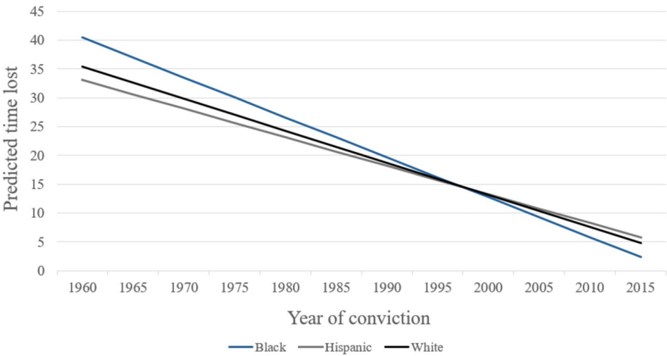
- The race × conviction-year interaction was significant for Black exonerees (b = −0.14, p < 0.01) but not Hispanic exonerees (b = 0.06, p > 0.05), indicating the Black–White gap changed over time while the Hispanic–White gap stayed constant.
- Among those convicted in 1960, Black exonerees were predicted to serve 40.44 years vs. 35.34 for White exonerees (a 5.10-year gap, p < 0.01); by 1995 the gap shrank to 0.28 years and was non-significant; for 2015 convictions the trend reversed, with White exonerees serving 2.48 more years than Black exonerees (p < 0.05).
- Controls associated with longer time lost included prison sentence (b = 8.26, p < 0.001), innocence organization involvement (b = 5.52, p < 0.001), conviction integrity unit involvement (b = 6.00, p < 0.001), official misconduct (b = 1.83, p < 0.001), perjury/false accusation (b = 1.68, p < 0.01), inadequate legal defense (b = 1.52, p < 0.001), and state DNA testing laws (b = 1.79, p < 0.01); younger age, more recent conviction year, capital punishment, and higher Republican vote share were associated with shorter time lost.
Methods
- Retrospective analysis of National Registry of Exonerations data on murder exonerations; from an initial 1,376 murder exonerees, exclusions (federal/military courts, U.S. territories, exonerations after 2022, Asian/Native American/"Other"/"Don't know" groups, missing values) left a final sample of 1,201 (677 Black, 147 Hispanic, 380 White).
- Dependent variable was "time lost," the years between conviction and exoneration (mean = 16.52, SD = 10.15); state-level contextual data on DNA testing laws, Republican vote share, and minority share were merged in.
- Three-step multilevel (hierarchical linear) modeling with exonerees nested in states: a null model to compute the ICC, a main-effects model, and a model adding a race/ethnicity × conviction-year interaction; robustness checks used a square-root transformation of time lost and an additive scale of contributing factors.
Limitations
- Stated: the NRE includes only legally exonerated individuals, not a representative sample of all wrongful convictions, so the sample may disproportionately exclude members of groups facing greater barriers to exoneration, potentially underestimating true disparities.
- Stated: the study cannot empirically test the proposed mechanisms (declining racist attitudes, growing awareness), and the analysis is limited to murder convictions, restricting generalizability to other offense types.
- Evident from the text: the downward trend in predicted time lost is partly an artifact of the data, since all cases were exonerated by 2022 and earlier-convicted individuals had a longer window in which to accumulate time lost (e.g., a 1960 conviction allowed up to 62 years vs. 2 years for a 2020 conviction).
Model-written summary. Check it against the paper before relying on it.
Integrity signals
Registry
Cites
Statistics
Figures
Verification
Claims the paper makes
8 Valid · 0 Not valid · 16 Not checked · 77 Own results and interpretations
A result the paper reports from its own data — it cites no other source for it, so there is none to check. The quote shows it is in the paper.
In the paper
“Interestingly, no significant differences - past or present - were found between Hispanic and White wrongful convicts.”
plain- Asserted: passes — The authors put it forward as true.
- Checkable: passes — It can be checked against evidence.
- Load-bearing: passes — The paper’s conclusions depend on it.
- Based: passes — The paper gives a reason why it holds.
A result the paper reports from its own data — it cites no other source for it, so there is none to check. The quote shows it is in the paper.
In the paper
“Our findings indicate that while Black wrongful convicts have historically faced significantly longer exoneration times than their White counterparts”
hedgedstates an association- Asserted: passes — The authors put it forward as true.
- Checkable: passes — It can be checked against evidence.
- Load-bearing: passes — The paper’s conclusions depend on it.
- Based: passes — The paper gives a reason why it holds.
A result the paper reports from its own data — it cites no other source for it, so there is none to check. The quote shows it is in the paper.
In the paper
“Second, exoneration patterns vary significantly across different crimes, including in the duration of time lost.”
plainstates an association- Asserted: passes — The authors put it forward as true.
- Checkable: passes — It can be checked against evidence.
- Load-bearing: passes — The paper’s conclusions depend on it.
- Based: passes — The paper gives a reason why it holds.
A result the paper reports from its own data — it cites no other source for it, so there is none to check. The quote shows it is in the paper.
In the paper
“Consistent with the latter two explanations, our data show that defendants were significantly younger among those who accepted plea bargains ( p < 0.01) and those whose cases involved official misconduct ( p < 0.001) than among those who did not, whereas no significant age differences were observed with respect to inadequate legal defense.”
plain- Asserted: passes — The authors put it forward as true.
- Checkable: passes — It can be checked against evidence.
- Load-bearing: unclear — It is unclear whether the paper’s conclusions depend on it.
- Based: passes — The paper gives a reason why it holds.
A result the paper reports from its own data — it cites no other source for it, so there is none to check. The quote shows it is in the paper.
In the paper
“For those convicted in 2015, however, the trend reverses, with White exonerees serving 2.48 more years than Black exonerees ( p < 0.05).”
plainstates an associationn = 1,201 ·- Asserted: passes — The authors put it forward as true.
- Checkable: passes — It can be checked against evidence.
- Load-bearing: passes — The paper’s conclusions depend on it.
- Based: passes — The paper gives a reason why it holds.
44 more claims
Create a free account to see all 101 claims and to verify the 5 references still open.
- It may state two separate claims as one. 27
- Probably not a substantial claim. 29
- The quote only partly states this claim. 1
Self-check
Percentages, sums and reported differences re-computed from the paper’s own numbers.
Each contradiction between two passages listed here was confirmed by an independent check.
Rated major: it would touch a result — a value a result rests on, reported and recomputed p-values on opposite sides of the significance level, two passages that conflict with no sign which is right, or a cited work retracted before this paper was published.
In the paper
§ Discussion
“with no significant disparities observed among those convicted in more recent years.”
§ Results
“For those convicted in 2015, however, the trend reverses, with White exonerees serving 2.48 more years than Black exonerees ( p < 0.05).”
Rated minor: it would not touch a result — a value no result rests on, a p-value that stays on the same side of the significance level, or a conflict that is clerical, resolved elsewhere in the paper, or outside its own findings.
In the paper
§ The current study
“Previous research has consistently shown that racial and ethnic minorities experience longer delays before successfully proving their innocence compared to their White counterparts (Dierenfeldt et al., 2024; Itskovich et al., 2023; Rafail & Mahoney, 2019).”
§ Race, ethnicity, and wrongful convictions
“Olney and Bonn (2015) found that the period between conviction and exoneration was longest for Black exonerees but shortest for Hispanic exonerees relative to Whites, a pattern also observed by Rafail and Mahoney (2019) and Braden (2024).”
Citations
Cites
Introducing Multilevel Modeling
Kreft, I., & de Leeuw, J. (1998) · doi:10.4135/9781849209366 · Cited by 2,997
Gelman, A., Fagan, J., & Kiss, A. (2007) · Journal of the American Statistical Association · doi:10.1198/016214506000001040 · Cited by 873 · cited 1×
“Although research on ethnic disparities is relatively limited (Martínez, 2007), evidence indicates that Hispanic individuals are more likely to be stopped by police (Gelman et al., 2007), detained pretrial (Sutton, 2013), and subject to biased criminal records (Grunwald, 2024).”
Introducing Multilevel Modeling
Stangl, D., Kreft, I., & Leeuw, J. D. (1999) · Journal of the American Statistical Association · doi:10.2307/2670020 · Cited by 584
The Race Discrimination System
Reskin, B. (2012) · Annual Review of Sociology · doi:10.1146/annurev-soc-071811-145508 · Cited by 558 · cited 1×
“Historically, outcomes across various domains, including education, wealth, and health, have been marked by significant racial and ethnic disparities (Reskin, 2012).”
A Meta-Analysis of Race and Sentencing Research: Explaining the Inconsistencies
Mitchell, O. (2005) · Journal of Quantitative Criminology · doi:10.1007/s10940-005-7362-7 · Cited by 492 · cited 1×
“…studies have shown that Black individuals in the United States experience higher arrest rates (Barnes et al., 2015; Kochel et al., 2011), higher incarceration rates (Bales & Piquero, 2012; Hawdon et al., 2017), and more severe sentencing outcomes (Mitchell, 2005) compared to White defendants.”
CUMULATIVE DISADVANTAGE: EXAMINING RACIAL AND ETHNIC DISPARITY IN PROSECUTION AND SENTENCING
KUTATELADZE, B. L., ANDILORO, N. R., JOHNSON, B. D., & SPOHN, C. C. (2014) · Criminology · doi:10.1111/1745-9125.12047 · Cited by 478 · cited 1×
“A substantial body of research has supported this assertion, consistently demonstrating that race and ethnicity shape multiple stages of the criminal justice process (Kutateladze et al., 2014).”
EFFECT OF SUSPECT RACE ON OFFICERS’ ARREST DECISIONS*
KOCHEL, T. R., WILSON, D. B., & MASTROFSKI, S. D. (2011) · Criminology · doi:10.1111/j.1745-9125.2011.00230.x · Cited by 362 · cited 1×
“For example, studies have shown that Black individuals in the United States experience higher arrest rates (Barnes et al., 2015; Kochel et al., 2011), higher incarceration rates (Bales & Piquero, 2012; Hawdon et al., 2017), and more severe sentencing outcomes (Mitchell, 2005) compared to White…”
Riddle, T., & Sinclair, S. (2019) · Proceedings of the National Academy of Sciences · doi:10.1073/pnas.1808307116 · Cited by 269 · cited 2×
“Although such inequalities persist today (e.g., Montalmant & Ettinger, 2024; Riddle & Sinclair, 2019), emerging evidence indicates that they may not be as pronounced as in the past.”
Dwyer-Lindgren, L., Kendrick, P., Kelly, Y. O., Sylte, D. O., Schmidt, C., Blacker, B. F., Daoud, F., Abdi, A. A., Baumann, M., Mouhanna, F., et al. (2022) · The Lancet · doi:10.1016/s0140-6736(22)00876-5 · Cited by 262 · cited 3×
“There is evidence that racist attitudes in the United States are declining in general (Charlesworth & Banaji, 2022; Dwyer-Lindgren et al., 2022) and in the criminal justice system in particular (Ferguson & Smith, 2024; Robey et al., 2023; Thiem, 2024).”
DRIVING WHILE BLACK: BIAS PROCESSES AND RACIAL DISPARITY IN POLICE STOPS*
WARREN, P., TOMASKOVIC‐DEVEY, D., SMITH, W., ZINGRAFF, M., & MASON, M. (2006) · Criminology · doi:10.1111/j.1745-9125.2006.00061.x · Cited by 244 · cited 1×
“The predominant explanation for these disparities is racial discrimination, which manifests through biased actions by justice system officials, including police officers and pros - ecutors (Jordan, 2021; Warren et al., 2006).”
Rate of false conviction of criminal defendants who are sentenced to death
Gross, S. R., O’Brien, B., Hu, C., & Kennedy, E. H. (2014) · Proceedings of the National Academy of Sciences · doi:10.1073/pnas.1306417111 · Cited by 186 · cited 1×
“Gross et al. (2014) analyzed data on U.S. death-sentenced prisoners and estimated a wrongful conviction rate of 4.1 percent, while Roman et al. (2012 ) examined rape cases with previously untested DNA and estimated that about 3 percent would have produced exculpatory results.”
InfluentialA Test of Racial Bias in Capital Sentencing
Alesina, A., & La Ferrara, E. (2014) · American Economic Review · doi:10.1257/aer.104.11.3397 · Cited by 169 · cited 2×
“Alesina and La Ferrara ( 2014) reached similar conclusions by demonstrating that the reversal rates in capital murder cases were notably higher for Black defendants with White victims compared to those who did not kill Whites, indicating that a larger share of these cases did not warrant capital…”
Shadish, W. R., Kyse, E. N., & Rindskopf, D. M. (2013) · Psychological Methods · doi:10.1037/a0032964 · Cited by 150 · cited 1×
“This is because in linear models, such as those employed here given the continuous nature of the outcome, the variance is estimated independently of the mean (Shadish et al., 2013).”
Structural bias in the sentencing of felony defendants
Sutton, J. R. (2013) · Social Science Research · doi:10.1016/j.ssresearch.2013.04.003 · Cited by 142 · cited 1×
“Although research on ethnic disparities is relatively limited (Martínez, 2007), evidence indicates that Hispanic individuals are more likely to be stopped by police (Gelman et al., 2007), detained pretrial (Sutton, 2013), and subject to biased criminal records (Grunwald, 2024).”
Patterns of Implicit and Explicit Attitudes: IV. Change and Stability From 2007 to 2020
Charlesworth, T. E. S., & Banaji, M. R. (2022) · Psychological Science · doi:10.1177/09567976221084257 · Cited by 138 · cited 5×
“This shift aligns with broader trends in the United States, where racially biased attitudes have declined over time (Charlesworth & Banaji, 2022), which might have contributed to reductions in disparities across various aspects of the criminal justice system (Ferguson & Smith, 2024; Mitchell et…”
InfluentialGuilty Until Proved Innocent: Wrongful Conviction and Public Policy
Huff, C. R., Rattner, A., Sagarin, E., & MacNamara, D. E. J. (1986) · Crime & Delinquency · doi:10.1177/0011128786032004007 · Cited by 130 · cited 2×
“As discussed earlier, prior research has estimated that between 0.5 and 6 percent of convictions may be wrongful (Huff et al., 1986 ; Loeffler et al., 2019).”
InfluentialSelf-reported false confessions and false guilty pleas among offenders with mental illness.
Redlich, A. D., Summers, A., & Hoover, S. (2010) · Law and Human Behavior · doi:10.1007/s10979-009-9194-8 · Cited by 129 · cited 1×
“Loeffler et al. ( 2019), for example, used survey data from prisoners and suggested a wrongful conviction rate of 6 percent (see also Redlich et al., 2010).”
RACIAL THREAT, PARTISAN POLITICS, AND RACIAL DISPARITIES IN PRISON ADMISSIONS: A PANEL ANALYSIS*
KEEN, B., & JACOBS, D. (2009) · Criminology · doi:10.1111/j.1745-9125.2009.00143.x · Cited by 123 · cited 1×
“Minority share represents the proportion of the state’s population that is non-white, which is associated with harsher penal policies and greater racial disparities within the criminal justice system (Keen & Jacobs, 2009).”
Montalmant, K. E., & Ettinger, A. K. (2023) · Journal of Racial and Ethnic Health Disparities · doi:10.1007/s40615-023-01816-x · Cited by 119 · cited 2×
“Although such inequalities persist today (e.g., Montalmant & Ettinger, 2024; Riddle & Sinclair, 2019), emerging evidence indicates that they may not be as pronounced as in the past.”
Ideology, Social Threat, and the Death Sentence: Capital Sentences across Time and Space
Jacobs, D., & Carmichael, J. T. (2004) · Social Forces · doi:10.1353/sof.2004.0115 · Cited by 107 · cited 1×
“Republican vote share captures the percentage of voters who supported the Republican candidate in the state, which is associated with the state’s punitiveness (Jacobs & Carmichael, 2004; Rafail & Mahoney, 2019).”
Racial/Ethnic Differentials in Sentencing to Incarceration
Bales, W. D., & Piquero, A. R. (2012) · Justice Quarterly · doi:10.1080/07418825.2012.659674 · Cited by 104 · cited 1×
“…studies have shown that Black individuals in the United States experience higher arrest rates (Barnes et al., 2015; Kochel et al., 2011), higher incarceration rates (Bales & Piquero, 2012; Hawdon et al., 2017), and more severe sentencing outcomes (Mitchell, 2005) compared to White defendants.”
Nguyen, T. T., Criss, S., Michaels, E. K., Cross, R. I., Michaels, J. S., Dwivedi, P., Huang, D., Hsu, E., Mukhija, K., Nguyen, L. H., et al. (2021) · SSM - Population Health · doi:10.1016/j.ssmph.2021.100922 · Cited by 103 · cited 3×
“These trends are accompanied by growing public awareness of racial and ethnic bias, driven by high-profile racial clashes and movements such as Black Lives Matter (Nguyen et al., 2021; Thiem, 2024).”
Race and Wrongful Convictions in the United States 2022
Gross, S. R., Possley, M., Otterbourg, K., Stephens, K., Paredes, J., & O'Brien, B. (2022) · SSRN Electronic Journal · doi:10.2139/ssrn.4245863 · Cited by 97 · cited 2×
“For instance, data from the NRE indicate that Black individuals represent approximately 53% of exonerees, despite comprising only about 13% of the U.S. population (Gross et al., 2022).”
Measuring Self-Reported Wrongful Convictions Among Prisoners
Loeffler, C. E., Hyatt, J., & Ridgeway, G. (2019) · Journal of Quantitative Criminology · doi:10.1007/s10940-018-9381-1 · Cited by 95 · cited 2×
“As discussed earlier, prior research has estimated that between 0.5 and 6 percent of convictions may be wrongful (Huff et al., 1986 ; Loeffler et al., 2019).”
InfluentialFrequency and Predictors of False Conviction: Why We Know So Little, and New Data on Capital Cases
Gross, S. R., & O'Brien, B. (2008) · Journal of Empirical Legal Studies · doi:10.1111/j.1740-1461.2008.00146.x · Cited by 88 · cited 1×
“This is because a conviction is recognized as erroneous only once the individual is exonerated (Gross & O’Brien, 2008).”
Have Racial and Ethnic Disparities in Sentencing Declined?
King, R. D., & Light, M. T. (2019) · Crime and Justice · doi:10.1086/701505 · Cited by 85 · cited 3×
“For example, King and Light (2019) used decades-long data to show that disparities in sentence length between Black and Hispanic defendants and their White counterparts have diminished (see also Mitchell et al., 2023 ).”
Ramsey, R. J., & Frank, J. (2007) · Crime & Delinquency · doi:10.1177/0011128706286554 · Cited by 78 · cited 1×
“Studies surveying criminal justice personnel, such as prosecutors and judges, have produced lower estimates, typically between 0.5 and 3 percent (Huff et al., 1986; Ramsey & Frank, 2007 ).”
InfluentialINCORPORATING LATINOS AND IMMIGRANTS INTO POLICING RESEARCH*
Martínez, R. (2007) · Criminology & Public Policy · doi:10.1111/j.1745-9133.2007.00421.x · Cited by 71 · cited 1×
“Although research on ethnic disparities is relatively limited (Martínez, 2007), evidence indicates that Hispanic individuals are more likely to be stopped by police (Gelman et al., 2007), detained pretrial (Sutton, 2013), and subject to biased criminal records (Grunwald, 2024).”
Arrest Prevalence in a National Sample of Adults: The Role of Sex and Race/Ethnicity
Barnes, J. C., Jorgensen, C., Beaver, K. M., Boutwell, B. B., & WRIGHT, J. P. (2014) · American Journal of Criminal Justice · doi:10.1007/s12103-014-9273-3 · Cited by 67 · cited 1×
“For example, studies have shown that Black individuals in the United States experience higher arrest rates (Barnes et al., 2015; Kochel et al., 2011), higher incarceration rates (Bales & Piquero, 2012; Hawdon et al., 2017), and more severe sentencing outcomes (Mitchell, 2005) compared to White…”
Officials' Estimates of the Incidence of “Actual Innocence” Convictions
Zalman, M., Smith, B., & Kiger, A. (2008) · Justice Quarterly · doi:10.1080/07418820801954563 · Cited by 48 · cited 1×
“…and prosecutors tended to report lower estimates than lawyers representing defendants, possibly reflecting greater professional defensiveness among the former, and later studies showed higher estimates, suggesting growing awareness of wrongful convictions (Dioso-Villa, 2015; Zalman et al., 2008 ).”
The criminal costs of wrongful convictions: Can we reduce crime by protecting the innocent?
Norris, R. J., Weintraub, J. N., Acker, J. R., Redlich, A. D., & Bonventre, C. L. (2019) · Criminology & Public Policy · doi:10.1111/1745-9133.12463 · Cited by 47 · cited 2×
“With respect to factors hypothesized to expedite exonerations, we included the conviction year to account for the growing awareness of and advocacy for wrongful convictions, which has resulted in more tools and resources available for exonerees (Norris et al., 2020).”
Race, Wrongful Conviction & Exoneration
Smith, E. L., III, & Hattery, A. J. (2010) · Journal of African American Studies · doi:10.1007/s12111-010-9130-5 · Cited by 41 · cited 1×
“Moreover, Smith & Hattery, (2011) and West and Meterko (2015) revealed that racial disparities in the wrongful conviction rate were even more pronounced in cases involving a Black defendant and a White victim.”
A Generational Shift: Race and the Declining Lifetime Risk of Imprisonment
Robey, J. P., Massoglia, M., & Light, M. T. (2023) · Demography · doi:10.1215/00703370-10863378 · Cited by 39 · cited 4×
“Indeed, with respect to the justice system, recent studies indicate a decline in racial disparities in outcomes such as arrest rates, incarceration rates, and sentence lengths (Mitchell et al., 2023; Robey et al., 2023; Slocum et al., 2020 ).”
InfluentialThe Criminology of Wrongful Conviction: A Decade Later
Leo, R. A. (2017) · Journal of Contemporary Criminal Justice · doi:10.1177/1043986216673013 · Cited by 38
Garrett, B. L. (2020) · Annual Review of Criminology · doi:10.1146/annurev-criminol-011518-024739 · Cited by 35 · cited 2×
“These factors may delay exonerations by increasing the burden of proof, intensifying stigma, or limiting the legal pathways available to exonerees (Garrett, 2020; Rafail & Mahoney, 2019 ).”
National Historical Geographic Information System: Version 19.0
Manson, S., Schroeder, J., Van Riper, D., et al. (2024) · Institute for Social Research and Data Innovation · doi:10.18128/d050.v19.0 · Cited by 30
Framing DNA: Social Movement Theory and the Foundations of the Innocence Movement
Norris, R. J. (2016) · Journal of Contemporary Criminal Justice · doi:10.1177/1043986216673014 · Cited by 28
Advancing Wrongful Conviction Scholarship: Toward New Conceptual Frameworks
Norris, R. J., & Bonventre, C. L. (2013) · Justice Quarterly · doi:10.1080/07418825.2013.827232 · Cited by 28 · cited 1×
“Norris and Bonventre (2015) proposed this framework as a useful lens for understanding racial disparities in wrongful convictions.”
Too Late for Luck: A Comparison of Post-Furman Exonerations and Executions of the Innocent
Harmon, T. R., & Lofquist, W. S. (2005) · Crime & Delinquency · doi:10.1177/0011128705275977 · Cited by 27 · cited 2×
“…that the growing public awareness of racial inequities within the justice system (Nguyen et al., 2021; Thiem, 2024), and increased resources and attention directed toward Blacks (Harmon & Lofquist, 2005), have contributed to more equitable perceptions and treatment of Black wrongful convicts.”
Karaffa, K. M., Page, J., & Koch, J. M. (2017) · Criminal Justice Policy Review · doi:10.1177/0887403415607049 · Cited by 24 · cited 2×
“…to be more stigmatized and viewed as less deserving of support upon release compared to Black exonerees (Faison et al., 2023; Kieckhaefer & Luna, 2024; Scherr et al., 2018), or at least no significant differences were observed (Bettens et al., 2024; Hamovitch et al., 2022 ; Karaffa et al., 2017 ).”
Reducing False Guilty Pleas and Wrongful Convictions through Exoneree Compensation
Mungan, M. C., & Klick, J. (2016) · The Journal of Law and Economics · doi:10.1086/684686 · Cited by 23 · cited 1×
“…(e.g., type of crime and plea bargains), and contextual characteristics (e.g., states’ punitiveness and political affiliation) on various aspects of wrongful convictions (see, e.g., Dierenfeldt et al., 2024; Gould et al., 2013; Mungan & Klick, 2016; Norris et al., 2020; Rafail & Mahoney, 2019).”
Olney, M., & Bonn, S. (2015) · Criminal Justice Policy Review · doi:10.1177/0887403414521461 · Cited by 23 · cited 3×
“Olney and Bonn (2015) found that the period between conviction and exoneration was longest for Black exonerees but shortest for Hispanic exonerees relative to Whites, a pattern also observed by Rafail and Mahoney (2019) and Braden (2024).”
Scherr, K. C., Normile, C. J., & Sarmiento, M. C. (2017) · Journal of Experimental Criminology · doi:10.1007/s11292-017-9306-2 · Cited by 21 · cited 1×
“…to be more stigmatized and viewed as less deserving of support upon release compared to Black exonerees (Faison et al., 2023; Kieckhaefer & Luna, 2024; Scherr et al., 2018), or at least no significant differences were observed (Bettens et al., 2024; Hamovitch et al., 2022 ; Karaffa et al., 2017 ).”
Identifying Patterns Across the Six Canonical Factors Underlying Wrongful Convictions
Berube, R., Wilford, M. M., Redlich, A. D., & Wang, Y. (2023) · The Wrongful Conviction Law Review · doi:10.29173/wclawr82 · Cited by 20 · cited 2×
“Several mechanisms may account for this pattern (Berube et al., 2022; Dierenfeldt et al., 2024 ).”
Cassell, P. G. (2018) · SSRN Electronic Journal · doi:10.2139/ssrn.3276185 · Cited by 15
Ferguson, C. J., & Smith, S. (2024) · Aggression and Violent Behavior · doi:10.1016/j.avb.2023.101905 · Cited by 14 · cited 6×
“…aligns with broader trends in the United States, where racially biased attitudes have declined over time (Charlesworth & Banaji, 2022), which might have contributed to reductions in disparities across various aspects of the criminal justice system (Ferguson & Smith, 2024; Mitchell et al., 2023 ).”
InfluentialThe Effect of Wrongful Conviction Rate on Death Penalty Support and How It Closes the Racial Gap
Wu, S. (2021) · American Journal of Criminal Justice · doi:10.1007/s12103-021-09637-6 · Cited by 14 · cited 1×
“Descriptive data on exonerees commonly serve as background for these studies, revealing notable patterns in the racial and ethnic composition of those wrongfully convicted (Wu, 2022).”
Racial Bias in Criminal Records
Grunwald, B. (2022) · Journal of Quantitative Criminology · doi:10.1007/s10940-023-09575-y · Cited by 14 · cited 1×
“Although research on ethnic disparities is relatively limited (Martínez, 2007), evidence indicates that Hispanic individuals are more likely to be stopped by police (Gelman et al., 2007), detained pretrial (Sutton, 2013), and subject to biased criminal records (Grunwald, 2024).”
Slocum, L. A., Huebner, B. M., Greene, C., & Rosenfeld, R. (2020) · Journal of Community Psychology · doi:10.1002/jcop.22265 · Cited by 13 · cited 2×
“Indeed, with respect to the justice system, recent studies indicate a decline in racial disparities in outcomes such as arrest rates, incarceration rates, and sentence lengths (Mitchell et al., 2023; Robey et al., 2023; Slocum et al., 2020 ).”
Mitchell, O., Yan, S., & Mora, D. O. (2023) · Journal of Research in Crime and Delinquency · doi:10.1177/00224278221120677 · Cited by 12 · cited 4×
“…aligns with broader trends in the United States, where racially biased attitudes have declined over time (Charlesworth & Banaji, 2022), which might have contributed to reductions in disparities across various aspects of the criminal justice system (Ferguson & Smith, 2024; Mitchell et al., 2023 ).”
InfluentialKatzman, J., & Kovera, M. B. (2023) · Law and Human Behavior · doi:10.1037/lhb0000503 · Cited by 12 · cited 2×
“…evidence supports the claims advanced by these theoretical perspectives, showing racial bias against Black individuals in police decision-making (Katzman & Kovera, 2023) and more pronounced racial effects in contexts less welcoming to racial and ethnic minorities, such as Republican-controlled…”
Wrongful Conviction as Racialized Cumulative Disadvantage
Umamaheswar, J. (2022) · The British Journal of Criminology · doi:10.1093/bjc/azac061 · Cited by 12
The Politics of Wrongful Conviction Legislation
Hicks, W. D., Mullinix, K. J., & Norris, R. J. (2021) · State Politics & Policy Quarterly · doi:10.1017/spq.2020.4 · Cited by 11 · cited 2×
“To the registry’s data, we merged contextual state-level information, including data on laws related to the exoneration procedure (Hicks et al., 2021), presidential electoral returns (MIT Election Data and Science Lab, 2017), and demographic composition (Manson, 2024).”
Frequency and Predictors of False Conviction: Why We Know So Little, and New Data on Capital CasesPreprint
Gross, S. R., & O'Brien, B. (2007) · SSRN Electronic Journal · doi:10.2139/ssrn.996629 · Cited by 11
A Long Road to Freedom: The Exoneration Pipeline in the United States, 1989–2015
Rafail, P., & Mahoney, M. (2019) · The Sociological Quarterly · doi:10.1080/00380253.2018.1547175 · Cited by 10 · cited 10×
“However, while the number of exonerations is ascertain-able, estimating the prevalence of wrongful convictions among currently incarcerated individuals remains a challenge (Rafail & Mahoney, 2019).”
InfluentialCan you put a price on 14 years of life? Examining predictors of monetary compensation for exonerees
Kieckhaefer, J., & Luna, S. (2022) · Psychology Crime and Law · doi:10.1080/1068316x.2022.2093871 · Cited by 10 · cited 2×
“…justice system (King & Light, 2019; Mitchell et al., 2023) and more positive attitudes toward minority wrongful convicts (Bettens et al., 2024; Kieckhaefer & Luna, 2024), we hypothesize that while racial and ethnic minorities historically suffered longer exoneration durations, these…”
What Can DNA Exonerations Tell Us about Racial Differences in Wrongful-Conviction Rates?
Bjerk, D., & Helland, E. (2020) · The Journal of Law and Economics · doi:10.1086/707080 · Cited by 8 · cited 4×
“Building on these statistics, Bjerk and Helland (2020 ) found that the wrongful conviction rate for rape was significantly higher for Black defendants compared to White defendants in the United States.”
InfluentialCarmichael, J. T., & Kent, S. L. (2017) · Criminal Justice Review · doi:10.1177/0734016816684925 · Cited by 8 · cited 1×
“…racial threat theory (Blalock, 1967), posits that inequalities in the criminal justice system, including wrongful convictions, serve to reinforce social control by the majority group in response to perceived threats from expanding racial minority populations (Carmichael & Kent, 2017; Jordan, 2021).”
Structural Bias in the Sentencing of Felony DefendantsPreprint
Sutton, J. R. (2012) · SSRN Electronic Journal · doi:10.2139/ssrn.2095594 · Cited by 8
Itskovich, E., Factor, R., & Ohana, D. (2023) · Punishment & Society · doi:10.1177/14624745221148318 · Cited by 6 · cited 8×
“Second, the model included several case-specific characteristics, some of which have been found or hypothesized to delay exoneration, while others are thought to expedite it (Dierenfeldt et al., 2024; Itskovich et al., 2023; Rafail & Mahoney, 2019).”
InfluentialSelf-citationThe stigma of wrongful conviction differs for White and Black exonerees.
Faison, L., Smalarz, L., Madon, S., & Clow, K. A. (2023) · Law and Human Behavior · doi:10.1037/lhb0000522 · Cited by 6 · cited 2×
“…of wrongful convictions, the results echo recent studies that found no significant differences in attitudes toward Black and white exonerees and even indicated more positive attitudes toward Black exonerees in some cases (e.g., Faison et al., 2023; Hamovitch et al., 2022 ; Karaffa et al., 2017).”
Hamovitch, L., Zannella, L., Rempel, E., Graf, H., & Clow, K. (2022) · The Wrongful Conviction Law Review · doi:10.29173/wclawr71 · Cited by 5 · cited 2×
“…to be more stigmatized and viewed as less deserving of support upon release compared to Black exonerees (Faison et al., 2023; Kieckhaefer & Luna, 2024; Scherr et al., 2018), or at least no significant differences were observed (Bettens et al., 2024; Hamovitch et al., 2022 ; Karaffa et al., 2017 ).”
Addressing the Race Gap in Incarceration Rates: An Agent Based Model
E.Hawdon, J., Lum, K., Swarup, S., Torres, J. A., & Eubank, S. (2017) · Corrections · doi:10.1080/23774657.2016.1265472 · Cited by 5 · cited 1×
“…studies have shown that Black individuals in the United States experience higher arrest rates (Barnes et al., 2015; Kochel et al., 2011), higher incarceration rates (Bales & Piquero, 2012; Hawdon et al., 2017), and more severe sentencing outcomes (Mitchell, 2005) compared to White defendants.”
The color of confinement: examining youth exoneration decisions and the critical race theory
Webb, P., Savard, D. M., & Delaney, A. X. (2020) · Journal of Ethnicity in Criminal Justice · doi:10.1080/15377938.2020.1754990 · Cited by 5 · cited 2×
“Despite its limited scope, the NRE is widely regarded as the most comprehensive and systematically verified source on wrongful convictions (Leo, 2017), and has therefore been used extensively in recent scholarship (e.g., Braden, 2024; Webb et al., 2020).”
Folk Psychology Wins the DAY! Daubert and the Challenge of False Confessions
Hardcastle, V. G. (2017) · Philosophy, psychiatry & psychology · doi:10.1353/ppp.2017.0038 · Cited by 4 · cited 1×
“These factors may affect the exoneration process differently due to variations in the legal pathways available for addressing them (e.g., Hardcastle, 2017).”
Stigma or Support? How Gender, Race, and Intersectionality Impact Perceptions of Exonerees
Bettens, T., Warren, A. R., & Pica, E. (2026) · Women & Criminal Justice · doi:10.1080/08974454.2024.2386654 · Cited by 4 · cited 4×
“…in the criminal justice system (King & Light, 2019; Mitchell et al., 2023) and more positive attitudes toward minority wrongful convicts (Bettens et al., 2024; Kieckhaefer & Luna, 2024), we hypothesize that while racial and ethnic minorities historically suffered longer exoneration…”
InfluentialIn Pursuit of Innocence: A Study of Race and Ethnicity Differences in Time-to-Exoneration
Braden, V. E. (2024) · The Wrongful Conviction Law Review · doi:10.29173/wclawr113 · Cited by 3
A. Jordan, K. (2021) · Journal of Mental Health and Social Behaviour · doi:10.33790/jmhsb1100148 · Cited by 3 · cited 2×
“The predominant explanation for these disparities is racial discrimination, which manifests through biased actions by justice system officials, including police officers and pros - ecutors (Jordan, 2021; Warren et al., 2006).”
Scherr, K. C., Normile, C. J., & Sarmiento, M. C. (2018) · Journal of Experimental Criminology · doi:10.1007/s11292-018-9336-4 · Cited by 3
Hattery, A. J., & Smith, E. L., III (2022) · doi:10.4324/9781003121251-5 · Cited by 2
Thiem, A. (2024) · Law, Culture and the Humanities · doi:10.1177/17438721231179183 · Cited by 1 · cited 3×
“These trends are accompanied by growing public awareness of racial and ethnic bias, driven by high-profile racial clashes and movements such as Black Lives Matter (Nguyen et al., 2021; Thiem, 2024).”
Dierenfeldt, R., Jackson, E., Basham, S. L., & Iles, G. (2024) · Journal of Ethnicity in Criminal Justice · doi:10.1080/15377938.2024.2375214 · Cited by 1 · cited 13×
“Second, the model included several case-specific characteristics, some of which have been found or hypothesized to delay exoneration, while others are thought to expedite it (Dierenfeldt et al., 2024; Itskovich et al., 2023; Rafail & Mahoney, 2019).”
Influential
Research works printed but not linked: 11
- Acker, J., & Redlich, A. (2019). Wrongful Conviction: Law, Science, and Policy. Carolina Academic Press.
- Blalock, H. M. (1967). Toward a Theory of Minority-group Relations. Wiley.
- Dioso-Villa, R. (2015). A repository of wrongful convictions in Australia: First steps toward estimating prevalence and causal contributing factors miscarriages of justice special issue. Flinders Law Journal, 17 (2), 163-202.
- Gould, J., Carrano, J., Leo, R. A., & Hail-Jares, K. (2013). Predicting erroneous convictions. Iowa Law Review, 99 (2), 471-522.
- Gould, J., & Leo, R. A. (2015). The path to exoneration. Albany Law Review, 79 (2), 325-372.
- Griffin, L., & Mason, D. (2022). The prosecutor in the mirror: Conviction integrity units and brady claims. Loyola of Los Angeles Law Review, 55 (4), 1005-1052.
- Hair, J. F., Black, W. C., Babin, B. J., & Anderson, R. E. (2010). Multivariate Data Analysis . Pearson. Hamovitch, L., Zannella, L., Rempel, E., Graf, H., & Clow, K. (2022). You are not the tenant i am looking for: ' An analysis of landlords' response to rental inquiries from wrongfully convicted individuals. The Wrongful Conviction Law Review, 3 (1), 34-59.
- Henry, J. S. (2018). Smoke but no fire: When innocent people are wrongly convicted of crimes that never happened. American Criminal Law Review, 55 (3), 665-704.
- O'Brien, B., Stephens, K., Possley, M., & Grosso, C. M. (2019). Latinx defendants, false convictions, and the difficult road to exoneration. Ucla Law Review, 66 , 1682-1715.
- Rizer, A. L. I. (2003). The race effect on wrongful convictions justice in a changed world. William Mitchell Law Review, 29 (3), 845-868.
- West, E., & Meterko, V. (2015). Innocence project: DNA exonerations, 1989-2014: Review of data and findings from the first 25 years. Albany Law Review, 79 (3), 717-796.
Metadata
- Authors
- Itskovich, E.
- Affiliations
- Hebrew University of Jerusalem (IL)
- Corresponding author
- Itskovich, Eran
- ORCID
- Itskovich, Eran
- Venue
- American Journal of Criminal Justice
- Published
- 2025-11-08
- Volume
- 51
- Issue
- 4
- Pages
- 1043-1064
- ISSN
- 1066-2316 (ISSN-L)
- 1936-1351
- OpenAlex
- W4416026495
- Cited by
- 0
- References
- 67
- FWCI
- 0.00
- Type
- journal article
- Language
- en
- Open access
- hybrid
- doi.org
- Licence
- cc-by
- creativecommons.org/licenses/by/4.0 (tdm)
- creativecommons.org/licenses/by/4.0 (vor)
- Locations
- American Journal of Criminal Justice (publishedVersion, cc-by)
- Funders
- Hebrew University of Jerusalem
- Topics
- Social Sciences › Sociology and Political Science › Criminal Justice and Corrections Analysis
- Social Sciences › Law › Legal processes and jurisprudence
- Social Sciences › Law › Criminal Law and Evidence
- Keywords
- wrongful convictions, racial disparities, ethnic disparities, exoneration, racial bias, National Registry of Exonerations, temporal trends
About these checks
Registry, retraction, Cites and statistics results are computed, not judged, with one exception: a printed reference that no index lists is read once by a model before it counts as a citation error. Claims are extracted by a model and kept only when their quote appears verbatim in the text; each cited source is then checked, with a model’s help, for whether it says what the claim relies on. Those verdicts can be wrong — read the claim’s quote and the cited source before relying on one.
The claim verdicts this report counts are experimental: their accuracy is not yet measured.
A language model drew the claims from the paper on 2026-09-29, under version 3 of the claim definition (model deepseek-v4.1-flash, prompt extract-v3).
A second model labelled each claim on 2026-09-29 (model jev-1.13-20260917, definition revision gold-guideline-v0.2).
Statistics and arithmetic are recomputed, not judged.
Confidence bands are shown only for fields calibrated on our annotated test set. None is calibrated yet, so no band is shown.
What counts as a claim ›How we measure confidence ›How we check this ›
Are you an author, or do you see a problem with this page? Request a review
Data sources
Bibliographic data: Semantic Scholar, OpenAlex, Crossref.
Contains information from the Semantic Scholar Academic Graph Datasets, made available under the ODC Attribution License (ODC-BY 1.0).
Semantic Scholar’s data is described in: Kinney, R., et al. (2023). The Semantic Scholar Open Data Platform. arXiv:2301.10140.
