

The DOI matches its Crossref record; 4 of the 4 references it cites were found in a registry or an index.
FANatics: Systematic literature review of factors associated with celebrity worship, and suggested directions for future research
Abstract
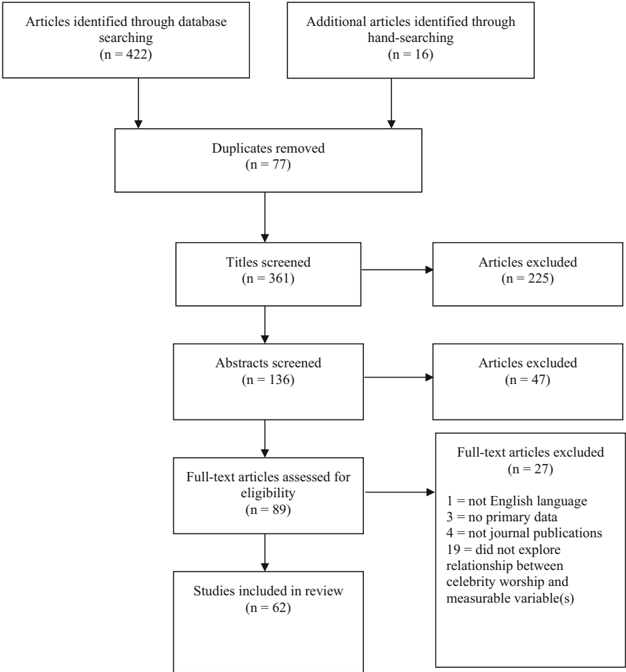
A ‘culture of celebrity’ began to emerge in the twentieth century, profoundly impacting the social world. Recent years have seen the publication of an increasing wealth of literature focusing on people who are enthralled with celebrities – often to the point of obsession – termed ‘celebrity worshippers’. The current paper systematically reviews this literature to gain a comprehensive understanding of the various factors associated with celebrity worship and to identify gaps in the literature. Papers were identified through a systematic literature search and 62 were deemed relevant for inclusion in the review. These provided evidence that celebrity worship may be related to demographic factors (e.g. age); personality factors (e.g. dimensions of the psychoticism-extraversion-neuroticism model, materialism); religiosity; behavioural and cognitive-behavioural factors (e.g. fantasy proneness, obsessive behaviours); feelings about the self or the world (e.g. self-esteem); cognitive factors (e.g. cognitive flexibility, critical thinking); relationships with others (e.g. attachment style, romantic relationship style); attitudes towards the body, eating, and cosmetic surgery; and psychological wellbeing (e.g. depression, anxiety). The results are used to help researchers understand the individual and psychosocial factors associated with celebrity worship, and directions for future research in this area are identified.
Overview
The claims and statistics of this paper haven’t been checked yet.
Run the check — free, no account needed. It reads the open-access text and checks the sources it cites.
Integrity signals
Registry
Cites
Statistics
Figures
Verification
Claims the paper makes
The claims and statistics of this paper haven’t been checked yet.
Run the check — free, no account needed. It reads the open-access text and checks the sources it cites.
Claims other papers make about this one
Each is checked against this paper’s own text: does it say what the citing paper says it does?
The source backs part of the claim, not all of it — or backs it for a different population, condition or comparison.
In the citing paper
“While such connections can be supportive, intense attachments may contribute to withdrawal, obsessive checking, or negative self-evaluations, especially among isolated youth [28, 47].”
From Understanding Teen Overreliance on AI Companion Chatbots Through Self-Reported Reddit Narratives (2026) · cites this paper as [28]
Experimental — accuracy not yet measuredIn the citing paper
“The cultlike status of celebrities (Brooks, 2021; McCutcheon et al., 2002) may rest on virtually all of them being in the business of storytelling.”
From Stories in Action. (2022) · cites this paper as Brooks, 2021
Self-check
Percentages, sums and reported differences re-computed from the paper’s own numbers.
The self-check needs the paper’s full text.
Citations
Cites
Using thematic analysis in psychology
Braun, V., & Clarke, V. (2006) · Qualitative Research in Psychology · doi:10.1191/1478088706qp063oa · Cited by 194,414
Mass Communication and Para-Social Interaction
Horton, D., & Richard Wohl, R. (1956) · Psychiatry · doi:10.1080/00332747.1956.11023049 · Cited by 4,380
Body image and body shape ideals in magazines: exposure, awareness, and internalization
Cusumano, D. L., & Thompson, J. K. (1997) · Sex Roles · doi:10.1007/bf02936336 · Cited by 540
Greenwood, D. N., & Long, C. R. (2011) · Communication Research · doi:10.1177/0093650210362687 · Cited by 142
Research works printed but not linked: 132
- Alexander, J. C. (2010). The celebrity-icon. Cultural Sociology, 4(3), 323–336. · DOI
- Allport, G. W., & Ross, J. M. (1967). Personal religious orientation and prejudice. Journal of Personality and Social Psychology, 5, 432–443. · DOI
- Ang, C.-S., & Chan, N.-N. (2016). Adolescents’ views on celebrity worship: A qualitative study. Current Psychology, 37, 139–148. https://doi.org/10.1007/s12144-016-9497-0,. · DOI
- Aruguete, M., Griffith, J., Edman, J., Green, T., & McCutcheon, L. (2014). Body image and celebrity worship. Implicit Religion, 17(2), 223–234. · DOI
- Ashe, D. D., & McCutcheon, L. E. (2001). Shyness, loneliness, and attitude toward celebrities. Current Research in Social Psychology, 6(9), 124–132.
- Ashe, D. D., Maltby, J., & McCutcheon, L. E. (2005). Are celebrity-worshippers more prone to narcissism? A brief report. North American Journal of Psychology, 7(2), 239–246.
- Austin, E. W., Van de Vord, R., Pinkleton, B. E., & Epstein, E. (2008). Celebrity endorsements and their potential to motivate young voters. Celebrity Studies, 11(4), 420–436.
- Baek, Y. M., Bae, Y., & Jang, H. (2013). Social and parasocial relationships on social network sites and their differential relationships with users’ psychological well-being. Cyberpsychology, Behavior, and Social Networking, 16(7), 512–517. · DOI · Paper page
- Basil, M. D. (1996). Identification as a mediator of celebrity effects. Journal of Broadcasting and Electronic Media, 40, 478–495. · DOI
- Bond, B. J. (2018). Parasocial relationships with media personae: Why they matter and how they differ among heterosexual, lesbian, gay, and bisexual adolescents. Media Psychology, 21, 457–485. https://doi.org/10.1080/15213269.2017.1416295. · DOI
- Boon, S. D., & Lomore, C. D. (2001). Admirer-celebrity relationships among young adults: Explaining perceptions of celebrity influence on identity. Human Communication Research, 27(3), 432–465.
- Branch, S. E., Wilson, K. M., & Agnew, C. R. (2013). Committed to Oprah, Homer, or house: Using the investment model to understand parasocial relationships. Psychology of Popular Media Culture, 2(2), 96–109. · DOI
- Briggs-Myers, I., & Briggs, K. C. (1985). Myers-Briggs type Indicator (MBTI). Palo Alto: Consulting Psychologists Press.
- Brown, W. J. (2015). Examining four processes of audience involvement with media personae: Transportation, parasocial interaction, identification, and worship. Communication Theory, 25, 259–283. · DOI
- Brown, W. J., & Basil, M. D. (1995). Media celebrities and public health: Responses to “magic” Johnson’s HIV disclosure and its impact on AIDS risk and high-risk behaviours. Health Communication, 7(4), 345–370. · DOI
- Brown, W. J., & de Matviuk, M. A. (2010). Sports celebrities and public health: Diego Maradona’s influence on drug use prevention. Journal of Health Communication, 15(4), 358–373. · DOI
- Campbell, W. K., & Foster, C. A. (2002). Narcissism and commitment in romantic relationships: An investment model analysis. Personality and Social Psychology Bulletin, 28(4), 484–495. · DOI
- Casey, G. M., Morris, B., Burnell, M., Parberry, A., Singh, N., & Rosenthal, A. N. (2013). Celebrities and screening: A measurable impact on high-grade cervical neoplasia diagnosis from the ‘jade goody effect’ in the UK. British Journal of Cancer, 109(5), 1192–1197. · DOI
- Chapman, S., McLeod, K., Wakefield, M., & Holding, S. (2005). Impact of news of celebrity illness on breast cancer screening: Kylie Minogue’s breast cancer diagnosis. Medical Journal of Australia, 183(5), 247–250. · DOI
- Cheng, S. T. (1997). Psychological determinants of idolatry in adolescents. Adolescence, 32(127), 687–692.
- Cheung, C.-K., & Yue, X. D. (2003a). Identity achievement and idol worship among teenagers in Hong Kong. International Journal of Adolescence and Youth, 11(1), 1–26. · DOI
- Cheung, C.-K., & Yue, X. D. (2003b). Adolescent modelling after luminary and star idols and development of self-efficacy. International Journal of Adolescence and Youth, 11(3), 251–267. · DOI
- Cheung, C.-K., & Yue, X. D. (2011). Pentangular dimensions of Chinese adolescents’ idol worship. International Journal of Adolescence and Youth, 16(3), 225–244. · DOI
- Cheung, C.-K., & Yue, X. D. (2012). Idol worship as compensation for parental absence. International Journal of Adolescence and Youth, 17(1), 35–46. · DOI
- Chia, S. C., & Poo, Y. L. (2009). Media, celebrities, and fans: An examination of adolescents’ media usage and involvement with entertainment celebrities. Journalism & Mass Communication Quarterly, 86(1), 23–44. · DOI
- Chung, S., & Cho, H. (2017). Fostering parasocial relationships with celebrities on social media: Implications for celebrity endorsement. Psychology & Marketing, 34(4), 481–495. · DOI · Paper page
- Cohen, J. (2001). Defining identification: A theoretical look at the identification of audiences with media characters. Mass Communication and Society, 4(3), 245–264. · DOI · Paper page
- Cushman, P. (1990). Why the self is empty. Toward a historically situated psychology. The American Psychologist, 45(5), 599–611. · DOI
- Deci, E. L., & Ryan, R. M. (2002). Handbook of self-determination research. Rochester: University of Rochester Press.
- Derrick, J. L., Gabriel, S., & Tippin, B. (2008). Parasocial relationships and self-discrepancies: Faux relationships have benefits for low self-esteem individuals. Personal Relationships, 15, 261–280. · DOI
- Engle, Y., & Kasser, T. (2005). Why do adolescent girls idolize male celebrities? Journal of Adolescent Research, 20(2), 263–283. · DOI
- Eysenck, H. J., & Eysenck, M. W. (1985). Personality and individual differences: A natural science approach. New York: Plenum. · DOI · Paper page
- Ferris, K. O. (2001). Through a glass, darkly: The dynamics of fan-celebrity encounters. Symbolic Interaction, 24(1), 25–47. · DOI
- Fraley, R. F., & Davis, K. E. (1997). Attachment formation and transfer in young adults' close friendships and romantic relationships. Personal Relationships, 4, 131–144. · DOI
- Gabriel, S., & Young, A. F. (2011). Becoming a vampire without being bitten: The narrative collective-assimilation hypothesis. Psychological Science, 22, 990–994. · DOI
- Giles, D. (2000). Illusions of immortality: A psychology of fame and celebrity. New York: St Martin’s Press. · DOI
- Giles, D. (2002). Parasocial interaction: A review of the literature and a model for future research. Media Psychology, 4, 279–305. · DOI · Paper page
- Giles, D. C. (2017). How do fan and celebrity identities become established on twitter? A study of ‘social media natives’ and their followers. Celebrity Studies, 8(3), 445–460. · DOI
- Giles, D. C., & Maltby, J. (2004). The role of media figures in adolescent development: Relations between autonomy, attachment, and interest in celebrities. Personality and Individual Differences, 36, 813–822. · DOI
- Giles, D., & Maltby, J. (2006). Praying at the altar of the stars. The Psychologist, 19(2), 82–85.
- Gleason, T. R., Theran, S. A., & Newberg, E. M. (2017). Parasocial interactions and relationships in early adolescence. Frontiers in Psychology, 8, 255. · DOI · Paper page
- Goldberg, L. R. (1990). An alternative “description of personality”: The big-five factor structure. Journal of Personality and Social Psychology, 59, 1216–1229. · DOI · Paper page
- Green, M. C. (2004). Transportation into narrative worlds: The role of prior knowledge and perceived realism. Discourse Processes, 38, 247–266. · DOI
- Green, M. C., Brock, T. C., & Kaufman, G. F. (2004). Understanding media enjoyment: The role of transportation into narrative worlds. Communication Theory, 14, 311–327. · DOI
- Green, T., Griffith, J., Aruguete, M. S., Edman, J., & McCutcheon, L. E. (2014). Materialism and the tendency to worship celebrities. North American Journal of Psychology, 16(1), 33–42.
- Greene, A. L., & Adams-Price. (1990). Adolescents’ secondary attachments to celebrity figures. Sex Roles, 23(7,8), 335–347. · DOI
- Greenwood, D. N., Pietromonaco, P. R., & Long, C. R. (2008). Young women’s attachment style and interpersonal engagement with female TV stars. Journal of Social and Personal Relationships, 25(3), 387–407. · DOI
- Griffith, J., Aruguete, M., Edman, J., Green, T., & McCutcheon, L. (2013). The temporal stability of the tendency to worship celebrities. SAGE Open, 3(2), 1–5. · DOI
- Hackley, C., & Hackley, R. A. (2016). The iconicity of celebrity and the spiritual impulse. Consumption Markets & Culture, 19(3), 269–274. · DOI
- Harrison, K., & Cantor, J. (1997). The relationship between media consumption and eating disorders. Journal of Communications, 47(1), 40–67. · DOI
- He, X. Z. (2006). Survey report on idol worship among children and young people. Chinese Education & Society, 39(1), 84–103. · DOI
- He, Y. Z., & Feng, X. T. (2002). Idol worship among the youth: A sociological analysis of 207 letters from Zhao Wei fans. Chinese Education & Society, 35(6), 81–94. · DOI
- Hollander, P. (2010). Why the celebrity cult? Society, 47(5), 388–391. · DOI
- Houran, J., Navik, S., & Zerrusen, K. (2005). Boundary functioning in celebrity worshippers. Personality and Individual Differences, 38(1), 237–248. · DOI
- Huh, H. (2012). Digit ratio and celebrity worship. Personality and Individual Differences, 52, 265–268. · DOI
- Hyman, M. R., & Sierra, J. J. (2010). Idolizing sport celebrities: A gateway to psychopathology? Young Consumers, 11(3), 226–238. · DOI
- Jung, J., & Hwang, C. S. (2016). Associations between attitudes toward cosmetic surgery, celebrity worship, and body image among south Korean and US female college students. Fashion and Textiles, 3, 17. · DOI
- Karniol, R. (2001). Adolescent females’ idolization of male media stars as a transition into sexuality. Sex Roles, 44(1–2), 61–77. · DOI
- Kosenko, K. A., Binder, A. R., & Hurley, R. (2016). Celebrity influence and identification: A test of the Angelina effect. Journal of Health Communication, 21(3), 318–326. · DOI
- Larson, R. (1995). Secrets in the bedroom: Adolescents’ private use of media. Journal of Youth and Adolescence, 24(5), 535–550. · DOI
- Leets, L., de Becker, G., & Giles, H. (1995). FANS: Exploring expressed motivations for contacting celebrities. Journal of Language and Social Psychology, 14(1–2), 102–123. · DOI
- Lewallen, J., Miller, B., & Behm-Morawitz, E. (2016). Lifestyles of the rich and famous: Celebrity media diet and the cultivation of emerging adults’ materialism. Mass Communication & Society, 19(3), 253–274. · DOI
- Liu, J. K. K. (2013). Idol worship, religiosity, and self-esteem among university and secondary students in Hong Kong. Discovery – SS Student E-journal, 2, 15–28.
- Malik, G., & Guptha, A. (2014). Impact of celebrity endorsements and brand mascots on consumer buying behavior. Journal of Global Marketing, 27(2), 128–143. · DOI
- Maltby, J. (2004). Celebrity and religious worship: A refinement. The Journal of Psychology, 138(3), 286–288. · DOI
- Maltby, J., & Day, L. (2011). Celebrity worship and incidence of elective cosmetic surgery: Evidence of a link among young adults. Journal of Adolescent Health, 49, 483–489. · DOI
- Maltby, J., & Day, L. (2017). Regulatory motivations in celebrity interest: Self-suppression and self-expansion. Psychology of Popular Media Culture, 6(2), 103–112. · DOI
- Maltby, J., & McCutcheon, L. E. (2001). Correlations between scores on attitudes toward celebrities and authoritarianism. Psychological Reports, 88, 979–980. · DOI
- Maltby, J., McCutcheon, L. E., Ashe, D. D., & Houran, J. (2001). The self-reported psychological wellbeing of celebrity worshippers. North American Journal of Psychology, 3(3), 441–452.
- Maltby, J., Houran, J., Lange, R., Ashe, D., & McCutcheon, L. E. (2002). Thou shalt worship no other gods – Unless they are celebrities: The relationship between celebrity worship and religious orientation. Personality and Individual Differences, 32, 1157–1172. · DOI
- Maltby, J., Houran, J., & McCutcheon, L. E. (2003). A clinical interpretation of attitudes and behaviours associated with celebrity worship. Journal of Nervous and Mental Disease, 191(1), 25–29. · DOI
- Maltby, J., Day, L., McCutcheon, L. E., Gillett, R., Houran, J., & Ashe, D. D. (2004a). Personality and coping: A context for examining celebrity worship and mental health. British Journal of Psychology, 95, 411–428. · DOI
- Maltby, J., Day, L., McCutcheon, L. E., Martin, M. M., & Cayanus, J. L. (2004b). Celebrity worship, cognitive flexibility, and social complexity. Personality and Individual Differences, 37, 1475–1482. · DOI
- Maltby, J., Giles, D. C., Barber, L., & McCutcheon, L. E. (2005). Intense-personal celebrity worship and body image: Evidence of a link among female adolescents. British Journal of Health Psychology, 10, 17–32. · DOI
- Maltby, J., Day, L., McCutcheon, L. E., Houran, J., & Ashe, D. (2006). Extreme celebrity worship, fantasy proneness and dissociation: Developing the measurement and understanding of celebrity worship within a clinical personality context. Personality and Individual Differences, 40, 273–283. · DOI
- Maltby, J., McCutcheon, L. E., & Lowinger, R. J. (2011). Brief report: Celebrity worshipers and the five-factor model of personality. North American Journal of Psychology, 13(2), 343–348.
- Martin, M. M., Cayanus, J. L., McCutcheon, L. E., & Maltby, J. (2003). Celebrity worship and cognitive flexibility. North American Journal of Psychology, 5, 75–80.
- McCarley, N. G., & Escoto, C. A. (2003). Celebrity worship and psychological type. North American Journal of Psychology, 5(1), 117–120.
- McCutcheon, L. E. (2002). Are parasocial relationship styles reflected in love styles? Current Research in Social Psychology, 7(6), 82–93.
- McCutcheon, L. E. (2003). Machiavellianism, belief in a just world, and the tendency to worship celebrities. Current Research in Social Psychology, 8(9), 131–138.
- McCutcheon, L. E., & Maltby, J. (2002). Personality attributions about individuals high and low in the tendency to worship celebrities. Current Research in Social Psychology, 7(19), 325–338.
- McCutcheon, L. E., & Richman, H. (2016). Do religious skeptics differ from religious believers in their interest in celebrities? Implicit Religion, 19(2), 225–235. · DOI
- McCutcheon, L. E., Lange, R., & Houran, J. (2002). Conceptualization and measurement of celebrity worship. British Journal of Psychology, 93, 67–87. · DOI · Paper page
- McCutcheon, L. E., Ashe, D. D., Houran, J., & Maltby, J. (2003). The cognitive profile of individuals who tend to worship celebrities. The Journal of Psychology, 137(4), 309–322. · DOI
- McCutcheon, L. E., Aruguete, M., Scott Jr., V. B., & VonWaldner, K. L. (2004). Preference for solitude and attitude toward one’s favorite celebrity. North American Journal of Psychology, 6(3), 499–506.
- McCutcheon, L. E., Scott Jr., V. B., Aruguete, M. S., & Parker, J. (2006a). Exploring the link between attachment and the inclination to obsess about or stalk celebrities. North American Journal of Psychology, 8(2), 289–300.
- McCutcheon, L. E., Aruguete, M., Scott Jr., V. B., Parker, J. S., & Calicchia, J. (2006b). The development and validation of an indirect measure of celebrity stalking. North American Journal of Psychology, 8(3), 503–516.
- McCutcheon, L. E., Griffith, J. D., Aruguete, M. S., & Haight, E. (2012). Cognitive ability and celebrity worship revisited. North American Journal of Psychology, 14(2), 383–392.
- McCutcheon, L. E., Wong, M., Black, J., Maynard, D., Frey, R., & Rich, G. (2014a). Does “irresponsibility” predict the addictive level of celebrity worship? North American Journal of Psychology, 16(3), 519–530.
- McCutcheon, L. E., Lowinger, R., Wong, M., & Jenkins, W. (2014b). Is analytic thinking related to celebrity worship and disbelief in religion? North American Journal of Psychology, 16(3), 453–462.
- McCutcheon, L. E., Pope, T. J., Garove, A. R., Bates, J. A., Richman, H., & Aruguete, M. (2015). Religious skepticism and its relationship to attitudes about celebrities, identification with humanity, and the need for uniqueness. North American Journal of Psychology, 17(1), 45–58.
- McCutcheon, L. E., Rich, G., Browne, B., & Britt, R. (2016a). The relationship between attitudes toward celebrities & the five factor personality inventory at an elite Indian university: A brief report. North American Journal of Psychology, 18(3), 465–472.
- McCutcheon, L. E., Aruguete, M., McCarley, N. G., & Jenkins, W. J. (2016b). Further validation of an indirect measure of celebrity stalking. Journal of Studies in Social Sciences, 14(1), 75–91.
- McCutcheon, L. E., Pope, T. J., Rich, G., & Simplis, K. (2016c). Does savoring predict attendance at high school reunions and the tendency to admire celebrities? North American Journal of Psychology, 18(2), 295–306.
- McCutcheon, L. E., Aruguete, M. S., Jenkins, W., McCarley, N., & Yockey, R. (2016d). An investigation of demographic correlates of the celebrity attitude scale. Interpersona, 10(2), 161–170. · DOI
- McCutcheon, L. E., Gillen, M. M., Browne, B. L., Murtagh, M. P., & Collisson, B. (2016e). Intimate relationships and attitudes toward celebrities. Interpersona, 10(1), 77–89. · DOI
- McCutcheon, L. E., Browne, B. L., Rich, G. J., Britt, R., Jain, A., Ray, I., et al. (2017). Cultural differences between Indian & US college students on attitudes toward celebrities & the love attitudes scale. Journal of Studies in Social Sciences, 16(1), 24–44.
- Meloy, J., Sheridan, L., & Hoffmann, J. (2008). Stalking, threatening, and attacking public figures: A psychological and behavioral analysis. Oxford: Oxford University Press. · DOI
- Moher, D., Liberati, A., Tetzlaff, J., Altman, D. G., & The PRISMA Group. (2009). Preferred reporting items for systematic reviews and meta-analyses: The PRISMA statement. PLoS Medicine, 6(7), e1000097. · DOI · Paper page
- Mullen, P. E., James, D. V., Meloy, J. R., Pathe, M. T., Farnham, F. R., Preston, L., et al. (2009). The fixated and the pursuit of public figures. Journal of Forensic Psychiatry and Psychology, 20(1), 33–47. · DOI
- Neave, N., Laing, S., Fink, B., & Manning, J. T. (2003). Second to fourth digit ratio, testosterone and perceived male dominance. Proceedings of the Royal Society B, 270, 2167–2172. · DOI
- North, A. C., & Hargreaves, D. J. (2005). Brief report: Labelling effects on the perceived deleterious consequences of pop music listening. Journal of Adolescence, 28(3), 433–440. · DOI
- North, A. C., & Hargreaves, D. J. (2006). Problem music and self-harming. Suicide and Life-threatening Behavior, 36(5), 582–590. · DOI
- North, A. C., Desborough, L., & Skarstein, L. (2005). Musical preference, deviance, and attitudes towards music celebrities. Personality and Individual Differences, 38, 1903–1914. · DOI
- North, A. C., Sheridan, L., Maltby, J., & Gillett, R. (2007). Attributional style, self-esteem, and celebrity worship. Media Psychology, 9(2), 291–308. · DOI
- Obst, P., Zinkiewicz, L., & Smith, S. G. (2002). Sense of community in science fiction fandom, Pt 1: Understanding sense of community in an international community of interest. Journal of Community Psychology, 30, 87–103. · DOI
- Price, J. L., Lowinger, R. J., Jenkins, W., & McCutcheon, L. E. (2014). The stigmatization of people with a history of mental illness by those who admire celebrities. North American Journal of Psychology, 16(2), 253–260.
- Raviv, A., Bar-Tal, D., Raviv, A., & Ben-Horin, A. (1996). Adolescent idolization of pop singers: Causes, expressions, and reliance. Journal of Youth and Adolescence, 25(5), 631–650. · DOI
- Redmond, S. (2016). The passion plays of celebrity culture. European Journal of Cultural Studies, 19(3), 234–249. · DOI
- Reeves, B., & Nass, C. (1996). The media equation: How people treat computers, television, and new media like real people and places. New York: Cambridge University Press.
- Reeves, R. A., Baker, G. A., & Truluck, C. S. (2012). Celebrity worship, materialism, compulsive buying, and the empty self. Psychology & Marketing, 29(9), 674–679. · DOI
- Reyes, M. E. S., Santiago, A. G. F., Domingo, A. J. A., Lichingyao, E. N., Onglengco, M. N. M., & McCutcheon, L. E. (2016). Fandom: Exploring the relationship between mental health and celebrity worship among Filipinos. North American Journal of Psychology, 18(2), 307–316.
- Roberts, K. A. (2007). Relationship attachment and the behaviour of fans towards celebrities. Applied Psychology in Criminal Justice, 3(1), 54–74.
- Sansone, R. A., & Sansone, L. A. (2014). “I’m your number one fan” – A clinical look at celebrity worship. Innovations in Clinical Neuroscience, 11(1–2), 39–43.
- Scharf, M., & Levy, M. (2015). The contribution of familial characteristics and idolization to children’s body and eating attitudes. Journal of Child and Family Studies, 24, 1943–1954. · DOI
- Sheridan, L., Maltby, J., & Gillett, R. (2006). Pathological public figure preoccupation: Its relationship with dissociation and absorption. Personality and Individual Differences, 41, 525–535. · DOI
- Sheridan, L., North, A., Maltby, J., & Gillett, R. (2007). Celebrity worship, addiction and criminality. Psychology, Crime & Law, 13(6), 559–571. · DOI
- Stever, G. S. (2011a). Fan behavior and lifespan development theory: Explaining Para-social and social attachment to celebrities. Journal of Adult Development, 18, 1–7. · DOI · Paper page
- Stever, G. S. (2011b). Celebrity worship: Critiquing a construct. Journal of Applied Social Psychology, 41(6), 1356–1370. · DOI
- Stever, G. S. (2017). Evolutionary theory and reactions to mass media: Understanding parasocial attachment. Psychology of Popular Media Culture, 6(2), 95–102. · DOI
- Stever, G. S., & Lawson, K. (2013). Twitter as a way for celebrities to communicate with fans: Implications for the study of parasocial interaction. North American Journal of Psychology, 15(2), 339–354.
- Swami, V., Taylor, R., & Carvalho, C. (2009). Acceptance of cosmetic surgery and celebrity worship: Evidence of associations among female undergraduates. Personality and Individual Differences, 47, 869–872. · DOI
- Swami, V., Chamorro-Premuzic, T., Mastor, K., Siran, F. H., Said, M. M. M., Jaafar, J., et al. (2011a). Celebrity worship among university students in Malaysia: A methodological contribution to the celebrity attitude scale. European Psychologist, 16(4), 334–342. · DOI
- Swami, V., Taylor, R., & Carvalho, C. (2011b). Body dissatisfaction assessed by the photographic figure rating scale is associated with sociocultural, personality, and media influences. Scandinavian Journal of Psychology, 52, 57–63. · DOI
- Tajfel, H., & Turner, J. C. (1986). The social identity theory of intergroup behavior. Psychology of Intergroup Relations, 5, 7–24.
- Tengco-Pacquing, C., Cayubit, R., Reyes, M., Agnes, M. C., & McCutcheon, L. E. (2014). The experience of power and the tendency to worship celebrities. North American Journal of Psychology, 16(2), 225–234.
- Veer, E., Becirovic, I., & Martin, B. A. (2010). If Kate voted conservative, would you? The role of celebrity endorsements in political party advertising. European Journal of Marketing, 44(3–4), 436–450. · DOI
- Vega, C. B. C., Magpantay, J. A. G., Zapanta, J. Y. R., Tolentino, R. M. N., Varona, A. A., Tengco-Pacquing, C., et al. (2013). A brief report on celebrity attitude scale data collected in the Philippines. North American Journal of Psychology, 15(1), 213–214.
- Wang, J.-S., Cheng, Y.-F., & Chu, Y.-L. (2013). Effect of celebrity endorsements on consumer purchase intentions: Advertising effect and advertising appeal as mediators. Human Factors and Ergonomics in Manufacturing & Service Industries, 23(5), 357–367. · DOI
- Wann, D. L. (1995). Preliminary validation of the sport fan motivation scale. Journal of Sport & Social Issues, 19(4), 377–396. · DOI
- Weiner, B. (1986). An attributional theory of motivation and emotion. New York: Springer-Verlag. · DOI
- Yue, X. D., & Cheung, C. K. (2000). Selection of favourite idols and models among Chinese young people: A comparative study in Hong Kong and Nanjing. International Journal of Behavioral Development, 24(1), 91–98. · DOI
Cited by
Sorted by citations
Walsh, J., Vaida, N., Coman, A., & Fiske, S. T. (2022) · Psychological Science in the Public Interest · doi:10.1177/15291006231161337 · Cited by 26
“The cultlike status of celebrities (Brooks, 2021; McCutcheon et al., 2002) may rest on virtually all of them being in the business of storytelling.”
BackgroundUnderstanding Teen Overreliance on AI Companion Chatbots Through Self-Reported Reddit Narratives
Namvarpour, M. (., Brofsky, B., Medina, J. Y., Akter, M., & Razi, A. (2026) · Proceedings of the 2026 CHI Conference on Human Factors in Computing Systems · doi:10.1145/3772318.3790597 · Cited by 24
Qu, F., & Zhong, L. (2025) · Acta Psychologica · doi:10.1016/j.actpsy.2025.105935 · Cited by 1
Metadata
- Authors
- Brooks, S. K.
- ORCID
- Brooks, Samantha K.
- Venue
- Current Psychology
- Published
- 2018-09-26
- Volume
- 40
- Issue
- 2
- Pages
- 864-886
- ISSN
- 1046-1310
- 1936-4733
- Cited by
- 75
- References
- 4
- Language
- en
- Funders
- King's College London
About these checks
Registry, retraction, Cites and statistics results are computed, not judged, with one exception: a printed reference that no index lists is read once by a model before it counts as a citation error. Claims are extracted by a model and kept only when their quote appears verbatim in the text; each cited source is then checked, with a model’s help, for whether it says what the claim relies on. Those verdicts can be wrong — read the claim’s quote and the cited source before relying on one.
Statistics and arithmetic are recomputed, not judged.
Confidence bands are shown only for fields calibrated on our annotated test set. None is calibrated yet, so no band is shown.
What counts as a claim ›How we measure confidence ›How we check this ›
Are you an author, or do you see a problem with this page? Request a review
How to cite
Cite CoChat for the checks on this page, and the paper for its own findings.
- This page
- CoChat. (2026). Citation check: FANatics: Systematic literature review of factors associated with celebrity worship, and suggested directions for future research. https://app.cochat.ai/papers/10.1007/s12144-018-9978-4
- The paper
- Brooks, S. K. (2021). FANatics: Systematic literature review of factors associated with celebrity worship, and suggested directions for future research. Current Psychology. https://doi.org/10.1007/s12144-018-9978-4
