

An Explicit Strategy Prevails When the Cerebellum Fails to Compute Movement Errors
Open accessThe DOI matches its Crossref record; 27 of the 28 references it cites were found in a registry or an index.
Abstract
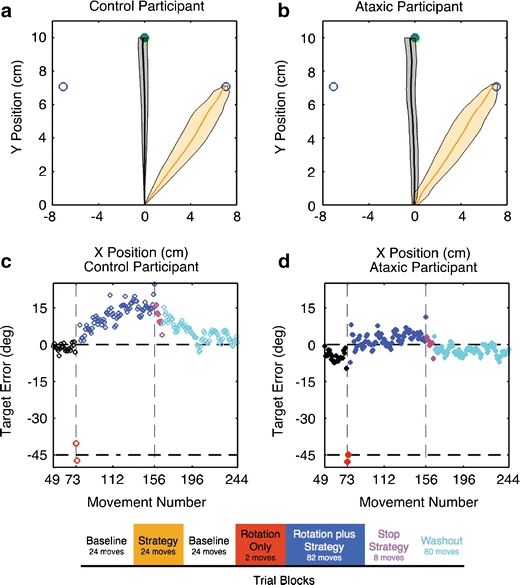
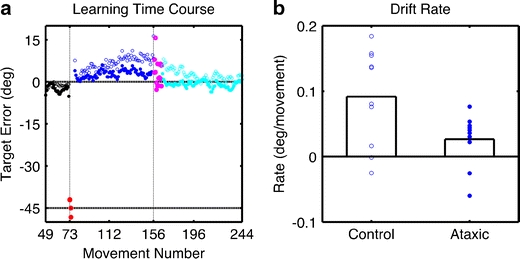
In sensorimotor adaptation, explicit cognitive strategies are thought to be unnecessary because the motor system implicitly corrects performance throughout training. This seemingly automatic process involves computing an error between the planned movement and actual feedback of the movement. When explicitly provided with an effective strategy to overcome an experimentally induced visual perturbation, people are immediately successful and regain good task performance. However, as training continues, their accuracy gets worse over time. This counterintuitive result has been attributed to the independence of implicit motor processes and explicit cognitive strategies. The cerebellum has been hypothesized to be critical for the computation of the motor error signals that are necessary for implicit adaptation. We explored this hypothesis by testing patients with cerebellar degeneration on a motor learning task that puts the explicit and implicit systems in conflict. Given this, we predicted that the patients would be better than controls in maintaining an effective strategy assuming strategic and adaptive processes are functionally and neurally independent. Consistent with this prediction, the patients were easily able to implement an explicit cognitive strategy and showed minimal interference from undesirable motor adaptation throughout training. These results further reveal the critical role of the cerebellum in an implicit adaptive process based on movement errors and suggest an asymmetrical interaction of implicit and explicit processes.
Overview
The claims and statistics of this paper haven’t been checked yet.
Free: it reads the open-access text and checks the first 5 claims that cite a source we can check. Create a free account to check every claim.
Integrity signals
Registry
Cites
Statistics
Figures
Verification
Claims the paper makes
The claims and statistics of this paper haven’t been checked yet.
Free: it reads the open-access text and checks the first 5 claims that cite a source we can check. Create a free account to check every claim.
Claims other papers make about this one
Each is checked against this paper’s own text: does it say what the citing paper says it does?
The source backs part of the claim, not all of it — or backs it for a different population, condition or comparison.
In the citing paper
“confirming that intact cerebellar function is required for implicit motor adaptation (Taylor et al., 2010).”
From Cerebellum, Predictions and Errors (2019) · cites this paper as Taylor et al., 2010
Experimental — accuracy not yet measuredThe source backs part of the claim, not all of it — or backs it for a different population, condition or comparison.
In the citing paper
“Patients with cerebellar pathology when given a declarative strategy that accounts for the visuomotor rotation lack the after effects associated with motor adaptation and lack the gradual degrading in task performance present in the healthy subjects, confirming that intact cerebellar function is required for implicit motor adaptation (Taylor et al., 2010).”
From Cerebellum, Predictions and Errors (2019) · cites this paper as Taylor et al., 2010
Experimental — accuracy not yet measured
Self-check
Percentages, sums and reported differences re-computed from the paper’s own numbers.
The self-check needs the paper’s full text.
Citations
Cites
Folstein, M. F., Folstein, S. E., & McHugh, P. R. (1975) · Journal of Psychiatric Research · doi:10.1016/0022-3956(75)90026-6 · Cited by 88,282
The relation of the Trail Making Test to organic brain damage.
Reitan, R. M. (1955) · Journal of Consulting Psychology · doi:10.1037/h0044509 · Cited by 1,798 · cited 1×
“This abbreviated battery included the Mini-Mental State Examination (MMSE) [13] to assess dementia, the Tool for Real-time Assessment of Information Literacy Skills (TRAILS) test [14] to assess attention and working memory, and the National Adult Reading Test (NART) [15] to assess intelligence.”
MethodControl of mental activities by internal models in the cerebellum
Ito, M. (2008) · Nature Reviews Neuroscience · doi:10.1038/nrn2332 · Cited by 1,356 · cited 1×
“Thus, damage to the cerebellum may not only disrupt implicit adaptation but may also disrupt the generation of cognitive strategies [27], assuming that this error information is a prerequisite for the self-generation of a compensatory strategy.”
BackgroundTrouillas, P., Takayanagi, T., Hallett, M., Currier, R. D., Subramony, S. H., Wessel, K., Bryer, A., Diener, H. C., Massaquoi, S., Gomez, C. M., et al. (1997) · Journal of the Neurological Sciences · doi:10.1016/s0022-510x(96)00231-6 · Cited by 1,263
Interacting adaptive processes with different timescales underlie short-term motor learning
Smith, M. A., Ghazizadeh, A., & Shadmehr, R. (2006) · PLoS Biology · doi:10.1371/journal.pbio.0040179 · Cited by 1,113 · cited 1×
“Learning curves on a range of motor tasks exhibit two stereotypical phases, an initial rapid decrease in movement errors followed by a gradual phase in which performance continues to improve until reaching asymptote [16].”
BackgroundSensory prediction errors drive cerebellum-dependent adaptation of reaching
Tseng, Y.-W., Diedrichsen, J., Krakauer, J. W., Shadmehr, R., & Bastian, A. J. (2007) · Journal of Neurophysiology · doi:10.1152/jn.00266.2007 · Cited by 883 · cited 1×
“Participants were instructed to make ballistic-style movements and reach through the target [9].”
MethodAn implicit plan overrides an explicit strategy during visuomotor adaptation
Mazzoni, P., & Krakauer, J. W. (2006) · The Journal of Neuroscience · doi:10.1523/jneurosci.5317-05.2006 · Cited by 833 · cited 6×
“Given that drift occurred in a gradual and relatively continuous manner during the 80 trials of the rotation+strategy block (see also Mazzoni and Krakauer [6]), we fit the data from this block with a linear function to quantify the rate of drift as well as the initial bias (i.e., the intercept of the regression).”
BackgroundResultInfluentialA neuropsychological theory of motor skill learning.
Willingham, D. B. (1998) · Psychological Review · doi:10.1037//0033-295x.105.3.558 · Cited by 799
Throwing while looking through prisms. I. Focal olivocerebellar lesions impair adaptation
Martin, T. A., Keating, J. G., Goodkin, H. P., Bastian, A. J., & Thach, W. T. (1996) · Brain · doi:10.1093/brain/119.4.1183 · Cited by 625 · cited 3×
“In contrast, if patients with cerebellar degeneration are not provided with an explicit strategy, they show poor adaptation [ 8 , 10, 11].”
BackgroundMethodInfluentialAttentional and nonattentional forms of sequence learning.
Curran, T., & Keele, S. W. (1993) · Journal of Experimental Psychology: Learning, Memory, and Cognition · doi:10.1037/0278-7393.19.1.189 · Cited by 594 · cited 1×
“Indeed, when participants are made aware of task manipulations, strategies can facilitate performance [3–5], leading to the idea that strategic and adaptation processes may work in concert.”
Background
Cited by
Items 101–200 of 208
Cerebellar output shapes cortical preparatory activity during motor adaptation
Israely, S., Ninou, H., Rajchert, O., Elmaleh, L., Harel, R., Mawase, F., Kadmon, J., & Prut, Y. (2025) · Nature Communications · doi:10.1038/s41467-025-57832-4 · Cited by 21
“Similarly, adaptation in cerebellar patients to a repeatedly presentedtargetwas shown tobemaintainedeven in severely affected subjects 32,46 – 48 .”
Cerebellar Differences after Rehabilitation in Children with Developmental Coordination Disorder
Gill, K. K., Lang, D. J., & Zwicker, J. G. (2022) · Brain Sciences · doi:10.3390/brainsci12070856 · Cited by 18
Ma, Q., Pu, M., Haihambo, N. P., Baetens, K., Heleven, E., Deroost, N., Baeken, C., & Overwalle, F. V. (2021) · Cognitive Affective & Behavioral Neuroscience · doi:10.3758/s13415-021-00966-x · Cited by 17
Motor Control and Learning Theories
Alessandro, C., Beckers, N., Goebel, P. M., Resquín, F., González, J., & Osu, R. (2015) · Biosystems & biorobotics · doi:10.1007/978-3-319-24901-8_9 · Cited by 17
Motor Adaptation Impairment in Chronic Cannabis Users Assessed by a Visuomotor Rotation Task
Herreros, I., Miquel, L., Blithikioti, C., Nuño, L., Ballester, B. R., Grechuta, K., Gual, A., Balcells‐Oliveró, M., & Verschure, P. F. M. J. (2019) · Journal of Clinical Medicine · doi:10.3390/jcm8071049 · Cited by 18
Visuomotor adaptation in Parkinson's disease: effects of perturbation type and medication state
Semrau, J. A., Perlmutter, J. S., & Thoroughman, K. A. (2014) · Journal of Neurophysiology · doi:10.1152/jn.00095.2013 · Cited by 19
Wang, T., & Ivry, R. B. (2025) · Science Advances · doi:10.1126/sciadv.adr4540 · Cited by 17
Self-citationNettekoven, C., Mitchell, L., Clarke, W. T., Emir, U. E., Campbell, J., Johansen‐Berg, H., Jenkinson, N., & Stagg, C. J. (2022) · Journal of Neuroscience · doi:10.1523/jneurosci.0096-22.2022 · Cited by 18
Cortical processing of saccade‐related efference copy signals in patients with cerebellar lesion
Peterburs, J., Koch, B., Schwarz, M., Hoffmann, K., Daum, I., & Bellebaum, C. (2012) · European Journal of Neuroscience · doi:10.1111/ejn.12081 · Cited by 14
Implicit Adaptation Is Modulated by the Relevance of Feedback
Parvin, D. E., Tsay, J. S., Dang, K. V., Stover, A. R., Ivry, R. B., & Morehead, J. R. (2024) · Journal of Cognitive Neuroscience · doi:10.1162/jocn_a_02160 · Cited by 15
Self-citationUpdating of Visual Space Across Horizontal Saccades in Cerebellar and Thalamic Lesion Patients
Peterburs, J., Koch, B., Schwarz, M., Hoffmann, K.-P., Daum, I., & Bellebaum, C. (2012) · The Cerebellum · doi:10.1007/s12311-012-0386-2 · Cited by 13
Faytak, M. (2018) · UC Berkeley Phonology Lab Annual Reports · doi:10.5070/p7141042486 · Cited by 13
Interactions between sensory prediction error and task error during implicit motor learningPreprint
Tsay, J. S., Haith, A. M., Ivry, R. B., & Kim, H. E. (2021) · bioRxiv (Cold Spring Harbor Laboratory) · doi:10.1101/2021.06.20.449180 · Cited by 14
Self-citationNeural Signatures of Reward and Sensory Prediction Error in Motor LearningPreprint
Palidis, D. J., Cashaback, J. G. A., & Gribble, P. L. (2018) · bioRxiv (Cold Spring Harbor Laboratory) · doi:10.1101/262576 · Cited by 14
Increased Cerebellar Gray Matter Volume in Athletes: A Voxel-Wise Coordinate-Based Meta-Analysis
Kang, N. (2022) · Research Quarterly for Exercise and Sport · doi:10.1080/02701367.2022.2026285 · Cited by 11
How to help cerebellar patients make the most of their remaining learning capacities
Donchin, O., & Timmann, D. (2019) · Brain · doi:10.1093/brain/awz020 · Cited by 10
Rajeshkumar, L., & Trewartha, K. M. (2019) · Experimental Brain Research · doi:10.1007/s00221-019-05551-w · Cited by 10
Cerebellum and Internal Models
Popa, L. S., & Ebner, T. J. (2019) · Springer eBooks · doi:10.1007/978-3-319-97911-3_56-2 · Cited by 11
Blazhenets, G., Kurz, A., Frings, L., Leukel, C., & Meyer, P. T. (2020) · Journal of Neuroscience Methods · doi:10.1016/j.jneumeth.2020.109061 · Cited by 10
Ayala, M. N., & Henriques, D. Y. P. (2021) · PLoS ONE · doi:10.1371/journal.pone.0253948 · Cited by 10
Strategy-based motor learning decreases the post-movement β power
Korka, B., Will, M., Avci, I., Dukagjini, F., & Stenner, M. (2023) · Cortex · doi:10.1016/j.cortex.2023.05.002 · Cited by 9
Motor adaptation does not differ when a perturbation is introduced abruptly or gradually
Bansal, A., Hart, B. M. ’., Cauchan, U., Eggert, T., Straube, A. M., & Henriques, D. Y. P. (2023) · Experimental Brain Research · doi:10.1007/s00221-023-06699-2 · Cited by 9
“Although the functional deficits for people with cerebellar damage are still unclear, people with cerebellar ataxia can use an explicit strategy to compensate in making adaptive movements (Taylor et al. 2010).”
BackgroundTowards mastery of complex visuo-motor transformations
Heuer, H., & Sülzenbrück, S. (2013) · Frontiers in Human Neuroscience · doi:10.3389/fnhum.2013.00032 · Cited by 9
“…decline (Bock, 2005; Heuer and Hegele, 2008c); implicit adjustments depend on intact cerebellar functions, whereas explicit adjustments do not (Taylor et al., 2010); different implicit adjustments cannot be acquired concurrently when the start position of the hand is the same, but different…”
Short duration event related cerebellar TDCS enhances visuomotor adaptation
Weightman, M., Lalji, N., Lin, C., Galea, J. M., Jenkinson, N., & Miall, R. C. (2023) · Brain stimulation · doi:10.1016/j.brs.2023.01.1673 · Cited by 10
“[31,32]), and hence we removed them from further analysis.”
Exploring Contextual Interference in Implicit and Explicit Motor LearningPreprint
Dang, K. V., Parvin, D. E., & Ivry, R. B. (2019) · bioRxiv (Cold Spring Harbor Laboratory) · doi:10.1101/644211 · Cited by 8
Self-citationReward actively engages both implicit and explicit components in dual force field adaptation
Forano, M., & Franklin, D. W. (2024) · Journal of Neurophysiology · doi:10.1152/jn.00307.2023 · Cited by 9
Mahdavi, S., Lindner, A., Schmidt‐Samoa, C., Müsch, A.-L., Dechent, P., & Wilke, M. (2024) · NeuroImage · doi:10.1016/j.neuroimage.2024.120927 · Cited by 8
“Studies involving patients with cerebellar damage have shown impairments in accurately localizing hand position compared to a control group (Izawa et al., 2012; Synofzik et al., 2008) and learning from sensory prediction error (Butcher et al., 2017; Taylor et al., 2010).”
Chang, H., Woo, S., Kang, S., Lee, C. Y., Lee, J., & Ryu, J.-K. (2023) · Frontiers in Psychiatry · doi:10.3389/fpsyt.2022.963303 · Cited by 7
Hula Hoop in Fitness and the Centripetal Force
García-Falgueras, A. (2016) · Psychology · doi:10.4236/psych.2016.713147 · Cited by 8
Can we improve slow learning in cerebellar patients?Preprint
Hulst, T., Mamlins, A., Frens, M. A., Chang, D., Goericke, S. L., Timmann, D., & Donchin, O. (2020) · bioRxiv (Cold Spring Harbor Laboratory) · doi:10.1101/2020.07.03.185959 · Cited by 8
Nettekoven, C., Draganova, R., Steiner, K. M., Goericke, S. L., Deistung, A., Konczak, J., & Timmann, D. (2025) · Journal of Neuroscience · doi:10.1523/jneurosci.1823-24.2025 · Cited by 7
Cognitive Neuroscience of Implicit Learning: Implications for Complex Learning and Expertise
Han, Y. C., Schmidt, K. D., Grandoit, E., Shu, P., McRobert, C. P., & Reber, P. J. (2022) · Oxford University Press eBooks · doi:10.1093/oso/9780197501573.003.0003 · Cited by 10
Error related EEG potentials evoked by visuo-motor rotations
Benyamini, M., Demchenko, I., & Zacksenhouse, M. (2021) · Brain Research · doi:10.1016/j.brainres.2021.147606 · Cited by 6
“Error processing during movements is essential for both on-line error cor2 rection and motor learning [1, 2, 3, 4, 5].”
Different generalization of fast and slow visuomotor adaptation across locomotion and pointing tasks
Xing, X., & Saunders, J. A. (2021) · Experimental Brain Research · doi:10.1007/s00221-021-06112-w · Cited by 6
General Management of Cerebellar Disorders: An Overview
Ilg, W., & Timmann, D. (2012) · Springer eBooks · doi:10.1007/978-94-007-1333-8_105 · Cited by 6
Saccadic-like visuomotor adaptation involves little if any perceptual effects
Laurent, D., Sillan, O., & Prablanc, C. (2011) · Experimental Brain Research · doi:10.1007/s00221-011-2815-8 · Cited by 6
Highlights from the 28th Annual Meeting of the Society for the Neural Control of Movement
Mazurek, K. A., Berger, M., Bollu, T., Chowdhury, R. H., Elangovan, N., Kuling, I. A., & Sohn, M. H. (2018) · Journal of Neurophysiology · doi:10.1152/jn.00475.2018 · Cited by 7
Revisiting the explicit-implicit additivity assumption in visuomotor adaptation
Chen, Y. P., & Taylor, J. A. (2026) · Journal of Neurophysiology · doi:10.1152/jn.00525.2025 · Cited by 5
Self-citationCompensatory postural responses to backward loss of balance in patients with cerebellar disease
Im, C.-H., Kim, D., Yun, J.-E., & Park, J.-H. (2021) · Gait & Posture · doi:10.1016/j.gaitpost.2021.02.027 · Cited by 5
The role of the cerebellum in rock climbing
Lin, C.-Y. R., & Kuo, S. (2017) · Journal of the Neurological Sciences · doi:10.1016/j.jns.2017.10.050 · Cited by 5
Voets, S. H. E. M., Panouillères, M., & Jenkinson, N. (2020) · Experimental Results · doi:10.1017/exp.2020.16 · Cited by 5
An Aha moment precedes the strategic response to a visuomotor rotation
Townsend, M., Warburton, M., Campagnoli, C., Mon-Williams, M. A., Mushtaq, F., & Morehead, J. R. (2026) · Current Biology · doi:10.1016/j.cub.2026.04.021 · Cited by 5
Application of Neuroscience Methods in HRDM for Brain-Based Human Capital Optimization
Patangia, B., Rithani, J. M., & Alfonso, T. (2024) · Advances in human resources management and organizational development book series · doi:10.4018/979-8-3693-1858-4.ch013 · Cited by 4
Chronic cannabis use affects cerebellum dependent visuomotor adaptation
Blithikioti, C., Miquel, L., Paniello-Castillo, B., Nuño, L., Gual, A., Ballester, B. R., Fernandez, A., Herreros, I., Verschure, P. F. M. J., & Balcells-Olivero, M. (2022) · Journal of Psychiatric Research · doi:10.1016/j.jpsychires.2022.10.007 · Cited by 4
Palidis, D. J., & Fellows, L. K. (2023) · Cerebral Cortex · doi:10.1093/cercor/bhad424 · Cited by 5
Avraham, C., Avraham, G., Mussa-Ivaldi, F. A., & Nisky, I. (2018) · Frontiers in Human Neuroscience · doi:10.3389/fnhum.2018.00335 · Cited by 4
Cerebellum and Internal Models
Popa, L. S., & Ebner, T. J. (2021) · Springer eBooks · doi:10.1007/978-3-030-23810-0_56 · Cited by 5
The interface issue in second language acquisition research: An interdisciplinary perspective
Foryś‐Nogala, M., Krajewski, G., & Haman, E. (2022) · Lingua · doi:10.1016/j.lingua.2022.103243 · Cited by 4
Movement Neuroscience Foundations of Neurorehabilitation
Sainburg, R. L., & Mutha, P. K. (2016) · Springer eBooks · doi:10.1007/978-3-319-28603-7_2 · Cited by 5
General Management of Cerebellar Disorders: An Overview
Timmann, D. (2012) · Cited by 4
Fast implicit and slow explicit learning of temporal context
Mangili, L., Wissing, C., & Narain, D. (2025) · Scientific Reports · doi:10.1038/s41598-025-01664-1 · Cited by 3
“Here, we investigate the learning rates of context-dependent temporal responses and measure their relative implicitness and explicitness to determine how these systems are entwined and what insights can be obtained about the underlying neural circuits believed to encode these behaviors.”
Generalization of adaptation to a complex visuo-motor transformation across the workspace
Heuer, H., & Sülzenbrück, S. (2012) · Behavioural Brain Research · doi:10.1016/j.bbr.2012.10.050 · Cited by 3
Zhou, W., Monsen, E. R., Fernandez, K. D., Haly, K., Kruse, E. A., & Joiner, W. M. (2024) · Journal of Neurophysiology · doi:10.1152/jn.00198.2023 · Cited by 3
Metronome-guided training accelerates the adaptation to an aerobic training pace in swimming
Fassone, M., Puce, L., Biggio, M., Avanzino, L., Bove, M., & Bisio, A. (2025) · Frontiers in Sports and Active Living · doi:10.3389/fspor.2025.1588758 · Cited by 3
“Indeed, numerous lines of evidence have shown that the cerebellum plays a critical role in motor adaptation (42, 43), and, in particular, in learning from sensory prediction errors (44, 45).”
Workplace Diversity Influence on Employee Retention in Organizations during the COVID-19
Rodprayoon, N. (2021) · AU-GSB e-JOURNAL · doi:10.14456/augsbejr.2021.21 · Cited by 8
General Management of Cerebellar Disorders: An Overview
Ilg, W., & Timmann, D. (2021) · Springer eBooks · doi:10.1007/978-3-030-23810-0_105 · Cited by 3
Effect of repeated explicit instructions on visuomotor adaptation and intermanual transfer
Werner, S., & Strüder, H. K. (2022) · Experimental Brain Research · doi:10.1007/s00221-022-06470-z · Cited by 3
Altered Dynamics of Cortical Beta-Oscillations during Motor Learning in Cerebellar AtaxiaPreprint
Klimpke, J., Henkel, D., Heinze, H., & Stenner, M. (2020) · bioRxiv (Cold Spring Harbor Laboratory) · doi:10.1101/2020.10.06.328807 · Cited by 4
Ayala, M. N., & Henriques, D. Y. P. (2020) · PsyArXiv (OSF Preprints) · doi:10.31234/osf.io/an5wp · Cited by 4
Systematic modulation of sensorimotor learning by domain-specific working memoryPreprint
O’Bryan, S. R., Liddy, J. J., & Song, J. (2025) · bioRxiv (Cold Spring Harbor Laboratory) · doi:10.1101/2025.04.11.648414 · Cited by 3
“…evidence that explicit strategies, such as re-aiming, tend to dominate during this period (Mazzoni & Krakauer, 2006; Taylor, Krakauer, & Ivry, 2014; Taylor et al., 2010; Taylor & Ivry, 2011), cumulative adaptation represents a mixture of both explicit and implicit processes, making it difficult to…”
InfluentialStates Are A-Changing, Complex Spikes Proclaim
Popa, L. S., Aronson, J. D., & Ebner, T. J. (2021) · Contemporary clinical neuroscience · doi:10.1007/978-3-030-75817-2_12 · Cited by 2
Anderl, E., & Trammell, H. J. (2017) · International Symposium on Wearable Robotics and Rehabilitation (WeRob) · doi:10.1109/werob.2017.8383812 · Cited by 2
Palidis, D. J., McGregor, H. R., Vo, A., MacDonald, P. A., & Gribble, P. L. (2020) · bioRxiv (Cold Spring Harbor Laboratory) · doi:10.1101/2020.11.19.390302 · Cited by 2
Mista, C. A., Arguissain, F. G., Ranieri, A., Nielsen, J. F., Andersen, H., Manresa, J. A. B., & Andersen, O. K. (2024) · Behavioural Brain Research · doi:10.1016/j.bbr.2024.115024 · Cited by 1
“It has been proposed that the explicit component of the motor adaptation is not an independent process and thus it contributes and competes with other neural circuits in motor learning [1,37].”
Mental fatigue does not impede visuomotor adaptation driven by implicit processes
Peters, E., & Cressman, E. K. (2026) · Consciousness and Cognition · doi:10.1016/j.concog.2026.104041 · Cited by 1
Modeling the effect of explicit information in visuomotor adaptation
Yavari, F., & Towhidkhah, F. (2014) · Iranian Conference on Electrical Engineering · doi:10.1109/iraniancee.2014.6999864 · Cited by 1
Song, Y.-G., & Park, J.-H. (2015) · 한국특수체육학회지 · doi:10.17006/kjapa.2015.23.4.101 · Cited by 1
Movement Neuroscience Foundations of Neurorehabilitation
Sainburg, R. L., & Mutha, P. K. (2022) · Springer eBooks · doi:10.1007/978-3-031-08995-4_2 · Cited by 2
Swainson, A., Woodward, K. M., Boca, M. I., Rolinski, M., Collard, P., Cerminara, N. L., Apps, R., Whone, A. L., & Gilchrist, I. D. (2023) · Neuropsychologia · doi:10.1016/j.neuropsychologia.2023.108681 · Cited by 2
“…adaptation paradigms, and of particular importance to prism adaptation is cognitive strategy, also referred to as recalibration (Redding and Wallace, 2002; Izawa and Shadmehr, 2011; Mazzoni and Krakauer, 2006; Taylor et al., 2010; Taylor and Ivry, 2011; Taylor and Ivry, 2012; Taylor et al., 2014).”
Impaired reaching adaptation links to vestibular symptomsPreprint
Santos-Pata, D., Bellmunt, A., Mozo, R. M. S. S., Sáez, S., Domènech‐Vadillo, E., Carballo, L., Verschure, P. F. M. J., & Ballester, B. R. (2022) · medRxiv · doi:10.1101/2022.02.07.22270496 · Cited by 1
Wojaczynski, G. J., Ivry, R. B., Hussain, S. J., Morton, S. M., Tanaka, H., B, T. J. S. A., Wang, J., Lei, Y., & Binder, J. R. (2015)
Self-citationThe Neural and Behavioral Processes Underlying Limb Selection
Elenzil, R. H. S. (2013) · eScholarship (California Digital Library)
Chauvigné, L. A. S. (2017) · MacSphere (McMaster University) · doi:10.71548/23894
Ruttle, J. E. (2017) · YorkSpace (York University)
Hoskens, M. C. J. (2020) · Research Commons (University of Waikato) · Cited by 1
Neural substrates of reward, error, and effort processing underlying adaptive motor behaviour
Palidis, D. J. (2021) · Scholarship@Western (Western University)
The role of cerebellum in action acquisition and motor learning
Dagioglou, M. (2014) · University of Birmingham Institutional Research Archive (University of Birmingham)
General Management of Cerebellar Disorders: An Overview
Ilg, W., & Timmann, D. (2020) · Springer eBooks · doi:10.1007/978-3-319-97911-3_105-2
Thalamic Contributions to Internal Models for Motor Control
Mahdavi, S. (2025) · eDiss (Georg-August-Universität Göttingen) · doi:10.53846/goediss-11092
Neural signatures of motor memories emerge in neural network modelsPreprint
Chang, J. C., Clopath, C., & Gallego, J. Á. (2025) · bioRxiv (Cold Spring Harbor Laboratory) · doi:10.1101/2025.04.02.646788
Neural signatures of motor memories emerge in neural network modelsPreprint
Chang, J. C., Clopath, C., & Gallego, J. Á. (2025) · eLife · doi:10.7554/elife.106871
Neural signatures of motor memories emerge in neural network modelsPreprint
Chang, J. C., Clopath, C., & Gallego, J. Á. (2025) · eLife · doi:10.7554/elife.106871.1
KHAN, E. S. I., Nasiri, S., Chiasson, S., Couvrette, L. J., Laliberté, A. M., & Bui, T. V. (2025) · bioRxiv (Cold Spring Harbor Laboratory) · doi:10.1101/2025.09.22.677841
Differential aging effects on visuomotor control : evidence for an adaptive aging brain
Huang, J., & Justus Liebig University Giessen (2018) · University writing server of the Justus Liebig University Giessen (Justus-Liebig-Universität Gießen) · doi:10.22029/jlupub-15167
Implicit adaptation to galvanic vestibular perturbations during goal-directed postural movements
Villemer, S. (2025) · cIRcle (University of British Columbia) · doi:10.14288/1.0448230
Die Bildung und der Abruf motorischer Erinnerungen in der Dualadaptation
Forano, M., Franklin, D. W., & München, T. U. (2024) · mediaTUM (Technical University of Munich)
Larssen, B. C. (2025) · cIRcle (University of British Columbia)
Gastrock, R. Q., Nezakatiolfati, S., & Henriques, D. Y. P. (2026) · Journal of Neurophysiology · doi:10.1152/jn.00124.2026
Rezaei, A., Areshenkoff, C. N., Gale, D. J., Oby, E. R., Smallwood, J., Flanagan, J. R., Wammes, J. D., & Gallivan, J. P. (2026) · PLoS Biology · doi:10.1371/journal.pbio.3003684 · Cited by 1
Gastrock, R. Q., Nezakatiolfati, S., King, A., & Henriques, D. Y. P. (2026) · bioRxiv (Cold Spring Harbor Laboratory) · doi:10.64898/2026.03.20.713284
“One example is a similarity between the interplay of explicit and implicit processes, an interaction that has been well characterized in studies of motor skill acquisition and adaptation (13–20).”
Stimulations spécifiques pour la rééducation de déficits moteurs : biomécanique et modélisation
Laurent, D. (2011) · theses.fr (ABES) · doi:10.70675/55143abazcd16z4331zae57zcb4340001f13
Étude du rôle du cervelet dans la plasticité cérébrale : cas de la dystonie
Hubsch, C. A. (2014) · theses.fr (ABES) · doi:10.70675/b1b3ecffz3bddz444fzb2fdz20d59995a1be
Bases neuronales du jugement d’ordre temporel chez le rat
Paulcan, S. (2021) · theses.fr (ABES) · doi:10.70675/7ec2690fz9fb0z43daz9d8fz2b6264fba1e0
Baudou, É. (2022) · theses.fr (ABES) · doi:10.70675/f8823c9az02bcz4e48z9961z42f9530b760f
Consolidation Separates Implicit and Explicit Components of Compound Motor MemoriesPreprint
Kumar, A. S., Kumar, A. S., & Kumar, N. (2026) · bioRxiv (Cold Spring Harbor Laboratory) · doi:10.64898/2026.04.15.718660
EEG dynamics of movement preparation and error processing in motor adaptation and De Novo learning
Gastrock, R. Q., Henriques, D. Y. P., & Hart, B. M. ’. (2026) · Discover Neuroscience · doi:10.1186/s13064-026-00260-x
Metadata
- Authors
- Taylor, J. A., Klemfuss, N. M., & Ivry, R. B.
- Affiliations
- University of California, Berkeley (US)
- Corresponding author
- Taylor, Jordan A.
- Venue
- The Cerebellum
- Published
- 2010-08-10
- Volume
- 9
- Issue
- 4
- Pages
- 580-586
- ISSN
- 1473-4222 (ISSN-L)
- 1473-4230
- PMC
- PMC2996538
- OpenAlex
- W2103366222
- Cited by
- 200
- References
- 28
- Citations by year
- 2026: 11 · 2025: 11 · 2024: 13 · 2023: 14 · 2022: 16 · 2021: 17 · 2020: 13 · 2019: 16 · 2018: 13 · 2017: 7 · 2016: 10 · 2015: 14 · 2014: 11 · 2013: 12 · 2012: 12
- FWCI
- 6.21
- Type
- journal article
- Language
- en
- Open access
- hybrid
- doi.org
- Licence
- cc-by-nc
- Locations
- The Cerebellum (publishedVersion, cc-by-nc)
- PubMed Central (publishedVersion, cc-by-nc)
- PubMed (publishedVersion)
- eScholarship (California Digital Library) (submittedVersion)
- Funders
- National Ataxia Foundation
- National Institute of Neurological Disorders and Stroke (P01NS040813, F32NS064749)
- Eunice Kennedy Shriver National Institute of Child Health and Human Development (R01HD060306)
- Topics
- Life Sciences › Neuroscience › Cognitive Neuroscience › Motor Control and Adaptation
- Life Sciences › Neuroscience › Cognitive Neuroscience › Tactile and Sensory Interactions
- Life Sciences › Neuroscience › Cognitive Neuroscience › Memory and Neural Mechanisms
- Keywords
- sensorimotor adaptation, cerebellum, cerebellar degeneration, implicit motor learning, visual perturbation, strategy maintenance
- MeSH terms
- Adaptation, Physiological, Adult, Aged, Biomechanical Phenomena, Cerebellar Ataxia, Disability Evaluation, Female, Humans, Learning, Male, Mental Status Schedule, Middle Aged, Movement, Predictive Value of Tests, Psychomotor Performance, Visual Perception
About these checks
Registry, retraction, Cites and statistics results are computed, not judged, with one exception: a printed reference that no index lists is read once by a model before it counts as a citation error. Claims are extracted by a model and kept only when their quote appears verbatim in the text; each cited source is then checked, with a model’s help, for whether it says what the claim relies on. Those verdicts can be wrong — read the claim’s quote and the cited source before relying on one.
Statistics and arithmetic are recomputed, not judged.
Confidence bands are shown only for fields calibrated on our annotated test set. None is calibrated yet, so no band is shown.
What counts as a claim ›How we measure confidence ›How we check this ›
Are you an author, or do you see a problem with this page? Request a review
Data sources
Bibliographic data: Semantic Scholar, OpenAlex, Crossref.
Contains information from the Semantic Scholar Academic Graph Datasets, made available under the ODC Attribution License (ODC-BY 1.0).
Semantic Scholar’s data is described in: Kinney, R., et al. (2023). The Semantic Scholar Open Data Platform. arXiv:2301.10140.
