

An Explicit Strategy Prevails When the Cerebellum Fails to Compute Movement Errors
Open accessThe DOI matches its Crossref record; 27 of the 28 references it cites were found in a registry or an index.
Abstract
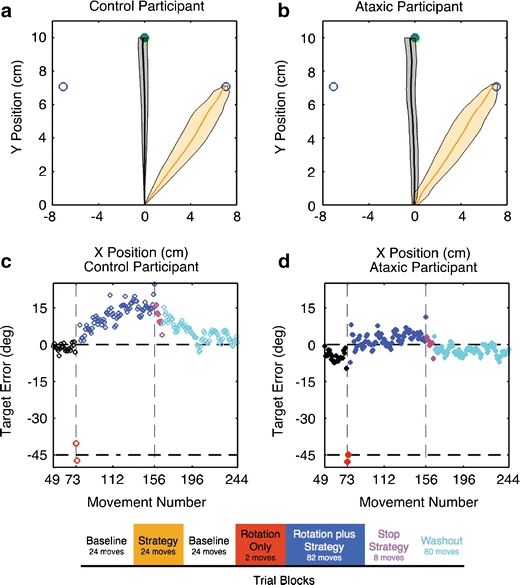
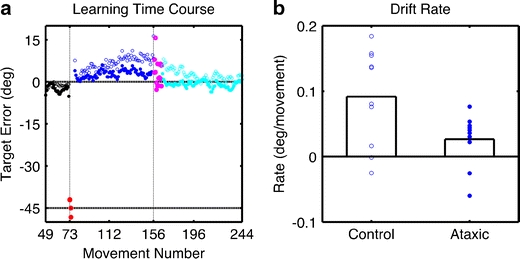
In sensorimotor adaptation, explicit cognitive strategies are thought to be unnecessary because the motor system implicitly corrects performance throughout training. This seemingly automatic process involves computing an error between the planned movement and actual feedback of the movement. When explicitly provided with an effective strategy to overcome an experimentally induced visual perturbation, people are immediately successful and regain good task performance. However, as training continues, their accuracy gets worse over time. This counterintuitive result has been attributed to the independence of implicit motor processes and explicit cognitive strategies. The cerebellum has been hypothesized to be critical for the computation of the motor error signals that are necessary for implicit adaptation. We explored this hypothesis by testing patients with cerebellar degeneration on a motor learning task that puts the explicit and implicit systems in conflict. Given this, we predicted that the patients would be better than controls in maintaining an effective strategy assuming strategic and adaptive processes are functionally and neurally independent. Consistent with this prediction, the patients were easily able to implement an explicit cognitive strategy and showed minimal interference from undesirable motor adaptation throughout training. These results further reveal the critical role of the cerebellum in an implicit adaptive process based on movement errors and suggest an asymmetrical interaction of implicit and explicit processes.
Overview
The claims and statistics of this paper haven’t been checked yet.
Free: it reads the open-access text and checks the first 5 claims that cite a source we can check. Create a free account to check every claim.
Integrity signals
Registry
Cites
Statistics
Figures
Verification
Claims the paper makes
The claims and statistics of this paper haven’t been checked yet.
Free: it reads the open-access text and checks the first 5 claims that cite a source we can check. Create a free account to check every claim.
Claims other papers make about this one
Each is checked against this paper’s own text: does it say what the citing paper says it does?
The source backs part of the claim, not all of it — or backs it for a different population, condition or comparison.
In the citing paper
“confirming that intact cerebellar function is required for implicit motor adaptation (Taylor et al., 2010).”
From Cerebellum, Predictions and Errors (2019) · cites this paper as Taylor et al., 2010
Experimental — accuracy not yet measuredThe source backs part of the claim, not all of it — or backs it for a different population, condition or comparison.
In the citing paper
“Patients with cerebellar pathology when given a declarative strategy that accounts for the visuomotor rotation lack the after effects associated with motor adaptation and lack the gradual degrading in task performance present in the healthy subjects, confirming that intact cerebellar function is required for implicit motor adaptation (Taylor et al., 2010).”
From Cerebellum, Predictions and Errors (2019) · cites this paper as Taylor et al., 2010
Experimental — accuracy not yet measured
Self-check
Percentages, sums and reported differences re-computed from the paper’s own numbers.
The self-check needs the paper’s full text.
Citations
Cites
Folstein, M. F., Folstein, S. E., & McHugh, P. R. (1975) · Journal of Psychiatric Research · doi:10.1016/0022-3956(75)90026-6 · Cited by 88,282
The relation of the Trail Making Test to organic brain damage.
Reitan, R. M. (1955) · Journal of Consulting Psychology · doi:10.1037/h0044509 · Cited by 1,798 · cited 1×
“This abbreviated battery included the Mini-Mental State Examination (MMSE) [13] to assess dementia, the Tool for Real-time Assessment of Information Literacy Skills (TRAILS) test [14] to assess attention and working memory, and the National Adult Reading Test (NART) [15] to assess intelligence.”
MethodControl of mental activities by internal models in the cerebellum
Ito, M. (2008) · Nature Reviews Neuroscience · doi:10.1038/nrn2332 · Cited by 1,356 · cited 1×
“Thus, damage to the cerebellum may not only disrupt implicit adaptation but may also disrupt the generation of cognitive strategies [27], assuming that this error information is a prerequisite for the self-generation of a compensatory strategy.”
BackgroundTrouillas, P., Takayanagi, T., Hallett, M., Currier, R. D., Subramony, S. H., Wessel, K., Bryer, A., Diener, H. C., Massaquoi, S., Gomez, C. M., et al. (1997) · Journal of the Neurological Sciences · doi:10.1016/s0022-510x(96)00231-6 · Cited by 1,263
Interacting adaptive processes with different timescales underlie short-term motor learning
Smith, M. A., Ghazizadeh, A., & Shadmehr, R. (2006) · PLoS Biology · doi:10.1371/journal.pbio.0040179 · Cited by 1,113 · cited 1×
“Learning curves on a range of motor tasks exhibit two stereotypical phases, an initial rapid decrease in movement errors followed by a gradual phase in which performance continues to improve until reaching asymptote [16].”
BackgroundSensory prediction errors drive cerebellum-dependent adaptation of reaching
Tseng, Y.-W., Diedrichsen, J., Krakauer, J. W., Shadmehr, R., & Bastian, A. J. (2007) · Journal of Neurophysiology · doi:10.1152/jn.00266.2007 · Cited by 883 · cited 1×
“Participants were instructed to make ballistic-style movements and reach through the target [9].”
MethodAn implicit plan overrides an explicit strategy during visuomotor adaptation
Mazzoni, P., & Krakauer, J. W. (2006) · The Journal of Neuroscience · doi:10.1523/jneurosci.5317-05.2006 · Cited by 833 · cited 6×
“Given that drift occurred in a gradual and relatively continuous manner during the 80 trials of the rotation+strategy block (see also Mazzoni and Krakauer [6]), we fit the data from this block with a linear function to quantify the rate of drift as well as the initial bias (i.e., the intercept of the regression).”
BackgroundResultInfluentialA neuropsychological theory of motor skill learning.
Willingham, D. B. (1998) · Psychological Review · doi:10.1037//0033-295x.105.3.558 · Cited by 799
Throwing while looking through prisms. I. Focal olivocerebellar lesions impair adaptation
Martin, T. A., Keating, J. G., Goodkin, H. P., Bastian, A. J., & Thach, W. T. (1996) · Brain · doi:10.1093/brain/119.4.1183 · Cited by 625 · cited 3×
“In contrast, if patients with cerebellar degeneration are not provided with an explicit strategy, they show poor adaptation [ 8 , 10, 11].”
BackgroundMethodInfluentialAttentional and nonattentional forms of sequence learning.
Curran, T., & Keele, S. W. (1993) · Journal of Experimental Psychology: Learning, Memory, and Cognition · doi:10.1037/0278-7393.19.1.189 · Cited by 594 · cited 1×
“Indeed, when participants are made aware of task manipulations, strategies can facilitate performance [3–5], leading to the idea that strategic and adaptation processes may work in concert.”
Background
Cited by
Explicit and implicit contributions to learning in a sensorimotor adaptation task
Taylor, J. A., Krakauer, J. W., & Ivry, R. B. (2014) · The Journal of Neuroscience · doi:10.1523/jneurosci.3619-13.2014 · Cited by 768
Self-citationKrakauer, J. W., Hadjiosif, A. M., Xu, J., Wong, A. L., & Haith, A. M. (2019) · Comprehensive Physiology · doi:10.1002/cphy.c170043 · Cited by 635
Human sensorimotor learning: adaptation, skill, and beyond
Krakauer, J. W., & Mazzoni, P. (2011) · Current Opinion in Neurobiology · doi:10.1016/j.conb.2011.06.012 · Cited by 558
Contributions of Spatial Working Memory to Visuomotor Learning
Anguera, J. A., Reuter-Lorenz, P. A., Willingham, D. T., & Seidler, R. D. (2010) · Journal of Cognitive Neuroscience · doi:10.1162/jocn.2009.21351 · Cited by 319
Flexible explicit but rigid implicit learning in a visuomotor adaptation task
Bond, K. M., & Taylor, J. A. (2015) · Journal of Neurophysiology · doi:10.1152/jn.00009.2015 · Cited by 269
Self-citationCharacteristics of Implicit Sensorimotor Adaptation Revealed by Task-irrelevant Clamped Feedback
Morehead, J. R., Taylor, J. A., Parvin, D. E., & Ivry, R. B. (2017) · Journal of Cognitive Neuroscience · doi:10.1162/jocn_a_01108 · Cited by 268
Self-citationModel-Based and Model-Free Mechanisms of Human Motor Learning
Haith, A. M., & Krakauer, J. W. (2013) · Advances in Experimental Medicine and Biology · doi:10.1007/978-1-4614-5465-6_1 · Cited by 263
“When patients with cerebellar ataxia are given an explicit strategy, they are able to successfully maintain performance without undergoing any drift in performance (Taylor et al. 2010) (Fig.”
The role of strategies in motor learning
Taylor, J. A., & Ivry, R. B. (2012) · Annals of the New York Academy of Sciences · doi:10.1111/j.1749-6632.2011.06430.x · Cited by 237
Self-citationTaking aim at the cognitive side of learning in sensorimotor adaptation tasks
McDougle, S. D., Ivry, R. B., & Taylor, J. A. (2016) · Trends in Cognitive Sciences · doi:10.1016/j.tics.2016.05.002 · Cited by 236
“In terms of reaching studies, patients with cerebellar degeneration consistently show attenuated adaptation in response to sensory perturbations [14,15,36,47,76].”
BackgroundSelf-citationNeurocognitive Contributions to Motor Skill Learning: The Role of Working Memory
Seidler, R. D., Bo, J., & Anguera, J. A. (2012) · Journal of Motor Behavior · doi:10.1080/00222895.2012.672348 · Cited by 234
Learning to expect the unexpected: rapid updating in primate cerebellum during voluntary self-motion
Brooks, J. X., Carriot, J., & Cullen, K. E. (2015) · Nature Neuroscience · doi:10.1038/nn.4077 · Cited by 231
The Influence of Movement Preparation Time on the Expression of Visuomotor Learning and Savings
Haith, A. M., Huberdeau, D. M., & Krakauer, J. W. (2015) · The Journal of Neuroscience · doi:10.1523/jneurosci.3869-14.2015 · Cited by 227
The Effects of Brain Lateralization on Motor Control and Adaptation
Mutha, P. K., Haaland, K. Y., & Sainburg, R. L. (2012) · Journal of Motor Behavior · doi:10.1080/00222895.2012.747482 · Cited by 217
Are We Ready for a Natural History of Motor Learning?
Shmuelof, L., & Krakauer, J. W. (2011) · Neuron · doi:10.1016/j.neuron.2011.10.017 · Cited by 210
Cerebellar and Prefrontal Cortex Contributions to Adaptation, Strategies, and Reinforcement Learning
Taylor, J. A., & Ivry, R. B. (2014) · Progress in Brain Research · doi:10.1016/b978-0-444-63356-9.00009-1 · Cited by 205
Self-citationDifferences in Adaptation Rates after Virtual Surgeries Provide Direct Evidence for Modularity
Berger, D. J., Gentner, R., Edmunds, T., Pai, D. K., & d'Avella, A. (2013) · Journal of Neuroscience · doi:10.1523/jneurosci.0122-13.2013 · Cited by 205
Consensus Paper: Management of Degenerative Cerebellar Disorders
Ilg, W., Bastian, A. J., Boesch, S., Burciu, R. G., Celnik, P., Claaßen, J., Feil, K., Kalla, R., Miyai, I., Nachbauer, W., et al. (2014) · The Cerebellum · doi:10.1007/s12311-013-0531-6 · Cited by 196
“Taylor and coworkers [144] observed that explicit cognitive strategies are helpful in patients with cerebellar degeneration in implicit learning.”
BackgroundCerebellum, Predictions and Errors
Popa, L. S., & Ebner, T. J. (2019) · Frontiers in Cellular Neuroscience · doi:10.3389/fncel.2018.00524 · Cited by 191
“…strategy that accounts for the visuomotor rotation lack the after effects associated with motor adaptation and lack the gradual degrading in task performance present in the healthy subjects, confirming that intact cerebellar function is required for implicit motor adaptation (Taylor et al., 2010).”
Overcoming Motor “Forgetting” Through Reinforcement Of Learned Actions
Shmuelof, L., Huang, V. S., Haith, A. M., Delnicki, R. J., Mazzoni, P., & Krakauer, J. W. (2012) · The Journal of Neuroscience · doi:10.1523/jneurosci.2184-12.2012 · Cited by 181
Dual-process decomposition in human sensorimotor adaptation
Huberdeau, D. M., Krakauer, J. W., & Haith, A. M. (2015) · Current Opinion in Neurobiology · doi:10.1016/j.conb.2015.03.003 · Cited by 161
“Furthermore, it is known to be cerebellum-dependent [13] and can be abolished if feedback about movement kinematics is provided only after the movement has ended [12 ].”
BackgroundCerebellar direct current stimulation enhances motor learning in older adults
Hardwick, R. M., & Celnik, P. A. (2014) · Neurobiology of Aging · doi:10.1016/j.neurobiolaging.2014.03.030 · Cited by 178
“These results and others point to the role of the cerebellum in adaptive motor learning (Bernard and Seidler, 2013a, Hardwick et al., 2013; Taylor et al., 2010), supporting the view that it acts as a forward model (Hardwick et al.”
ResultMoving, sensing and learning with cerebellar damage
Bastian, A. J. (2011) · Current Opinion in Neurobiology · doi:10.1016/j.conb.2011.06.007 · Cited by 146
The Primate Cerebellum Selectively Encodes Unexpected Self-Motion
Brooks, J. X., & Cullen, K. E. (2013) · Current Biology · doi:10.1016/j.cub.2013.04.029 · Cited by 147
The influence of task outcome on implicit motor learning
Kim, H. E., Parvin, D. E., & Ivry, R. B. (2019) · eLife · doi:10.7554/elife.39882 · Cited by 153
“…of neural mechanisms, converging evidence points to a critical role for the cerebellum in SPE-driven sensorimotor adaptation (Tseng et al., 2007; Taylor et al., 2010; Izawa et al., 2012; Schlerf et al., 2012; Butcher et al., 2017), including the observation that patients with cerebellar…”
BackgroundSelf-citationTelgen, S., Parvin, D., & Diedrichsen, J. (2014) · The Journal of Neuroscience · doi:10.1523/jneurosci.5306-13.2014 · Cited by 123
“These restrictions largely prevented participants from consciously replanning their movement endpoint (Mazzoni and Krakauer, 2006; Taylor et al., 2010; Taylor and Ivry, 2011; Georgopoulos and Massey, 1987; Neely and Heath, 2009).”
BackgroundInfluentialKitago, T., Ryan, S. L., Mazzoni, P., Krakauer, J. W., & Haith, A. M. (2013) · Frontiers in Human Neuroscience · doi:10.3389/fnhum.2013.00307 · Cited by 132
Understanding implicit sensorimotor adaptation as a process of proprioceptive re-alignment
Tsay, J. S., Kim, H. E., Haith, A. M., & Ivry, R. B. (2022) · eLife · doi:10.7554/elife.76639 · Cited by 141
Self-citationAwareness of Sensorimotor Adaptation to Visual Rotations of Different Size
Werner, S., van Aken, B. C., Hulst, T., Frens, M. A., van der Geest, J. N., Strüder, H. K., & Donchin, O. (2015) · PLoS ONE · doi:10.1371/journal.pone.0123321 · Cited by 130
Delayed feedback during sensorimotor learning selectively disrupts adaptation but not strategy use
Brudner, S. N., Kethidi, N., Graeupner, D., Ivry, R. B., & Taylor, J. A. (2016) · Journal of Neurophysiology · doi:10.1152/jn.00066.2015 · Cited by 126
Self-citationImplicit adaptation compensates for erratic explicit strategy in human motor learning
Miyamoto, Y. R., Wang, S., & Smith, M. A. (2020) · Nature Neuroscience · doi:10.1038/s41593-020-0600-3 · Cited by 130
Neurocognitive mechanisms of error-based motor learning
Seidler, R. D., Kwak, Y., Fling, B. W., & Bernard, J. A. (2013) · Advances in Experimental Medicine and Biology · doi:10.1007/978-1-4614-5465-6_3 · Cited by 120
The Errors of Our Ways: Understanding Error Representations in Cerebellar-Dependent Motor Learning
Popa, L. S., Streng, M. L., Hewitt, A. L., & Ebner, T. J. (2015) · The Cerebellum · doi:10.1007/s12311-015-0685-5 · Cited by 131
Butcher, P. A., Ivry, R. B., Kuo, S.-H., Rydz, D., Krakauer, J. W., & Taylor, J. A. (2017) · Journal of Neurophysiology · doi:10.1152/jn.00451.2017 · Cited by 119
Self-citationInternal model recalibration does not deteriorate with age while motor adaptation does
Vandevoorde, K., & de Xivry, J. O. (2019) · Neurobiology of Aging · doi:10.1016/j.neurobiolaging.2019.03.020 · Cited by 116
Interactions between sensory prediction error and task error during implicit motor learning
Tsay, J. S., Haith, A. M., Ivry, R. B., & Kim, H. E. (2022) · PLoS Computational Biology · doi:10.1371/journal.pcbi.1010005 · Cited by 115
Self-citationAvraham, G., Morehead, J. R., Kim, H. E., & Ivry, R. B. (2021) · PLoS Biology · doi:10.1371/journal.pbio.3001147 · Cited by 111
Self-citationMini-review: The Role of the Cerebellum in Visuomotor Adaptation
Tzvi, E., Loens, S., & Donchin, O. (2021) · The Cerebellum · doi:10.1007/s12311-021-01281-4 · Cited by 101
Stark‐Inbar, A., Raza, M., Taylor, J. A., & Ivry, R. B. (2016) · Journal of Neurophysiology · doi:10.1152/jn.01141.2015 · Cited by 101
Self-citationDe novo learning versus adaptation of continuous control in a manual tracking task
Yang, C. S., Cowan, N. J., & Haith, A. M. (2021) · eLife · doi:10.7554/elife.62578 · Cited by 91
Task errors contribute to implicit aftereffects in sensorimotor adaptation
Leow, L., Marinovic, W., de Rugy, A., & Carroll, T. J. (2018) · European Journal of Neuroscience · doi:10.1111/ejn.14213 · Cited by 90
Persistent Residual Errors in Motor Adaptation Tasks: Reversion to Baseline and Exploratory Escape
Vaswani, P. A., Shmuelof, L., Haith, A. M., Delnicki, R. J., Huang, V. S., Mazzoni, P., Shadmehr, R., & Krakauer, J. W. (2015) · Journal of Neuroscience · doi:10.1523/jneurosci.2656-14.2015 · Cited by 90
Credit assignment in movement-dependent reinforcement learning
McDougle, S. D., Boggess, M. J., Crossley, M. J., Parvin, D. E., Ivry, R. B., & Taylor, J. A. (2016) · Proceedings of the National Academy of Sciences · doi:10.1073/pnas.1523669113 · Cited by 87
“Individuals with cerebellar degeneration often exhibit impairments in sensorimotor adaptation, a deficit that has been attributed to an inability to encode and/or use sensory prediction errors (7, 8, 13).”
BackgroundSelf-citationTrial-by-trial analysis of intermanual transfer during visuomotor adaptation
Taylor, J. A., Wojaczynski, G. J., & Ivry, R. B. (2011) · Journal of Neurophysiology · doi:10.1152/jn.01008.2010 · Cited by 91
“In experiment 4 (n ϭ 10), we employed a method developed to examine the effect of strategic instructions on visuomotor rotation (Mazzoni and Krakauer 2006; Taylor et al. 2010; Taylor and Ivry 2011).”
Self-citationThe neural basis of audiomotor entrainment: an ALE meta-analysis
Chauvigné, L. A. S., Gitau, K. M., & Brown, S. (2014) · Frontiers in Human Neuroscience · doi:10.3389/fnhum.2014.00776 · Cited by 69
Heuer, H., & Hegele, M. (2011) · Journal of Neurophysiology · doi:10.1152/jn.00043.2011 · Cited by 72
“2000); explicit adjustments decline across the adult age range, whereas implicit adjustments remain stable (Bock 2005; Heuer and Hegele 2008); explicit adjustments are insensitive to spinocerebellar ataxia, whereas implicit adjustments depend on intact cerebellar functions (Taylor et al. 2010); and explicit adjustment…”
Practice induces a qualitative change in the memory representation for visuomotor learning
Huberdeau, D. M., Krakauer, J. W., & Haith, A. M. (2019) · Journal of Neurophysiology · doi:10.1152/jn.00830.2018 · Cited by 83
Neural signatures of reward and sensory error feedback processing in motor learning
Palidis, D. J., Cashaback, J. G. A., & Gribble, P. L. (2019) · Journal of Neurophysiology · doi:10.1152/jn.00792.2018 · Cited by 67
Cerebellar motor learning: are environment dynamics more important than error size?
Gibo, T. L., Criscimagna-Hemminger, S. E., Okamura, A. M., & Bastian, A. J. (2013) · Journal of Neurophysiology · doi:10.1152/jn.00745.2012 · Cited by 72
Can patients with cerebellar disease switch learning mechanisms to reduce their adaptation deficits?
Wong, A. L., Marvel, C. L., Taylor, J. A., & Krakauer, J. W. (2019) · Brain · doi:10.1093/brain/awy334 · Cited by 65
Self-citationSpencer, R. M. C., & Ivry, R. B. (2009) · Journal of Cognitive Neuroscience · doi:10.1162/jocn.2009.21102 · Cited by 56
Self-citationSavings in sensorimotor adaptation without an explicit strategy
Yin, C., & Wei, K. (2020) · Journal of Neurophysiology · doi:10.1152/jn.00524.2019 · Cited by 58
Visuomotor Prediction Errors Modulate EEG Activity Over Parietal Cortex
Savoie, F.-A., Thénault, F., Whittingstall, K., & Bernier, P. (2018) · Scientific Reports · doi:10.1038/s41598-018-30609-0 · Cited by 59
Formation of model-free motor memories during motor adaptation depends on perturbation schedule
de Xivry, J. O., & Lefèvre, P. (2015) · Journal of Neurophysiology · doi:10.1152/jn.00673.2014 · Cited by 59
Kaplan, J., Ventura, J., Bakshi, A., Pierobon, A., Lackner, J. R., & DiZio, P. A. (2016) · Autonomic Neuroscience · doi:10.1016/j.autneu.2016.08.019 · Cited by 57
Plan-based generalization shapes local implicit adaptation to opposing visuomotor transformations
Schween, R., Taylor, J. A., & Hegele, M. (2018) · Journal of Neurophysiology · doi:10.1152/jn.00451.2018 · Cited by 50
Self-citationStructural Learning in a Visuomotor Adaptation Task Is Explicitly Accessible
Bond, K. M., & Taylor, J. A. (2017) · eNeuro · doi:10.1523/eneuro.0122-17.2017 · Cited by 50
“It is unlikely that the cerebellum, which has been consistently linked with performing computations akin to a forward model (Taylor et al., 2010; Izawa et al., 2012; Schlerf et al., 2012; Morehead et al., 2017), could facilitate structural learning.”
BackgroundSelf-citationBlocking trial-by-trial error correction does not interfere with motor learning in human walking
Long, A., Roemmich, R. T., & Bastian, A. J. (2016) · Journal of Neurophysiology · doi:10.1152/jn.00941.2015 · Cited by 50
Purkinje Cell Representations of Behavior: Diary of a Busy Neuron
Popa, L. S., Streng, M. L., & Ebner, T. J. (2018) · The Neuroscientist · doi:10.1177/1073858418785628 · Cited by 45
Robot assistance of motor learning: A neuro-cognitive perspective
Heuer, H., & Lüttgen, J. (2015) · Neuroscience & Biobehavioral Reviews · doi:10.1016/j.neubiorev.2015.07.005 · Cited by 50
A Role for the Parietal Cortex in Sensorimotor Adaptation of Saccades
Panouillères, M., Habchi, O., Gérardin, P., Salemme, R., Urquizar, C., Farnè, A., & Pélisson, D. (2012) · Cerebral Cortex · doi:10.1093/cercor/bhs312 · Cited by 43
Online and post-trial feedback differentially affect implicit adaptation to a visuomotor rotation
Schween, R., Taube, W., Gollhofer, A., & Leukel, C. (2014) · Experimental Brain Research · doi:10.1007/s00221-014-3992-z · Cited by 44
“to targets without the rotation. thereafter, subjects performed six test phases (similar to the protocol of taylor et al. 2010 ).”
InfluentialAction Science Emerging: Introduction and Leitmotifs
Herwig, A., Beisert, M., & Prinz, W. (2013) · The MIT Press eBooks · doi:10.7551/mitpress/9780262018555.003.0003 · Cited by 45
Explicit and implicit components of visuo-motor adaptation: An analysis of individual differences
Heuer, H., & Hegele, M. (2015) · Consciousness and Cognition · doi:10.1016/j.concog.2014.12.013 · Cited by 39
Popa, L. S., Streng, M. L., & Ebner, T. J. (2017) · eneuro · doi:10.1523/eneuro.0036-17.2017 · Cited by 36
Variable Neural Contributions to Explicit and Implicit Learning During Visuomotor Adaptation
Liew, S., Thompson, T., Ramirez, J., Butcher, P. A., Taylor, J. A., & Celnik, P. A. (2018) · Frontiers in Neuroscience · doi:10.3389/fnins.2018.00610 · Cited by 41
Self-citationPupil diameter tracked during motor adaptation in humans
Yokoi, A., & Weiler, J. (2022) · Journal of Neurophysiology · doi:10.1152/jn.00021.2022 · Cited by 37
Effect of Long-Term Climbing Training on Cerebellar Ataxia: A Case Series
Anke, S. M., Krattinger, S., Pasquier, J., Shahid, B., Fournier, T., Rüegg, D. G., & Diserens, K. (2011) · Rehabilitation Research and Practice · doi:10.1155/2011/525879 · Cited by 41
Avraham, G., Keizman, M., & Shmuelof, L. (2019) · Journal of Neurophysiology · doi:10.1152/jn.00080.2019 · Cited by 38
Whole-brain dynamics of human sensorimotor adaptation
Standage, D., Areshenkoff, C. N., Gale, D. J., Nashed, J. Y., Flanagan, J. R., & Gallivan, J. P. (2022) · Cerebral Cortex · doi:10.1093/cercor/bhac378 · Cited by 35
Age-related variations of visuo-motor adaptation beyond explicit knowledge
Heuer, H., & Hegele, M. (2014) · Frontiers in Aging Neuroscience · doi:10.3389/fnagi.2014.00152 · Cited by 34
Mechanisms of Human Motor Learning Do Not Function Independently
Therrien, A. S., & Wong, A. L. (2022) · Frontiers in Human Neuroscience · doi:10.3389/fnhum.2021.785992 · Cited by 34
Sugiyama, T., Schweighofer, N., & Izawa, J. (2023) · Nature Communications · doi:10.1038/s41467-023-39536-9 · Cited by 37
The Influence of Visual Motion on Motor Learning
Danziger, Z. C., & Mussa-Ivaldi, F. A. (2012) · Journal of Neuroscience · doi:10.1523/jneurosci.5528-11.2012 · Cited by 34
“This result has been repeated many times and persists through unusual visual distortions (Flanagan and Rao, 1995; Scheidt and Ghez, 2007), perturbing forces (Lackner and Dizio, 1994; Shadmehr and Mussa-Ivaldi, 1994), and experimentally imposed reaching strategies (Mazzoni and Krakauer, 2006; Taylor et al., 2010).”
Theoretical Models of Motor Control and Motor Learning
Adrian, M. H., & John, W. K. (2015) · Routledge eBooks · doi:10.4324/9780203132746.ch1 · Cited by 31
“It appears that the cerebellum is of critical importance in motor learning (Bastian, 2006; Tseng et al., 2007; Taylor et al., 2010), likely subserving adaptation through an internal forward model that is updated by sensory prediction errors.”
BackgroundGastrock, R. Q., Modchalingam, S., Hart, B. M. ’., & Henriques, D. Y. P. (2020) · Scientific Reports · doi:10.1038/s41598-020-76940-3 · Cited by 32
“It has been shown that sensory prediction error-based learning is an automatic process that both healthy individuals and people with cerebellar damage involuntarily engage in (Martin et al., 1996; Tseng et al., 2007; Bastian, 2008; Taylor et al., 2010; Wong et al., 2019).”
BackgroundGale, D. J., Areshenkoff, C. N., Standage, D. I., Nashed, J. Y., Markello, R. D., Flanagan, J. R., Smallwood, J., & Gallivan, J. P. (2022) · Proceedings of the National Academy of Sciences · doi:10.1073/pnas.2209960119 · Cited by 33
Neurophysiology of cerebellar ataxias and gait disorders
Manto, M. U., Serrao, M., Castiglia, S. F., Timmann, D., Tzvi, E., Pan, M., Kuo, S., & Ugawa, Y. (2023) · Clinical Neurophysiology Practice · doi:10.1016/j.cnp.2023.07.002 · Cited by 33
Foot placement relies on state estimation during visually guided walking
Maeda, R. S., O’Connor, S. M., Donelan, J. M., & Marigold, D. S. (2016) · Journal of Neurophysiology · doi:10.1152/jn.00015.2016 · Cited by 31
Revisiting the Role of the Medial Temporal Lobe in Motor Learning
McDougle, S. D., Wilterson, S. A., Turk‐Browne, N. B., & Taylor, J. A. (2022) · Journal of Cognitive Neuroscience · doi:10.1162/jocn_a_01809 · Cited by 28
Self-citationDe novo motor learning creates structure in neural activity that shapes adaptation
Chang, J. C., Perich, M. G., Miller, L. E., Gallego, J. Á., & Clopath, C. (2024) · Nature Communications · doi:10.1038/s41467-024-48008-7 · Cited by 28
Age of onset determines intrinsic functional brain architecture in Friedreich ataxia
Naeije, G., Wens, V., Coquelet, N., Sjøgård, M., Goldman, S., Pandolfo, M., & Tiège, X. D. (2019) · Annals of Clinical and Translational Neurology · doi:10.1002/acn3.50966 · Cited by 27
French, M. A., Cohen, M. L., Pohlig, R. T., & Reisman, D. S. (2021) · Neurorehabilitation and neural repair · doi:10.1177/15459683211001025 · Cited by 27
Adaptation to novel visuo-motor transformations: further evidence of functional haptic neglect
Heuer, H., & Rapp, K. (2012) · Experimental Brain Research · doi:10.1007/s00221-012-3013-z · Cited by 27
Leow, L., Marinovic, W., Riek, S. P., & Carroll, T. J. (2017) · PLoS ONE · doi:10.1371/journal.pone.0179977 · Cited by 29
Gu, C., Pruszynski, J. A., Gribble, P. L., & Corneil, B. D. (2018) · Journal of Neurophysiology · doi:10.1152/jn.00720.2018 · Cited by 24
Areshenkoff, C. N., de Brouwer, A. J., Gale, D. J., Nashed, J. Y., Flanagan, J. R., Smallwood, J., & Gallivan, J. P. (2024) · PLoS Biology · doi:10.1371/journal.pbio.3002934 · Cited by 23
Vaca‐Palomares, I., Díaz, R., Rodríguez‐Labrada, R., Medrano-Montero, J., Vázquez‐Mojena, Y., Velázquez‐Pérez, L., & Fernández-Ruíz, J. (2013) · The Cerebellum · doi:10.1007/s12311-013-0496-5 · Cited by 23
Im, S. J., Kim, Y., Kim, K.-H., Han, J.-W., Yoon, S.-J., & Park, J.-H. (2016) · Disability and Rehabilitation · doi:10.1080/09638288.2016.1177124 · Cited by 23
Motivational Modulation of Age-Related Effects on Reaching Adaptation
Huang, J., Hegele, M., & Billino, J. (2018) · Frontiers in Psychology · doi:10.3389/fpsyg.2018.02285 · Cited by 26
“At the same time, this capacity has been found preserved in cerebellar patients (Taylor et al., 2010).”
BackgroundMa, Q., Pu, M., Haihambo, N. P., Baetens, K., Heleven, E., Deroost, N., Baeken, C., & Overwalle, F. V. (2022) · Social Cognitive and Affective Neuroscience · doi:10.1093/scan/nsac044 · Cited by 23
“This seems consistent with the general assumption that the cerebellum is specifically involved in implicit learning and automatization (Taylor et al., 2010; Morgan et al., 2021).”
NSF DARE—transforming modeling in neurorehabilitation: a patient-in-the-loop framework
Cashaback, J. G. A., Allen, J. L., Chou, A. H. Y., Lin, D. J., Price, M. A., Katic, N., Song, S., Zhang, H., & Miller, H. L. (2024) · Journal of NeuroEngineering and Rehabilitation · doi:10.1186/s12984-024-01318-9 · Cited by 23
“Error-based adaptation has implicit and explicit components that reflect cerebellar processes [109, 118–122] and cognitive strategy [123–127], respectively.”
BackgroundZobeiri, O. A., & Cullen, K. E. (2024) · Nature Communications · doi:10.1038/s41467-024-48376-0 · Cited by 23
Did I do that? Detecting a perturbation to visual feedback in a reaching task
Gaffin-Cahn, E., Hudson, T. E., & Landy, M. S. (2019) · Journal of Vision · doi:10.1167/19.1.5 · Cited by 23
Cerebellar Degeneration Impairs Strategy Discovery but Not Strategy Recall
Tsay, J. S., Schuck, L., & Ivry, R. B. (2022) · The Cerebellum · doi:10.1007/s12311-022-01500-6 · Cited by 19
Self-citationSong, Y.-G., Ryu, Y. U., Im, S. J., Lee, Y.-S., & Park, J.-H. (2018) · Physiotherapy Theory and Practice · doi:10.1080/09593985.2018.1457119 · Cited by 18
Miall, R. C., Afanasyeva, D., Cole, J. D., & Mason, P. (2021) · Experimental Brain Research · doi:10.1007/s00221-021-06110-y · Cited by 19
Motor training‐related brain reorganization in patients with cerebellar degeneration
Draganova, R., Konietschke, F., Steiner, K. M., Elangovan, N., Gümüs, M., Göricke, S. L., Ernst, T., Deistung, A., van Eimeren, T., Konczak, J., et al. (2021) · Human Brain Mapping · doi:10.1002/hbm.25746 · Cited by 19
The cerebellum acts as the analog to the medial temporal lobe for sensorimotor memory
Hadjiosif, A. M., Gibo, T. L., & Smith, M. A. (2024) · Proceedings of the National Academy of Sciences · doi:10.1073/pnas.2411459121 · Cited by 18
Palidis, D. J., McGregor, H. E., Vo, A., MacDonald, P. A., & Gribble, P. L. (2021) · Journal of Neurophysiology · doi:10.1152/jn.00696.2020 · Cited by 17
“These distinctions are supported by the fi ndings that cerebellar degeneration impairs force fi eld adaptation, while patients with Parkinson ’ s disease are spared in initial adaptation but display de fi cient savings and interference (10, 66, 91, 92, 158).”
BackgroundFrench, M. A., Morton, S. M., & Reisman, D. S. (2020) · Journal of Neurophysiology · doi:10.1152/jn.00340.2020 · Cited by 18
Metadata
- Authors
- Taylor, J. A., Klemfuss, N. M., & Ivry, R. B.
- Affiliations
- University of California, Berkeley (US)
- Corresponding author
- Taylor, Jordan A.
- Venue
- The Cerebellum
- Published
- 2010-08-10
- Volume
- 9
- Issue
- 4
- Pages
- 580-586
- ISSN
- 1473-4222 (ISSN-L)
- 1473-4230
- PMC
- PMC2996538
- OpenAlex
- W2103366222
- Cited by
- 200
- References
- 28
- Citations by year
- 2026: 11 · 2025: 11 · 2024: 13 · 2023: 14 · 2022: 16 · 2021: 17 · 2020: 13 · 2019: 16 · 2018: 13 · 2017: 7 · 2016: 10 · 2015: 14 · 2014: 11 · 2013: 12 · 2012: 12
- FWCI
- 6.21
- Type
- journal article
- Language
- en
- Open access
- hybrid
- doi.org
- Licence
- cc-by-nc
- Locations
- The Cerebellum (publishedVersion, cc-by-nc)
- PubMed Central (publishedVersion, cc-by-nc)
- PubMed (publishedVersion)
- eScholarship (California Digital Library) (submittedVersion)
- Funders
- National Ataxia Foundation
- National Institute of Neurological Disorders and Stroke (P01NS040813, F32NS064749)
- Eunice Kennedy Shriver National Institute of Child Health and Human Development (R01HD060306)
- Topics
- Life Sciences › Neuroscience › Cognitive Neuroscience › Motor Control and Adaptation
- Life Sciences › Neuroscience › Cognitive Neuroscience › Tactile and Sensory Interactions
- Life Sciences › Neuroscience › Cognitive Neuroscience › Memory and Neural Mechanisms
- Keywords
- sensorimotor adaptation, cerebellum, cerebellar degeneration, implicit motor learning, visual perturbation, strategy maintenance
- MeSH terms
- Adaptation, Physiological, Adult, Aged, Biomechanical Phenomena, Cerebellar Ataxia, Disability Evaluation, Female, Humans, Learning, Male, Mental Status Schedule, Middle Aged, Movement, Predictive Value of Tests, Psychomotor Performance, Visual Perception
About these checks
Registry, retraction, Cites and statistics results are computed, not judged, with one exception: a printed reference that no index lists is read once by a model before it counts as a citation error. Claims are extracted by a model and kept only when their quote appears verbatim in the text; each cited source is then checked, with a model’s help, for whether it says what the claim relies on. Those verdicts can be wrong — read the claim’s quote and the cited source before relying on one.
Statistics and arithmetic are recomputed, not judged.
Confidence bands are shown only for fields calibrated on our annotated test set. None is calibrated yet, so no band is shown.
What counts as a claim ›How we measure confidence ›How we check this ›
Are you an author, or do you see a problem with this page? Request a review
Data sources
Bibliographic data: Semantic Scholar, OpenAlex, Crossref.
Contains information from the Semantic Scholar Academic Graph Datasets, made available under the ODC Attribution License (ODC-BY 1.0).
Semantic Scholar’s data is described in: Kinney, R., et al. (2023). The Semantic Scholar Open Data Platform. arXiv:2301.10140.
