

An Explicit Strategy Prevails When the Cerebellum Fails to Compute Movement Errors
Open accessThe DOI matches its Crossref record; 27 of the 28 references it cites were found in a registry or an index.
Abstract
In sensorimotor adaptation, explicit cognitive strategies are thought to be unnecessary because the motor system implicitly corrects performance throughout training. This seemingly automatic process involves computing an error between the planned movement and actual feedback of the movement. When explicitly provided with an effective strategy to overcome an experimentally induced visual perturbation, people are immediately successful and regain good task performance. However, as training continues, their accuracy gets worse over time. This counterintuitive result has been attributed to the independence of implicit motor processes and explicit cognitive strategies. The cerebellum has been hypothesized to be critical for the computation of the motor error signals that are necessary for implicit adaptation. We explored this hypothesis by testing patients with cerebellar degeneration on a motor learning task that puts the explicit and implicit systems in conflict. Given this, we predicted that the patients would be better than controls in maintaining an effective strategy assuming strategic and adaptive processes are functionally and neurally independent. Consistent with this prediction, the patients were easily able to implement an explicit cognitive strategy and showed minimal interference from undesirable motor adaptation throughout training. These results further reveal the critical role of the cerebellum in an implicit adaptive process based on movement errors and suggest an asymmetrical interaction of implicit and explicit processes.
Overview
The claims and statistics of this paper haven’t been checked yet.
Free: it reads the open-access text and checks the first 5 claims that cite a source we can check. Create a free account to check every claim.
Integrity signals
Registry
Cites
Statistics
Figures
Verification
Claims the paper makes
The claims and statistics of this paper haven’t been checked yet.
Free: it reads the open-access text and checks the first 5 claims that cite a source we can check. Create a free account to check every claim.
Claims other papers make about this one
Each is checked against this paper’s own text: does it say what the citing paper says it does?
The source backs part of the claim, not all of it — or backs it for a different population, condition or comparison.
In the citing paper
“confirming that intact cerebellar function is required for implicit motor adaptation (Taylor et al., 2010).”
From Cerebellum, Predictions and Errors (2019) · cites this paper as Taylor et al., 2010
Experimental — accuracy not yet measuredThe source backs part of the claim, not all of it — or backs it for a different population, condition or comparison.
In the citing paper
“Patients with cerebellar pathology when given a declarative strategy that accounts for the visuomotor rotation lack the after effects associated with motor adaptation and lack the gradual degrading in task performance present in the healthy subjects, confirming that intact cerebellar function is required for implicit motor adaptation (Taylor et al., 2010).”
From Cerebellum, Predictions and Errors (2019) · cites this paper as Taylor et al., 2010
Experimental — accuracy not yet measured
Self-check
Percentages, sums and reported differences re-computed from the paper’s own numbers.
The self-check needs the paper’s full text.
Citations
Cites
Folstein, M. F., Folstein, S. E., & McHugh, P. R. (1975) · Journal of Psychiatric Research · doi:10.1016/0022-3956(75)90026-6 · Cited by 88,282
The relation of the Trail Making Test to organic brain damage.
Reitan, R. M. (1955) · Journal of Consulting Psychology · doi:10.1037/h0044509 · Cited by 1,798 · cited 1×
“This abbreviated battery included the Mini-Mental State Examination (MMSE) [13] to assess dementia, the Tool for Real-time Assessment of Information Literacy Skills (TRAILS) test [14] to assess attention and working memory, and the National Adult Reading Test (NART) [15] to assess intelligence.”
MethodControl of mental activities by internal models in the cerebellum
Ito, M. (2008) · Nature Reviews Neuroscience · doi:10.1038/nrn2332 · Cited by 1,356 · cited 1×
“Thus, damage to the cerebellum may not only disrupt implicit adaptation but may also disrupt the generation of cognitive strategies [27], assuming that this error information is a prerequisite for the self-generation of a compensatory strategy.”
BackgroundTrouillas, P., Takayanagi, T., Hallett, M., Currier, R. D., Subramony, S. H., Wessel, K., Bryer, A., Diener, H. C., Massaquoi, S., Gomez, C. M., et al. (1997) · Journal of the Neurological Sciences · doi:10.1016/s0022-510x(96)00231-6 · Cited by 1,263
Interacting adaptive processes with different timescales underlie short-term motor learning
Smith, M. A., Ghazizadeh, A., & Shadmehr, R. (2006) · PLoS Biology · doi:10.1371/journal.pbio.0040179 · Cited by 1,113 · cited 1×
“Learning curves on a range of motor tasks exhibit two stereotypical phases, an initial rapid decrease in movement errors followed by a gradual phase in which performance continues to improve until reaching asymptote [16].”
BackgroundSensory prediction errors drive cerebellum-dependent adaptation of reaching
Tseng, Y.-W., Diedrichsen, J., Krakauer, J. W., Shadmehr, R., & Bastian, A. J. (2007) · Journal of Neurophysiology · doi:10.1152/jn.00266.2007 · Cited by 883 · cited 1×
“Participants were instructed to make ballistic-style movements and reach through the target [9].”
MethodAn implicit plan overrides an explicit strategy during visuomotor adaptation
Mazzoni, P., & Krakauer, J. W. (2006) · The Journal of Neuroscience · doi:10.1523/jneurosci.5317-05.2006 · Cited by 833 · cited 6×
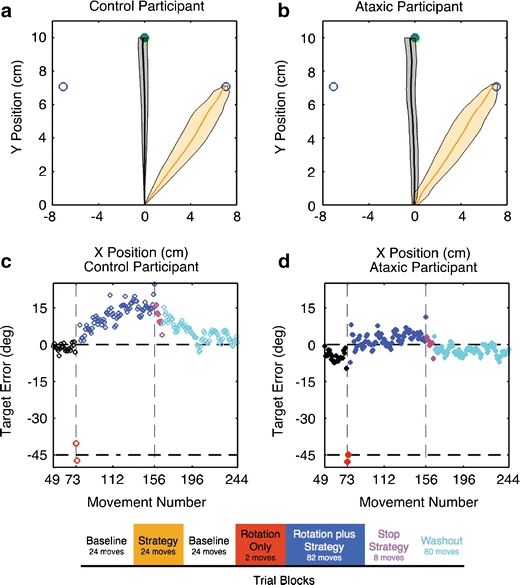
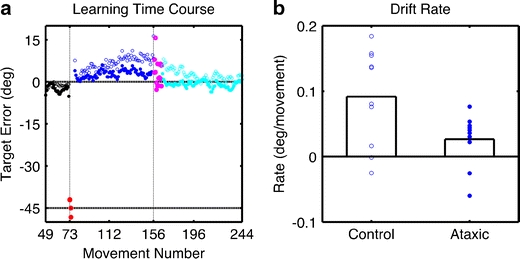
“Given that drift occurred in a gradual and relatively continuous manner during the 80 trials of the rotation+strategy block (see also Mazzoni and Krakauer [6]), we fit the data from this block with a linear function to quantify the rate of drift as well as the initial bias (i.e., the intercept of the regression).”
BackgroundResultInfluentialA neuropsychological theory of motor skill learning.
Willingham, D. B. (1998) · Psychological Review · doi:10.1037//0033-295x.105.3.558 · Cited by 799
Throwing while looking through prisms. I. Focal olivocerebellar lesions impair adaptation
Martin, T. A., Keating, J. G., Goodkin, H. P., Bastian, A. J., & Thach, W. T. (1996) · Brain · doi:10.1093/brain/119.4.1183 · Cited by 625 · cited 3×
“In contrast, if patients with cerebellar degeneration are not provided with an explicit strategy, they show poor adaptation [ 8 , 10, 11].”
BackgroundMethodInfluentialAttentional and nonattentional forms of sequence learning.
Curran, T., & Keele, S. W. (1993) · Journal of Experimental Psychology: Learning, Memory, and Cognition · doi:10.1037/0278-7393.19.1.189 · Cited by 594 · cited 1×
“Indeed, when participants are made aware of task manipulations, strategies can facilitate performance [3–5], leading to the idea that strategic and adaptation processes may work in concert.”
BackgroundMartin, T. A., Keating, J. G., Goodkin, H. P., Bastian, A. J., & Thach, W. T. (1996) · Brain · doi:10.1093/brain/119.4.1199 · Cited by 584
Smith, M. A., & Shadmehr, R. (2005) · Journal of Neurophysiology · doi:10.1152/jn.00943.2004 · Cited by 497 · cited 1×
“Previous research has demonstrated that patients with damage to the cerebellum are impaired across a range of tasks involving sensorimotor adaptation, including reaching in force fields [10, 21], prism adaptation [8], and visuomotor rotations [10, 11].”
BackgroundMotor learning and consolidation: the case of visuomotor rotation
Krakauer, J. W. (2009) · Advances in Experimental Medicine and Biology · doi:10.1007/978-0-387-77064-2_21 · Cited by 324
Contributions of Spatial Working Memory to Visuomotor Learning
Anguera, J. A., Reuter-Lorenz, P. A., Willingham, D. T., & Seidler, R. D. (2010) · Journal of Cognitive Neuroscience · doi:10.1162/jocn.2009.21351 · Cited by 319 · cited 2×
“While various cognitive factors [17–19] such as spatial working memory capacity [20] have been shown to account for individual differences in adaptation tasks that do not entail explicit strategies, we failed to observe any correlations between drift rate and the various neuropsychological measures in our patient grou…”
BackgroundBRIGHT, P., JALDOW, E., & KOPELMAN, M. D. (2002) · Journal of the International Neuropsychological Society · doi:10.1017/s1355617702860131 · Cited by 293 · cited 3×
“Table 1 Demographics of the ten patients with cerebellar ataxia and ten control participants Participant Gender Age Handedness Type Years ICARS NART IQ TRAILS TMTA TMTB Ataxics CBL1 Female 31 Right SAOA 14 26 114 0.12 −0.43 CBL2 Female 38 Right SAOA 1 10 104 1.08 0.26 CBL3 Male 37 Right Family history 6 16 100 0.31 0.…”
MethodInfluentialSize of Error Affects Cerebellar Contributions to Motor Learning
Criscimagna-Hemminger, S. E., Bastian, A. J., & Shadmehr, R. (2010) · Journal of Neurophysiology · doi:10.1152/jn.00822.2009 · Cited by 271 · cited 2×
“This hypothesis offers one account of why patients with cerebellar degeneration show a greater impairment in learning to compensate for an abrupt and large force field perturbation, compared to when the perturbation is introduced gradually [26].”
BackgroundAiming error under transformed spatial mappings suggests a structure for visual-motor maps.
Cunningham, H. A. (1989) · Journal of Experimental Psychology Human Perception & Performance · doi:10.1037//0096-1523.15.3.493 · Cited by 235 · cited 1×
“Adaptation to a visuomotor rotation is seemingly automatic and gradual [2].”
BackgroundRabe, K., Livne, O., Gizewski, E. R., Aurich, V., Beck, A., Timmann, D., & Donchin, O. (2009) · Journal of Neurophysiology · doi:10.1152/jn.91069.2008 · Cited by 218 · cited 3×
“Previous research has demonstrated that patients with damage to the cerebellum are impaired across a range of tasks involving sensorimotor adaptation, including reaching in force fields [10, 21], prism adaptation [8], and visuomotor rotations [10, 11].”
BackgroundAdaptation to visuomotor rotations in younger and older adults.
Heuer, H., & Hegele, M. (2008) · Psychology and Aging · doi:10.1037/0882-7974.23.1.190 · Cited by 147 · cited 1×
“Previous work had suggested these two learning systems may work in tandem [5, 22, 23], perhaps with explicit strategies providing a means to bootstrap adaptive processes.”
BackgroundDivided Attention Impairs Human Motor Adaptation But Not Feedback Control
Taylor, J. A., & Thoroughman, K. A. (2007) · Journal of Neurophysiology · doi:10.1152/jn.01070.2006 · Cited by 133 · cited 1×
“While various cognitive factors [17–19] such as spatial working memory capacity [20] have been shown to account for individual differences in adaptation tasks that do not entail explicit strategies, we failed to observe any correlations between drift rate and the various neuropsychological measures in our patient grou…”
BackgroundSelf-citationMotor Adaptation Scaled by the Difficulty of a Secondary Cognitive Task
Taylor, J. A., & Thoroughman, K. A. (2008) · PLoS ONE · doi:10.1371/journal.pone.0002485 · Cited by 96 · cited 1×
“While various cognitive factors [17–19] such as spatial working memory capacity [20] have been shown to account for individual differences in adaptation tasks that do not entail explicit strategies, we failed to observe any correlations between drift rate and the various neuropsychological measures in our patient grou…”
BackgroundSelf-citationDissociable effects of the implicit and explicit memory systems on learning control of reaching
Hwang, E. J., Smith, M. A., & Shadmehr, R. (2006) · Experimental Brain Research · doi:10.1007/s00221-006-0391-0 · Cited by 94 · cited 1×
“Indeed, when participants are made aware of task manipulations, strategies can facilitate performance [3–5], leading to the idea that strategic and adaptation processes may work in concert.”
BackgroundFunctional independence of explicit and implicit motor adjustments
Sülzenbrück, S., & Heuer, H. (2009) · Consciousness and Cognition · doi:10.1016/j.concog.2008.12.001 · Cited by 90 · cited 1×
“This profile— one in which performance actually becomes worse with practice—suggests a strong segregation of explicit and implicit learning processes [7].”
BackgroundWerner, S., Bock, O., Gizewski, E. R., Schoch, B., & Timmann, D. (2010) · Experimental Brain Research · doi:10.1007/s00221-009-2052-6 · Cited by 58 · cited 3×
“Previous research has demonstrated that patients with damage to the cerebellum are impaired across a range of tasks involving sensorimotor adaptation, including reaching in force fields [10, 21], prism adaptation [8], and visuomotor rotations [10, 11].”
BackgroundSpencer, R. M. C., & Ivry, R. B. (2009) · Journal of Cognitive Neuroscience · doi:10.1162/jocn.2009.21102 · Cited by 56 · cited 1×
“Sequence-learning deficits associated with cerebellar degeneration have been attributed to an impairment in working memory processes for maintaining stimulusresponse representations [25].”
BackgroundSelf-citationWerner, S., & Bock, O. L. (2007) · Experimental Brain Research · doi:10.1007/s00221-007-0925-0 · Cited by 54 · cited 1×
“Previous work had suggested these two learning systems may work in tandem [5, 22, 23], perhaps with explicit strategies providing a means to bootstrap adaptive processes.”
BackgroundSecondary tasks impair adaptation to step- and gradual-visual displacements
Galea, J. M., Sami, S. A. K., Albert, N. B., & Miall, R. C. (2010) · Experimental Brain Research · doi:10.1007/s00221-010-2158-x · Cited by 39
Cited by
Explicit and implicit contributions to learning in a sensorimotor adaptation task
Taylor, J. A., Krakauer, J. W., & Ivry, R. B. (2014) · The Journal of Neuroscience · doi:10.1523/jneurosci.3619-13.2014 · Cited by 768
Self-citationKrakauer, J. W., Hadjiosif, A. M., Xu, J., Wong, A. L., & Haith, A. M. (2019) · Comprehensive Physiology · doi:10.1002/cphy.c170043 · Cited by 635
Human sensorimotor learning: adaptation, skill, and beyond
Krakauer, J. W., & Mazzoni, P. (2011) · Current Opinion in Neurobiology · doi:10.1016/j.conb.2011.06.012 · Cited by 558
Contributions of Spatial Working Memory to Visuomotor Learning
Anguera, J. A., Reuter-Lorenz, P. A., Willingham, D. T., & Seidler, R. D. (2010) · Journal of Cognitive Neuroscience · doi:10.1162/jocn.2009.21351 · Cited by 319
Flexible explicit but rigid implicit learning in a visuomotor adaptation task
Bond, K. M., & Taylor, J. A. (2015) · Journal of Neurophysiology · doi:10.1152/jn.00009.2015 · Cited by 269
Self-citation
Metadata
- Authors
- Taylor, J. A., Klemfuss, N. M., & Ivry, R. B.
- Affiliations
- University of California, Berkeley (US)
- Corresponding author
- Taylor, Jordan A.
- Venue
- The Cerebellum
- Published
- 2010-08-10
- Volume
- 9
- Issue
- 4
- Pages
- 580-586
- ISSN
- 1473-4222 (ISSN-L)
- 1473-4230
- PMC
- PMC2996538
- OpenAlex
- W2103366222
- Cited by
- 200
- References
- 28
- Citations by year
- 2026: 11 · 2025: 11 · 2024: 13 · 2023: 14 · 2022: 16 · 2021: 17 · 2020: 13 · 2019: 16 · 2018: 13 · 2017: 7 · 2016: 10 · 2015: 14 · 2014: 11 · 2013: 12 · 2012: 12
- FWCI
- 6.21
- Type
- journal article
- Language
- en
- Open access
- hybrid
- doi.org
- Licence
- cc-by-nc
- Locations
- The Cerebellum (publishedVersion, cc-by-nc)
- PubMed Central (publishedVersion, cc-by-nc)
- PubMed (publishedVersion)
- eScholarship (California Digital Library) (submittedVersion)
- Funders
- National Ataxia Foundation
- National Institute of Neurological Disorders and Stroke (P01NS040813, F32NS064749)
- Eunice Kennedy Shriver National Institute of Child Health and Human Development (R01HD060306)
- Topics
- Life Sciences › Neuroscience › Cognitive Neuroscience › Motor Control and Adaptation
- Life Sciences › Neuroscience › Cognitive Neuroscience › Tactile and Sensory Interactions
- Life Sciences › Neuroscience › Cognitive Neuroscience › Memory and Neural Mechanisms
- Keywords
- sensorimotor adaptation, cerebellum, cerebellar degeneration, implicit motor learning, visual perturbation, strategy maintenance
- MeSH terms
- Adaptation, Physiological, Adult, Aged, Biomechanical Phenomena, Cerebellar Ataxia, Disability Evaluation, Female, Humans, Learning, Male, Mental Status Schedule, Middle Aged, Movement, Predictive Value of Tests, Psychomotor Performance, Visual Perception
About these checks
Registry, retraction, Cites and statistics results are computed, not judged, with one exception: a printed reference that no index lists is read once by a model before it counts as a citation error. Claims are extracted by a model and kept only when their quote appears verbatim in the text; each cited source is then checked, with a model’s help, for whether it says what the claim relies on. Those verdicts can be wrong — read the claim’s quote and the cited source before relying on one.
Statistics and arithmetic are recomputed, not judged.
Confidence bands are shown only for fields calibrated on our annotated test set. None is calibrated yet, so no band is shown.
What counts as a claim ›How we measure confidence ›How we check this ›
Are you an author, or do you see a problem with this page? Request a review
Data sources
Bibliographic data: Semantic Scholar, OpenAlex, Crossref.
Contains information from the Semantic Scholar Academic Graph Datasets, made available under the ODC Attribution License (ODC-BY 1.0).
Semantic Scholar’s data is described in: Kinney, R., et al. (2023). The Semantic Scholar Open Data Platform. arXiv:2301.10140.
