

Validation of the adult attention-deficit/hyperactivity disorder quality-of-life scale in European patients: comparison with patients from the USA
Open accessThe DOI matches its Crossref record; 25 of the 25 references it cites were found in a registry or an index.
Abstract
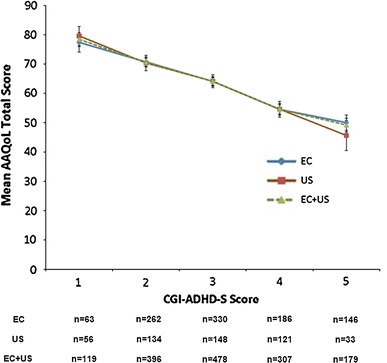
The adult attention-deficit/hyperactivity disorder (ADHD) quality-of-life (AAQoL) scale was previously validated in adult patients in the USA; here, the AAQoL is validated in adult European patients. Data from a 12-week open-label acute treatment period with atomoxetine (80-100 mg/day) in adults with ADHD were used. Patients (≥ 18 to ≤ 50 years old) had a score ≥ 2 on ≥ 6 items on the inattentive or hyperactive core subscales of Conners' Adult ADHD Rating Scale-Investigator Rated: Screening Version (CAARS-Inv:SV); a CAARS-Inv:SV 18-item total ADHD symptom score ≥ 20; and Conners' Adult ADHD Rating Scale-Observer: Screening Version 6-item inattentive or hyperactive core subscale scores ≥ 2. Data were stratified based on patients' geographic region (Europe vs USA). Scale validation psychometric properties results were very similar between European (n = 1,217; 57.7 % male; mean age 33.0 years) and US (n = 602; 62.1 % male; mean age 33.5 years) patients, including factor loading, internal consistency, convergent and discriminant validity, and responsiveness. Exploratory factor analysis confirmed four AAQoL subscales. Internal consistency was acceptable (Cronbach's alpha > 0.70 for all subscales). The AAQoL total score showed moderate convergent validity with CAARS-Inv:SV 18-item total ADHD symptom and clinical global impression-ADHD-severity (CGI-ADHD-S) scores; and strong convergent validity with Behavior Rating Inventory of Executive Function-Adult Version: Self-Report Global-Executive-Composite Index scores. Mean AAQoL total scores were significantly different among patients grouped by CGI-ADHD-S scores, suggesting good discriminant validity. The AAQoL total and subscale scores presented good responsiveness from baseline to 12 weeks. The AAQoL scale shows comparable validity in European and US adults with ADHD.
Overview
The claims and statistics of this paper haven’t been checked yet.
Free: it reads the open-access text and checks the first 5 claims that cite a source we can check. Create a free account to check every claim.
Integrity signals
Registry
Cites
Statistics
Figures
Verification
Claims the paper makes
The claims and statistics of this paper haven’t been checked yet.
Free: it reads the open-access text and checks the first 5 claims that cite a source we can check. Create a free account to check every claim.
Claims other papers make about this one
Each is checked against this paper’s own text: does it say what the citing paper says it does?
The source backs part of the claim, not all of it — or backs it for a different population, condition or comparison.
In the citing paper
“The instrument has excellent internal consistency (Cronbach's α = 0.93 for the overall measure).”
From A study protocol of a randomized controlled study of internet-based cognitive behavioral therapy for adult attention deficit hyperactivity disorder (2023) · cites this paper as Brod et al., 2015
Experimental — accuracy not yet measured
Self-check
Percentages, sums and reported differences re-computed from the paper’s own numbers.
The self-check needs the paper’s full text.
Citations
Cites
Coefficient Alpha and the Internal Structure of Tests
Cronbach, L. J. (1951) · Psychometrika · doi:10.1007/bf02310555 · Cited by 43,931 · cited 2×
“30 was deemed to indicate successful factor loading (Cronbach 1951).”
BackgroundMethod(1976) · Medical Entomology and Zoology · Cited by 8,899
Statistics notes: Cronbach's alpha: Table 1
Bland, J. M., & Altman, D. G. (1997) · BMJ · doi:10.1136/bmj.314.7080.572 · Cited by 5,300 · cited 1×
“When comparing groups, Cronbach’s a values of 0.70–0.80 are regarded as satisfactory (Bland and Altman 1997).”
MethodInfluentialU.S. Department of Health and Human Services FDA Center for Drug Evaluation and Research, U.S. Department of Health and Human Services FDA Center for Biologics Evaluation and Research, & U.S. Department of Health and Human Services FDA Center for Devices and Radiological Health (2006) · Health and Quality of Life Outcomes · doi:10.1186/1477-7525-4-79 · Cited by 2,856
ECDEU Assessment Manual: (591322011-001)
Guy, W. (1976) · PsycEXTRA Dataset · doi:10.1037/e591322011-001 · Cited by 1,896
Evaluating quality-of-life and health status instruments: development of scientific review criteria
Lohr, K. N., Aaronson, N. K., Alonso, J., Audrey Burnam, M., Patrick, D. L., Perrin, E. B., & Roberts, J. S. (1996) · Clinical Therapeutics · doi:10.1016/s0149-2918(96)80054-3 · Cited by 591
Biederman, J., Faraone, S. V., Spencer, T. J., Mick, E., Monuteaux, M. C., & Aleardi, M. (2006) · The Journal of Clinical Psychiatry · doi:10.4088/jcp.v67n0403 · Cited by 565 · cited 2×
“Moreover, at least in children with ADHD, the overall impact of the disease is comparable to other major psychiatric disorders or to severe physical conditions (Biederman et al. 2006a; Danckaerts et al. 2010).”
MethodThe quality of life of children with attention deficit/hyperactivity disorder: a systematic review
Danckaerts, M., Sonuga-Barke, E. J. S., Banaschewski, T., Buitelaar, J., Döpfner, M., Hollis, C., Santosh, P., Rothenberger, A., Sergeant, J., Steinhausen, H.-C., et al. (2010) · European Child & Adolescent Psychiatry · doi:10.1007/s00787-009-0046-3 · Cited by 516 · cited 1×
“Moreover, at least in children with ADHD, the overall impact of the disease is comparable to other major psychiatric disorders or to severe physical conditions (Biederman et al. 2006a; Danckaerts et al. 2010).”
Health Status Measures: Strategies and Analytic Methods for Assessing Change Scores
Stratford, P. W., Binkley, J. M., & Riddle, D. L. (1996) · Physical Therapy · doi:10.1093/ptj/76.10.1109 · Cited by 433 · cited 2×
“Convergent validity estimates the degree to which any two measures that assess the same or similar entities are related to each other (Stratford et al. 1996).”
BackgroundMacey, K. (2003) · Archives of Clinical Neuropsychology · doi:10.1016/s0887-6177(03)00021-0 · Cited by 257 · cited 2×
“The CAARS-Inv:SV is a 30-item scale containing three subscales: the Inattention subscale (items 1, 9, 13, 14, 19, 21, 26, 29, and 30), the Hyperactivity/Impulsivity subscale (items 2, 4, 6, 8, 16, 18, 22, 25, and 27), and the ADHD Index (items 3, 5, 7, 10, 11, 12, 15, 17, 20, 23, 24, and 28) (Conners et al. 1999).”
Zhang, S., Faries, D. E., Vowles, M., & Michelson, D. (2005) · International Journal of Methods in Psychiatric Research · doi:10.1002/mpr.7 · Cited by 255 · cited 1×
“A commonly accepted minimal standard for internal consistency is a Cronbach’s a of 0.65 (Zhang et al. 2005).”
BackgroundInfluentialBiederman, J., Petty, C., Fried, R., Fontanella, J., Doyle, A. E., Seidman, L. J., & Faraone, S. V. (2006) · American Journal of Psychiatry · doi:10.1176/ajp.2006.163.10.1730 · Cited by 213
Behavior Rating Inventory of Executive Function, Adult Version
National Cancer Institute (2020) · Definitions · doi:10.32388/xlccsc · Cited by 212
Brod, M., Johnston, J., Able, S., & Swindle, R. (2006) · Quality of Life Research · doi:10.1007/s11136-005-8325-z · Cited by 200 · cited 10×
“Exploratory factor analysis Exploratory factor analysis loaded all AAQoL items onto their previously reported subscales (Brod et al. 2006) with the exception of item #29 (your intimate relationship is going well emotionally), which loaded on the Relationships subscale instead of the Life Outlook…”
BackgroundMethodResultInfluentialBiederman, J. (2006) · American Journal of Psychiatry · doi:10.1176/appi.ajp.163.10.1730 · Cited by 183 · cited 2×
“Moreover, at least in children with ADHD, the overall impact of the disease is comparable to other major psychiatric disorders or to severe physical conditions (Biederman et al. 2006a; Danckaerts et al. 2010).”
MethodAdler, L. A., Liebowitz, M., Kronenberger, W., Qiao, M., Rubin, R., Hollandbeck, M., Deldar, A., Schuh, K., & Durell, T. (2009) · Depression and Anxiety · doi:10.1002/da.20549 · Cited by 176 · cited 3×
“that ADHD is associated with increased psychological dysfunction and disability, significant job impairment, drug and alcohol misuse, family conflicts, violence, traffic violations, and accidents (Adler et al. 2009).”
BackgroundSelf-citationCoghill, D. (2010) · CNS Drugs · doi:10.2165/11537450-000000000-00000 · Cited by 103 · cited 2×
“Within the ADHD research community, an increasing demand to incorporate assessments of treatment effects that go beyond pure symptomatic amelioration is being recognized (Coghill 2010).”
BackgroundFunctional Outcomes in the Treatment of Adults With ADHD
Adler, L. A., Spencer, T. J., Levine, L. R., Ramsey, J. L., Tamura, R., Kelsey, D., Ball, S. G., Allen, A. J., & Biederman, J. (2008) · Journal of Attention Disorders · doi:10.1177/1087054707308490 · Cited by 93 · cited 2×
“The impact of ADHD involves many aspects of the patient’s life, such as lack of organization, difficulty concentrating, forgetfulness, greater employment disruption, lower academic achievement, difficulty initiating and maintaining relationships, and poor driving behaviors (Adler et al. 2008).”
BackgroundSelf-citationAssessment of ADHD With Culturally Different Groups: The Use of Behavioral Rating Scales
Reid, R. (1995) · School Psychology Review · doi:10.1080/02796015.1995.12085787 · Cited by 84 · cited 1×
“Principal-components analysis with varimax rotation was used to estimate the factor loadings and, in turn, determine the underlying factor structure of this study’s AAQoL items in European and US patient groups (Reid 1995).”
MethodResponsiveness of the Adult Attention-Deficit/Hyperactivity Disorder Quality of Life Scale (AAQoL)
Matza, L. S., Johnston, J. A., Faries, D. E., Malley, K. G., & Brod, M. (2007) · Quality of Life Research · doi:10.1007/s11136-007-9254-9 · Cited by 69 · cited 1×
“Responsiveness is the extent to which a health status measure accurately reflects change in a patient’s condition over time (Matza et al. 2007).”
BackgroundSelf-citationTest–Retest Reliability of Two Patient-Report Measures for Use in Adults With ADHD
Matza, L. S., Van Brunt, D. L., Cates, C., & Murray, L. T. (2011) · Journal of Attention Disorders · doi:10.1177/1087054710372488 · Cited by 54 · cited 1×
“Effects of attention-deficit/hyperactivity disorder (ADHD) in adults go beyond symptoms of inattention, hyperactivity, and impulsivity that characterize the disorder (Adler et al. 2008; Matza et al. 2011).”
BackgroundMattos, P., Louzã, M. R., Palmini, A. L. F., Oliveira, I. R. D., & Rocha, F. L. (2013) · Journal of Attention Disorders · doi:10.1177/1087054711434772 · Cited by 47 · cited 1×
“Not surprisingly, patients with ADHD report lower quality-of-life (QoL) than healthy comparison subjects, and the severity of ADHD symptoms is negatively correlated with measures of QoL (Adler et al. 2009; Mattos et al. 2012).”
BackgroundUpadhyaya, H. P., Ramos‐Quiroga, J. A., Adler, L. A., Williams, D. W., Tanaka, Y., Lane, J. R., Escobar, R., Trzepacz, P. T., Camporeale, A., & Allen, A. J. (2013) · The European Journal of Psychiatry · doi:10.4321/s0213-61632013000300004 · Cited by 33
Upadhyaya, H. P., Adler, L. A., Casas, M., Kutzelnigg, A., Williams, D. W., Tanaka, Y., Arsenault, J., Escobar, R., & Allen, A. J. (2013) · Child and Adolescent Psychiatry and Mental Health · doi:10.1186/1753-2000-7-14 · Cited by 13 · cited 3×
“The results of the primary study objective, examining the maintenance of response to atomoxetine compared with placebo in adult patients with ADHD, were published elsewhere (Upadhyaya et al. 2013a, b).”
BackgroundMethodResultInfluentialMattos, P., Segenreich, D., Dias, G. M., Saboya, E., Coutinho, G., & Brod, M. I. (2011) · Archives of Clinical Psychiatry (São Paulo) · doi:10.1590/s0101-60832011000300001 · Cited by 11 · cited 1×
“It was developed based on qualitative data on the impact of ADHD on everyday activities as reported by patients and experts, as well as information collected from the scientific literature (Mattos et al. 2011).”
Research works printed but not linked: 1
- National Institute of Mental Health Clinical global impression scale Psychopharmacol Bull 1985 21 839 943
Cited by
The Impact of Adult ADHD in the Quality of Life Profile
Quintero, J., Morales, I., Vera, R., Zuluaga, P., & Fernández, A. (2019) · Journal of Attention Disorders · doi:10.1177/1087054717733046 · Cited by 77
“The patients’ QoL was measured using the Adult ADHD Quality of Life (AAQoL) scale, a disease-specific tool for the assessment of QoL in adult ADHD patients (Brod et al., 2015).”
MethodBen-Dor Cohen, M., Eldar, E., Maeir, A., & Nahum, M. (2021) · Health and Quality of Life Outcomes · doi:10.1186/s12955-021-01904-8 · Cited by 35
“The Adult ADHD Quality-of-Life scale (AAQoL; [5]) is one of the most commonly used disease-specific instruments to measure HRQoL in adults with ADHD in both research and clinical practice [56, 57].”
MethodSubjective cognition in adults with common psychiatric classifications; a systematic review
Groenman, A. P., van der Werf, S. P., & Geurts, H. M. (2021) · Psychiatry Research · doi:10.1016/j.psychres.2021.114374 · Cited by 36
“In 16 studies the relation between reported psychiatric, psychological, or difficulties and subjective cognition was reported (six in ADHD (Brod et al., 2015; Gray et al., 2016, 2014; Low et al., 2018; Roth et al., 2013; Stem and Maeir, 2014), one in ASD (van Heijst and Geurts, 2015), four in…”
A self-guided internet-delivered intervention for adults with ADHD: a feasibility study
Nordby, E. S., Kenter, R. M. F., Lundervold, A. J., & Nordgreen, T. (2021) · Internet Interventions · doi:10.1016/j.invent.2021.100416 · Cited by 22
“AAQoL has demonstrated good psychometric properties with a Cronbach's alpha of 0.93 (Brod et al., 2015).”
MethodInfluentialKastner, L., Velder-Shukrun, Y., Bonne, O. B., Bar-Ilan, R. T., & Maeir, A. (2022) · American Journal of Occupational Therapy · doi:10.5014/ajot.2022.046417 · Cited by 23
“Studies have consistently found decreased quality of life (QoL) in adults with ADHD compared with peers without ADHD (Brod et al., 2015).”
Metadata
- Authors
- Brod, M., Adler, L. A., Lipsius, S., Tanaka, Y., Heinloth, A. N., & Upadhyaya, H.
- Affiliations
- Brod Group (US)
- New York University (US)
- Eli Lilly (United States) (US)
- Corresponding author
- Upadhyaya, Himanshu
- Venue
- ADHD Attention Deficit and Hyperactivity Disorders
- Published
- 2015-01-07
- Volume
- 7
- Issue
- 2
- Pages
- 141-150
- ISSN
- 1866-6116 (ISSN-L)
- 1866-6647
- PMC
- PMC4449381
- OpenAlex
- W1995533620
- Cited by
- 40
- References
- 25
- Citations by year
- 2026: 5 · 2025: 5 · 2024: 7 · 2023: 5 · 2022: 1 · 2021: 4 · 2020: 2 · 2019: 1 · 2018: 3 · 2017: 3 · 2016: 3 · 2015: 1
- FWCI
- 2.71
- Type
- journal article
- Language
- en
- Open access
- hybrid
- doi.org
- Locations
- ADHD Attention Deficit and Hyperactivity Disorders (publishedVersion, cc-by)
- PubMed Central (publishedVersion, cc-by)
- PubMed (publishedVersion)
- Funders
- Bristol-Myers Squibb
- Eli Lilly and Company
- Major League Baseball
- York University
- Shire
- National Institute on Drug Abuse
- Topics
- Health Sciences › Medicine › Psychiatry and Mental health › Attention Deficit Hyperactivity Disorder
- Social Sciences › Decision Sciences › Management Science and Operations Research › Psychometric Methodologies and Testing
- Health Sciences › Medicine › Psychiatry and Mental health › Schizophrenia research and treatment
- Keywords
- adult ADHD, quality of life, scale validation, psychometric properties, atomoxetine, cross-cultural validation, convergent validity, discriminant validity, responsiveness, executive function
- MeSH terms
- Atomoxetine Hydrochloride, Adolescent, Adult, Attention Deficit Disorder with Hyperactivity, Europe, Factor Analysis, Statistical, Female, Humans, Male, Middle Aged, Psychiatric Status Rating Scales, Psychometrics, Quality of Life, United States, Multicenter Studies as Topic, Randomized Controlled Trials as Topic, Clinical Trials, Phase III as Topic, Adrenergic Uptake Inhibitors, Young Adult
About these checks
Registry, retraction, Cites and statistics results are computed, not judged, with one exception: a printed reference that no index lists is read once by a model before it counts as a citation error. Claims are extracted by a model and kept only when their quote appears verbatim in the text; each cited source is then checked, with a model’s help, for whether it says what the claim relies on. Those verdicts can be wrong — read the claim’s quote and the cited source before relying on one.
Statistics and arithmetic are recomputed, not judged.
Confidence bands are shown only for fields calibrated on our annotated test set. None is calibrated yet, so no band is shown.
What counts as a claim ›How we measure confidence ›How we check this ›
Are you an author, or do you see a problem with this page? Request a review
Data sources
Bibliographic data: Semantic Scholar, OpenAlex, Crossref.
Contains information from the Semantic Scholar Academic Graph Datasets, made available under the ODC Attribution License (ODC-BY 1.0).
Semantic Scholar’s data is described in: Kinney, R., et al. (2023). The Semantic Scholar Open Data Platform. arXiv:2301.10140.
