

Burden of foodborne disease in low-income and middle-income countries and opportunities for scaling food safety interventions
Open accessThe DOI matches its Crossref record; 55 of the 58 references it cites were found in a registry or an index, and 1 are not checked yet; 27 of the 74 sources its claims cite were checked for support.
Abstract
Abstract Foodborne diseases (FBD) are an important externality of agriculture and food systems... over 90% of the burden falls on people in LMIC.
Verified 2026-11-25 · 1 reference not checked yet
Overview
CoChat Summary
TL;DR
This review synthesizes evidence on the burden of foodborne disease (FBD) in low- and middle-income countries (LMIC) and argues that food safety interventions have been under-invested and rarely scaled. It proposes five factors—efficacy, enabling environment, economic viability, incentives, and equity—as critical for scalable food safety interventions.
Key findings
- WHO FERG estimated foodborne hazards caused around 420,000 deaths and around 33 million DALYs lost annually in LMIC; children under 5 (9% of world population) experienced 38% of FBD, 30% of deaths, and 40% of DALYs, while people in the poorest areas (41% of population) bore 53% of FBD, 75% of deaths, and 72% of DALYs. Heavy metals added more than 1 million diseases, over 56,000 deaths, and more than 9 million DALYs lost; combined all FBD was estimated at around 42 million DALYs lost per year, with over 90% of the burden falling on LMIC.
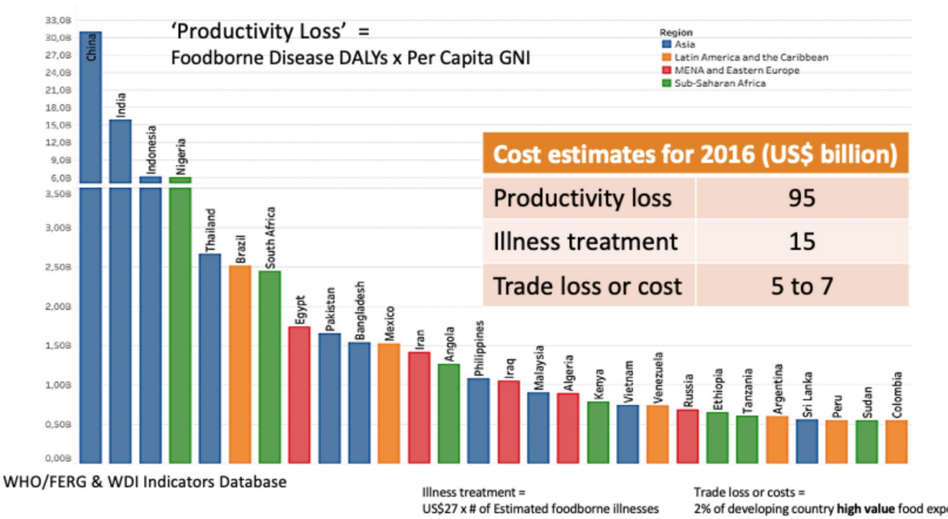
- The economic cost of FBD in LMIC was estimated at over US$100 billion per year, with lost human capital the greatest cost. Meat consumption was associated with a 6% increase in FBD mortality for every additional metric ton consumed per 100 people (correlation not causation), and animal products were suggested as the source of around one-third of FBD, likely an underestimate.
- A systematic review focused on Africa identified 3,470 titles, 498 abstracts, 84 papers, and 67 included papers; most measured knowledge, attitudes, and/or practices, less than 10% measured a direct health outcome, and only one had a livelihood outcome, with no papers reporting economic, social, environmental, or gender-related outcomes. Around half the studies claimed success or partial success, and 14% failed partially or completely.
- The Global Food Safety Partnership assessed more than 360 food-safety projects in sub-Saharan Africa and found investment focused on export markets, with little done to reduce FBD in African consumers; there was no evidence that any evaluated intervention had been scaled. Five factors were identified as critical for scalability: efficacy, an enabling environment, economic viability, incentives, and equity.
Methods
- Design: a review that includes a systematic literature review following PRISMA guidelines, focused on Africa with plans to extend to Asia, and development of a typology/framework for evaluating food safety interventions.
- Data: searches in CabDirect and PubMed using PICO, MeSH, truncation, and Boolean operators; inclusion criteria were published 2000–2017, English, an intervention aimed at improving food safety, evaluation of hazards or health impacts, and conducted in Africa. The initial search found 3,470 titles, 498 relevant abstracts, 84 papers identified, and 67 papers included after exclusions. The review also draws on a GFSP assessment of more than 360 food-safety projects in sub-Saharan Africa.
- Analysis: narrative synthesis and typology of interventions along the value chain and at population level, with a qualitative estimate of relative intervention importance in Africa (Table 1) and derivation of five scalability factors.
Limitations
- Stated in the paper: little empirical information exists on FBD burden in LMIC; official reports are unreliable due to under-reporting; epidemiological studies are often subnational and cover only one hazard or a subset; quantitative risk assessments are limited; very little information exists on food sources; monitoring trends is difficult due to lack of accurate reporting; few studies used RCTs; most were experimental; WTP studies often used methods prone to overestimation; most studies assessed only short-term outcomes; few evaluations addressed cost; only one livelihood outcome and no economic, social, environmental, or gender outcomes were reported; no evidence showed interventions had been scaled; FERG estimates are likely conservative; chemical burden is likely under-estimated; aflatoxin–stunting causality is unproven; and the meat–FBD mortality correlation does not imply causation.
- Evident from the text: the review relies heavily on secondary estimates, expert opinion, and a systematic review limited to Africa and published papers, so it may miss unpublished or non-African interventions and cannot fully resolve uncertainty in several burden estimates.
Model-written summary. Check it against the paper before relying on it.
Integrity signals
Registry
Cites
Statistics
Figures

Verification
Claims the paper makes
26 Valid · 8 Not valid · 45 Not checked · 76 Own results and interpretations
The cited sources support only part of this claim — read each source’s verdict below.
In the paper
“No credible, comprehensive, quantified evidence on the impact of agricultural chemicals in food on human health in LMIC currently exists (Käferstein, 1997;Prüss-Ustün et al., 2011)”
What the sources say
- Not checked — no full text of the sourcecites Käferstein, 1997
- Partly supportedcites Prüss-Ustün et al., 2011 matched to “Knowns and unknowns on burden of disease due to chemicals: a systematic review” (2011) sourceExperimental — accuracy not yet measured
The Results section (‘Pesticides in self-inflicted injuries’; page unavailable) says exposure and exposure-response data were too limited to estimate pesticides’ global health impacts. The Discussion (‘Limitations’; page unavailable) likewise identifies major gaps in quantified chemical-health evidence. Neither passage specifically establishes that no credible, comprehensive, quantified evidence exists for agricultural chemicals consumed in food in low- and middle-income countries. (LLM, conf=0.84)
plain- Asserted: passes — The authors put it forward as true.
- Checkable: passes — It can be checked against evidence.
- Load-bearing: unclear — It is unclear whether the paper’s conclusions depend on it.
- Based: passes — The paper gives a reason why it holds.
The cited sources support only part of this claim — read each source’s verdict below.
In the paper
“In high-income regions with good reporting, such as North America and Europe, there has been no overall marked decline in the burden of FBD in the first decades of the 21st century (Grace, 2015).”
What the sources say
- Partly supportedcites Grace, 2015 matched to “Food Safety in Low and Middle Income Countries” (2015) sourceExperimental — accuracy not yet measured
Section 3.5 reports no obvious decline in foodborne disease in countries with good records, citing unchanged or worsening case counts for most diseases in the EU and USA. That supports the central point, but the paper specifies the preceding five years for the EU and ten years for the USA; it does not establish the trend across the first decades of the 21st century or all of North America and Europe. (LLM, conf=0.83)
plain- Asserted: passes — The authors put it forward as true.
- Checkable: passes — It can be checked against evidence.
- Load-bearing: unclear — It is unclear whether the paper’s conclusions depend on it.
- Based: passes — The paper gives a reason why it holds.
- Partly supported
The cited sources support only part of this claim — read each source’s verdict below.
In the paper
“In a cross-country study, for every additional metric ton of meat consumed per 100 people, mortality from FBD increased by 6% (Hanson et al., 2012).”
What the sources say
- Partly supportedcites Hanson et al., 2012 matched to “Estimating global mortality from potentially foodborne diseases: an analysis using vital registration data” (2012) sourceExperimental — accuracy not yet measured
Table 3 in the Results reports that 10 additional metric tons of meat production per 1,000 people—equivalent to one ton per 100 people—predicts a 6% increase in potentially foodborne-disease mortality. The claim changes meat production to meat consumed and describes a predicted association as an observed increase. (LLM, conf=0.90)
plainstates a cause- Asserted: passes — The authors put it forward as true.
- Checkable: passes — It can be checked against evidence.
- Load-bearing: unclear — It is unclear whether the paper’s conclusions depend on it.
- Based: passes — The paper gives a reason why it holds.
- Partly supported
The cited sources support only part of this claim — read each source’s verdict below.
In the paper
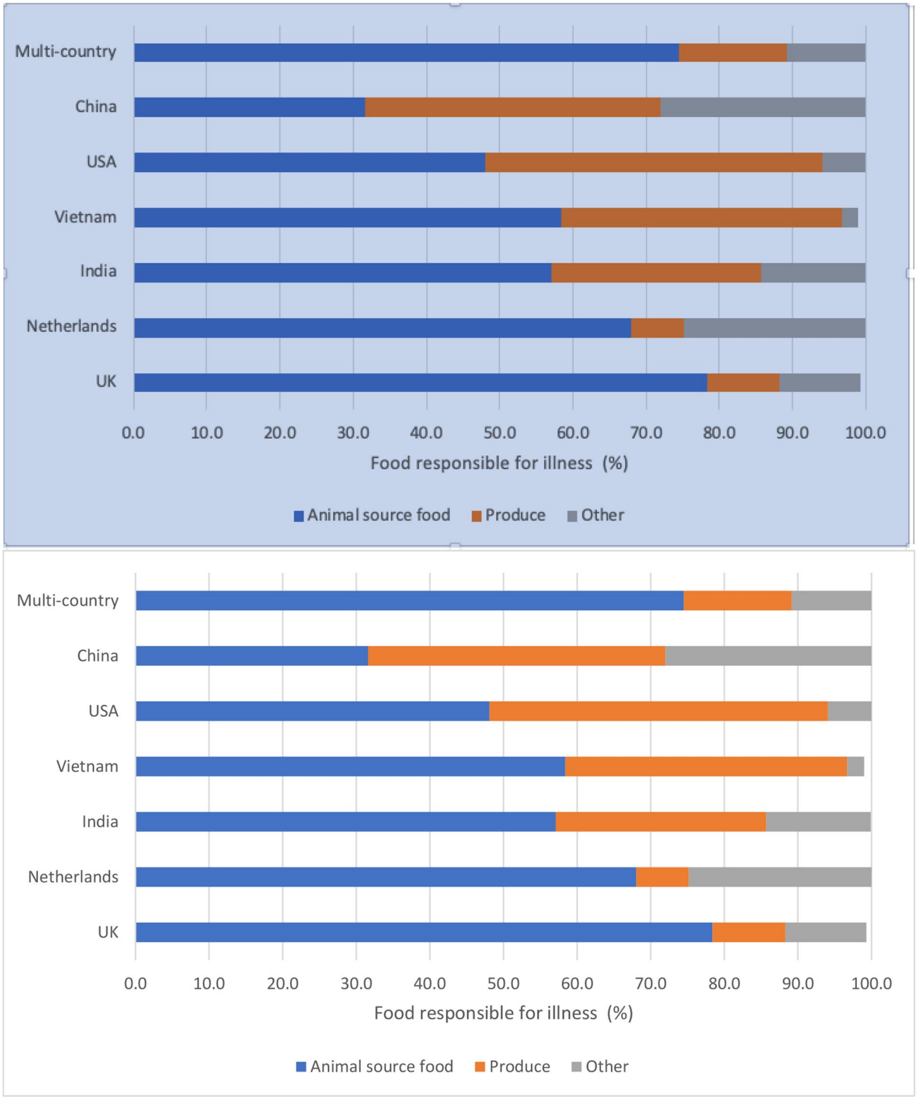
“The limited data from LMIC on reported FBD by food source show a similar pattern to the data from HIC (Fig. 1) (Painter et al., 2013;Sudershan et al., 2014;Mangen et al., 2015;Tam et al., 2012;Sang et al., 2014).”
What the sources say
- Partly supportedcites Painter et al., 2013 matched to “Attribution of Foodborne Illnesses, Hospitalizations, and Deaths to Food Commodities by using Outbreak Data, United States, 1998–2008” (2013) sourceExperimental — accuracy not yet measured
The Results report food-source attribution patterns for the United States, supplying the HIC side of the comparison. The paper does not report LMIC data or establish that the patterns are similar; it cannot support that part of the citing sentence. (LLM, conf=0.83)
- Not matchedcites Sudershan et al., 2014
An author–year citation the paper’s reference list doesn’t settle. We don’t search these by name.
- Partly supportedcites Mangen et al., 2015 matched to “Cost-of-illness and disease burden of food-related pathogens in the Netherlands, 2011” (2015) sourceExperimental — accuracy not yet measured
Section 2.8 (page unavailable) describes attribution of Dutch foodborne illness to food groups, and Table 5 gives results by food group. The paper therefore supplies a high-income-country pattern, but our copy does not report LMIC data or compare the two patterns. (LLM, conf=0.83)
plain- Asserted: passes — The authors put it forward as true.
- Checkable: passes — It can be checked against evidence.
- Load-bearing: unclear — It is unclear whether the paper’s conclusions depend on it.
- Based: passes — The paper gives a reason why it holds.
- Partly supported
The cited sources support only part of this claim — read each source’s verdict below.
In the paper
“Meat consumption is a strong predictor of mortality from FBD.”
What the sources say
- Partly supportedcites Hanson et al., 2012 matched to “Estimating global mortality from potentially foodborne diseases: an analysis using vital registration data” (2012) sourceExperimental — accuracy not yet measured
The Results (Table 3) identify meat production, not meat consumption, as a positive predictor of potentially foodborne-disease mortality at the country level. The paper does not establish that meat consumption is a strong predictor; its separate measure of calorie supply from animal products has a negative association. (LLM, conf=0.88)
boostedstates an association- Asserted: passes — The authors put it forward as true.
- Checkable: passes — It can be checked against evidence.
- Load-bearing: unclear — It is unclear whether the paper’s conclusions depend on it.
- Based: passes — The paper gives a reason why it holds.
- Partly supported
60 more claims · 8 with their cited sources checked
Create a free account to see all 155 claims and to verify the 4 references still open.
- Probably not a substantial claim. 71
- It may state two separate claims as one. 41
Citations
Cites
The PRISMA 2020 statement: An updated guideline for reporting systematic reviews
Page, M. J., McKenzie, J. E., Bossuyt, P. M., Boutron, I., Hoffmann, T. C., Mulrow, C. D., Shamseer, L., Tetzlaff, J. M., Akl, E. A., Brennan, S. E., et al. (2021) · BMJ · doi:10.1136/bmj.n71 · Cited by 108,283
The PRISMA 2020 statement: an updated guideline for reporting systematic reviews
Page, M. J., McKenzie, J., Bossuyt, P., Boutron, I., Hoffmann, T., mulrow, C., Shamseer, L., Tetzlaff, J., Akl, E., Brennan, S. E., et al. (2020) · doi:10.31222/osf.io/v7gm2_v1 · Cited by 8,090
The PRISMA 2020 statement: an updated guideline for reporting systematic reviews
Page, M. J., McKenzie, J., Bossuyt, P., Boutron, I., Hoffmann, T., mulrow, C., Shamseer, L., Tetzlaff, J., Akl, E., Brennan, S. E., et al. (2020) · doi:10.31222/osf.io/v7gm2 · Cited by 5,177
Surveillance for Foodborne Disease Outbreaks—United States, 2006
(2010) · Annals of Emergency Medicine · doi:10.1016/j.annemergmed.2009.11.004 · Cited by 2,361
Havelaar, A. H., Kirk, M. D., Torgerson, P. R., Gibb, H. J., Hald, T., Lake, R. J., Praet, N., Bellinger, D. C., de Silva, N. R., Gargouri, N., et al. (2015) · PLoS Medicine · doi:10.1371/journal.pmed.1001923 · Cited by 2,067 · cited 3×
“This paper, which represents the work of more than 60 experts over a period of 10 years, can be considered the most definitive and comprehensive guide to the health burden of FBD (Havelaar et al., 2015).”
BackgroundInfluentialPainter, J. A., Hoekstra, R. M., Ayers, T., Tauxe, R. V., Braden, C. R., Angulo, F. J., & Griffin, P. M. (2013) · Emerging Infectious Diseases · doi:10.3201/eid1903.111866 · Cited by 1,146 · cited 1×
“1) (Painter et al., 2013; Sudershan et al., 2014; Mangen et al., 2015; Tam et al., 2012; Sang et al., 2014).”
The growing burden of foodborne outbreaks due to contaminated fresh produce: risks and opportunities
LYNCH, M. F., TAUXE, R. V., & HEDBERG, C. W. (2009) · Epidemiology and Infection · doi:10.1017/s0950268808001969 · Cited by 803 · cited 1×
“In HIC, the proportion of outbreaks of FBD attributed to fresh produce has increased in since the 1980s (Lynch et al., 2009).”
BackgroundThe European Union One Health 2021 Zoonoses Report
Authority, E. F. S., & European Centre for Disease Prevention and Control (2022) · EFSA Journal · doi:10.2903/j.efsa.2022.7666 · Cited by 703
Multi-country analysis of the effects of diarrhoea on childhood stunting
Checkley, W., Buckley, G., Gilman, R. H., Assis, A. M., Guerrant, R. L., Morris, S. S., Mølbak, K., Valentiner-Branth, P., Lanata, C. F., Black, R. E., et al. (2008) · International Journal of Epidemiology · doi:10.1093/ije/dyn099 · Cited by 653 · cited 1×
“These costs include domestic and exported attributed to experiencing more than four episodes of diarrhoea before the age of 24 months (Checkley et al., 2008).”
BackgroundFood Safety in Low and Middle Income Countries
Grace, D. (2015) · International Journal of Environmental Research and Public Health · doi:10.3390/ijerph120910490 · Cited by 544 · cited 4×
“In high-income regions with good reporting, such as North America and Europe, there has been no overall marked decline in the burden of FBD in the first decades of the 21st century (Grace, 2015).”
BackgroundInfluentialSelf-citationConsumer attitudes, knowledge and behaviour: a review of food safety issues
Wilcock, A., Pun, M., Khanona, J., & Aung, M. (2004) · Trends in Food Science & Technology · doi:10.1016/j.tifs.2003.08.004 · Cited by 483
Analysis of foodborne outbreak data reported internationally for source attribution
Greig, J. D., & Ravel, A. (2009) · International Journal of Food Microbiology · doi:10.1016/j.ijfoodmicro.2008.12.031 · Cited by 451
Knowns and unknowns on burden of disease due to chemicals: a systematic review
Prüss-Ustün, A., Vickers, C., Haefliger, P., & Bertollini, R. (2011) · Environmental Health · doi:10.1186/1476-069x-10-9 · Cited by 397
The Safe Food Imperative: Accelerating Progress in Low- and Middle-Income Countries
Jaffee, S., Henson, S., Unnevehr, L., Grace, D., & Cassou, E. (2019) · doi:10.1596/978-1-4648-1345-0 · Cited by 373
Self-citationBurnett, S. L., & Beuchat, L. R. (2001) · Journal of Industrial Microbiology and Biotechnology · doi:10.1038/sj.jim.7000199 · Cited by 294
World Health Statistics Quarterly
Coates, M. (1982) · Pathology · doi:10.1016/s0031-3025(16)37484-0 · Cited by 277
Surveillance for foodborne disease outbreaks – United States, 2013 : annual report
Dewey-Mattia, D., Kisselburgh, H. M., Manikonda, K., Silver, R., Subramhanya, S., Sundararaman, P., Whitham, H. K., & Crowe, S. J. (2015) · Cited by 229
Food safety culture: the evolution of an emerging risk factor?
Griffith, C. J., Livesey, K. M., & Clayton, D. A. (2010) · British Food Journal · doi:10.1108/00070701011034439 · Cited by 164 · cited 1×
“For example, Griffith et al. considered that the type of food-safety culture existing within a business could explain why food handlers choose not to implement known food safety practices and why training, although important, might not change practices (Griffith et al., 2010).”
BackgroundGlobal disease burden of pathogens in animal source foods, 2010
Li, M., Havelaar, A. H., Hoffmann, S., Hald, T., Kirk, M., Torgerson, P. R., & Devleesschauwer, B. (2019) · PLoS ONE · doi:10.1371/journal.pone.0216545 · Cited by 150
Tam, C. C., O'Brien, S. J., Tompkins, D. S., Bolton, F. J., Berry, L., Dodds, J., Choudhury, D., Halstead, F., Iturriza-Gomara, M., Mather, K., et al. (2012) · Clinical Infectious Diseases · doi:10.1093/cid/cis028 · Cited by 148
Cost-of-illness and disease burden of food-related pathogens in the Netherlands, 2011
Mangen, M.-J. J., Bouwknegt, M., Friesema, I. H. M., Haagsma, J. A., Kortbeek, L. M., Tariq, L., Wilson, M., van Pelt, W., & Havelaar, A. H. (2015) · International Journal of Food Microbiology · doi:10.1016/j.ijfoodmicro.2014.11.022 · Cited by 140
Food Safety and Informal Markets: Animal Products in Sub-Saharan Africa
(2014) · doi:10.4324/9781315745046 · Cited by 140 · cited 2×
“Pastoralists in West Africa believe that raw milk does not cause illness (Roesel & Grace, 2014) and, in Vietnam, widespread consumption of raw or undercooked blood, meat, and fish leads to several zoonoses (Carrique-Mas & Bryant, 2013).”
BackgroundInternational agricultural research to reduce food risks: case studies on aflatoxins
Grace, D., Mahuku, G., Hoffmann, V., Atherstone, C., Upadhyaya, H. D., & Bandyopadhyay, R. (2015) · Food Security · doi:10.1007/s12571-015-0469-2 · Cited by 117
Self-citationGeorge, C. M., Oldja, L., Biswas, S. K., Perin, J., Lee, G. O., Ahmed, S., Haque, R., Sack, R. B., Parvin, T., Azmi, I. J., et al. (2015) · The American Society of Tropical Medicine and Hygiene · doi:10.4269/ajtmh.14-0694 · Cited by 116
Methodology for Valuing the Health Impacts of Air Pollution
Narain, U., & Sall, C. (2016) · World Bank, Washington, DC eBooks · doi:10.1596/24440 · Cited by 107
Stafford, R. J., Schluter, P. J., Wilson, A. J., Kirk, M. D., Hall, G., Unicomb, L., & the OzFoodNet Working Group (2008) · Emerging Infectious Diseases · doi:10.3201/eid1406.071008 · Cited by 106 · cited 1×
“Consumption of offal has been found to be a risk factor for diarrhoea (Stafford et al., 2008; Grace et al., 2012b).”
Live and Wet Markets: Food Access versus the Risk of Disease Emergence
Naguib, M. M., Li, R., Ling, J., Grace, D., Nguyen-Viet, H., & Lindahl, J. F. (2021) · Trends in Microbiology · doi:10.1016/j.tim.2021.02.007 · Cited by 106
Self-citationGibb, H. J., Barchowsky, A., Bellinger, D., Bolger, P. M., Carrington, C., Havelaar, A. H., Oberoi, S., Zang, Y., O’Leary, K., & Devleesschauwer, B. (2019) · Environmental Research · doi:10.1016/j.envres.2018.12.062 · Cited by 104
A Review of Foodborne Bacterial and Parasitic Zoonoses in Vietnam
Carrique-Mas, J. J., & Bryant, J. E. (2013) · EcoHealth · doi:10.1007/s10393-013-0884-9 · Cited by 92
Meat Consumption Culture in Ethiopia
Seleshe, S., Jo, C., & Lee, M. (2014) · Korean Journal for Food Science of Animal Resources · doi:10.5851/kosfa.2013.34.1.7 · Cited by 88
The impacts of aflatoxin standards on health and nutrition in sub-Saharan Africa: The case of Kenya
Sirma, A. J., Lindahl, J. F., Makita, K., Senerwa, D., Mtimet, N., Kang’ethe, E. K., & Grace, D. (2018) · Global Food Security · doi:10.1016/j.gfs.2018.08.001 · Cited by 79 · cited 1×
“A study on aflatoxin in Kenya found that if existing standards were strictly enforced, enormous amounts of staple foods would have to be destroyed, which would be economically and practically infeasible (Sirma et al., 2018).”
BackgroundSelf-citationFoodborne Infections and Intoxications in Hyderabad India
Sudershan, R. V., Kumar, R. N., Kashinath, L., Bhaskar, V., & Polasa, K. (2014) · Epidemiology Research International · doi:10.1155/2014/942961 · Cited by 60
Kumi, J., Mitchell, N., Asare, G., Dotse, E., Kwaa, F., Phillips, T., & Ankrah, N.-A. (2014) · Ghana Medical Journal · doi:10.4314/gmj.v48i3.1 · Cited by 59 · cited 1×
“In another study from Ghana, a strong peak in the incidence of diarrhoea was found after the introduction of supplementary foods, and weaning foods often had high levels of aflatoxin and fumonisin contamination(Kumi et al., 2014 ).”
BackgroundHanson, L. A., Zahn, E. A., Wild, S. R., Döpfer, D., Scott, J., & Stein, C. (2012) · Population Health Metrics · doi:10.1186/1478-7954-10-5 · Cited by 58 · cited 1×
“In a cross-country study, for every additional metric ton of meat consumed per 100 people, mortality from FBD increased by 6% (Hanson et al., 2012).”
BackgroundDang-Xuan, S., Nguyen-Viet, H., Unger, F., Pham-Duc, P., Grace, D., Tran-Thi, N., Barot, M., Pham-Thi, N., & Makita, K. (2017) · International Journal of Public Health · doi:10.1007/s00038-016-0921-x · Cited by 41
Self-citationNanyunja, J., Jacxsens, L., Kirezieva, K., Kaaya, A. N., Uyttendaele, M., & Luning, P. A. (2016) · Journal of the Science of Food and Agriculture · doi:10.1002/jsfa.7518 · Cited by 31 · cited 1×
“Kenyan exporters had higher compliance with standards and regulations than Ugandan exporters, which was attributed to a better legal framework, more power with suppliers, qual - ity assurance departments, and intensive support from importers (Nanyunja et al., 2016).”
BackgroundBello, M., Lawan, M. K., Kwaga, J. K. P., & Raji, M. A. (2011) · International Journal of Food Microbiology · doi:10.1016/j.ijfoodmicro.2011.07.029 · Cited by 31
Evaluation of pot-chlorination of wells during a cholera outbreak, Bissau, Guinea-Bissau, 2008
Cavallaro, E. C., Harris, J. R., da Goia, M. S., dos Santos Barrado, J. C., da Nóbrega, A. A., de Alvarenga Júnior, I. C., Silva, A. P., Sobel, J., & Mintz, E. (2011) · Journal of Water and Health · doi:10.2166/wh.2011.122 · Cited by 25 · cited 1×
“…WHO-recommended chlorine levels in well water during a cholera outbreak and conveyed a false sense of security to local residents, some of whom stopped chlorinating their household water (Cavallaro et al., 2011). fast-food venues, the food sold was cheaper and the patrons poorer (Mwangi, 2010 ).”
BackgroundCriminalizing Informal Workers: The Case of Street Vendors in Abuja, Nigeria
Adama, O. (2021) · Journal of Asian and African Studies · doi:10.1177/0021909620930740 · Cited by 24 · cited 1×
“By contrast, street vendors often experience a disabling environment; they can be subjected to harassment from authorities and forced to pay bribes (Rahman, 2019; Adama, 2021).”
BackgroundGrace, D., Olowoye, J., Dipeolu, M., Odebode, S., & Randolph, T. (2012) · Tropical Animal Health and Production · doi:10.1007/s11250-012-0207-0 · Cited by 24 · cited 2×
“For example, around 13% of people suffer from pork-borne salmonellosis each year in Vietnam (Dang-Xuan et al., 2017) and around 1% of children are exposed to zoonotic milk-borne Cryptosporid-ium spp. annually in Nairobi, Kenya (Grace et al., 2012a).”
BackgroundSelf-citationMaking Sense of Recent Cost-of-Foodborne-Illness Estimates
Hoffmann, S., Anekwe, T. D., Hoffmann, S., & Anekwe, T. D. (2013) · Unknown · doi:10.22004/ag.econ.262123 · Cited by 23
Sang, X.-L., Liang, X.-C., Chen, Y., Li, J.-D., Li, J.-G., Bai, L., & Sun, J.-Y. (2014) · BMC Public Health · doi:10.1186/1471-2458-14-787 · Cited by 19 · cited 1×
“1) (Painter et al., 2013; Sudershan et al., 2014; Mangen et al., 2015; Tam et al., 2012; Sang et al., 2014).”
Grace, D., Monda, J., Karanja, N., Randolph, T. F., & Kang’ethe, E. K. (2012) · Tropical Animal Health and Production · doi:10.1007/s11250-012-0204-3 · Cited by 18
Self-citation(1997) · PubMed · Cited by 18
Han, S., Zhang, X., Chen, R., Wen, J., Li, Y., Shu, J., Ling, H., & Zhang, F. (2013) · PLoS ONE · doi:10.1371/journal.pone.0080173 · Cited by 16
Slayton, R. B., Murphy, J. L., Morris, J., Faith, S. H., Oremo, J., Odhiambo, A., Ayers, T., Feinman, S. J., Brown, A. C., & Quick, R. E. (2016) · The American Society of Tropical Medicine and Hygiene · doi:10.4269/ajtmh.14-0566 · Cited by 14
Apaassongo, I. L., Aidoo, R., & Ohene-Yankyera, K. (2016) · World Development Perspectives · doi:10.1016/j.wdp.2016.10.003 · Cited by 12 · cited 1×
“Queues were long, the process was slow, fees were arbitrary, and some examinations were not covered by receipts (Apaassongo et al., 2016).”
BackgroundHealth Impact Assessment of Urban Agriculture in Kampala
Nasinyama, G. W., Cole, D. C., & Lee-Smith, D. (2010) · Springer eBooks · doi:10.1007/978-1-4419-6250-8_9 · Cited by 12
Training and service in Public Health, Nigeria Field Epidemiology and Laboratory Training, 2008-2014
Nguku, P., Oyemakinde, A., Sabitu, K., Olayinka, A., Ajayi, I., Fawole, O., Babirye, R., Gitta, S., Mukanga, D., Waziri, N., et al. (2014) · Pan African Medical Journal · doi:10.11604/pamj.supp.2014.18.1.4930 · Cited by 11
Leroy, J. L. (2013) · 2020 vision briefs · Cited by 7
Technologies and strategies for aflatoxin control in Kenya: A synthesis of emerging evidence
(2019) · doi:10.2499/p15738coll2.133582 · Cited by 5
Self-citationAbogrean, E. M., & Abugrain, L. O. (2013) · WIT Transactions on Biomedicine and Health · doi:10.2495/ehr130161 · Cited by 1 · cited 1×
““Staff in these institutions is aware of the high penalty of losing their jobs by being instantly dismissed if they do not follow such practices, whereas with government most workers are fairly assured that they have their jobs secured regardless of whatever situation” (Abogrean & Abugrain, 2013).”
BackgroundKumi, J., Nicole, M. K., Asare, G. A., et al. (2013) · Toxicology Letters · doi:10.1016/j.toxlet.2013.05.207 · Cited by 1
(2018) · CGSPace A Repository of Agricultural Research Outputs (Consultative Group for International Agricultural Research)
Self-citationPopulation-Attributable Risk Estimates for Campylobacter Infection, Australia
Stafford, R. J., Schluter, P. J., Kirk, M. D., et al. (2009) · Emerging Infectious Diseases · doi:10.3201/eid1505.090080
(2010) · CGSPace A Repository of Agricultural Research Outputs (Consultative Group for International Agricultural Research)
Research works printed but not linked: 5
- Fishbein, M., & Ajzen, I. (2009). Predicting and changing behavior: The reasoned Action Approach (1st ed.). Psychology Press.
- Global Food Safety Partnership (2019). Food Safety in Africa: Past Endeavors and Future Directions World Bank Group. Retrieved November, 18, 2021 from https://hdl.handle.net/10568/108321
- National Disease Surveillance Centre (NDSC) (2002). Preventing Foodborne Disease: A Focus on the Infected Food Handler. Retrieved November 19, 2021 from http://hdl.handle.net/10147/46646
- 40. Rahman, M. S. (2019). Exploring socio-economic and psychological condition of street vendors of Barishal City: Evidence from Ban- gladesh. American Journal of Humanities and Social Sciences, 7(2), 1-15. https://doi.org/10.11634/232907811705982 · doi:10.11634/232907811705982
- 49. Tortoe, C., Johnson, P. N. T., Ottah-Atikpo, M., & Tomlins, K. I. (2012). Systematic approach for the management and con- trol of food safety for the street/informal food sector in Ghana. Food and Public Health, 3(1), 59-67. https://doi.org/10.5923/j. fph.20130301. · doi:10.5923/j
Cited by
Lun, Z., Wu, X., Dong, J., & Wu, B. (2025) · Foods · doi:10.3390/foods14132350 · Cited by 122
Split immunological tolerance to trophoblast
de Mestre, A. M., Noronha, L. E., Wagner, B., & Antczak, D. F. (2009) · The International Journal of Developmental Biology · doi:10.1387/ijdb.082795ad · Cited by 77
Ban-Cucerzan, A., Imre, K., Morar, A., Marcu, A., Hotea, I., Popa, S. A., Pătrînjan, R.-T., Bucur, I.-M., Gaspar, C. M., Plotuna, A.-M., et al. (2025) · Microorganisms · doi:10.3390/microorganisms13081805 · Cited by 74
Liu, C., Ahmad, N., Jiang, M., & Arshad, M. Z. (2024) · Journal of Retailing and Consumer Services · doi:10.1016/j.jretconser.2024.103958 · Cited by 61
Sobhy, M., Abdelkarim, E. A., Hussein, M. A., Aziz, T. A., Al‐Asmari, F., Alabbosh, K. F., Cui, H., & Lin, L. (2025) · Food Bioscience · doi:10.1016/j.fbio.2025.105937 · Cited by 66
Metadata
- Authors
- Grace, D.
- Affiliations
- Natural Resources Institute (GB)
- Corresponding author
- Grace, Delia
- ORCID
- Grace, Delia
- Venue
- Food Security
- Published
- 2023-09-05
- Volume
- 15
- Issue
- 6
- Pages
- 1475-1488
- ISSN
- 1876-4517 (ISSN-L)
- 1876-4525
- OpenAlex
- W4386441505
- Cited by
- 159
- References
- 52
- Citations by year
- 2026: 55 · 2025: 74 · 2024: 26
- FWCI
- 22.42
- Type
- journal article
- Language
- en
- Open access
- hybrid
- doi.org
- Licence
- cc-by
- creativecommons.org/licenses/by/4.0 (tdm)
- creativecommons.org/licenses/by/4.0 (vor)
- Locations
- Food Security (publishedVersion, cc-by)
- Greenwich Academic Literature Archive (University of Greenwich) (submittedVersion)
- RePEc: Research Papers in Economics (submittedVersion)
- CGSPace A Repository of Agricultural Research Outputs (Consultative Group for International Agricultural Research) (submittedVersion, cc-by)
- Funders
- Natural Resources Institute (N/A)
- ILRI (N/A)
- Bundesministerium für Wirtschaftliche Zusammenarbeit und Entwicklung (OHRECA)
- Topics
- Life Sciences › Agricultural and Biological Sciences › Food Science › Food Safety and Hygiene
- Life Sciences › Agricultural and Biological Sciences › Food Science › Salmonella and Campylobacter epidemiology
- Health Sciences › Nursing › Nutrition and Dietetics › Child Nutrition and Water Access
- Keywords
- food poisoning, food safety interventions, low- and middle-income countries, Africa, economic burden of disease, informal markets, food systems, nutrition, gender equity, environmental impact, scalability and sustainability
About these checks
Registry, retraction, Cites and statistics results are computed, not judged, with one exception: a printed reference that no index lists is read once by a model before it counts as a citation error. Claims are extracted by a model and kept only when their quote appears verbatim in the text; each cited source is then checked, with a model’s help, for whether it says what the claim relies on. Those verdicts can be wrong — read the claim’s quote and the cited source before relying on one.
The claim verdicts this report counts are experimental: their accuracy is not yet measured.
A language model drew the claims from the paper on 2026-09-30, under version 3 of the claim definition (model deepseek-v4.1-flash, prompt extract-v3).
A second model labelled each claim on 2026-09-30 (model jev-1.13-20260917, definition revision gold-guideline-v0.2).
Cited sources are checked with a language model’s help (gpt-6-sol).
Statistics and arithmetic are recomputed, not judged.
Confidence bands are shown only for fields calibrated on our annotated test set. None is calibrated yet, so no band is shown.
What counts as a claim ›How we measure confidence ›How we check this ›
Are you an author, or do you see a problem with this page? Request a review
Data sources
Bibliographic data: Semantic Scholar, OpenAlex, Crossref.
Contains information from the Semantic Scholar Academic Graph Datasets, made available under the ODC Attribution License (ODC-BY 1.0).
Semantic Scholar’s data is described in: Kinney, R., et al. (2023). The Semantic Scholar Open Data Platform. arXiv:2301.10140.
