

Mindfulness Interventions Delivered by Technology Without Facilitator Involvement: What Research Exists and What Are the Clinical Outcomes?
Open accessThe DOI matches its Crossref record; 35 of the 36 references it cites were found in a registry or an index.
Abstract
New cost-effective psychological interventions are needed to contribute to treatment options for psychiatric and physical health conditions. This systematic review aims to investigate the current literature on one potentially cost-effective form of mindfulness-based therapy, those delivered through technological platforms without any mindfulness facilitator input beyond the initial design of the programme. Three electronic databases (Ovid Medline, PsychINFO and Embase) were searched for relevant keywords, titles, medical subject headings (MeSH) and abstracts using search terms derived from a combination of two subjects: ‘mindfulness’ and ‘technology’. Overall, ten studies were identified. The majority of studies were web-based and similar in structure and content to face-to-face mindfulness-based stress reduction courses. Clinical outcomes of stress ( n = 5), depression ( n = 6) and anxiety (n = 4) were reported along with mindfulness ( n = 4), the supposed mediator of effects. All eight studies that measured significance found at least some significant effects ( p < .05). The highest reported effect sizes were large (stress d = 1.57, depression d = .95, both p s > .005). However, methodological issues (e.g. selection bias, lack of control group and follow-up) which reflect the early nature of the work mean these largest effects are likely to be representative of maximal rather than average effects. Whilst there are important differences in the construction, length and delivery of interventions, it is difficult to draw firm conclusions about the most effective models. Suggestions of key characteristics are made though, needing further investigation preferably in standardised interventions. Given the existing research and the speed at which technology is making new platforms and tools available, it seems important that further research explores two parallel lines: first, refinement and thorough evaluation of already established technology-based mindfulness programmes and second, exploration of novel approaches to mindfulness training that combine the latest technological advances with the knowledge and skills of experienced meditation teachers.
Overview
The claims and statistics of this paper haven’t been checked yet.
Free: it reads the open-access text and checks the first 5 claims that cite a source we can check. Create a free account to check every claim.
Integrity signals
Registry
Cites
Statistics
Figures
Verification
Claims the paper makes
The claims and statistics of this paper haven’t been checked yet.
Free: it reads the open-access text and checks the first 5 claims that cite a source we can check. Create a free account to check every claim.
Claims other papers make about this one
Each is checked against this paper’s own text: does it say what the citing paper says it does?
The source backs part of the claim, not all of it — or backs it for a different population, condition or comparison.
In the citing paper
“However, in-person interventions may not be suitable for adolescents with acute concussion owing to high cost and low accessibility [22,23] and require commitment from parents and children for in-person weekly meetings for periods varying from 8 to 16 weeks.”
From Smartphone App–Delivered Mindfulness-Based Intervention for Mild Traumatic Brain Injury in Adolescents: Protocol for a Feasibility Randomized Controlled Trial (2024) · cites this paper as [23]
Experimental — accuracy not yet measuredThe source backs part of the claim, not all of it — or backs it for a different population, condition or comparison.
In the citing paper
“those who report high levels of engagement with digital MBIs report greater improvement in outcomes than those who do not [12]”
From Experiences of Using Digital Mindfulness-Based Interventions: Rapid Scoping Review and Thematic Synthesis (2023) · cites this paper as [12]
Experimental — accuracy not yet measuredThe source backs part of the claim, not all of it — or backs it for a different population, condition or comparison.
In the citing paper
“reviews of digital MBIs have found that between 8% and 52% to 60% of participants do not complete all sessions [9,12]”
From Experiences of Using Digital Mindfulness-Based Interventions: Rapid Scoping Review and Thematic Synthesis (2023) · cites this paper as [12]
Experimental — accuracy not yet measuredThe source backs part of the claim, not all of it — or backs it for a different population, condition or comparison.
In the citing paper
“the success of digital MBIs is reliant on adequate engagement, which remains a crucial challenge”
From Experiences of Using Digital Mindfulness-Based Interventions: Rapid Scoping Review and Thematic Synthesis (2023) · cites this paper as [12]
Experimental — accuracy not yet measuredThe source backs part of the claim, not all of it — or backs it for a different population, condition or comparison.
In the citing paper
“There is accumulating evidence that mindfulness-based interventions can be delivered online with similar efficacy as in-person classes on reducing stress, depression, and anxiety [22], but this approach has not been tested for improvement of sleep outcomes in pregnant women.”
From Online prenatal trial in mindfulness sleep management (OPTIMISM): Protocol for a pilot randomized controlled trial (2020) · cites this paper as [22]
Experimental — accuracy not yet measured
2 more claims about this paper
Create a free account to see every claim other papers make about this one.
Self-check
Percentages, sums and reported differences re-computed from the paper’s own numbers.
The self-check needs the paper’s full text.
Citations
Cites
Preferred reporting items for systematic reviews and meta-analyses: the PRISMA Statement.
(2009) · PubMed Central · Cited by 44,859
Preferred reporting items for systematic reviews and meta-analyses: The PRISMA statement
Moher, D., Liberati, A., Tetzlaff, J., Altman, D. G., & the PRISMA Group* (2009) · Annals of Internal Medicine · doi:10.7326/0003-4819-151-4-200908180-00135 · Cited by 37,554
Kabat-Zinn, J. (1982) · General Hospital Psychiatry · doi:10.1016/0163-8343(82)90026-3 · Cited by 4,255 · cited 2×
“The two most popular programmes are mindfulness-based stress reduction (MBSR; Kabat-Zinn 1982) and mindfulness-based cognitive therapy (MBCT; Segal et al.”
BackgroundMindfulness-based stress reduction and health benefits
Grossman, P., Niemann, L., Schmidt, S., & Walach, H. (2004) · Journal of Psychosomatic Research · doi:10.1016/s0022-3999(03)00573-7 · Cited by 3,958
Mindfulness-based therapy: a comprehensive meta-analysis
Khoury, B., Lecomte, T., Fortin, G., Masse, M., Therien, P., Bouchard, V., Chapleau, M.-A., Paquin, K., & Hofmann, S. G. (2013) · Clinical Psychology Review · doi:10.1016/j.cpr.2013.05.005 · Cited by 2,003
Carmody, J., & Baer, R. A. (2008) · Journal of Behavioral Medicine · doi:10.1007/s10865-007-9130-7 · Cited by 1,823 · cited 1×
“Specifically, the contribution of informal but not formal practice lies in opposition to a previous study by Carmody and Baer (2008) who found no significant relationship between informal practice and outcomes in their review of face-toface interventions.”
ResultChiesa, A., & Serretti, A. (2009) · The Journal of Alternative and Complementary Medicine · doi:10.1089/acm.2008.0495 · Cited by 1,681 · cited 2×
“…in reducing clinical features of depression, anxiety, stress and psychological components of pain alongside increases in well-being (Bohlmeijer et al. 2010; Chiesa and Serretti 2009; Chiesa and Serretti 2011; Grossman et al. 2004; Ledesma and Kumano 2009; Marchand 2012; Piet and Hougaard 2011).”
BackgroundInternet-based cognitive behaviour therapy for symptoms of depression and anxiety: A meta-analysis
SPEK, V., CUIJPERS, P., NYKLÍČEK, I., RIPER, H., KEYZER, J., & POP, V. (2007) · Psychological Medicine · doi:10.1017/s0033291706008944 · Cited by 1,586 · cited 2×
“Additional therapist support appears to be more effective than those without (ES=1 vs .2; Spek et al. 2007) and reduce attrition rates (So et al.”
BackgroundAndrews, G., Cuijpers, P., Craske, M. G., McEvoy, P., & Titov, N. (2010) · PLoS ONE · doi:10.1371/journal.pone.0013196 · Cited by 1,311
Barak, A., Hen, L., Boniel-Nissim, M., & Shapira, N. (2008) · Journal of Technology in Human Services · doi:10.1080/15228830802094429 · Cited by 1,283 · cited 2×
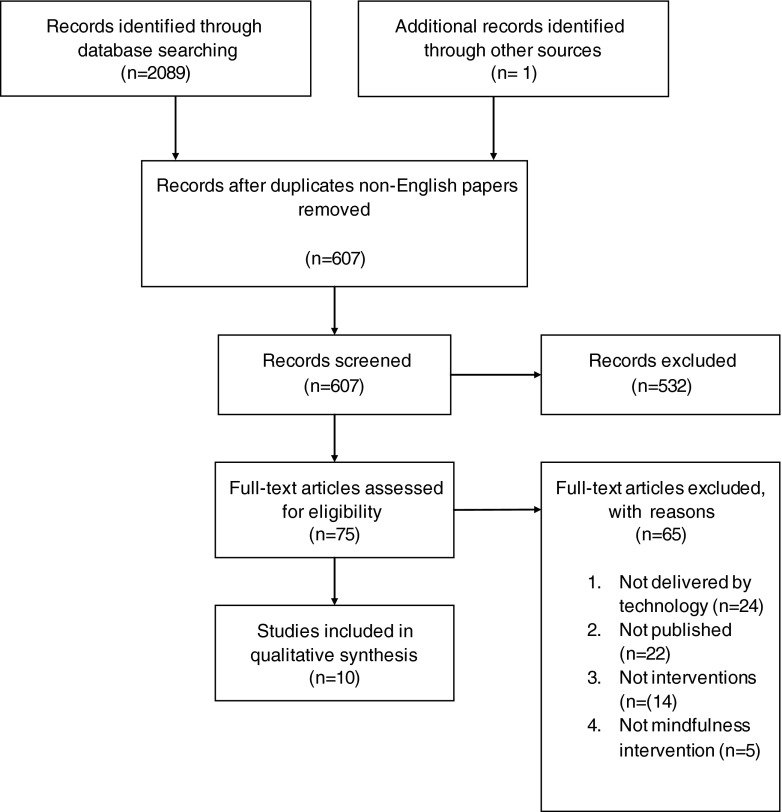
“Of these, 24 were not technology-delivered, 22 were not published research, 14 were not interventions and four were not mindfulness interventions.”
Background
Cited by
Gupta, S., Kumar, P., & Tekchandani, R. K. (2023) · Multimedia Tools and Applications · doi:10.1007/s11042-022-13558-9 · Cited by 230
The future of mindfulness training is digital, and the future is now
Mrazek, A. J., Mrazek, M. D., Cherolini, C. M., Cloughesy, J. N., Cynman, D. J., Gougis, L. J., Landry, A. P., Reese, J. V., & Schooler, J. W. (2019) · Current Opinion in Psychology · doi:10.1016/j.copsyc.2018.11.012 · Cited by 201
Mindfulness‐based stress reduction for psychological distress among nurses: A systematic review
Ghawadra, S. F., Abdullah, K. L., Choo, W. Y., & Phang, C. K. (2019) · Journal of Clinical Nursing · doi:10.1111/jocn.14987 · Cited by 162
Noone, C., & Hogan, M. J. (2018) · BMC Psychology · doi:10.1186/s40359-018-0226-3 · Cited by 140
Walsh, K. M., Saab, B. J., & Farb, N. A. (2019) · JMIR Mental Health · doi:10.2196/10844 · Cited by 123
“Technology-delivered mindfulness-based interventions have proven to be successful in improving well-being [27-29], including reductions in anxiety, depression, and stress [20,30-36].”
Metadata
- Authors
- Fish, J., Brimson, J., & Lynch, S.
- Affiliations
- King's College London (GB)
- Corresponding author
- Fish, James
- ORCID
- Fish, James
- Venue
- Mindfulness
- Published
- 2016-06-02
- Volume
- 7
- Issue
- 5
- Pages
- 1011-1023
- ISSN
- 1868-8527 (ISSN-L)
- 1868-8535
- PMC
- PMC5010616
- OpenAlex
- W2413261855
- Cited by
- 126
- References
- 36
- Citations by year
- 2026: 2 · 2025: 8 · 2024: 16 · 2023: 10 · 2022: 16 · 2021: 23 · 2020: 15 · 2019: 10 · 2018: 18 · 2017: 5 · 2016: 3
- FWCI
- 1.78
- Type
- journal article
- Language
- en
- Open access
- hybrid
- doi.org
- Locations
- Mindfulness (publishedVersion, cc-by)
- PubMed Central (publishedVersion, cc-by)
- PubMed (publishedVersion)
- St Andrews Research Repository (St Andrews Research Repository) (submittedVersion, cc-by)
- Topics
- Social Sciences › Psychology › Clinical Psychology › Mindfulness and Compassion Interventions
- Social Sciences › Psychology › Applied Psychology › Digital Mental Health Interventions
- Health Sciences › Health Professions › General Health Professions › Mobile Health and mHealth Applications
- Keywords
- mindfulness-based interventions, technology-based interventions, mindfulness-based stress reduction, depression, anxiety, stress, clinical outcomes
About these checks
Registry, retraction, Cites and statistics results are computed, not judged, with one exception: a printed reference that no index lists is read once by a model before it counts as a citation error. Claims are extracted by a model and kept only when their quote appears verbatim in the text; each cited source is then checked, with a model’s help, for whether it says what the claim relies on. Those verdicts can be wrong — read the claim’s quote and the cited source before relying on one.
Statistics and arithmetic are recomputed, not judged.
Confidence bands are shown only for fields calibrated on our annotated test set. None is calibrated yet, so no band is shown.
What counts as a claim ›How we measure confidence ›How we check this ›
Are you an author, or do you see a problem with this page? Request a review
Data sources
Bibliographic data: Semantic Scholar, OpenAlex, Crossref.
Contains information from the Semantic Scholar Academic Graph Datasets, made available under the ODC Attribution License (ODC-BY 1.0).
Semantic Scholar’s data is described in: Kinney, R., et al. (2023). The Semantic Scholar Open Data Platform. arXiv:2301.10140.
