

The DOI matches its Crossref record; 76 of the 77 references it cites were found in a registry or an index.
The Effectiveness of Mindfulness-Based Interventions on Maternal Perinatal Mental Health Outcomes: a Systematic Review
Open accessAbstract
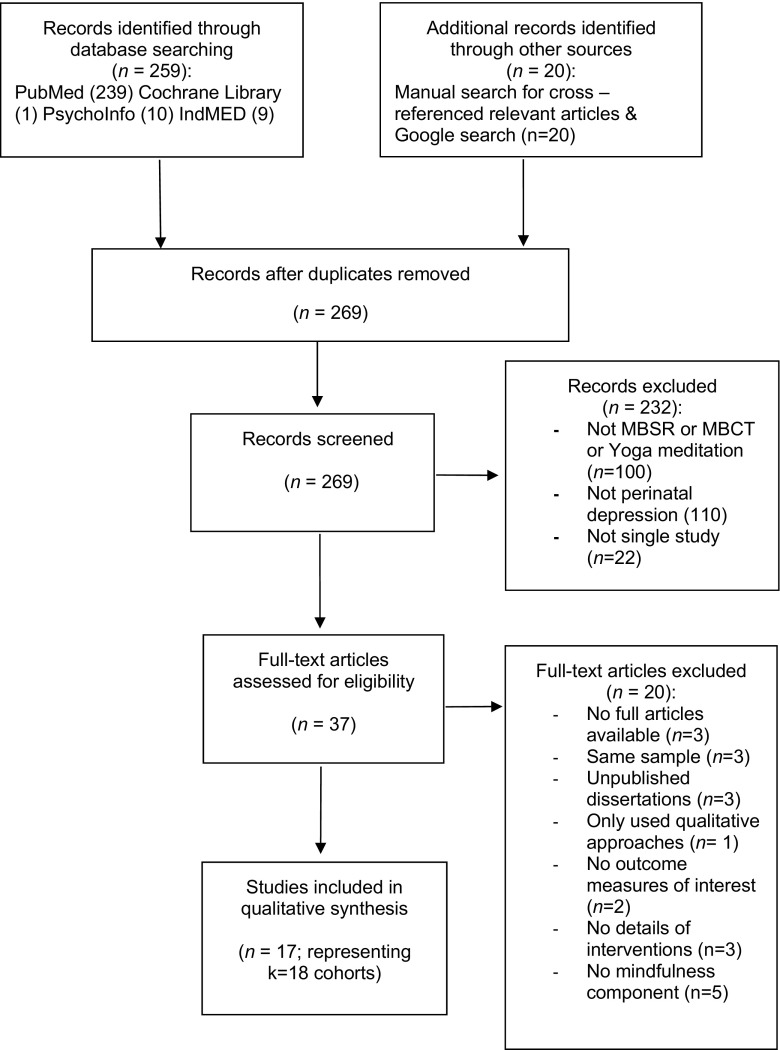
Presenting with common mental health difficulties, particularly depression and anxiety, there is also preliminary evidence that mindfulness-based interventions (MBIs) including mindfulness-based cognitive therapy (MBCT), mindfulness-based stress reduction (MBSR) and integrated mindfulness yoga practices may also be effective in reducing common mental health difficulties during pregnancy. We systematically reviewed and synthesized the current literature on the effectiveness of MBIs in reducing severity of perinatal anxiety and depression. Databases including PubMed, Cochrane Library, IndMED and PsychoInfo were searched for relevant studies. Manual searches were conducted in relevant articles and Google Scholar. Seventeen cohorts representing 18 studies were included. Pre-post effect sizes were reported for both treatment and control groups. Seven randomized controlled trials (RCTs), two non-randomized controlled trials and nine treatment evaluations were included. Maternal participation in an MBI was associated with reductions in perinatal anxiety of moderate to large magnitude. Results for the effect of MBIs on depression were less consistent, with pre-post treatment reductions of moderate magnitude, but no significant differences in depression scores when MBI was compared with a control group. There was some evidence that MBIs were associated with increased mindfulness. Risk of bias in studies was variable. Our review offers preliminary evidence for the effectiveness of MBIs in reducing perinatal anxiety, with more equivocal findings with regard to perinatal depressive symptoms. Further methodologically rigorous evaluation using RCTs and longer follow-up periods are recommended.
Overview
The claims and statistics of this paper haven’t been checked yet.
Run the check — free, no account needed. It reads the open-access text and checks the sources it cites.
Integrity signals
Registry
Cites
Statistics
Figures
Verification
Claims the paper makes
The claims and statistics of this paper haven’t been checked yet.
Run the check — free, no account needed. It reads the open-access text and checks the sources it cites.
Claims other papers make about this one
Each is checked against this paper’s own text: does it say what the citing paper says it does?
The source backs part of the claim, not all of it — or backs it for a different population, condition or comparison.
In the citing paper
“Systematic reviews and meta-analyses point towards a trend in favor of mindfulness-based interventions but state that shortcomings in study designs limit the conclusions.”
From Mindfulness-based stress reduction adapted to pregnant women with psychosocial vulnerabilities—a protocol for a randomized feasibility study in a Danish hospital-based outpatient setting (2021) · cites this paper as [3]
Experimental — accuracy not yet measuredThe source backs part of the claim, not all of it — or backs it for a different population, condition or comparison.
In the citing paper
“Moreover, it is an acceptable intervention for pregnant women [3].”
From Mindfulness-based stress reduction adapted to pregnant women with psychosocial vulnerabilities—a protocol for a randomized feasibility study in a Danish hospital-based outpatient setting (2021) · cites this paper as [3]
Experimental — accuracy not yet measuredThe source backs part of the claim, not all of it — or backs it for a different population, condition or comparison.
In the citing paper
“The majority of studies are pilot and feasibility trials that are not adequately powered to demonstrate the effectiveness [3, 18, 19].”
From Mindfulness-based stress reduction adapted to pregnant women with psychosocial vulnerabilities—a protocol for a randomized feasibility study in a Danish hospital-based outpatient setting (2021) · cites this paper as [3]
Experimental — accuracy not yet measuredThe cited source says what the claim attributes to it.
In the citing paper
“Similarly, a systematic review of the effectiveness of MBIs on maternal perinatal mental health outcomes offered preliminary evidence for the effectiveness of the interventions in reducing anxiety [26].”
From HAPPY MAMA Project (Part 2)—Maternal Distress and Self-Efficacy: A Pilot Randomized Controlled Field Trial (2022) · cites this paper as [26]
The cited source says what the claim attributes to it.
In the citing paper
“However, more research is needed to explore the possible benefits of mindfulness-based interventions on mental health in pregnancy, and in particular in psychosocially vulnerable groups [3, 19].”
Self-check
Percentages, sums and reported differences re-computed from the paper’s own numbers.
The self-check needs the paper’s full text.
Citations
Cites
The CES-D Scale: A Self-Report Depression Scale for Research in the General Population
Radloff, L. S. (1977) · Applied Psychological Measurement · doi:10.1177/014662167700100306 · Cited by 53,267
The Cochrane Collaboration's tool for assessing risk of bias in randomised trials
Higgins, J. P. T., Altman, D. G., Gotzsche, P. C., Juni, P., Moher, D., Oxman, A. D., Savovic, J., Schulz, K. F., Weeks, L., Sterne, J. A. C., et al. (2011) · BMJ · doi:10.1136/bmj.d5928 · Cited by 33,817
A Global Measure of Perceived Stress
Cohen, S., Kamarck, T., & Mermelstein, R. (1983) · Journal of Health and Social Behavior · doi:10.2307/2136404 · Cited by 32,807
PRISMA-P Group, Moher, D., Shamseer, L., Clarke, M., Ghersi, D., Liberati, A., Petticrew, M., Shekelle, P., & Stewart, L. A. (2015) · Systematic Reviews · doi:10.1186/2046-4053-4-1 · Cited by 26,223
Dermyshi, E., Wang, Y., Yan, C., Hong, W., Qiu, G., Gong, X., & Zhang, T. (2017) · Neonatology · doi:10.1159/000454668 · Cited by 24,586
Lovibond, P. F., & Lovibond, S. H. (1995) · Behaviour Research and Therapy · doi:10.1016/0005-7967(94)00075-u · Cited by 14,523
Detection of Postnatal Depression: Development of the 10-item Edinburgh Postnatal Depression Scale
Cox, J. L., Holden, J. M., & Sagovsky, R. (1987) · British Journal of Psychiatry · doi:10.1192/bjp.150.6.782 · Cited by 14,183
Mindfulness-based interventions in context: Past, present, and future
Kabat-Zinn, J. (2003) · Clinical Psychology: Science and Practice · doi:10.1093/clipsy.bpg016 · Cited by 8,615 · cited 1×
“A large number of studies suggest mindfulness-based interventions (MBIs) such as Mindfulness-based stress reduction (MBSR; Kabat-Zinn 2003) and Mindfulness-based cognitive therapy (MBCT; Segal et al. 2002) are effective psychological interventions to reduce depression and anxiety in clinical and…”
BackgroundMindfulness-based interventions in context: Past, present, and future.
Kabat-Zinn, J. (2003) · Clinical Psychology: Science and Practice · doi:10.1093/clipsy/bpg016 · Cited by 8,612
Using Self-Report Assessment Methods to Explore Facets of Mindfulness
Baer, R. A., Smith, G. T., Hopkins, J., Krietemeyer, J., & Toney, L. (2006) · Assessment · doi:10.1177/1073191105283504 · Cited by 7,511
Research works printed but not linked: 3
- Beck, A. T., Steer, R. A., & Brown, G. K. (1996). Manual for The Beck Depression Inventory Second Edition (BDI-II). San Antonio: Psychological Corporation.
- Cohen, J. (1988). Statistical power analysis for the behavioural sciences. Hillsdale, MI: Lawrence Erlbaum Associates.
- Spielberger, C. D. (1989). State-Trait Anxiety Inventory: Bibliography (2nd ed.). Palo Alto, CA: Consulting Psychologists Press
Cited by
Sorted by citations
Mindfulness-based interventions: an overall review
Zhang, D., Lee, E. K. P., Mak, E. C. W., Ho, C. Y., & Wong, S. Y. S. (2021) · British Medical Bulletin · doi:10.1093/bmb/ldab005 · Cited by 668
The Economic Case for the Prevention of Mental Illness
McDaid, D., Park, A., & Wahlbeck, K. (2019) · Annual Review of Public Health · doi:10.1146/annurev-publhealth-040617-013629 · Cited by 261
Mental Health in Women Living With HIV: The Unique and Unmet Needs
Waldron, E. M., Burnett‐Zeigler, I., Wee, V., Ng, Y. K. W., Koenig, L. J., Pederson, A. B., Tomaszewski, E. P., & Miller, E. S. (2021) · Journal of the International Association of Providers of AIDS Care (JIAPAC) · doi:10.1177/2325958220985665 · Cited by 174
Sun, Y., Li, Y., Wang, J., Chen, Q., Bazzano, A. N., & Cao, F. (2021) · Journal of Medical Internet Research · doi:10.2196/23410 · Cited by 165
Zemestani, M., & Fazeli Nikoo, Z. (2020) · Archives of Women's Mental Health · doi:10.1007/s00737-019-00962-8 · Cited by 127
Metadata
- Authors
- Shi, Z., & MacBeth, A.
- Affiliations
- University of Edinburgh (GB)
- Corresponding author
- MacBeth, Angus
- ORCID
- MacBeth, Angus
- Venue
- Mindfulness
- Published
- 2017-01-19
- Volume
- 8
- Issue
- 4
- Pages
- 823-847
- ISSN
- 1868-8527 (ISSN-L)
- 1868-8535
- PMC
- PMC5506176
- OpenAlex
- W2571740036
- Cited by
- 148
- References
- 77
- Citations by year
- 2026: 9 · 2025: 23 · 2024: 11 · 2023: 30 · 2022: 22 · 2021: 24 · 2020: 11 · 2019: 12 · 2018: 6
- FWCI
- 1.29
- Type
- journal article
- Language
- en
- Open access
- hybrid
- doi.org
- Locations
- Mindfulness (publishedVersion, cc-by)
- PubMed Central (publishedVersion, cc-by)
- PubMed (publishedVersion)
- Edinburgh Research Explorer (University of Edinburgh) (submittedVersion, cc-by)
- Funders
- University of Edinburgh
- Topics
- Health Sciences › Medicine › Public Health, Environmental and Occupational Health › Maternal Mental Health During Pregnancy and Postpartum
- Social Sciences › Psychology › Clinical Psychology › Mindfulness and Compassion Interventions
- Social Sciences › Psychology › Applied Psychology › Digital Mental Health Interventions
- Keywords
- mindfulness-based interventions, perinatal anxiety, perinatal depression, maternal mental health, mindfulness-based cognitive therapy, mindfulness-based stress reduction, mindfulness yoga, pregnancy
About these checks
Registry, retraction, Cites and statistics results are computed, not judged, with one exception: a printed reference that no index lists is read once by a model before it counts as a citation error. Claims are extracted by a model and kept only when their quote appears verbatim in the text; each cited source is then checked, with a model’s help, for whether it says what the claim relies on. Those verdicts can be wrong — read the claim’s quote and the cited source before relying on one.
Statistics and arithmetic are recomputed, not judged.
Confidence bands are shown only for fields calibrated on our annotated test set. None is calibrated yet, so no band is shown.
What counts as a claim ›How we measure confidence ›How we check this ›
Are you an author, or do you see a problem with this page? Request a review
