

For Whom Does Mindfulness-Based Stress Reduction Work? Moderating Effects of Personality
Open accessThe DOI matches its Crossref record; 45 of the 47 references it cites were found in a registry or an index.
Abstract
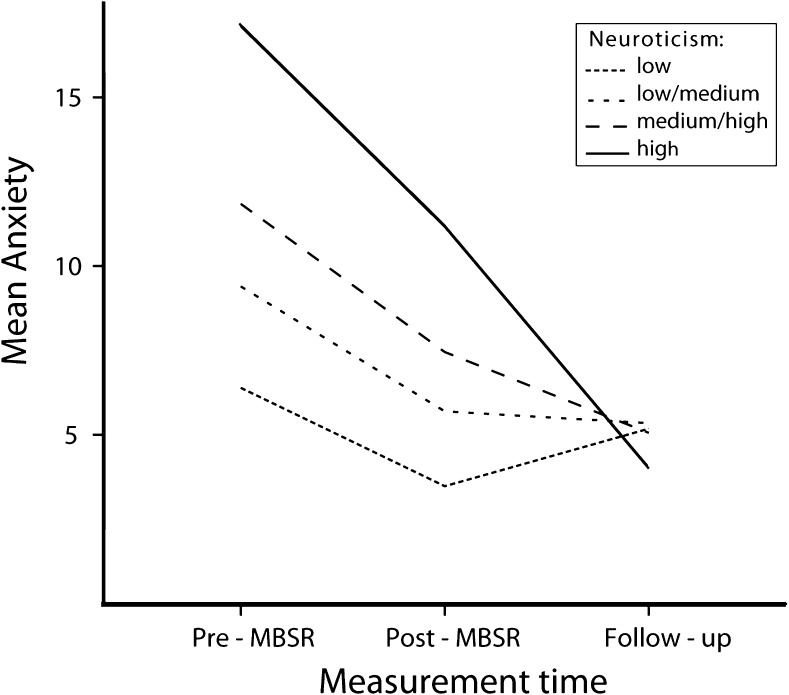
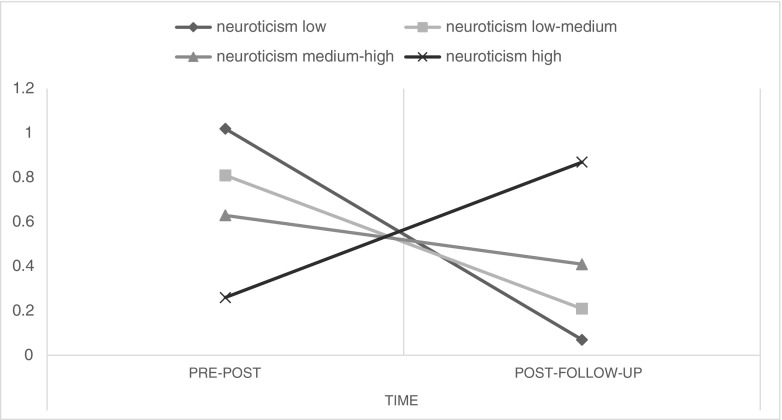
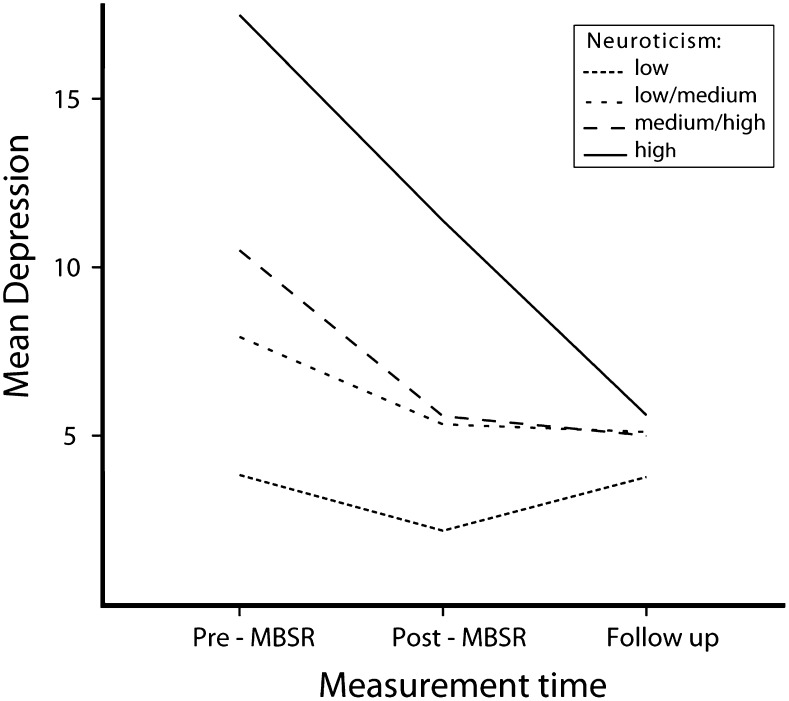
The aim of the present study was to examine potentially moderating effects of personality characteristics regarding changes in anxious and depressed mood associated with Mindfulness-Based Stress Reduction (MBSR), controlling for socio-demographic factors. Meditation-naïve participants from the general population self-presenting with psychological stress complaints ( n = 167 participants, 70% women, mean age 45.8 ± 9.3 years) were assessed in a longitudinal investigation of change in mood before and after the intervention and at a 3-month follow-up. Participants initially scoring high on neuroticism showed stronger decreases in both anxious and depressed mood (both p < 0.001). However, when controlled for baseline mood, only the time by neuroticism interaction effect on anxiety remained significant ( p = 0.001), reflecting a smaller decrease in anxiety between pre- and post-intervention but a larger decrease in anxiety between post-intervention and follow-up in those with higher baseline neuroticism scores. Most personality factors did not show moderating effects, when controlled for baseline mood. Only neuroticism showed to be associated with delayed benefit. Results are discussed in the context of findings from similar research using more traditional cognitive-behavioral interventions.
Overview
The claims and statistics of this paper haven’t been checked yet.
Free: it reads the open-access text and checks the first 5 claims that cite a source we can check. Create a free account to check every claim.
Integrity signals
Registry
Cites
Statistics
Figures
Verification
Claims the paper makes
The claims and statistics of this paper haven’t been checked yet.
Free: it reads the open-access text and checks the first 5 claims that cite a source we can check. Create a free account to check every claim.
Claims other papers make about this one
Each is checked against this paper’s own text: does it say what the citing paper says it does?
The source backs part of the claim, not all of it — or backs it for a different population, condition or comparison.
In the citing paper
“In contrast, two studies found that individuals with greater pre-treatment neuroticism experienced a greater reduction in distress (de Vibe et al., 2015) and anxiety (Nyklíček & Irrmischer, 2017) after an MBSR course, independent of pre-treatment mood in one case (Nyklíček & Irrmischer, 2017).”
From Who Benefits Most from a Brief Mindfulness Intervention to Reduce Anxiety During Stereotactic Breast Biopsy: the Moderating Effect of Trait Mindfulness, Spiritual Well-being, and Distress Tolerance (2021) · cites this paper as Nyklíček & Irrmischer, 2017
Experimental — accuracy not yet measured
Self-check
Percentages, sums and reported differences re-computed from the paper’s own numbers.
The self-check needs the paper’s full text.
Citations
Cites
The benefits of being present: Mindfulness and its role in psychological well-being
Brown, K. W., & Ryan, R. M. (2003) · Journal of Personality and Social Psychology · doi:10.1037/0022-3514.84.4.822 · Cited by 13,448
Using Self-Report Assessment Methods to Explore Facets of Mindfulness
Baer, R. A., Smith, G. T., Hopkins, J., Krietemeyer, J., & Toney, L. (2006) · Assessment · doi:10.1177/1073191105283504 · Cited by 7,511 · cited 9×
“This attitude, consisting of a set of learnable skills, is often defined as being attentive to phenomena occurring in the present moment in a nonjudgmental or accepting way (Baer et al. 2006; Brown and Ryan 2003; Kabat-Zinn 1990).”
BackgroundInfluential(2008) · Medical Entomology and Zoology · Cited by 7,477
Shapiro, S. L., Carlson, L. E., Astin, J. A., & Freedman, B. (2006) · Journal of Clinical Psychology · doi:10.1002/jclp.20237 · Cited by 4,002 · cited 1×
“In general, CBT shows weaker benefit regarding anxious and depressed mood for those high in neuroticism, perhaps making changemore difficult for those having amore stable propensity to negative affect (Quilty et al. 2008; Spek et al. 2008; Taylor andMclean 1993;Wolitzky-Taylor et al. 2012).”
BackgroundThe effect of mindfulness based therapy on anxiety and depression: A meta analytic review
Hofmann, S. G., Sawyer, A. T., Witt, A. A., & Oh, D. (2010) · Journal of Consulting and Clinical Psychology · doi:10.1037/a0018555 · Cited by 3,846 · cited 3×
“First, consistent with previous studies as summarized in recent reviews and meta-analyses (Fjorback et al. 2011; Hofmann et al. 2010; Khoury et al. 2013), overall decreasing anxious and depressed mood have been found in the present study.”
BackgroundResultClinical Psychology: Science and Practice
(2021) · Clinical Psychology Science and Practice · doi:10.1111/(issn)1468-2850 · Cited by 3,672
Psychological flexibility as a fundamental aspect of health
Kashdan, T. B., & Rottenberg, J. (2010) · Clinical Psychology Review · doi:10.1016/j.cpr.2010.03.001 · Cited by 3,054 · cited 7×
“Perhaps the central mindfulnessaspectof (self)acceptance incombinationwithasafe andacceptinggroupformatof theinterventionlargelyfocusingon introspective and interoceptive processes may be well fitting the more introverted participants, which may have balanced out the expected potential benefit of extraversion associat…”
BackgroundInfluentialEffects of mindfulness on psychological health: A review of empirical studies
Keng, S.-L., Smoski, M. J., & Robins, C. J. (2011) · Clinical Psychology Review · doi:10.1016/j.cpr.2011.04.006 · Cited by 2,687 · cited 1×
“Recent systematic reviews (Chiesa and Serretti 2010; Fjorback et al. 2011; Keng et al. 2011) and meta-analyses (Hofmann et al. 2010; Khoury et al. 2013) on the effectiveness of MBSR regarding psychological outcomes have concluded that MBSR and its variant Mindfulness-Based Cognitive Therapy (MBCT)…”
BackgroundMcCrae, R. R., & Costa, P. T. (2010) · Medical Entomology and Zoology · Cited by 2,345
Assessment of Mindfulness by Self-Report: The Kentucky Inventory of Mindfulness Skills
Baer, R. A., Smith, G. T., & Allen, K. B. (2004) · Assessment · doi:10.1177/1073191104268029 · Cited by 2,298
Research works printed but not linked: 1
- Wald FDM Mellenbergh GJ De verkorte versie van de Nederlandse vertaling van de Profile of Mood States (POMS) [the shortened version of the Dutch translation of the Profile of Mood States (POMS)] Nederlands Tijdschrift voor de Psychologie 1990 45 86 90
Cited by
Mak, W. W., Tong, A. C., Yip, S. Y., Lui, W. W., Chio, F. H., Chan, A. T., & Wong, C. C. (2018) · JMIR Mental Health · doi:10.2196/mental.8597 · Cited by 123
“Previous studies showed that people scoring high on neuroticism tend to show greater decrease in anxiety and depressive symptoms 3 months after mindfulness-based stress reduction program, whereas introverts were less likely to drop out from mindfulness-based training [43,44].”
Galante, J., Friedrich, C., Collaboration of Mindfulness Trials (CoMinT), Aeamla-Or, N., Arts-de Jong, M., Barrett, B., Bögels, S. M., Buitelaar, J. K., Checovich, M. M., Christopher, M. S., et al. (2023) · Nature Mental Health · doi:10.1038/s44220-023-00081-5 · Cited by 113
“While some studies support this suggestion 44 , age was not a significant effect modifier in the clinical MBCT IPD meta-analysis nor in other studies 34,45 .”
Tang, R., & Braver, T. S. (2020) · Frontiers in Psychology · doi:10.3389/fpsyg.2020.00818 · Cited by 91
“The General Health Questionnaire Subjective well-being – Subjective Well-being Scale Student stress – Perceived Medical School Stress Nyklíček and Irrmischer, 2017 Longitudinal MBSR 167 Neuroticism – Revised NEO Personality Inventory Anxiety – Profile of Mood States Krick and Felfe, 2019 RCT Mindfulness intervention/…”
BackgroundMethodInfluentialRosenkranz, M. A., Dunne, J. D., & Davidson, R. J. (2019) · Current Opinion in Psychology · doi:10.1016/j.copsyc.2018.12.022 · Cited by 81
A balanced view of mindfulness at work
Choi, E., Gruman, J. A., & Leonard, C. (2021) · Organizational Psychology Review · doi:10.1177/20413866211036930 · Cited by 90
“Similar results were obtained by Nykĺıček and Irrmischer (2017) who found that neuroticism moderated changes in anxiety levels among participants who took part in mindfulness-based stress reduction training.”
ResultBurrowes, S. A. B., Goloubeva, O. G., Stafford, K. A., McArdle, P. F., Goyal, M., Peterlin, B. L., Haythornthwaite, J. A., & Seminowicz, D. A. (2021) · Pain · doi:10.1097/j.pain.0000000000002372 · Cited by 76
Karl, J. A., Johnson, F. N., Bucci, L., & Fischer, R. (2022) · Journal of the Royal Society of New Zealand · doi:10.1080/03036758.2021.1915804 · Cited by 44
“Research that investigated the influence of bottom-up effects in mindful practice demonstrated that personality differences influence the effect of mindfulness practice on outcomes such as wellbeing (de Vibe et al. 2015; Nyklíček and Irrmischer 2017; Jagielski et al. 2020; Krick and Felfe 2020), which suggests that in…”
BackgroundAdverse Meditation Experiences: Navigating Buddhist and Secular Frameworks for Addressing Them
Compson, J. (2018) · Mindfulness · doi:10.1007/s12671-017-0878-8 · Cited by 40
A Qualitative Investigation of the Experience of Mindfulness Training Among Police Officers
Eddy, A., Bergman, A. L., Kaplan, J., Goerling, R. J., & Christopher, M. (2019) · Journal of Police and Criminal Psychology · doi:10.1007/s11896-019-09340-7 · Cited by 45
Predicting Individual Preferences in Mindfulness Techniques Using Personality Traits
Tang, R., & Braver, T. S. (2020) · Frontiers in Psychology · doi:10.3389/fpsyg.2020.01163 · Cited by 47
“Based on prior studies of individual differences in psychotherapy and MBIs, personality and dispositional traits are promising candidates that have been shown to influence standardized intervention effectiveness and outcomes (Chapman et al., 2014; de Vibe et al., 2015; Nyklíček and Irrmischer, 2017).”
BackgroundThe Insight Knowledge of Fear and Adverse Effects of Mindfulness Practices
Anālayo, B. (2019) · Mindfulness · doi:10.1007/s12671-019-01198-4 · Cited by 37
“There is in fact considerable evidence that MBIs tend to be effective in reducing anxiety and depression (Goldberg et al. 2018; Hofmann et al. 2010; Khoury et al. 2013; Nyklíček and Irrmischer 2017; Wang et al. 2018), rather than causing it.”
BackgroundWebb, C. A., Swords, C. M., Lawrence, H. R., & Hilt, L. M. (2022) · Journal of Consulting and Clinical Psychology · doi:10.1037/ccp0000763 · Cited by 43
Осин, Е. Н., & Turilina, I. I. (2021) · Applied Psychology Health and Well-Being · doi:10.1111/aphw.12293 · Cited by 39
Küchler, A., Kählke, F., Vollbrecht, D., Peip, K., Ebert, D. D., & Baumeister, H. (2022) · Mindfulness · doi:10.1007/s12671-022-01949-w · Cited by 45
“Contrary to earlier findings, we could not confirm that participants with higher baseline mindfulness (Shapiro et al., 2011), neuroticism (de Vibe et al., 2015), or extraversion (Nyklíček & Irrmischer, 2017) benefited more from our intervention.”
BackgroundResultGoisbault, M., Lienhart, N., Martinent, G., & Doron, J. (2022) · Psychology of sport and exercise · doi:10.1016/j.psychsport.2022.102157 · Cited by 41
Nyklíček, I., van Son, J., Pop, V. J., Denollet, J., & Pouwer, F. (2016) · Journal of Psychosomatic Research · doi:10.1016/j.jpsychores.2016.10.009 · Cited by 28
Self-citationRowland, Z., Wenzel, M., & Kubiak, T. (2019) · Mindfulness · doi:10.1007/s12671-019-01204-9 · Cited by 30
Sleimen-Malkoun, R., Devillers-Réolon, L., & Temprado, J.-J. (2023) · PLoS ONE · doi:10.1371/journal.pone.0282188 · Cited by 33
“In the context of MM, it is supported, inter alia, by studies showing that personality traits moderate the cognitive [19], psychological [20] and physiological [21] benefits of MM practice.”
ResultFang, Y., Kang, X., Feng, X., Zhao, D., Song, D., & Li, P. (2018) · Psychology Health & Medicine · doi:10.1080/13548506.2018.1492731 · Cited by 32
“…by mindfulness, and personality (i.e., neuroticism, extraversion, and conscientiousness) moderate its effect on perceived stress, emotional distress, and other stress-related psychological symptoms(De Vibe et al., 2015; Nyklicek & Irrmischer, 2017; Nyklicek, Van Son, Pop, Denollet, & Pouwer, 2016).”
BackgroundProtein Supplementation and Resistance Training in Childhood Cancer Survivors
Krull, M. R., Howell, C. R., Partin, R. E., Lanctot, J. Q., Phipps, S., Klosky, J. L., Carney, G., Mulrooney, D. A., Robison, L. L., Hudson, M. M., et al. (2020) · Medicine & Science in Sports & Exercise · doi:10.1249/mss.0000000000002345 · Cited by 22
“For instance, mindfulness-based stress reduction approaches (34) help these individuals reduce psychological distress by learning how to regulate emotional responses; using mindfulness-based stress reduction approaches in physical ac-”
BackgroundSchlatter, S., Louisy, S., Canada, B., Thérond, C., Duclos, A., Blakeley, C., Lehot, J.-J., Rimmele, T. R., Guillot, A., Lilot, M., et al. (2022) · Scientific Reports · doi:10.1038/s41598-022-24905-z · Cited by 26
Jagielski, C. H., Tucker, D. C., Dalton, S. O., Mrug, S., Würtzen, H., & Johansen, C. (2020) · Journal of Psychosocial Oncology · doi:10.1080/07347332.2019.1626524 · Cited by 20
“Similar findings were found in a study of 167 participants in a community sample where high neuroticism was the only personality factor associated with decreased anxiety following an MBSR intervention.(43) Of note, while neuroticism was associated with a small decrease in anxiety immediately post-intervention, it was…”
ResultTortella‐Feliu, M., Luís-Reig, J., Gea, J., Cebolla, A., & Soler, J. (2020) · Mindfulness · doi:10.1007/s12671-020-01471-x · Cited by 19
“…to a smaller decrease in anxiety symptoms at the end of the intervention but presented larger reductions from postintervention to follow-up (Nyklíček and Irrmischer 2017), while other studies reported immediate benefits for those scoring high in neuroticism at baseline (de Vibe et al. 2015).”
ResultLu, F., Xu, Y., Yu, Y., Zhao, R., Peng, L., Liu, B., & Li, M. (2023) · Nurse Education in Practice · doi:10.1016/j.nepr.2023.103640 · Cited by 17
Cognitive fusion and personality traits in the context of mindfulness: A cross-sectional study
Pux, S., Hahn, E. W., Bergmann, N., Hahne, I., Pauly, L., Ta, T. M. T., Pijenborg, G. H. M., & Böge, K. (2022) · PLoS ONE · doi:10.1371/journal.pone.0273331 · Cited by 20
“This observation corresponds to Neuroticism consistently being found to be most strongly associated with mindfulness, psychological flexibility, and negative affect [32, 33, 36] and sharing considerable conceptual overlap with inflexibility and negative affect [65].”
Gan, Y., Wang, R., Wang, X., Li, J., & Fan, H. (2023) · International Journal of Sports Science & Coaching · doi:10.1177/17479541231159171 · Cited by 22
“For instance, Nyklíc ̌ ek and Irrmischer 16 believe that it is theoretically and clinically important to identify a moderating factor that may in fl uence the size and direction of intervention effects.”
BackgroundResultCultivating ambiguity tolerance through mindfulness: An induction randomized controlled trial
Spinelli, C., Ibrahim, M., & Khoury, B. (2022) · Current Psychology · doi:10.1007/s12144-021-02597-4 · Cited by 24
“Several researchers identified those having higher neuroticism deriving more benefit from mindfulness training on psychological outcomes, and some also noted moderating effects of conscientiousness and openness (de Vibe et al., 2015; Krick & Felfe, 2020; Nyklíček & Irrmischer, 2017).”
BackgroundPavani, J., Berna, G., Andreotti, E., Guiller, T., Antoine, P., Dauvier, B., & Congard, A. (2019) · Applied Psychology Health and Well-Being · doi:10.1111/aphw.12189 · Cited by 16
“This has indeed been shown to be the case in several initial studies of this issue (Antoine, Congard, et al., 2018; Bhayee et al., 2016; Nyklíček & Irrmischer, 2017).”
ResultSparacio, A., Ropovik, I., Jiga‐Boy, G. M., Forscher, P. S., Paris, B., & IJzerman, H. R. (2021) · PsyArXiv (OSF Preprints) · doi:10.31234/osf.io/zpw28 · Cited by 14
Matko, K., Berghöfer, A., Jeitler, M., Sedlmeier, P., & Bringmann, H. C. (2022) · doi:10.31231/osf.io/9rbqe · Cited by 13
“There have been mixed findings regarding the moderating role of extraversion on MBM intervention outcomes [25,76].”
BackgroundResultTang, Y., & Tang, R. (2020) · Elsevier eBooks · doi:10.1016/b978-0-12-818266-6.00003-4 · Cited by 17
Akase, M., Terao, T., Kawano, N., Sakai, A., Hatano, K., Shirahama, M., Hirakawa, H., Kohno, K., & Ishii, N. (2020) · Frontiers in Psychiatry · doi:10.3389/fpsyt.2020.00252 · Cited by 16
“The interaction between low conscientiousness and MBSR and that between high neuroticism and MBSR each predicted significantly lower levels of depression and distress at 12-month follow-up compared to women who were higher in conscientiousness or lower in neuroticism (13).”
BackgroundInfluentialSaux, O. L., Canada, B., Debarnot, U., Haouhache, N. E. H., Lehot, J.-J., Binay, M., Cortet, M., Rimmelé, T., Duclos, A., Rode, G., et al. (2024) · Academic Medicine · doi:10.1097/acm.0000000000005714 · Cited by 15
Baranski, M. F. S. (2021) · Journal of Cognitive Enhancement · doi:10.1007/s41465-020-00198-w · Cited by 17
Spreading positive change: Societal benefits of meditation
Engert, V., Klimecki, O., & Kanske, P. (2023) · Frontiers in Psychiatry · doi:10.3389/fpsyt.2023.1038051 · Cited by 25
Hou, L., Chang, L., Chen, L., Fei, J., & Zhou, R. (2022) · International Journal of Public Health · doi:10.3389/ijph.2022.1605074 · Cited by 16
“Nyklíček1 and Irrmischer (2017) found that highly neurotic participants showed stronger decreases in both anxious and depressed mood than lowly neurotic students [66].”
BackgroundThe relationship between neuroticism as a personality trait and mindfulness skills: a scoping review
Angarita‐Osorio, N., Escorihuela, R. M., & Cañete, T. (2024) · Frontiers in Psychology · doi:10.3389/fpsyg.2024.1401969 · Cited by 22
“Nyklíček and Irrmischer (2017) assessed the effect of personality on mood changes after MBSR training and found that neuroticism was associated with benefits3 in the reduction of anxiety and depressed mood.”
刘美林, Guo, Y., Bai, J., Wang, Z., 韩继明, Zhu, J., & Wang, J. (2025) · Australian Critical Care · doi:10.1016/j.aucc.2025.101255 · Cited by 14
Galante, J., Friedrich, C., Dalgleish, T., White, I. R., & Jones, P. B. (2022) · BMJ Open · doi:10.1136/bmjopen-2021-058976 · Cited by 9
A Systematic Review and Taxonomy of Neuroticism Interventions for the General PublicPreprint
Wright, A. J., Haehner, P., Hopwood, C. J., & Bleidorn, W. (2024) · PsyArXiv (OSF Preprints) · doi:10.31234/osf.io/jy3eb · Cited by 17
Atalay, A. A., Abdulcebbar, A., Kantarcı, L., & Yılmaz, E. (2024) · Current Psychology · doi:10.1007/s12144-024-06243-7 · Cited by 13
“Although some recent studies indicated a similar relationship between mindfulness and trait-based vulner - ability factors (Feltman et al., 2009 ; Nyklíček & Irrmischer, 2017 ), this function of mindfulness has received less inter - est from the researchers.”
Ratcliff, C. G., Fowler, S. N., Sinclair, K. L., Prinsloo, S., Chaoul, A., Zepeda, S. G., Spelman, A., Yang, W. T., & Cohen, L. (2021) · Mindfulness · doi:10.1007/s12671-020-01581-6 · Cited by 5
A Systematic Review and Taxonomy of Neuroticism Interventions for the General Public
Wright, A. J., Haehner, P., Hopwood, C. J., & Bleidorn, W. (2026) · Personality Science · doi:10.1177/27000710261421531 · Cited by 9
Matiz, A., Pascut, S., Fabbro, F., & Crescentini, C. (2025) · Mindfulness · doi:10.1007/s12671-025-02573-0 · Cited by 7
“…of the moderating role of personality on the effects of MBIs, where it was found that significant MBI improvements were more likely to be observed for higher neuroticism and lower conscientiousness (De Vibe et al., 2015; Nyklı́ček & Irrmischer, 2017; Krick & Felfe, 2020; Jagielski et al., 2020).”
InfluentialHolas, P., & Wardęszkiewicz, J. (2026) · Mindfulness · doi:10.1007/s12671-025-02738-x · Cited by 7
Rigsby, B. A., Miller, R. L., Moran, M. J., Rzonca, A. J., Najman, J. I., Adams, M. S., Prince, M. A., & Lucas‐Thompson, R. G. (2024) · International Journal of Environmental Research and Public Health · doi:10.3390/ijerph21081030 · Cited by 5
“The literature documents numerous potential moderators of the beneficial effects of mindfulness, including motivation [65], personality [67,68], gender [69], and age [70,71].”
BackgroundSexual Mindfulness Measure (SMM)
Leavitt, C. E. (2024) · Springer eBooks · doi:10.1007/978-3-030-77644-2_97-1 · Cited by 4
The greatest challenge in contemplative science: tailoring meditative practices
García‐Campayo, J., Whyte, R., & Hijar-Aguinaga, R. (2024) · Frontiers in Psychology · doi:10.3389/fpsyg.2024.1483342 · Cited by 4
University Students' Early Maladaptive Schemas' Prediction of Their Mindfulness Levels.
Yalçın, S., Kavaklı, M., Kesici, Ş., & Ak, M. (2017) · Cited by 4
Ruiz‐Íñiguez, R., Montero, A. C., Burgos-Julián, F. A., Roche, J. R. F., & Germán, M. Á. S. (2021) · International Journal of Environmental Research and Public Health · doi:10.3390/ijerph18136721 · Cited by 5
“Extroversion and openness to experience did not moderate the effects of the intervention; agreeableness was not assessed [16,17].”
BackgroundResultInfluentialBig Five personality traits and voting: A systematic review, meta-analysis, and mega-analysis
Stahlmann, A. G., Hopwood, C. J., Orth, U., Smillie, L. D., & Bleidorn, W. (2025) · European Journal of Personality · doi:10.1177/08902070251383955 · Cited by 3
“Evidence suggests that psychotherapy can effectively reduce neuroticism levels (Armstrong & Rimes, 2016; Nykl´ ı ˇ cek & Irrmischer, 2017; Roberts et al., 2017; Wright et al., 2024).”
Baltramonaityte, V., Lussier, A. A., Smith, A. D. A. C., Simpkin, A. J., Fairchild, G. F., Dunn, E. C., & Walton, E. (2024) · Journal of Affective Disorders · doi:10.1016/j.jad.2024.12.068 · Cited by 4
Advancing the Study of Mindfulness-Based Interventions in Relation to Psychological Health
Lucas‐Thompson, R. G., & Moran, M. J. (2023) · International Journal of Environmental Research and Public Health · doi:10.3390/ijerph20085473 · Cited by 6
Schlosser, M., Gonneaud, J., Poletti, S., Bouet, R., Klimecki, O., Collette, F., Marchant, N. L., Chételat, G., Lutz, A., André, C., et al. (2024) · Scientific Reports · doi:10.1038/s41598-024-77069-3 · Cited by 3
Yu, X., Vinci, C., & Potts, G. F. (2025) · Frontiers in Psychology · doi:10.3389/fpsyg.2025.1629282 · Cited by 3
Effects of personality traits on mindful self-care practices of healthcare workers
Osman, I., & Singaram, V. S. (2023) · South African Journal of Psychiatry · doi:10.4102/sajpsychiatry.v29i0.2019 · Cited by 4
“31 Kabat-Zinn 12 also referred to acceptance in the service of self-understanding in his definition of mindfulness.”
BackgroundGalante, J., Friedrich, C., Dalgleish, T., White, I. R., & Jones, P. B. (2021) · doi:10.31234/osf.io/3gsv9 · Cited by 2
Sexual Mindfulness Measure (SMM)
Leavitt, C. E. (2025) · Springer eBooks · doi:10.1007/978-3-031-47219-0_97 · Cited by 1
The key role of cognitive fusion linking mindfulness and personality: a cross-sectional study
Heppt, D., Bergmann, N., Conell, I., Hahne, I. M., Hahn, E. W., Ta, T. M. T., & Böge, K. (2025) · Scientific Reports · doi:10.1038/s41598-025-18324-z · Cited by 1
Dinesh, T. K., & Shetty, A. (2023) · Vision The Journal of Business Perspective · doi:10.1177/09722629231191312 · Cited by 2
“A reasonable practice of mindfulness programmes (Palitsky & Kaplan, 2019), like meditation and training, will help increase employees’ productivity and well-being (Nyklíček & Irrmischer, 2017) as well as we can get favourable effects on stress, mental stability and well-being.”
Moran, M. J., Miller, R. L., Rzonca, A. J., Krause, J. T., Adams, M. S., Rigsby, B. A., Prince, M. A., & Lucas‐Thompson, R. G. (2023) · Counselling and Psychotherapy Research · doi:10.1002/capr.12724 · Cited by 3
Yan, K., Ikani, N., Yusainy, C., Witteman, C. L. M., & Spijker, J. (2025) · Trials · doi:10.1186/s13063-025-08858-y · Cited by 2
“Mindfulness aims to increase awareness of, and responses to, experiences that contribute to emotional distress or maladaptive behavior [15–17].”
Achtsamkeitstraining im Referendariat
Beuchel, P. (2022) · Springer eBooks · doi:10.1007/978-3-658-37473-0_7 · Cited by 1
Alonzo, D. M. (2022) · Journal of Mental Health and Social Behaviour · doi:10.33790/jmhsb1100170 · Cited by 1
Wardęszkiewicz, J., & Holas, P. (2023) · Research Square · doi:10.21203/rs.3.rs-3622035/v1 · Cited by 3
Sanner, C. M., McGregor, H. A., Preston, A. E., & Neece, C. L. (2020) · International review of research in developmental disabilities · doi:10.1016/bs.irrdd.2020.09.004
Personality traits affect anticipatory stress vulnerability and coping effectivenessPreprint
Schlatter, S., Louisy, S., Canada, B., Thérond, C., Duclos, A., Blakeley, C., Lehot, J.-J., Rimmele, T. R., Guillot, A., Lilot, M., et al. (2022) · Research Square · doi:10.21203/rs.3.rs-1840272/v1
Yanguas, J., Webb, L., Schulman, J., & Parrish, C. (2022) · Elsevier eBooks · doi:10.1016/b978-0-12-818872-9.00102-3 · Cited by 2
Individual differences and health
Tang, Y., & Tang, R. (2024) · Elsevier eBooks · doi:10.1016/b978-0-443-15602-1.00011-2
Furnell, M., Gordon, W. V., & Elander, J. (2025) · Healthcare · doi:10.3390/healthcare13233044 · Cited by 1
A meta-scientific approach to understanding stress regulation
Sparacio, A. (2023) · theses.fr (ABES) · doi:10.70675/757862f2z87a4z4ec7zabc9z5a275e01261b
Do personality traits moderate the relationship between mindfulness and satisfaction with life?
Biro, F., & Popov, B. (2025) · Psiholoska istrazivanja · doi:10.5937/psistra0-53630
Olarza, A., Nyklíček, I., Mindeguia, R., Soroa, G., & Aritzeta, A. (2025) · Mindfulness · doi:10.1007/s12671-025-02742-1 · Cited by 1
Self-citationHolopainen, M., Hintsanen, M., Lahti, J. M. T., Vahlberg, T. J., & Volanen, S. (2026) · Mindfulness · doi:10.1007/s12671-025-02744-z · Cited by 1
“This is contrary to previous studies in various populations, including adolescents, that have found mostly null effects (de Vibe et al., 2015; Halland et al., 2015; Huppert & Johnson, 2010; Küchler et al., 2022; Nyklíček & Irrmischer, 2017).”
InfluentialSchlatter, S. (2021) · theses.fr (ABES) · doi:10.70675/e9d0dbb0z6c06z4dbcz9faaz496f16be9da0 · Cited by 2
Devillers-Réolon, L. (2023) · theses.fr (ABES) · doi:10.70675/75486083zdc50z4f3az9c14z9aa2902a1270
Siew, S. K. H., & Yu, J. (2026) · PLoS ONE · doi:10.1371/journal.pone.0352195
Herrera, L. J., & Roca, P. (2026) · Behaviour Research and Therapy · doi:10.1016/j.brat.2026.105140
A meta-scientific approach to understanding stress regulation
Sparacio, A. (2023) · Cronfa (Swansea University) · doi:10.23889/suthesis.63454
Metadata
- Authors
- Nyklíček, I., & Irrmischer, M.
- Affiliations
- Tilburg University (NL)
- Vrije Universiteit Amsterdam (NL)
- Corresponding author
- Nyklíček, Ivan
- Venue
- Mindfulness
- Published
- 2017-02-15
- Volume
- 8
- Issue
- 4
- Pages
- 1106-1116
- ISSN
- 1868-8527 (ISSN-L)
- 1868-8535
- PMC
- PMC5506177
- OpenAlex
- W2588148143
- Cited by
- 81
- References
- 47
- Citations by year
- 2026: 5 · 2025: 10 · 2024: 10 · 2023: 15 · 2022: 13 · 2021: 10 · 2020: 7 · 2019: 6 · 2018: 3 · 2017: 1
- FWCI
- 5.77
- Type
- journal article
- Language
- en
- Open access
- hybrid
- doi.org
- Locations
- Mindfulness (publishedVersion, cc-by)
- PubMed Central (publishedVersion, cc-by)
- Research portal (Tilburg University) (publishedVersion, other-oa)
- PubMed (publishedVersion)
- VU Research Portal (publishedVersion, other-oa)
- Data Archiving and Networked Services (DANS) (submittedVersion, other-oa)
- Funders
- Tilburg University
- Topics
- Social Sciences › Psychology › Clinical Psychology › Mindfulness and Compassion Interventions
- Social Sciences › Psychology › Clinical Psychology › Personality Disorders and Psychopathology
- Social Sciences › Psychology › Social Psychology › Psychological Well-being and Life Satisfaction
- Keywords
- mindfulness-based stress reduction, mindfulness meditation, neuroticism, personality moderators, anxious mood, depressive mood, psychological stress, delayed treatment effect
About these checks
Registry, retraction, Cites and statistics results are computed, not judged, with one exception: a printed reference that no index lists is read once by a model before it counts as a citation error. Claims are extracted by a model and kept only when their quote appears verbatim in the text; each cited source is then checked, with a model’s help, for whether it says what the claim relies on. Those verdicts can be wrong — read the claim’s quote and the cited source before relying on one.
Statistics and arithmetic are recomputed, not judged.
Confidence bands are shown only for fields calibrated on our annotated test set. None is calibrated yet, so no band is shown.
What counts as a claim ›How we measure confidence ›How we check this ›
Are you an author, or do you see a problem with this page? Request a review
Data sources
Bibliographic data: Semantic Scholar, OpenAlex, Crossref.
Contains information from the Semantic Scholar Academic Graph Datasets, made available under the ODC Attribution License (ODC-BY 1.0).
Semantic Scholar’s data is described in: Kinney, R., et al. (2023). The Semantic Scholar Open Data Platform. arXiv:2301.10140.
